


Why oil costs over $130 per barrel: the decline of North Sea Oil
Posted by Euan Mearns on June 9, 2008 - 10:00am in The Oil Drum: Europe
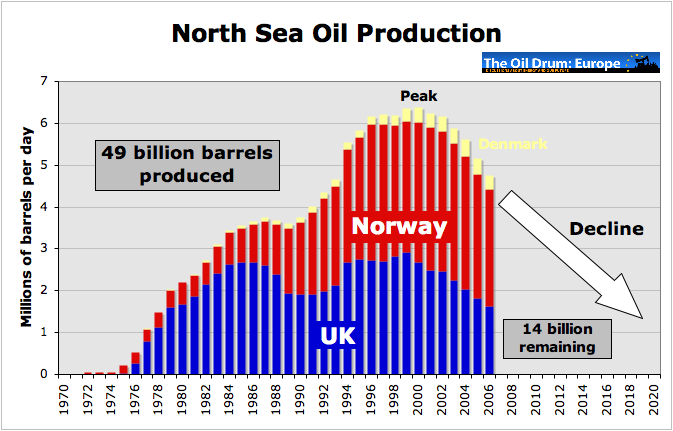
Rising North Sea oil production was a significant factor in keeping oil prices under control in the 1970s, 80s and 90s. Production peaked at 6.4 million barrels per day in 2000 and since then, declining North Sea Oil production is one significant reason that oil prices are now rising exponentially.
The UK
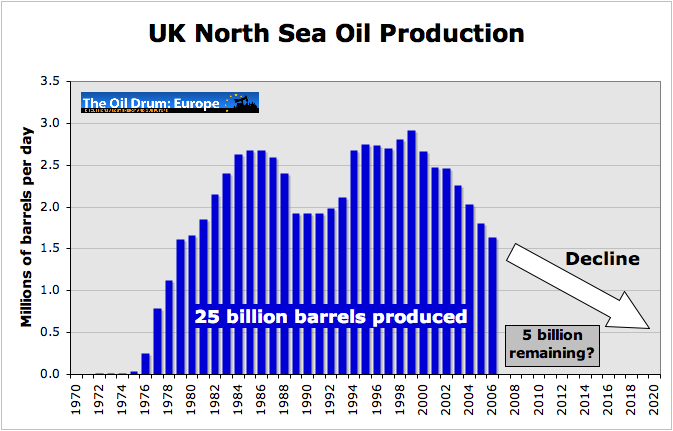
Crude oil, condensate and natural gas liquids (C+C+NGL) production. Source BP statistical review of world energy published 2007 with data up to 2006.
- UK oil production has two peaks and it is vitally important to understand that the reason for peak 1 in 1986 and peak 2 in 1999 are quite different, since many observers seem to think that production may begin to rise again as it did in the early 90s..
- Rising North Sea Oil production contributed to the oil price crash of 1986. Deferred investment resulting from this is the principal reason for decline in 1987. This was made worse by the Piper Alpha oil rig explosion of 1988. These are above ground factors.
- The all time high of 2.9 million bpd was reached in 1999. Decline that began in 2000 is caused by resource depletion and exhaustion of reservoir energy. It is no longer possible to bring on new small fields fast enough to compensate for natural decline and the trend that has now existed for 8 years will likely continue down as indicated.
From riches to rags
- The UK was an oil exporting country from 1980 to 2005. This had significant positive impact upon the trade balance. In 2006 production dropped below consumption levels and the UK once again became an oil importing country and will be an oil importer from now on.
- High prices will cause consumption to fall through conservation and pricing poor people out of the energy market. Thus it is difficult to forecast what the future consumption, production and price curves will look like. But by way of example, importing 200,000 bpd at $138 per barrel will add $10 billion per annum to the trade deficit.
Throughout this article referring to the North Sea is a simplification. Whilst most UK oil production does come from the North Sea, there are significant fields off south England, in the Irish Sea and on the Atlantic margin, west of Shetland. Norway also has significant production from the Atlantic margin off mid and north Norway. The data from these regions are all lumped together.
Norway
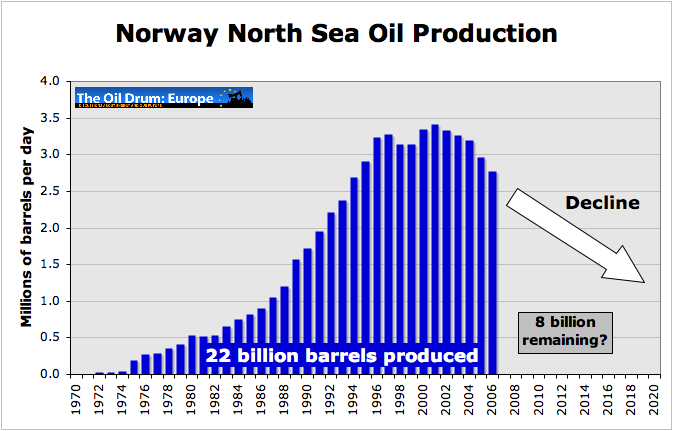
Crude oil, condensate and natural gas liquids (C+C+NGL) production. Source BP statistical review of world energy published 2007 with data up to 2006.
- Norwegian oil production is shaping up to have a classic Hubbert bell shape curve.
- Production peaked in 2001 at 3.4 million bpd.
- As in the UK, the majority of Norway's giant world class fields have been developed and are in decline. The oil is gone. Smaller fields being developed now are not large enough to compensate for decline which will likely continue as indicated.
- Norway with a population of only 4.6 million, exports most of its oil. These exports are falling
- With a vast continental shelf that extends along the Atlantic margin and into the Barents Sea, the prospect of new discoveries are much better in Norway than in the UK.
The North Sea
Crude oil, condensate and natural gas liquids (C+C+NGL) production. Source BP statistical review of world energy published 2007 with data up to 2006.
- Adding the small amount of production from Denmark to that for Norway and the UK provides this integrated picture for North Sea Oil production.
- Production peaked at 6.4 million bpd in 2000 and decline will likely continue as indicated.
- With falling North Sea oil production Europe will have to import more oil each year in competition with other regions (the USA and China) from a decreasing number of countries that actually have oil for export. This is one of the main reasons that the oil price is rising exponentially.
A note on reserves figures The remaining reserves figures reported above are for the discovered and developed resource. There may be some incremental growth in these numbers with new discoveries and deployment of Enhanced Oil Recovery (EOR) technologies. These are unlikely to make a huge difference, even if an additional 10 billion barrels are produced between 2030 and 2050. What matters are declining flow rates now that will likely persist for the foreseeable future.
Technology
Horizontal drilling, 3D seismic and dynamically positioned production ships have been deployed for over a decade. The incremental oil these technologies produce are embedded in the production data. Simply continuing to do what you are already doing will not change the decline trends.
The one technology that is not widely deployed that would add some incremental oil is CO2 miscible gas flooding of reservoirs. This would not change the picture very much but would reduce the decline rate and extend field life. The North Sea desperately needs this technology deployed. The UK government failed to support the flagship BP Boddam - Miller scheme and the Miller Field is now shut down. Indifference and ignorance on the part of the British and other OECD governments is another reason the oil price is rising exponentially.
Economists

Steadily rising oil price since 1999 has had little discernible impact upon declining UK oil production. Where economists want to see a positive correlation between production and price the reality in a post peak oil world is the exact opposite - a negative correlation. Annual oil price and production data from the BP statistical review of world energy
There are many economists involved in running UK and European government agencies. Classical economics thinking is that high price will stimulate production and reduce consumption providing an amiable equilibrium between supply and demand.
In natural resource exploitation this rule works during the exploration and production build up where high price may stimulate fruitful exploration effort and new field development projects. However, once past peak, these rules break down and do not apply. It seems there are no economists around that understand this simple point. Once a resource is gone, used up, no amount of money in the world will bring it back. Economists who advise that production will somehow do a U-turn as prices rise are doing untold harm. This false hope, optimistic message grasped by politicians, is blocking the action required to mitigate for peak oil. This is another reason oil now costs over $130 per barrel. Vigorous expansion of all viable alternative energy sources may reduce demand for oil and that will bring down the oil price.
High price may slow the decline of the North Sea a bit but it cannot invent fields to be discovered or alter the rules of reservoir physics that dictate decline. Since high price will not stimulate much new production in mature provinces like the North Sea the only route available is demand destruction. The oil price will stop rising when gasoline gets too expensive and we stop using it.
31 Billion barrels per year
With production running at 86 million barrels per day, that means we are consuming 31 billion barrels of oil every year. It is a sobering thought that by the time the Sun sets upon the whole of the North Sea, it will have produced enough oil to fuel planet Earth for just 2 years. To keep the oil party going we need to discover a "new North Sea" every two years and the last time we managed that rate of discovery was in the late 1980s, 20 years ago. We have been living off savings since then, and the bank balance is running down. It is not possible to get an oil overdraft or to create an energy instrument to magic oil and energy out of nothing. There is no choice other than to reduce our oil consumption and it is much better that we do this in a controlled way than to let high energy prices and inflation rip through our economies - which is exactly what is happening now.
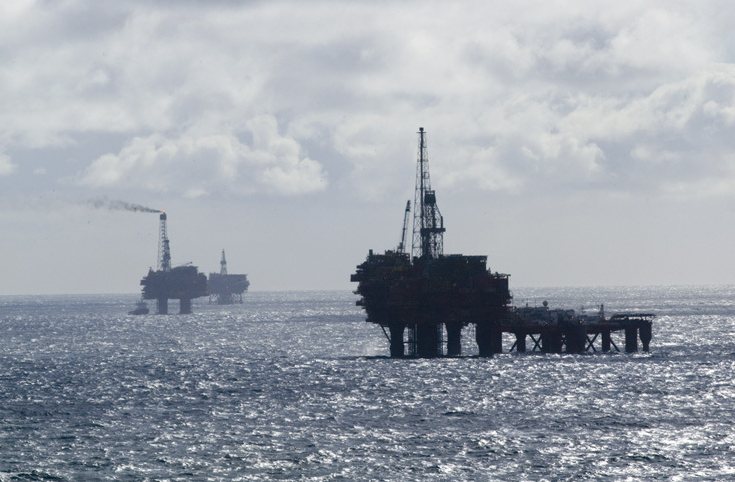
The Brent Field. One of the UK's largest producers of oil and gas. Field operator Shell are in discussion with the UK government about decommissioning this icon of the North Sea. Image from Oil Rig Photos
More detailed analysis can be found in the following articles:
EU oil imports set to grow by 29% by 2012
The architecture of UK offshore oil production in relation to future production models
Personnel
Editors
Contributors
Peak Oil Primers
Archives
- November 2010 (3)
- October 2010 (6)
- September 2010 (4)
- August 2010 (7)
- July 2010 (6)
- June 2010 (7)
- May 2010 (2)
- April 2010 (8)
- March 2010 (4)
- February 2010 (6)
- January 2010 (3)
- December 2009 (5)
- November 2009 (8)
- October 2009 (12)
- September 2009 (6)
- August 2009 (5)
- July 2009 (11)
- June 2009 (8)
- May 2009 (16)
- April 2009 (10)
- March 2009 (7)
- February 2009 (10)
- January 2009 (15)
- December 2008 (9)
- November 2008 (9)
- October 2008 (9)
- September 2008 (13)
- August 2008 (10)
- July 2008 (14)
- June 2008 (23)
- May 2008 (16)
- April 2008 (12)
- March 2008 (16)
- February 2008 (9)
- January 2008 (13)
- December 2007 (13)
- November 2007 (16)
- October 2007 (22)
- September 2007 (8)
- August 2007 (9)
- July 2007 (16)
- June 2007 (8)
- May 2007 (7)
- April 2007 (7)
- March 2007 (10)
- February 2007 (10)
- January 2007 (12)
- December 2006 (9)
- November 2006 (15)
- October 2006 (4)
- September 2006 (5)
- August 2006 (5)
- July 2006 (9)
- June 2006 (5)
- May 2006 (10)
- April 2006 (9)
- March 2006 (13)
Vital Trivia
License

This work is licensed under a Creative Commons Attribution-Share Alike 3.0 United States License.
And 25 billion to go at (and thats the worst case estimate). Haley Millar (whatever her name is/was) does not understand the implications of rising oil prices and the concept of flow rates and reducing EROEI. She is a bit of a baffoon!
I think you mean Hayley Millar and this article
Oil reserves 'will last decades'
If it were not so tragic, I would be tempted to laugh.
Good work Euan.
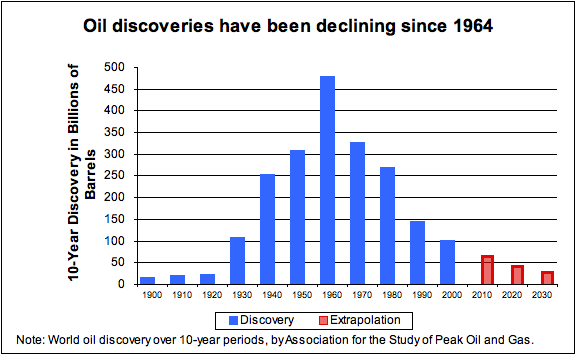
The dots you connect become even scarier when one considers global oil discoveries:
And the fact that many datapoints suggest that NEW oil is very expensive (lower EROI). TOTAL Ceo de Margerie said last week that to replace reserves now will cost a minimum of $80 per barrel. This is all hidden from most market participants as the oil they sell is a combination of new expensive-to-find oil and old $1-$5 oil - e.g. the fixed and marginal EROI is being smushed together to be sold at $130. Once the high EROI supergiants are largely depleted, we will be selling (and buying) predominantly lower EROI (higher cost) oil. Furthermore, this cheap 'older' oil that is still being pumped essentially for very low marginal costs per barrel, is subsidizing the finding and production of the rest. How much cheap oil is left is the $64,000 question? As it depletes, the prices and reactions will not be linear. Positive feedback loops abound...
Nate - I think this is the first time I've seen this version of this data plotted at the decade scale.
So at 31 billion barrels per year we are consuming 310 billion barrels of oil per decade. There are only three decades in human history where we discovered this amount of oil - the 1950s, 60s, and 70s. In the recent past we've gotten nowhere close.
So this has to be the most sh*t scary chart I've ever seen.
I was looking for the time for half measures is over quote but this one from Matt was the one that was live at the time....
That chart would be less scary if our recovery % of STOOIP has been increasing dramatically to offset lower discoveries over that time frame but as you know recovery has been stuck at 35% for a very long time. ( The average global oil recovery factor is about 30-35% , Geologist Francis Harper, BP using IHS data)
New EOR methods (e.g. CO2 injection) hold promise, but need precisely the right type of fields to work economically.
Ergo, I agree with you, it is scary chart.
Haven't the oil gurus set aside $100 billion plus for exploration this year? With that sort of outlay, they must be at the very least a little bit confident about crude's future... Surely?
The TOTAL CEO says replacement cost is $80/bbl. If that is correct, your $100 billion will get you about 1.25 billion barrels, enough oil for about 15 days.
Huh? Thought I said $100B+ for "exploration"; as in, searching for more. They must be somewhat confident in finding "something".
Mustn't they?
I can guarantee you that they will find "something." The problem is whether it will make a material difference. Hubbert found more than 50 years ago that a one-third increase in estimated URR for the Lower 48 only postponed the projected Lower 48 peak by five years.
But, but, but (stammer, stammer)...
Why do the newspapers, the TV heads, radio commentators, presidents of motoring bodies, MS in general rarely talk about this - particularly given recent fuel spikes? And when someone does phone in and drops the line, "the world is running out of oil", why is such a comment never expanded upon? Why don't other listeners phone in and ask, "Did that guy just say, 'the world is running out of oil'? What did he mean?"
Why, after nearly NINE MONTHS of first seeing the doco, "A Crude Awakening" do I still seem to be the only one in my immediate circle who is asking questions?
And, and, and (more stammering)...
Man, I thought marriage was frustrating!
Well,
Honestly it seems to be a variety of things IMO. Politicians are generally very ignorant people, who either haven't heard of peak oil, don't understand it or are in completely denial of it. Many politicians and the MSM have been talking about the falling dollar and speculation mainly. Today on C-Span, Michael Greenberger
http://www.law.umaryland.edu/faculty/profiles/faculty.html?facultynum=059
did a good job of being ignorant of the oil markets in front of the senate who regarded him as an expert. He stated 50-60% of the current price could be speculation, and then Senator Olympia Snow R-Maine, proclaimed this is not a supply and demand issue. When you have lawyers, Politician and Businessmen, trying to mess with energy policy and grasping energy markets, you are bound to worsen the problem. Most people as I have seen many a time again, are simply not willing to sit down and do a small amount of research over the subject. America has two emotions and only two, complacency and panic, we won't do hardly anything till we are on the downside of the curve. It's kind of sad, but as days go by I have a less and less hope for the future seeing our ignorant politicians and stupid people. Good for you though, you sat down and did some research, and you know the future, which 99.9% of people do not, that's an advantage right?
Thanks for the reply, Swords and hello again. Still haven't decided if it's an advantage or not (perhaps if I had shares in Woodside; but a definate NO at parties - "Please, no more red wine for the crazy guy in the corner asking gloomy questions!").
Then again, my dad, who's turning 68, and myself are booked in to get our motorbike licenses in July. Guess that's a start.
Regards, Matt B
Dear Joe,
you can do one of two things at this point:
1. Prepare yourself and your family for the Tsunami (i.e. get off the beach)...
2. Run around on the beach asking why everyone is still sun-bathing while its 'obvious' that the white crispy froth on the distant horizon is "not right"...
I've tried 2 for a while, I'm leaning more and more towards "1 Mode" now...
To get a decade perspective multiply direct fossil fuel cost inputs to your life by a factor of 5 {transport, heat, electricity, food) and determine the effect... Is your life changed? Only the very rich will answer "No".
Nick.
Thanks Nick and you're probably right... Though, I would have flapped my arms about for at least a few minutes before grabbing the kids; and probably would have shouted, "there's a tidal wave coming", in the days before people knew what a tsunami was.
BTW, that's one of my complaints about the term "Peak Oil" (someone once replied, "P Coyle? Who's that?"). A term like, "The world is running out of oil", or something more mainstream should be discussed further.
As for running around on the beach first, I sent the following off this morning to one of the local so-called TV current affair shows, along with an intro, just for the hell of it. But as you say, doubt I'll get a reply...
True or False?
• An estimated 100 tons of organic material must be cooked for millions of years under ideal conditions to produce a single barrel of crude oil.
• Each year, mankind consumes more than 30 billion barrels of crude; or around 160,000 litres every second.
• We use crude for the majority of transport, rubber and plastic (mostly non-recyclable and toxic), bitumen, pesticides, crop farming, to name a few.
• In the last 30 years, few significant new oil fields have been found to replace the aging ones. This year alone, oil companies will spend over 100 billion dollars in exploration, with no guarantee of success. Nonetheless, they will want to recoup their costs.
• Significant fields that have been discovered are deep beneath the ocean and very expensive to get to.
• Within the next decade, most of the 500 largest fields will near their use-by dates for cheap and affordable oil.
• Mother Nature created a limited amount of liquid energy. Man-made alternatives (on a massive scale) are decades away and will cost trillions.
• By 2050, the world population is expected to be around 9 billion people. To get there, on average an extra 75 million births (that’s on top of those that cancel out deaths) must occur each year. That’s around an extra 200,000 births each day – mouths to feed, clothe and shelter.
So…
Is the world running out of “easy” (affordable) oil?
What will a litre of petrol cost in 2020? Or a plane ticket to Sydney?
Will there be enough liquid fuel to go around?
Is life as we know it today sustainable for decades to come? Or a mere few years?
If there’s a problem with how much affordable oil is left (no-one really knows how much remains!), shouldn’t we be discussing this in a little more depth?
Or are the above points and questions not A Current Affair?
Around 4 years, if you are not too picky about 'as we know it today' would be my estimate.
ACA is far too busy one-upping Today Tonight, defending convicted drug-runner Corby, and castigating single mums, dole bludgers, and dodgy used car salesmen moonlighting as Home Removators who are killing our fat kids to be bothered with such a piddly little item such as Cheap Oil running out.
No, much easier to do an 'expose' on petrol stations ripping off 'working families' by putting the price up the day before a Long Weekend. Damn you, Big Oil! :p
In late 2005 I bought the website: www.megatrends2020.com with the intention of defining the major themes that will impact our lives to 2020. I chose to research Energy first as it seemed to me the single most important theme (I had heard somewhere that the oil price accounts for ~40-50% of GDP swings so that sounded like a reasonable backdrop to the rest of the trends).
So off I went researching...
I got into this one thread so much I never finished the others. The more I discovered the more I realised that none of the others really mattered. This was the one 'trend' that would define the shape of our lives in the decades ahead. The problem was that it wasn't a trend, it was a trend reversal!
Rather than continue I decided last summer to write up all I had learned -I called the result: Peak Oil Joining The Dots:
http://www.megatrends2020.com/Peak_Oil__Joining_The_Dots.doc
I have updated the specualtive timeline and it is now available online:
http://www.flickr.com/photos/8745365@N04/2504887199/sizes/o
Personally I have a very rough 5 year plan that basically involves going 'off grid'/Home food production/no debt and I am now in the process of downsizing to prepare (selling my Thai Penthouse -I live in London, UK). I don't think most airlines will last the next decade, airlines that operate business traveller level fares with passengers packed in like sardines might just survive...
My 'best guess' at when things start to get 'really sticky' -i.e. major amounts of demand destruction kick in- is around 2012 +- a year or two, so not long really...
Regards, Nick.
I'd go along with most of that - fine job, Nick!
Where I differ would be mainly in moving some of the events forward in time.
What would be useful if you have time would be a greatly expanded view for 2008-15.
A lot of 'interesting' things should happen in this time frame.
I would suggest for one that this winter should see an emergency budget in the UK as the balance of payments widens towards infinity and the budget deficit spirals with rising unemployment and low or nil growth.
Long distance tourist destinations should get a huge hit together with property prices there and tourist airlines in the following summer.
Nick, I am thinking that we are about at the stage that a sector by sector forecast could be attempted, although it would be patchy as none of us are full-time on these matters.
To take one example, it seems to me that the age of the Football mega event may be on the wane.
In the UK, major clubs are highly leveraged, with Manchester United, for instance, having large debts after a £790million takeover, requiring an interest payment of £62million pa.
Wages to turnover is over43%:
http://news.bbc.co.uk/1/hi/business/7180767.stm
BBC NEWS | Business | Success boosts Man Utd finances
I would expect that business model to rapidly unravel, with the most highly leveraged clubs having to sell players to reduce the wage bill, as recession means falling ticket sales and prices and reduced sales of replica kit etc.
Nationally backed teams like Real Madrid should do relatively well, as the politicians try to keep the circuses part of bread and circuses going at all costs for a depressed population.
By 2010 I would expect distress sales of large British clubs, and re-negotiation of players salaries downwards.
American football should do even worse, I assume, as large distances are regularly covered to play matches across a much greater area.
Hi Nick,
Are you going 'off grid'/Home food production in London? Would be interested in where and what you are planning to do.
Thai Penthouse sounds like a good central location for a TOD party.
Let's do it! :o)
http://www.knightfrankphuket.com/sale/RS0174.htm
noutram
I think your "joining the dots" document is a nice compilation.
The only thing I think you might want to reconsider is that the current reserves of Uranium should not be considered a constraint on future production.
There is a few orders of magnitude more out there once we bother to look for it (no one has in the past ~15 years due to the Russian nuke decommissioning flooding the market).
Other than what I consider an overly pessimistic view on the future potential of fission, I think you are spot on with the energy analysis.
"the world is running out of oil"
And has been since the first day oil was pumped.
And that's the problem. I'm 40 too. Don't you remember the '70s, when everyone knew that we were running out of oil? Just like Daniel Yergins loves to say: the world has run out of oil five time in the last 150 years. We've gotten an incredibly thick skin to the whole concept. Til, of course, the day it starts to really hurt.
The day I lose my job because of it.
The day I don't get any unemployment..
The day I wait in line two hours to get into the store and don't come home with anything to show for it.
Forget the deap analyses here. Look at perspectives (thanks for bringing it up Westex):
During George W.'s presidency, the world will have used 20% of all the oil IT WILL EVER USE...
Cheers, Dom
A correction regarding total oil consumption during the reign of George Bush the Second, it's about 10% of conventional oil that we will ever use (based on Deffeyes' HL estimate).
In round numbers, we are using about 25 Gb of of C+C per year. Through 2005 we had used about 1,000 Gb, and Deffeyes gave us another 1,000 Gb of remaining conventional. So, during the first four year term we used 100 Gb, or 10% of all oil ever used. And during his second term, we will have used 10% of all remaining conventional reserves (according to Deffeyes). However, this is 200 Gb in 8 years, or 10% of Deffeyes' estimate for world URR (C+C) of 2,000 Gb.
So, pursuant to Deffeyes, in the first term we used 5% of total conventional URR, during second term, 5% of total conventional URR.
...if that increase came early enough to substantially increase the peak flow rate.
If, on the other hand, today's oil production rate is more-or-less as high as it'll get, then increasing URR by 1/3 would enormously slow the post-peak decline rate, making the transition to other energy sources much easier.
Indeed, huge-but-slow resources, such as the oil sands, are great for post-peak mitigation, as they simply can't be drained dry in short order. Not only does that mean they'll produce for a long time, it means they can't make oil cheap again, and hence can't derail price-motivated efforts to switch away from it.
If we assume that we can get another 1000 Billion barrels (about half the total) at $100 that's 100 Trillion dollars.
The total value of the Worlds stock markets in 2007 was 51 Trillion or about half the in-ground value of the oil.
If we are at or near Peak Oil the value of the in-ground oil will climb remorselessly in the years ahead making the 100 Trillion a lower estimate...
Result1: we will go 'to the ends of the Earth' to get this resource out the ground.
Result2: SWFs (Sovereign Wealth Funds) of NET oil exporters are going to 'own' Wall Street...
...and can anyone tell me 'if electricity is our future' why the total market cap of the Uranium miners is just 30 Billion US??
Nick.
For the same reason water was, until recently at least, 'free'.
The only commodities valued are those in short supply.
The price of uranium has halved in the last year - with just a little exploration, vast new finds were made, enough so that even with much expanded plans for nuclear energy production it is darn near a free good.
Dave,
Do you have any sources on the Uranium story ?('scuse the lame pun).
Not that I doubt you, but Anti nuke types spent (again , 'scuse the lamer pun..) most of the last three years telling us that there wasnt enough U for the nuke plans anyway.
Here is the source of my claim that uranium prices have halved:
http://www.business-standard.com/common/storypage_c_online.php?leftnm=10...
Here is the position paper by the World Nuclear Association:
http://world-nuclear.org/info/inf75.html
Bill Hannaghen extensively lists sources and resources amongst the information here:
http://www.nuclearcoal.com/energy_facts.htm
Energy Facts
And Charles Barton deals with the issue here:
http://nucleargreen.blogspot.com/
Nuclear Green
For the EROI and a rebuttal of Storma nd Smith which has been the source of most of the rumours about uranium shortages see here:
http://nuclearinfo.net/Nuclearpower/WebHomeEnergyLifecycleOfNuclear_Power
Nuclear Power Education - Energy Lifecycle of Nuclear Power
If needs be, the basic technology of uranium from the sea has also been tested:
http://jolisfukyu.tokai-sc.jaea.go.jp/fukyu/mirai-en/2006/4_5.html
4-5 Confirming Cost Estimations of Uranium Collection from Seawater
Obviously it is not worth the bother at present uranium costs.
Finally, it is not very difficult to massively increase the efficiency of burn:
http://nextbigfuture.com/search/label/thorium
Scroll down to the Fuji design.
That's the spot price. The long term contract price varies. Reactors tend to be built after you have signed a thirty year contract or the equivalent. It helps with the financing if you can reassure the bondholders that you aren't going to run your reactor for only a few years and then shut down after you run out of fuel.
It also helps to have a contract to sell the electricity as well...
Fuel costs a tiny proportion of the costs of a reactor, less than 1%. Processing is a lot of that, so the raw material costs are even less.
As a percentage of total costs this will be small item.
You can also buy from France, in a deal which includes uranium, as China recently did.
Of course they expect to find oil and they will. At tomorrow's prices they should make money for awhile yet. However, it doesn't change the point made here, which is that ongoing finds are not large or plentiful enough to prevent the declines stemming from the depletion of the older and larger fields. This makes the smaller amounts found just that much more valuable.
Joe, the easy way of looking at it is to imagine that for a given amount of money spent exploring and developing, to keep it simple let's say $1million, you got an extra so many barrels of oil, say 20,000, and you sell that at $50 plus your margin.
Oil gets tougher to find, so in a couple of years for the same $1million you only get 10,000 barrels.
However, the price has doubled so you make the same!
The oil company gets just as much money, and obviously carries on looking for more oil, but the poor old customer only gets half as much oil for the same money.
So long as the oil price keeps rising, the oil companies keep looking for more oil.
This over-simplifies things, but not enough to alter the broad picture.
You get less and less oil for your money.
Thanks, Dave. Get it! You guys (and gals?) just need to keep whacking me over the head 'til this stuff sinks in.
Now for the other 6.35 billion AJ's...
Regards, Matt B
Of course they will continue looking and all Oil Majors budget for Exploration.
One or two things must be born in mind though.
A modern , deepwater hpht semi-sub or drill ship rents out at circa $500, 000 per day. Thats about 1.5 billion US per operational year.
A less modern offshore rig goes for less, but they too are in short supply.
An Exploration programm is usually 2-4 wells per year , depending upon sea depth and final drilling depth.
So, $100 Billion doesnt actually amount to a massive exploration pulse in real terms. A dollar doesnt go quite as far as it used to.
Compared with the Halcyon days of the 80's, 100 Billion is not translated into a grat deal of new exploration wells. - Admittedly, fewer wells need to be drilled because of advances in Seismics and other techniques, but 100 billion sounds like a lot but it isn't.
100 Billion US = 50 Billion Sterling = Labour's bail out of a half assed mortgage company called Northern Wreck.
The problem for Western Majors is: Where to look? If you want to spend money on exploration, you want to go where you will find an elephant, be able to develop it and not see it nationalised after you have done all the hard work. This too is a limiting factor.
Thanks Mudlogger (and thanks to others for answering my very basic questions in simple terms).
I guess it's the "scale" I'm still trying to get my mind around (like the 200,000 extra humans coming into the world each day to make up the expected 9 billion by 2050); and which of those seemingly huge numbers can be explained away, which can't.
I'm sure I'll get there eventually!
Regards, Matt from Melbourne, Australia
Joe,
Just to emphasize what the Mudlogger said about exploration costs. Last year I worked on a Deep Water well that cost $148 mm. Just one well. And not only did it not find hydrocarbons it did a good job of condeming any future drilling in the immediate area. Of course the operator was optimistic about the potential and all the new technology (very expensive technology) helps. But in general exploration success runs around 10% to 20%. But when the payoff can be huge the players will make the bets. The growing problem now is the diminishing number of places to make the bet. Besides fighting mother nature the fear of nationalization is quickly becoming a dominant factor. All the oil companies in the world now control only 15% of the production. The national oil companies (the governments) control the other 85%. As government revenue drops due to depletion they will be even more tempted to redo the trade and take more of the production stream regardless of the terms of the original concession.
This is a very good example of why you don't invest in the prospectors, but invest in those supplying the picks and shovels--they MUST be paid whether or not the prospector strikes its lode.
For reference, "dramatically" means about 0.25% per year, based on the presentation you linked. (1% increase = ~63Bbbl = 2 years' consumption, and assuming discovery has been half consumption recently)
The presentation you link notes that the UK fields saw an average reserves increase of 25% over the first 20 years after they were booked (slide 13). On slide 14, it says that that growth is both due to there being more oil than was originally thought and to the recovery factor increasing.
It would be interesting to see why you say recovery factor hasn't changed for a very long time, as the presentation you link to appears to suggest the opposite.
No, 'dramatically' would have to offset the 'dramatically' lower oil discoveries in my first graph, e.g. oil discoveries this decade will have dropped 90% from the 1960s.
In the one source I linked, slide 12 the BP geologist states "average global recovery factor is about 30-35%".
But here are other links. This information doesn't exist in one tidy number (much like most of peak oil related data and heuristics), partially because these numbers largely represent CURRENT fields in production and don't include ones already abandoned, and as I'm sure you are aware there is not one international clearinghouse for this sort of data - people can't even agree on reserves within a 50% ballpark.
1. http://www.slb.com/media/services/solutions/reservoir/carbonate_reservoi...
Schlumberger - "The average recovery factor—the ratio of recoverable oil to the volume of oil originally in place—for all reservoirs is about 35%."
2. http://www.eoearth.org/contributor/mamdouh.salameh
Oil expert Dr Mamdouh Salameh said that "And despite the great technological strides by the oil industry, the average global oil recovery rate has been stuck at 32% of the oil in place since the early 1990s. However, rates of 50% and even 55% have been achieved in the North Sea and also in the most recently-developed, state-of-the-art Shaybah oilfield in Saudi Arabia respectively." (Old ODAC May 7, 2007 not working to provide source for Salameh's statement)
3. http://www.bfe.admin.ch/php/modules/publikationen/stream.php?extlang=en&...
http://www.mees.com/postedarticles/oped/a46n51d01.htm
The present “worldwide” average oil recovery factor is just above 29% - Leif Meling, Statoil
(uses IHS data). Meling does think that the recovery factor can be increased to an optimistic 38% by using EOR techniques to increase URR. Eg, for Saudi Arabia he estimates max URR of 460 Gb.
4. Even optimistic ex Aramco Nansen Saleri, now leading his own consultancy
http://www.quantumreservoirimpact.com/
said at 5:35 of this video
http://www.youtube.com/watch?v=KZnkjwBAW7U
that "the industry only recovers one out of three barrels" which is equal to a recovery factor of about 33%. Also, from Harper's presentation which uses IHS data, he says that original world discovered in place volumes are about 5.5-7.0 trillion barrels (Tb). Using a recovery factor of 35% gives a URR range of 1.93 Tb to 2.45 Tb. The world has produced about 1.08 Tb C&C to end of April 2008 which leaves remaining URR range of 0.85 Tb to 1.37 Tb.
For comparison, your neighbor, Colin Campbell's estimate (excluding gas liquids and rounding) is now about URR 2.20 Tb from his May 2008 newsletter.
http://www.aspo-ireland.org/contentFiles/newsletterPDFs/newsletter89_200...
TOD contributor "Ace" also discussed world average field recovery factors in section 3 of his article on Saudi Arabia's Crude Oil Reserves Propaganda
There is more but thats all I could find for you now sirrah. Perhaps if ONCE you would agree with someones comments, I might feel compelled to find 5 or 6 related sources instead of 4. If you have a source that nicely summarizes the historic global recovery ratios of OOIP, I would be grateful, as I've not seen it.
Another important point is that a lot of our remaining reserves are in existing developed fields and have been added because of dubious assumptions about recovery based on technical progress and price. They are dubious simply because these numbers are provided by the same people that also believe we have trillions of barrels left.
But more importantly because they are often in existing fields none of this oil zero nada zip is available for extraction today unless the field can be reworked to take advantage of these reserve increases. This means this oil will only be pumped at some future date and by the time we hit that date total world production rates will be much lower.
We have the same problem with conventional oil we face with unconventional the extraction rates are going to be a lot lower than what the reserve estimates indicate. We simply don't have enough manpower and time and money to rework these old fields to maintain much less enhance extraction rates to any significant degree. So even assuming we have 1 trillion barrels left does not do us a lot of good since we have to pump the first 500GB before we can get to the next 500GB since its in already fully developed reserves.
And if you break int up into increments like this its obvious that the cost and difficulty will only increase over time.
My estimate of 150GB of reserves that can be extracted within 15-20mbd of todays extraction rate is not bad this is what
people should focus on. Later we will have to deal with a world thats pumping oil at a lot lower production rate than we do today and its almost certainly a very different world. What needs to happen is focusing on how we make that transition.
Given the situation we could have already started seeing steep declines in production worldwide we need to focus on getting the governments to deal with every 1mbd drop in production in a smart manner. The news overall is not good very every country that drops subsidies another increases them or uses some other means to cushion high fuel costs. The world is already made a number of potentially deadly mistakes by not recognizing peak oil and adopting a depletion protocol. If your in North America or Europe you better consider how your going to heat your home through the next winter not worry about recovery factors.
But he did not say that it was stuck at a fixed level, just that it was currently at that level. That is your claim, not his. In fact, he says the opposite on slide 14!
Let's look at your other references:
So of your five references for the claim "recovery factor has been stuck...for a long time", only one actually says that, and three say either that it can be increased or that it has been increasing.
Doing some searching of my own simply bolsters this consensus. For example, Norway has seen its recovery factor increase by 20% (from 34% to 41%) since 1991. BP estimates a recovery factor of 49% for its portfolio of resources, and says it's working on increasing that.
So the evidence really does not appear to be supporting your claim that recovery factor has been stuck for a long time.
Indeed he does, but he doesn't say that they aren't increasing. That's your claim, and - other than Salameh - apparently only yours.
What is the point of posting "me too" comments?
If I have something to add, I do so.
If I see something to correct, I do so.
If I agree, I do so. I just don't feel the need to tell the world about it.
However, you're wrong. I do indeed note agreement with people, and even thank them for pointing out errors I've made. Finding a recent example of that means going all the way back to Friday.
Are you objective enough and honest enough to not only admit when you're wrong, but thank people for pointing it out? If you're not afraid, it's a fantastic way to learn.
Pitt my Elder,
Heres the deal. I spend a great deal of time on this site. Sometimes I don't see that all of our efforts have made much progress in the greater sphere at mitigating upcoming oil depletion, so I get frustrated. Today was one of those days, and I was distracted by much more unpleasant items than ducks on a pond and singled you out with an accusatory tone and for that I'm sorry. However, I must say that when I see your login pseudonym, I have come to instantly expect a criticism or a pointing out of an error, so this has obviously become a knee jerk defensive pavlovian response, especially in my own interaction with you (n>30). Don't get me wrong. This community needs 'cleaner fish'/border collie types to reign in any BS and call people on unsupportable facts - it keeps the discussions high level and credible - but there does exist a fine line between correcting and searching/heckling minor errors when the larger point of the comment is valid.
In the current example, I admit to not being an expert on historical recovery rates, though in talking to people in the field I've been led to believe rates have been roughly in the same range for a long time, with very gradual increases. The BP slideshow showed they were increasing marginally, not dramatically - which was the initial point of my comment to Euan - the drop in discoveries would NOT be that alarming if recovery rates were keeping pace. Furthermore, the discovery graph I posted includes backdated reserves that were added to initial discoveries. Ultimately, a large part of the Peak Oil story WILL be about recovery rates, as the difference between 35% and 50% recovery could be hundreds of billions of barrels and moderate global decline rates. I know Gareth Roberts at Denbury Resources is shooting for 50%+ using CO2 injection and there are other EOR techniques that offer promise as well. As is usually the case when the stakes are high, there are many claims that recovery rates will dramatically increase in the future - the problem is we can't really know recovery rates until a well/region is finally abandoned. I listed the recovery rate sources I had available not as definitive answers but as datapoints I had read and learned about.
I have a low tolerance for misinformation, even when it's inadvertent.
It's easy enough to avoid having me correct you, though: don't be wrong. Thanks to the web, it's pretty trivial to check your facts before posting them to the world. If someone doesn't respect their argument or their audience enough to spend three minutes checking their facts, how am I as an audience member supposed to feel about them or their argument?
A great many people here say things that they wish were true as if they were true, and that's an enormous cognitive flaw. If you believe this to be an important issue - and I suspect most people here do - then it's important to avoid faulty reasoning about it, no?
(In general, I'd far prefer not to have to correct people; the modeling and numeric discussions are much more interesting and personally informative.)
Yet, as you say:
"the difference between 35% and 50% recovery could be hundreds of billions of barrels"
That may not be best characterized as "minor".
Moreover, let's get something straight: there were two points in my original post, and only one of them disagreed with you. Saying that recovery factor would have to increase by 0.25%/yr to make up for discovery shortfalls in no way makes those shortfalls irrelevant; indeed, 0.25%/yr increase in recovery factor strikes me as somewhat optimistic, even in the medium term. All I was doing there was putting a number to what you were saying.
The second point, however, was that your link said the opposite of what you were saying. Most people don't read links, and your word tends to carry some weight here, so I thought that difference was important to clarify. That kind of situation is how something wrong becomes "common knowledge".
Euan,
This is an excellent post. It shines because of its simplicity.
Have you sent it to Ms Millar and Gordon Brewer of BBC Scotland?
Maybe they would go home and thing again.
The email starts:
I actually thought Gordon Brewer did a good job. Hopefully next time they return to peak oil they will be better aware of the issues and what questions to ask.
In a recent discussion with a friend who works in the finance industry I made the point that discovery peaked in the 60's, referring to a graph like this, and he pointed out that it was backdated, which distorts the true picture. I remember reading about this a long time ago, and also an explanation (from Colin Campbell I think) about why backdating was the correct method. Could anyone remind me of the paper, or the rationale from the paper, as to why this is considered the best way to characterise the history of oil discovery? (By 'backdating' I mean that gaining more oil from a particular field at a later date, eg through more development or more technology etc, is dated back to the first discovery of the field as a whole.)
Good question. Campbell and Laherrere argued in their 1998 SciAm article that backdating is the correct way to go about assessing future discoveries, but do not fully explain why.
Bob Lloyd explains this in more detail in his article The End of Oil.
Prof Aleklett discusses this further in his OECD discussion paper 2007-17 on page 21.
Another reference for peak in oil discovery in the 60's using the backdating method comes from Campbell who references article by Longwell of ExxonMobil The Future of Oil and Gas Industry (World Energy vol. 5, no.3, page 101, lower right graph) in the Oil Depletion protocol (page 3).
Thank you for those links. The Bob Lloyd article link seems to be dead, it is here:
http://www.physics.otago.ac.nz/eman/The%20End%20of%20Oil%20essay%201.pdf
Or rather this one which loads the pdf properly:
http://www.victoria.ac.nz/chaplains/issues/bob-lloyd-the-end-of-oil.pdf
Backdating is not always the best way to look at oil reserves. The main reason is that the backdated reserves are different from new field discoveries. As and example take two fields with 10GB each vs one field with 10 later upgraded to 20.
The larger 20GB field would have 10GB left at 50% and at this point production would be declining. While if you did the two 10GB field in series say starting the second one when the first was at 50% then production would increase or remain flat till the second one hit 5GB. The production rate is lower than the 20GB case but you keep the same production rating till your 75% depleted.
I've been arguing that we have effectively done both. The serial case is small fields with short lifetimes and the bulk of the reserve additions are in older fields and won't keep production from declining. In fact the addition of the small fields worked to hide to a large extent the advanced depletion levels of the larger fields.
In any case you can see how backdated reserve additions can give you a way to rosy picture about future production once growth stops.
Most of the remaining oil if its extracted at all will be produced at production rates much lower than today. And finally even if EOR methods add to the final produced volumes the chances of them also getting a high production rate are slim.
All EOR methods I'm aware of either give brief increases or rates less than 10% of the maximum production rate the field achieved.
Nice work Euan.
Nate...great article on applying reflexivity to the commodities market. I have to eventually finish that book...damn.
I wanted to make sure that my numbers were correct so I sent the charts to Mike Earp (today Sunday) and he responded with this chart.
Mike has been extremely helpful to me in providing all sorts of data and reports. His chart is based on EIA data and is up to date to end 2007 - one more year than mine since I am using BP data.
Mike's estimate for the North Sea is 50 billion produced + 13 billion remaining = 63 billion.
My estimate for the North Sea is 49 billion produced + 14 billion remaining = 63 billion.
These figures do not include yet to find.
Any estimates on the costs of the 'yet to find', holding everything else constant? (see my comment up top)
Nate, technology has allowed the oil industry to become very discerning about what they drill. Inverted seismic data and controlled source electromagnetic imaging actually allows companies to image oil and gas in the sub-surface - they can actually see the stuff. This makes companies much more risk averse to drilling. In the old days it was a gung ho approach. Today its much more sophisticated. The success of this technology is clearly visible in your decadal discovery chart posted above (I think) (sarcasm alert). There is very little left to find and it costs a fortune to drill it.
I think you are spot on about comments of a huge but rapidly depleting inventory of high eroei oil and gas subsidising todays E&P effort. The real energy costs involved are hidden. No one knows the energy balance of satellite field developments with 2 long reach horizontal wells linked back to a massive steel jacket platform producing just a dribble compared with its design capacity.
This is the sort of work that BERR should be funding with some urgency. Taxation and decommissioning costs also distort the picture. Companies will do anything to defer the costs of decommissioning large offshore structures. Hell, they'll even build wind farms to defer decommissioning. I'm afraid this is where energy economics and conventional economics collide.
No doubt we are using more and more energy to produce energy and the share of GDP assigned to energy production is escalating. Bring on the ecologists to explain the consequences of this for society.
Euan, the 'share of GDP' in your last paragraph was referenced very recently by Kenneth Deffeyes: Oil Production, Oil Price.
KD points out that at $130/bbl oil production already represents 6.5% of GDP. I was trying to figure out if there's a direct correlation between ERoEI and the percentage of GDP taken up by oil production, for example if overall ERoEI were to fall to 6.5 would we then hit the 15% of GDP solely to extract and refine oil? As the old, mature fields with high net energy returns fade and are replaced by smaller substitute (or more accurately part-substitute) oil sources I'd expect overall ERoEI to fall below 6.5.
This is very complicated. First of all $130 oil may represent much more than 6.5% of GDP if oil stays the same and the economy tanks.
More importantly, we basically have TWO energy banks that the economy draws from - liquid fuels and electricity. So while increasing EROI of electricty based renewables is great, it must be matched at same time by infrastructure change that can use electricity for the basic goods we get from cheap oil, otherwise the new energy surplus won't be beneficial. We therefore either need to find higher total energy gain liquid fuels (EROI x Scale x Flowrate), or change the way the global economy works (or else...). As was pointed out in "At $100 Oil, What Can the Scientist Say to the Investor?", declining EROI means the energy sector continually requires a larger % of the total energy pie for themselves, taking it away from non-energy society. The mechanism of this in a free market is higher prices. One possible benevolent exception is if the 'economy' itself was heavily devoted to high EROI alternative energy deployment. More jobs, more surplus energy, more options, etc. But if this happens with a low EROI source, we are doing worse than spinning our wheels.
The Gordian Knot is that there doesn't seem to be any high EROI liquid fuel options. Let alone those that are scalable and environmentally sound. Since liquid fuels are currently the limiting input, this means barring a crash conservation/efficiency plan, we are going to go for the low EROI and/or non-scalable and/or non-environmentally sound options (biofuels, Fischer-Tropsch, shale oil, etc.)
FYI - Refining oil itself takes about 20% of the energy content in oil (e.g. refining is about 80% efficient). Though this isn't technically an EROI (energy harnessing) but an energy conversion (efficiency), we can't put crude directly into our cars/trucks so it might as well be. IOW, whatever the EROI of the oil becomes, we have to lop off 20% from that number before it is usable (though this could come from the second energy 'pool' as much of this is natural gas/electricity and could be generated using renewables.
Re: Refining oil itself takes about 20% of the energy content in oil.
From an oil importers perspective then the EROI of imported oil has got be to less than zero buy a substantial amount. IMO it is negative 100 percent. Lumping all oil together, i.e. the EROI of domestic oil with imported oil, does a disservice to the understanding of the EROI situation. EROI is only valid when comparing like and like in tightly controlled comparisons.
While imported and domestic oil may look and test the same, they are different. In the case of imported oil the energy gain goes to the seller. The buyer receives the economic gain minus the cost of energy inputs he must make such as refining and distribution. To claim that there is a net energy gain for the buyer on imported oil is preposterous.
To hold that biofuels, Fisher-Tropsch, tar sands etc. have inferior EROI compared to imported oil is fallacious reasoning. They may have lower EROI compared to domestically produced oil, but that is irrelevant since we are slowly running out of the stuff.
I find it unreasonable that ethanol is repeatedly condemned for it's low EROI when in fact the EROI of imported oil which makes up the majority of oil consumed in the USA is even lower by a couple of orders of magnitude.
As long as the EROI of imported oil is blended with domestic oil and assigned the same value as domestic oil, EROI arguments against ethanol can not be taken seriously.
X/practical
We have disgreed in the past, but these comments by you are beyond the pale.
After 3 years of bashing EROI and supporting corn ethanol, one would think you would understand the formula for EROI, which is energy output / energy input. It cannot be less than zero. It cannot be negative at all. An energy breakeven process would have an EROI of 1.0 - a terrible energy sink might have an EROI of .2 or .3
Wrong. First of all you calculate the energy gain - it is what it is, without dollars. Then the buyers and sellers split the energy surplus. I would argue that the sellers have gotten a much lower % of the real energy gain for a long time because oil is cheap. If the OECD importing nations can buy oil cheaper than milk or Gatorade, they are buying high energy gain for virtually nothing. In any case, high EROI/low EROI, from a planetary perpsective is a discrete number - what is done with it after it is produced is another argument entirely. The great giant oil wells that have probably had EROIs of 1000 continue to subsidize tiny EROI prospects such as corn ethanol, AND with very small comparative externalities (e.g. they are have high energy returns on land, and the land (Saudi desert) has few alternative uses, unlike your land that you grow corn on, which has multiple other uses.
This is ridiculous. The 'net' energy we get to use is EROI-1. The net energy for corn ethanol is about .3 - and that is aggressive because we give dry distiller grains a full energy credit, when if all we talked about was ENERGY, those would be backed out. International EROI for oil, while declining is still 10+:1, meaning 9:1+ net. 900% gain vs 30% gain and somehow the 30% is 'orders of magnitude' lower? Are you growing anything else on your land, and possibly smoking it?
You do realize that if society ran on corn ethanol, we would not have ANY excess energy gain for hospitals, roads, infrastructure, etc. Each increment of double digit EROI we replace with .3 gain, we price out some other aspect of society. We need much much higher EROIs than 1.3:1 in the current system. IF corn ethanol had no negative externalities (and it has HUGE ones), and IF corn ethanol had an EROI closer to what the average annual energy gain needed by society, then it could reasonably be considered as a small part of a solution to peak oil. As it stands, it is one of the most disastrous allocations of scarce resources (diesel, natural gas, and land) that I can imagine. I know your heart is in the right place, but your head is somewhere else entirely.
Here, among the oil-ignorant masses, we are looking at $5 a gallon gas, and $100 fill-ups, and that's by July of this year. The conflicts between the "there are undiscovered reserve" people, the "got ethanol?" people, and the "it's speculation" people are getting us nowhere fast, and we need to find some consensus about all this NOW, not in a year's time or in a decade. Is there any hope that will happen?
There are none so blind as they who will not see.
I think the vast majority of regular contributors to this forum will agree that there is no supply side solution to this problem. The solution therefore must lie on the demand side within the OECD. And since most of the oil we use goes into transportation, if we want an immediate fix the only one available is to impose speed restrictions and enforce them throughout the OECD. That will work a little for a little while.
Looking beyond this summer a strategy for reducing oil consumption needs to be planned with some urgency and that will mean legislating on car / engine size and power, single occupancy commutes etc. But again that will only work a little for a short while.
We (OECD governments) are way behind the curve and so I fear that high price will be the mechanism for rationing supplies. This I imagine may mean hoards of disenfranchised poor people wrecking cars and stealing gas. Global oil production is still rising slowly, so what we have now is a mere foretaste of what is to come - when production actually starts to fall.
The other thing that could be done is a 100% tax on jet fuel imposed throughout the OECD. The vast majority of airlines will go out of business in any case - its already happening so this is not some reckless forecast.
In ASPO Boston Randy Udall gave a talk titled "Living Like Gods" - one of the most passionate talks I ever heard. Once the population at large finds out that they are not Gods with rights to fly and do whatever they want whenever it could get ugly.
Glenn has a post in preparation addressing the issue of what should be done Now
Euan,
As you also point out in the article:
there is a need for control. But, you suggest legislating efficiency and increasing prices through taxes. Ending aviation immediately could help a bit, but the sector does not consume that much energy presently. It seems to me that we should avoid price as the rationing mechanism and simply have a per-person oil ration. This can aviod wasting effort on seeking ever more expensive-to-produce supplies by driving the price of oil down to a level where investment in exploration will not pay at all. If we keep demand well below supply through rationing, then prices will fall and the economic impact of reduced supplies will be minimized.
Edit: During WWII, US rationing was set at 4 gallons/week. This mainly to conserve rubber. Currently the per capita
use in the US is about 9 gallons/week. Cutting that to 7 gallons/week would entail much less hardship than during WWII and would reduce the price of oil by quite a lot since world consumption would drop by about 6%.
Chris
Chris - I agree entirely and did not write that since suggesting such may be too far off field for many to grasp. Yesterday Glenn sent around an email asking how demand could be reduced in order to bring down prices and this was my reply:
The only way to fix this problem is by reducing demand for oil. But I'm afraid that it seems the huge vast majority of people just don't seem to see that current high price is due to supply / demand imbalance and will look for any other reasons apart from those which are staring them in the face.
Euan,
I also see tradable rations as a currency, though an extra one like postage stamps rather than a replacement. The risk of seeing energy as a basis for a replacement currency is that there is so much available that inflation would be inevitable rather than controlable.
The military currently gets its fuel on the open market, but they don't use that much. In the US the Air Force is moving pretty quickly to get synthetic fuel supplies, the Navy is looking at producing fuel at sea using nuclear power, and DARPA is aiming at deploying 40% efficient solar panels in the next couple of years to reduce the mass burden and logistics issues for soldiers on the ground from generators and fuel.
It is not really military energy use that drives the current policy on keeping oil supplies available but rather domestic energy use.
Rather than a step towards an energy based fundemental currency, I would see (tradable) fuel rationing as a step towards carbon rationing at a more general level that could move us all towards energy independence more quickly: http://www.theoildrum.com/story/2006/8/4/163554/8625
Chris
My first reaction to this assertion is 'Huh!?" But on further reflection, basing fiat on energy would be an excellent way of getting a real market definition of the differences in the quality and availability of energy. Some dude claiming he has tons of energy for sale would get nothing when it turns out the energy is sunlight falling on a few acres of desert land, while someone else with a stripper oil well would get $$$$$ for each barrel squeezed out of the well. We would get to see real quickly how bogus (or real) claims of a massive energy surfeit are by (mostly) 'renewable' energy advocates.
Yeah that kind of worries me.. I'm still out to lunch as to whether the whole solar/wind/geothermal paradigm is worth pursuing.
The contribution renewables can make to energy supply is vast.
The problems only start when the present level of the technology or where it is suitable is distorted.
It is the nature of renewables to be very localised and specific in it's application.
Most sources are also intermittent, and exaggerated claims of our present storage capabilities should also be viewed with scepticism.
On areas like the great plains in America though the wind resources provide a magnificent alternative, and gas prices are rapidly making it one of the cheapest sources save for carbon intensive coal.
PV costs are now dropping to the point where within the time frame of 2012-15 they should be a very economic source of peak power in hot climates.
If all this seems like very luke warm endorsement, it should be remembered that a reduction in use in one area means that more is available at lower cost elsewhere.
Geothermal may also be effective in some areas, as might solar thermal - we should know more and be able to be more quantitative within five years.
For base load at the moment though nuclear is king of the low carbon sources - that may change, but at the moment it is certainly the case.
I've just done some BOTE calculations on another fourm, and the numbers I've come up with suggest that with CSP we can generate 1400MWp in an area under 10 square kilometres (assuming all the mirrors but up against each other, which won't happen in the real world) , all the way out to 45 degrees londitude, at a cost of about Au$4.4Bn. This compares to a new FFF plant with a rating of 500MWp that cost NSW Au$6Bn. We could build four CSP plants for the cost of three FFF plants (which are already a third the capacity) and use the 'spare' CSP plant to pump water into dams for hydro use at night/on cloudy days. Back it up with rooftop PV for charging your EV, and Wind producing Anhydrous Ammonia for heavy freight, and we have both clean power and clean transportation.
Never happen though. Even if the calculations are right, the Coal Lobby has too much leverage. :(
I'd be interested in a link - I'd like to take a detailed look.
How does the water consumption look? That seems to me one of the biggest things to get over in arid areas.
If you want to mail me privately I am on brittanicone2007 at yahoo dot co dot uk
I was thinking of the Douglas Adams story of leaves being adopted as currency by a bunch of account executives and telephone sanitizers who became our ancestors. Your point about easy energy and difficult energy is important, but the rationing I'm suggesting would aim at ensuring that we don't waste our efforts on difficult oil. It also buys us time to extend the life of easy oil. During that time, if alternatives do not turn out to be easier than difficult oil, we'll at least have a little space to think about the implications. No matter what, the EROEI of oil gets worse with time while that of renewables improves so there is a crossing point.
There are serious reasons to consider energy as a currency. Hubbert considered the possibility. But, it is the scarcity of money which gives it value and energy is not scarce. By the time we get organized around the idea, there will be much more energy available to us than we can use. Thus, it suffers from the same problem as the leaves.
Chris
The problem is there are lots of uses that are vital, but can't afford to pay alot (farming is one). Once you start wrapping lots of special cases for who get first dibs on the oil that is around, the percentage of 'special cases' grows (can you see a politician saying they are less important than a farmer?). Road vehicles are less than 50% of all usage.
Once that happens you get 'rationland' a multiplier on the decline rate similar to exportland which steepens the decline rate (see my graph from a few drumbeats back for an image of this). Net effect is to reduce the likelihood that people can adapt, since there is less time to do it in.
Call it an example of the law of unintended consequences - rationing can make things more likely to collapse unless you can really cap it to few vital users (and probably to less than 10% of current usage).
Oh, and you get a roaring trade in oil tanker hijackings.
In a tradable ration scheme, commercial use of fuel would need to get its rations from the consumers. So, if you want a tomato, you need to supply the farmer with the rations needed to get you the tomato. Farmers don't get special rations just to farm. Now, it might be simpler for them to buy rations than to charge a fractional ration for each tomato but it comes to the same thing. Government activities might get rations or they might also be supplied from the market. If supplied from the market, that gives a nice indication to tax payers how well government is doing on energy efficiency.
I don't see how tanker hijackings would increase. The product would be worth less rather than more. In fact, one hopes that the rationing would drive prices so far down that even Bakken oil would not be developed. We want the cheap oil to be cheap and not to waste resources on expensive oil since we are going to have to make a switch in any case. Keeping the cheap oil cheap makes more money available for switching to other energy sources. Time=Money so by avoiding the expensive oil, we win.
Chris
Wouldn't rationing destroy the US manufacturing sector even more quickly than a hands-off (ie. "free") oil market? I mean, if the US implemented your rationing scheme, and Canada didn't, that would be a definite insentive for energy-intensive manufacturing to head north.
Not that I don't find the resource redistribution that you are talking about attractive, but it would seem simpler, especially politically, to just tie up any development of oil/NG importing infrastructure in red tape. Just quietly and indirectly cap how much can be imported and let the droplets of oil fall where they may.
US industry is not all that dependent on oil for energy. There should be no objection at the WTO to requiring rations be used to allow the import of goods that use oil for their production or to leave that function up to countries which import US goods: that is: do not charge rations for embodied oil in exports.
Chris
If you look at the history of rationing it is very effective in the short term, but rapidly deteriorates as people find out the wheezes to get around it.
That is not to say it won't happen, likely in the context of nationalisation, but it has substantial difficulties.
At the end of the day essential uses get allocated for because the price gets paid, for instance diesel for agriculture to eat.
Socially though I would not fancy living in a society where the fat cats continue to drive their limos, and we should work t get the industrialists out of their Mercs and bureaucrats from their Zils.
David,
I don't know of evidence of rapid deterioration. Do you have some? Again, the tradable approach answers the issues you raise. http://www.teqs.net/indepth.html
One very clear aspect of rationing is that prices are kept down.
Chris
My information is really pretty anecdotal, as rather like the drugs trade black marketeers do not publish their figures!
When I was a boy in Britain though, rationing was still in for a few items, and the talk was all of the fortunes which had been made in the Second World war.
Almost everyone got some of their supplies through the black market, and in places like Germany after the war the economy such as it was was almost founded on the black market.
In more recent years agricultural diesel was also sold at lower prices, and led to substantial criminal involvement - it was one of the chief sources of funding for the IRA.
The longer it goes on the more work-arounds people find.
It is not surprising really, as in essence it is an attempt to provide supply at a below market clearing rate.
I should emphasise that I am in favour of it, but our eyes should be wide open and just like the drug trade, which led to criminal activity when they were banned, extensive criminal activity will follow as night follows day.
Germany has perhaps the best documentation of the workings and history of the black market:
http://www.zum.de/whkmla/region/germany/ger4548west.html
As far as possible I would go for an indirect approach of differential and very heavy taxes on large house, large cars, meat and so on - and large incomes.
This takes away a lot of the 'fuel' which drives the differential consumption - if you have two people who have identical incomes, in the event of fuel shortages they will always prioritise food.
It is only where you have very large income differentials as in South America that the rich will prioritise fuel for their Mercedes.
You have to watch it then though, or the fuel ends up in the 'essential' car of the bureaucrat who runs the tax system - the Soviet syndrome.
In the US, at least, fuel distribution is pretty strongly regulated in terms of weights and measures. It is also taxed. Imposing rationing has an extant plan for carrying out rationing including a ration exchange white market: http://www.osti.gov/energycitations/product.biblio.jsp?osti_id=6307185
Thus, a program could likely be in place within a few months. It might be a few months from January '09 though.
With that kind of flexibility together with a habit of regulation and taxation, I doubt that a black market would be all that active.
Chris
Also see Memmel's link on Hot Oil, that is, crude oil procured and sold on the black market. The notion that oil can be made cheap by rationing strikes me as totally absurd.
Prohibition has criminal aspects by definition. I don't see agricultural diesel as rationing but the big difference in price comes of having high fuel taxes. This is not really a market issue.
Now, it is possible that we would get some kind of black market delivery system. But, almost by definition, it will have to charge a higher price than the rationed fuel, and it would be hard to do illegal fuel at lower cost than the bid up rations. So, I would think that the market share would be pretty small.
Remember, all we want to do is keep consumption far enough below world cheap oil production capacity to keep the oil price very low. This does not entail all that much rationing if we start now. It is true that consumption in non-rationing countries will jump, but it should be fairly clear to policymakers in those countries that increasing reliance on oil may not enhance future security. But, if the largest consumer nations are reducing their use of oil faster that it is safe for the producers to reduce production, the price will drop to a very low level. That sets the market price. We are not prohibiting the use of oil, we are just extending the period of time when it will be available at a low price. Because this is not prohibition, and because the price differential works the wrong way, a large black market would not be expected.
Chris
It's worth noting that tradeable rations are economically equivalent to a tax that rations by price.
In this case, I think that there is not an equivalence. If we ration a scarce good, rather than imposing scarcity for another reason, the price of that good will drop. It is true that the rations will be bid up, but for those who use exactly their ration and no more, they will be paying a lower price than if there had been no rationing. For the government, there will certainly be less need to provide finacial assistance to those who use very little fuel owing to poverty since they will have some income from the rationing. So, government spending would go down somewhat.
What you say could be correct for carbon trading but I would want to see the analysis done on TEQs rather that top-down cap-and-trade before going along with that.
Chris
I tend to think in slightly different terms: it is likely enough that there is no supply side solution to this problem that we ought to be implementing demand reduction options now, since they won't deeply deleterous if it turns out that in five-ten years something comes along to save current usage patterns. (As analogous logic, if I'm a couple of months away from the end of a fixed term job contract it's possible that I'll land a new job that starts the day after my current one finishes. But I ought to reduce my discretionary spending now in case I have a few months of unemployment until I find a new job. Relying entirely on the JIT job fairy is generally seen as foolhardy.)
This viewpoint has one big disadvantage from a communications point of view: it diminishes the force of the message. This is sometimes referred to as the Overton window
( http://en.wikipedia.org/wiki/Overton_window )
in public policy making: having people making more extreme statements than they necessarily believe legitimises people in the audience holding what had previously been extreme views, as no-one in the crowd wants to be seen as the guy with the fringe views, but if you shift the fringe even further out...
Your suggestions are practical and needed, but won't happen, at least in an orderly manner. Eventually, and perhaps sooner than we think, rationing will be mandated, as suggested later. The alternative is social chaos when average-Joe driver sees his financial betters running around in gas guzzlers while he/she is barely able to make the drive to a car-pool parking lot. Getting to the rationing point isn't going to be pretty, but pain seems to be the last available mechanism for bringing about change.
I think this is going to come as the most major shock to a lot of people who are currently 'Spoon fed' in the welfare state or have come to rely on 'Star Trek' technology saving the day... After 5 or 10 miserable years of 'no answer on the horizon to the energy crisis' the sales of Prozac are going to be through the roof... (I read today the the US military has already started to hand it out to their troops like candy, nice, maybe the US armed forces motto should be 'making war feel better'...)
Nick.
Or non-liquid-fuel options, such as electrified rail, electric cars, and electric bikes, of which more were sold in China last year (17M) than cars in the US (16M).
Avoiding liquid fuels entirely appears to be possible for an increasingly-large segment of the transportation market.
zceb90 - very perceptive comment. When I saw the Deffeyes article I sent an email round the TOD group posing the exact same question.
My current thinking is that GDP encompasses a very broad bound eroie. And so infact encompasses the huge amounts of energy that society wastes. What is happening just now is that totally pointless activities like flying jet loads of N Europeans to Spain to catch skin cancer is pushing up the price of oil making it too expensive for oil companies to explore for and produce more - not that there's much to go for here.
Deffeyes is a geologist who relies on gut feel - like me, and like I do. And I'd like to believe that the larger the gut the more reliable that feel should be.
In very crude terms, 15% of GDP translates to a maximum bound eroei of 6.7. And plotting that on my eroei energy distribution chart it lies close to the tangent of the cliff. Deffeyes is wise.
I suspect the connected monetary economy can only function to the left of the cliff. To the right of the cliff is a return to the Neolithic where the concept of GDP is meaningless.
It should be noted that "Energy for Society" includes contributions for coal, nuclear, wind, solar, biomass, ethanol, bitumen scraped off roads after the collapse of civilisation, cow dung, burning scavenged wood from the derelict foreclosed houses, etc. (or as Zoolander would say, derelicte)
To reach the right side of that chart we would literally have to be back in the stone age. Worse than that, actually. We would have to forget how to make fire. If civilisation had collapsed, 99% of humanity had died off, and the 50 million survivors were burning wood from re-growing forests & jungles, wouldn't EROEI be that of gathered firewood? Which is not bad actually. I'm pretty sure it's above 10.
So it's kind of misleading - just as you were about to "fall of the EROEI cliff" your population would crash, "Energy for Society" would crash, and your actually EROEI ration would rebound even as total energy fell to levels not seen in milllenia.
”KD points out that at $130/bbl oil production already represents 6.5% of GDP.”
So assuming that oil represents approx. 50 % of the global (US?) energy bill, then energy now is alarmingly close to 15 % of GDP (assuming that oil prices pulls the prices of other energy sources with it).
World GDP: $48 trillion
World Energy Consumption: 475 million trillion joules
GDP Density of Energy Consumption: $1/10 million joules
Energy in one barrel of oil: 6,667 million joules
Oil's Contribution in GDP: $667/barrel (take it $640 for convenience)
Considering a ROI of 1:2 gasoline price must be at or below $320/barrel for it to be economically useful.
Considering 25% profit margin for refineries it is $256/barrel crude oil, the upper limit of oil price.
Actually, a few years ago, I was involved in creating the first 4D petroleum systems models looking at this stuff - use full 3D seismic, backstripping, decompaction, thermal history, the whole lot. Very computer intensive..
The obvious problem with the whole process was that - as with all advanced exploration processes - you could, with extremely good input data, find a huge number of small oil pools. Unfortunately, the total amount of oil in those pools would be small and probably not worth drilling at any price (EROEI etc).. and the big worthwhile pools would be found just in the process of getting data good enough to model in the first place.
"No doubt we are using more and more energy to produce energy..."
Can anyone point me to a graphic depiction of this comment?
I picture the classic world production graph and then part way up the slope a red line peals off and peaks sooner than production turning the "plateau" into a decline.
The North Sea is an unusually easy to graph HL case, since the complete data set is on the EIA website. I believe that I came up with an estimated URR (Qt) of about 60 Gb (C+C), and it appears to have peaked at around 50% of Qt.
Regarding world production, the best way that I have found to explain it is that during George Bush's first four year term, the world consumed about 10% of oil that has ever been produced. During his second four year term, we will have consumed--based on Deffeyes' model--about 10% of all remaining conventional reserves (C+C).
The North Sea is one of two counterarguments to the major oil companies' argument that we can drill our way out of this mess--and boost conventional production for decades to come (if the majors were in charge and had unlimited access). The other counterargument is Texas.
Texas and the North Sea were developed by private companies, using the best available technology with virtually no restrictions on drilling. Texas peaked in 1972, and has declined at about -4%/year. The North Sea peaked in 1999, and has declined at about -4.5%/year (C+C in both cases). In both cases, the initial declines corresponded to higher oil prices, so we saw: Higher Oil Prices + Increased Drilling = Lower Crude Oil Production.
So, if major oil companies could not reverse the Texas and North Sea declines, why would they be able to reverse the declines anywhere in the world? Can they, in some cases, do an incrementally better job? Probably. Is it material? IMO, no. The hard fact is that the rise and fall or producing provinces is largely driven by the rise and fall of the big fields, and we tend to find the big fields first.
BTW, our middle case is that both Norway and Russia will be approaching zero net oil exports in the 2025 time frame. The EU, with Norway and Russia, has the same kind of Problems with Proximal Petroleum Producers that the US has with Venezuela and Mexico.
Jeff - I'm basically using HL in my estimates here, cross checking with BERR and BP stat review to ensure that numbers are broadly sensible.
As you know its best not to focus too much on reserves but to focus on flows and decline instead. I'm pretty well agreed that no matter how much money is now thrown at the North Sea the trend will be down. We may see a couple of blips on the way but decline will win out in the end of the day.
I hasten to add that once UK production is down in 500,000 bpd region we could see reversal since by then a giant find - which will happen - could add 150,000 to 200,000 bpd dragging everything back up - before decline drags everything back down.
Its like getting old - nothing can reverse the process at the end of the day.
There is a very distinct possibility that the last 15-20% will be left in place.
Why?
The Majors (Shell, BP, Total , ChevTex , ExMob etc) all have major over heads and maintenance costs on big ticket items such as the aging platforms and piplines.
At some point, no matter how much a barrel costs, the production drops to such an extent that revenue is less than operational costs.
Then, like any other rational business, they pull stumps.
Now smaller, lighter companies could move in and strip what is left.
But only assuming that there is still enough barrels per day x price per barrel to cover costs.
Note also, that the smaller companies are not looking for new, stranded fields that have been left behind. Like Apache and Fairfield, they are concentrating largely on existing fields with depreciated infrastructure.
There is no guarantee that all the oil will be pulled from the UKCS.
In order to ensure that the last possible barrel is pulled, the PRT and other taxes such as corp tax would have to be reduced to ZERO.
Do you think that Gordon or Alec are that kind of smart?
You got it all wrong Mudlogger. The astute way is to chicken out of raising tax on fuel -thereby increasing demand. You fan the flames a little bit more by building more roads and airports. And then the smart bit. You raise taxes on your oil and gas production - thereby encouraging shortage. And when oil hits $130 you blame OPEC. They would have blamed the Tories but no one can remember who the Tories are.
Prof Odell, of whom we've heard plenty this past week, is one of the leaders of this camp. As you rightly say Gov'ts have grasped at the totally unrealistic estimates of such economists which is why UK transport planning assumes $70 oil in 2020. The result - highway and aviation expansion and business parks springing up all over the place.
Have you any comments as to how long such mitigation would take to deliver? The graphs in the Hirsch Report (page 52 pdf file) show little impact for 1st 5 years. Similarly for new N Sea developments Chris Skrebowski uses 6 to 8 years for offshore project lead time. On this basis, even in the (unlikely) event of a sudden U-turn by UK Gov't to start tackling the demand side rather than holding out Gordon Brown's 'begging bowl' to OPEC the price is likely to go a whole lot higher before potential mitigation steps kick-in.
Nice article btw.
On top of geology and mismanagement by governments such as UK (and Australia - PM Rudd wants to blow torch OPEC! - why do we always copy UK? - not that it isn't a good example, but a little originality would be nice) we also have this reaction setting in:
At first glance the strategy of saving your own resources (and consuming everyone else's) makes good sense.
However, if you're sitting on a "valuable resource" which everyone else is rapidly running out of, you're a prime target for invasion.
Resource wars, anyone?
First Iraq, now the sabre-rattling over Iran...
Nate I believe may have an article on this report on the way.
With Saudi production running at about 10.5 mmbpd C+C+NGL this is an admission that their target is to stand still. They will likely manage that for a few years with new mega projects coming on. But eventually decline will overwhelm them - 2011 / 12.
I'd agree with you but for the fact that Ghawar is 50% of their production and its a old field. And a lot of their fields are old we focus on Ghawar but these are ancient field that have been produced for decades.
I don't think the Saudi's will be able to stand still. I think they might be able to keep decline rates fairly low but not stand still even for 1-2 years.
Does anyone know what is the main source for Saudi NGL production?
Normally NGLs are derived from nat gas production (both oil and nat gas fields) and some comes from refining.
I have a feeling of that most of SA NGLs comes from refining........crude oil.
ghawar produces gas and condensate from the permian khuff. the status of this production is murky.
They have growing dry gas production for the Khuff - paleozoic reservoirs - underlying the Arab D in Ghawar. The bulk of Saudi NGL does appear to come form nat gas plants - and is ethane - C2H6 - liquid at -86C - not that handy for putting in your tank (gas tank not tiger tank).
This is feed stock for petrochemicals industry and counting this as "liquid" is deceptive.
Everyone knows ethane is a gas.
Euan thx for your reply,
Reason why I ask is that SA (Saudi Arabia) has about 11-12 % of the nat gas production compared to Russia, but a NGL (Natural Gas Liquids) production that is more than 3 times bigger than Russia’s.
Why is it then SA has a relatively higher NGL production than other oil and gas producers in the Persian Gulf area?
(This according to data from EIA International Petroleum Monthly).
Euan,
Couldn't one argue that when KSA starts declining that the decline rates will be rather vicious compared to Texas back in the 1970's. Texas during the 1970's declined at around 4% a year and didn't have horizontal drilling and salt water injection technology. I think it may be likely that the Ghawar will end up looking more like Cantarell because of the tertiary recovery technology which makes for higher production via steeper decline rates later and less oil recovered overall?
And then there is consumption . . .
At their 2007 rate of increase in consumption, Saudi Arabia would be consuming 4.6 mbpd in 2017 (up from 2.3 mbpd in 2007). If they maintained a flat production rate of 10.2 mbpd total liquids (their 2007 rate), we would see a 10 year net export decline rate of -4.4%/year.
So if you throw in Cantarell-like production decline rates with a -4.4 percent decline in exports due to consumption, you get? Congressmen harassing oil market buyers and sellers? Thanks for bringing up consumption, I almost forgot. So Jeff, do you have much hope for the future? If so how do you, maintain it?
Thanks,
Crews
If we see a 4% decline rate from Saudi Arabia and the 2007 rate of increase in consumption, their 10 year net export decline rate would be in excess of -12%/year.
I call Alan Drake and his plans for Electrification Of Transportation (EOT) my "Peak Oil Tranquilizer." See my "Rhett Butler" post toward the bottom of the June 8th Drumbeat thread:
http://www.theoildrum.com/node/4118#comment-357720
Thanks Jeff, I appreciate it. Also I think the stuff you do is very important and a great contribution to the peak oil community and the entire oil depletion issue.
Thanks for all that you do,
Crews
Sword:
In this conceptual production forecast for Saudi I built in a very rapid decline in N Ghawar.
Forecast numbers are production capacity. Actual production may be lower depending upon demand. Click all charts to enlarge
http://www.theoildrum.com/node/2910
I think its a mistake to assume the whole country will decline quickly since they are still bringing on new fields, still have dry oil to drill in Ghawar, still have Safaniyah - albeit heavy sour crude - they are building refineries to cope with that. So I'll stand by peak in 2011 - though the timing of that steep decline in N Ghawar is uncertain.
The Saudis of course may chose to build spare capacity instead of production.
Euan,
Very interesting graph, Thank You! This is still quite killer to exporting countries if you add that -4.4 decline in exports due to consumption. I believe that implies an accelerating ~8% decline rate overall for exports. This would be devastating to the world starting around 2011. That's a 2 mpd shock or so in 2-3 years, I believe, very telling Euan thanks. So, are the European politicians taking up the false banner of speculation or the falling dollar so they can continue to believe in the oil fairy, or are they slightly better than American politicians?
Best Wishes,
Crews
For reference, compare that to the 9Mb/d production drop between 1979 and 1982.
3% over 3 years is unlikely to be worse than 14% over 3 years was.
Yes, but that is just Saudi Exports, 14% is nothing if you also figure out the net export picture for the entire world. Consider back then you had cushions of oil in reserve and and a gap between supply and demand, where demand was lower than supply. The maximum oil prices adjusted for inflation have already been surpassed and it's only 2008, not 2011. There is good and many reason to believe that the current oil crisis by 2011 will be much worse than the 1979 energy crisis. Also this time, Iran and Saudi are not going to be ramping back up production to save the day. We will get to see what happens when things get far worse than gas lines.
"Marri will seek to persuade council members that the oil production must be linked to the country's actual development needs not the needs of foreign consumers,"
Sounds like a good way to get yourself invaded!
UK planning transport assuming $70 in 2020.
Do you have a reference for that?
In looking at the Heathrow expanion, hoped for 2020, the latest relevant document I found was DfT document published 2004, which says:
"A2.12 Aviation fuel prices The price of oil is assumed to stabilise around its current value of $25 a barrel, although in the longer term it may decline. As fuel is approximately 10% of costs even a 50% change in the price of oil has a modest effect on air fares but nevertheless a significant one compared to other drivers."
Is there something public newer?
The econ term "stranded asset" comes to mind.
In "UK air passenger demand and carbon dioxide forecasts" dated Nov 2007 the long term price is taken as $53:
"Oil prices are assumed to move in line with the DTI’s central oil price projection, which falls from about $65 per barrel in 2006 to $53 per barrel in 2030, with most of the decline occurring by 2012"
See section 2.29 of the report at:
http://www.dft.gov.uk/pgr/aviation/environmentalissues/ukairdemandandco2...
The latest BERR fossil fuel price assumptions (May 2008) are here:
http://www.berr.gov.uk/files/file46071.pdf
Assumptions for 2030 are now low: $45 central: $75 high: $105 and a new category High-high: $150
Assumptions for 2010: low: $45 central: $65 high: $85 high-high $107
Do you think the DoT will review their projections on aviation growth?
emdeef: many thanks
I expect the DfT to issue a statement that they see no reason to change their projections as they expect the arrival of hydrogen powered aircraft in a 15-20 year timeframe.
John, the $70 figure was quoted by a Liberal-Democrat MP in a BBC Radio 4 interview about 3 weeks ago (I did not catch his name at the time and could not find specific reference).
Here's another source showing DfT were using an even lower figure during a debate in late 2007: House of Lords Debates - Railways - Nov 29, 2007
As was pointed out both in above debate and by the Lib-Dem interviewee in recent R4 interview future oil price assumptions are totally critical with regard to key infrastructure decisions such as further large scale rail electrification. To the vast majority on this forum the concept of the oil price falling from $65 in 2006 to $53 in 2030 is utterly absurd....and yet that's what UK powers-that-be are basing long term transport planning upon hence large scale plans for highway and aviation expansion. Tragic imo.
There is movement. The latest BERR fossil fuel price assumptions May 2008) I linked in my post above introduce a new high-high scenario which assumes:"In the high-high price scenario, strong oil demand, a lack of investment and a fast decline in spare capacity is assumed to drive prices upwards until the point of demand destruction—when alternative energy sources become competitive and oil consumption declines. The oil price is then assumed to remain around this point in the long-term."
The High-high long term price is $150 so it will be interesting to see how soon this is reflected in government pronouncements on transport. They should be pressed on this in parliament. I suspect however that as usual the Central scenario will hold sway, i.e. $65 in 2010, $68 in 2015, $70 in 2020, $73 in 22025 and $75 in 2030.
As you say, tragic
Acceptance of the higher case for future oil would show up government projections for the nonsense they are.
It is not going to happen as it would involve ripping up all the spending and taxing projections, and dealing with an uncomfortable reality with much lower living standards for all.
For the present government in particular, it would entail a complete admission of utter failure.
They will swear black is white to avoid that.
Forgive me if the answer to this is obvious, but why don't you include Dutch production and only British, Norwegian and Danish production in your charts?
BP stat review does not break out Dutch oil production. While The Netherlands are a huge gas producer, the oil production is irrelevantly small.
Further reading on Dutch oil.
Thanks for a fine post.
Just to add a counterpoint, there is an article in today's Independent referencing Richard Pike of the Royal Society of Chemistry, who is one of those who feel that reserves of oil are understated:
http://www.independent.co.uk/environment/climate-change/oil-shortage-a-m...
Oil in ground very different than a)recoverable oil, b)flow rate of said oil and c)dollar (and energy) cost of said oil.
Yeah, my posting this was not meant to be an endorsement!
But I thought it needed commenting on.
I believe he may have been quoted in the Scottish radio program.
Here is Leggett on Dr Pike from the same article:
Hello Davemart,
Leggett is correct to tell Dr Pike: "It the flowrates,Stupid!"
The entire reserves of the Colorado River System [Lake Powell, Lake Mead, etc] plus the Arizona multi-dam watershed reserves are tied to my kitchen tap, but that doesn't mean I can get billions of gallons/sec to flood my living quarters.
I would suggest Dr. Pike should be required to drink only from a 5,000 gallon cistern that dribbles only 1 cup of water/day until he understands the critical concept of flowrates.
Bob Shaw in Phx,Az Are Humans Smarter than Yeast?
I am surprised at Pike.
He should know better.
But then who do you believe? Reserves or your lying eyes?
Dave, whilst we cannot ignore reserves all together they are somewhat imponderable.
The focus right now must be on flow rates and decline.
If individuals and corporations want to blow about huge reserves - fine. Go produce them and SOS.
As Nate points out irreducible residual oil, thin tiny pools, ultra deep and remote can unlikely be produced at any cost because the energy costs involved are too high.
We need a new definition of reserves to include eroei - if its less than 10 forget it.
from the article linked:
"Explaining why the published estimates of proven global reserves are less than half the true amount, Dr Pike said there was anecdotal evidence that big oil producers were glad to go along with under-reporting of proven reserves to help maintain oil's high price."
not only do we have speculation, but speculation that under-reporting of reserves helps maintain oil's high price.
These sort of counter-stories - like those arguing whether global warming/cooling cycles can be influenced by man, whether a population of 9 billion is sustainable, whether whether God exists or not... whatever - are what makes it so hard for Average Joes and Janes like myself, who suddenly start thinking for themselves, to get off the fence.
Bring on the asprin!
Joe, what you have to look at, then, is the *preponderance* of the evidence, and the overall consensus of the science.
Given that, especially re: Global Warming, you should have no problem getting off the fence and on the side of us activists.
Luce, my call sign isn't "Joe Average" for nothing (average IQ, sporting/communication skills, etc). Using words like "preponderance" (I'm even having trouble with the dictonary meaning!) just adds to my frustration. It's all a bit overwhelming.
As for Global Warming, try explaining to my wife, a maths/science teacher - with masters in chemisty/biology - that a jumper in winter is preferrable to heating the entire house. One example, I'm sure, in a trillion.
Until the powers that be in Australia make a concerted effort - they're still approving billions on new road-works and the like - the fence is where I'll stay.
Thanks for the reply though, Matt B from Melbourne
Think of it like this:
See what you have. Who do you trust? Who do you take at their word?
The scientists who do their best to come up with the most accurate picture they can and who have nothing to gain by lieing.
Or
The vested interests who pay the bills of scientists that say what ever their bosses tell them to.
And as for the heating the entire house vs. jumper in the winter. Try figuring out or better yet have her figure out (she's the math teacher) how much more does one degree of warmth cost. Especially taking into account rising energy costs. I bet she'll put on that jumper real quick. :-)
And since when have politicians been smarter than the regular people?
I am of the opinion that politicians are actually more stupid than regular folk. (With notable exceptions) They are just better at manipulating people to give them what they want. Which is power.
I know what you're saying and I don't disagree. It's just tough: One day, things are rosey and you're looking at which brand of big-screen-TV to buy. The following day, you stumble across arguements why buying a big-screen-TV may be ill-advised. I know I don't need it, that it sucks power and money and finite resources... But it's so... big! And cool! And wouldn't a Playstation 3 complement it so nicely, with a plastic steering wheel and pedals and...
RE "She Who Must Be Obeyed": I've shown the wife the bills for winter versus summer (thankfully, no air-conditioner!). The point I was poorly making is that going from consume-more to consume-less will take more effort than this little Joe can imagine: I can't even sway the loved ones!
Thanks for your reply, Matt from Melbourne, Oz
Joe,you don't need aspirin.Just to start off,you need a series of filters.Obviously,the BS filter is first in line.Then there is the techno filter.I'm still working on the rest but those two were enough to get me off the fence.
The other problem I have, thirra, is that I'm a little dopey. Only just this second realised why click-on text alternates colors... Blue, for example, means TOD "Europe"! Doh!!!
Man, I've a lot of catching up to do!
PS. As a forty-year-old, influenced since birth by mainstream, I'm still stuck at your first filter. And as an Average Joe, doubt I'll EVER get past the second! But there is something amiss...
Start with West Texas's ELM - its downhill from there
Euan,
i'm not an educated person, and yet i understood your entire article. you are an excellent writer, and i am for one, thankful that you contribute to the TOD.
I've read several articles lately by economists in newspapers saying that oil will hit 150 and then crash back down to 75. They base this on "market history" or something like that. it seems they like to think of oil as just another stock in the dow.
again, many thanks for the fine writing
phil in austin, texas
Thanks very much Phil. I wrote this actually with educating journalists in mind - but of course it serves the double and more commendable purpose of reaching a wider audience.
Even supposing they're right, I seem to recall serious economic problems being predicted at 75 dollars (with about 40 dollars being the BAU ceiling) and that it was just that the lag time in the propagation was such that by the time they'd have filtered through the oil price was even higher so that to a casual glance there weren't any problems "at the 75 dollar price" but the issues "appeared to" start when the oil price reached even higher prices. IOW, is a long-term consistent price of even 75 dollars capable of supporting the status quo?
If Shakespeare were alive today he might have written, "First, kill all the economists.
Slowly!
That should be fine because obviously the demand would cause more to come into existence.
Governments and international agencies are focusing almost solely on production at this point. It seems to me that is woefully inadequate. The critical factors are:
1. How much "liquid" is produced.
2. What is the energy content of that liquid in BOE
3. How much energy was used to produce that liquid
4. How much of the liquid is exported to oil consumers
#1 could be increasing, and we could still be in a world of hurt because of #3 and #4. #3 seems to me to be the most opaque of the 4, but I suspect it is starting to become very important to the price & availability of oil.
There are a number of things we can say for sure:
1. The energy content of some recent production growth is lower - NGL, ethanol
2. ERoEI - of average liquids production is falling
3. Liquids available for export market are falling
More reasons why oil costs over $130 / bbl.
In the same way that the ELM shows that depletion & economic growth are cumulative, I think the three things you mention are cumulative as well. The average energy content is declining, the average EROI is declining, and net exports are declining all at the same time. If you look at only one of those factors, you might be led to conclude that "it's not so bad." I think all in conjunction are a disaster.
I'd like to see some quantitative work done linking the three. I feel like we're kind of workng our way up to a unified field theory of oil. So far we've unified production & exports. We now need to bring energy content & EROI into the picture.
And you can say for sure that despite all this pressure overall oil production has remained relatively flat for 5 years.
These are extreme forcing functions on a complex system. Complex systems in general can behave chaotically. When you force them you can get extreme changes in behavior forces tend to drive them away from any quasi-stable state into chaotic regions. Extremes are not good. If we are in decline or go into decline soon this pressure will increase exponentially or worse.
You don't need a lot of math to see this is a recipe for a crash.
Just look around you and look at how the system is responding.
Euan, you're a Strong, Intelligent Writer, and I think you've done a Wonderful Job researching, and explaining the situation with oil.
However, I really wish you would do a little more in-depth research on ethanol. You're just "way off" on your numbers; and, you could do actual harm. With Great Talent comes Great Responsibility. Look at how some plants are moving toward gassification of some of the by-products, to start. This is lowering their nat gas usage by 50%, or more. Look at how these plants are, now, producing ash soil supplements. Notice how other plants are fractionating the kernel, and removing the oil, thus not only removing more energy, but making the ddgs more digestible.
Euan, for the next few years, this is all we're going to have. Batteries will come on; but they won't make a noticeable difference next year. Ethanol will. We'll be using a Million Barrels/day by 2010. Add that to conservation and it could make a difference.
And, I know I've been catching the devil for saying this; but, the evidence is starting to swarm all over us that 20, and 30% ethanol blends are giving virtually the same, and in some cases superior, efficiency in many cars as straight gasoline. This HAS TO be Considered.
Anyway, it's an Excellent Article, and I AM going to recommend it to several of my friends.
Best of Luck educating on oil
K
Wrong. We don't 'have' corn ethanol. We 'have' natural gas, oil, land, water etc. and we need liquid fuels. You are advocating that we allocate a portion of our high quality scarce resources towards basically an energy break even venture with high volatility and large negative externalitites. Euan is saying there is no combination of OIL (which is far far superior to ethanol) to meet worldwide demand, and is pointing towards conservation and efficiency. ALLOCATING our remaining resources in this manner further limits our future options. I don't know why we keep responding to you ethanol proponents on this site, other than making sure others see the folly of this tactic. If you truly believe the Peak Oil problem can even be dented by corn ethanol you haven't learned a thing here the last 3 years. At least you're polite about it.
Nate,
If you google "Kum Dollison," you can figure out plainly by three pages of websites with ethanol comments such as green car congress ect, that the man is either crazy or paid to do this stuff.. don't feed the trolls : )
Ethanol wouldn't be an issue here if it wasn't for the huge subsidies. End the subsidies and you end the discussion. Ethanol is just another solution touted by nitwits which ends of being a problem. Pulleese....no more solutions. we have enough problems.
Ethanol is a lose-lose situation, you know it and I know it.
Whatever little net gain there may be from this process, it's surely nothing to drive large societies on. Not today, not in the future nor as any sort of mitigation ..... ever.
You see kdolliso, the trouble is the ICE (that's the ball), after all the efforts with regards to the ongoing ethanol-scam during a year ........ still 85% of the energy is wasted as heat ... benefiting the crows only. DO you understand this ?
Do you, as a person, have any philosophical horison ? Are you able to foresee stuff ?
Ethanol has been driving large societies for thousands of years.
Burp.
The only type of ethanol people will be driving with will be the type that lands them in jail or in a ditch..
US average gasoline prices rise above 4 dollars for the first time.
http://news.yahoo.com/s/nm/20080608/bs_nm/energy_gasoline_price_dc_5
In the 70's UK was the "sick man" of Europe and it was said that Thatcherism made the UK economy well again.
This must be BS. When looking at the graphs it becomes clear, it was oil that saved the Brits.
Well, look at the graphs again and you'll see that it hasn't saved us at all.
We've just used fossil fuels to propel us higher up the cliff from which we're about to fall.
Yes countries like Germany and France have had to learn to live without large amounts of indigenous oil and gas. They are having the pain of high price but not the double pain caused by falling production. North Sea revenues are of course sky high, but they always forget to mention that the UK's bill for importing oil and gas is also escalating out of control. Same situation as USA.
The GBP : Norwegian Krone exchange rate tells the story:
Source: http://uk.finance.yahoo.com/
It's worth noting that the Pound has fallen by almost exactly the same amount against the Euro - and, hence, that the Euro has been steady against the Krone - so there's a good chance the story isn't about oil.
I'm not sure the trading relationship between Eurozone and Norway has changed that much. It has changed a lot between UK and Norway where we are now buying ever larger amounts of ever more expensive nat gas at spot market prices. Most Norwegian gas that goes to Eurozone is sold at old contract prices.
If the fall of the £ against the NOK is not due to the large a growing flow of money from UK to Norway what is it due to?
Hmm 14 billion barrels at 4.5 million barrels a day = 1.6 GB a year = 11% depletion rate.
In five years if they kept this rate they would have burned over 50% of the available oil.
Thats a pretty high depletion rate. Obviously I question that we can keep production rates
even in a smooth decline at this rate.
If you assume that globally right now we have been depleting at 10% for the last 5 years given
the high prices.
Then it fits that we have about 150 GB or so of oil we cant extract at a high production rate left assuming about 30 GB
a year.
I'd argue that as we burn through this oil over this and the next few years it would make sense that we will see
the production rate drop quite a bit from the current level. Loosing 2-3GB a year of production rates given the
stress the system is under is not impossible. So a production drop starting now of 5-15 mbd over the next 5 years
is fairly reasonable. Anything over about four will send oil prices to the moon.
I'm not saying that we are not going to continue to pump a lot more oil if things hold steady but given the depletion
rate and the overall level of depletion in many areas expecting production rates to remain close to the current rate
seems questionable at best.
Yes, and the physical manifestation of that in the North Sea may come with decommissioning. The old decommissioning schedules have been abandoned since high price meant it worth while keeping the rust belt running a few years more. But you reach a point where the cost of maintaining old infrastructure overtakes the declining production higher oil price part of the equation.
In Norway, the Troll field has also been a big oil producer - but this is a thin oil rim below a gigantic gas cap that has been developed with great skill using horizontal wells. But at some point Statoil will allow the gas cap to blow into the oil producers once they are convinced they've got all the oil they can get.
Further afield, OPEC may well decide that it is no longer in their best interest to pump flat out and could shave a few mmbpd - thereby reinstating spare capacity.
And Russia may do the same. When exporting countries learn they can earn twice as much for half the effort....
Memmel said:
upto 4 mbd loss per year; thats not just scary thats Pennywise the Clown scary. Hey! Wanna balloon?
and Euan said:
Eaun said further up re: Saudi:
Are you guys favouring the rapid descent 'sharkfin' option presenting itself circa 2012?.
My memeplex informs me that prices will continue to rise, some demand destruction, then shedloads of demand destruction and finally supply destruction by depletion and politics. But its good to know the numbers.
Forget about wind farms then, we'll be lucky to get the 'taters established.
Memmel.... Sir, would you be so kind as to compile a master summary of your argument that would include some graphs that outline your conclusions? I have tried to follow your posts for the last year and although I tend to agree with your pessimism I am unable to grasp your whole faster depletion rate argument.... Regards TG80 sends from the Philippines
FWIW, in the latest Medium-Term Oil Market Report, the IEA calculated the average depletion rate for an offshore well to be 12%.
World depletion rate is about 4%.
Onshore wells deplete much more slowly than offshore, so it is very difficult to generalize from North Sea or Cantarell to the world and get any kind of reasonable result.
Thanks Euan for an excellent post.
What troubles me is the lack of 'information' where it should be on the BERR website, so that UK industry (such as it is) can make appropriate plans.
The last JESS report was in December 2006 and the October 2007 BERR Energy Markets report
http://www.berr.gov.uk/energy/energymarketsoutlook/page41839.html
can only be described as pretty well devoid of useful content.
Personally, its Peak Gas that worries me most and I think we need to be furiously insulating the housing stock like the Germans.
Are our policymakers ignorant or is it that they just don't want to admit that there's a problem?
BobE
Yes Bob - I'm actually more worried about nat gas supplies. It is relatively painless to drive less, get a smaller car, drive more slowly - which will see us through on the oil side for a while at least.
Nat gas shortages are another thing completely - prospect of industrial consumers on low cost interruptable tariffs having their supplies interrupted. And our growing reliance on nat gas for electricity generation could easily lead to blackouts when supplies fail.
The new supply from Ormen Lange should keep things going for a year or two - but beyond that a lot of pain unless the Russians really do have a stack more gas than I / Laherrere currently assume.
The European Gas Market
Of course prices will work their magic: UK day ahead gas prices:
today 59 p / therm
year ago 23 p / therm
http://www.upstreamonline.com/market_data/?id=markets_gas
I guess those who can't afford this will simply have to stop using gas and electricity - its a bit ironic if not entirely predictable that a Labour Government should bring us to this point. There is a severe danger that they introduce more fuel subsidies for the poor - thereby stimulating demand.
What we do need - AND WE NEED IT NOW - is a massive state subsidised program to insulate the housing stock and to replace old inefficient gas boilers. I got a quote form Scottish Gas for over £5K - to replace our boiler.
And then we need to shut down all old inefficient coal fired plant and replace it with local co-generation, heat and power.
Replaced a 20 year old standard boiler/hot water tank with a condensing combi boiler earlier this year, and got cavity wall insulation and another layer of loft insulation.
Scary thing is that even if this drops my gas consumption 50%, my bill may just be flat for a couple of years.
I'm not sure where you are coming from with the old coal shut-down - even replacing it with CHP would still increase gas consumption overall. I'd advocate a large scale Nuclear build out to replace ALL fossil fuelled electric generation, with a plan to replace gas in homes with electricity in the medium term. But I know that can be a bit of a hot topic here..
What about accelerating GW? ;-)
Euan, you're lucky to have a gas boiler. I'm one of the 1.5m UK households with no prospect of gas supplies who are thus forced to use heating oil or LPG. I'm not sure what's happened to LPG price but HO is up around 6 fold since 2001...and yet all the protest / publicity in UK is directed to gasoline (around 50% increase) and natural gas (maybe around 100% increase).
At least I've now got 2 wood stoves and masses of (currently free) wood.
This is the really frightening news in the UK Euan, what we can do I don't know - perhaps the guy who interviewed you on Newsnight is interested enough to pick up on this?
Otherwise, what? A key post?
What was your prediction for next year?
100p/therm?
UK nat gas is up 4% today to 62 p / therm. Its June and about 20 C here in Aberdeen. A year ago it was 22 p / therm. So there's definitely something wrong here. Someone left a cooker on?
The thing that worries me most about nat gas prices is that the UK used to buy nat gas on long term contracts at pretty low price - maybe 10p a therm. But THE ECONOMISTS decided liberal markets would work better. So as the long term contracts expire (say 10p) they will be replaced with spot market prices - say over 100p.
I saw all this in a report somewhere and need to dig out the data.
It's already 70p a therm for next month.
U.K. Natural Gas for July Reaches Record as Spot Prices Climb
Grid System Warnings
Electrical and Gas Supply problems it seems.
Also www.interconnector.com
shows that the UK is currently exporting gas to France.
Can you help expand on this?
Probably both.
The UK policy makers say they can't make contingency plans assuming we have world peak oil now - because, if the public knew that plans were being made they would panic and ruin the economy! The theory/plan is - peak in 2030 and the free market will provide.
However, in the real UK world, if you look at the graph of UK oil supply related to price in the article above http://www.theoildrum.com/files/prod_price.png
you will see that up to now the economist's theory is just plain wrong about a positive correlation once we are past peak! That is definitely ignorance of real world facts.
So, the current plan is to have no plan - when the public realise we are at world peak oil they will panic and the invisible hand of the free market will ruin the economy.
Both plans have the same result.
But, if the UK Government made a plan assuming peak now and they are wrong they would be accused of making a huge economic mistake. If there is a peak now the Government can just say they couldn't predict the problem/future - which is true to some extent, I'm sure it allows them to sleep better at night. They just don't want to admit that there's a problem, possibly because they don't know what to do, normal politician/human behavior - IMO it is wrong to expect more in a free society.
Good post Euan, BTW.
Production Peak or 'Undulating Plateau" ??
Looking at the chart's in Euan's excellent analysis here, it appears the North Sea had a production plateau of about 7 or 8 years around it's "peak" year of 2000.
I wonder how long the current so-called "plateau" will last for world production.
Good observation - a break in slope around 1996 followed by peak 4 years later (for the North Sea - chart up top):
Global Total Liquids production and oil price, January 2002 to present. Production data from the IEA, data files supplied by Rembrandt Koppelaar. Monthly average WTI oil prices from Economagic.
That slope break in 2004 begins to look ever more convincing - so there are 3 options from here - continue slowly up for a while, sideways, or down.
From: Why oil costs over $120 per barrel
That whole "North Sea argument" sounds pretty good, but I ain't buying it as the reason oil is $140 a barrel.
5 million barrels per day decline is not that dramatic out of the whole 86 mbpd the world uses.
At the end of 2001 oil was at $18 a barrel, now it's at $140 a barrel. That's a 640% increase for all you mathematicians out there.
I'd like to see some graphs/numbers that match that 640% to a 640% increase in production costs during the last 7 years. And then show me how production costs have increased 150% in the last year and half alone, like the price has. And then match all that up to the P/L statements of big oil and their net profits.
Surely the price can be justified by the cost....right?
So show me the money and where it went during the last 7 years.
Funny how we don't see any of those kind of graphs on here.
Who suggested that the price of oil is wholly determined by decline in the North sea?
Other fields go though a similar production curve - it is not unique.
Have a look at production in Mexico, for a start.
I have no idea where you get the idea that price is justified by cost - price is determined by demand at the margin.
However, the reason for this excess demand is that supply has not kept up with demand at a constant price level.
The overall costs are being held down though because old, low cost fields are still producing oil.
New fields are on average much, much more expensive.
This is because you also get an overall production curve for the world, not just individual fields, so that follows an analogous pattern to yields from the North Sea.
In other words, we use a lot of oil and they are not making any more.
Who suggested that the price of oil is wholly determined by decline in the North sea?
-----------
Read the title of the article.
==========================================
price is determined by demand at the margin.
However, the reason for this excess demand is that supply has not kept up with demand at a constant price level.
--------
Go ahead and show me a graph that shows how demand has increased 640% more than production, along with the price during the last 7 years then.
Listen, I'm going to try to be polite about this, but for an inelastic good such as oil it only takes a small difference between supply and demand to change price by a much larger percentage.
Ok, think of this..
There are 20 Ethiopians in a room on day 1, they all require 1 loaf of bread to day to survive, assume they will instantly die if they do not have their 1 loaf of bread, their are 20 loaves of bread, they all have varying amounts of money
the next day there are 19 pieces of bread, They all bid on their bread to the baker, bread was going for a few dollars a loaf the day before
All of the sudden the prices starting going up and up, by the time the 19th loaf of bread is bid on, the prices is at ridiculous levels, no one wanted to be the poor bastard priced out of the last barrel of oil.. umm.. *cough*.. loaf of bread.. The last two men bid on the last piece of bread and they ended up spending all their money and the richer man got the bread..
The next day everyone killed each other in a riot... because there was only 10 loaves of bread...
This is kind of an example how pricing at the margin works..
a 1% change in demand doesn't equal a 1% change in price, it is determined by factors such as the goods elasticity, stockpiles ect.
http://en.wikipedia.org/wiki/Price_elasticity_of_supply
http://en.wikipedia.org/wiki/Price_elasticity_of_demand
hope that explains your misunderstanding, if you would like any explanation as to speculation or the falling dollar I can explain that too..
That was a good example...but you left out the middle-man.
You left out the key person who can change the price by buying and selling his "bread futures contracts" without taking physical delivery of the bread.
They ate the bread "middle-man" last week. Made them feel good for a couple of days and then they realised that the problem was still lack of bread.
True....after they made a 640% return on their money (less expenses) hyping the fear of the next bread delivery shortage.
It doesn't matter, They wouldn't pay for the bread speculators contract if it was ridiculously overvalued, what is the speculator going to do with all that bread... the speculators can't store the ..bread.. anywhere..
Point is, speculators are only going to be able to affect the markets under inventory accumulation, and we have the exact opposite going on in the world, inventory draw-downs...
http://www.cnbc.com/id/15840232?video=753754816&play=1
Rick Santelli can explain to you whats going on...
They wouldn't pay for the bread speculators contract if it was ridiculously overvalued.
------------
Obviously they did and still would.
What choice do they have....starve?
Of course delivery has to be taken on all the contracts because that's all the bread there is. That doesn't mean they can't be bought and sold a hundred times before their expiration date to make them more valuable before delivery is taken.
No matter how you try to spin it, "someone" or "some group" still made a 640% return on their investment in last 7 years.
That was a good video. The fact that guy was so defensive and foaming-at-the-mouth screaming says a lot about how close they were getting to the truth.
Where the money has gone is obvious.
Overwhelmingly to the big oil exporters, Saudi and Russia.
Unfortunately what they have got is largely rapidly devaluing dollars and dodgy bond assets in exchange for a resource which is becoming more scarce.
They are likely to get fed up with that at some point.
Ah-ha!
So it is a conspiracy after all...to leave the Ruskies and Arabians with worthless currency for all of their oil. LOL
Actually, I think you're onto something there....but that would take up a whole nuther topic board.
It was good chatting with all of you today.
Keep up the good fight,
Shane VanHorne
No, he was mad cause they're all idiots, who, no matter how much you try to explain economics or the markets to them they don't get it...
The fact is it can be bought and sold a hundred times, but the last guy to sell it is screwed and will have to sell it for the real supply/demand based value, and he has no choice because he has nowhere to put the stuff. Why would the Refiner pay 135$ a barrel for a contract that is only really worth 60$ a barrel.
Wrong he does not have to sell it he can throw it in the trash can to keep the bubble going :)
Also I'll repeat a earlier post here. The calculations of speculative interest in the oil markets is completely wrong since most of the worlds oil is sold at a discount or premium to the market price settled in one of the main oil markets. WTI is the premier one.
These indexed contracts would show a major disconnect and in some cases the oil is higher quality.
This does not say there are not a lot of speculators in the oil markets but given that they have not and probably can't increase the value of the contracts significantly beyond what real buyers are willing to pay all they are doing is converting dollars to a store of wealth.
So then they eat their money...??
No, the speculator can't store the oil, so he has to eventually sell it to someone who can before the delivery date.
The North Sea is given as an example of the resource depletion which causes the high prices, obviously oil is also produced elsewhere, but it has similar depletion curves.
This was felt to be too obvious to need explicit comment.
No one has said that demand has increased by 640%.
You are entirely failing to comprehend that that is not how prices are determined.
Rather than making demands for information which no-one is suggesting, a simple search for sites which give 101 economics information would show you how prices are actually determined.
You are entirely failing to comprehend that that is not how prices are determined.
----------
I never said that's how prices were determined. Futures prices are determined on the floor of a commodities exchange by a market-maker. They basically trade like shares of stock to anyone with enough money in a margin account to buy and/or short-sell them. If they're covered or sold before the expiration date, no delivery is taken. The price can be manipulated if traders/fund managers have a large enough bankroll....especially on the ICE network. There's a huge investigation going on right now into the manipulation of oil prices by large hedgefund traders.
http://www.consumeraffairs.com/news04/2008/05/gas_prices246.html
This has been discussed here in length of late:
1)at the end of each calendar month, someone is taking delivery and paying these high prices,
2)if speculators were largely responsible for the oil price spike, where would all the stored oil be that they were taking delivery on?
3)There are a great many other crude grades than WTI (which is what futures are based on), all with some premium or discount for quality (more or less sweet or sour, etc.) You can't make a huge speculative bubble in WTI futures
since these other grades would be sold at ever widening spreads pulling real WTI purchases out of the market and dropping the prices for actual oil delivery. e.g. end users would simply begin to buy other suitable grades and refine them - there is an arb.
Otherwise known as "Shoot the messenger."
Let's see, we have seen two years of back to back declines in total world net oil exports, with the 2007 rate of decline accelerating relative to 2006, and available data suggest that the net export decline rate is probably accelerating into 2008, with some exporters showing astonishing declines, e.g., Venezuela & Mexico. Let's see, falling supply, falling supply, what's supposed to happen to price? I remember now, prices go up.
My working assumption is that world net exports will decline by between 75% and 90% from 2005 to 2031 (when our middle case shows the top five net exporters collectively approaching zero net oil exports). This would correspond to an annual decline of 1.3 mbpd to 1.6 mbpd per year (versus 1.0 mbpd per year in 2007). This is an accelerating net export decline rate per year, which requires an accelerating rate of increase in oil prices, in order to balance supply & demand. Even if we extrapolate the 2007 decline (one mbpd per year) out to 2031, we would still be looking at a 50% decline.
2031 is all well and good. Question. Is the cliff, that demand is going to fall off of when $8 gasoline ignites a nation-wide depression in the US, factored into your working assumption?
Yeah, you can see evidence of a depression in Norway and elsewhere where gasoline and diesel are around $9 per gallon. This is not to argue that demand is not going to fall; it has to. And it is only when, not if, that we have a global depression.
But you have to consider what happens as forced energy conservation moves up the food chain. If we put all energy consumers in all oil importing countries into five equal size groups, and rank them by income from lowest to highest, with a poor third world consumer at the bottom of the bottom quintile and Bill Gates at the top of the top quintile, what we see is that energy costs as a percentage of income fall as we go up the food chain, and the amount of discretionary spending that can be shifted to non-discretionary food & energy consumption increases. This plausibly requires an accelerating rate of increase in oil prices in order to balance supply & demand.
The epic mistake that the US made was in not heavily taxing energy consumption and in building out a suburban infrastructure system that has no future. As Pogo said, "We have met the enemy, and he is us."
The epic mistake that the US made was in not heavily taxing energy consumption and in building out a suburban infrastructure system that has no future. As Pogo said, "We have met the enemy, and he is us."
-----------
Very harsh reality....and so true...and I'm right in the middle of it. I'm in the transportation business in the LA area. hahaha. Talk about massive sprawl. We're reeling...literally trying to figure out what we're going to do next with the threat of $6 and $7 diesel. Real estate prices are still plummeting and people aren't spending money. The city use to be vibrant and alive at night and now it's pretty much a vacant ghost town.
Sell up and get out of the industry while you still can.
Either that, or buy a tank farm, and buy some Diesel Futures for delivery over the next few years to fill the tanks (and get some combat veterans to guard the tanks).
Up to now, using 2% more oil each year is required for BAU growth and that is indeed why the IEA says we need to supply that much new oil each year.
Using less oil each year (or an adequate alternative) is almost certainly recessionary, as you say ... it is the essence of peak oil. But $8 gasoline for a poor person in a poor country that just uses a very small amount of fuel to grow extra food would likely result in less food.
If you live in an oil importing country and aren't cutting back your imported oil consumption by the rate that world 'net exports' are declining you are likely contributing to serious food price problems in poor countries - just like converting food to ethanol or bio-diesel.
If you live in an oil importing country it is declining 'Net Exports' you need to worry about and the oil supply chain - if you are forced to change from supply by pipeline (or short distance by tankers) to a supply long distance by tankers, more tankers will likely be required (in the short term at least.)
Evidence of a shortage (or hoarding) of oil or tankers for hire would be an increase in their cost ... tanker hire is now up from ~$28K per day to ~$110K per day in just two months! http://www.bloomberg.com/apps/news?pid=newsarchive&sid=aFaHo.efjmX4
Without adequate numbers of tankers you can't import what you need for BAU, whatever the price! A shortage of tankers would also push up the price of the now limited oil supply. A cascade of consequences.
Peak oil due to geological factors is 'best case' - there will always be above ground factors making things worse for importers (and more profitable for exporters.)
It helps my understanding of the oil futures debate to see the 'speculators' as being people who are placing bets on what the future spot price of oil will be. I don't see a futures bet as more than a slight and temporary influence on the spot price. The influence works in the other direction; that is, a higher spot price will likely cause speculators to bid up the futures price. But it all comes back to the actual price an oil consumer is willing to pay an oil producer. This is reflected in the spot price which is actual oil delivered.
I agree, that the recent run-up in crude oil prices is MOSTLY due to the effect that speculators are having in the market. The falling dollar is causing people to not hold onto their dollars, but rather buy into commodities which now have stable or rising value. Once the dollar stabilizes or even increases in value, the price of oil will drop extensively (perhaps down to around $100/bbl). In a different world, if the price of crude oil would have increased while the price of other commodities would have stayed relatively low, then I would have attributed the price increase to a shortfall in crude oil supply.
A crude oil supply-demand imbalance does share a portion of the blame for today's high oil prices, but I certainly would not attribute today's $130/bbl price to the reduced output from the North Sea (and other decreasing supply), as the title suggests.
The recent jump in oil prices from $122 to $138 per barrel was mainly attributed to the news that Europeans may raise interest rates, which would further lower the value of the Dollar. I recall that when the North Sea (North 40) production was shutdown, I was expecting the price of oil to increase substantially. However, it hardly budged. Instead, other news about the value of the dollar tends to drive oil prices upwards and downwards, not other seemingly important announcements in crude oil supply.
Retsel
http://europe.theoildrum.com/node/4007#more Why oil cost 120$ a barrel,
He is not implying the whole reason is falling north sea output, it is stagnant world output and declining net exports, which are the main drivers. This article is just focusing on the North Sea's role in higher oil prices.
It has been covered that the falling dollar holds no wind to why oil prices are rising. There is a very indirect relationship, but it's more related to rising oil prices, causing sell-out's in the stock market, where people move their assets out of the dollar. The falling dollar only has a small affect.
look:
http://www.jeffvail.net/ -2nd article down
http://i122.photobucket.com/albums/o263/Daneelo/ET%20graphs/OilEuros/Cru... - If the falling dollar is behind oil prices rising, why has oil prices risen so much for Europeans too?
Speculation:
3 things can happen to oil on the market:
1. It can be bought and used, no speculation
2. It can be bought and stored, heavy speculation only under accumulation, in the real world, inventory is being drawn down, supply/demand imbalance
3. The contract can be sold before the delivery date. limited speculation, The speculator eventually has to sell to an industry of some sort, because the oil must be delivered and it's not going in their backyard. If the real price of oil is so low, then why would industry be paying exuberant prices? Why would ALL the speculators be bidding up to these ridiculous levels only to have to lose "the 25-50%" speculation premium in the end.
http://www.cnbc.com/id/15840232?video=753754816&play=1
Rick Santelli, explains this fairly well, albeit jumping around a lot.
If the falling dollar is behind oil prices rising, why has oil prices risen so much for Europeans too?
-----------
That's an interesting topic.
The Euro has risen dramatically against the dollar though...which gives someone holding Euros and edge or additional buying power over someone holding dollars when trying to buy the same commodity that's being traded in dollars. (Thanks for all the info and links by the way)
I just found the following on Bloomberg, for those who don't trust my own assessment. Someone correlated the change in crude oil prices with the changing value of the dollar relative to the value of the Euro.
"The correlation coefficient between oil prices and changes in the euro has been 0.934 for the past year, indicating the two have moved in the same direction 93 percent of the time."
Also in the same article:
The weakness of the dollar is a primary reason for where crude is,'' said Justin Fohsz, a broker at Starsupply Petroleum, a division of GFI Group Inc. in Englewood, New Jersey. ``I think a lot of participants are just sitting on their hands shell- shocked after Friday's move.''
This is a VERY strong indicator that the value of the dollar is in the driver seat when it comes to oil prices. Again, I am not saying that peak oil is not a factor, but it just is NOT a prime driver behind the recent runup in oil prices. Peak Oil has been a major the last several years, and it will be again....
Retsel
I'm not at all convinced that the first implies the second. I don't know how the analysis was done, but if it just doing day by day comparisons, that could be likened to measuring only high frequency signals while missing a more significant lower frequency signal
An analogy would be to say that temperature and time of day have a very high correlation coefficient, but that does not mean that time of day is in the drivers seat when it comes to temperature since it misses the potentially more significant but longer timescale seasonal effect.
I know the analogy is not perfect, but I hope the meaning is clear.
Odd. The way it was mostly explained in the US media was that the promise by Israel to attack Iran spiked the price - quite rationally. And anyone who thinks Israel won't be motivated to hit Iran before Bush is out of office has a hopeful aspect.
It is absurd to think that demand should increase at the exact same percentage rate as the price. If there is not enough supply to meet demand then the price increases until demand drops to meet supply. The price could very well double due to only a very small percentage increase in demand that is not met by new supply.
It was a glut in supply that caused prices to drop in the teens in 1998. A glut drives prices down until enough supply drops and/or demand increases. The opposite happens when there there is a shortage of oil. It is really absurd to think that there should be a one to one ratio between demand increase and price increase.
Ron Patterson
I remember someone saying a few years ago that if everyone in China went out today and bought a moped, that the world would be in an oil crisis tomorrow. Well, not everyone owns a moped, but many of them now own automobiles. I have even heard that in some Chinese cities, the local authority has attempted to presuade the people to purchase automobiles to that the region will appear more prosperous (ie..More western looking). But with Chinese government oil price fixing, I believe the real costs of goods are not being felt even if prices skyrocket here in the US.
Except, of course, there would be a serious shortage of mopeds. And then the price of mopeds would skyrocket :-(
To an extent the prices have for the raw materials. The prices for all commodities involved in vehicle manufacturing have skyrocketed over the last few years. Iron just a few years ago was dirt cheap, Platinum less than 10 years ago was around $350/Oz--now around $2,000/Oz. Copper is up, Molybdenum is way up. The vehicles themselves have not gone up as much as the materials prices imply, one way to cut costs is to use less material in an item. I couldn't imagine having to go out and buy a catalytic converter for my car. Mucho Dinero--In english that means a crap load of money.
DaveMart addresses your points.
Lets imagine oil cost $50 / barrel - can you tell me what demand would be today - and where all that extra oil would be produced from? And at that price it is below the finding and development cost of new oil - according to Total - so how do you keep the party going with low cost oil that is below the cost of replacing what you use - at the margin.
If you can provide me with oil demand data for the following prices I will make a chart and post it.
$25
$50
$75
$100
$150
$200
The data you provide must be backed by references and a solid analysis of how the numbers are derived.
According to EIA IEO 2007 reference case world total liquids consumption will be 97,3 Mb/d in 2015 and the price SHALL be just above US$50/bbl (2005).
Did the above information help?
!!
Is it remotely possible there is another light/sweet Elephant field out there somewhere?
EG, What about any 10Bl+ fields - anty still to be found?
For example Have we got our depth cut-off wrong?
What areas have we not explored yet?
Iv'e heard many discussions on the above but I think we need a geology/oil exploration 101 post on the subject.
Marco.
There may be, however it won't solve anyones problems, it may lessen the decline rates for a few years.. perhaps the Amazon Basin might have one of those, or it may not.
The effect of a large increase of supply has been extensively studied as part of the Hubbard peak analysis.
Let's not mess around with small amounts, but imagine that a new Saudi is discovered.
It would only make a few years difference to peak oil.
Demand is growing geometrically, so unless supply does the same you still rapidly run into the limits.
In practise though we can get a good idea on the scale of world supply, which is easier to look at as it averages the random lucky or unlucky finds or disappointments, and it is obvious from that that new finds have been way lower than use for many years, and of course we have looked at more and more places so have less places to get lucky.
I think you are both missing my point. I'm saying we need a ground up analysis on why it is virtually game over - in the form of a "geology 101" sort of post. I'm sure i've seen nothing like that here yet.
I don't expect there to be any elephants left but I want to know "why?" because of this...this and this etc.. these areas have been explored etc, these have not because......fill in blanks.
Virtually on a daily basis we are getting comments like "plenty unexplored areas" or "plenty left in the ground" but I never see any real analysis - for example that basin isn't suitable so we haven't looked there. The press is just full of a bunch of plenty more places to look statements.
Marco.
Go, Do the Research, Write the paper and return
Thank you in advance for your effort
Ed
I not being lazy here! There are guys more than qualified than me on this site who could do such a good quality essay.
Let me put it this way. Twenty years ago the oil companies were farsighted enough to go to the ends of the Earth, quite literally, in Chad. Chad is far, far, from transport infrastructure.
Then ten years ago they developed it and it is now pumping oil, all the way to the ocean (by way of Cameroun).
Can you imagine a more politically interesting place to drill for oil? A harder to get into and out of place?
At least in the 'stans we can use the Soviet infrastructure. There wasn't much of it, but it was there.
Interesting post and interesting comments.
Does anyone have any estimates or references to how much (what percentage) of global oil (liquids) production is used for global food production?
This might help to further understand the oil price increases, when this is added to the equation of declining EROEI (declining net energy) and all other good and relevant points listed on this thread.
Assuming that oil consumption for global food production is on the rise (due to increasing population, soil degradation etc.) this could further help illustrate the “iron grip” from depletion and why transportation (airlines, auto industry) will come to experience an accelerating pain when supplies declines. This of course provided food production is given priority use of oil.
Looking inside Program Trading to see it's effect on Price...
Oil moves for many reasons, Peak, Decline in the Dollar, Instability in the Middle East.
But one day in day out reason is that Program Trades, either Buy Programs or Sell Programs fire up.
The following post shows how Program Trading runs in the Crude Oil Pre-Market, which is defined as when the NYMEX pits are closed, effects price.
http://www.transactionlevelanalysis.com/
Hope that you find it interesting.
If TOTAL has an $80/BBL, I wonder at what MARR they are looking for. 15,20, or 25%. We cant lose sight of the basics in businesss, If it can't be done at a profit, then it isn't going to be done. Just because this area or that has oil, there is still no guarantee that production will occur. Oil companies are around to make money just like every other entity. To assume that they are ignoring this area or that because someone says it doesn't have any prospects (HAAA). I understand that the industry follows trends (if someone discovers something in one place-they start running like a mob to stake leases) but just because a few people say there is nothing in a certain place means that everyone is going to stay away is preposterous. There are several major discoveries where exploratory drilling occured and they deemed the location not economic. Then, later someone went back and further explored and hit pay dirt. In one instance the reason was they analysed the geologic data (cuttings) along with logs. A person may say that everyone looks at cuttings, but don't forget logs do not give an exact picture of the lithology--the picture comes from what we interpret. How many exploratory programs are based on logs from a couple of wells without ever looking at cuttings (which are stored at some warehouse).
I wasn't sure by the context if de Margerie had built in profit into that $80 figure or not... In either case, that is a very telling admission
Forget not to help us spread TOD around the web. It helps us, believe me!
http://digg.com/business_finance/Why_oil_costs_over_130_per_barrel_the_d...
http://www.reddit.com/info/6mm73/comments/
http://www.reddit.com/info/6ml2n
Looking at the graph at top, I have a question regarding decline rates. The EIA data shows that almost 40 years post-peak, the US is still producing 53% of its peak production rate:
http://tonto.eia.doe.gov/dnav/pet/hist/mcrfpus2a.htm
Why would we expect the North Sea to deplete faster? Is this because it was developed more recently, and with more modern recovery techniques?
Of course, the US is not one oil producing region, but really a number of different regions, each with its own above and below ground factors influencing oil production. But if the world as a whole behaves at all similarly to the US, then we might expect world production to be 45-50 million barrels per day in 2050, at EROIs perhaps similar to the EROIs experienced in US oil production today.
While this scenario requires a significant drop in per capita oil consumption, and will entail hardship, it doesn't spell the end of the world, nor the end of modern economies. It will just require a whole lot of fuel efficiency, and a whole lot of renewables to displace as much fossil fuel usage as possible.
I wonder if fuel rationing would work. Say give each family a gas card where they can only purchase 50 gallons of fuel each month. By limiting how much fuel a family uses, they will inevitably make driving habit changes such as driving less (only have a fixed amount of fuel) or they would change to a smaller vehicle where their livestyle would not be impacted as much based on the given allotment.
I think the main reason for higher decline in the North Sea is that it is an exclusively off shore province. Much of US production is on shore. Being offshore provides some major cost and logistical problems. For example, a platform may have 20 slots (locations to have 20 operational wells) so you are limited to that number or wells no matter what. During decline onshore you may go from 20 to 40 to 80 wells and so forth on a field with infill drilling at relatively little cost. You just can't do that offshore. And the platforms do eventually have a design life that cannot be exceeded without massive investment. The cost of keeping helicopters and supply boats going to service a giant platform that may be producing a dribble of 5000 bpd eventually gets uneconomic and the field is abandoned - with still oil left that would be recoverable on shore.
The second main part of the question seems a good one - if those difficulties are peculiar to off-shore exploration, and with the obviously diversified fields world wide, why should the decline rate not be gentler and more like the US in the lower 48 than the North Sea?
I think I know part of the answer, but your comments would be valuable.
http://money.cnn.com/2008/06/09/news/international/saudi_oil.ap/index.ht...
It's too late baby......The commodities world has caught on to the game.
30 cents a cup is a good price and *NOT* unwarranted.
Using less oil is the only way to overt this crisis.
If we try to reduce the price, it will result in more consumption and a potential shortage.
Is this the first time, during the recent run up in prices, that a head of major oil company has admitted to supply problems?
http://www.reuters.com/article/reutersEdge/idUSSP12987020080609?pageNumb...
Oil volatile as markets not well supplied: BP CEO
Mon Jun 9, 2008 7:37am EDT
By Ramthan Hussain
What the "Doomers" are missing (or, maybe they're not) is that a 3 mi. sq area in every county in the U.S. would support one of these,
http://ethanolproducer.com/article.jsp?article_id=4309
and, that would be, . . . oh, I don't know, . . . . 150 Billion Gallons/Yr?
And, if you'll notice, sweet sorghum is one of the feedstocks; and, it CAN be grown almost everywhere. Of course, in the Northern States you might want to use Tropical Maize. Also, this type of plant can, and is being, modularized. In addition, notice that they burn the bagasse for process energy.
Now, folks, with this type of process we can put about 300 people to work in every county, and tell the Saudis to "take a hike."
I do agree with you that it appears to make a lot more sense than the corn based ethanol disaster that we have had in the US, but there is still the basic food versus fuel debate, at a time when grain stockpiles are very low.
A better course of action is to transition away from liquid fueled personal vehicles, in favor of Alan Drake's Electrification Of Transportation (EOT) plans.
I'm "big time" in favor of Alan's Electrified Rail, WT. It's a natural for Urban environments. However, there will always be a significant percentage of the Country's population that will need personal transport. Also, it will take Decades to really get going.
I like Hybrids. But, again, it will take several (many?) years to get geared up; and, being an economy that hasn't been scaled yet, we might want to have a back-up.
I'm just saying we have This, NOW. We're producing 575,000 bpd, as we speak, and, probably, importing another 30,000 bpd from Brazil. If we really do fall off the cliff in a couple of years, this might be the only thing we have to save us.
Jes Sayin :)
Kdolliso,
any idea how many of these "25 MMgy ethanol plants" would it take to replace -say- 10% of the US oil used in transport?
Nick.
Noutram, we are using, I guess, about 250 Billion Gallons of Diesel, and gasoline. So, to replace 25 Billion Gallons we would need 1,000 of these. There are a little over 3,000 U.S. counties; so, we would need to put one of these in 1/3 of our areas.
Two Important things, I think: 1) These units are modularized, and could be put up "by the numbers; and, 2) Feedstocks like Sorghum can be grown on some awfully "Scrubby" land. It doesn't need much water, and Monsanto (I think it was) has developed a variety that will grow in "Acidic" soil.
Oops, one more: 3) I, particularly, like the fact that it can be produced, Locally. Solves a lot of problems. NOTE: This is just one of many bb's. But, it could contribute, significantly, I think.
and, that would be, . . . oh, I don't know, . . . . 150 Billion Gallons/Yr?
Uh, No, Dumbbell,; That would be 75 Billion Gallon/Yr.
Oops. :)
You're correct, you don't know.
There are 3077 counties in the US. At 640 acres/sqmi, that's about 6M acres of crops. If every one of those acres achieves the 600gal yield that sunnier-than-Maine Brazil gets, that's 3.6B gallons per year.
The only way to get 150B gallons is to assume that you can get 25,000 gallons per acre, but real-life yields aren't even remotely close to that.
You don't gotta be mean. I corrected it, didn't I? :]
Yeah, I wuz tryin to get 6,000 counties into a 3,000 county country; my bad.
I think your 600 gallon/acre is a little skinny, though. The thing about these crops is you can get more than one crop/year. This guy gives 3,000 gal/acre.
http://www.sorganol.com/
I cut that in half to 1500. Unfortunately, I was talking on the phone, listening to CNBC, and watching the little ducks on the lake. Let's try again.
25,000,000/1,500 = 16,666 acres/640 = 26 sq mi, or, roughly 5 mi sq.
NOTE* I might still be a touch high on yield; but, the Brazilians have made some pretty good stride since that article was written in 06', and it's probably not a really big thing anyway, in that these crops are so cheap to grow, and that there are very little fossil fuel resources used, anywhere in the production.
No need to explain; so long as you admit your mistakes, assimilate the new information, and go from there, it doesn't really matter why you were wrong. There's nothing wrong with making mistakes, just in failing to admit and learn from them.
Although watching ducks on a lake is a good reason...
1500gal/acre/year is still pretty questionable, but let's go with that for now.
At 42 gal/bbl, the US consumed ~400Mgal/day of gasoline, or 150Bgal/yr. 1% of that is 1500Mgal/yr; at 1500gal/acre, that would take 1M acres. Ethanol has 2/3 the energy per gallon that gasoline does, though, so it would take 1.5M acres, or about 0.33% of US cropland.
So if 1500gal/acre/year is achievable, the US could replace its gasoline usage by using about 1/3 of its cropland.
That may or may not be acceptable; however, it's largely a moot point, as ethanol yields seem to be substantially lower than 1500gal/acre.
I think you're probably right that 1500 is too high. In Texas it most assuredly is. I imagine it would get closer to my number in the South, and Southeast. Maybe, a thousand would be reasonable.
BUT, you have to adjust your thinking on that 2/3 energy thing. You've gotta understand, ethanol punches above it's weight, as far as btu content goes. Remember, it has a 113 Octane rating. I've posted a couple of studies that showed a 20 or 30 percent blend of ethanol to have virtually identical efficiency as straight gasoline. If this is hard to visualize think of "Premium" gasoline. It, normally, contains 10% ethanol. But, in some higher performance engines it will not only give more power; but it will give better mileage.
Pitt, what makes this topic so difficult is the technology (not just the plant, but the farm/seed, also) is changing so rapidly that it's almost impossible to keep up. I'm not trying to say that ethanol will "save the world," but, it's going to have to have a seat at the table if it turns out that we're in as bad a shape as many, here, think.
Anyway, Soup's On - It's been good chatting with you.
Chou
Don't even listen to Kdolliso he is so humble pessimist, and his numbers are outdated and vastly understated.
Take this for example.
I think the average ethanol yield per acre is 300,000 gallons, hmm is that right.?? I'll shake my magic 8-ball, it says "You betcha."
Therefore, it is obvious I can subject Ethanol yields to Moore's law, since it uses "Technology", meaning that the ethanol yields will double every 18 months. For you non-math types that means long term ethanol yields will be pretty decent.
The Laws of Thermodynamics are completely outdated also, haven't you ever read anything by Julian Lincoln Simon, the bestest economist ever
This great country we live in has ideas, and Idea's are so powerful and strong and idealistic, that if you believe them enough and click your shiny red shoes together enough, then, you can go back to Kansas..
I admit however their is one drawback, there is going to be less grazing land for Unicorns in the future...
: (
(Note from editor Pornographic image removed. Next time account is banned
Knowhadimean?
Pretty Unicorn
Now, we've just gotta work on there, their, they're.
I admit however their There is one drawback, there is going to be less grazing land for Unicorns in the future...
But, I do like the piktur.
Dont Woree about me mistear kdolliso I'll git it evontontally, sids, its knott my folt you dinie ethanals potinchal...
Doesn't Brazil get most of its ethanol production from sugar cane. There was an interesting article in National Geographic a while back. It compared the equivalent energy output versus input for various crops. Corn was just above break-even, while sugar cane had something like 30 times more. I forget the exact details, but it steered toward the inclination that sugar cane is a much better source for biofuel than corn. The article mentioned some problems with sugar cane- snakes and burning the fields-which implies labor intensive. However, by using machines the whole plant could be chopped up in the field and whatever is not used by the ethanol plant can be used as fertilizer/compost or for animal feedstock. The same is for corn, the mash is resold back to the market for feedlot cattle. The point is that sugar cane would be a much better alternative for ethanol production than corn in terms of energy output. --Where's the sugar cane lobyists?
Growing Sugar Can has problems of its own, not least runoff.
Glory Hallelujah!
Hi WT,
Unfortunately IMHO he is saying that there are supply problems because the oil cos are being taxed too heavily and if they reduce the taxes then all will be well.
"The taxes governments take from the oil and gas industry have continued to increase across the world. I believe this is unsustainable and counterproductive. All it means is that you have less money to invest in new production,"
North sea oil is depleting: All very well, but Holland is 2-0 up against the Azzurri. And it is just half time now.
Let's stick to the important stuff here.
;-)
I keep seeing this assertion that the Saudi's can pump 2 mbd more a day, but at this stage of depletion, isn't this an unsubstantiated presumption?
"Energy experts say most producers have little ability to expand output. The exception is Saudi Arabia, which is producing about 9.4 million barrels a day and has the ability to increase production by about 2 million barrels a day, but has not done so."
Isn't it widely conjectured that Ghawar is past peak and therefore overall Saudi production cannot be much greater than it is today? And doesn't this get back to reserve estimates, which many including Simmons view as being over-inflated, and will potentially be revised downward by the IEA in their Nov. report? What will happen to the price of oil if that report dramatically reduces worldwide oil reserves?
Saudi is a long, long story. In short, they have two main grades of crude. Arab light and Arab heavy. The light sweet crude from fields like Ghawar, Abqaiq and Berri is good quality stuff rich in the fractions needed to make gasoline, diesel and jet fuel. The heavy crude is not just heavy but sour, which means it contains a lot of sulphur. This makes it difficult to refine. In fact there are few refineries that can handle it. The Saudis are building new refineries to tackle the problem.
So yes they have spare capacity. Water, water everywhere but not a drop to drink - from the rhyme of the Ancient Mariner.
Euan,
How does it work out that we have this demand greater than supply but somehow we have all this heavy sour oil that is not even being used? I thought we were refining every bit of conventional oil we had? I never quite understood this, can you explain it? Does this mean we would have much lower gas and diesel prices if we had the refining capacity for all this excess sour crude?
http://www.bloomberg.com/apps/news?pid=20601072&sid=aCvsbL.iegY0&refer=e...
How do we have a glut of sour crude oil, high gas and diesel prices, without being able to blame lack of sour crude refining capacity on those high prices?
By the way, Didn't we already kill the albatross?
I remember seeing in an old oildrum post about how many drilling rigs were in Saudi. It showed a large increase in the number of rigs while still there is no increased output. I understand that infrastructure (pipelines, seperators, sweeteners) take time to set up. But that still does not account for the production plateau--unless they are coming on production just to meet current output levels.
The current oil scam could be removed if we would just permit drilling within the US! There are over 60 years of oil reserves residing within the US if we could just gain access. Instead we have let the minority of single focused "environmentalists" limit our access and look what is happening. We are forced to buy from other countries that only have a greed facotr and not the interest of of the US. It is about time that we work to harvest our own energy, in a safe and careful manner and remove our being held slaves to the Mid-East and other dictators.
What has happened to the US independence? Instead of utilizing our technology to keep us independent we have fallen back to a weak society that will not even work to protect itself.
Where the Hell do you people come from. Have you done any research?
Look your not going to reverse the depletion trend in the United States, we produce a bit less than half what we did in the 1970's and we are not going to cover the other 15 million barrels per day with ANWR, that would help, but it's not going to do much at all. 60 years of oil left in the US, at what rate 200,000 barrels per day? Show me some sources and do some research before you start saying ridiculous stuff. Forget a nation nt willing to protect itself, more like a nation not wanting to sit down, do a little research and ground itself in reality.
It's a good point. Most people aren't perceptive enough to realize that all drilling for new oil wells in the US stopped in 1972, when Texas peaked. If we had been permitted to drill new wells in Texas after 1972, perhaps we could have reversed the long term post-1972 production decline rate of -4%/year.
True, I just don't think we are going to do too much in the way of becoming energy independent by drilling in the US. People seem to think if only we could drill our own land then the problem would be fixed. How many million barrels per day could we optimistically get out of ANWR, the Rockies, Bakken and Continental shelf ect.? I don't see us going back up to 7mbpd, I don't think there is another Alaska's worth of oil, like people would be lead to believe. What do you think Westexas?
When did they relieve the ban on drilling in the US?
The number of wells drilling the North Dakota Bakken jumped from 300 in 2006[16] to 457 in 2007.[17] Those same sources show oil production in the North Dakota Bakken increasing 229%, from 2.2 million barrels in 2006 to 7.4 million barrels in 2007.
http://en.wikipedia.org/wiki/Bakken_Formation
By the way, I don't think he was being perceptive as much as just referring to ANWR and the Continental Shelf, like the usual rabble.
I believe it's called sarcanol.
And most people aren't perceptive enough to catch on to well crafted sarcasm. :-)
Drilling off rich people's beaches in California and Florida will just slow down the oil depletion catastrophe. Drilling in ANWAR and the military oil reserves is not going to help much either, but it's better than nothing.
Jeffrey - so just how many wells were drilled lower 48 post- peak USA?
A breakdown between development wells and exploration wells, oil and gas would be handy to have if data are easily to hand.
I don't have the numbers, but of course the US is the most highly drilled area in the world, especially onshore.
Sorry but you have been listening to too many cranks on youtube or similar and there are no great untapped reserves left that will change the game.
Every US president for at least the last 30+ years has said they will go for energy independence but the amount of oil imported has steadily risen.
Whilst you persist in having ludicrously cheap gas and driving huge gas guzzlers it will never happen. The US has about 5% of the world's people but uses about 25% of the oil. It's completely out of balance.
"We are forced to buy from other countries that only have a greed facotr" I am hard pushed to think of a country that has a higher greed factor than the US.
"we have fallen back to a weak society that will not even work" that about sums it up.
Personally I am sure that all your reserves will be opened up sooner or later as oil prices continue to rise. I would like to see the revenues from this used only to provide sustainable electric transport in the cities.
The US Gulf of Mexico is also an offshore oil production region which is producing less than the North Sea but also experiences a similar overconfidence in production forecasts by government authorities.
This is the forecast made by the US Dept of the Interior - Minerals Management Service - Gulf of Mexico OCS Region May 2007
http://www.gomr.mms.gov/PDFs/2007/2007-020.pdf
click to enlarge
This is my monthly forecast using EIA production and reserves data. It is clear that the forecast above for 2007 was far too optimistic as shown by the actual data for 2007. Note that the production profile below of the US Gulf of Mexico has two peaks similar to Euan's UK North Sea chart above.
click to enlarge
This is a story by Dave Cohen who called the Gulf of Mexico the "Gulf of Despair".
http://www.aspo-usa.com/index.php?option=com_content&task=view&id=159&It...
The IEA OMR March 2008 has already issued a warning about high mature field decline rates of 18%/yr in the US offshore on page 23.
http://omrpublic.iea.org/archiveresults.asp?formsection=full+issue&formd...
The crude oil production decline in the US Gulf of Mexico is another reason for high oil prices.
Ace,
A major factor in the second peak is the development of the Deep Water play in the GOM. Once drilling technology caught up with geology a fair number of DW fields were discovered. Last time I saw the stats about 40% of the GOM production is coming from these DW discoveries. It wasn't uncommon to see recoverable reserve estimates of 200 to 300 million bo. Not huge but much, much bigger than shallow water and onshore efforts.
But these flds decline at a very rapid pace. Most of those intial discoveries are now 50% to 70% depleted. The hunt goes on but there is still a finite area to explore...just like the North Sea. And it's getting very costly. Last fall I worked on a DW well in the GOM that cost $148 million to drill. Not only did it not discover hydrocarbons but it did a good job of condemning any future drilling in the immediate area. And even if operators are willing to place such large bets in the future they'll run into a drilling rig shortage. There are only 21 drilling rigs in the workd that can drill in 3000'+ water depth. Petrobras (Brazilian gov't) now has 80% of those rigs under long term contracts. New rigs are under construction but commonly take 3 to 4 years to build at a cost around $700 million each.
Or as I have put it, there is a huge difference between oil and gas companies being able to make money finding smaller fields and developing resource plays like the Barnett Shale and the tar sands and making a real difference in total energy supplies.
Net energy consumers that confuse the two do so at their peril.
Very good point WESTEXAS.
Even the biggest plays around won't have the impact on PO as many of the villagers might think. Petrobras (Brazil) may well have made a 5 to 8 billion bo discovery in the Deep Water pre-salt play. But devloping those reserves and getting them to market will make the North Sea development look easy (and it wasn't easy by a long shot). An indication of Petrobras' thoughts on how quickly this new play will add to their production stream: Petrobras just approved the construction of two huge LNG facilities. But they won't be built to export natural gas; they are for NG imports that Brazil desparitely needs right now.
But as sure as the sun will rise tomorrow the media will offer offshore Brazil as proof that PO is BS. And the angry villagers will want blood for all the lies the peak oilers have been spreading.
Ace - your official GOM forecast looks like the sort of c*** that Kemp puts out - a few new fields overpowering decline spiced up with with fantasy. To raise production by 500,000 bpd sitting on top of a stack of declining fields is fantasy land. If you could bring on 100,000 bpd per year for 5 years - maybe. But I don't think the deep water has that potential. A couple of shoulders on the decline curve maybe.
If my forced logistic concept is correct then the US should drop from 5mbd to 3mpd over the span of a few years. If its 3 years then thats a 20%+ decline rate each year.
This approach does not say why this would happen but a collapse of production in the Gulf coupled with problems from horizontal wells on land would probably be enough.So its not impossible. All the model says is once production begins to decline of a horizontal then it drops back down to logistic. At the moment we are 2mbpd above what the logistic predicts for now and starting to come off a long production plateau with little decline in the US.
memmel -- Your point is well taken but I perhaps wouldn't use the term "collapse". There are new discoveries scheduled for development in the Deep Water GOM that could be capable of coming on at 200,000 BO or more EACH. But the lag time is signficant (3 to 6 years). In the mean time, the DW production continues it's rapid decline. There's no data base with the future development forcast but the operators have always been happy to throw out their expectations. I'll try to dig up some of the numbers but at best it will be short of the actual.
What problems do you foresee with onshore horizontal wells? My guess is that you're refering to their typical high decline rates. In a way, that's not so much a problem as it is the benefit of horizontals. It's not uncommon for a horizontal to flow at rates 4 to 5 times that of a vertical well in the same reservoir. And the horizontal will often recovery incrementally more oil. But the high flow rate obviously produces it's reserves much faster.
This is why some of the new resource plays like the Bakken are getting the headlines. Vertical completions just don't deliver flow rates sufficient to make the economics work. It may come as a little surprise but the ultimate recover of a proposed well is not considered a major factor by the oil industry. I've been running economic analysis of drilling deals for over 30 years. The key economic consideration (beside the probability of success) is the rate of return on the investment. And this is tied directly to the cash flow from the well. In other words, how quickly will the net production pay back the investment. Even though drilling costs have increased greatly, horizontal completions can payout in 12 to 18 months yielding a 30% to 100% rate of return. It may sound odd but if an operator had to choose between two propects where one recovered twice as much oil as the other they would choose the lower ultimate recovery project if the rate of return were significantly better. This is particularly true of public companies who are judge quarterly and not over the life of their production stream.