


Crisis, what energy crisis?
Posted by Euan Mearns on July 3, 2007 - 10:19am in The Oil Drum: Europe
The energy gap left by declining fossil Solar fuels may be filled by alternative sources of energy. In short, the Earth has ample supplies of energy to sustain human population and economic growth. Discuss....
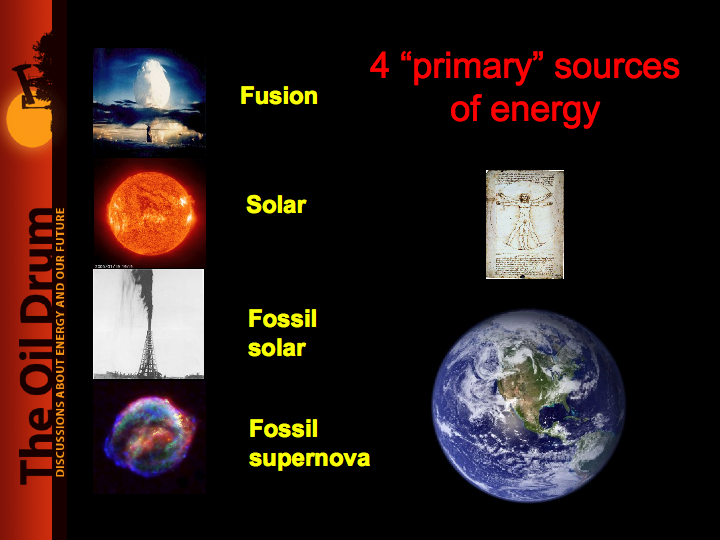
This post is intended to provide a structured background to energy matters for new readers and hopefully to provide a provocative debate with seasoned Oil Drum veterans. A listing of over 50 links to Oil Drum articles from the past year is provided which combined provide a comprehensive overview of the issues surrounding peak oil and energy decline. If you are new to the site or have been lurking and want to ask a question then all you have to do is sign up and post your query. The Oil Drum is here to educate--and we are here to help.
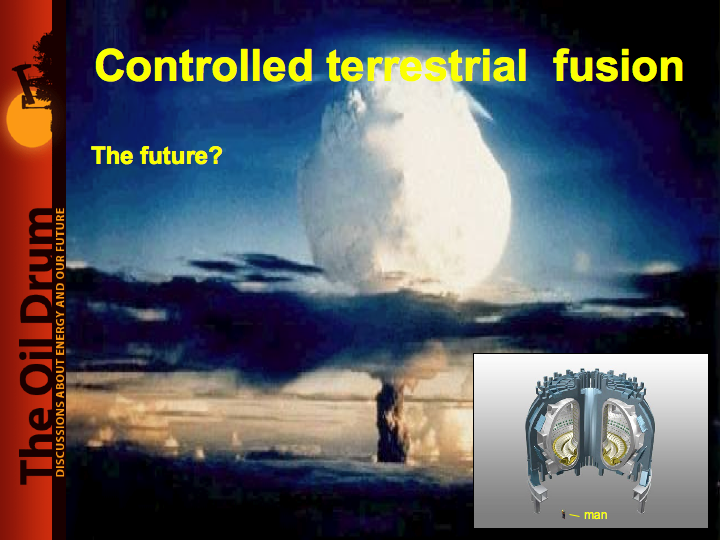
Will Nuclear Fusion Fill the Gap Left by Peak Oil? Guest post by Nick Rouse posted by Chris Vernon.
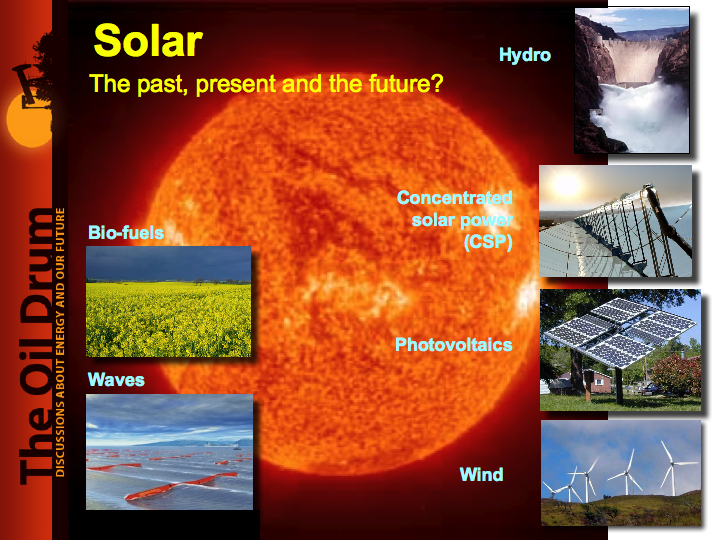
Report: Brazilian Ethanol is Sustainable Posted by Robert Rapier.
Corn-Based Ethanol: Is This a Solution? Posted by Gail the Actuary.
Cellulosic Ethanol vs. Biomass Gasification Posted by Robert Rapier.
Has the Algae Cavalry Arrived? Guest post by Fireangel, posted by Heading Out.
How the Energy Crisis Will Help My Diet Guest post by seismobob, posted by Prof Goose.
Why wind power works in Denmark Guest post by Cry Wolf, posted by SuperG.
The First Ever Off-Shore Wind Farm Financed by Banks... Guest post by Jerome a Paris, posted by Prof. K. Goose.
Energy from Wind: A Discussion of the EROI Research Guest post by Cutler Cleveland, posted by Nate Hagens.
Pelamis: a Shot in the Dark? Guest post by Luis de Sousa, posted by Prof Goose.
Outsourcing Solar Roofs Posted by Glenn
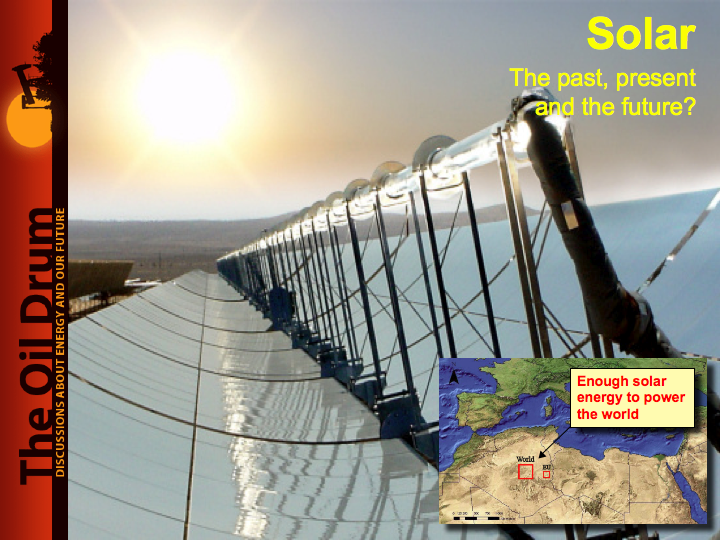
Concentrating Solar Power Guest post by Gerry Wolff posted by Chris Vernon.
Peak Oil Overview - June 2007 Posted by Gail the Actuary.
Oilwatch Monthly - May 2007 Posted by Rembrandt.
Peak Oil Update - February 2007: Production Forecasts and EIA Oil Production Numbers Posted by Khebab.
Is There A Painless Way To Fill The Oil Supply Gap? Guest post by Michael Smith, posted by Euan Mearns.
World Oil Exports: A Comprehensive Projection Guest post by Luis de Sousa, posted by Prof Goose.
Natural gas: how big is the problem? Posted by Luis de Sousa.
What Does an Undulating Plateau Really Mean? Posted by Glenn
Simple mathematics - The Saudi reserves, GOSPs and water injection Posted by Heading Out.
The Status of North Ghawar Posted by Stuart Staniford.
Depletion Levels in Ghawar Posted by Stuart Staniford.
GHAWAR: an estimate of remaining oil reserves and production decline (Part 2 - results) Posted by Euan Mearns.
Ghawar reserves update and revisions (1) Posted by Euan Mearns.
An Update on Mexico's Oil Production--The Rapid Collapse of Cantarell by the Numbers Posted by Khebab.
Flesh on the bones of Mexican oil production Posted by Euan Mearns.
A primer on Caspian Oil Posted by Jerome a Paris.
Canadian Oil Sands Production Update Posted by Khebab.
Oh, Canada! -- Natural Gas and the Future of Tar Sands Production Posted by Dave Cohen.
Getting a Grasp on Oil Production Volumes Posted by Khebab.
The Loglet Analysis Posted by Khebab.
The Shock Model: A Review (Part I) Posted by Khebab.
Does the Hubbert Linearization Ever Work? Posted by Robert Rapier.
Norway and the Parabolic Fractal Law Posted by Khebab.
Peak Coal - Coming Soon? Guest post by Shaun Chamberlin Posted by Chris Vernon.
Implications of "Peak Oil" for Atmospheric CO2 and Climate Posted by Chris Vernon.
Dr James Hansen: Can We Still Avoid Dangerous Human-Made Climate Change? Posted by Chris Vernon.
Greenland, or why you might care about ice physics Posted by Stuart Staniford.
And a series of 26 technical posts by Heading Out.
The electric wheel - a breakthrough in car efficiency Posted by Rembrandt.
Why we Drive Posted by Stuart Staniford.
The Auto Efficiency Wedge Posted by Stuart Staniford.
Aviation and Oil Depletion Guest post by Christopher Smith, posted by Euan Mearns.
Is Nuclear Power a Viable Option for Our Energy Needs? Guest post by Martin Sevior posted by Prof Goose.
Uranium Depletion and Nuclear Power: Are We at Peak Uranium? Guest post by Miquel Torres posted by Prof Goose.
How Uranium Depletion Affects the Economics of Nuclear Power Guest post by Miquel Torres posted by Prof Goose.
A review of the underlying fundamentals of nuclear energy Posted by Jerome a Paris.
Nuclear Power for the Oilsands Guest post by Brian Wang, posted by Stoneleigh.
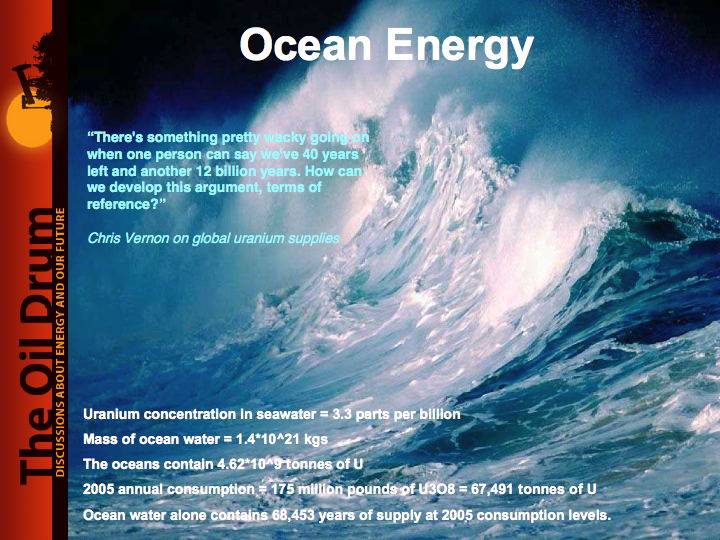
There are no Oil Drum posts on extracting uranium from seawater as far as I know. However, I feel this is an important topic, so here's a couple of links giving contrasting views:
Annex 8. Evaluation of Cost of Seawater Uranium Recovery and Technical Problems toward Implementation Hat tip Khebab.
Nuclear Power: the energy balance, Storm and Smith (large pdf) Hat tip Nate Hagens.
And finally a few miscellaneous posts on vital energy matters:
Ecological Footprint, Energy Consumption, and the Looming Collapse Guest post by Francois Cellier, posted by Khebab.
Ten Fundamental Principles of Net Energy Guest post by Cutler Cleveland, posted by Nate Hagens.
A Net Energy Parable: Why is ERoEI Important? Posted by Nate Hagens.
Living for the Moment while Devaluing the Future Posted by Nate Hagens.
Burning Buried Sunshine Posted by Dave Cohen.
Sustainability, Energy Independence and Agricultural Policy Posted by Engineer Poet.
That cubic mile Posted by Engineer Poet.
More on the Units of Energy Posted by Heading Out.
Entropy and Empire Posted by Stoneleigh.
Peak Oil, Carrying Capacity and Overshoot: Population, the Elephant in the Room Guest post by GliderGuider, posted by Stoneleigh.
DrumBeat posted daily by Leanan provides a menu of peak oil news and links that is second to none combined with an open discussion thread - that is often not recommended for the faint hearted.My current position on the looming energy gap is this. The OECD faces unprecedented peril from energy decline (oil first, then gas, coal and uranium) and energy insecurity - increasing amounts of oil and natural gas are being imported into the OECD. However, there is ample fossil energy contained in and solar energy arriving at Earth to sustain current population and economic growth. The challenge lies in real energy conservation measures, rebuilding our energy gathering and distribution infrastructure, redesigning our transportation networks and stabilising global population below 7 billion. A momentous task, but can this be done?
Or is industrial civilisation doomed to decay in a maelstrom of civil unrest, resource wars, famine, terrorism and pestilence?
You can always count on Americans to do the right thing - after they've tried everything else. Winston Churchill
I joined The Oil Drum one year ago in June 2006. I was aked to join as a contributor to TOD UK in September 2006 which has since evolved into TOD Europe. This year has been an amazing voyage of discovery.

Personnel
Editors
Contributors
Peak Oil Primers
Archives
- November 2010 (3)
- October 2010 (6)
- September 2010 (4)
- August 2010 (7)
- July 2010 (6)
- June 2010 (7)
- May 2010 (2)
- April 2010 (8)
- March 2010 (4)
- February 2010 (6)
- January 2010 (3)
- December 2009 (5)
- November 2009 (8)
- October 2009 (12)
- September 2009 (6)
- August 2009 (5)
- July 2009 (11)
- June 2009 (8)
- May 2009 (16)
- April 2009 (10)
- March 2009 (7)
- February 2009 (10)
- January 2009 (15)
- December 2008 (9)
- November 2008 (9)
- October 2008 (9)
- September 2008 (13)
- August 2008 (10)
- July 2008 (14)
- June 2008 (23)
- May 2008 (16)
- April 2008 (12)
- March 2008 (16)
- February 2008 (9)
- January 2008 (13)
- December 2007 (13)
- November 2007 (16)
- October 2007 (22)
- September 2007 (8)
- August 2007 (9)
- July 2007 (16)
- June 2007 (8)
- May 2007 (7)
- April 2007 (7)
- March 2007 (10)
- February 2007 (10)
- January 2007 (12)
- December 2006 (9)
- November 2006 (15)
- October 2006 (4)
- September 2006 (5)
- August 2006 (5)
- July 2006 (9)
- June 2006 (5)
- May 2006 (10)
- April 2006 (9)
- March 2006 (13)
Vital Trivia
License

This work is licensed under a Creative Commons Attribution-Share Alike 3.0 United States License.
Dear EM
Thanks for this great summary of the TOD debate. The gathering of world class general- and sometimes incredible detailed information collected here is simply stunning.
I agree with your comments- conservation and restructuring of energy use, supply, infrastructure, economy, taxation etc on a masive scale must be initiated soon. We all are in for interesting times. Activity tend to create jobs and wealth, so if managed well, the changes could be beneficial for many, maybe all. Doom and gloom not unavoidable.
Regarding conservation. The EU has invented a word for this-NegaJoules - energy not used. See effect on slide 12 in this EU paper. http://ec.europa.eu/energy/efficiency/doc/2005_slide_presentation_en.pdf
Without the marginal improvments in conservation +energy efficiency since 1971 the EU would use almost 50% more energy today.
Kind regards/And1
WOW!!!!
Great Post. I have it bookmarked and will refer to it often.
Love it.
However :(
The world is not headed for a peaceful future of powerdown.
This is a geek fantasy.
Name ONE civilization of any importance (and large) that has powered down successfully.
If we were to realize our fate as a global society and take measures to powerdown together we might have chance to bring in a new world.
But anyone can see that this is not happening. ALL nations seem to be preparing for war, we are just waiting for the go signal....
I remember on this site a reference to a study that said that we need 20yrs to prepare for Peak Oil, in order to transition peacefully away from Fossil Fuels.
We have squandered that time.
It seems we now have no option but to fight to the death for the remaining Fossil Fuel reserves in order to try and sustain our country's lifestyles (what ever country you choose to live in).
It is OVER. No amount of technofixes will save us now. It is too late. We need to realize this in order to have a chance to move forward. Forward to an ugly future. A future of countinual WAR. War for oil. War for Water. War for all of Earth's resources.
This will be the last great war. After this there will not be enough resources left to support a world-wide war on this scale. The USA is very aware of this and is trying to prepare. China and Russia are preparing as well. Seen through this lense the events of the last 6yrs make perfect sense.
Soon the world players will make their move and we will see what happens after the dust settles.
One thing is for certain: The world will not PEACEFULLY powerdown for the next 25yrs as some ivory tower fuckheads suggest. WAR is in mankind's blood and WAR it shall be.
Korg, before you meet your doom though, you can say you listened to this.
http://www.youtube.com/watch?v=En0A8KGMgq8
stay until the very end for the last comment by Simon for kicks.
amazing.
Even if you are correct the journey and the knowledge is still useful.
Quid Clarius Astris
Ubi Bene ibi patria
PrisonerX
I was expecting some sarcastic but realistic comment but Simon Cowell was 100% pleasant. Did I miss something?
A six year old girl was "pitch perfect", thru the whole performance.
That is an amazing comment.
Quid Clarius Astris
Ubi Bene ibi patria
I want my 4 minutes and 57 seconds back.
Don't become a Buddhist. The world doesn't need more Buddhists. Do practice compassion. The world does need more compassion. -- Dalai Lama
Korg - you definitely need to listen to Connie singing "Somewhere over the Rainbow"
I guess I do too, because I'm with Korg. We're on the Highway to Hell. The most perverse aspect of this is that the Highway will be paved with gold for those with the right connections.
I do thank you for your efforts, Euan. I will bookmark this.
I agree there...
I think the most ironic aspect of this will be if the USA and co-conspirators decide to stay on that highway whilst turning down opportunities to change direction.
My fear is that the USA is toast. Your fear has to be that we don't take you with us.
Hahahahahah....
But Connie has provided my nation with hope and inspiration for a better future.
Perhaps the humble phone salesman in his brown suit, well worn, ill fitting, would do for them.
That guy blew me away. I like the first show the best. The finals were great, but the little banter and that that that that came from that figure.
amazing.
http://www.youtube.com/watch?v=9oxTy7KIAaA
Never judge a book by its cover, and people can do surprising things.
Quid Clarius Astris
Ubi Bene ibi patria
But in the July 2 Drumbeat:
Japan: Oil imports decline for 13th month
Crude oil imports fell 11 percent in May from a year earlier, declining for a 13th month.
Crude oil imports fell to 17.5 million kiloliters last month, the Ministry of Economy, Trade and Industry said in a report Friday.
How have they done this without everyone hearing the noise of their economy collapsing? (No it's not a rhetorical question - I'd be grateful for any comment on what has happened there). I'm not cynical enough about governments - at least in Europe - to believe they will let our economies collapse due to peak oil, if avoiding measures can be taken. In my view, the problem is partly one of conditioning the public to accept the changes that will be necessary and this will take time together with some "shocks" that will alert people to the need for change.
It may be that some actions being taken by governments in the guise of climate change prevention, have a hidden peak oil agenda. However, there are still too many signals and trends going in the wrong direction - road building, plans for airport expansion, weak investment in public transport. The most optimistic scenario is that the current steady increase in peak oil awareness in the MSM will continue and main political parties will soon get the message that they must address the issue properly.
Edit: Korg wrote "... fight to the death", "... a future of continual war". I can see why Euan wrote "not recommended for the faint hearted"!
Re: Japan, there was amention later in the Jily 2 Drumbeat: "Japan's population is aging. Old people don't drive much if at all. Japan's population is shrinking. Less people, less cars. People are moving from the rural areas to the city area. You need a car in the boonies but in the city its a huge pain."
So there you have it: electrify transport (politically OK, but you need the investment); move people into cities ("End of Suburbia" - not popular idea in USA, not much more so in UK, better in rest of Europe); end "car culture" (big problems - powerful lobbies, people's freedom, aspirations, etc.).
The other issue was "fuel switching", in that the Japanese are changing over to an "all electric" housing situation, thus reducing consumption of kerosene and oil used for heating. The problem is that coal consumption and strain on the nuclear power plants of the electric grid are becoming a real problem.
The nation that is the home of the city of Kyoto may run into real issues with the Kyoto treay obligations. So oil consumption declines, but leaves yet another liability.
RC
Remember we are only one cubic mile from freedom
Not quite. There is that stupid switch campain
http://www.tepco-switch.com/
but its a relativly new thing and hasn't had much of an impact.
In my experience fuel switching is almost non existant in Japan so far.
The biggest impact the all electric house will have is on gas (ng and lpg) consumption. Not oil.
The grid in Japan is incredibly robust. Blackouts are almost unheard of.
I have been out of the market for a while but the Japanese import crude (sweet) to burn in their thermal power plants. The reason for the sweet is because the emissions are less...
I am sure that is going p off a lot of people...what a waste...The time of peak imports is when the nukes are not running full...a couple of years ago they had some terrible problems with nuke maintainence which prompted a large proportion of their nuke genration down.
Now i have been out of the market for a bit so the market maybe changing (hence the reduction in crude imports) as they switch to to alternatives, however I dont think because crude imports are down is a sign necessarily of lower demand...it needs more research it maybe a fuel switch.
That fits nicely with my anecdotal experience as well. There has been no major change in Japanese consumer habits (that I have seen) that would lead to lower consumption. And as someone in another thread pointed out, demographics would change much to slowly to show such a large month to month decline.
Japan does use a surprisingly large amount of oil to generate electricity. The nuke explanation is the best one I've heard so far.
The bit with the oil peak is real stealth. Governments are keeping it hidden even as they use global warming as the excuse to pull off the policies to try to deal with the peak. A government will want to keep the oil peak hidden so as not to panic the financial markets. But nonetheless, the oil peak is needed to understand why the world operates as it does.
Without knowing about the oil peak, the world makes no sense. But once you know about it, suddenly, the world makes, well, all the sense in the world. The prime example is the Iraq war. The war makes no sense until you find out about the global oil peak. "It's the oil, stupid!" That paraphrase sums up the bit with the war.
The original Iraq war of 1992 was also about oil. Saddam got greedy and we had to push him out of that oil patch called Kuwaut. We could not let Saddam Hussein corner the market. Once Saddam sent in the troops into Kuwait, we had to act. We had no other choice. And now, with the repeat Iraq war, we had to act. After all, Iraq represents the last largely untapped oil reserve of a significant size. Of course, we want to plateau the peak. The only way to do that is to tap the reserve in Iraq.
But beware. The repeat Iraq war is not working out. But it could end up being a good thing. Plateauing the peak might help a politician, but it also means a steeper decline. You don't want a steep decline. A 3%/year decline is going to be maddening enough. A 10%/year decline would be absolutely disasterous.
Petrol prices high enough yet? Just wait!
*IF* iraq has that much oil
and thats a pretty big iff.
Iraq certainly could be the worlds #1 producer in 5-6 years.
I find that incredulous. Even if Iraq had the potential (debatable) the time frame you stipulate seems incredible.
Boris
London
I pretty much agree with this and don't see a future with everyone living once again on family farms and communes that don't currently exist.
The real question I'm posing here:- "is powerdown essential?" Are there sufficient alternative energy supplies (nuclear, wind and direct solar) to enable industrial civilisation to adapt to a new, sustainable energy future? If the answer is no then we are well and truly stuffed. If the answer is yes then does our industrial society have the will and wherewithall to grasp the opportunity?
Or is it easier to overcome the problem by force? And the elephant in the room is population.
Our only hope
Is to get the Pope
TO HAND OUT CONDOMS
Get Joseph Ratzinger/Benedict v.16 to hand out condoms? He will not do it for an incredibly simple reason: More followers means more power. Any preacher will preach "be fruitful and multiply" because it means more people to brainwash with crap. All the successful religions preach overpopulation.
This is a major reason I hate organised religion. I have come to the conclusion that religion if organised is a force of evil that must be removed. Islam only serves as the present example. Religion is enough to get someone to want to drive an airliner into a building. If there is ANY damn lesson to be learned with the 9/11 disaster, it is that. Organised religion is evil. Pure and simple.
Islam might be the example now, but Christianity is not innocent. After all, the crusades were done up. The only reason more abortion clinics were not blown up is that Americans are on average too stupid to develop a car bomb. We Americans have our own homebrew Al Queda-like group, the "Army of God". The whackos are Christians not Moslems. But they serve as a danger to any abortion doctor. Doctors have been whacked by anti-abortion whack jobs, as well as clinics being torched. So far, they have not yet resorted to the "poor man's air force" of the car bomb.
For peace, the world must give up religion. Religion must be phased out, but it cannot be done by force. We find that out with the former Soviet Union. When the empire collapsed, religion re-started. Sweden is an example of non-force phasing out of religion. We Americans need to get off religion, before we blow ourselves up with the stash of nukes.
Petrol prices high enough yet? Just wait!
Religion is not the problem, human nature is the problem. The new levels of persecution seen in State enforced Marxism amply demonstrate that.
Based on that observation, I think you will find that the backlash from Peak Oil in secular countries such as in Western Europe will be no better than religiously oriented countries. In fact, it could be worse if the individualism so beloved of secular humanism is allowed free course in a crisis.
You're implying that individualism is the opposite of religiosity. It is not; the opposite of religiosity is skepticism.
One look at all the unworkable "solutions" proposed for peak oil, AGW etc. proves that skepticism is a sine qua non.
I was implying that? There are a lot of opposites to religion, not just one thing as you state and individualism, now you mention it, is one.
As for the "sine qua non" of skepticism during a Peak Oil crisis, unfortunately skepticism will cut both ways depending on the prejudices and agendas of the mind exercising it. We already have people applying their form of skepticism to say that Peak Oil is just an engineered scam to send more money flowing to "corporate fascists".
In the secular worldview everything is relative, including skepticism. Excuse my skepticism on skepticism!
Skepticism is demanding that all claims be supported.
Skepticism != nay-saying. Skepticism is most certainly not anti-capitalist dogma. You should know better than to post nonsense like that.
As a skeptic, I'm going to demand that you either support that claim (starting from the implied claim that there is a unified "secular worldview"), retract it, or take the intellectual drubbing you deserve.
You may demand but most people go through life carrying assumptions or an "on balance" approach. Yours is an idealistic approach. Life is too short for idealism as Peak Oil will demonstrate. The post peak oil world will be more the world of the pragmatist than the idealist.
As a free-market capitalist I am not sure where I said skepticism was anti-capitalist "nonsense". If you meant the brand of skeptics who deny peak Oil and say it is a corporate conspiracy, that remains true - whether they are right or wrong. I was merely pointing out that this brand of skeptic exists. You misread me I am afraid.
As a skeptic, you may demand but since you have already hastily misinterpreted me (see above) I am unsure you're not just in this to grab some debating points with no intention of being swayed in your opinions.
In other words, they are using intellectual shortcuts instead of working through all implications and getting facts where they lack them. This means they'll believe many things which are wrong.
"It ain't what you don't know that hurts you; it's what you know that ain't so."
You are a prime example of this:
You "know" this, but you can't support it and won't defend it. If someone calls you on it, you tuck your mental tail between your legs and run away, trying to change the subject.
That's dogma, which is closely allied to religiosity.
Har. One of the things I find annoying about major secular humanist publications is that they are heavily socialist, not individualist. Of course, this doesn't matter to you when you're picking bogeymen.
The USA isn't going to make progress on the energy problem until frank honesty pushes the dogma from center stage and produces a set of responses based on the facts. All the dogmatic beliefs that "ethanol from corn will save us" or "when we throw out the enviros and drilling is allowed in ANWR/off Florida/off California we'll have cheap gas" or "I'll just drive my Excursion until I can buy a hydrogen car" are small variations of the same sort of mental errors you exhibit (and cravenly refuse to address squarely).
Heaven forbid you should change your mind, especially in response to ugly things like facts.
Consider:
(1) Self-imposed population stabilization or even slowing of growth so as to reach an asymptotic limit.
(2) Democracy - rule not according to what's true, but by brute force of the most people voting for the prettiest face on the emptiest head, or the zingiest nonsensical sound bite.
(3) Tribalism and nationalism - nowadays driven by political correctness and ethnic special privileges, ever more firmly enshrined in law. If we can grow to outnumber you, or, failing that, at least grow enough to become able to deafen you with our whining and sniveling, then democracy authorizes us to loot you rather than earn our own living.
So pick any two from the list. You cannot ever have all three unless population magically stabilizes on its own. And if we're in for a rough patch, the often-mooted universal demographic transition based on everybody becoming rich simply will not occur for the foreseeable future. Nor will exhortation have more than a transitory effect, as the subsequent generation will simply consist of those who are not amenable to exhortation.
In reality, the unshakable modern simultaneous insistence upon (2) and (3) renders any serious discussion of population taboo, as we have seen from the periodic fireworks in the Drumbeat thread. No go.
Fortunately, world population appears to be doing exactly that.
If you look at the UN figures on world population, you'll find its growth rate grew until about 1970, but has been falling ever since. Moreover, it's projected to continue falling for decades to come, reaching a growth rate of only 0.36% in 2050, and should become negative before the end of the century.
And if we're in for a patch rough enough that it stops global GDP growth - which even the oil shocks of the 70s could not accomplish - then poor, rapidly-growing countries may become unable to support that rapid population growth. Recent history suggests that will lead to localized starvation (Ethiopia), genocide (Rwanda), voluntary population control (parts of India), and involuntary population control (China).
All of which global civilization has successfully weathered in the past.
I doubt the UN looks into peak oil/NG
if natgas falls down in production, farm production will also drop like a rock!
I assume you are referring to ammonia production requiring natural gas. It doesn't, the Haber-Bosch process originally used coal to produce the hydrogen needed in ammonia production.
C + H2O --> H2 + CO
Any electrolysis of water can make H2 to fix on N2 to make Ammonia. This needs, of course, electricity and water, but can be done in the middle of nowhere without access to the grid - not real cheap, but flexible!
I love ammonia, I really do!!
Huh?
I thought a major reason to discuss these matters was to see if there might be a way to transition out of fossil fuels and out of infinite population growth in a somewhat humane manner. If genocide and mass starvation are satisfactory outcomes, the whole discussion, not only this one but the one on Peak Oil itself, becomes unintelligible, or at least superfluous.
As to the UN figures, they are only educated guesses, not gospel, and I insist that they are predicated on robust economic growth. The "6" in "0.36%" is pure noise, and the "3" is probably pure noise as well. In addition, voluntarism is guaranteed to be transitory, as the volunteers will be represented less and less in each future generation. There are still many large families even in rich countries, and they will "win" out.
Oh, and the Chinese involuntary approach is falling apart.
Oh, and the 1970s were only two transitory blips, with long gas lines for only a few months and really bad only in limited areas.
So, I say, Houston, we really do have a problem.
Genocide and mass starvation have happened throughout human history though - nothing is likely to change that until the entire world is living in prosperous economic conditions (which didn't stop Hitler either, but hopefully our memories aren't so short to allow such a thing to happen again).
Transitioning away from fossil fuels may well happen in a "somewhat humane manner" - if we restrict our focus to developed countries. For developing countries, especially those like China and India that are only just now getting the taste of fossil-fuel power, it's really hard to see how things could be smooth sailing. For truly impoverished countries where fossil fuels are not an integral part of economic conditions, things will probably get worse as developed nations increasing find themselves worrying about their own problems, and aid/tourism/medical assistance/export dollars dry up. I don't hold much hope for sub-Saharan Africa at all, sadly.
The best I think we can realistically hope for is a) prevention of out-and-out large-scale warfare and/or collapse of democracy and b) moderately quick recovery time - perhaps within as little as a decade. Given a major problem with making progress today is the entrenched attitudes of consumers and corporations with vested interests, a decade-long recession should largely rid us of those attitudes.
The biggest unknown is how will various nations deal with huge changes in the global balance of power. If the U.S. does as badly as many here expect it to, and Saudi Arabia becomes an enormously powerful country, global politics will be vastly different.
And the first part of that is seeing if there's a way to transition out at all.
Which, despite the insistence of a few die-hard doomsayers, there is.
False dilemma fallacy.
You're holding peak oil mitigation to an unreasonably high standard. The world already has genocide and mass starvation at times, so expecting a post-peak world to not have those is expecting a substantial improvement. If their prevalence is approximately the same post-peak, I would think that would be a reasonable outcome vis-a-vis peak oil.
Of course; however, they're almost certainly rather more well-founded than most of the population numbers people here throw around.
Meaning population growth is tapering off even without harsh resource constraints, making it basically an upper bound. So the pressures associated with population growth should be assumed to be declining towards zero, rather than increasing towards infinity, as they might with a "constant growth rate" model.
Only if you assume that the reason for not volunteering is genetic and inheritable, rather than cultural and changeable.
Care to back up that assertion with evidence?
Care to back up any of your assertions with evidence?
Oil production fell four years in a row - from 1979 through 1983 - by an average of 3.5% per year, and by almost 5% in the first 3 years.
That that caused only a "transitory blip" is perhaps evidence that declining oil production will not cause the massive disruption you seek, rather than evidence that a sudden 13% decline in oil production was minor.
Yeah, we do - nihilists with a doomsday fetish keep throwing up nonsensical statements without providing a shred of evidence to back them up.
Pitt, do you have UN figures for individual years, going from 2000 to the present? from what I've been able to find out elsewhere, population growth remained only static (in percentage terms) from the UN's 2000 figure, and the latest estimate I've seen shows a slight uptick this year. So I see no evidence for falling growth, at present, even though it clearly fell in the past.
True, but then there was capacity to increase production, which did happen. What evidence is there that oil production will increase in the future?
That doesn't seem to be true recently. I've been following the estimates for the last few years. In 2000, the UN estimated growth at 1.14%. The CIA World Fact Book had the estimate at 1.14% in 2005 and 2006. So it looks as though the growth rate had remained stuck for the first half of this decade. However, the latest estimate is 1.167%. One year doesn't give a trend but I don't think you can rely on those UN estimates of falling growth.
Care to provide a link? Because the one source I can find that does have year-by-year estimates - US Census - disagrees with you, and has year-on-year population growth rate (as % of current) staying the same or decreasing every year for the last two decades.
I gave a link (it's surely not hard to find the CIA World Fact Book on the web). However, you seem to now be placing more faith in the US Census figures than the UN figures. I found a UN estimate for 2000 population growth at 1.14, below the figure given in your linked table. I don't have a link to that at present (I found it about a year ago). That 1.14 figure was identical to the world fact book figure that I saw in 2005 and in 2006. The latest estimate from the fact book has it at 1.167%.
The real question I'm posing here:- "is powerdown essential?"
Powerdown will happen because the collection apparatus for photons when you have to PAY for the externalities of collection. Memory of not having to pay for that act as a block. The present society has alot of energy spent supporting what could be called 'not useful' activity.
The "However, I don't see peak oil as an immediate catastrophe for two reasons. " position seems to ignore how people who remember keeping their homes at 80 degrees in the winter and barely had a balanced budget react when another stressor like a sick child hits. Echos of interviews where people say "I'm gonna do what I have to do" during Katrina, combined with trains being stopped over the theft of 200 feet of wire and 'slogans' like "nuke their ass, take their gas" make me ask
How does this all end well?The memory of how things where and the promises that 'if you just do this and you can get back there' is powerful mojo.
"[I] don't see a future with everyone living once again on family farms and communes.."
Who says 'Everybody' will have to be doing the same thing to solve this problem? That is one of those hyperbolic stereotypes of those who say there are things we CAN do, that there are ways to improve our chances. It's one of the big marketing challenges for solar electric, and even for efficiency measures, which is that it has 'Hippy' written all over it, as much as this is a silly anachronism at this point. Just the same, the image sticks, as shown by your commune comment.
'A problem that was created with intelligence won't be solved with ignorance.' Einstein
The answer is no. We must consider that the harnessing of renewables (I'm discounting nuclear, since it is not renewable) requires non-renewable resources. And that leads to the more general case of the world using up (and usually at growing rates) other finite resources. Yes, population growth is possibly the number one problem (and, the latest CIA World Fact Book estimate has it up to 1.167% growth now), but our refusal to give up economic growth and rising living standards (not necessarily equated to quality of life) is just as big a problem, particularly with the rapid growth in China, India and some other countries.
Unless we change course, in both population and how we organize societies, we're stuffed.
That's why we shouldn't do it. "Power down" means decreasing the standard of living as fossil fuels deplete, and trying to maintain networks without the wherewithal to run them. This would be very difficult to do even without politics in the way.
We have no shortage of energy. A 1/4 acre lot in Kansas receives an average of 1.5 megawatt-hours of sunlight per day. There's an estimated 72 terawatts of available wind power world-wide (current human energy consumption from all sources is roughly 13 TW). We do not need to power down, we ought to re-power.
The US has spent perhaps $500 billion on the Iraq war thus far. That $500 billion could have paid the $3000 premium to put hybrid technology in 100 million cars (roughly 6 years of US purchases), plus buy 40 GW of PV systems at $5/watt. That money could have gone a long way toward eliminating the problem.
It's no wonder your view of the future is so dark; the only cure you can see is more of the disease.
I recommend Thom Hartmann's book, "The Last Rays of Ancient Sunlight". Less energy, simpler living do NOT equate to a lower 'standard' of living, but higher. The current measure of our standard of living seems to be tied to our consumption, rather than quality of life. Instead of measuring property ownership(which equates to additional government protection, disposal, clutter, and overtime worked), we should measure the standard of living by how much time is actually spend working (for someone else?). People who are constantly worried and working are constantly buying and burning energy they don't need to get to places they don't need to go. If we are forced into a more laid-back, conserving lifestyle, perhaps we wouldn't be going to war to prove we can go to war. Just because no other civilization hasn't powered down intelligently doesn't mean we CAN'T. We have the technology, the networks, and the resources to do it. We only need the right motivation. Almost everyone polled wants a simpler life, so why make it complicated? Give people what they want. Turn off the switches, park the cars, set up systems of shared transport and shorter work weeks. Most people are 'working' at jobs that don't produce anything necessary to the future of the human race, anyway.
Put them at home in a garden. It doesn't have to be a commune. $500 billion doesn't even begin to cover the cost of Iraq, especially when depreciation and wear and tear on the equipment is considered. Plus interest.
"Doing more with less" doesn't mean doing things we don't need done. It means doing more USEFUL things with less resources wasted. If we COULD have fusion or some other cheap energy, then what? What, exactly, should be done by humans in the long term. I'm pretty sure it doesn't involve blowing up things for the sake of blowing up things, or buying things (eventully, leading to blowing up things) for the sake of buying things.
Just because it works for you doesnt make it universally true. You have a vision for utopia; Guess what, you arent the first. Millions have died for such dreams over the centuries and we're no closer.
Millions have died for which dreams over the centuries?
Are you talking about the hippies that went off to live off the land or are you talking about the Amish?
(Or are you talking about something that you though he was talking about, but he really wasnt..)
Cheers, Dom
Dont be obtuse. People have fought wars and staged bloody revolutions over ideologies is all. What he views as a happier life will not be shared by the rest of the world, and getting people to fall in line requires force.
Achso!
Now I understand. You were talking about a very specific historic event (ideology) called communism.
< obtusion - pedantism>
It is usually better to give the baby a name than to assume you are talking about the same thing as your partner/opponent.
Now, on communism - wasn't the idea NOT to power down but to take the power away from the few (the capitalists) and give it to the many?
Communism (USSR) industrialized hell-bent, and was not in the least interested in powering down.
Or were you talking about some other specific "event"? Do you mean some other "idealistic" world view? Maybe you could point to islamic fundamentalism or something - but again, the idea here was not powering down, but to TAKE POWER FROM OTHERS.
Nationalism (Nazi Germany and Japan, breaking up of Yugoslavia): TAKING POWER FROM OTHERS
Emperialism: TAKING POWER FROM OTHERS
Terrorism: TAKIMG POWER FROM OTHERS
"getting people to fall in line requires force."
I agree with you 110%! And if there's no open warfare, it's called *Politics*: a subtler from of COERSION.
Who has intentionally powered down in history, other than 3rd century desert monks, a few hippies in the '70s and the Amish?
But please - if you're going to refer to something (refuting someone else's non-differentiated claims), give the baby a name.
< /obtusion - pedantism>
Cheers, Dom
Munich
Or the French Revolution.
Or the English Civil War.
Or the American Civil War.
Or...
You (I hope) get the idea. People have died for many ideologies and views of "how things should be" over the years. Communism, reviled though it may still be in America, is only one of them.
Pitt, now let me get pedantic again.
I get your point, but you don't get mine.
My comment was not about Communism or ideological revolution. My comment was, that Dekazin assumed something was being discussed which wasn't.
The French Revolution was not about powering down, was it?
The English Revolution was not about powering down, was it?
The Am. Civil war was promoting industrialization instead of slaves (powering up), now, wasn't it?
Anyway, Do you see Autiegrav saying anything about Revolution?
I see him saying something about using less.
Besides, I agreed 110% with Dekazin, remember?:
"and getting people to fall in line requires force"
Yes, that's right, even for idealists!
Please read my comments in context next time.
Thank you.
Dom
The hell it wasn't. Read it again and stop being obstinate and off topic. Theres no way you will get me or most of the industrialized world to volantarily power down.
There you have it, the pithy epitaph of our arrogant folly.
Equally, you are susceptible to the folly that "powering down" is the best way we can give ourselves a secure future. I certainly don't buy it.
Did you miss the title article? Powerdown is not necissary; We aren't running out of energy.
To wizofaus & Dezakin:
Aye, I am well aware of the article title, but I guess right there is my biggest mistake. Silly me. I was figuring our problems are not just about energy and how much of it there is to be had but rather how and what we do with it on this earth that counts. In short, the reality based contextual interplay between our unlimited desires juxtaposed with our human liabilities and this finite earthly creation is what is crucial. Or so I thought.
Dezakin's sentiment, which amounts to nothing more than, I am and I (we) will have it, is but the individual expression of a supremely self-centered cultural ethic devoid of any context to earthly creation as something humans are dependent upon, and absolutely so. Gee, I'm glad to have it pointed out it just ain't so!
It's great to now know that the western (techno-industrialized) belief that whatever we don't like about how things are we can control it so that one day (much sooner than later, of course; like tomorrow) it'll all be better and all without any repercussions within or upon the human and biotic realm. Man, that's a relief!
What I really don't get is: If there is so much energy to be had for fulfilling such energetic desires as Dezakin makes clear he will not do without, why don't we have it and wizofaus' "secure future" now? After all, it's all there to be had and has been there all along, right?
Ah, what the hell. Screw all this nonsense of energy shortages. You're right, fellas, and that's great! Now excuse me while I run out to buy that Hummer I've always wanted, the diesel powered motorboat and my vacation home in the sun! Man, life's great getting it my way! No powerdown for me either. What a world, baby! I'm the man! Hoooowee!
Beam me up, Scotty.
If human beings had perfect foresight and were even close to rational most of the time, no doubt we would have planned everything perfectly and obtained our "secure future" by now. We don't, and we're not, and we won't ever obtain a truly secure future. But we will keep doing what we do best, which is approaching new challenges with a will to solve them, building on what has come before, and continuing our ambitions for a better future.
Those that believe that the technology we have now (or had 50 years ago, or 100, or whatever) is more than enough are welcome to stick with it, but I can almost guarantee you that if the entire population of the Earth made that same decision, we wouldn't be around much longer - a few centuries at best. At any rate, it simply isn't going to happen, so wishing for it is seems fairly pointless.
I'm glad to see you grasp the essence of our problem as I proposed it. Still, it would help if you defined a "secure future" by your reckoning because I do think there are (or were) ways to, if not to "truly" or completely 'secure' the future, at least 'assure' a more viable future for our species and all the rest of earthly life than our presently arranged prospects grant. Yet, this does not mean living an uncivilized life. Of course, we would have to define what that means for each of us and how we would envision securing it.
I question this proposition of yours, especially the idea of a "better future" built upon our "ambitions." Haven't we already established that such a future as so determined by man (particularly our techno-industrial model of ambitions) is inherently not assured? If so, how does one suppose it can ever be "better" by building upon that which is failing us? By my way of reckoning, better would, of necessity, mean more assurance for our species and all the rest of earthly creation's survival tomorrow (the future), not less.
To which I say: Those that believe that the technology we have now (or might have in 50 years, or 100, or whatever) will be enough are welcome to stick with it, but I guarantee you that if the entire population of the earth makes this decision, we won't be around much longer -- a few decades at best. At any rate, it simply isn't going to happen, so wishing for it seems fairly pointless.
Aside from mirroring hyperbole, the point is simply this: Man's attempt to fulfill his unlimited ambitions built upon a failed model of relationship to the earth is more than tragic, it's insane. But that's where we at. Until mankind (of the 21st century industrial based civilized kind) recognizes the true context of his place on this planet, he'll continue to do not at all what is his best to fit in and better ensure his survival, but continue to ruin it for himself and all the rest of life he is dependent upon.
As Aldo Leopold recognized: "The question is, does the educated citizen know he is only a cog in an ecological mechanism? That if he will work with that mechanism his mental health and material well being can expand indefinitely? But that if he refuses to work with it, it will ultimately grind him to dust?"
No matter how much energy there is to be had, it is all about how and what we use it for -- our survival or our selfish petty ambitions of a "better future" we can never have.
In any event, wizofaus, I would suggest that despite the disagreement of minutia expressed here, based on other thoughts of yours, there is probably a good range of semi, if not total, agreement in some other regards. Nuance is easily misunderstood here. Not so with Dezakin and that is what I thought worth pointing out. And to the extent that his statement encapsulates our culture's self-centered arrogance my original reply still stands.
To the future, better or not...
I guarantee that the experiment with the whole of human population consuming as much as the average american will be tried, and prove you wrong within fifty years.
For a population of, say, 9 billion humans (est. pop in 2050) to be consuming as much as the average American today, we'd effectively be consuming at at least 10 times our current rate. Estimates of many available critical resources give us in the order of 100 or 200 years at current consumption rates, so they would potentially be fall to 10-20 years' supply. The effort that would be required to support the scale of recycling necessary to enable us to continue to make do with what's available would be truly phenomenal, and I can't see how we're going to get there within 50 years.
And that's all without taking into consideration the economic and political reality of transforming the third world into a thriving economy within that time frame.
Eventually we may well get to a point where the whole human population is able to enjoy a high standard living with levels of consumption not dissimilar to many in the first world today, but it will take a lot more than 50 years, and most likely a significant reduction in population too.
Now the baby has a name.
Thank you.
No, you don't. My point is that you're the one misunderstanding the discussion.
Dezakin said:
i.e., imagining utopia is easier than achieving it, and muscular attempts to do so have lead to millions of deaths.
All of those wars I listed involved a common thread of one group trying to enforce its vision of the common good - a limited utopia, if you will.
None of them involved powering down, but, then again, that wasn't Dezakin's point, now was it?
You had a good point in your initial post that Dezakin was talking about forcing a lifestyle into people whereas the previous poster had not talked directly about that; however, you tried to take that way, way too far - even after Dezakin explicitly clarified that he was indeed talking about that - and ended up with a non sequitur.
If you were a little more direct and tried to make fewer strained analogies, it'd be harder to make those kinds of errors. Much clearer, too.
I can see that Dezakin and Pitt are off topic in this case. Sorry guys, but something just hasn't clicked for you yet.
Utopia was suggested by Dezakin in response to
This does not mean "ideologies" must be adopted. It mearly suggests there is a different way of looking at quality of life issues that aren't about ideology. This is not about following the Amish or hippies. Bringing civil wars and revolutions into the dialog doesn't make sense (unless something hasn't clicked for you yet).
Civilization isn't the same as humanity. History doesn't begin with the plowing of fields. Cities define people separated from the natural world upon which they depend and/or people living in numbers that exceed the carrying capacity of the land upon which they inhabit (food must be transported to them). By definition, civilization, or city culture, requires work performed by other people or the equivalent in cheap energy.
As cheap energy declines, it means many of us will be sent back to the fields to support this "non negotiable". Unless, of course, we abandon the paradigm of living beyond our natural means. Sure we can get away with it for a good long time, but the longer we keep pretending to be something special in nature, the worst the consequences when our fate finally arrives.
Earth was not "given" to us. We must participate, or face our end (perhaps taking 70% of all other life with us). After Peak Oil and Climate Change, you still have to reckon with Extinction Rates and Overshoot. All the while, life would be much more pleasant without any of this cheap energy. All you have to do is stop fighting to get away from nature. It's silly to think otherwise (not an ideology, just a fact of life).
"...life would be much more pleasant without any of this cheap energy"
That sounds very much an ideology, and one you can't possibly prove.
I agree that cheap energy has been a reason that we've allowed ourselves to get to a point where we have serious problems on our hand, but there's no reason that should necessarily be the case. A few decades of considerably more expensive energy, and a bit of soul-searching might just change attitudes enough to allow us a future where we have ample cheap energy (from whatever source) and a robust pace of technological advance both contributing towards a style of existence that doesn't continually degrade our natural environment.
There will always be a place for those who wish to live "outside the system", and stick with older technologies (and it's all relative - even the Amish rely on sophisticated technologies and agriculture that took millenia to develop and perfect), but it's never going to be a realistic or even desirable option for the bulk of the population.
The word "life" is not exclusive to humanity. Life won't be more pleasant with civilization still around and no more cheap energy. For life to be more pleasant, civilization must go. As it is, Climate Change, Mass Extinction, and Human Population Overshoot will be sad facts in the short history of civilization and long history of humanity.
The Great Forgetting:
http://www.davidsheen.com/b/b1.htm
We gave it a try and cities require somebody having to do the work getting the rest of us food and goods, as if nature never tended to this before we made it into work. If we try to replace this human labor with machines, we will then need cheap energy, which it self only carries the veneer of reducing labor (see "One Straw Revolution" by Masanobu Fukuoka).
As Fukuoka began exploring what "farm work" was "required", he found very little actually required (understand "do nothing" as an overstatement and avoid negligence). In fact, he discovered countless "modern technologies" created ever greater work. The more you understand about human ecology, the more you will understand what I'm typing about.
Humanity has only very recently even known about millions of fungi and millions of bacteria in places our advanced technologies never thought to look. Though our human minds are certainly impressive, we couldn't possibly grok the whole (not even with computers; think unknown quantities of snowflaking many-to-many relations for all you data modelers).
This is not ideology, just telling you that you must breath clean air, drink clean water, and eat healthy food, which science hasn't begun understanding as much as you might think. The Amish have nothing to do with this, as they are just a pre-industrial version of the same culture. After cheap energy is gone, you'll have to consider the Amish lifestyle to continue the failed experiment called civilization. If you'd like a less grim choice, consider your attachment of civilization to humanity.
otherwise....
Begin here: http://www.edibleforestgardens.com/
or here: http://www.tagari.com/
or here: http://fungi.com/
buy a farm: http://permaculture.org.au/2007/03/01/tagari-farm-designed-and-establish...
learn: http://www.spiralseed.co.uk/permaculture/
For the meaning we're discussing, it is.
In world of 7, 8, 9 billion human beings, there will be plenty of room for any of those ideas (permaculture especially, which may go some way towards weaning us off the need for oil/gas-based fertilizers and pesticides).
If you don't care for civilisation, no-one's forcing you to be a part of it. We have a model for what humanity as a whole is like without civilisation - millenia of tribal hunter/gatherer societies, who engaged in constant violent attacks, were constantly susceptible to disease, starvation and predation, forced to practice infanticide to keep their populations in check etc. etc.
Civilisation may be a veneer, but it's a veneer that allows to avoid a style of existence that few would choose voluntarily. You have your utopian vision of what our existence could be like, and are welcome to it. I have mine too, except that I'm realistic enough to accept that human nature is too flawed and the future too unpredictable for it to be likely.
There are too many flaws in your message to get every detail. However, I suggest you actually research some of these claims. I believe one suggested reading was the start to this dialog.
See if you can find this out there:
Those quotes demonstrate precisely that people tend to prefer to stick with the devil they know - another reason that no-one is going to voluntarily ditch civilisation.
At any rate, it strikes me that many Native American peoples were quite advanced, and possessed a form of civilisation that was almost certainly not the case for the bulk of human existence (i.e. the first 195,000 years).
It doesn't surprise me in the least that they saw little attractive about what C17th European culture appeared to be offering.
There is much to praise about the Native American way of life, and I don't believe any objective case can be made to show that it is measurably better or worse than modern industrial civilisation.
But do note, there's no way that America could support a population of 300 million living as the natives did - I gather it was at most 2 million before Columbus arrived.
So what do you propose the remaining 298 million do?
E-P, the current course of action may not seem rational to you and me, but it seems to make sense to someone, does it not? So, we have two problems here -- one technological and the other (far more difficult to deal with) political.
It makes a huge amount of sense if you consider it as blatant corruption: using public office and influence for private gain.
The API quiz correctly says that the US oil majors have only a tiny amount of the world's oil reserves (and countries like Russia and Venezuela like to confiscate their investments when it looks profitable to do so). The left was calling the war "blood for oil", and I dismissed them... until now. The new Iraqi hydrocarbon law, written behind closed doors but with the plans for it laid out in detail even before the 2000 elections, is the smoking gun. The whole point of the effort was and is to move control of the last major untapped oil deposits on Earth to the international oil companies. The US taxpayers (or whoever gets stuck with worthless US debt) pay the bill. Public expense, private gain. They have also done what they can to block the alternatives. From the killing of the PNGV in 2001, it all fits together.
Depending how much traction that narrative gets, the disillusionment and consequent backlash could make the political job a lot easier.
It doesn't hurt that a prosecutor with a gift for words has already written an indictment of Bush for conspiracy to defraud.
The left was calling the war "blood for oil", and I dismissed them... until now.
I am impressed that you've been able to change your mind.
And thanks for the link to De La Vega's "indictment". Recommended and sobering reading.
I find this a particularly unconvincing argument, yet I've heard it often. It implies that we have the resources to harness as much of that energy as we want, that diverting any amount of sunlight to our own use will never have any side-effects and that energy is the only resource problem that we'll ever have (and also that it is the only problem we face).
It's also a fallacy to assume that because you see a solution (regardless of the validity of it), then that solution will be implemented, either at all or in a timely fashion.
No it does not. It only tells you where the energy is; going where the energy is not guarantees failure, but going where it is does not guarantee success.
Technologies like the $2/watt solar vapor engine that the MIT students built for Lesotho... that would practically guarantee success.
Well, of course. However, if nobody recognizes that a solution is possible or requires certain things, it is almost guaranteed that it will not be implemented or the attempts will fail. First things first.
So the availability of energy does not mean that we can harness it in any amounts we choose. Consequently, we need to realise that, at some point, we need to figure out how to live with a static supply of energy, not a growing supply. And probably at a lower level than we harness now.
Consequently, we need to realise that, at some point, we need to figure out how to live with a static supply of energy, not a growing supply.
Right on the head of the nail.
I would even say that it is not so much the exact level of this "static supply of energy" which matters but HOW it is somehow enforced by social/political/technical/whatever regulatory feedback.
This is the "safety valve" which we should look for and build.
The mistake both of you make is that the "limited" supply of energy is several orders of magnitude greater than what humanity is using now, even if we limit ourselves to the disc of the Earth.
I don't make that mistake at all. This huge "supply" of energy doesn't come free; it takes all sorts of other much more limited resources to harness it and use it. I thought I'd make that plain, but obviously not.
Consequently, we will have to make do, at some point, with a non-expanding supply of energy. Unfortunately, many simply assume that such a point is in the distant future, so I don't expect any preparations for such a situation until it stares us in the face.
This is the exact assumption *that cannot be made*.
Where the level is, is the unknown.
Engineer-Poet says it's higher.
You say it's lower. I *assume* it's many degrees higher, but that the transition away from FF is the big "if" (will it work?? - that's why I hang out at this board) - but I hardly know where that limit is!
Like many here have pointed out, the earth is hardly a closed system.
Cheers, Dom
The earth receives very few resources from outside - apart from solar energy. So saying it is hardly a closed system implies a dismissal of limits.
However, you're right that I should not make the assumption that energy will ultimately be harnessable at a lower level than we have now. Unfortunately, the prevailing opinion (and it remains an opinion) is that the level is much greater than now. It is this prevailing assumption that is likely to hinder any kind of relatively calm transition to some stable system. On the other hand, an assumption that the level is lower (or at least lower on a per person basis, globally, is less likely to adversely affect our ability to transition, provided that assumption is acted upon.
I'm not sure what you mean by "if". We will have to transition away from fossil fuels so I assume that you mean transition with no essential change in our way of life. I really can't see that working because it requires continuous growth (and not at a linear rate).
"The earth receives very few resources from outside"
Right now I would say that we are only dealing with energies from the Earth-Surface-System.
Drilling/Mining for FF was the first step outside of this system (although very limitted in total amount and non-renewable; or you could call them "surface" energies collected from the past), geothermal would be another step outside. Satelites collecting solar energy outside of the atmosphere are also (although only to an infintessimal amount) already outside of the system, but serving it!
One step could be mining deuterium from the moon. Might be Sci-Fi, might not be.
"So saying it is hardly a closed system implies a dismissal of limits."
Exactly. I am dismissing presently perceived limits. Whether these perceived limits will present real limits is the question.
"I'm not sure what you mean by "if"."
Sorry, I meant if we transition *successfully*, whatever that means (my meaning would be: no significant/sudden collapse i.e. the proverbial soft landing/transition, whether we power down or not).
"I really can't see [the transition] working because it requires continuous growth (and not at a linear rate)."
Not necessarily. It would probably mean continued growth at the present - at least til a new level (of consumption/energy collection) is reached. Whether growth continues/can continue after that next step is of no concern now.
Cheers, Dom
Nitpick: Deuterium is far too common in ordinary water for this to ever be likely. Its often assumed that He3 would be a good source of fusion fuel present on the moon, but its also ridiculous seeing you could manufacture it from neutron irradiation of lithium far easier.
:-)
No problem.
I'm no expert and I don't usually mind nitpicking..
Cheers, Dom
Well, I'd profoundly disagree with that. By disregarding possible limits now, we make it harder, in the future, to cope with those limits, because we just continue consuming more and become more reliant on that level and on growth.
Aahhhh,
I figured you wouldn't like that statement.-)
I think I'm saying too much here.
The "next level" to me is not what we will be presented with in 10 years. This will be what we have after the turbulance of PO and the digestion of the flattening (my assumption) population growth, with or without a "long emergency", with all its sollutions and failures.
I do not know how that world will look.
I do not know what level of consumption, whether sustainable or not, we will have.
I do not know if we will be ready to attack the next level (eg moving to outer space / colonizing our upper atmosphere / reaching the "singularity" / what have you) at all.
So why worry about the next-next level?
It would be like asking the first farmers to start thinking about planning for industrialization, or even about modelling society in the River Valley Civilizations or dealing with metalurgy - just things which did not exist in their paradigms..
Dig?
Cheers, Dom
Sorry; I quoted you out of context. You said:
So growth is necessary, in your opinion, to reach the next step. However, you've now said that it is not so and "the next level" is merely what we'll have after the coming energy crisis is over (whatever that means).
It's a sad thought that whatever trials the human race goes through over the next few years or decades, the remnants will simply pick itself up and start the party all over again, learning nothing from even, what will then be, the recent past.
Just saw a news article about Clove flavored cigarettes targeted to Indonesia. How is this related to Peak Oil and transition? I think it shows a good case where we KNOW that cigarettes are bad for the population, yet investors see a profit potential by owning stock of tobacco companies. The companies see a profit opportunity by targeting sectors of the population and creating the market, even though the consequences are known and can be seen as immoral. Do the directors of Philip Morris not understand that hooking a new generation of users in a 3rd world country will end badly for many of those people? How is it different from Exxon Mobil, Shell or any of the NOCs?
For an effective PowerDown strategy, powerful corporations will need to promote the effort because the see a profit potential greater than the potential of the current status quo.
Just my take,
ej
Great comment. However, I do not see the majority of corporates joining in this ideal...
"You can never solve a problem on the level on which it was created."
Albert Einstein
"All nations are preparing for war" Tell me what Denmark is devoting to preparation for war? How about Costa Rica? Burkino Faso? Bhutan?
One of the remarkable things about the last 60 years is the lack of war between nations. There have been a few surrogate wars between the US and the Soviet Union but mostly acts of war have been between groups of people within nations using the technology of the 19th century. A large percentage of the Earth's surface has been free of open warfare since 1945. North America hasn't had major warfare since 1865.
thomas, funny that you should first name Denmark. Denmark is a Bush ally in the "War on Terror."
With all due respect to you, it strikes me that your point that "a large percentage of the earth's surface has been free of open warfare" is a bit sheltered -- even naive. First of all, we live now with "the bomb" and this -- so far, anyway -- has served to discourage open hostilities amongst major powers. But how long will this hold, especially as petroleum, nat gas and other resources become limited?
I don't have the time to add up all of the numbers but I would remind you that, since 1945, several million have died in America's wars alone -- and those are just wars in which America was directly involved. Throw in the proxy wars and the number is certainly several times that. Then, you've got Rwanda, Cambodia, the former Yugoslavia, etc.
The old methods of fighting wars are fast becoming obsolete -- much to the frustration of those with half-trillion dollar military budgets. Going forward, it's going to be 4GW and 5GW. These conflicts may not make the imperial history books but they will be costly and bloody, nonetheless.
* 1945-1949 Chinese Civil War
* 1945-1949 Indonesian National Revolution
* 1946-1949 Greek Civil War
* 1946-1954 First Indochina War
* 1947 Paraguayan Civil War
* 1947-1948 Indo-Pakistani War of 1947
* 1947-1948 Palestinian Civil War
* 1947-1949 First Arab-Israeli War
* 1948 Costa Rican Civil War
* 1948-1960 Malayan Emergency
* 1948-1965 Sino-Taiwanese War
* 1949-1959 Chinese Invasion of Tibet
* 1950-1953 Korean War
* 1950-1961 Indonesian Civil War
* 1952-1955 Tunisian War of Independence
* 1952-1960 Mau Mau Uprising
* 1954-1975 Second Indochina War
o 1959-1975 Vietnam War
o 1962-1975 Laotian Civil War
o 1967-1975 Cambodian Civil War
* 1954-1962 Algerian War of Independence
* 1955-1972 First Sudanese Civil War
* 1956-1957 Suez War (Second Arab-Israeli War)
* 1956 Hungarian Uprising
* 1956-1959 Cuban Revolution
* 1957-1958 Ifni War
* 1958 Lebanon Crisis of 1958
* 1958-1987 Columbian Civil War
* 1960-1965 "Congo Crisis"
* 1960-1996 Guatemalan Civil War
* 1961 Bay of Pigs Invasion
* 1961-1991 Eritrean War of Independence
* 1961-1974 Portuguese Colonial War
o 1961-1974 Angolan War of Independence
o 1963-1974 Guinea-Bissauan War of Independence
o 1964-1974 Mozambican War of Independence
* 1961 Invasion of Goa
* 1962 Sino-Indian War
* 1962 Indonesian Annexation of Western New Guinea
* 1962-1966 Indonesia-Malaysia Confrontation
* 1962-1970 Yemen Civil War
* 1962-1975 Dhofar Rebellion
* 1963 Sand War
* 1963-1967 Shifta War
* 1964-Present Colombian Armed Conflict
* 1965 Dominican Civil War
* 1965 Indo-Pakistani War of 1965
* 1965-1993 Chadian Civil War
* 1965-1989 South African Border War
* 1966-1988 Namibian War of Independence
* 1966-1979 Second Chimurenga(Rhodesian Bush War)
* 1967 Chola Incident
* 1967 Six-Day War (Third Arab-Israeli War)
* 1967-1970 Nigerian Civil War
* 1967-1989 Second Malayan Emergency
* 1967-Present Communist Insurgency in the Philippines
* 1968 Prague Spring in Czechoslovakia
* 1968-1970 War of Attrition
* 1969-Present Islamic Insurgency in the Philippines
* 1969 Football War
* 1969 Sino-Soviet border conflict
* 1969-1994 The Troubles in Northern Ireland
* 1971 Bangladesh Liberation War
* 1971 Indo-Pakistani War of 1971
* 1972 Libya-Sudan conflict
* 1973 Yom Kippur War (Fourth Arab-Israeli War)
* 1974 Turkish Invasion of Cyprus
* 1974-1991 Ethiopian Civil War
* 1974-2002 Angolan Civil War
* 1975-1991 Western Sahara conflict
* 1975-1991 Lebanese Civil War
* 1975-1978 Indonesian invasion of East Timor
* 1975-1998 East Timorese War of Independence
* 1975-2006 Independence War in Cabinda
* 1975-1989 Cambodian-Vietnamese War
* 1976-1983 Argentina's "Dirty War"
* 1977-2002 Mozambican Civil War
* 1977 Libyan-Egyptian War
* 1977 Hutt River Province-Australian War
* 1977-1978 Ogaden War
* 1978 Israeli Invasion of Lebanon
* 1978-2005 The Aceh War
* 1978-1979 Uganda-Tanzania War
* 1978-1987 Chadian-Libyan conflict
* 1979 Sino-Vietnamese War
* 1979-1982 First Chadian Civil War
* 1979-1989 Soviet Invasion of Afghanistan
* 1980-1992 El Salvador Civil War
* 1980-1988 Iran-Iraq War
* 1980-present Internal Conflict in Peru
* 1981 Paquisha War
* 1981-1986 Ugandan Bush War
* 1982 Falklands War
* 1982 Israeli Invasion of Lebanon
* 1983 U.S. Invasion of Grenada
* 1983-Present Sri Lankan Civil War
* 1983-2005 Second Sudanese Civil War
* 1984-present Kurdish insurgency in Turkey
* 1984-present Free Papua Movement
* 1984 Siachin War
* 1985 Agacher Strip War
* 1987-1993 First Intifada
* 1987-present Second Ugandan Civil War
* 1988-Present Casamance Conflict
* 1988-Present Somali Civil War
* 1988-1994 Nagorno-Karabakh war
* 1989-1991 Mauritania-Senegal Border War
* 1989-1990 U.S. Invasion of Panama
* 1989-1992 Afghan Civil War
* 1989-1996 First Liberian Civil War
* 1989 Romanian Revolution
* 1984-present Kashmir conflict
* 2003-present Balochistan conflict, Pakistan
* 2003-present Central African War
o 2003-present Darfur conflict, Sudan
o 2004-2007 Central African Republic Civil War
o 2005-present Chad-Sudan conflict
* 2003-present Iraq War
* 2004-2006 Waziristan War
* 2004 Haiti rebellion
* 2004-2007 Sa'dah conflict
* 2004-present South Thailand insurgency
* 2006 Israel-Lebanon War
* 2006-present Palestinian Civil War
* 2006-present War in Somalia
* 2007 North Lebanon conflict
Homo sapiens in all his glory.
Isn't it though? There is a reason that paleontologists have called our species "red of tooth and claw" and it's not because of covergirl makeup.
[begin sarcasm] Amazing how peaceful the world is, eh? Maybe it can get a little more "peaceful". After all "peace" is "profits", don't you know?[end sarcasm]
Ghawar Is Dying
The greatest shortcoming of the human race is our inability to understand the exponential function. - Dr. Albert Bartlett
I'm going to grow up and be an arms dealer.
screw saving people, ima help kill them and make a quick buck.
shoddy arms, misfiring bullets, unstable munitions, screw you all! Ima strip the copper out your houses and make bullets to kill you with it all! Melt down your cars, turn aluminum for folding stocks, bore axles for missle tubes, turn gas to napalm, and burn it all down.
ILL BE RICH, RICH!!! RIIICCCHHH!!!
A peaceful half-century century indeed.
Don't become a Buddhist. The world doesn't need more Buddhists. Do practice compassion. The world does need more compassion. -- Dalai Lama
Plus present Afghanistan war...
Wow - is this all you got to offer?
I think the first point I'd like to make is that this is an energy blog - therefore, I'd ask of you is to provide a revised list showing conflicts that are directly related to grabs on energy resources. Socio-economic depravation or sectarian and racial discrimination won't do I'm afraid. How many of these conflicts are related to energy?
Second point then is you need to show these data in the context of deaths, casualties and economic cost - on a global population / GDP basis - if you want to illustrate some point about the 20th / 21st century world declining into armed conflict and chaos - trends need to be compared.
Third - I'd just like to piick up on this point:
* 1969-1994 The Troubles in Northern Ireland
And point out that "Southern Ireland" is now one of the most prosperous countries in the world - since joining the EU - and is dragging the N along with it. And I won't go into discussing the US role in sponsoring terrorism here! But its well worth noting the benefits of a political and equitable solution.
Your list confirms my point about open warfare between nations is rare compared to what occurred before 1945. North America has been free of open warfare since 1865 which was 80 years before the "bomb". It is hard to say if the Balkans War of the 1990s was within a nation or between nations because it certainly started out as a civil war. With this one exception Europe has been free of open warfare between nations for the last 62 years. When you add in the vast territory of the Soviet Union to that of Europe and North and South America It all adds up to a majority of the Earth's land being free of war between nations.
The USA though has been the biggest violator of international peace since 1950 by invading Korea, Viet Nam, Grenada, Lebanon, Panama, Afghanistan and Iraq. The Domino Theory didn't die in Viet Nam and has been the dominant doctrine of US foreign policy for over 50 years. We also have troops in over 100 more countries. It is way past the time to bring the troops home from more than just Iraq.
whoa, and you say others are having geek fantasies?
Some geeks dream of Utopia, others prefer Conan.
"To Crush your enemies, see them driven before you, and hear the lamentation of the Women.." Ahnold..
or to jump accents over to Kissinger..
'Nonsense, our geeks are better than their geeks'
I'm in the quasi-pessimistic camp: solutions are technically possible, as there is still enough fossil energy to both build a new energy infrastructure and continue business-as-usual, and there will be for least a few years more. But it is the cultural factors that make me pessimistic. Americans are basically living through the 3rd re-run of the 1973 oil crisis, and most of us still don't get the lesson, or even understand that there is one being taught. Will America and the countries so eagerly following in its industrial, car-centric footsteps wake up before it is too late - before there is too little energy left to make a transition to a different type of high-energy civilization, instead of low energy chaos? I certainly hope so...
I agree fully, at least up to the cultural part.
I would even go further and say that the changes that need to be made are as plain as the nose on your face - and actually not that difficult to do, even after Peak is a number of years, even decades, in the rear view mirror.
I don't see rolling back America's sub(ex-)urbanism as undoable.
Where my pessimism comes from is the structural/systemic challenge. Let me just mention a few of the structures which exist, which more than likely need to be destroyed/critically reorganized in order to compensate for failing fossil fuel reserves:
Sovereignity of the nation/state
Fiat currency/reserves banking
A top-down money system (the consumer does not get the prime rate)
The need for interest, the need for economic growth, borrowing in the future
The corporate structure, also depending on growth:
The demand of capital to increase itself.
These are all structures that worked well enough with the spending of our fossil-fuel bank account..
Cheers, Dom
"A top-down money system (the consumer does not get the prime rate)"
Why should they? That's an honest question. I don't see any particular reason why a consumer should necessarily be able to borrow at the prime rate. Economies of scale would be a good reason why the consumer should *not* be able to borrow at prime.
"The need for interest, the need for economic growth, borrowing in the future"
Like investing, borrowing is a way of moving capital to where and when it is most needed. There is nothing wrong with that. Now, the current low interest rates, they are the source of many problems, but that's turning around.
Economic growth is fine as well. Certainly, I want it to continue (but know that its nature will change). But exponential economic growth is a rat's nest. What we can reasonably expect is asymptotic growth. Luckily, asymptotic growth will be enforced by the laws of nature. I would argue that we're already seeing that and that peak oil is just one aspect of it.
I think we can agree that the current economic system (which encompasses government) needs to be more honest and transparent. The fiat currency and reserve banking concern of yours goes to the heart of this. (This is one of the reasons that I am leaning more and more to commodities investments or buying hard goods, like solar panels, that I'll use in the future.)
What do you mean by asymptotic growth? Do you mean that any measure of the economy will tend to converge on a single value which then, by and large, doesn't change?
If so, then that means economic growth must end. If economic growth must end then economic growth is not fine, contrary to your position (or Euan's). It's not fine, because it's unsustainable. Any economic growth (the notion of "exponential growth" is spurious, since growth always gives you more than what you start out with, exponential is just an adjective which places emphasis on the fact that the amount of growth increases unless the percentage growth decreases, but growth is still growth).
This is one of the central points that even those here seem to miss out on. Growth is unsustainable - period. I have never seen a good argument which shows otherwise. Growth in anything will mean that more resources, of some kind, are needed for any period that is measured. Of course, some resources are, essentially, infinite and growth in such resources can be regarded as sustainable. The problem is, is anyone suggesting growth in only the essentially non-finite resources (including the harnessing of those resources)?
Agreed: any (continuous) growth is necessarily exponential.
But my point is, even if one were to disagree with a particular element I mentioned, it all represents a complete system.
Turn one screw in the system and the others turn it back.
I really do think that the system will have to break before an improved one can take its place. (see the fall of the Soviet Union.) Technology will also be needed to help. Replacing/improving the elements above will IMHO do a lot more to society's health than technology.
Cheers, Dom
That's twice I've heard that...that continuous growth is necessarily exponential. Why can't it be linear?
And asymptotic growth is fine if the asymptote won't be reached for thousands of years - by then the nature of what we define an economy now will in all likelihood be unrecognisable.
Growth can be linear, if the amount of growth is identical each year. Thus the percentage growth decreases each year. Have you done the calculation for what linear growth might mean in 10 years, 50 years, 100 years? For example, in about 34 years, a growth rate of 3% will be 1.5%, and in 67 years, it will be 1%. Well before your projected thousands of years, there will effectively be no growth. That's why I said that growth must effectively stop, regardless of how you try to contrive continuous growth. And, on a finite planet, even that growth must eventually slow down in linear terms.
All growth is exponential, it's just that the percentage is decreasing continually. I know this is just playing with figures but it's meant to illustrate that growth in the use of resources, means that more of those resources get used each year. Eventually, that will have to stop, in a finite world. So growth is unsustainable, whether it can be described as exponential or not.
Growth in the use of resources can't be sustained. So it boils down to how long do you want to sustain them and are you happy that at some point for this generation, or some future one, a proverbial cliff will be experienced.
In that case it's not exponential. While we are redefining mathematics, let's redefine the laws of physics as well! Unfortunately, exponential is becoming a nearly useless pejorative word used by doomers who invariably mean unsustainable.
Exponential has a specific mathematical definition, it is not just a throwaway superlative. Not all growth is exponential. If you mean growth is unsustainable, say that, but don't throw in words to make it sound technical if you are not using them correctly, it makes us look innumerate.
I think we can agree continuous physical growth of any rate is unsustainable.
Well that's really what I've been trying to get across. My remarks on exponentiality were trying to avoid what appears to be an optimistic position that if we can change the growth to linear, we can still enjoy growth. Exponential is only interesting when applied with a fixed percentage of growth, because it is easy to calculate doubling times. With linear growth, we still get doubling but many here seem to think that's OK, providing (with fingers crossed) that the doubling periods are long in relation to their lifespans or that (with fingers still crossed) the growth can continue without hitting limits, so that they don't have to worry about it.
It's not a matter of doubling periods being long in relation ot my lifespan - its merely an issue of what sorts of limits we're talking about and how far away they are. Your definition of limit is based entirely on the current structure of our economy, and the current way we mine raw materials and burn fossil fuels. No-one is questioning that those limits will be hit very soon.
But let's say we master nuclear fusion. In that case, the amount of harnessable energy available to us is for all purposes infinite. Once your have infinite energy available, you can do anything - transform matter, fly to other celestial bodies to mine further resources etc. etc.
Maybe we never will succeed with that, but the mere possibility of it proves that growth, even exponential growth, is not necessarily limited by anything meaningful.
I agree that fusion could give us theoretically unlimited power, but this is no different from solar, which is effectively unlimited also. However, harnessing that energy will take resources that are not unlimited. Whether or not we succeed in replacing limited sources by potentially unlimited sources, there will be other limits that will be hit if we continue to try and harness/use increasing amounts of energy.
So, whilst you think that growth is not necessarily limited by anything meaningful, our living in a resource limited world means just the opposite, regardless of how much theoretical energy is "available" in which to fuel that growth.
So then "sustainable growth" is meaningful - it means growing in such a manner that the known limits aren't going to be reached within any sort of timeframe that need worry us (thousands of years).
We both agree we will have to significantly change the current way our economy works, and how we develop new technologies. You're proposing we alter our ways to achieve some sort of "steady state" economy with essentially no significant further advances in technology. My preference is to keep striving to find ways we can harness what energy is available to us so we can continue improving our economic wealth in order to continue advancing our technologies (I'll leave better standards of living out of the equation for now). Personally I don't see your preference ever being possible, because it flies in the face of human nature. You seem sceptical of mine simply because we haven't worked out how to do it yet.
So both are just as challenging. The difference is which will be more rewarding, and ultimately that comes down to personal opinion (although I defend my preference also on the grounds that it gives us the best long-term chance of surviving planetary-scale natural disasters).
No, I don't think sustainable growth has any practical meaning. Unless you are able to show that all the resources necessary to maintain significant growth for thousands of years will be available for that period. I don't think you've done that. Certainly, linear growth becomes insignificant well before such time periods, even if there are the resources (not just energy) to maintain it that long. So sustainable growth is meaningless.
I'm not proposing no further advances in technology but some form of steady state economy would be desirable, I think. Whether we can continue technological advances depends on how we wish to organise such societies and what priorities we choose.
I understand the human nature bit and am greatly saddened by our willingness to subdue our intelligence to human nature. It's becoming increasingly obvious to me that people would rather try to continue the party than try to figure out how to power down to sustainability. Of course, it may just be possible that we figure out how to stabilise world population and how to become ultra efficient in our use of finite resources and how to limit our effects on our environment, enough to ensure that the party continues for millennia. But there is certainly no guarantee of success in that at all. So I'd rather we concentrated on figuring out what a sustainable world might look like, how to ensure that it can provide a good quality of life, and how it might continue to support technological advances and artistic achievements.
It seems to me that this latter aim is preferable to the former, in that we can then modify the plan to try to pick up more of the former aim. If we aim for the former, we just increase the difficulty of switching to the latter, should we find that continued partying is impossible.
Well your "...we can then modify the plan to pick to pick up more of the former aim" is sounding a lot like what I expect to see. Over the next few decades we WILL have to start to manage much more sustainable methods of existence. After that, and once we've secured a clean reliable and sufficient long term energy infrastructure, I expect to see the "march of progress" take off again. That is, if I'm lucky enough to be still alive.
Well, I'd pretty much have to agree with that, wiz.
Mastering the technology of an efficient fusion reactor only solves the energy problem, not all sorts of other resource problems. To some extent you could use an enormous energy supply to extract resouces from sea water or trash (minerals, metals, fresh water) but that in turn will generate more waste. Unless we are very wise with its use we will only wind up with bigger problems.
Growth is a very slippery thing. If we can figure out how to have growth without increasing the use of physical resources that would be a good thing. For example, there could be increasing utility from computers which use less and less electricity. We could find ways to put more value on human services which take no more resources than they do now.
Ultimately, we need to find a way to live more elegantly that use less physical resources and energy.
To my eyes the Hubbert Peak is a problem more of lack of time than of lack of alternatives. The peaking of world Oil production by the early XXI century was foreseen in the 1950s and widely anticipated in the 1970s. But since then no alternative energy source emerged in the market. The world simply chose to stick with traditional fossil fuels.
When I reach retirement age all fossil fuels will be in decline, Oil, Coal and Natural Gas will all peak in succession before that. On normal market conditions the chances of a new energy source emerging occupying, say 50% of the market, up to that time are slim to say the least.
It will require major commitments both on Conservation and on the Development of infrastructure that allows Society to take advantage of alternative energy sources. But it is possible; the human mind is a formidable asset.
Unfortunately, Oil is not only energy; it is also the base commodity input of our industry (plastics, cement, chemicals, etc, etc) and above all the Guardian of Perpetual Growth. Peak Oil will probably impose the first serious limit to physical growth of our Society.
It is the transition from Perpetual Growth to Steady State that presents itself as the major challenge of the Hubbert Peak. And this is were my view is most hazy and were I feel most insecure about our common future.
Happy TOD birthday Cry Wolf.
Luis my feeling is that mankind will not begin to make this "major commitment" until it is absolutely clear that a crisis is at hand and that we have no choice. So I don't see our industrial civilisation starting to prepare 20 years or 10 years in adavance of peak oil - and in any case I suspect we have something like 5 years to go.
However, I don't see peak oil as an immediate catastrophe for two reasons. First, we currently waste so much energy that conservation may offer reatively painless mitigation in the first instance and second, we will still have excess supplies of natural gas that can substitute for gasoline in LPG form. What happens immediately post peak oil will determine our future.
If the OECD attempts to continue with business as usual - i.e. resource grabs and waste then that I think will lead to the maelstrom.
Alternatively, peak oil may serve as a major wake up call and realisation that our global resources are finite and I'm hopeful that this may lead to the investment required to build a sustainable energy future - albeit a bit late - better late than never.
One thing I'd be interested to know Luis is the energy deficit that the world will face post peak oil - and I was wondering if you may fill in some numbers here. Lets assume oil declines at 1.5% per annum post-peak. How much energy is that? (in joules) and what % of global energy consumption does that represent? Lets also assume that growing energy needs are taken care of by conservation.
How many nuclear plants / windmills / direct solar generating plants are required per year to replace the energy decline from peak oil?
Your chart above says oil is 39% of total global energy consumption (2005) so a 1.5% decline in oil represents a 0.59% decline in total energy per year (consumption and other sources staying the same). Again looking at the graph the 2005 total seems to be around 76 billion barrels of oil equivalent so 0.59% of this represents a shortfall of ~440 million BOE per year.
One BOE is 5.8x10^6 BTU or in real units 6.1x10^9 J or 1.7 MWh. This is thermal energy.
Sticking with MWh, 440 million x 1.7 MWh = 760 TWh per year.
A nuclear power station is perhaps 40% thermally efficient so a 1GW plant operating with an 80% load factor produces 7TWh of electricity from 17.5TWh of thermal energy. So our 760TWh of thermal shortfall represents the output of 43 1GW nuclear power stations.
Given that it takes around 10 years to build a nuclear power station – we really needed have started construction of ~43 in ~2000, started construction of another ~43 in ~2001 and so on. Today we would need to have 7 x ~43 = ~300 1GW reactors under construction based on a 2010 peak.
I’ve just used nuclear here as an example – replace with your future energy supply of choice. It also assumes a TWh of thermal energy in a nuclear power stations is equivalent to a TWh of thermal energy from oil burnt in an internal combustion engine, clearly it isn’t so there is additional infrastructure to build.
You bet me this time :)
Well, those numbers are a bit high. Halving those from The Cubic Mile post one gets about 25 new reactors per year. Although doing the accounting myself I also get higher numbers.
What’s interesting to see is that for a program like this succeed, assuming linear growth, we would have at least 250 nuclear power stations being built at the same time worldwide. This can’t possible be left to the “Market’s Magic Hand”.
Factor in how some nations that have an energy crisis are challenged over their desire for civilian power reactors, Fission power becomes yet another friction point between the haves and have nots.
Chris thanks for that. 43 1 GW power stations per year sounds a lot - but that is spread across the whole of the OECD. In the period 1970 to 1990 around 400 nuclear power stations were built - that's around 20 per year.
You're also saying we should have started in 2000 - and so are currently roughly 7 years or 301 power stations behind. Can you remind us how many new nuclear power stations have in fact been started since 2000 which would provide us with a better figure for the deficit.
You also make the point about thermal efficiencies. I know that internal combustion engines (ICE) are very inefficient. Do you know if electric cars would be more or less efficient in converting the nuclear electricity into vehicular transportation? And give us an idea of the relative efficiencies between ICE and electric cars?
It's also worth remembering that wind power has meaningfull levels of penetration in power generation in Denmark, Germany and Spain - 20 to 7%? So renewable solar can be done - and share the load with nuclear.
In another comment I said that I don't believe the OECD will act until energy decline is a reality and that cutting waste will provide a cussion for a number of years. The real question is how the OECD reacts when energy decline becomes a reality.
A lot of interesting questions there Euan, right now all I can do is point to this statement from the former environment minister:
And these thoughts I had at the time:
Taken from this TOD article:
UK Government: "energy security and climate change"
One minor point about nuclear is that due to the slow build rate over the last 20 years (after Chernobyl) we are currently in a period of rapid decommission. We would need an aggressive build programme just to maintain the existing nuclear capacity. The UK for example is certain to experience a net decrease in nuclear generation, no matter what policies are agreed regarding new nuclear build. I imagine the US is in a similar position.
The 12% number if true certainly shows that this problem is quite surmountable. With 39% of energy consumed = oil, lets assume that 30% is for vehicular transportation. If electric cars are twice as efficient (and Rembrandt's electric wheels post suggests they might be) - then we march in the direction of 18% of energy being used in vehicles.
One thing for sure, we will need more electricity - and smarter ways of using and storing it when it is available - V2G for example.
Hi Euan,
been thinking a lot recently about the "problems" of either the e- or H2 transport economy. One of the biggest being, energy needs to be transported from somewhere like the middle of the desert to where it can be used. Wind, solar, waves, etc.. all have this problem - also storage for peak use.
I think I've come up independently with a solution and voila, I looked long enough to find something on the web about it. Although I don't read all the comments around here, I don't think this has been mentioned here..
Ammonia as the "answer" to the Hydrogen economy.
http://www.energy.iastate.edu/becon/ammonia.html
Lots of PowerPoints included. I'm psyched.
Cheers, Dom
Dom - I don't know anything about the energetics of ammonia - but will pass this on to the eds to see if anyone has or can do a post on it.
That would be great.
My proposal would be to mix it into other fuels like they're doing with ethanol right now. Has the same energy content as gasoline. Right now they're thinking of using it for fuel cells, pretty rediculous (expensive), if you ask me.
Ammonia has far less energy content than gasoline, and boils at -33.3°C at atmospheric pressure. On top of this, it's highly poisonous. If you think you are just going to mix this with conventional fuels, you're crazy.
Hi Poet,
good to see your comments. OK, "just mixing" won't work, and it's obvious that it needs to be kept under pressure in a pure state - but why can we put it on the shelf for use at home, for instance? (5-10% NH3 in water, if I understand right) Why doesn't it just gasify away?
I admit, I'm no chemist.
Here is a functioning engine mixing ammonia with other fuels.
The company is Hydrogen Engine Center".
Cheers, Dom
Did you even look at that PDF? The engine has two completely separate fuel systems.
I question the author's competence, especially re: compression ratios. IIRC, the ideal compression ratio for best efficiency is around 16:1. Diesels require greater CR's to achieve reliable ignition, and gasoline engines must use lower CR's to avoid knock. High CR's are associated with high NOx production.
This guy thinks that an engine with 30:1 CR is viable. Perhaps burning pure ammonia (the high CR would help dissociate the fuel before ignition and help with the slow burn rate, assuming you can get the ammonia), but anyone who thinks that it would work as a flex-fuel engine is nuts.
Then there's the problem of ammonia itself. Ammonia has to be produced from hydrogen. The end-to-end efficiency of hydrogen from renewable energy is around 25%, but this gets far worse with ammonia. Ammonia's standard heat of combustion is -91.4 kcal/mol (-382.6 kJ/mol). Each mole of ammonia requires 1.5 moles of hydrogen, which has -70.6 kcal/mol heat of combustion. Ergo, ammonia imposes an additional energy loss of about 14%.
Hydrogen is non-viable, but it's still better than ammonia (it appears that it's being promoted in part to divert attention from the problems of gaseous hydrogen). Forget both of them.
"Did you even look at that PDF? The engine has two completely separate fuel systems."
Poet, I thank you for your technical analysis.
I don't thank you for your disdain. Just because I failed to reference page fifteen of the pdf (I wanted to, really!) is no reason to act like a school teacher. Quote MY post: "OK, "just mixing" won't work". (Did you even read my post?? Obviously you clicked on the link:-)
might just be the best advice.
HOWEVER: What is your best suggestion for an energy carrier from windmills "stranded" in Minnesota or solar instalations in N. Africa headed for Europe?
Cheers, Dom
Or let's look at it from another angle (to complete the analysis):
Is using ammonia better or worse than ethanol or bio-diesel?
Cheers, Dom
I've also read about Ammonia as a possible alternative. I do not know enough (yet) about the advantages and disadvantages of using this substance, I think it would make a good article here at TOD.
Here's a quick Google-found link that introduces the idea of 'The Ammonia Economy': http://www.memagazine.org/contents/current/webonly/webex710.html
And one from Sandia:
http://www.sandia.gov/surface_science/pjf/On_NH3_roles_in_H2_economy.pdf
[Interesting one this as lot's of links, they state that Ammonia can be made cheaply from Natural gas -perhaps initially use this source as we transition to Renewable source?]
It could hold promise as PO is initially a liquid fuels crisis and Ammonia has an existing transport infrastructure that could be expanded. It seems to have some real positives as an aviation fuel (over Hydrogen) as it is compact , does not need very low temperature cooling or high pressure containment vessels (weight) and when 'cracked' onboard can provide the Hydrogen fuel needed with only Nitrogen and water as waste products. Leaks would also be easily detected!
Regarding the energy shortfall how many of those 450MegaWatt NanoSolar 'roll PV' plants would make it up ($100 million a pop)? Print PV, roll it out over rooftops and deserts, use it to form Ammonia and transport to where it's needed most...
Regards, Nick.
I've been wondering about Ammonia, both with our dependence on it for Fertilizer, and as a component in Absorbtion Solar Refridgeration.
Just make sure the trains carrying Ammonia cars don't also have Chlorine-bleach cars, okay?
Bob Fiske
Designing ammonia cars is making things too complex. Converting natural gas is mainly for fertillizer.
There are already millions of compressed natural gas cars on the road in Argentina and Brazil. They do not need it converted to ammonia first. They save more energy that way. LNG liquefication plants were cheaper than gas to liquids technology. Chile is building an LNG regas facility as they can no longer rely on Argentina for natural gas. Venezuela was talking about a plan for a natural gas pipeline to Argentina.
There has never been enough for everyone to get rich, or for everyone to have a car. When more was invested in having large families than in energy production, fewer people had more energy and there were more to experience having less.
Population cannot drive further than the gas supply and mileage ratings on their vehicles will allow. People with long commutes might see higher bills than those who can walk to work. There were always solutions to problems, it was easy to overlook them.
Rainsong, please.
Forget NG. Forget Coal.
Mix NH3 in with other things. Why would this be so complicated??
Hi Nick, thanks for the link - somehow I missed the first one:
The Ammonia Economy
and the guy's credentials are impeccable.
EngineeringPoet, would you like to do a post on it?
Could we get Vito Agosta to Post here?
Cheers, Dom
What if 1.5% decline rate is too low, Euan? What if, say, Andrew Gould, the CEO of Schlumberger, is correct when he says that annual decline rates appear closer to 8%? How many nuclear reactors is that per year? Can we build those?
Do you understand why I focus so heavily on the political side of this problem and the issue of speed of mitigation?
Ghawar Is Dying
The greatest shortcoming of the human race is our inability to understand the exponential function. - Dr. Albert Bartlett
We have been over this before but Gould is obviously referring to the decline rate of existing fields, not total world production.
Fatih Birol of the IEA in the recent Le Monde interview similarly refers to an 8% decline rate for existing fields and even raises the possibility of 9%.
http://www.lemonde.fr/web/article/0,1-0,36-928476,0.html
Are you clear, GreyZone, on the difference between the decline rate of existing fields in production and potential decline rates for total world production?
Are you clear, Asebius, that existing fields, in particular 1% of ALL fields produce 60% of all the oil? That these same 1% of EXISTING fields have 65% of all known reserves?
An 8% decline rate in the existing fields will be catastrophic unless you can find over 75000 more of the smaller fields every ten years. And mind you that we only have about 50,000 fields worldwide now with those 1%, 507 to be exact, producing 60% of all oil so you basically need to more than double the find rate of non-giant fields OR find a couple Ghawars every ten years.
Now tell me again how an 8% decline rate in EXISTING fields will not turn out to be catastrophic, Asebius.
You may not like my numbers but if you do not, you can argue with Robelius and his Ph.D. thesis. I've linked it dozens of times and here it is again in case you need to understand the overarching impact of the giant and supergiant fields on total global production.
I remain astounded that so many in the peak oil community remain ignorant of how important giant and super giant fields are to total global production. It strikes me as almost willful ignorance.
Ghawar Is Dying
The greatest shortcoming of the human race is our inability to understand the exponential function. - Dr. Albert Bartlett
Ah, so you are clear about the difference! Then how are we to explain your earlier post where you seem willfully ignorant of it and conflate the two? I guess we'll chaulk it up to a bad day at the office.
PS. We are definitely agreed on the importance of the Robelius paper.
New fields are almost irrelevant against the backdrop of the giants and super giants. The average new field today is 34 million barrels, as I recall. That's total. It's exhausted in 8 or 9 years and as the giants and super giants go into decline, we will produce the remaining small fields at even faster rates, using EOR techniques, so any assumption you have about decline in new fields is going to get hammered by demand and new field decline will accelerate as well.
Thus we come back to those 507 giants and super giants. An 8% decline rate in those IS catastrophic, no matter what sort of happy BS you try to paint on it.
Ghawar Is Dying
The greatest shortcoming of the human race is our inability to understand the exponential function. - Dr. Albert Bartlett
The average new field today is 34 million barrels ... It's exhausted in 8 or 9 years (or 10 hours at current world production rates).
we only need 2.5 "average" finds a day to keep up with this.
"Only 2.5 new fields per day"
I trust that this is a "tongue in cheek" comment, as for the past 150 years we have found less than ONE new field per day.
No it is not tongue in cheek. That is how many we need to find of these small fields just to break even as the super giants and giants decline.
Does the impossibility of stopping decline with new development begin to sink in yet? And an 8% decline on existing fields, even if we could find 2.5 fields per day, when taken in terms of total reserves declining versus new reserves still translates into a 6-7% total decline rate anyway.
Everyone assumes that global decline will be just like the US where we drilled like madmen and had scads of small companies taking the risks to get any oil out of the ground at all. Given that I find this to be a preposterous notion with the current geopolitical situation, I will deliberately ignore those cornucopians who insist otherwise without extensive proof of how this capitalist utopia will emerge in a world of declining fossil fuel energy sources, how it will get all of its venture capital, and how it will avoid the fate of even the big boys in places like Nigeria. And Nigeria is happening as everything is supposed to be going well!
Ghawar Is Dying
The greatest shortcoming of the human race is our inability to understand the exponential function. - Dr. Albert Bartlett
Does the capacity even exist to cast that many reactor vessels per year? There are not many facilities left around the world with the capacity to cast things that big, and it would take quite a while to build additional capacity. That won't happen unless there is a virtually 100% certain steady stream of orders that they can count upon for decades.
European passenger vehicles are almost twice as fuel efficient as U.S. passenger vehicles (check Honda profits compared to GM). If the U.S. were to improve the fuel efficiency of their vehicles like Europe it might save half the 9.5 million barrels of gasoline used every day.
If there were a fuel crisis in the United States then fewer people would be buying SUV's. With gasoline under $3.00 a gallon it is a small cost for someone who earns a median family income of $46,000 per year. Now if gasoline will be $8.00 a gallon, more people might flinch at the price and buy subcompact or diesel subcompact type cars, yet others might be earning $64,000 per year family income and have a 20 minute commute of about six miles and only use less than a gallon of gas per day and not really feel any pain when buying fuel.
Maybe it is the poor who sense a crisis more than the rich.
If your price of gasoline goes to $20 a gallon people might tell you the world is coming to an end. Some already are proclaiming a probable collapse of society as the price of oil went from $23 a barrel to more than $70 a barrel. Three or four trillion barrels of undeveloped tar are of little comfort unless technology to produce and refine it continues to improve. Am not sure that 31 billion barrels of oil per year from tar sands will be forever impossible. War in Iraq cannot last forever either. The Nigerian Forcados terminal reopening in July might send panic to the oil trading desks, not sure about that. Too many old oil fields in decline to get smug about work that has not been done.
I wish cars could be replaced overnight. This would perhaps enable us to solve part of the transport issue, IF we had the miracle car to replace to.
USA Car fleet replacement age is 15-20 years (average, incl. transport trucks).*
Also, as an example, Toyota car development cycle is 5 years. Once the problem is at hand, a crash program would still take several years to make a really revolutionary car. And then it would need to start the slow and painful replacement process that takes a couple of decades to make a significant dent in the consumption.
*I recommend this video of Bill Reinert (Toyota/USA) explaining the difficulty of making smaller cars, designing new ultra-efficient cars AND replacing the fleet fast. He also says the same thing as others have: cellulosic ethanol is no panacea, but important nevertheless. He also says that Amory Levins' carbon car is not a good idea from LCA point of view. He is also pessimistic of world energy situation, so PHEV may not be the panacea either.
http://video.google.com/videoplay?docid=-2558276641904882805
Thanks.
That should be required viewing for everyone on this site. He is really frank about the engineering difficulties inherent in producing fuel efficient cars. I think a lot of posters tend to overlook this.
I really wish I could see the details on his PHEV timeline slide. He tone was not very optimistic but I couldn't make out the details.
It's the inherent delays from concept to showroom which frustrated me so much about California's botched ZEV mandate. Had it been a PHEV mandate, the automakers would have already had around 4 complete engineering cycles to work the problems out, and companies like Firefly Energy would have had markets justifying billion-dollar investments in improved traction battery technology years ago.
nukes are about 33% efficient, because of primary coolant limitations.
Per odograph, the average oil refinery turns crude into gasoline at 82.9% efficiency, and the average gasoline LDV turns gasoline into work against resistance (e.g. not braking losses) at 14.9%; well-to-wheels is 12.5%. Diesel vehicles might get twice that.
If we consider the mix to be 40% diesels and 60% gas, the average is 17.5%; the 760 TWh of oil becomes 133 TWh of work, or a mere 15 GW. That's slightly less than 10 1600 MW stations per year, ignoring electrical losses (perhaps 2-3/yr in the USA). This looks achievable.
good point.
furthermore if you assume that starting/stopping represents 1/3 of gasoline usage, and that regenerative breaking(and electric cars are being used) can increase capacity by roughly 4-5 times at 80% recapture (Infinite series of sum(1+0.8+0.8*0.8+0.8*0.8*0.8...) )
therefore that 1/3rd of gasoline usage can be reduced 4 or 5 fold to 1/12 to 1/15 equivalent energy units for stopping/starting for an overall reduction between 1/4 and 4/15ths of our gasoline usage!
I propose that we switch to electric cars and screw it if nickel becomes expensive. starting and stopping are a significant contributor to gasoline waste, and electric cars + regenerative breaking represents significant reductions in overall usage.
The new reactors being added appear to average over 1GWe (1100MWe for US's AP1000, 1700MWe for US's APWR, 135-MWe for Japan's ABWR, 1600MWe for EU's EPR), suggesting it would take 30-40 reactor units to replace the energy.
Moreover, several of these newer designs were intended to lower the construction time of new reactors, with a low of three years for the AP1000, substantially reducing the number that need to be "in progress" at once, and the lead-in time required to ramp up.
There are applications for 28 units expected in the USA in 2007-2008, representing about 40% of the theorized-necessary global capacity for those two years (if they're all approved and built), suggesting that that level of construction is not unreasonable.
I think that's called LNG - Liquefied Natural Gas. About this, transportation to the West will be an issue.
As a quick response, if we take a peak in 2010 at 85 Mb/d, with a 1.5%/a decline, we’ll be below 40 Mb/d by 2060. This a bit optimistic but let’s take it that way.
Now we can apply directly the numbers from That Cubic Mile of Oil, by simply halving them, meaning the build up of about 1250 Nuclear power plants over that same period (~ 25 per year). That will equate to more or less every state of the EU building a new one every 4 years and every state of the US one every 8 years – far from impossible.
A bit more on this by Pierre-René Bauquis here (pdf). Basically we can substitute oil with 3000 Nuclear power plants worldwide.
Euan, I really don’t think we can start a Nuclear program like that right away, without first resolving some of the Waste disposal, Uranium resource problems. But then again these numbers are far from being insurmountable.
My bleaker view is indeed on that move from Growth to Steady State. Even if Conservation takes care of it, the changes implied to our Society are enormous: money, et al.
P.S.: If anyone can give a bit of insight on this kind of numbers for CSP it’d be great.
Luis - LPG or liquid petroleum gas has been on sale in the UK for decades. But very few folks got conversions done on their cars because the tank left no space for the golf clubs.
If we assume that wind and solar take half the generating load and that electric cars are somehow twice as efficient as ICE cars then the number of neuks would fall dramatically. But this is not to belittle the problem. To have a rolling program of decomissioning nuclear power plants whilst aiming for a target of say 1500 units world wide will produce a lot of waste.
To translate todays energy usage with 8mpg Hummers and SUVs into it's pure energy equivalent is neglecting the impact that the coming crisis will have on our appreciation of the real value of consumed energy. Look what happened to US Energy consumption post 70s shock.
Of course we won't build 1250 Nukes or whatever figure but some % of that figure along with some % of solar, wind, wave, OTEC, etc. I.e. it will be a 'blended' response with local solutions optimised for the environment. The UK has good wind and wave, Spain and California good solar, France good Nuke experience, etc, etc.
IMO it will be a big response only after mass recognition of the problem gives the political 'green light' to spending the required huge sums on these solutions. Before this its just going to be tinkering around the edges -possible GW response will give us a small head start in the build out/research. During this Post PO Recognition phase as we spend the vast sums needed to restructure our energy infrastructure there will be a healthy dose of demand destruction and drive for efficiency in every walk of life.
The choice for developing Nations will be clear -invest in a Renewable energy infrastructure with low running costs to grow your economy or invest in an infrastructure based on one with ever increasing costs. Once we see oil prices constantly heading North the decision for them will be clear.
Regards, Nick.
Actually most plastics, fertilizer, etc are made from natural gas, not oil.
Your premise that we face a Uranium shortage is not supported by the facts. Right now spot Uranium prices are high because demand has been suppressed for many years by the US and Russia dumping weapons materials into the reactor fuel markets, by political opposition to fission and because competing energy source, principally coal, have not been required to include cleanup cost (e.g. CO2 mitigation) in lifecycle cost analyses. But reactor operator still pay an average of $35/lb for the Uranium they use because they have long term contracts with suppliers. Peak fossil fuels will only make fission more economically competitive and politically acceptable.
It takes a long time to get new Uranium mines into production now that a fission boom appears to be starting and mining companies have to believe that the new demand will be sustained. No new reactors have been started in the US since the 1970s. Many Uranium mines have closed in recent years, not because they have run out of ore but because there are plentiful of supplies in high grade (300 or greater ppm) deposits around the world. However, mining ores in the 10-20 ppm concentration range still offer EROIs comparable to crude oil. Dezakin has several times on this site provided credible evidence that there are a trillion tons of recoverable reserves of Uranium and many times this amount if the spent fuel is reprocessed or other proven fuel cycles, including ones from Thorium, are used. Bottom line is that the world effectively holds an inexhaustible supply of fission fuel.
There are many contrary claims by fission opponent but their arguments appear to be impervious to facts. This issue is too important that their claims not be exposed to serious scrutiny using the same hard headed objective analyses that readers of this site have show regarding other parts of the worlds energy situation. I am a software guy and have no personal stake in this.
Sterling,
You make an interesting point. I have never understood how, with the almost complete abandonment of nuclear power plant construction, and the end of the Cold War, which would have meant the decline in demand for uranium, that the huge volumes of priorly known uranium (the uranium that the earlier very aggressive nuclear power programs were built on) just up and disappeared!
I do not for one moment believe that nuclear power is suffering from a "uranium" peak that would cause the industry to stall.
I do however believe the nuclear industry has already seen it's prime, for purely economic reasons. This is what the nuclear energy industry has to fear:
http://www.theoildrum.com/node/2583
http://www.2001company.com/Content_Solar/ASR%20PPT.pdf
The issue is that investors are becoming nervous about pouring a few billion dollars into a nuclear plant that must be built all at once, and must be built exactly right, or it will be a mega-liability. The plant then must be well secured, and will have to deal with a stream of waste into effective infinity that no one wants anywhere near them. Compare that to PV solar, which can be installed and paid for in modular section, taking advantage of each now development as it arrives, as the solar projects are small scale, decentralized, and emit no continuing waste stream that will not be accepted by anyone.
The distributed model, modular and changing is the way to go. It is the complete opposite of the nuclear power plant model, in which all eggs are in one hugely expensive basket. If the nuclear plant is mis-built, it junks hundreds of millions or even a billion plus dollars of investment. This is why the nuclear industry will always require protection from lawsuit and liability that no other energy industry would even have the nerve to ask for, and would be even less likely to receive.
I am afraid that uranium depletion is the absolute least of the nuclear industries problems. Ask yourself a question: Would you invest your money in nuclear power, given the risks in construction, the long wait time for return (remember that with PV, concentrating solar or wind, the power production begins almost immediately with the assembly of each modular unit), and the risk that other alternatives may come in and steal the marketplace for electric power while you wait 10 to 15 years for the first unit to go online? Is this really a commercially viable option? Unless proven otherwise, I give nuclear power the financial viability that I given the tar sands or ethanol. Not much.
Roger Conner Jr.
Remember, we are only one cubic mile from freedom
Nuclear is hardly "all eggs in one basket".
A single nuclear power-plant doesn't come close to the energy needs of any given developed nation...an equivalent renewables-based project (wind/solar/geothermal) would surely be just as huge an undertaking.
This is an article I posted in another forum recently regarding nuclear power, full of errors I'm sure:
Hmm, well we certainly have a problem at the moment - there's only about 36 power plants even being built at any one time, globally.
At that rate, given that it takes 10 years to build a plant and they last about 30 years, in 50 years time we'd be down from 430+ plants to barely 120. In order for us to double the total number of operational power plants, from 430 to over 800, we'd have to be building at least 220 at any one time, which is about two a month.
On a planet with 6.5 billion people, that doesn't seem that unrealistic.
BUT...that would we need to do this assumes that there are no technological advances allow us to a) extend the life of a power plant b) extend the maximum capacity of a plant and c) reduce the building time.
As it is, the largest nuclear reactor being built (in Finland) has a capacity of 1600MW, whereas the current average capacity is about half that.
So if all the new reactors were built with 1600MW capacity, we'd only need half as many - down to one a month.
If we could figure out a way of extending their lives by 10 years, then all the power plants completed in 10 years time would still be operational in 2050, reducing the required build rate a bit more. On top of that, there has been talk that the time required to build a reactor could be shortened to by as much as 5 years. If we could do that, we'd be down to needing to build less than one power plant a month, anywhere in the world, in order to double the existing global capacity.
Whether doubling is enough remains to be seen. While a significant program in improving energy efficiency could easily see most western countries cut their electricity consumption in half, once the oil is all gone, and all transport is run off electricity, this will probably eat up almost everything that we have gained through efficiency. So the existing developed world would probably be using about the same amount of electricity it does now. But in that time frame, China, India, Brazil and other large rapidly developing nations could expected to be essentially at "developed world" status, hence using vastly more electricity than they do now.
And then of course the there's increase in global population, although I expect that will be mostly in 3rd world countries with limited usage anyway. But all in all it's not unreasonable to assume that in 50 years time we might need as much as double what we do now.
So if nuclear power was to increase its share from 16% to 33%, then needing to build 2 plants a month seems about right to me. Given that just China alone (a 6th of the world's population) is building one coal power plant every week, then for the whole world to be building one nuclear power plant every 2 weeks doesn't seem so unreasonable.
I cringe at the thought of 1500 MW nuclear power plants. In the 1970s we were designing 1000 MW (electrical), 4000MW (thermal) plants. When we started looking at the scale up issues it was frightening. The technical and administrative problems seemed to go up exponentially with plant size. I can't imagine things are better now.
But the real issues are proliferation, waste management and liability. Most conventional plant designs create Plutonium which can be chemically separated from the waste stream. Thorium breeder plants require weapons grade Uranium going in. And not one single plant would ever have been built in the US without the Price-Anderson act which limited the liability of plant operators.
Where do you find the ethical head room to accept the manufacture of deadly waste products that will last at least ten times as long as any civilization has existed? Does air conditioning and HDTV justify that?
The world already has 'deadly' products that will last longer than any civilization so far. And even to have just sufficient energy to provide for essential needs (refrigeration, heating in cooler climates, transport), we need something: without nuclear power and the energy it provides either our civilisation collapses, or we keep burning coal, and pour enough CO2 into the atmosphere to trigger catastrophic warming. Having said this, I'm not convinced that nuclear is going to be a huge part of the solution, because peak oil will trigger too much of a recession for it to be viable. At best it might maintain its current percentage of supply (~17%).
Look at Japan. They have about 50 reactors and get about a third of their electricity from them.
They are having a hell of a time with them. Accidents, piss poor safety, long downtimes.
And this is one of the richest most advanced nations in the world.
If nukes are our best last hope...
Japan does seem to be something of an exception in this regard though - I'm not aware of other nations having such difficulties.
And are the accidents that have occurred at nuclear power plants really any worse than those that have occurred at fossil fuel power plants?
Do you have a cite for this?
U-233 has a shorter half-life (and higher spontaneous fission rate) than Pu-239. It would be much harder to detonate than plutonium, and would present much greater heat-management problems also. It appears that nothing of weapons grade would be involved, so your claim mystifies me.
Most fluid fuel thorium breeder designs I've seen need either highly enriched uranium or plutonium as the starter charge. This doesn't need to be weaponizable however, you can use reactor grade plutonium or uranium enriched to lower than whats required for a weapon.
U233 has a half life of 159200 years, where Pu239 has a half life of 24100 years. Its spontaneous fission rate isn't significant enough to make detonator construction for U233 any different than Pu239 and indeed has a lower critical mass.
It would be a great material for weaponization... Except for U232 (often called ionium). In breeding U233 you inevitably get U232 contamination. The decay chain is filled with spontaneous fission and hard gammas and that makes building and maintaining weapons a nightmare. Its far safer to breed Pu239 or enrich U235.
In a molten salt reactor you conceivably could have a two fluid configuration where you have thorium irradiated by neutron flux and the protactinium separated online with relatively little U232 contamination, so some of the schemes discussed on the thoriumenergy board is ensuring that U232 contamination is present for proliferation resistance.
A big part of the financial risk owes to the vast overempowerment of NIMBYs and BANANAs, which causes it to take an endless time to permit and construct a nuclear plant. Maybe, if things become harsh enough, it will be time to roll over the NIMBYs and BANANAs, pay a little heed to the greater need of the greater number for a change, and get the job done. Heck, in the USA, we can't even build wind turbines without enduring years of Luddite whining and obstructionism.
Your conflation of "Luddite whining and obstructionism" with NIMBY and BANANA folks is totally off base.
I consider myself a Luddite and yet I'm for wind power if done right. I even have my own Bergey 1500 wind generator in my back yard. I'm also working on a town alternative energy committee proposal to install three 1.5 MW wind generators and the real sticking point is not "luddites" but bureaucratic. The town owned land is within national park boundary.
However, in another town that proposed a windmill project the objection had to do with location, aka, NIMBY, which it literally was. Yet, none of these objecting folks would ever consider themselves 'luddites' as this phrase is commonly misused. They simply were opposed to having these giant things sprout up in their neighborhood. I can't say I blame them. There should be a reasonable buffer or set-back from community housing for large turbine arrays.
The vocal obstructionists to the Nantucket Shoals wind project are in no way luddites. They are mostly very well-to-do idiots with an array of objections, of which not wanting to see them out their million dollar seaside homes is but one NIMBY rational.
In any event, I object to your gross misuse of the term 'Luddite' and it's true meaning. Go and read Rebels Against The Future by Kirkpatrick Sale before libeling luddites again.
[edited for clarity of thought]
Thanks, Godraz..
I agree with your points, and I appreciate the efforts to see community-based windpower (and other RE) being installed.
While it's frustrating, I do understand the reasons people are cautious about the rampant industrial-scale deployment of windpower, and the side-effects it may have. In Maine, we've seen a big farm start up this winter (Red Hill), while another (Redington) has had its proposals hit some tough walls. I think a compromise location is coming together, though.
PaulS;
I thought your image of 'Rolling over the Obstructionists and Luddites' was a perfect example of the Industrial Revolution mentality that Nuclear has been a fine example of, and which I'd like to get us away from. Drive Safely.
'The Motto of the Industrial Revolution seems to have been "If brute force doesn't work, use more." '
--William McDonough
Bob Fiske
Well, maybe. No, on second thought maybe not. That worthless, redundant 19th century Luddite lot would have us still living in caves, merely to preserve their own obsolete situation from its well-deserved and overdue fate on the scrap heap of history. Perish the thought that their comparatively cushy price-supported existences might ever be disturbed by a need to learn new ways. Quel dommage. I'm shedding crocodile tears already.
Come to think of it, that's about as close to the problem off Nantucket Shoals, or even to the NIMBYs in general, as anything from 200 years ago could possibly be. In each case we have those who won life's lottery protecting their winnings from everyone else - no matter how awful the cost. Now, that's a perfectly natural response, but, yes, I still think that lot need to be forced aside for the greater good, and the sooner the better. They are beyond libel. So I insist on the conflation. Sorry.
Quite obviously your knowledge of the 'Luddite rebellion' is woefully lacking in historical facts, which only allows you to compound the errors of your thoughts. Let us examine exactly how.
1) The folks behind the Luddite rebellion did not "live in caves" nor advocated for such shrill silliness. Neither do contemporary luddites.
2) Their was nothing "cushy" (i.e., undemanding, easy, or secure) about their lives. Yet it did provide for a settled living that kept them out of destitution, which is the only comparison worth noting! Handloom weavers were otherwise a 'famously impoverished' lot.
3) Your allegation of "price controls" is neither accurate nor illuminating. Cottage hand looms were relatively inexpensive to acquire, the skill to use easy to learn, and as the number of weavers grew prices dropped. They desired to earn a fixed wage -- as any group of laborers would organize and argue for -- just in order to stay out of poverty. What, pray tell, is so wrong with this 'preservation' concept?
4) The thing that made their "situation" "obsolete" was industrial looming, housed in factory buildings, whereby the work of many cottage weavers could now be done by one adult and two children per loom, under conditions that are now recognized as horridly inhumane: relentlessly long hours, poor pay, petty fines, hazardous to health and limbs, etc. Oh, the glorious progress!
Meanwhile many more formerly self-employed weavers joined the growing ranks of the unemployed all over England and viable rural communities were upended. Qui bono?
5) The folks responsible for this were the well-to-do landed gentry and Bank of England stockholders who financed and profited even more from the construction and operation of these industrial mills. The common folk suffered miserably and thus was borne the tales of Dickens and others detailing the abject impoverishment that followed the rise of industrialism in England. Hence your suggestion of the original luddites as those "who won life's lottery protecting their winnings" is woefully misbegotten.
Compounding the error of your ways, making a comparison of them to the landed gentry of Hyannis, Harwich, Nantucket, and Martha's Vineyard whose seaside views or multi-million $ sail/motor boat rides would be infringed upon by the Nantucket Shoals wind project is complete absurdity. But then again, what does one expect from someone who conflates luddites with cave dwellers.
I think I've covered the basic historical facts of the matter. Perhaps what really needs sweeping into "its well-deserved and overdue fate on the scrap heap of history" is your muddled mind on such matters.
On this day of celebration for the Declaration of Independence, it's quite appropriate to also declare: Long live King Ludd!
Good to see you posting again Godraz... or have I just missed your recent thoughts???
"You can never solve a problem on the level on which it was created."
Albert Einstein
NZSanctuary: It's mighty kind of you to notice. I've been watching from the sidelines but not been motivated to add anything of late. Been busy offline too. Anyway, it's heartening to know that some, like you and jokuhl, see some worth to what I bring to this feast. I likewise appreciate reading your -- and several other's -- offerings. TOD is a fascinating place, the characters and discussion here challenging and invigorating.
As I get a feel for them there are some folk, who live in New England, whom I think I might like to visit in person. I'd like to fly my family to visit NZ, which I had the chance to tour from end to end in 1991, but such a desire is fraught with additional conundrums above and beyond those that I wrestle with in my day to day life in this day and age.
Anyway, your regard is noted and appreciated. Best wishes to you too.
wind and oil do not obey property lines
i estimate 5 years before you cannot do anything about new windtowers being put up.
(you dont own the mineral rights for the land below you, and you dont own the rights to the sky above you!)
You really believe that if oil & gas go through the roof, nuclear costs will come down?
First, thats a strawman; More economically competitive is not the same as absolutely less expensive.
But we have reason to assume that if many standardized plants are built nuclear costs will come down overall; The big cost is in the first plant of a particular design, covering the learning curve of plant construction.
Sterling, it was not my intention to imply uranium shortage but when confronted with the extreme contrasting views on this subject many readers (including me) have had difficulty finding a reliable framework - and I'm a geologist.
The Japanese have spent a lot of effort looking at extracting uranium from seawater and they are doing this because of trade balance and energy security issues. There are lessons for us all to learn here. It seems they are at the stage where they can recover meaningful quantities of U from seawater and if this is scalable and provides a significant energy profit then they will not have to import the amount of energy they do now and they will be independent of third party energy sources.
It's always worth remembering that after Australia it is Kazakhstan that has the largest known uranium resources according to this source:
Known Recoverable Resources of Uranium
Euan,
Try this source: Uranium Distribution
It also touches on EROI of low quality sources. Each reactor requires only 200 tons per year.
The views are extremely contrasting because one side is impervious to the facts.
Sterling
One of the things that worries me about tables such as this is that little consideration is given to the minerals hosting the uranium.
Much of the U in the crust occurs in insoluble minerals that are not ore minerals. So what you need are high concentrations of acid soluble U minerals.
http://www.dangerouslaboratories.org/radore.html
This is the first time I've heard this one; Probably because its irrelevant. Theres more than one way to do resource extraction.
Euan don't worry about Dezakin's claim here - its the typical response. Takes a concern that is valid and declares the claim irrelevant rather than actually dealing with it.
Thanks for the advice Eric - but since I'm a geologist and do know enough about this to know what I don't know I thought I'd expand a little bit more.
In U mining, rock is either dug up and milled and is then subject to an acid leach, or the acid leacing is conducted in-situ. For this to work, the U bearing minerals must be quite easily acid soluble. This is what makes it a U ore - rocks full of U minerals that are acid soluble. A few of these minerals:
pitchblende
uraninite
coffinite
carnotite
There is quite a long list.
One thing to be wary of then when folks start talking about vast U resources in granites and sandstones etc is that I believe that much of the U in these rocks occurs in three minerals:
zircon
apatite
monazite
These minerals are pretty insoluble. Zircon for example needs to be disolved in hydrofluoric acid at high temperature under pressure - no way will this ever, ever be done commercially.
So I find I am none the wiser. In estimating U resources care needs to be taken to include only deposits that contain acid soluble U ore minerals - and I'm not sure if the list in Sterlings link does that.
http://www.uic.com.au/nip34.htm
http://www.uic.com.au/nip40.htm
Thanks, I'll look into it.
Why?
Why?
As an employee of the nuclear industry you should know that they are not too keen to spend too much money on non cost-effective process.
Your propaganda blather is boring and taking too much TOD bandwidth.
Answering an honest question with an ad hominem attack is not at all persuasive.
You claim:
Why do you assert that this is true? That you believe it does not make it so.
Pitt - I think you're mixing quotes here. The main point I'm making is that U recovery from rocks is based on a very low tech / relatively low cost leaching process normally using sulphuric acid. This can be applied to mined rock that is milled or in-situ.
The main point is the relative solubilities of the minerals involved. If everything disolved you'd need huge amounts of acid and would end up with a very dilute solute. The fact that the U - bearing minerals can be more easily disloved allows for a high degree of U enrichment in the recovery process.
Apatite (Ca5(PO4)3(OH,F,Cl)) may be dissolved in hot 6N HCl.
Monazite (Ce,La,Th)PO4 is a Rare Earth Element phosphate and may be dissolved in hot 6N HCl under pressure over a period of days
Zircon Zr(SiO4) - is tetrahedral silicate with a 3D covalent bonded structure making it almost as hard as diamond.
None of this from memory - but copied from my mineralogy text book which I keep on my desk.
Now I can come up with more energetic ways of dissolving or decrepitating these minerals but don't see the point. My main point is that the significant quantities of U contained in these accesseroy minerals may not be recovered using conventional low tech differential leaching techniques.
Not exactly a problem with breeder reactor regimes, and I cant see the percentage of lower grade ores being insoluble in some acid or alkaline solution being large enough to make a difference of more than a couple orders of magnitude... which is what you need for the subject to even be relevant.
Nice. I certainly would like to know when the nuclear industry will start paying me for being an employee.
Hi Sterling, I think you are mixing several concepts.
First of all you should check the guest post by Miquel Torres on Uranium Peak, which is a digest of Energy Watch Group on the subject.
What this post tells you is that traditional cycles where you simply perform the fission of U235 without reprocessing will hardly achieve more than they’ve already.
It is probably true that closed fuel cycles with U238 or Thorium can be an energy source for several hundred years. The problem is that the scaling up of the infrastructure will take several decades that right now we don’t seem to have.
Luis,
I read the posts by Torres at the time and was appalled by the inaccurate, highly politicized information presented. I challenged him in the first thread but found him unwilling to consider evidence. TOD readers deserve better. It was clearly demonstrated by knowledgeable posters that there are millions of years of available resource.
Unlike many such disputes, one side here is completely wrong. This is not a split the difference situation. Nuclear science and technology are complicated but many people in this dispute seem to be willfully ignorant.
Sterling
Sterling - "Unlike many such disputes, one side here is completely wrong. This is not a split the difference situation. Nuclear science and technology are complicated but many people in this dispute seem to be willfully ignorant."
The people that oppose nuclear power are not automatically wrong just because they oppose you. You are posting on a site that basically talks about depletion of natural resources that are consumed at a greater rate than they are renewed. Oil, gas and uranium are all natural resources that will deplete when used on such a vast scale. With uranium it will be first the high grade ores then the low grade etc until the resource is depleted. Theoretically there will be oil for millions of years as well - Peak Oil is not about running out of oil but whether the energy source can be extracted at a net economical energy gain and at a rate sufficient for whatever society is using.
Quite apart from the nuclear fuel what about the waste. Each of those reactors is going to produce 30 tons of spent nuclear fuel per year. How are you proposing to dispose of this? Or are you going to ignore it like most nuclear power proponents.
You saw the list of wars posted further up this thread. Are all the participants in these wars going to have nuclear power as well? Are they all going to be trusted with the nuclear fuel cycle, including reprocessing, so that they have the potential to convert the nuclear waste into weapons grade material suitable for weapons? Or is nuclear power only for rich nations.
Assuming that you are talking about the USA and Europe here you do not have any uranium. You are talking about basing your future on somebody else's energy again just like with oil. This means that you must be always militarily strong so that the countries with uranium, like here in Australia, are always too scared not to sell it to you. Imagine at the next election here, which is this year, the Greens get the balance of power and one of the concessions they demand is that Australia stops exporting uranium? How are you going to fuel all your reactors without the Saudi Arabia of uranium which includes most of the really high grade ores?
You cannot simply write off opponents as ignorant. If you cannot answer all the questions that I have posed then it should make you think that maybe there are drawbacks to nuclear power that you have not thought of.
You see a nuclear future - I see a nuclear armed future where nations, armed to the back teeth with nuclear weapons, fight to the death over the last of the world's resources. The future could be so different if we ignore the fool's promise of nuclear power and look the the one resource that will not deplete and has managed to power the biosphere for billions of years - the sun.
No, but they're trivially obviously wrong about uranium supply in particular and nuclear fuel supply in general.
With breeder reactor regimes if you burn uranium and thorium as fast (at the rate allowed for heat radiation capacity of earth before you have to worry about waste heat burning the planet) you have 120 trillion tons lasting some 16 million years. Without breeder reactor regimes, you can use some 1 trillion tons of uranium for some 500 years at the fastest possible rate, giving us some time to develop breeder reactor regimes, cheap solar, nuclear fusion or whatever.
People that oppose nuclear power on grounds that the fuel will run out simply demonstrate their ignorance and undermine their own position.
Why shouldn't we ignore it? It takes up less space than a dump truck in a parking lot. We can seal it in concrete and revisit the issue every hundred years or so. It costs almost nothing to maintain and control, is too heavy to steal, to durable to damage and after a century is about as radioactive as an east coast basement; By that time we'll probably crack open the spent fuel casks for the uranium and plutonium for reprocessing anyways. Spent fuel is the biggest nonproblem inflated to political relevance by the ignorant. That we're even talking about geologic repositories in the political arena demonstrates the publics total lack of understanding of waste management and discounting. It isn't the one ring of sauron that threatens all life by merely existing; Its just a pile of heavy metal in some concrete.
This is nonsense, uranium is everywhere. We have decades worth of medium grade ore exploitable everywhere; If things get real rough with mines opening you can allways get decades worth of the stuff from coal ash.
Of course you can; That people still parrot the same tired arguments writes off opponents as not just ignorant but spectacularly stupid and partisan as well. If you're worried about security of the nuclear fuel cycle, thats a legitimate argument to have but focusing on spent fuel and uranium depletion is the way of the dumb.
Dezakin - "Without breeder reactor regimes, you can use some 1 trillion tons of uranium for some 500 years at the fastest possible rate, giving us some time to develop breeder reactor regimes, cheap solar, nuclear fusion or whatever.
People that oppose nuclear power on grounds that the fuel will run out simply demonstrate their ignorance and undermine their own position."
OK on your logic the Oil Drum is writing about nonsense as there are trillions of barrels of oil in shale, coal and heavy oil deposits enough for thousands of years. We should not have to worry about oil depletion. You cannot possibly just measure the amount of thorium or uranium in the Earths crust and oceans, as you are obviously doing, and decide that there is enough for millions of years. There is with uranium and oil recoverable resources which are a tiny fraction of the overall available resource.
"Why shouldn't we ignore it? It takes up less space than a dump truck in a parking lot. We can seal it in concrete and revisit the issue every hundred years or so. It costs almost nothing to maintain and control, is too heavy to steal, to durable to damage and after a century is about as radioactive as an east coast basement"
Are you going to be around to visit it for a hundred years or so. Are you going to pay for someone to do it and check that they do? Spent nuclear fuel is dangerously radioactive for 500 years or more. Your glib assertions that radioactive waste disposal is typical of nuclear power proponents that ignore the very real problem of spent nuclear fuel.
"This is nonsense, uranium is everywhere. We have decades worth of medium grade ore exploitable everywhere; If things get real rough with mines opening you can allways get decades worth of the stuff from coal ash."
Sure it is - so obviously the drilling teams wandering around here in Western Australia spending millions of dollars trying to find uranium deposits are completely misguided. They should just be looking in your backyard as uranium is everywhere. Before writing me off as stupid an partisan you really need to take a long hard look at your own glib, ignorant and shallow opinions about nuclear fuel safety and uranium mining.
Sunlight and wind ARE everywhere. You do not have to mine them and you can't kill job lots people with them. You do not have to store the waste produced generating electricity from them. No one can cut off your supply and you do not have to defend the supply lines. Considering all these advantages why would you even consider nuclear power?
Here you're simply being innumerate; 1 trillion tons of uranium != 1 trillion tons of shale. A ton of uranium is several thousand tons of shale in energy content when burned in a light water reactor, and several million when burned in breeder reactors.
Of course you can, simply because of the fantastically huge energy content of uranium and thorium.
Its very easy to pay for; You missed the section on discounting in accounting? What exactly are your concerns? If its civilization collapsing and people not being able to mantain spent fuel casks, we'll have much more existential worries than some hicks killing themselves digging in old rock piles; That wont be any more unusual than people digging around old chemical plants anyways. This is a pure case of nuclear exceptionalism. Mercury will be dangerously toxic forever and you dont see people planning geologic repositories for quicksilver.
If you're worried about security of spent fuel, its a legitimate argument to have; Worrying about spent fuel being inherintly dangerous is just dumb.
Enter strawman. Pursuing uranium in Australia makes sense for mining companies; Duh. Say Australia disapears through magic or green party legislation and then you'll have mining companies setting up shop in Canada, following the path of least resistance. Uranium price will spike for a short period (a decade or so) and no one will notice because uranium is allready a small percentage of the price of nuclear power.
Its easy to be glib when you're right. If you want to oppose nuclear, go right ahead and focus on relative cost vis a vis solar and wind and the potential for weaponization of civilian reactors and we can have a civil discussion that happen to be just difference of opinions. But focusing on spent fuel and resource avaliability is just a matter of correct and incorrect.
This is where we can have a discussion that isn't based on simply ignoring facts. I feel nuclear must be in the mix because neither solar nor wind have been demonstrated to the extent that nuclear has. Our current electricity distribution system relies on the central producer model with baseload supply that nuclear offers. Its reasonable to speculate that wind and solar could run the global economy, but to do so they would have to ramp up several thousand fold, with additional infrastructure to deal with variability and distribution.
It seens whenever nuclear has been blocked in the past, what has filled the void in demand has been fossil fuel rather than wind or solar, and I worry that nuclear exeptionalism still plays its part today. I think that nuclear power provides the most potential reward and the risks are relatively low. Security concerns are legitimate, but sovereign countries that desire weapons will pursue them weather anyways, no matter what 'our' position on nuclear power is.
I'm sure that you'll never change your opinion on this because quantifying risk isn't so cut and dried as quantifying fuel supply.
Dezakin - "Its easy to be glib when you're right."
I guess this says it all really. There is no point discussing it further. I wish I was was as confident about being right as you are.
Good luck with that BTW.
You aren't listening. Uranium resource limits just aren't worth talking about if you oppose nuclear power. Find something else you dont like about it to object to.
Security issues, relative cost, safety issues, all these are open for debate. Nuclear fuel resources just arent.
We can seal it in concrete and revisit the issue every hundred years or so.
We (meaning hummans) could do what you have claimed, and yet, somehow, human history with handling the waste doesn't support your position.
But hey - don't let the actual demonstrated FACTS of how humans have handled the waste stop you from shining on like the crazy diamond that you are.
Ocean dumping, the British dumping along the coast, mixing radioactive material with scrap metal (And on and on) all examples of the failure modes of fission power.
focusing on spent fuel and uranium depletion is the way of the dumb.
Yea, its 'dumb' to point out how there have been failures in the past . Normally, when kids are not acting in a responsible manner with dangerous material responsible adults separate the kids from the dangerous material. And a fine argument can be made for said kids not being part of the future gene pool. But the demonstrated failures of the past show mankind isn't up to doing your can. So what is the responsible course of action?
Calling tidal energy 'fossil supernova' energy seems a stretch...everything in our solar system presumably owes its existence to some previously exploded star, so I'm not sure why you'd single it out in this case. Tidal energy is essentially using gravity as a source energy, no?
I suppose the earth is concentrated space dust from a previous blowout, but the energy for tidal is inertia. I don't think there is any input to the earths rotation?
Of course if we slowed the rotation or even stopped it, there would still be large water currents as the hot water from the uninhabitable sunbaked 1//2 of the planet flowed to the uninhabitable cold 1/2 of the planet. Hopefuly there would be enough space on the boundary for temperate human living.
As a light hearted exercise from our 'finite' earth thoughts..is the earth increasing or decreasing in mass?
ie cosmic dust versus core radioactivity?
Mostly, yes, it's gravity stolen from the earth/moon system. How it technically works, don't ask:-), but it's causing the moon to move farther away from the earth..
--
My grandfather pumped oil with an engine-house,
my father pumped oil with a 20 lb. electric motor,
can't I just pump it online?
Ok, found an acceptable explanation:
http://en.wikipedia.org/wiki/Tidal_acceleration
The main reason was to draw a distinction with solar energy - which is what Pondlife refers to regarding water temperature gradients.
Your right that gravity is a significnant part of the tidal effect but the other component is the rotation of Earth, Moon and Sun and that rotational potential energy is derived from heavy elements formed in a supernova precursor to our solar system.
Luis sent me this link with more details.
You could also consider organizing your presentation around the four fundamental forces: gravity, electromagnetic, strong nuclear and weak nuclear.
Gravity = Hydro*, Tidal, Wind*, Wave*
Electromagnetic (photons courtesy of strong nuclear via the Sun) = Solar, Biomass, Fossilized Biomass
Strong nuclear = Fusion reactors (theoretical)
Weak nuclear = Fission reactors, Geothermal
* I recognize that latitudinal and seasonal differentials in insolation also contribute to wind and wave action; I am assuming that given the rotation of the earth and the action of the moon upon the earth, we would have wind and waves even in the absence of any thermal differentials. I also recognize that the water cycle is driven by insolation; however, it is the force of gravity upon height differentials in water flows that is being exploited in hydropower.
I had to think for a couple of minutes about why Euan had classified this as 'fossil supernova' energy, but after that! I think he's right - tides= rotational + gravitational energy of the moon around the sun = not simple GMM=R2 gravity
Cuchulainn
Then you might as well call it "fossil big-bang energy".
In otherwords, it's tapping into the inherent energy of the cosmos.
Yeah! Let's tap into "the inherent energy of the cosmos".
As Einstein said :
"Only two things are infinite, the universe and human stupidity, but I am not sure about the universe."
Hey! Voila!
Find a way to convert human stupidity into energy!
I think that's the power supply for a host of political and religious movements.
isn't what 1/2 of the previous up-thread discussion is?
Euan,
Great post-
Can I suggest also
"Energy Resources and Our Future" - Speech by Hyman Rickover in 1957 which is remarkably prescient and shows that the problem has been understood for at least 50 years.
and although there is a tag for wave power - I couldn't see an entry so how about
http://www.ceto.com.au/home.php
as an example under development
Thanks Euan, a terrific compilation.
I try to drip-feed peak oil ideas to my students here in Wales when I do lectures on energy, sustainability, etc. Reactions are hard to gauge, but I suspect many take the view that I'm exaggerating, that it's nothing to worry about yet, or that someone will come up with a solution. A few I think, do get it, especially the post-graduates. What, if anything, they will actually DO with the information, I don't know.
Three great "perception altering" articles at TOD:
http://www.theoildrum.com/node/2186
http://www.theoildrum.com/node/2320
http://www.theoildrum.com/node/2583
You know how some folks claim that when they "discovered" peak oil, they were left feeling disoriented, a bit dizzy, not sure how to react.
Having been raised at a time and in a generation that accepted doomsday as just around the corner (the late 1970's, recession {it was actually a depression}, gas lines at the pump, war in the middle east, projections of catastrophic social upheaval, {remember, this was when the "Mad Max", "Escape From New York" and motion picture version of "Soylent Green" scenarios that we still use today as "doom" visualizers were created. So the "peak" idea as put forth after 2000 was a bit of a yawn to me.
But the "one cubic mile" revealation was astounding to me! I polled my friends (boomers, raised and educated at much the same time I was) and we all would have bet money it was 10, 20 or more times that (some guessed the amount consumed yearly worldwide at 100 cubic miles plus easily!) This is the age we were raised in, when mankind was accused of absolute astronomical consumption, and accepted our horrible guilt without questioning). This means that the United States would use about one quarter cubic mile per year (!!!!), and if we reduced that by half that is, down to European levels of consumption per person) we would be talking about, (are you ready for this?) one eighth cubic mile per year!
Thats a box about 850 feet per side! Absolutely astounding!
(Compare that to the physical size of Ghawar, or the area of the Outer Continental Shelf, just for fun!)
The other one that I am still trying to digest:
http://www.theoildrum.com/node/2583
I have always been a proponent of solar energy. When I was in high school, I purchased a set of parabolic mirrors to experiment with, and was astonished at the amount of heat they could concentrate. But nothing prepared me for the illustration that is in the TOD article on concentrating solar: A tiny block in the Sahara able to provide the amount of electric power the whole world uses (!!!), and an almost miniscule little block would provide the electric power that the whole of the EC uses (?!) Could this be right? The more research I did, the more I realized the unbelievable potential of solar power. I am beginning to accept that this is indeed the industry that will rival the glory days of rail construction, automobles, radio and television, and will make the personal computer revolution we all remember look like small beans!
Indeed, I believe that while the doomers are winning the public relations fight among the "peak aware" community, and while the "cornucopians" are winning the public relations fight among the public at large, it is the technicians who are and will be the deciding factor. The hands on folks in the shops are once again working while we talk, and deciding the future.
This could be a great time to be alive, as the slavery to the one cubic mile of oil, and the bondage to the carbon fuels is broken. We will begin to see soon whether we choose to take the path to freedom, or allow our worship of oil, inertia, habit and laziness destroy us.
Thank you.
Roger Conner Jr.
Remember, we are only one cubic mile from freedom
Roger
Agree with the sentiment - but the math!
1/8 cubic mile = 1/2 X 1/2 X 1/2
Each side is therefore 2640 feet
So the box is over 27 times larger!
Hey, I’m an old drag racing fan from youthful days. Per Wikipdedia,
A drag race is an acceleration contest from a standing start between two vehicles over a measured distance. The accepted standard for that distance is either a quarter-mile (1,320 feet) or an eighth-mile (660 feet)
I actually over estimated the size of an eighth mile box because my aging memory failed and I remembered a quarter mile as 1,620! :-) blush...
RC
Remember we are only one cubic mile from freedom
My favorite illustration of the volumetrics of the oil business is the fact that the daily oil consumption of the United States is equal to the cubic capacity of the (former) Twin Towers of the WTC (20 million barrels, ten million per tower). Some would call that a creepy coincidence...
PUD
This is why I find the doom mongering on this site hard to follow. Whether industrial scale PV, CSP or parabolic refection, it appears that solar electicity is already only two to three times the cost of other sources of electricity.
So this is the back stop; the worst case scenario. If power prices triple, this would be annoying, but it would not be the end of the world. And the supply of power at this cost is effectively limitless.
And even at these higher costs, solar electricity is already competitive with peak electicity prices during the mid-summer, mid-day demand peak.
Meanwhile the cost of PV is dropping slowly but continuously, and there is no obvious technological reason why it will not continue dropping.
Meanwhile, Brazilian (not US) ethanol is already competitive with gasoline. New techniques for reducing the cost and energy requirements for producing ethanol, especially cellulosic ethanol, seem to be announced on a daily basis. And the biotechnology boys have hardly started playing with the bug genes.
Meanwhile again, Li battery technology is leaping forward in leaps and bounds, and PHEVs seem likely to appear as a mass market within the next couple of years.
In all three technologies, PV, ethanol and batteries, the economics is now driving the research, and large scale manufacturing. So expect costs to continue falling in all three cases on a continuous basis.
Peak Oil, and Peak Fossil, will soon be here because new fossil development will no longer be profitable compared to PV and cellulosic ethanol.
And oddly enough, being one of the very few countries in the world that has large advanced urban areas close to large empty very hot deserts, I expect the US to be in the vanguard of this particular revolution.
Crisis, what crisis?
Kagiso - I agree with some but not all of what you say. More hydro, more wind and more direct solar combined with imporoved batteries I see as major part of the solution.
But I see temperate latitude ethanol as part of the problem. Too many folks latch on to the Brazilian sugar cane ethanol story (ERoEI in vicinity of 7 to 10) and believe this can be replicated at temperate latitude (ERoEI currently around 1.2). The fact is that Brazil sits on the Equator and receives more and more regular solar energy than temperate regions. I believe there's also something with Sugar cane that fixes nitrogen in the soil - so it doesn't need to be fertilised. So I see temperate latitude ethanol as the way to the abyss - same reasons as solar will never work in Scotland - the sun rarely shines.
Direct Solar looks like it has a massive future - but most of Europe does not receive enough Sun, though Greece, Italy and Spain are well positioned. Going the solar route, Europe I believe will be dependent upon N Africa.
Euan,
I agree with pretty much all your points.
To me it is common sense to make ethanol in the places where it is easiest to make it, Brazil, Peru, the Caribean, Sub-Saharan Africa, etc. I find it bizarre that the US imposes a tariff on Brazilian ethanol while subisdising it's own corn ethanol. I think there is a big confusion between energy security and energy self sufficiency. US energy security could be acheived by importing from a range of Latin American and African countries, mostly democracies, who would then buy US manufactures and services to balance the trade.
Meanwhile the Brazilians are already moving into cellulosic ethanol, driven by the profit motive rather than federal tax give aways:
http://thefraserdomain.typepad.com/energy/2007/06/cellulosic_etha.html#more
By distorting the ethanol market, as the US currently is doing, they are holding back progress in places like Brazil, and so delaying improvements that will lead to cheaper ethanol, and better fuel security for all.
I agree that direct solar will be massive, the US is particularly well placed to benefit. I think Europe can meet a lot of it's demand from Spain, though North Africa would be cheaper. One way or another, Northern Europe is going to be dependent on somebody. It should also be noted that the North Africans would also become quite dependent on us for revenue. We would need to make sure there were links across from Sicily to Tunisia as well as Spain to Morocco, so we weren't dependent on one country.
This cellulosic ethanol article is difficult to understand. They claimed they could make ethanol for about $1.02 a gallon. Towards the bottom of the article there is just one catch. The cost of the enzymes volumes used to break down the cellulose are thee times higher than the value of the value of ethanol volumes they get out. If they could cut the costs of enzymes in half, then they might not be able to do something commercially viable outside of an R&D lab. On the other hand if gasoline will be $9.00 a gallon, perhaps cellulosic ethanol might become more attractive as a technology with certain amenable plant wastes as fuel.
kagiso, you paint a pretty picture of the future -- sort of like watching the Jetson's with green-tinted eye-glasses.
All of your points seem to hinge on one very big supposition: That the cost of the raw materials and energy required to build all of this new infrastructure will not rise significantly. Personally, I find that to be preposterous. But maybe you have some evidence that oil is the only natural resource that is limited.
It will be swell if things proceed in the frictionless manner that you describe. When I see the US military leave the Middle East, I'll have a pretty good idea that things are "working out."
Until then, color me skeptical.
'Crisis, what crisis?'
Kagiso,
This used to be the way Infinite Possibilities would put it, too.. 'There's plenty of Sun, it's just a matter of putting up the hardware!' Well, that's the rub, ain't it?
We have a LOT of little BB's to pull all together to balance out those big, old cannonballs- and probably not enough time, and clearly not even the right priorities yet to be heading in that direction with any appreciable speed. Will we pull off some fine, Hollywood '11th hour miracle' ? To that point, we all can start guessing and bickering some more.
There are technologies out there that clearly work, and can help. Start a company already, write a brilliant op-ed or screenplay.. I'm going offline to work on my stuff some more.
Bob
According to this article Brazil only exported a small amount of ethanol.
http://www.planetark.com/dailynewsstory.cfm/newsid/40012/story.htm
Domestic oil consumption was also increasing on an annual basis as the Brazilians try to raise their standard of living and support more population growth.
The high cost of enzymes used to make cellulosic ethanol rule out the use of cellulosic ethanol as a "cheap" fuel. It would be cheaper to burn cordwood in small local boilers to generate electricity or in wood burning stoves to displace fossil fuels. This was already being done. Where the cost of home heating oil was higher than cordwood and there were no natural gas pipelines the rural people had woodpiles in their backyards and it was hard to find old growth forests on the hills.
Considering the subsidies in the US, 1 gallon of gas should cost $13 to $14. How does solar relate to those real costs ? If congress threw 6 billion in tax breaks to big oil last year, how far would 6 billion go in solar?
"it appears that solar electicity is already only two to three times the cost of other sources of electricity."
I just dont see it that way..
A little note from one hands-on person. First, I find all the talk about finding more oil, and when we peak, and all that- boring. What I want to hear is -OK, we know all that, so how do we fix it? Engineer-Poet for one has done a lot of that kind of talk, and I thank him.
Here's some suggestions you probably don't want to hear.
1) please note that people in the US WASTE HUGE AMOUNTS FOR NOTHING. I haven't even tried hard, and we in my house use between 1/3 and 1/4 what our equally educated friends do, and we aren't suffering a bit. Example- we have good insulation, and our house is cool and warm, when their houses are hot and cold and trying to make up for it by burning fossils. STUPID! That's what it is. So tell 'em and make them mad at you. Might work. Nice words and pleading didn't.
2) As a gadget man, I know from experience that there are HUGE opportunities business-wise in things that could do us good and are EASY to do. Example, I just last week tried to make a biomass gasifier- turned out to be very simple, and worked just great- turned any biomass into a very nice hot flame, with lots of carbon left over to put in the garden. I am gonna put a supersimple stirling engine on it and pump water over a turbine to run my house (300 watts, steady state). PS- I have been trying for a lifetime to make a business out of this kind of thing. Failed every time- oil too cheap.
3) Use what we have- example, my roof supplies all our water- copiously- rain goes into a big cistern from which we water the garden, wash clothes, and all the rest. NO need for miles of pipe, chlorine treatments, and big interruptions when lightning frazzles a wire or some bulldozer rips out the pipe.
4) Recognize that work is good for us! An incredibly high fraction of the young technicians I hire get devorced within a couple of years. If they had to feed the chickens, prepare the produce for market or storage, cut and store the wood and feed it into a gasifier, repair all the stuff that breaks, and such, they would NEED each other. As it is, oil makes nobody needed, so why stick around?
5) As Michael Moore reminds us in 'SICKO', we are social animals. We don't do well all by ourselves. We the people, and all that. Let's get it together, and all this moaning will turn out to be unnecessary. Of course, that might take a global extinction of homosapiens to make room for the next evolutionary step, but, since I personally am mighty close to extinct anyhow, that's OK with me.
Excellent comment and goes to the foundation of the human species. I am a victim/beneficiary of each of your points. We are social animals as well as ones that need security, so those competing interests are satisfied in my life by being able to drive to different social settings while maintaining the security of my personal space by fleeing the social setting that goes beyond the bounds of my security.
I think your point about number 4 is especially under played as divorce is one of the main drivers of sprawl as families that were once in one household, sharing resources, are now in two. More housing required, more energy to get the kids back to each parent.... However, I do not believe that taking care of chickens will solve the problem as people are social animals and in spite of popular myths, men and women need more contact with beings than the wife and the kids.
Wimbi, I always love your comments - keep them coming! I suspect oil will not always be cheap. And good luck with your Stirling engines :)
Nice comments, educational demand destruction and social re-orientation it is then!
There's a huge market IMO for cheap, simple 1-5KW class stirling engines -good luck in your search!
Nick
I still want to see pics of your Stirlings, and notes on construction.
EP- all I am doing is stealing some old Sunpower designs. They have been around a long time, and some of them are very easy to make. You can look at them here.
http://www.sunpower.com/index.php?pg=26
I'm not sure I really understand this whole "one cubic mile from freedom thing". I mean, are you basically saying that because the idea of a cubic mile seems "not that big" to an average person, that it means it is somehow "not that bad" of a problem? The fact that the very idea of the actual volume of the oil used can somehow be used to say, "Oh, well the problem really isn't that bad..." seems a bit off to me. It does not diminish by one bit the amount of effort to produce the cubic mile or the fact that we still need the cubic mile. It is a number, a quantity, nothing more, nothing less. The fact that this quantity seems to be "small" to a human really doesn't, how should I put this, matter, IMHO. Thoughts?
I agree, the comparison is quite meaningless. But it's no more daft than other tag lines people put on their posts.
waffe7,
First, let us admit that volumetric comparison alone is indeed a very limited tool to use as a comparison.
Having said that, a few points about the "one cubic mile from freedom thing" and why I want to keep it at the front of my mind, and hopefully cause a few people to think about it:
-Whether or not many here at TOD are aware of it, many newcomers to peak oil awareness are absolutely beside themselves with despair. Make no mistake, the issue as it is being portrayed, as the absolutely assured destruction of all we now know, all that our whole culture has worked generations for and all we understand, with the possible destruction of millions of human lives....gee, for some reason that rattles some people, and all the more so if the person was already in some crisis anyway.
-The "cubic mile of oil" came from an absolutely fascinating post by khebab, the one that is linked in my earlier post. I use the line partially as a bit of tribute to khebab and the others like him who have done such stellar work here on the mathematical and statistical issues as they involve oil and energy. I know that he extracted the comparison from a primary source quoted in the article, and I owe them for the birth of the idea.
-waffe7, you ask, "I mean, are you basically saying that because the idea of a cubic mile seems "not that big" to an average person, that it means it is somehow "not that bad" of a problem?" No. Anyone who has read my posts over time on TOD know that I repeatedly stress that we need to change, we need to change big and we need to change now, and by change, I mean one thing and one thing only: The humane reduction of fossil fuel consumption. To me, that is the first and absolutely imperative goal, the prize, the crown jewel.
Will it be easy? NO. It will be very hard. It will require the efforts of all the institutions of our nation. Educational, press and public relations, technical, banking and investment, business, government, non profits and civic groups will have to be in on this effort if we hope to succeed. It will rival America's "great causes" of years gone by, such as abolitionism, the Industrial Revolution, WWII, and the Cold War. Massive reduction of fossil fuel use is the great campaign, the "job" if you will, of this generation. I have NEVER made the claim that it is a small undertaking or "easy".
-So what does the "one cubic mile" measurement tell us? Simply this: The job is possible. Not easy, but possible. There is no technical or scientific or wall of "physics" that keep us from MASSIVELY reducing our use of fossil fuel.
For those who are made distraught by reading totally unscientific doomer scenarios, the one cubic mile is something of a reality check. It gives us a mental picture (by the way, another responder to my post mentions a fascinating one, that one cubic mile is the approximate volume of the now destroyed World Trade Center Towers formerly in New York City. That is a MENTAL IMAGE that can be very useful to the layman.
-Those who complain about the daftness of the comparison must be careful about throwing stones: Very often, alternative energy schemes are "shot down" here on TOD on a particularly volume or weight based set of comparisons, that is, they do not compare well to gasoline or Diesel fuel on a BTU's per pound, or BTU per cubic meter basis....or that another option requires too many cubic or square meters. If a volumetric measure is useless in one case, then should it not be useless in most, even all cases? Volume is a primary means of measure, Only heat content or price per unit as a method of measurement can be considered as useful or more useful.
-"The fact that this quantity seems to be "small" to a human really doesn't, how should I put this, matter, IMHO."
That it is a relatively small volume in comparison to a human being I had no interest in. But that one cubic mile is so tiny, not just small, but TINY in comparison to the size of the Earth interested me greatly. That the volume, when translated into other methods of measure (such as BTU's or Kilowatts) was so miniscule in comparison to the energy pouring down on Earth everyday was what interested me. I was made aware of something that I had allowed all this "doom" talk, all this "growth is the enemy" talk, all this "Earth is a closed system" talk to cause me to somewhat forget: When it comes to energy, the Earth is ANYTHING BUT A CLOSED SYSTEM. Of course if your talking about that tiny pocket of oil we use a year, yes, the planet is a closed system. But energy (which is what we use the oil for, after all), energy is NOT oil. Oil is a form of energy. (and actually, a pretty sloppy, filthy troublesome one in many ways...)
-So the tag line, "We are only one cubic mile from freedom" keeps the real scale of the task in front of me. It should cause some who have been made despairing by wild fantasy scenarios based on the absolute impossibility of a modern technical cultures ability to continue existing to stop and take a bit of a deeper look.
And, it is oil related, and it seems to be causing some folks to squirm, That makes it well worth the effort. :-)
Roger Conner Jr
Remember, we are only one cubic mile from freedom
I also think solar is great and hope to see it developed more. The strength of the doomer argument lies in the magnitude of the problem and the possible short time frame it needs to be solved in. If we launched an Apollo or Manhattan style solar program now with the goal of making solar our main energy source by 2075 and we assume we have plenty of oil till then then we have a great chance of success. If say that oil production will start to fall within a few years and fall at a large rate then it is not so clear we will succeed.
Euan,
Great article. Thanks for pulling this all together. I, for one, vote that a prominent link to this meta-post should be put specially on the TOD home page.
P.S. One post that I think is potentially worthy of inclusion here (as a fascinating footnote to the work you and Stuart did on Ghawar) is the post, I think in one of the Drumbeats - it never got a FPP which was a real shame, about tracking the location of Saudi oil wells on Google Earth and thus showing that wells are moving right into the centre of the structure, as would be entirely expected if your and Stuart's calculations were correct. To me this is kind of the 'experimental verification' of the 'theoretical physics' that you and Stuart did. Whatever did happen to that post? I can't even remember. Was it by garyp???
Cuchulainn
The mapping new wells post was by Joulesburn and it was scheduled to be "Main paged" but got stuck upon QCing some of the well locations. Not that the general gist was wrong - just that it wasn't 100% right.
That post represented all that is great about TOD - i.e. posters putting in a lot of work, pulling together disparate information and sharing it with others. The series of Saudi / Ghawar posts headed up by Stuart were like that - an amazing pooling of resources. I've not included these posts because they were problem working - and this culminated in the Ghawar reserves posts that both Stuart and I wrote.
The problem with depending on market to solve energy problem by switching to alternatives is that market will only realize that this problem is real when energy supplies would be so low (50%-75%) that switching to alternatives would not be humanly possible due to same reason, that is, lack of energy. You can call it Atifian Paradox in respect of my name :D.
Like screeching to a halt down a dead end street then realising you don't have enough fuel to get back to the intersection.
Sort of like thinking the free market will come up with an alternative once the last tree has been cut on Easter Island.
Free markets have never worked well for common pool goods, that is the whole point of the "Tragedy of the Commons". Absent some form of effective regulation, an unfettered market will indeed totally deplete a common pool good, even in the absence of an alternative.
Its never been demonstrated that we wont have energy supplies to retool our infrastructure after market signals are sent, nor do we have any reason to suspect its likely. It is a popular myth among the doomers though.
Why is there this group deathwish here anyways? Its not the least bit aparent as likely that 'TSHTF' or whatever ridiculous acronym is being used to describe transitioning from one resource with obvious substitutes for another.
Its never been demonstrated...
Absence of evidence is not evidence of absence, the usual "way of the weasel".
Wrong and wrong.
The first way you're wrong is that that's not "the way of the weasel". It's actually an aphorism by Carl Sagan, a well-respected scientist.
The second way you're wrong is that that's not what Dezakin was saying. What he was saying is simply that a proposition is being asserted ("retooling cannot be done post-peak due to lack of energy") but that no evidence has been presented supporting that proposition, and yet it's being taken as fact by many.
So, in fact, Dezakin's post was better summarized by another of Carl Sagan's aphorisms: "Extraordinary claims require extraordinary proof."
The claim's been made, but no evidence has been provided. Maybe, though, an even simpler phrase would make his argument clearer:
"Put up or shut up."
That you believe something does not make it true, no matter how strongly you wish it were.
From Whipple's Energy brief:
"Japan's crude oil imports fell 11.0% in May from a year earlier, the Ministry of Economy, Trade and Industry said Friday. It was the 13th consecutive month of declines."
http://www.energybulletin.net/31583.html
That is a significant drop. Where is this cutting in? What are the results of this drop? I don't recall to have read anything about impacts you would expect to be profound, especially for a country without any domestic oil .
If someone can shine a light on this it's very much appreciated. Thanks.
I seem to recall that Japan had to increase their oil consumption, last year, due to problems with one or more of their nuclear plants. Perhaps some of this decline is related to the fact those were brought back on line.
I am optimistic. I believe we will have trouble making the curve and the consequences will force use to recognize the need for essential behaviors. Self-reliance, self-discipline, foresight will be important in daily lives.
"The significant problems we face. cannot be solved at the same level of thinking we were at when we created them." Albert Einstein
Time will be a problem. But desire to endure, profits and an organization of highly disciplined people are on our side. About 4 billion of the 8 billion miles Americans drive daily are highly repetitive. These can be automated at a savings of 27 cents and 1.7 pounds of Carbon Credits per passenger mile.
There are several approaches to this automation and there will be a lot more. The one we have been preparing for 10 years is JPods. Solar powered and costing $4-10 million per mile (including vehicles, rail, solar collectors, stations, etc...) these networks have a payback of 1-7 years.
We have contacted hundreds, and soon thousands, of former military officers to help seed these networks in the towns and cities in which they live.
If you are interested in helping to build such networks please contact me. There is a lot to do; there is not much time. We will start building within 4 months.
If you have other ideas and I can help communicate your ideas, please contact me and I will help as best I can.
Bill James
bill.james@jpods.com
Except in the US of A people are used to having cargo. Things like groceries, work tools, materials for doing a job. moving a family about.
This design is fine 'if the solution is moving a person' But that is not the actual problem. And this design falls apart when the laws require children under 12 to be under supervision by someone over 12 - how does a large family get moved about with this system? Or any kind of actual cargo?
The sad fact remains that most people do not believe we have a loaming energy crisis and thus will not be apt to do anything about conservations. Most that seem to know we may have a problem believe that oil prices are being manipulated by the large pol companies and that once government investigates this prices will come down again.. Or they believe man will INVENT another fuel source because we are an ingenious people and have resolved problems before that have facts this nation..
SO I believe that challenges you have present here will go unchallenged until its too late.. And once its too late, what will the sheeple do??
What the hell do people mean by 'too late' anyways?
Only $4.50 more to hit "double Yergin" again.No hurricane, no obvious above ground issue, no wonder the MSM isn't even mentioning it.
Couple of questions ... I hope someone here will be able to help me with those issues.
First of all I tried to find some information about Russian oil production and what percentage of oil is currently being produced from giant fields? All I could really find was some information about Samotlor or Romaschkino and both seem to be 90% or more depleted. There is some information about couple of the new projects like Sakhalin, but what I'm really interested is current production. I wasn't able to find a list of lets say 10 or 15 biggest fields in FSU. With basic data like current production, peak production, URR and remaining reserves.
Second issue is net energy. I was wondering if someone already calculated the net energy our society needs. Total liquids production is a bit misleading for a number of reasons – different energy input and most importantly different BTU content of various liquid fuels. Also some solutions in transport are quite frankly a dead end in my opinion. Liquid biofuels are a mystery for me … except energy density there are no advantages to this technology and it would be more efficient to burn biomass directly in CHPs and use electrified transport. No need for refineries and the entire extra infrastructure etc. So maybe we should focus on our energy needs instead of getting X barrels of oil. What they are and how much energy do we currently use?
Just curious as to why Robert's critique of the HL method is shown, but not my article "In Defense of the Hubbert Linearization Method?"
You may recall the debate that Robert and I had regarding world net export capacity. Part One is linked here on Robert's website: http://i-r-squared.blogspot.com/2006/12/debate-on-oil-exports.html
The above article followed my "Net Oil Exports Revisited" article: http://www.energybulletin.net/19420.html
The above Net Exports article has a link to my original TOD post in January, 2006, in which I specifically warned--based on HL and my Export Land Model--of a problem with net oil exports, especially from the top three net oil exporters, Saudi Arabia, Russia and Norway. The EIA has now confirmed a decline in net exports from 2005 to 2006, and the top three are down 3.8% from 2005 to 2006. Note that all three countries showed lower net exports from 2005 to 2006.
Speaking of problems with oil exports from top exporters:
http://www.themoscowtimes.com/stories/2007/07/03/044.html
Tuesday, July 3, 2007. Issue 3690. Page 5.
(Russian) Oil Exports Fall, Duties Advance
Bloomberg
Two reasons Jeffrey. The first is that I'm pretty firm in my belief that global oil production is linked to demand and population for the last 25 years - and not to geology or commercial exploitation of resources. The strain between demand and productive capacity is absorbed by the swing producers.
This is shown in this chart from the PhD thesis of Frederik Robelius (ASPO Upsalla) that Kjell Aleklett was kind enough to send me.
This is pretty much how I see things - no bell curve and little control from geology until of course we reach peak - and reservoirs are no longer able to deliver increasing volume at an acceptable price.
The second related reason stems from the work we did on Ghawar that showed segments of Ghawar continuing to produce at artificial low plateau at over 80% depleted. This essentially ties into the yarn spun by Robert whereby artificial low production rates cannot be used to forecast the size of the resource (I believe that is what he said) - which is why his post is included.
Global oil production has been rising at 1.5% per annum for the last 25 years and as mentioned this is correlated with population growth (why the correlation is so good is another issue). I see this continuing until ever higher oil price causes the global economy to snap.
I still like HL as one of the indicators for Global peak - but it needs to be used with caution and caveats.
So, virtually all of the available data fit the net export position--based on the HL method and the Export Land Model--that I took last year, and contradict Robert's position, and you listed no reference to my work?
I assume that you saw the article about Saudi Arabia looking into importing coal in order to meet rapidly increasing domestic energy consumption?
You may want to peruse some of the headlines over on Drumbeats that Leanan posted, regarding two other regions--the North Sea and Mexico--that like Saudi Arabia and Russia, that fit their HL models.
In regard to population growth, I would assume that we saw the same pattern in the US.
The key pattern that we are seeing now is higher crude oil prices = lower crude oil production worldwide (EIA, C+C), which is what we also saw in the Lower 48 in the Seventies, when the Lower 48--like the world now--crossed the 50% of Qt mark on its HL plot.
westexas,
Just ran into this and find it rather raw, but have no time to look more closely or respond other than this at the moment. Very curious stuff.
Mr mearns,
As a relatively new and less than fully informed new commenter I would not presume to be argumentative (heh), but if you stand by your words:
Then I think all major points of view should be given unless structured background is code for personal preference.
My structured background has not changed since finding TOD, but it has been expanded by the freewheeling talk. I enjoy seeing all the information and viewpoints provided, even those I do not agree with.
Your reasons for exclusion given above,
I think it has been said before 'preserve me from belief'?
I don't presume to correct you other than to say that as I understand SA information, it can be spotty? Further you go on to say that Robert's 'Yarn' is acceptable because it agrees (ties) with work (we) did. This seems rather self serving?
I am not questioning your abilities or your value to this site, merely objecting to what I see as, if not censorship, at least marginalization of opinion.
CrystalRadio - I think I understand your concerns. Hubbert linearisation has been extensively debated on TOD. To my mind Khebab's post on The Loglet Analysis was the culmination of that debate and is included on my list.
I think you need to note and take on board the fact that my current view of World Peak is 2012±3 years and is based on this HL analysis. I have gone on record many times stating this.
However, I have this position under continuous review. The bottom up reservoir analysis we have done on Ghawar makes me lean towards an earlier peak date, whilst the most recent work from the ASPO group in Upsalla make me lean towards a later peak date. So caught between these opposing forces I will stick with the wonderful mathematical treatment presented by Khebab back in September 2006.
I believe RR's post added something to the debate by drawing attention to the fact that production data for resources that are underporduced cannot be used to predict the size of that resource which is IMO highly relevant with respect to the production data and reserves held by ME OPEC countries.
The Loglet Analysis Posted by Khebab.
In Defense of the Hubbert Linearization Method Guest post by Westexas, posted by Khebab
On the one hand, robert presented a good argument that hl is not a reliable predictive tool, and should rather be used as a buttress for other stronger arguments, such as the evidence that stuart et al presented re: the condition of sa reserves, and the potential for future production. OTOH, I seem to remember that euan/robert both looked for all possible evidence that sa is not peaking... IEA is calling on opec for help, I doubt much more production will be forthcoming, furthermore think it unlikely sa will ever again reach 9mb/d for an extended period or, after this year, 8.5mb/d. Some here have said we will find out later this year, IMO we will hear more excuses and sunshine stories about how good it will be pretty soon.
IMO, your bringing attention to the export model, and how this may affect oecd imports, has been more worthwhile than your efforts to use hl to predict regional/world peaks. Some have said that, as production declines, there will be an effort to cut subsidies/internal consumption in order to maintain exports and cash flow. We are seeing Iran trying this experiment as we speak, apparently less concerned than other nearby dictatorships that this road may lead to revolution.
It will be interesting to see if the Iranians eventually settle down and accept that their reduction in personal energy consumption is a reasonable price to pay for their nation's increased clout as they gain entrance to the nuclear club.
I think westexas's articles should be included in this general summary. A lot of very valuable discussion was had through Robert's and westexas's debates.
I think it is a mistake not to include that in a summary of the last 12 months. Robert certainly convinced me that there may be other reasons for the current production plateau but Jeffrey's position has not been refuted and consequently it should be included.
On a related note, thanks for all the great work you do, it's one of the reasons that lurkers like myself can come and discover so much!
..or the critique of HL should be taken out.
Why present a critique of something that's itself not presented?
Your population and oil graph shows a rather poor correlation.
for instance, if oil fell in the 80's why didnt world population, or even world population growth?
global population kept on ticking upwards.
give me a graph of oil growth rates versus population growth rates and then we can talk more.
otherwise quit blowing smoke
And here's what I said:
And you also said:
This betrays an uncanny ability to read charts - but would you care to actually contribute to the debate and venture an explanation for why world population did not go off the edge of a cliff in the late 70s early 80s?
"Global oil production has been rising at 1.5% per annum for the last 25 years and as mentioned this is correlated with population growth (why the correlation is so good is another issue)"
As we both agree that correlation does not by itself sufficiently imply causation, then what is the underlying reason?
What is the model that ties population growth to the rise in consumption of oil?
Or is it a combination of various factors:
population growth + global tourism growth + urbanism growth + global trade growth + growing industrialization of farming + ...
... and are all of the other factors in addition to population just results of population growth?
Or do they just happen to line up historically?
The big answers to peak oil are conservation and population control.
Other than that, there are a lot of little answers. Fill the sunny southwest with concentrated solar power plants. This is a relatively low tech solution. Use wind wherever it works, that's another relatively low tech solution.
Nuclear seems like a risky bet to me. It's such an obvious answer that it will create intense global competition for uranium and will make the economics very difficult. The U.S. should definitely keep a hand in the game, but not try to build 500 nuclear power plants by 2050 or anything like that.
25 years from now, we may live in a society where only the fortunate few own personal motorized transportation larger than a moped, AC is a tightly controlled luxury, and 24 hours of uninterrupted electricity is rare, but that's not the same thing as the collapse of civilization.
Since this is all Euan's happy faced opinion, I'll toss my opinion out there as well.
First, it is my opinion that we have all the technology necessary to meet this crisis but that we are not deploying it fast enough.
Second, it is my opinion that unless we implement that technology before the crisis hits, then events will move so rapidly and so badly that industrial civilization as we know it will cease to exist sometime there after.
So, in my personal opinion, it is all about speed of mitigation. And frankly, Euan, I don't see the world doing squat on any serious scale to meet this crisis head on. Instead I see waffling, swiftboating of anyone discussing resource issues (because there are more resource issues than oil), and outright warfare as responses.
So tell me how, in the face of American imperialism that has openly threatened nuclear war you seriously expect everything to hold together just peachy keen?
Everyone forgets that 6.5 billion people is NOT normal for planet earth. Everyone forgets that 6.5 billion people rely on the modern infrastructure for some aspect of their lives. If the modern infrastructure hiccups, millions could die. If it outright fails, then expect hell on earth.
If techno-geeks can save the day, then why the hell hasn't New Orleans been rebuilt yet? Instead we have something very human in the way of deploying technology. It's called human nature and politics. All the techno geeks in the world are not going to solve human nature and politics.
The problem has never, ever been technology. The problem is and remains us. Solve that problem and homo sapiens will do just fine. Fail to solve that problem and you have no idea what you are unleashing.
Ghawar Is Dying
The greatest shortcoming of the human race is our inability to understand the exponential function. - Dr. Albert Bartlett
Ok, how do we solve human nature?
I guess if you want to set up a web site on how to change human nature and our future, there is nothing to stop you.
How does an agnostic say "Amen?"
Grey: You make good points, but in 2007 the USA is approx 20% of the global economy. Japan and Europe have been preparing for a while now and China will follow. The USA is being run like Enron, with predictable results, but a dramatic lowering of the standard of living in the USA is not going to derail world economic growth (IMHO). The USA is being run for the benefit of 1% of the population, and by that measure it is being run extremely well.
I am glad your techno geek optimism continues to shine, BrianT. However, in a rational world, threats would be legitimately evaluated and risk management techniques would be applied against those threats. This is not occurring globally yet and every day we lose makes the adoption of alternatives harder.
Here is the problem we face - if we move to alternatives too soon, there will be an "opportunity cost" lost to that choice. But if we move to alternatives too late, the real cost will be far higher in terms of real human suffering and death.
I still do not see a sense of urgency in the US, in Europe, or in Asia at all. And if we get a real depression, something that even Greenspan and the Bank of International Settlements have warned about, and if you expect technology to continue to roll out in massive waves, you are ignoring history.
Yet despite the clear positives from alternatives like solar, wind, and nuclear power, we continue to move at a snail's pace. And that includes Europe. I certainly hope that we land on our feet but I am not going to count on it.
P.S. George Bush is prepared to unleash a nuclear first strike on Iran involving at least 40 thermonuclear warheads. The chosen device is the B61 "bunker buster" bomb. Exploding below the surface, if the yield is dialed above about 5kt, there will be horrendous fallout across the entire southern half of Asia. This is one real action being considered by the Bush white house in response to oil issues. (Iraq was invaded primarily for the oil.) I do not think the Bush administration is the only entity on earth considering military action of this sort either. This is just a tiny bit of the human, the political part of peak oil. There is no IPod or technogeek toy that will solve such issues. So far other factors have stayed Bush's hand. Let's hope that he doesn't do this but if this is one possible response when the oil situation has not even become critical yet, do you really think that more extreme responses will not be considered or taken if conditions worsen?
Speed is of the essence. We need to move ASAP to alternatives and damn the so-called opportunity cost.
Ghawar Is Dying
The greatest shortcoming of the human race is our inability to understand the exponential function. - Dr. Albert Bartlett
BrianT
I live in Europe(Sweden), and i have not heard or read a word about preparing for PO. It´s all about GW and reducing emissions. AFAIK PO is unknown to our politicos.
Swede: Maybe this qualifies http://news.bbc.co.uk/2/hi/science/nature/4694152.stm
Why do I think you might be blogging from Newark?
No it does´nt qualifie at all. I am fully aware of everything in that article, and i have followed the work of the swedish oilcommission. I have also watched all hearings with experts in the oilcommission. One small part was Kjell Aleklett talking about PO. The Prime minister Göran Persson said with a smile that now Kjell will tell us about the so called Peak Oil theory. Then the audience listened, and i got the 100% firm opinion, that they listened, but didn´t understand.
Its a political project mainly about GW. If they were PO aware as we TODers are, why have they not started a crash program??? Why have they not informed the swedish people???
They have done nothing other than talk, and support some pilot projects with biofuel.
Now we have a new governement, and the oilcommission is in the doldrums, there is no news about it anymoore.
BTW Most TODers understand, that the swedish political talk about beeing oilfree from 2020, and sail along with other recources is nothing else than BS.
The truth is, that Sweden is not anymoore prepared than any other country in Europe.
The Swedish people and their politicos are as clueless about PO as in other countrys.
The fact, that the Royal Academy, and ASPO Kjell Aleklett and Robelius try to tell about PO, seems to have no practical effects.
SWEDEN IS NOT PREPARING FOR PEAK OIL, AND IS GOING TO HAVE THE SAME PROBLEMS AS OTHER COUNTRYS, ALBEIT WE HAVE ELECTRICITY FROM HYDRO AND NUCLEAR.
Kenneth
Swede: Apologies for the dig-you're probably right-little in the MSM is accurate over here-the BBC has no special exemption. Thanks for the info.
Grey Zone thanks for showing up with some alternative opinions. One thing I'm surprised about is the general consensus seems to be that the technology fixes are there - it is just a matter of chosing to impliment them.
I've reached the conclusion that no significant action will be taken to address this problem until it is upon us - and it is there that our views may diverge. During the 1970s we were hit by significant drops in oil production and civilisation did not end. Last time we went out and found more oil. This time, when the reality of oil, then gas and coal decline sets in, I think we will see massive programs to build new infrastructure. The massive waste that is currently in the system will provide some cussion.
The human nature aspects are interesting, and in particular the collective behavior of America - which Europeans I think are finding increasingly difficult to understand. The UK population was never behind the Iraq war, and with the departure of Blair, we will soon be moving to get out. America the war monger is an interesting paradox.
The population issue is the crux of the matter - no one seems to have a realistic plan of how to peg population below 7 billion - and I just don't see America setting out to do that by force. I think pestilence and famine are the likely answers and the US dash for alcohol makes sense in that context.
Kunstler calls suburbia the greatest misallocation of resources in human history. He may be right.
One thing that Paul Roberts wrote about in The End of Oil was about investments that have been made. Our civilization has extensive investments in a fossil fueled infrastructure. Once again you seem to assume that just because we can do a thing that it will occur. Tell me then why didn't we just restart all the factories when the Great Depression happened? As I've pointed out elsewhere, Hubbert notes that he was there and we had the manpower and resources but civilization essentially stopped, barely holding together in some places and allowing horrible people to rise to power in other places.
Just because a thing is technically doable doesn't mean it will occur. Why isn't New Orleans rebuilt 23 months after the hurricane? It's not for lack of technology, Euan. Why is genocide not being stopped in Darfur? It's not for lack of technology. Why isn't there peace in Iraq? It's not for lack of technology.
Too many people honestly do not seem to comprehend the controlling system of world civilization, which is economics, a hoary pseudo-science grown from myth and legend clear back to our days in the caves. Current economics makes assumptions that are flat out physically impossible (though there are some brave souls trying to change that, with little success so far). And economics, not science, is what drives our collective global decisions. We can't move to alternatives yet because we haven't gotten our money out of our former investments. That is the point that Roberts makes very clearly in The End of Oil. This is the problem that Roger Connor has pointed out where alternatives are under attack by mainstream energy sources... because the investments have not fully paid off yet. But if we allow economics to control when we move out of oil and into alternatives, we may wait too long.
No one, particularly here at TOD, has ever demonstrated why we should assume that the political problems will all inevitably work out. The political problems of the civil war did not work out and we nearly destroyed the country, over an issue that today seems horrible - slavery! We created the political problems that led to WWII by letting the victors be too punitive at the end of WWI, trying to grind Germany into the dust for what it had done. And these events all happened when our energy base was still growing exponentially and cheaply.
I am not afraid of the technology, Euan. I am afraid of men like Bush or Putin, or women like Hillary Clinton or old Maggie Thatcher. That is the caliber of the people who are leading, have led, or will lead the world in the near future. And I must state that I have very little faith in what they will choose to do. In fact, I am rather certain that these types of people will resort to force rather than undergo a massive reorganization of society that might cost them their power.
Peak oil is not happening in a vacuum and anyone who ignores the rest of what is going on around us does so at the peril of all of us.
And as for population, let's not even talk about the 800 pound gorilla in the room. No one really wants to talk about that so it's not going to ever be cleanly solved.
Ghawar Is Dying
The greatest shortcoming of the human race is our inability to understand the exponential function. - Dr. Albert Bartlett
It's even worse than that. Because the natural tendency is to want to squeeze every last drop of profit from any investment, holding onto outmoded technologies (and quashing competing technologies) becomes your highest priority.
Nice observation. Is that an original GreyZoneism? Anyway, I'm definitely going to use it myself.
PUD
Define "rebuilt".
The city's population is still down sharply - about 40% - from its pre-hurricane level; however, its population has been shrinking for 40 years, so it's not at all clear that it would make sense for all of those displaced to return, even if the city were restored to precisely its former state.
By contrast, commercially the city appears to be doing well, with its tourism trade apparently thriving again.
So you'll need to be much clearer about what you mean by "rebuilt" for your complaint to have merit.
Because it doesn't affect most people, so they don't really care about it. Peak oil, by contrast, will affect everyone. Ergo, Darfur is a poor analogy for peak oil.
And no one has ever demonstrated why we should assume that they won't.
And yet many people here do, every day, and are rarely called on it.
Besides, there are different definitions of "work out". One could say that all of the "counter-examples" you cited have "worked out", in the sense that civilization is still alive and vibrant. Grotesque violence was involved, but no one has ever demonstrated that civilization is as fragile and doomed as you seem to assume.
Why are you certain there will be a massive reorganization of society?
You say that there are technological solutions - solutions which, it seems, would not require all of society to be remade - and yet you seem to assume that those solutions will fail (requiring massive reorganization) in order to conclude that those solutions will fail (due to massive reorganization).
Circular reasoning.
Sure, why not?
The UN population estimate is for the recent trend of slowing growth to continue, reaching a maximum population of about 10B in 2075-or-so, with about 99% of this population growth being in less developed (less energy-intensive) regions.
OECD countries account for more than half of all energy consumption (EIA), meaning that population growth per se (i.e., not factoring in standard of living increases) will push energy consumption up by less than 25% over the next 45 years, or about 0.5% per year.
Compared to the magnitude of the effects being bandied about for peak oil, 0.5% per year one way or the other is a pretty minor change.
Not only pestilence and famine, but also the less dramatic declines in public health measures and growth in chronic undernutrition are likely to be the big positive checks on population growth. A resurgence of malaria is already happening, and the numbers of the undernourished have been growing each year for (I think) more than a decade and certainly for the past several years.
Today there are more undernourished and malnourished people in the world than ever before--and their ranks (mostly children in Africa and Asia, some in Latin America) increase each year. I can see nothing that is likely to reverse this trend.
What the world's population will be when it finally stabilizes in a century or two is impossible to say, but my guess is that it will be between one and two billion, with possibilities that it will be lower or higher than this range about equal. Death rates will exceed birth rates for some time to come before they come once again into the rough equality that held for humans' first million years on earth.
I'm just going point this out because I know I did the same thing a few threads back: a hominid from a million years ago wouldn't pass as 'human' today. Maybe 200,000 years.
Just curious, I essentially agree with your post, but what do you see as being the likely maximum population, and when is it likely to occur? My own guess is ~9 billion around 2050. To achieve that doesn't require death rates considerably greater than today, although it does require a steady lowering of birth rate, in keeping with what've seen so far.
I think that we are now close to the maximum that human population will reach in this century. I doubt that the world's Pop. will ever reach 8 billion--but of course there is no way to know that for sure.
But to not get even to 8 billion from here would require massive death rates. The fertility rate isn't going to drop that quickly, and there is a current "bulge" around the area of prime fertility age, so in 40 years time there will be at least 2 billion additional people - that would mean everyone alive today would have to be dead by then to keep the pop. under 8 billion.
I actually wrote a simulation that used the current global age-sex pyramid, with each demographic asssigned its own fertility level, and it didn't matter much what I did, you couldn't stop the population getting to 9 billion without a massive death rate that would be completely unparalleled in history.
There have been times in history when the human population contracted, though of course we do not have accurate information on death rates and birth rates or population totals for these occasions.
The fall of the Western Roman Empire led to a very substantial decrease in the population in the area over which it ruled (which was a goodly portion of the earth). The Black Plague reduced parts of Europe's population by a large fraction, about 25% to 40% in some places. The Thirty Years War killed off a significant portion of Germany's population. (Some rural areas remained depopulated for one or two hundred years after the war.)
Thus, going by examples in history, a decline in global population of 15% to 25% over the space of a few decades would not be something new under the sun. It is hard to imagine scenarios for Peak Oil that do not include large increases in global death rates--especially in the poorest parts of the world that are so dependent on the fossil-fueled Green Revolution that has enabled a more than doubling of the world's population over the past fifty years. As usually happens with social and economic changes, the poorest and most powerless people will be hit the hardest when Peak Oil bites.
Reversing the Green Revolution could cut the world's population from seven to three or four billion people, and when diesel becomes too expensive for irrigation pumps, pesticides to expensive to apply, fertilizer too expensive for poor farmers to buy, it is hard to overstate the consequences. As happens now, people will die of undernutrition because they cannot afford to buy food, and with food much higher in price, far more people will die than do now--when deaths from undernutrition and malnutrition are at the highest levels ever known. Indeed, there are more severely undernourished people in the world today than was the total world's population a hundred and fifty years ago.
Thus I think it is unlikely that world population will reach eight billion people in this century.
I think Peak Oil is about now, with a peak for crude plus condensate in 2005. The price increases we have seen so far are negligible compared to what is to come--and soon. I agree with Matt Simmons on this point. Corrected for inflation, oil prices and gasoline prices are about where they were about thirty years ago during the late seventies; thus oil products are still relatively cheap. This cheapness will end, and I think it will end soon and abruptly.
What will be inconvenience and some hardship for the wealthy countries of the world will be an unmitigated disaster for the poorest countries that will entail decades of rapidly rising death rates. And there is nothing whatsoever that anybody can do to stop this increase in death rates; it will not be (primarily) a result of bad government or selfishness or capitalism or globalism or the usual suspects. Peak Oil (capitals intended) is not a hypothesis: It is an emerging reality.
Although I would be delighted to be shown to be wrong in my conclusions, I think my logic and evidence are solid. If my premises are correct, the grim conclusion follows.
State your premises, logical steps, and conclusions clearly in this form:
...and so on. I bet you'll find that you're making more assumptions than you thought you were, either explicitly set out as premises, or implicitly in conclusions that do not follow from their premises. For example, if (C3) read:
"Prices will rise rapidly, removing many poorer groups from the market."
then that would be implicitly assuming that high prices will remove poor groups from the market, rather than merely lowering their purchases, making them take money away from other goods, or other alternative behaviours.
Logic is a very picky thing. If you think you can logically show that a 2005 peak of C+C will necessarily lead to hundreds of millions of deaths, it's almost certain that your logic is flawed.
I taught logic at the college level for thirty years.
My logic may be flawed (Anybody's logic may be flawed.) but you have not shown any such flaw.
People who cannot afford to eat must therefore die.
Many of my premises (e.g. no immediate breakthrough in fusion power) are unstated because they are generally accepted.
Show me your logic whereby there will be a "business as usual" increase in world population for the next forty years. IMO there are no reasonable premises that will allow that scenario to play out.
Peak oil per capita came decades ago. Many of the world's population are now children. As children grow up, their calorie requirements increase: I doubt that an adult population of six and a half billion people can be fed, given today's technology and global income distribution.
If you think there will be a global redistribution of income from rich nations to poor ones, I want to have some of what you are smoking. Much more likely is that rich nations will become poorer and poor nations will become much poorer and fall apart as a result of Peak Oil. To some extent, Africa is the future.
And you haven't shown your logic.
Kinda tough to see the flaws if I can't see the logic, now isn't it?
False Dilemma fallacy.
That I have not shown business-as-usual will continue does not imply that your we're-all-doomed hypothesis is correct.
You're making the same basic statistical error as the Olduvai guy does.
Suppose there are 100 poor people using 1 barrel of oil each, and 10 rich people each using 12bbl. Total consumption is 220bbl, or 2bbl per capita.
Let's assume the population of poor people increases much faster than the population of rich people, as it has in real life. Then at a later time we might see 200 poor people, each using 1.1 barrels of oil (10% more), and 12 rich people using 15bbl each (25% more). Total consumption would be 400bbl for 212 people, or about 1.9bbl each (5% less).
Per capita consumption is down 5%, but each demographic has seen their per capita consumption go up by at least 10%.
Simple averages are not the end-all, be-all of measurement, and it's folly to treat them as if they were.
And your evidence for this assertion is?...
Millions starve in India as I type.
What is there about Peak Oil that does not lead to the belief that even more millions will starve.
My reasoning is inductive and hence not 100% air tight, but I do believe it is valid. If my premises (generally accepted on TOD) are correct, then the conclusions follow.
BTW, I am not a doomer. Reduction of the world's population by one-half (or even three quarters) is not doom. Rather, it is more or less life as usual in the poorest countries of the world.
An appeal to emotion fallacy? With some made up numbers for good measure?
Only if the conclusions are a logical consequence of the premises.
Organic farmers claim they can get the same or better yields without artificial fertilizers and pesticides, so it's not a given that production will be insufficient without these.
What you are saying is really tautology "if I am correct, then I am correct". Don, this is Logic 101 stuff, you can't expect to fool anyone with it.
Er, no. They could be given food, or even steal it.
Perhaps you meant something else, but then I wonder which of your other claims meant something else.
Appeal to popularity fallacy?
Appeal to authority fallacy?
Anyway, I think that is incredible.
duplicate comment deleted
You fail on two grounds:
1. Logic. Even if the premises are correct, the conclusion does not necessarily follow (non sequitur). For a professed expert on logic, this is an elementary error.
2. I don't accept the premises. A large part of population growth is due to reduction in disease and better health generally. It is likely that population increase has led to an increased demand for food production, and not the other way round. Without a controlled experiment, it's very hard to tell.
The idea that the other side of the peak will simply be the reverse is very simplistic. It could be better or worse, but is definitely not the same. We have a vastly better understanding of science than we did 200 years ago, this might help or it might not, but it's a big difference. The Romans developed various technologies, but their Empire fundamentally relied on trade via sea, which was not new.
Very interesting, watching the techno-nerds thrash around to solve the problem. I finally came to my analysis of the peak oil problem by going out 500 years in the future and looking back toward today.
The world in 2507 will still be recovering oil and coal but it will be used as feedstock for chemicals or $200.00 per gallon of gas to operate your chain saw in the woods.
The world can produce food to support a maximum of 2 billion people unless you generate hydrogen from nuclear power to make fertilizer. The population adjustment (dieoff) will overshoot and probably hit 1 billion total world population. If we are lucky we will stay at one billion.
One billion of approximately 7 billion now is 14 percent. I checked and the total renewable (hydro, sind, solar, etc) energy production in the world is about 7 % of the total. Thus in 2507 the average world citizen could have about one half of the average consumption today. The reduction in energy consumption will be made up by conservation (voluntary or market enforced, electrified transport, etc). One billion people can still have a comfortable life style.
All the thrashing around and building of systems to maintain a current energy usage for 7 billion people is in vain as food production capability will solve the problem in the long term.
Get a lawn chair and a bowl of popcorn, sit far enough off the sidelines to avoid spatter, and watch the messy descent down the energy slide.
Lets assume that you are correct (which you arent.)
Why do you go off into fantasyland and start assuming that we wontbuild plants for generating hydrogen for food?
Wow, Mr. Dezakin!
Rather prickly today, eh?
I think other upthread tidbits have pretty well addressed what is seen as the flaw in your point of view, viz., what is possible or even reasonable is not what happens in an environment of desperate people. Call it the Second Law of Anthropology, but that crackhead who inadvertently stopped the trains in NYC for some scrap copper was not the exception to the rule.
When my employer offshored manufacturing to India several years ago, it was terrific on paper, even including all the baksheesh require to lubricate the process. But everything screwed up, and ground to a halt. We couldn't build parts because the latex gloves had all disappeared, one box at a time. The professionals hired for skilled assembly were so underpaid that they could double their takehome pay with a box of gloves sold on the side. And so they acted in their best short-term interest. They were poor, and didn't have the luxury of taking the longer view on preserving their employer's viability.
And then there's the Tragedy of the Commons - When systemic failure is perceived as inevitable, why be the last one to grab a box of gloves?
I suppose we could put half the population to work as security guards, to keep an eye on the other half. That's pretty much what I see in every large city in China: Lots of bored, restless young men from the countryside, without training or abilities, "guarding" apartment buildings and shops. Give 'em a uniform and tell 'em to stand by the door, and they're not out making trouble. Who knows, they might even deter some crimes, too.
No, I call it the uneducated guess of a dilettante.
In this view it was impossible for us to ever climb from the rural shithole of an agrarian fuedal economy to the industrial world we have today because some poor sod seeking to make a quick buck steals something. Its simply wrong.
It in no way precludes people upgrading infrastructure.
The very fact that you heard about it in the first place demonstrates that it was an unusual - or "exceptional" - occurrence.
Unfortunately, "the uneducated guess of a dilettante" really is a better description.
Yes, that's how things work in developing countries. While in India, I asked why 300m of road would be great and the next 300m would be awful, and I was told that corruption from the minister awarding the contract down through labourers taking home the concrete reduced the budget to 10% of what was allocated.
And those were the good stretches.
Creating a modern industrial democracy is more about transforming the culture than about building factories. Yet the very fact that we're debating this online shows it's possible, and the enormous growth in developing economies such as India shows that it's not merely probable but desired.
Will a few boxes of gloves go missing along the way? Of course.
But it would be terribly foolish to throw up our hands and give up because of such trivial hitches. Unless you think industrializing the West was all smooth sailing?
And when systemic failure is not inevitable, why run around bleating that it is?
Unless you have an apocalypse fetish, of course, and secretly want to see everyone and everything torn to ashes and dust. That would be reprehensible, but understandable.
"Everything seems yellow to the jaundiced eye."
That may be the China you see, but it sure doesn't sound like the China described by the person one desk over. Given that she's from Hunan via Beijing, I suspect she knows what she's talking about a little more than you do.
There are much better and cheaper ways to run a chainsaw than with gasoline at $200/gallon. Electricity is fine today. We can also make chemical feedstocks from just about anything that contains carbon; we won't need oil or coal.
You're quite wrong about energy consumption in a renewable world. Wind is exploding (doubling every 2 years, more or less) and solar is about to. Energy payback time on panels using SRI's silicon production process and Evergreen Solar's cell process might be less than a year. This allows exponential growth of that industry for quite some time also.
The world currently uses about 13 TW of energy from all sources, but there's an estimated 72 TW of power available from wind alone. Wind produces electricity rather than heat, so it's the equivalent of ~240 TW of thermal input. 72 TW is 8 kW continuous for each of 9 billion people, and the ~27 kW equivalency would allow a considerably higher standard of living than the US has today.
The potential power from solar PV is at least an order of magnitude greater.
We can do it. We have the means; have we the will?
I am going to be producing an interesting set of analysis about replacement power and growthrates thereof.
I'll send you a forward copy. Tell me what you think of it.
probably 2weeks-one month for it to happen.
If you are looking for alternative energy sources, check out these two youtube sites where they demonstrate how to use sulfur make electricity and hydrogen.
http://www.youtube.com/watch?v=fw4hqqvCdzM
http://www.youtube.com/watch?v=7YP0veNMl
Stan
oooh what a good post... i was looking for that old fusion article the other day.
best bookmark for sending people who want some really meat stuff...
excellent
Boris
London
Very informative post!
I have been "lurking" on this site for awhile and decided to take you up on your offer. Here's a little background: I come from the marketing science world and was first exposed to Peak Oil after reading AMERICAN THEOCRACY
The Peril and Politics of Radical Religion, Oil, and Borrowed Money in the 21st Century by Kevin Phillips. I had just finished an economic modeling project for a large energy equipment manufacturing client and spent lots of time digesting EIA, IEA, BP and other global energy time series data (ahem, they don't digest well). After reading Phillip's book, I read every book, presentation and article I could find on the subject. I also read everything I could from the peak oil skeptics. Unfortunately, their weak arguments and unsupported assumptions convinced me even more that we are in big, big trouble.
After that long introduction, I want to toss out two nagging questions:
1. Peak Oil skeptics are always quick to point out that high prices will encourage investment in new technologies, which will ultimately come to our rescue. So far, this doesn't seem to be the case (e.g. declining UK and Mexican production). What if the problem is that oil prices have been too low to encourage the optimal level of investment? If so, will ever increasing oil prices spur the necessary investment in time to avert disaster?
2. If Saudi Arabia is truly at or near peak production, why aren't more people talking about it? Aramco employs alot of people and works with alot of contractors (at least, I assume so). Do they know what's going on? If so, how can they keep something that big a secret? At what point did other large oil producers let the cat out of the bag? Were they able to keep it a secret?
I am really interested in what you have to say--these are the two remaining seeds of doubt that I have. Unfortunately, I think I can guess at the answers.
Thanks!
Debbie
Hi Debbie!
Welcome to The Oil Drum!
The answer to your first question is that no one knows if the high prices will last long enough to spur alternative energy investment. When this situation happened before, during the Carter Administration, the Saudis stepped up production to crash world oil prices and kept the prices low until the new century. The question is do they have the spare capacity to do it again, and, if so does the new King want to crash prices? If they can see the end of their flush production would they want to get a lower price for what is left? as far as their contractors discussing the Saudi situation and levels of depletion, current employees are not very likely to go against the party line for fear of losing their jobs. And, many of them may be in denial of the situation themselves.
The answer to your second question is that we have discussed Saudi production extensively on this website. Euan and Stuart Staniford have posted a couple of great key posts on the stage of depletion at Ghawar. There's a lot of discussion of this question in the threads.
Nate Hagens has posted a wonderful thread about human's discount rates of future events. This covers the psychology of addressing the problem. Really worth reading.
Please come back, and please continue to participate. Its great to have new perspectives!
Bob Ebersole
Thanks, Bob! I appreciate your perspective.
The Oil Drum has become a daily read for me...at least in the past few weeks. I'll stick around and hopefully become acquainted enough on the topic to add to the discussion once in awhile.
Debbie
Were they able to keep it a secret?
People tend to imagine ‘secrecy’ (suppressing or transforming information - lies; lies are often proffered to obscure reality, rather than getting the audience to truly believe some untruth or new version) in a personal context - the secrets they keep, or the secrets their family kept, etc. They realize sharply that if many ppl ‘know’ the secret, someone may leak. They also - duh - understand that if large numbers know that secret, it ain’t a secret no more. So the association between ‘small no. of ppl’ and ‘keeping the secret’ is very strong, and provokes belief in the reciprocal - large > secret not kept.
However, we live in social groups, and thus construct ‘reality’ - much of our reality is ‘myth’. For ex. we believe, or rather, if one likes, act on the assumption that ppl are usually truthful, that is, sincere. Of course that isn’t so - but we don’t shoot down those myths, as they provide the necessary social glue. We all collaborate in keeping that particular secret.
Even in very large groups, a whole host of things may be taboo in various ways - disbelief or opposition is kept silent (it stays secret), ‘facts’ may be willingly ignored to the point where they disappear. Loyalty, conventionalism, going with the herd, may be conscious and calculated for some (penalties for breaking away may be horrendous) but for many are just ‘the way things are’ - they accept what they learn (are told by other ppl) and perceive reality - even the length of sticks, etc. etc. - in a way that others might call ‘irrational’. If one combines this characteristic of humans with the fact that groups may have a willful intent to deceive, i.e. to act as if such and such is not the case, and something else is, usually, if not always, in their own interest, and again, usually, in a positive direction, it becomes clear that ‘secrets’ in the sense of acting within some prescribed framework are easily kept. Breakaways have to fight hard and be courageous to get a new paradigm adopted. ‘Conspiracies’ - plots that do harm - use the same mechanisms, with coercion/potential blackmail and compartmentalization added in. This last is not necessary for oil reserves; the very fact that they are so ‘veiled’ implies that ‘fact based truth’ in this case is not metrics, but attitude, posture, negotiation, compromise...spin.
Thanks! It sounds alot like the emperor with no clothes.
Hello Debbie!
The general thrust of this post was to highlight and discuss the various future energy options that are available. I've been somewhat surprised that the general consensus is that there are ample alternative sources of energy (nuclear and solar) so the real question is if higher energy prices / market forces will manage the problem for us? The problem with a market fix is that it will not react until late in the day and many beleive that 10 to 20 years of planning for fossil fuel decline is required for a low pain transition from fossil solar. Personally, I don't see the market reacting until it becomes dead certain that oil is in peak or plateau and cannot rise to meet demand - at this point energy prices should be going through the roof - feeding inflation, interest rates, and impacting consumer's ability to pay debt. This may result in a recession / depression - which will ease demand. So that is one potentially messy outcome. But I don't see this as terminal for Industrial Civilisation. When motivated to do so I believe the OECD and BRIC economies may work wonders - and rebuilding energy infrastructure may be seen as a way of dragging the Global economy out of a mess. I suspect we are already in a mess with growing trade imbalance and debt - and high energy prices may be the trigger to cause the system to snap.
For a start the vast majority of the population are oblivious to the concept of peak oil and finite resources. And whilst the media like reporting bad news, this is not the sort of bad news they like reporting - because no one will understand.
Oil production peaked in the UK in 1999 - never made the news. In fact its the sort of news that the government would quite like to squash. And UK government agencies still like to foreast rising production in the front year.
WRT Saudi Arabia I'd make a few points:
I don't like the notion of peak in Saudi Arabia because the resources have always been underproduced on an artifical low plateau. Consider Ghawar. we reckon it could have produced at over 15 million bpd (at 50cents / barrel) but has never been pushed much beyond 5 million. The natural / commercial bell shaped rise and fall has never been allowed to happen. One consequence of this management strategy is that fields may produce at a supressed plateau well into depletion. In other words there is no peak at 50% of reserves production and plateau may extend 80%+ into reserves - this could present a very perilous situation indeed.
Second, I reckon that no one in Saudi Arabia will actually have the overview of all fields and production required to confidently call a peak.
Lastly, we all suffer from optimistic bias (well many of us do), and so I don't see the Saudis acknowledging a peak until well after the event.
Hope this helps:-)
Here's a hypothetical question: Suppose the market does show foresight and decides to tackle the problem immediately. For example, some technologies are only "worth it" if a barrel of oil remains at, say, $80 or more. Are such technologies just waiting in the wings, ready to ramp up and save the day? In other words, can these technologies "turn on a dime" and avert an iceberg? Or is a "messy outcome" inevitable, but only differs in degree?
Here's the reason I ask. CERA's "rosy" projections are based on (what appears to be) quick and easy access to oil sands, oil shale, deep water, arctic, etc. Is there a price that indeed makes these sources quick and easy? Or are they smoking a crack pipe? :-)
Thanks again! I have learned alot from your posts and admire what you are doing!
Debbie
For the sake of argument, let us consider SRI's $14/kg silicon-production process and Evergreen Solar's "string ribbon" silicon-casting process as "waiting in the wings".
Evergreen claims to be able to continuous-cast 100-micron (0.1 mm) ribbons of silicon (0.28 kg/m²); at SRI's $14/kg cost, this is about $4/m² for the silicon. They also claim to have reached 12% efficiency with their cells. If a cell can be produced, wired and laminated to glass for 10x the cost of the silicon, that's $40/m² for a panel which will yield roughly 120 W. Triple the cost for the glass, framing, wiring, etc. and you're up to $1/watt.
Today's solar PV electricity costs about $0.21/kWh (per Solarbuzz) despite cell costs of nearly $5/watt. Drop this to $1/watt, you're down to 10¢/kWh or less. A Prius+ uses about 250 Wh/mile, so figure 2.5¢/mi on that solar energy. The same car running on gasoline at $3/gallon and 50 MPG costs 6¢/mi. The difference would have to be taken up by the batteries.
Solar PV looks very close to being cheaper than petroleum even at today's prices. Wind is cheaper yet. What qualifies as "waiting in the wings" for this test?
I think Debbie's definition of "waiting in the wings" is a technology that is proven and ready to go, being held back only because it is currently uncompetitive with current technology that it might replace.
Since you used the word "claim" in your description of SRI's process, I assume that it doesn't fit the definition. Indeed, it would already be ultra competitive and so should need no drive from higher energy costs.
Odds are that the people running the US don't care about implementing new technologies. They realize that once the economy collapses the whole Peak Oil thing is going to be taken care of by "above ground factors".
And if it doesn't happen this way they will make sure it does.
No difference in who wins the elections, anyone with a shot at winning has already sold their soul to the same puppet masters.
The demographics basically preclude any armed uprising of the people except against each other, nothing good can happen when 50% of the population is but a huge millstone around the neck of the other 50%
Hard to swim this way.
Why on earth would the elite of a country prefer that country be in shambles? Wouldn't it be much more profitable and overall-beneficial for them to be the elite of a prosperous, advanced nation, rather than the elite of a chaotic hellhole?
Of course. But what if the option is off the table?
The debt issue, sub prime mortgages, lack of production, and yes, Peak Oil. At some point the element raised sucking on the tit of the state will run head on into the former middle class. How can a society with purely materialistic values avoid this?
I wish I were wrong, but this is what it looks like to me from where I sit.
Given the mitigation options that are technologically available, that seems a dubious proposition at best.
The US's debt is quite modest in %GDP terms - it's only about 10 percentage points higher than the post-WWII average (link). The US's national debt is a big number, but the US's ability to pay that debt is an even bigger number, and that must be taken into account in any examination of debt.
What makes you think a 67% national debt level is terrible? Based on what evidence do you believe that?
Ahh, the latest poster child for the chronically pessimistic. Based on what evidence do you believe that subprime mortgages will severely damage the US economy? Most market analysts - including those with literally hundreds of billions of dollars on the line - say otherwise. What do you know that they do not?
A popular myth, but a myth nonetheless. See, for example, this analysis, which points out that US manufacturing output this decade represents the largest proportion of US GDP in at least 60 years.
Unless you have evidence to support your claim that the US hardly produces anything anymore?
Based on what do you believe peak oil can't be mitigated?
The technological solutions are largely there - solar, wind, and nuclear are technologically capable of providing more than enough energy, and electrified rail can transport the goods we need - which means that the key problems facing peak oil mitigation are largely sociological.
And sociological problems are exactly the ones "the elites" are in the best position to tackle.
So saying that "the elites" won't try to mitigate peak oil because peak oil can't be mitigated because the socialogical problems are too large is mostly a circular argument.
Again with the myth of the welfare queen? The people I knew on welfare were desperate to get off it. Care to provide some evidence that "the element raised sucking on the tit of the state" is a large enough demographic to have any meaningful effect on peak oil mitigation?
In fact, care to provide any evidence for any of your claims?
I guess we will find out soon enough who is on the right track.
http://www.moneyweek.com/file/31699/subprime-mortgage-collapse-why-bear-...
And if an influential fraction of the elite is "sucking on the tit of the state" how could one expect them to do anything.
Debbie, Welcome as an active commenter to TOD.
If you have been reading TOD for a while, you probably already understand that "money" ($$$) can't make the geology cough up more oil. "Money" ($$$) can't double the volume of easy-to-get-at crude.
"Money" ($$$) can't make "new technologies" arise like magic out of the ether to come and save "our" not-yet-sorry behinds. Indeed, if "money" could make things happen, a whole mess of rich folk wouldn't be dying from cancers, Alzheimers, drug overdoses and all sorts of other maladies.
Sadly, there's no innocent child out there to point out this basic truth. And even if there is, who's listening?
While I agree that, in this case, market forces are unlikely to be able to save us from the impact of peak oil, the reason isn't because market forces fundamentally don't work, just that they don't work fast enough, for two reasons a) there is a lot of resistance to change from big corporations who have a lot invested in the status quo, and b) to replace SO much infrastructure with one that requires far less oil (and ideally none) will necessarily take a very long time.
Market forces will encourage more efficient cars to be made and sold (already happening), they will encourage producing alternative fuels, and will eventually encourage cars that don't require any oil to be made and sold. But unless peak oil gives us a decent plateau and a very gentle decline (which seems highly unlikely) they won't work fast enough to avoid leaving a substantial amount of the population stuck with cars that they can't afford to run, leading to serious economic and social consequences.
In principle, if the reality and proximity of peak oil had been recognised by major market players 10 years ago, then by now we would already be a long way down the necessary path. That didn't happen, and still isn't happening, and the opportunity to provide for a smooth transition is pretty much lost. My big hope is a decent global recession will shake off the attitude of certain big market players that sticking to the status quo is always preferable to anticipating future changes, even though the future is always uncertain. Indeed, many of those big market players may not even survive such a recession.
My fear, exactly!
Oil prices are going up, for the simple reason that the easy and cheap resources were exploited first, are rapidly depleting, and what is now left are the difficult and expensive resources. Because oil prices are going up, all other energy prices are going up, too, as demand shifts to other forms of energy.
This much is as close to an absolute certainty as it is possible to get.
As oil prices go up, investments to exploit the more difficult resources like deap ocean, arctic, tar sands, oil shales, etc. become more feasible, as do renewable energy technologies. Energy efficiency and conservation investments also gain shorter payback periods. Furthermore, increasing numbers of people simply won't be able to afford as much energy of any type, and will simply have to cut back their usage, painful as that may be.
Thus, we can be reasonably certain that the continuous and uninterrupted projection of the energy demand curve upwards is unlikely to be realistic. Because we know that energy demand is relatively unelastic, we also know that the decline in energy demand will like be slow and lag behind declines in supplies. Fears of a repeat of the 1980s oil glut therefore do not appear to be well founded.
The real certainty is how the supply curve will play out. Given the increasingly expensive cost of developing new resources, and the unlikeliness that investments will be made in advance of the arrival of the necessary price points, it seems likely that the best possible case that we can hope for is a slow, soft decline. If we are far luckier than we deserve to be, we just might possibly avoid the plunge off the cliff. Obviously, there are a lot of rich and powerful people that would very much prefer the slow, soft decline to the plunge over the cliff. They would undoubtedly prefer continued onward and upward, and at present are apparently still deluded in thinking that is possible. I think that we can assume that they will eventually get their grip on reality, hopefully before we are already heading over the cliff. It is too late to avoid a decline; it may never have been possible to avoid a decline altogether in any case. Rising energy prices are now hard-wired into our future, and there is nothing that anyone can do to "rescue" us from that. It might still be just possible to rescue us from the plunge into total societal collapse, but maybe not -- we'll see.
First of all, some people are talking about it. Simmon's "Twilight in the Desert" had pretty good sales, some reviewers did write about it, and undoubtedly quite a few important and influential people did read it. Obviously, it is being talked about a lot on TOD and other blogs.
As far as the MSM are concerned, you must understand the context: How much of ANYTHING really important do they talk about intelligently? They talk about what they think their audience wants to hear: The mis-adventures of Paris Hilton or the latest celeb du jour; or other people's misfortunes due to some natural or man-made catastrophe; or extremist talking heads screaming at each other. Why would you expect to see extensive media coverage of a very complex issue that is difficult to understand and lacks compelling visuals or human interest stories?
As to why the lid is being kept on KSA oil reserve secrets:
a) The KSA would only keep this information secret if they considered it profitable to do so.
b) Those who work for the KSA with access to the relevant information would only keep their mouths shut if it were profitable to do so; the KSA has the means to buy their loyal silence.
c) If there is anyone in the KSA that would nevertheless talk, they will only do so if it were profitable enough to do so; there is no profit in simply spilling the beans on a blog.
d) Such sums would only be paid by those entities which would profit by obtaining that information - namely, a few major national governments or a few major oil cos. Were any of these to successfully obtain secret information through bribery, there would be no profit in spilling the means to the entire world. To do so would compromise their sources, and destroy any value that the secret information provides.
That's not so clear.
Electricity in the US in 2006 cost 8.38 cents per kWh (average over all customers). In inflation-adjusted dollars, electricity in 2001 cost 8.30 cents per kWh, or just 1% less.
While it's true that electricity is an energy carrier rather than source, it's one of the main ways most people use energy - indeed, it's about 30% of the US's natural gas consumption, 90% of its coal consumption, and a surprising 3% of oil consumption (EIA numbers), for a total of about half the US's energy consumption.
So while there may or may not be a problem with oil supply, there is not yet a problem with energy supply in developed countries.
Perhaps because it is possible, at least technologically - wind, solar, and nuclear are all proven technologies that are price-competitive with fossil fuels and that have maximum production levels well in excess of current consumption levels.
If you want to argue that increased energy consumption is not possible for much longer, you'll need to provide evidence, rather than simply assuming it. You might try arguing sociological factors, or time-to-scale factors.
You do realize that anyone who starts ranting about how "the MSM" does cover his personal pet issue "properly" tends to sound like a nutjob to people outside his circle?
Just so you know.
You assume that people only do things for profit. Not only does history show that to be a flawed assumption, biology shows that to be a flawed assumption - altruism is wired not only into humans, but into our close relatives, such as chimpanzees. The altruistic tendencies present in most people would be likely to be activated by an opportunity to save the entire world, no?
So your "no-profit" argument doesn't hold.
Concerning "Will Nuclear Fusion Fill the Gap Left by Peak Oil? Guest post by Nick Rouse posted by Chris Vernon."
Why the focus on tokamaks? The ITER is likely to lead nowhere, even if it functions as advertised for the 500 seonds or what ever its run time is supposed to be. TriAlpha Energy just got 5 million up front on a promise of 40 million of Venture capital. IEC enthusiasts are writing an open source public recipe to build the next IEC reactor in the style of Dr Bussards WB6, which broke a worlds record in fusion events in ratio to input for a IEC device.
Dr. Kulcinski of the Univ of Wisconson sees IEC fusion leading to electrical generation, burning p-B11 fuel, which generates no neutron radiation. And has already demonstrated steady state fusion using D-He fuel
http://fti.neep.wisc.edu/iec/potential_uses.htm
Dr. Kulcinski and his IEC reactor.
Dr Bussard also is planning on building a reactor to burn p-B11 fuel, after tweaking his design using DD fuel.
http://www.emc2fusion.org/
http://www.emc2fusion.org/2006-9%20IAC%20Paper.pdf
Dr Bussard, Tokamak vs polywell IEC fusion
http://www.youtube.com/watch?v=rBfsq80EgOs
"Will Nuclear Fusion Fill the Gap Left by Peak Oil? Guest post by Nick Rouse posted by Chris Vernon." only cover Tomamaks, using D-T fuel. Yet researchers are burning DD, DT, He-he D-he, amny with the goal od working up to the operating levels required for p-B11 fuel (proton- Boron11)
http://fti.neep.wisc.edu/iec/operat1.gif
Magnetic field lines if a polywell reactor show the potential well in center:
Saturn, 76 days away with IEC powered drive:
Bussards last test device, WB6 late 2005.
The google tech talk video of Dr Bussard
http://video.google.com/videoplay?docid=1996321846673788606
IEC polywell fusion for Dummies
http://www.youtube.com/watch?v=jmp1cg3-WDY
If you guys want a well written piece on IEC fusion, I can get you Tom Ligon, Dr Busssards former assistant. I'm sure big oils interests are well in hand with a Tokamak ITER project that is absolutly no worry to an oil man.
rdanafox at yahoo
http://en.wikipedia.org/wiki/Aneutronic_fusion
"The conditions required to harness aneutronic fusion are much more extreme than those required for the conventional deuterium-tritium (DT) fuel cycle, and even these conditions have not yet been produced experimentally. Even if aneutronic fusion is one day shown to be scientifically feasible, it is still speculative whether power production could be made economical."
Still, every option out there is a possibility for success.
Given Hirsch's involvement with research in this field, it's curious (and perhaps telling) that he doesn't mention it in this report he wrote in 1996 (which makes some strange claims about renewables, seemingly implying that we would need to allow for the possibility that the whole U.S. could go for days without enough sun or wind to allow sufficient power generation - and doesn't even mentioned geothermal, despite his having a background in it):
http://www.pur.com/pubs/1361.cfm
It's not mentioned in the famed PO report either, which essentially dismisses all non-liquid fuels:
"Non-hydrocarbon-based energy sources, such as solar, wind, photovoltaics, nuclear power, geothermal, fusion, etc. produce electricity, not liquid fuels, so their widespread use in transportation is at best decades away".
Look at the graphic
http://fti.neep.wisc.edu/iec/operat1.gif
DD fusion is easier. Which is why Kulcinski & Bussard started there.
Hirsh is a supporter of Bussard.
Tokamak advocates protect their turf and their budgets. Hirsh & Bussard advocated for Tokamaks after the Soviet declaration in 1968. They now advocate IEC. as well as Dr. Kulcinski & Krall and urbana has an IEC program.
http://fti.neep.wisc.edu/iec/potential_uses.htm
Dr. Kulcinski has demoed D-He fusion in steady state operation.
I have absolutely no faith that ITER will lead anywhere. And I dont appreciate, nor trust, the ITER cathedral and its supporters.
Cause electrostatic fusion doesnt work. Todd Rider wrote his thesis on why (bremsstrahlung) a decade ago, and I still haven't seen how polywell adresses this. He might have a better portable neutron source than the farnsworth fusor tho.
-sigh-
Bremsstrahlung occurs when electron density and velocity is high. The only place in a polywell device where electron density is high is the potential well... where electron velocity is low. Additionally if ions dont thermalize how do you get Bremsstrahlung losses significant enough to swamp the device. Bussard has brem loss figures here:
http://stinet.dtic.mil/cgi-bin/GetTR...c=GetTRDoc.pdf
Riders thesis , sure. Rider was paid by ONR to write it...
http://dspace.mit.edu/bitstream/1721...1/31763419.pdf
Rider left the field and has had nothing to do with Physics, a strange path to take if one has just written a paradigm shaping paper, that really deserved a PHd effort. But alas he ran away.
Please read Riders acknowledgements, specifically look for the Office of Naval Research (ONR). Page 3 of the pdf. Looks like the ONR gave Rider a fellowship...
"the author is partially owned and operated by a graduate fellowship from the Office of Naval research"
Additionally Rider doesnt deal with fuel density or any number of varibles, and Riders model assumes no ion accelerator. Stranage you should cite Riders paper because a polywell is an ion accelerator, but you knew that ... right ?
see also: results from reasearch done since Riders thesis. Since WB6 produced fusion events (based on neutron counts) 100,000 times higher than any IEC device, operated in near steady state ,
either Bussard forged his results, or Riders paper is now moot.
Heres a dozen papers that say that Riders paper is obsolete
http://fti.neep.wisc.edu/iec/inertia..._confineme.htm
Peer reviewed work from U of Wis. #10 looks good.
http://fti.neep.wisc.edu/iec/peer_reviewed.htm
Riders "maximally efficient system for maintaining a non-equilibrium distribution", the basis of his model, (page 69 if you're looking at his dissertation) is an unnecessary application of heat thermodynamics that leads to the search for "recirculating power," a nonsense concept for an accelerator.
I still dont understand pulling out a single 1994 MS thesis to rebuke the work of a dozen researchers and IEC devices all done since 1995. Tri Alpha Energy just got 40 mill in VC to explore p-B11 fusion, 40 million that in essence says Riders paper is moot. The DOD funded Bussard to the tune of 14 million 1995 to 2005... why? Because Riders paper was the say all on IEC.. nah, not really.
First, conspiracy theory? Yeah thats credible.
Second, theres nothing paradigm shaping (whenever someone uses the word paradigm start ducking for all the bullshit that will soon follow) about saying fusion doesnt work with a said technique; Thats been empirically true for decades except for inertial confinement with a fission trigger.
Third the fusion cross section of P/B11 is so ridiculously low I just dont see it in a non-maxwellian environment without huge losses. Just getting deuterium/tritium positive energy production in neutrons alone would be a major feat. Anyone can claim magic, but the demonstration is wanting.
Rider was paid by the ONR to write his thesis, he states it himself on page 3 of his thesis ...
why dont you read his thesis for your self? page 3 at the URL I previously provided.
Didnt Japan do that back in the '90's? You didnt know that ?
Japan went past break even to net power with DT in a Tokamak, correct? look @ Wiki.
Minimal or Non-maxwellian environment is exactly what I'm talking about. AS an ion completes its transit it slows, turns, makes another radial run at the well. Ions dont orbit the well, I hope thats not where you are going with this, because next could be that this is the reason vacume tubes dont work, but vacume tubes do work, WB6 is analogous to a vacume diode.
No, fuel ions are not elastic, they move too fast in center to be elastic. At the Perimeter fuel ions are low energy, reducing "upscatter". SO Maxwellian thermalization in minimal, as indicated by the BREM LOSS figures provided by DR Bussard.
I already cited the source, a DARPA study, the HEPS reactor, that shows Low Brem losses. SO you say Riders theory trumps actual results.... ?
Again Brem only happens when.... ?
High density & Energy of electrons....
...since the electrons form the potential where they tend to relax. Brem is about 1/32nd.
The Entire Physics dept of Univ of Wisconsin, says P-b11 will happen.
bussard needs 200 million for a prototype.
power output scales the cube of the reactor size, while costs only increase by the square.
He needs the 200mil for his full scale demo reactor.
i don't have 200mil lying around, but its worth a shot. Dr bussard is probably pretty smart, and the isostatic electric confinement seems very interesting to say the least.
the polygons which are optimal for the confinement are also really cool looking.(the class of the polygon/shape escapes me for now)
Correct 200 million is the price tag. 200 million is a series of devices, starting with 2 smaller devices using DD fuel...
1) WB7 a trunacted cube about 15 inches,
2) WB8 a truncated dodecahedron same size,
3) WB9 the 3 meter proof of concept 100MGw electrical generator using p-B11 fuel.
3 to 5 years. BUT 2 to 3 million keeps Bussard working. ITER looks to cost 13 billion over IIRC 7 years.
Let me know if they even get breakeven on tritium/deuterium let alone the ludicrous P/B11 interaction. Why they're shooting for this is obvious: appeal to VC. It makes no sense in a demonstrator where you're just trying to prove the concept.
If he proves me wrong, I'll honestly be pleased, but I really dont expect it. These guys are playing fast and loose with hope and hype.
Tritium is touchy stuff to work with, and firing up something which generates large quantities of 14.7 MeV neutrons is very dangerous. You're not going to see a live test of D-T because D-D requires few of the precautions, none of the cleanup, and the results can be extrapolated.
Dezakin, Bussard will tell you he is several steps from proof of concept, he has stated that repeatedly, he wants money to build WB7 a truncated cube about 30 cm. WB 8 would be a truncated Dodec 30 cm. My pals here:
http://forum.nasaspaceflight.com/forums/thread-view.asp?tid=5367&posts=1...
advocate for WB7x 30 cm with LN2 cooling. we are looking at WB7x, the same size as WB6, just more robust, Since WB6 shorted out, I would say to a lack of being robust, the question we have asked and answered is why rebuild WB6 since it was pulsed 5 or 6 times and then failed.
IMHo its makes no sense to engineer another WB6 that we know will run 5 or 6 times then fail.
So now that we agree that WB7 needs to be more robust than WB6, I would offer, while we're at it, lets cool it with maybe......ahhh..... LN2.
The resulting recipe for WB7x will validate/duplicate the WB6 results. In fact it may do so on a scale of 10's of minutes. if all is good at that point... we are talking about a validation of WB6 results that cannot be ignored, done in an open source fashion, not on a scale of milliseconds, but on a scale of 100's of seconds.
I'll correct myself, in Japan they burned D-D fuel, with Q over 1.0
http://en.wikipedia.org/wiki/JT-60
Jet got a Q of .7 with D-T fuel
http://en.wikipedia.org/wiki/Joint_European_Torus
I'm guessing Bussards WB6 got Q of .6 to .7
Anyway, Dezakin and all... dont you folks think 5 or 6 million to continue this work is a realatively good deal ?
I advocate duplicating the previous WB6 results but in a more open source, public domain style and a slightly more robust device capable of run times not in milli seconds but in 100's of seconds.... no ?
Gotta validate rersults before the program moves on no?
dont you folks think 5 or 6 million to continue this work is a realatively good deal ?
Lots more has been spent in less dubious ventures.
If one could tap 'the corruption of governments' as the funding source.....or of you can spin it as an energy source for weapons of war - the money would be arriving by the dumptruck full.
(oh, and TOD management - the drupal skin for this section switches from blue to red and back to blue when posting in this section)
How about a Polywell IEC fusion drive for the Navy, carriers & subs...
Drop me a line about pursuing this, please...
A septugenerian techie activist!
regards
I say a great thing to add to this list of links would be Nate's 3-part series, I think it was "peak oil - why smart folks disagree". Would be a very nice addition here...
thanks
I don't disagree, but the main thrust of this compilation was to look at the supply/production and demand/consumption side of things. There are a lot of behavioral, political and economic type posts that I've not included. Maybe an idea for someone else to pull these together.
Well done! This was really excellent. Could you post the original powerpoint file with your name also, I would enjoy using this in my Geophysics courses.
This is a tremendous summary of information and highly central to any discussion of energy resources or policy.
Cheers,
Bill
Associate Professor of Geophysics
The worst cases scenarios of peak oil seem less likely to happen at least in the West without an external factor ~ environmental disaster / terrorist incident / OPEC imbargo / Rapture etc. A more likely outcome is rising prices and messed up economic system and I think we are begining to see this happen. This all means we should have more time to avert the problem although as is commonly discussed we are running short of time.
Woooossshh The sound of LiveEarth going over the heads of several million people
What can we buy to help stop global warming??
The old toast is "may you live in interesting times", well I think that defines the turn of the 21st century pretty well.
The human race is SO fragile, that we could not even last through another Ice Age. Our fossil fuels would be completely inadequate to provide the heat for billions of people. The food supply would dwindle and there would be a massive die off.
I do not mean to be a buzz kill folks, but we bask in the warmth at the end of the last ice age. We think we are the be all and end all to the planet earth. That we are God's given creation and master of our dominion. Get real people, we are but a blip on the time line and the planet will continue on long after we are gone.
We better discover fusion energy of something before the next Ice Age hits. Other things like meteors are a matter of probability, but another Ice Age is almost a certainty and no amount of Global Warming is going to stop that...it might even bring it on sooner.
This is why we should be using fossil fuels to develop renewable energy sources and use as much renewable energy as possible. We either capture that energy and use it or it is not used and we use up even more finite fossil fuels that could have helped us out of this mess. Once the fossil fuels are gone, we have not options, we are out of luck.