
 | DrumBeat: June 30, 2008 | The Oil Drum | The US Offshore Drilling Argument: The Debate Between "Starting Now" and "Waiting a While" |  |
| McCain’s Energy Plan: Correct Diagnosis, Killer Prescription | The Oil Drum: Europe | Angola : A not so short history | |
Countdown to $200 oil: $140 oil and speculation
Posted by Jerome a Paris on June 30, 2008 - 9:55am in The Oil Drum: Europe
| As you may have heard, oil prices have reached a new high above $140. I can already hear the outcry against speculators and their out-of-control games to enrich themselves at our expense. |
Never mind that speculators have been caught shortselling oil (ie betting on a fall in prices) more than a few times in recent months. Never mind that spot oil prices, which require actual physical deliveries of oil at the end of each month, have behaved the same way as paper futures. Never mind that oil storage seems to not be increasing.
Nope, it is just too convenient, too irresistible and, let's say it, too comfortable an excuse that speculators are to blame. It's not our fault, we have our scapegoat. Our price increases are temporary, we'll soon be back to "normal" lower prices, as soon as (take your pick) speculators have been punished/oil companies are taxed for their profiteering/"fundamentals" are left to set prices.
This is just denial.
There are A LOT of good reasons why oil prices are going up. Let me show you just a few.
A Countdown to $200 oil diary
One you've probably heard by now is the "risk premium", linked to the prospect of a war with Iran. Let me explain how that works.
Say that the market price for oil, if there were no prospect of war with Iran whatsoever, were $100 per barrel.
Say that the market price for oil, should there be an attack on Iran, is estimated at $400/bl (because of production disruption in Iran itself, possibly a blockade of the Straits of Hormuz, etc...)
Say that the probability of such an attack is estimated, by markets, at 10% this year.
In that case, the price for oil will be 90%x100+10%x400 = 130$
A 10% probability of war with Iran which would tentatively quadruple oil prices increases the market price by 30%. Now you may quibble with the estimates I've provided here - but the point is, the market will sum up all the various hypotheses made by all players in that game into a single price, which will reflect the combination of war premium, and war probability that the market, as a whole, includes in the price.
So it is very much possible that 20-40$ in the current price are linked to worries about war. But speculators, here, are actually providing a valuable service: by betting on oil prices (in both directions), they allow all players to hedge that risk of war. Those that think war is more likely will be happy to buy oil futures at prices they think are very low; those that think that war is unlikely and that there is too much of a premium will be happy to sell futures into that market.
While this may create an increase in prices, it would only reflect the reality that a war with Iran would have consequences, and that it's not completely unlikely yet. However, I'd note that futures do not seem to change much in 2009 compared to 2008: so either the markets don't actually think that Obama will be elected, or they don't seem to think that it will have a material impact on the probability for war. Or there is no war premium now, and we're back to square one.
2) Chinese growth
This one has also been widely discussed, so I presume most of you are familiar with it. Still, a few graphs are worth showing here:
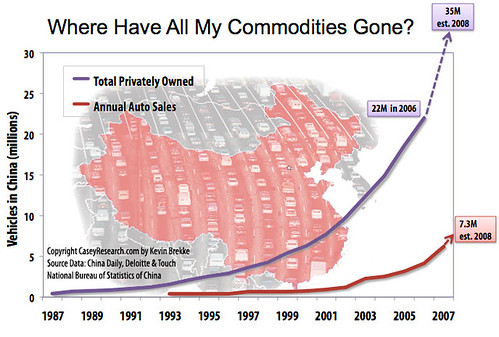
As discussed on Casey Research, China is enjoying staggering growth rates for car ownership.
Assuming that the 7.3 million new car owners in 2008 each drive 5,000 miles a year, and they achieve 40 miles per gallon, the result would be an additional 45.6 million barrels of crude demand, equivalent to 125,000 bbl/day. In other words, new Chinese drivers will devour 25-30% of the recently promised Saudi production increase in a single year.
Looking at this over a few years (from the International Energy Agency (pdf):
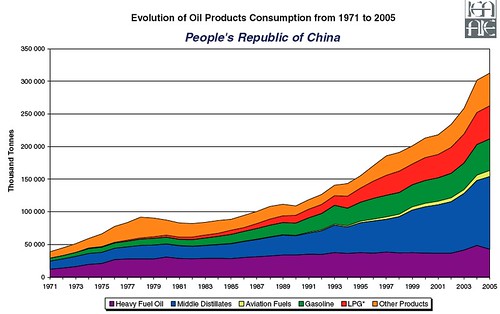
The lighter blue bit is mostly diesel. Note that 2007 consumption was 347 million tons, ie 7mb/d.
To put this in another perspective again (from Net Oil Exports):
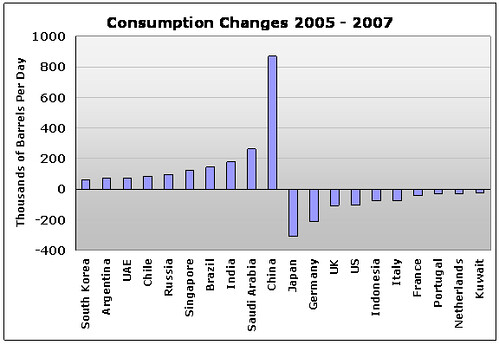
Chinese growth in consumption dwarfs by far the declines noted in rich world countries like Japan, Germany and, yes, the USA (note that the decline in the US is still a lot smaller in absolute terms than those in much smaller economies in Europe or Japan).
So: Chinese demand growth is very real, it's very large, it's highly likely to continue for a number of years (when people finally reach the car affordability stage, they're not going to be stopped by the cost of fuel - not for a while anyway. The difference between no car and a car is so massive that the price of gas is a minor consideration - especially when gas prices are still subsidized...). and it certainly has an impact on oil prices by its sheer size, given the current stagnation of oil production.
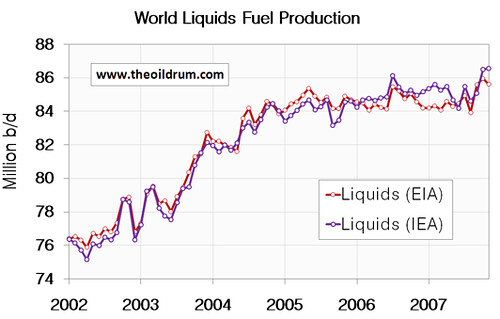
3) Saudi numbers
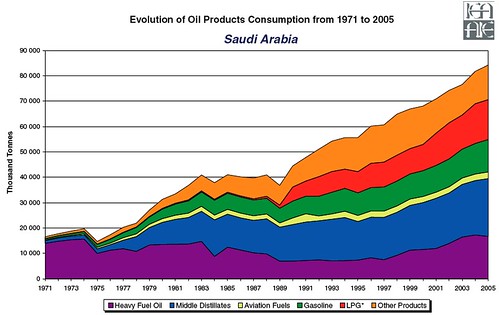
The previous two graphs, and this one above (from the IEA again (pdf), provide interesting information regarding oil producers: not only is their production stagnant, but their consumption is going up massively. And it's no wonder: they're flush with money, gas is heavily subsidized at home, so people drive more and more. Thus, the biggest increases in oil demand, beyond the "usual suspects" of China and India are almost all big oil producers: Saudi Arabia, Brazil, Russia, UAE. If you look over a slightly longer period, you'll also find Iran and Canada in there.
Which means that volumes available for export, and thus volumes available on the global oil market, are shrinking (from Net Oil Exports again):
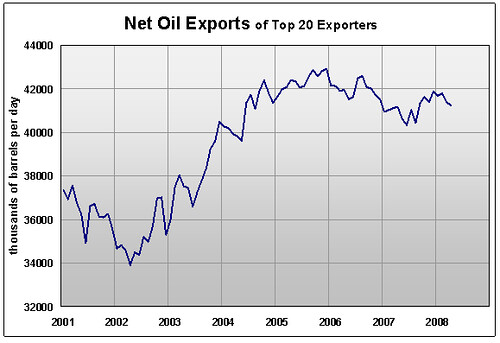
The numbers don't lie (from westexas [ed: the table was actually provided by datamunger]):
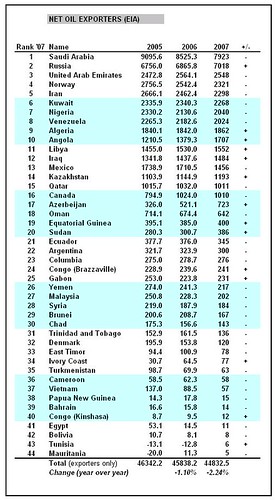
The only major producers which have increased exports lately are Angola and Russia, and Russian production is now declining (while consumption is booming). The conclusion is simple: there is less and less oil on the market for us.
4) Production declines
Beyond Russia, it is striking to note how many regions we have been relying on are experiencing absolute production declines. All mature fields have a natural decline rate, and whole provinces are seeing absolute declines in their production.
This is nowhere as spectacular - and worrisome - as in Mexico, where the supergiant Cantarell field has lost close to half its production capacity in the very recent past, thus threatening exports to the US from a (relatively) friendly neighbor: (from here)
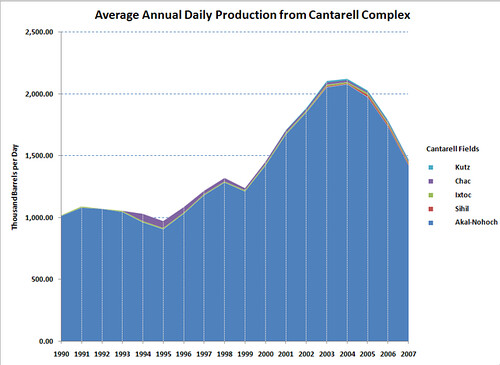
Just like the decline of the North Sea seems to have caught the UK government unaware, and is leading to quasi-panicky behavior by the UK government (which one day blames the Russians, one day wants to go all nuclear, one day wants to go all-wind, and generally blames "uncompetitive" continental Europe for its plight rather than its own policies, or lack thereof), the brutal decline of the Cantarell field, and of overall Mexian production is likely to have brutal consequences, as the country loses its main source of exports and the Mexican government its main source of tax income. Social unrest, and massive migration toward the North could be one outcome...
5) Lack of spare capacity
But let's come back to the oil market for a second: you have a combination of still strong demand growth (in particular in oil producing countries) and stagnant production combining into shrinking export capacity and, more importantly, into a quasi-permanent lack of spare capacity (from this comment by SamuM in a recent thread):
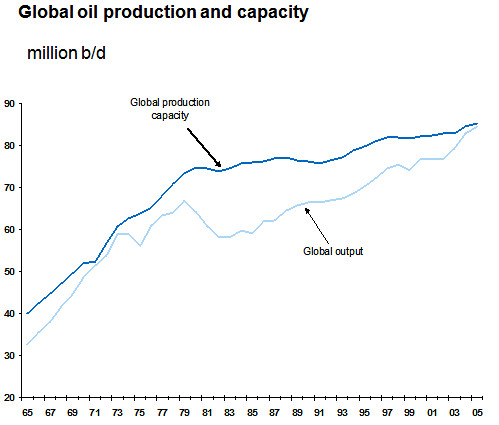
The significance of such tightness of supply cannot be overstated. In normal times, when demand varies, market equilibrium is reached by adjusting production to such demand, which is a relatively easy and cheap process. But when supply is constrained, as it is now, any brutal change in the market (whether on the demand side, for instance through a cold spell in winter requiring more heating, or a hot spell in summer requiring more AC, or on the supply side, for instance guerilla attacks in Nigeria, a refinery strike in Scotland, or a pipeline accident anywhere) will require market equilibrium to be reached by demand destruction, which is a lot harder and triggers much more substantial price movements: prices need to move high enough for some users of oil to renounce such use and "take their demand out of the market", whether by not doing what they wanted to, or by finding a substitute. In the US, people travelling less for vacations, or carpooling, have barely managed a couple percent demand destruction. Imagine that the Saudis and Venezualeans, with their subsidized prices, are immune fro msuch pressure, and that several percent need to be cut off demand abruptly: it will require much higher price hikes than have been experimented yet.
It's simple really: price will go high enough for the pain to translate into lower oil use in price-sensitive countries, the list of which is topped by the US, where consumption is high, oil price variations are not dampened by massive taxes (prices going from $3.50 to $4 is more painful than prices going from $8.50 to $9).
The lack of spare capacity certainly explains why very small variations in output or demand can have disproportionate impacts on prices: when you are right on the edge of the knife, any movement can make you fall off.
6) Refining issues
I thought I'd add just a few words on refining capacity in the US, as it is often blamed for gas prices as well.
Energy information Agency data shows that refining capacity has gone up in recent years even though no refineries were built, with refinery capacity use very stable at high levels. This has not changed much in the past 2 years, even as Katrina took its toll for a while.
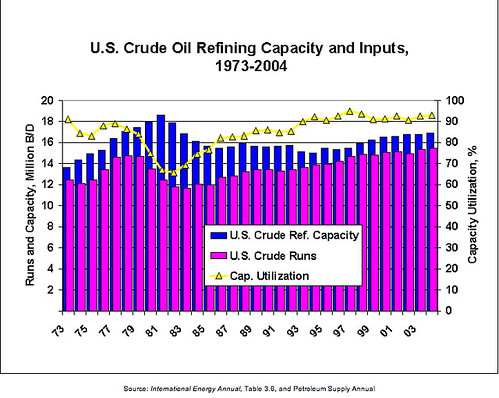
And as the tables that are provided on a monthly basis by Californian authorities show (see 2008 numbers and 2007 numbers), refining margins are actually a lot lower this year than last (roughly down from a dollar per gallon to half a dollar per gallon) and have helped lower the impact of oil price increases in the past few months. So you certainly can't blame refiners this year, even though global capacity is tightening:
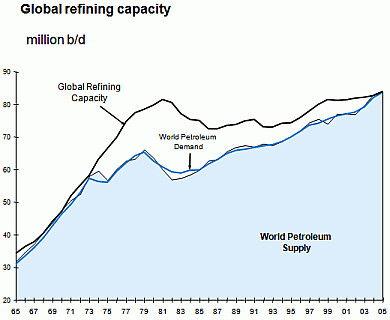
Altogether, it appears that they are a number of factors explain oil price increases perfectly well, with no need to go into conspiracy theories or market manipulations.
Personnel
Editors
Contributors
Peak Oil Primers
Archives
- November 2010 (3)
- October 2010 (6)
- September 2010 (4)
- August 2010 (7)
- July 2010 (6)
- June 2010 (7)
- May 2010 (2)
- April 2010 (8)
- March 2010 (4)
- February 2010 (6)
- January 2010 (3)
- December 2009 (5)
- November 2009 (8)
- October 2009 (12)
- September 2009 (6)
- August 2009 (5)
- July 2009 (11)
- June 2009 (8)
- May 2009 (16)
- April 2009 (10)
- March 2009 (7)
- February 2009 (10)
- January 2009 (15)
- December 2008 (9)
- November 2008 (9)
- October 2008 (9)
- September 2008 (13)
- August 2008 (10)
- July 2008 (14)
- June 2008 (23)
- May 2008 (16)
- April 2008 (12)
- March 2008 (16)
- February 2008 (9)
- January 2008 (13)
- December 2007 (13)
- November 2007 (16)
- October 2007 (22)
- September 2007 (8)
- August 2007 (9)
- July 2007 (16)
- June 2007 (8)
- May 2007 (7)
- April 2007 (7)
- March 2007 (10)
- February 2007 (10)
- January 2007 (12)
- December 2006 (9)
- November 2006 (15)
- October 2006 (4)
- September 2006 (5)
- August 2006 (5)
- July 2006 (9)
- June 2006 (5)
- May 2006 (10)
- April 2006 (9)
- March 2006 (13)
Vital Trivia
License

This work is licensed under a Creative Commons Attribution-Share Alike 3.0 United States License.
I'd like to see some probabilities and values in a chart--instead of what appears to be an arbitrary number of 200. For example, if production is declining by 5% a year, then we can expect to pay an extra 25 cents (or what?) over what we are paying now per gallon. Same for the attack on Iran (which may range from zero to 300 percent?).
As for Chinese consumption, you need to maybe lower your estimate a bit. For those who are making enough money to be able to afford a car, they may buy one (but keep the old foot-powered bicycle or electric bicycle), but not necessarily use it that much. When I was living and working in China a couple years ago, the "managers" and higher-ups bought cars (Chinese are very status conscious), but kept them parked most of the time, using the bus for work and the bicycles for errands. The car was a "show off" instrument, rarely used, and when used used to show off, like taking friends to dinner around the corner (but making a big fuss about the car and finding a place to park it, usually right on the sidewalk next to the restaurant). So maybe the Chinese buy cars but not that much gasoline. The same goes for other developing countries where it's far more convenient to walk than drive.
As far as chinese transportation using more oil, a lot of the increase in consumption is for diesel fuel. This is used by the trucking industry (many independant truckers there just like US), along with growth in railroad haulage of containers, coal and minerals. Many routes used for dense RR passenger traffic are electrified, but many heavy RR freight lines are diesel powered. This is based on the opinion of a friend of mine that has been to China several times in recent years.
I have heard that traffic problems are severe in Shanghai and I suppose other large cities. I know that where I live in Thailand there is no recent easing of traffic. To me this implies that even if some do keep their car parked there are still a great many out there driving. While it's hard to say whether Jerome has over or under estimated this I'd say with certainty that 40mpg is an over estimate on typically congestion bound car usage.
The single human being who comes up with a formula to accurately predict price response to each percentage shortfall in petroleum will be a multi-billionaire in short order. Your request is rather odd as no one has yet demonstrated any methodology capable of accurately making such a prediction. The only thing we do know is that there have been price responses to shortfalls in production and that the price responses appear to have varied greatly. In other words, the price response to the first percent of shortfall has not been consistent with the second percent or the third percent.
Your observation about Chinese behavior is identical to US behavior early in the adoption of the automobile. But as time wore on, people used their automobiles for more and more activities. That is already beginning to occur in China and how much higher prices moderate that changeover does not seem to be something we can easily predict. In other words, your anecdote is just an anecdote and is used by you to extrapolate to a guess. Jerome, on the other hand, is observing a statistical trend across a wide body of participants in China.
Buying gas in China is a 3 hour long venture as you go to a gas station and wait in an incredibly long line. I suspect they'll have a short term cure for that during the Olympics, but then return to status quo
It was mentioned a bit ago that China cut some of it's subsidies to gasoline. This was seen as a way to cut demand, but may in fact increase it because they'll have more fuel available to sell.
Although you explain a few reasons why other factors account for the price increase, I do not see an explanation why speculation can't be a reason for the price increase. I got flamed last month for suggesting that speculation could very well be behind the high prices.
Those that suggest that speculation is the cause state a very sobering fact- "Assets allocated to commodity index trading strategies have risen from $13 billion at the end of 2003 to $260 billion as of March 2008". I've not seen anyone dispute this figure. I can understand that statement, and I can see that MUST have an effect.
Those that refute the speculation theory state their case in terms that I can't understand, which translates to obfuscation, for me anyway. I readily admit that I don't understand how the futures market works. And neither do many others, so it is easy to go with an explanation people do understand.
I do understand this though - if speculators can bid up the price of houses, and people do buy those houses though overpriced, and if speculators can bid up the prices of stocks (a-la dotcom, et al) and people buy those stocks even though overpriced, why can't speculators bid up the price of oil and refineries buy that oil even though overpriced?
As for the spot market, doesn't it just follow the futures market? Irrelevant of the (over) price?
I cannot discount the speculator theory as long as I don't understand why it can't be so.
I'd like to see numbers comparing how much of that index trading is simple derivatives that have no influence on physicals and how much actually affects the physical market. I can understand that when people are piling funds into side markets and not buying physical then they are not creating false demand for a commodity but actually more like bets on a race horse. The analysis I've seen doesn't really delve into this in any meaningful way. I think that money looking for a place to find returns doesn't automatically mean pressure upwards on the market but it's unclear. I think more and more these flows of money are more and more like gambling - people are so desperate for some place to put their funds since the dollar is so very unattractive. If you are a fund manager holding cash of declining value then your clients have no need for you - they can hold cash without your help.
"I think more and more these flows of money are more and more like gambling -" If this gambling is a bet on the price of oil will be going up, I think that's a very good bet. To bet the other side you have to believe the official line about peak oil.
http://news.xinhuanet.com/english/2008-06/29/content_8456576.htm
A report the U.S. Congress released Monday showed that, in January 2000, 37 percent of the NYMEX crude futures contracts were held by speculative traders; but in April 2008, the number has soared to 71 percent. Meanwhile, the proportion of contracts held by commercial traders greatly declined.
The U.S. Commodity Futures Trading Committee (CFTC) revealed in May that it began investigating potential price manipulations in the oil trading market in December 2007. The early findings show that since the sub-prime mortgage crisis large amount of speculation fund has turned to buy commodities like crude as a hedge against inflation.
Why not? More money piling into the same amount of product means higher prices. You said it yourself, if money is not bidding then why not just put it under the mattress.
What I meant by this is it's unclear how much of the money ends up buying product and how much ends up in derivatives of product. For example, when you buy stock options you don't actually buy or sell stocks and hence have no effect on the stock price. I'm not clear on whether options trading on commodities (or other fancy ass derivatives that seem to be the rage with wall street nowadays) are where the big numbers are or whether all this money is in the physical market. Even when looking at the physical market whether future or spot one has to look at the difference between long and short rather than just the number of contracts held by specs. If a heavy short position is squeezed by underlying commercials needing more product, then specs will losing money from a push upwards.
I know if I were a spec (and I'm not in the market in any way) then I'd be long but still one looks around the media and guesses that many people think we're at unfathomable heights ready to crash - one can't help but wonder if the media is playing a part for wall street in making sure that some specs are willing to take the losing bet.
Along the same lines, hedge funds and institutional investors tend to move as a herd because when something goes wrong they can all claim solace together that they did the right thing but lost out. ie. when all funds lose money, they blame the market but when a unique single fund opposing conventional wisdom goes wrong, well everyone knows who to blame.
"I'm not clear on whether options trading on commodities ... are where the big numbers are or whether all this money is in the physical market."
Not in the physical according to most TOD posters but I would maintain there is still a linkage with the physical via information.
The report says that 71% of future contracts was held by speculators. But does the report specify a date when this percentage was held? If I'm correct, at the end of each month (actually 3 bus. days prior to the 25th) the number of contracts held by speculators should approach 0%. If they where to hold on to these contracts they would need to take delivery, which I'm sure no speculator wants.
So you can't simply say that in April 2008 speculators held 71% of the contracts. Because on the 22th of April the number of contracts held by speculators would surely have been close to 0%.
Shit, I don't know.
I was just quoting the news article I linked to. That's my point exactly, I don't understand it, but I'm trying to.
I believe that there are clearly more investment dollars in the oil futures market (thank you, in part, Ben Bernanke).
Perhaps it is the case that there could be (insert your own percent)% speculators in the market at any given time, but based on whether they are long and/or short they may not have a corresponding effect on price - one way or the other.
On Friday Karl Denninger said this in his Frightful Friday commentary:
Moe Gamble said this on Friday's DB:
So, it seesm that if you know where to look and how to interpret that it is realtively "easy" to determinthe level and effect on specualtion in the market.
Perhaps the what, where , and how of oil futures speculation effect could be the suject of a guest post by someone who can walk (many of) us through this?
Of course this seems to be happening downthread ;-)
Pete
That may be 71% across all contract months - as speculators are closing out all their delivery day contracts, most they tend to be 'rolling over' into the next month (ie: taking out a new contract for the next delivery month)
So the OVERALL ratio of speculative contracts, across the board, is probably reasonably constant. Generally though, lots goes on on the last couple of days, and I wouldn't be surprised if these are routinely excluded from 'averaged' stats.
1) the SPECULATORS are not really who are being blamed. Actually, the speculators, like Michael Masters who recently testified before Congress, are net short oil, and net long equities, so they want oil to go down. Its the index funds that are net long commodities. ETFs and funds linked to the GSCI or other commodity indexes.
2) Index funds are also very long wheat and gold and other commodities. Yet some of these markets have crashed from where they were a year ago - wheat dropped 50% from its highs of last year. Reason? The actual producers came in because there was plenty of wheat to supply at those high prices and for every index fund/speculator who wanted to buy wheat above $12 per bushel, an actual producer said 'here you go - I am very happy to sell you my wheat at $12". In this case reality caught up with a frothy market... If a large portion (or even a moderate portion) of oils rise is due to speculation (and index funds), the same will happen. Actual oil producers will sell the 'freely available oil' at what are 'too high of prices' and oil will do what wheat did. Hasn't happened yet.
3)By the same logic, those corporations (e.g. airlines) that are buying long term contracts to lock in prices could be swamped by actual oil companies selling them contracts if future oil availability seems adequate (based on their own internal reserve and production estimates. Thus producers will sell forward more contracts than hedgers will in the long dated months and prices will drop into backwardation. We have seen just the opposite.
4)Part of the reason we are this high is that speculators are SHORT the market, e.g each time we rally 10% there is a positive feedback loop where they have to cover their shorts and the market spurts higher again, which then encourages other deep pocketed hedge funds, who don't buy into the general peak oil concept of limited flow rates, to go short. After all, there will be plenty of ethanol and tar sands to make up for the 'possible' decline in crude. This is all changing as firms like Wood Gundy, Goldman, Barclays, etc. have started to publish very realistic research on how dire our oil situation is (though they are writing from a profit/investment perspective as opposed to a social/policy one). So once everyone has gotten oil religion and the large funds stop 'shorting' the market (e.g. no shorts left), then we will be free to drop in price. In this sense speculators ARE influencing the market, but in a very sneaky, self interested way not being discussed 'before Congress'.
5) Finally, oil margins have recently been raised to $8,500 per contract:
Consider we are at midway point of URR and there are 1 trillion barrels left, this is 150 barrels per person living on the planet (and none for any of their children or grandchildren). For $8,500 one can control 1,000 barrels of oil, 8 times ones all time allotment for posterity (assuming that each human had equal rights to oil, which clearly isn't the case). Imagine what $85,000 or $850,000 or $8.5 billion could do. As I've written about often here, there is a paradigm shift coming between abstract wealth (paper currency) and real wealth (commodities, real goods, social, natural capital, etc.) Left to their own devices the deep pocketed institutions could run oil closer to its true value, in the thousands per barrel, but OECD trade and the economic system as we know it grinds to a halt before that time.
Interesting and important times. I agree with Jerome. Lets hope our leaders are mature enough to look beyond the easy scapegoats and make some uncomfortable but necessary planning choices. Its always difficult to admit that its our own fault...
That's enough for everyone currently in the world to drive a car 500 miles (or 800km)*
Write that on your bumper sticker.
That really puts the scale into something people can start to comprehend - and start to realize just how little oil left in the world...
Say what ? 150 barrels lets you drive only 500 miles ?
ok, typing on calculators is dangerous (typed 19.5x25 when I've should've typed 19.5x150)
150 barrels at 19.5 gallons per barrel and 25gpm is
3000 miles per person in the world (or 4700km)
and the common rebuttals to this type of statistic is:
1)but there are so many people in the world that don't use ANY oil that your numbers are meaningless
or
2) ya but your forgot about ethanol and oil shale
(n=5 from personal experience)
To (1), "Virtually nobody uses no oil, it's just that a few people use a lot. For example, Ghanans use about a barrel of oil each a year, and Americans use 25. So those 150 barrels each could keep Ghanans going for 150 years, but Americans only for 6 years. Anyway, put together Europe, Japan, the US - and that's about a billion people using 15 barrels each. Ten years if nobody else gets any."
At this point they go silent and look surly and obviously hate me already, so I add, "Maybe you should take the bus."
Since when does 15 barrels per person times 1 billion people times ten years = 1 trillion barrels?
I make 15 x 10 x 1,000,000,000 = 150 billion. Out by an order of magnitude.
You'd be more convincing if you could add up.
Why not just skip the maths and go back to:
We use 30 billion barrels per year.
We have about a trillion left.
That's 30 years supply.
...oh wait that wasn't the answer you wanted. Not dramatic enough. Now you'll have to explain flow rates. Damn.
.
Flow rates are derivative of available supply and demand. The bell curve is simply the normal derivative. So we don't have 30 years of oil left in the ground because supply and demand are not constant.
Actually, we probably have 100 years of oil left in the ground. It's just that 1/3 of it will be used up in the next 15 years or so.
That is the point where the bell curve (assuming we are already past peak) will go into negative curvature, and drop gradually over decades to a point where a tiny number of users can afford the remaining resource. After that point is reached, it will become a niche market commodity.
Prices may begin to fluctuate normally, but only because it will no longer be in mass demand as a consumer application. It would no longer be a question of marginal demand-killing, the price would be high enough that the utilization would drop off as the vast majority of users switched to alternatives and we'd have excess capacity again. As the utilization dropped off, so would demand for unconventional oil.
Unconventional oil will increase total reserves, resulting in a second supply peak or echo peak, further extending the time frame for remaining oil in the ground, possibly indefinitely. But this secondary bell curve for new, higher-price oil will be much lower (in annual output) and wider than the current peak.
So we would never get back to today's flow rates because of the expense (relative to energy and work) needed to replace conventional sources of oil barrel for barrel, so oil would remain available even as the cost of using it goes up and the number of users goes down.
that makes 73000 miles?
The people who actually buy oil, primarily refiners, hedge their purchases on the futures market. They are experts with inside info betting against amateurs with incomplete info. Guess who wins? According to an IMF study in 2005, real oil traders win their bets 75% of the time. If they didn't, futures couldn't be a hedge. Its the hedge funds and index funds that are the net loosers and their money actually helps keep the price down, not up. Keep in mind that there is a winner and looser for every contract, so it's a zero sum game.
And despite your observation you fail to mention how those funds are being invested. For instance, the AMEX president stated that for May that the large speculators (amongst whom are US banks) were short over $50 billion on oil and had to scramble to cover their missed shorts, which in turn drove prices higher. In other words, many of the big speculative players were shorting oil (betting on price declines!!) not going long. And they lost. And they appear to have lost again this last week.
To state again, the big speculative players bet against the fundamentals. And the fundamentals are roughly flat production over 4+ years (maybe 1.5 mbpd max more in certain quarters) now versus a near 8 mbpd increase in consumption by China and India. If we subtract out that 1.5 mbpd occasional bump up in production, that means China and India combined are taking 6.5 mbpd away from someone else who was consuming that oil in 2004. And that doesn't account for increases in consumption elsewhere in the world, which have been documented.
There is no doubt that some small part of the price increase is due to the falling dollar. But measured in other currencies oil is at record highs also. So a larger part is due to something else. You appear to be asserting that this is entirely speculatively driven. I will grant that some portion of the price increase may be speculatively driven but that fundamentals were going to lead to higher prices over time regardless. In other words, without speculation maybe we'd be at $120 or $110 or even $100 per barrel. But it would not have stayed at $80 or gone back to $60 per barrel. The fundamentals, the lack of production increases coupled with the changes in consumption (mostly who is consuming), argue against lower prices and for higher prices.
What no one has yet demonstrated is what proportion of today's price is due to speculation. I don't think you can accurately show that as a specific number, and since a large part of the speculation is in shorts I do not think you can even argue clearly what effect speculation is even having in this market.
Speculation is adding about a 6 dollar premium to the price of oil pretty much independent of the price flucations.
And no I won't tell you how I figured this out. Given that you know its six you can read it off the market charts.
Speculation is only an issue because supply is tight enough to make speculation worthwhile.
When supply was plentiful, it was only a dull futures day-in-day-out-grind.
It's the shortage, stupid!
cfm in Gray, ME
One of the functions of speculation is "price discovery". You can't say something is over-priced until you discover that people are not willing to buy it any more. When you go to a market and haggle over price both sides have an interest and when you decide not to buy the seller also loses a sale and is stuck with the product. For decades I've listened to Americans on high horses about self-interest is good, greed is good. This is the way they designed their markets and it's absurd that when it comes back to bight them they all cry foul. It ought to fall on deaf ears as cries from around the globe have for decades on American ears. Speculation may play a part in this market - but it's the role it was always intended to play, liquidity and discovery. I think people are just shocked to "discover" how much they really want, need oil, must have oil. When the public stops buying, the refineries will be ready to stop buying and the sellers will accept a lower price. That is barely starting to happen now but still most people believe by throwing a tantrum they can get their way.
Indeed, the market 'works'. People who blame 'speculators' for the high oil prices are fooling themselves in two ways: it gives them an excuse to ignore the fundamentals, the peak oil that is happening, and the ELM that goes with it. And secondly it is a play of huge hypocrisy...
Why should I not be able to put my money on the market, risk loosing it on my belief that the price will go up in the future? Isn't that the whole idea of capitalism? What about the airline companies? Aren't they allowed to hedge their fuel costs?
The sad irony is that the liberal free market advocates are crawling out of their caves of unreality to demand market controls and government intervention because this time the market isn't going their way...
People seem to equate 'oil speculators' to war profiteers who deny food and shelter from the hungry and homeless in order to extort all that they own from them. But if oil is indeed like food and water to us - then many would argue that trading it is like trading human lives - except that we already trade food and water in many countries...?
Peak oil brings us to an unprecedented situation, a world of paradoxes, where all the old ideologies become obsolete - both left or right - and people sticking with them are going to get ever more confused, paranoid, insane...
Now that the world of reality has come to put an end to all our ideologies we treat them like like the straw dogs they are, void of utility we discard them into the fire...
Hans,
This is a true statement
This is a false statement.
It is necessary for you to have some understanding of the futures market to understand why the first statement does not lead to the second. It is not reasonable to say that, since you don't understand, others are obfuscating.
You have three choices really:
1) either accept the expertise of those who you acknowledge understand something important to the hypothesis that you dont understand.
2) educate yourself so that you do understand [the oil drum is not the right site for this, but there are many trading sites with excellent tutorials - be aware that watching the market for a few months is probably required for this]
3) stay stuck where you are, and be perceived as someone who chooses beliefs based on an acknowledged lack of understanding.
Please understand I'm honestly not having a go here!
Even when they are known to be less informed - that way lies blind faith, counter-science, and foolishness.
And here is the one, critical tidbit, that might explain, or might leave you going 'I don't understand' - but I will try:
With houses, or dot-com stocks, there is a restriction on supply. This means that people can profit by hoarding (collecting/acquiring) the resource. While new dot-com companies came along, it was still possible to bid-up their individual share values.
With futures, there is an infinite supply of contracts that can be written - there is no way in which a contract can be taken 'off the market' in the way a share, or a house can be. For every new contract there are two sides, one party betting that the price will go down, the other betting that it will go up - the same is not true for houses or shares, where parties sell their holdings not because they are betting on a price drop, but because they want to realise their profits (perhaps to build a new house, or invest in different dot-com stocks). There is simply no real comparison between the futures market, and the stock market or the housing market, because one trades in a finite supply of something, the other in an infinite supply (CONTRACTS for supply/purchase of oil, NOT oil).
The reverse is more true, the futures market CAN lead the spot market to a degree, but much more the futures market FOLLOWS the spot market, and then adjusts for the average of what the market thinks is 'likely' or 'could happen' in the next 30, 60 days, five years, or whatever for the specific contract. The starting point though is TODAY's price, as per the spot market.
Neither should you give it any credence though. You either place trust in those who you acknowledge know better, or you learn for yourself (your responsibility to put the leg-work in - asking for help here is a cop-out), or you look gullible. I strenuously recommend the middle option, as you're obviously curious about this.
By way of analogy, I'm sure there is something than you are quite capable, perhaps expert in - I'm sure other people must respect your skill, or knowledge in this area. How annoying would it be if people told you that they didn't believe what you told them about something in this area, because they were not experts, and you being an expert meant they didn't understand what you were saying, and so they thought the absolute opposite made more sense. It's frustrating - especially from someone who seems genuinely curious.
Apologies for and rant-like bits - I HOPE this has been helpful - if not, all I can say is, if you want to understand more, you need to learn more - as with everything else in life
"The reverse is more true, the futures market CAN lead the spot market to a degree, but much more the futures market FOLLOWS the spot market..." Are you saying this "much more" is the general case or is true in the particular case of the current oil market. And if the latter do you see the possibility of continual official denial of the realities of oil can interfere with the speculative function of price discovery? The speculation sends a signal. But denial continues.
Hi again...
The general case.
The Oil futures market is the only one I feel qualified to talk about really. Having said that, it seems reasonable that the same mechanism would apply in all futures markets (for physical goods at the very least).
I do think the official denials are interfering with the speculative price-discovery function, particularly for long-dated contracts, mostly by damping it. Without the official denials, 2016 futures would I expect have found prices at least double 2008 prices.
[disclosure: I stand to profit when, if, and as, that interference starts to fail, and speculative price-discovery for long-dated contracts becomes unhindered by official denial (whether deliberate or ignorant)]
Thanks Jaymax. The problem I have with making such a post is that I will seem like I'm asking people to explain things to me for no other reason than to save me from the trouble of finding out myself. I am not, and tried to word it such that I would not come across this way. But the problem is, I have done many hours of research and I can't find any explanation of how the futures system works that I can understand.
And I'm not a dummy, either. I am an electronic engineer, and as you speculate, yes I am well respected in my particular area of electronics. I can grasp most concepts, physics being my outstanding subject.
But it's not justme, and that's what I wanted to point out. The MSM and others are going along with the speculator theaory because 'why it could be' IS easier to understand than 'why it couldn't be'.
You said that 'must have an effect on price' is a false statement. I don't understand why it is false, but I will not ask you to explain. I will find it out in time.
Another thing here, too. I must state that I am NOT asserting that the speculators are to blame, I was hoping that my wording made that clear. I am only stating that I am open to the belief that It could be. The simplistic arguments I have heard that 'it could be' have so far outwieghed the complex arguments that I have heard so far that 'it couldn't be'.
As for putting my faith in those who do know. I don't who they are. Everyone seems to be an expert.
Once more for the record, I am not asking anyone to explain to me that which I should be finding out for myself. I am just pointing out that if there was an easy way of explaining why the speculators are not the cause, the MSM and others might have their doubts put to rest. Even congress openly admits that the derivatives market is 'convoluted and unaccountable'.
Another thing you just added to my confusion. How can there be an infinite number of contracts? Surely you can only write a contract for something you actually intend to supply? I just don't understand this stuff.
Apologies if I sounded like I was lecturing!
Understanding this is the crux of the matter. Once you get this, you will see how speculation in futures cannot drive prices to any significant amount/duration.
Anyone can write a futures contract - there is absolutely no need to have any intent to supply whatsoever. And indeed, many speculators are doing EXACTLY this all the time. It is wrong to think that all that speculative money is going into the BUY side of futures contracts.
How is that possible? What happens when the contract is coming due and there are a hundred times more barrels of oil contracted for delivery than available? The answers are actually quite simple - once you get your head around them. But that is exactly the situation - it is EXACTLY the same as someone (like myself) who contracts to buy oil, but has no intent to receive thousands of barrels of oil in 2012.
So I could write a contract to sell a million barrels of oil, sell it on the futures market, and say 'so long, suckers'?
Remember that $260 billion?
Those million barrels require 1000 NYMEX oil futures contracts.
Exchange rules require your broker to have on deposit from you about $12,000 per contract in order to place your sell order. So yes you can, but you need to deposit $12 million up front! - Incidentaly, the figure (the margin requirement) is exactly the same for the buyers.
Furthermore, lets say the price of oil goes down $2 per barrel overnight relative to the price you contracted for. Your broker now requires you to cover that margin (ie: maintain that $12,000 per contract), so now you must pay your broker a further $2,000,000 by the end of the business day.
If you fail to do that, and lets say the market drops another $3 per barrel during the day, your broker will close off your position (by finding other 'sellers' to take it on at the market price). It's okay though, because your broker will still have $7 million of your $12 million margin deposit, and you can have that back no problem, you just lost $5 million in two days is all ... :-)
[nb: this is a little bit simplified, but pretty close to reality - there can be different margin requirements for day traders etc]
So, if I understand this 'infinite contracts' thing correctly -
I could create a contract, out of thin air, to sell a million barrels of oil, then sell it on the futures market.
I watch the price go up and down, and then before it expires and I would have to supply the oil, buy it back, screw it up and throw in the bin, and take the profit or loss.
What a scam! No wonder congress wants to put a stop to it.
On the other hand, if I bought a contract on the futures market that someone created out of thin air, and held onto that contract until it expired, the person who created that contract would have to quickly find some oil to supply to me. But if I sold it before it expired, he would be off the hook and would take the profit or loss.
Is that close enough? (I hope so, because I understand how that would not affect the 'real' price)
See, this is why you shouldn't look here for an explanation - when there are much better writers, because obviously I'm not being clear.
You cannot screw it up and throw it in the bin - your broker will transfer your obligation to someone capable of fulfilling it, and it will cost you dearly.
There is no scam!
If EITHER buyer or seller holds on to their end of a contract until it matures, and realises all their margin calls, they then become legally liable (it's a contract after all) for the supply of, or the paying for and receiving of 1000 barrels of oil at the contracted price. Failure to deliver your end of the contract will end up with you in court I imagine - certainly you will lose your entire margin deposit and any profits.
This is what separates speculators from commercials, speculators never hold on to contracts until delivery dates, commercials do (more so). A speculator who is long sells to a speculator who is short (or vice versa) and effectively, the two contracts become one. (I owe you $10, you owe X $10, what say I just owe X $10)
Also, whether you hold on to your end of a contract, has no bearing on whether the person on the other side holds onto their end - they may, and probably have, long sold it - this is the basis for any contract market. The two sides can be independently traded - this is how the market discovers fair value.
Incidentally, futures contract DON'T expire, they fall due. Options expire - but that's a whole 'nother story (and one that no-one AFAICT is accusing of manipulating prices)
In that case, I back to where I don't understand how there can be infinite contracts if there is not infinite oil.
But it's not me you have to educate, it's the MSM and elected officials.
its a chain of obligation
It's easier to look at things more simply, in my view, rather than worrying about the technicalities.
You can place a bet on oil, that it goes up or down.
If you are wrong, you loose, plus the transaction costs.
If you are right, you win, minus transaction costs.
So you are effectively betting against the house, and it really only make sense if you are buying for an airline, say, so if you are wrong you have just suffered some losses, but if you are right you may have saved your company from bankruptcy.
This is a very different thing from speculation in property, where rental income covers part of the cost and so can more properly be counted as investment, and it is only to the extent that the real reason for the investment is in the hope of profit from rising property prices that it is speculation.
Fundamentally those who are saying that it is a speculative premium causing high oil prices are arguing that the bet that oil prices will continue to rise is wrong.
Any investment is a speculation, as profit is dependent on certain conditions coming true.
At the peak of a speculative bubble stocks such as high tech in the last bubble trade at silly premiums to any forecastable earnings.
If you want to know whether the present price of oil, which as I have tried to indicate when you hold it is not generating any income at all, is speculative or soundly based you only really need to look at what you consider is the likely supply and what is the likely demand.
So the people who are arguing that there is a lot of speculation in the price are saying either that there is plenty more oil out there which will come on stream or that conservation or recession will drastically reduce demand.
I know the MSM troll TOD a bit, but still...
on one hand, this is a convenient break from study, on the other, it's a useful exercise in working out what works explanation wise and what doesn't.
Also, I've given up on the MSM and authority - they have a responsibility to educate themselves - if they fail, I feel sorry, but not responsible, for all the people they hurt in the process.
Last try (probably) :-)
See if this makes sense
P is producer
C is consumer
U, V, W, X, Y and Z are speculators
V and W take out a contract between themselves (V is long)
X and Y take out a contract (X is long)
U and P take out a contract (U is long)
C and Z take out a contract (C is long)
So
V<-W ; X<-Y ; U<-P ; C<-Z (where <- is one contract)
The day before the last trading day of the month W and X take out a contract. Then Y and U take out a contract.
V<-W<-X<-Y<-U<-P ; C<-Z
Now, W's contracts with X and V may be for different prices, but any loss will have been covered by W's margin calls; same goes for X, Y, U.
W, X, Y, U all take their profits (or loss) and thier contract positions are 'closed' by the market, as they hold offsetting short and long contracts (like the I owe you; you owe X)
V<-P ; C<-Z
The last day of trading, V closes off position too (in reality of course, the market matches buyers and sellers, rather than any of the traders having to identify the trader on the other side of the contract
C<-Z<-P ; as before, Vs positions is cancelled by the market, V take their winnings or remainder of margin deposit.
So, Z is left with two contracts, at different values, Z neither want to take delivery nor supply any oil, Z must exit the market, again, in reality the market mechanisms handle this automatically, and by showing a single chain rather than a morass of trading. If you imagine Z being the net speculative position at this point, Z is either net short, or net long; Z must find either real-world buyers, or real-world sellers depending on Z's net position; this forces the price Z ultimately gets to what the physical market will pay for his surplus contracts.
C<-P
Contracts fall due ; from many contracts at the start of the month, very few remain, and all of those are held by traders who actually want to trade gloopy stuff.
Infinite contracts available at the start, and remain so in the market as a whole, but NOT at the closing date for the front-month contract. As the number of contracts nominally available moves from infinite to finite, so the speculators are pushed out of the market, and the price moves to that determined by physical traders.
[Now, if you have physical oil speculators - you can keep the game going - BUT those speculators have to take delivery and store the oil - the moment they sell it, it pushes down the physical market - this is the basis for the no inventory build, no speculative driver argument]
Post exams and holiday in the UK, I'm going to think about an animated diagram, with running account totals, or something.
OK. I understand that. The speculators are only making - or losing - money off each other. Thanks for your patience with me, Jaymax.
I wasn't aware of the 'infinite contracts' before, so I assumed that speculators were bidding for contracts from producers, and then accepting bids on those contracts from consumers. I imagine that is what the MSM and EO believe. They will need to be corrected, too.
It seems to me that it would be far better to only allow producers and consumers to trade, but I have read that speculators bring stability to the market. I don't know how, but if that is the way it is, then very well.
Thanks for bearing with me to an extent as well.
It's not so much stability that speculators bring, as fluidity and honesty - by having lots of people interested in what a commodity is worth, theorising and betting on the price, we all get the net benefit of the net of all that knowledge.
By having many fewer parties trading, especially big parties (like OPEC, or refining operations) and trades much less often, there is hugely more scope for market manipulation (think of the commodity markets where manipulation has occurred) and also much more scope for information to be hidden if it's not in a particular players interests.
Speculators are like lubricant, sometimes a cog can be spun too fast, but it corrects easily, vs everything locked in place, inefficient to operate, and you need to hammer it until it suddenly gives way, or breaks down completely.
This may seem a dumb question, but what happens if an oilsheikh or a sovereign wealth fund used a lot of dummy buyers to buy secretly a heap (say a few hundred million barrels) of contracts a few years out.
When the month of delivery comes around then instead of closing out for a prorit/loss they insist on delivery.
Sure millions of barrels will be delivered but IIRK the contract even specifies the specific type of oil ( Cushing?). So what happens then when there isn't the possibility of supplying the specified oil?
BTW I'm assuming the buyer has booked a heap of tankers to store any delivery.
I'm not sure what you mean by "secret" but I guess you mean the buyer isn't identified, since the trade certainly isn't secret if it's executed on the commodity exchange floor.
What your'e saying is that someone wants to buy that quantity of oil - real oil, that's called "demand" and the price goes up according to how available it is. It doesn't matter who the buyer is, if they are going to take delivery then they are buying oil and then they have to store it or use it. But what's the point? If some sheik is buying oil for a higher price then he's going to pay for it. He's going to sell or use it? Your'e back to the argument that a speculator can drive the price only if they are going to store the oil. This secret sheik of yours is going to store the oil, right?
The point is the buyer is cornering the market as the Hunt brothers tried to do with silver circa 1979. If the Iranians can store 30 million barrels of heavy crude at the moment then storage is possible.
The Hunts cornering drove silver to $50oz but was undone as their funds were not unlimited and a thousand years of silver production was available ( plenty of fine tea pots got melted down at that time).
My point is if a huge number of these contracts for oil were exercised and the other parties cannot physically deliver then would the price for the contracted oil rise exponentially? WHAT HAPPENS THEN?
75 million barrels of oil are produced every day. It is physically impossible to corner the market for oil. Even if you bought enough oil to affect the price on a given day, 75 million barrels are produced the next day and the next day and the next. The effect of your one day will diminish over time like ripples in a pond. So you need to buy (and store!) oil every day to keep the price up. If you were to try to store 1% of oil, that would be 750,000 barrels a day, every day. If you had been doing that ever since prices spiked up last fall, you'd be talking about something like 150,000,000 barrels of oil. It isn't going to happen, and that was only to sequester 1%.
The market is just too big. At $140/barrel the annual world oil market is 38 trillion dollars. That's 3X the size of the US GDP. Only big producers have the clout to manipulate a market that big by controlling supply. There just isn't enough money in the world to do it with cash.
Yes, I realize it is 75 million/day. but that is worldwide for all types (WTI, Brent, Tapas etc) . But (correct me if I'm wrong) I have been lead to believe that the contracts specify the type of oil for delivery at Cushing, so if the buyer insists on that particular type and no other then is it down to a million barrels/day? (anyone got the correct facts and figures?)
Sure the buyer will need deep pockets and the storage facilities to pull this off, but if it happened and the other parties cannot meet the contract then what comes next in the days and weeks that follow after expiry?
Well, if your'e asking what comes next then I think the answer is there would be some kind of default and the exchange carries insurance to cover unfulfilled contracts. I'm not up on the details of that but it's my understanding that this is one of the purposes of a commodity exchange - that both sides of contracts are covered regardless. I don't believe that happens because of various requirements to be met before contracts come due such that the exchange ensures it is very unlikely for their own sake.
From what JayMax has been saying I take it that a futures contract is a bet on the price at some future time. A futures contract is not guaranteeing delivery of oil at the time the contract comes due. The bet can be legally settled with an exchange of cash. No oil involved. So the Sheiks can't demand delivery of oil.
I wish we'd make a better distinction here between options and futures. If I buy an option to take delivery on oil at a future date the delivery of actual oil is part of the deal. A futures contract is a side bet the value of which is based on the price of oil.
The rule I'm using from now on is to just substitute "betting" for "futures." The side bets of the gamblers tend to inform the market but their gambling does not directly result in a change in supply of the underlying good.
Given the size of the market - 80+ million barrels a day of actual consumption - it's hard to imagine any financial agent with deep enough pockets to "throw the fight" by actually manipulating the market.
Given the Federal Government's fine history of market management it's a good bet that anything they do to regulate the speculation in oil will result in oil going higher faster. From what has been explained in this thread, speculation may well be holding the price of oil down right now. The simple fact is that the spot price of oil is $139 a barrel. If I want a barrel of oil then that's what I have to pay. Once I have it I'll refine it, sell it and soon enough it has become CO2. It's a consumable vs: gold or houses or stocks. Gold has to be mined but once in the economy it stays in circulation. Houses have to be built but stay around for years. Stocks can be printed like money at zero cost.
Linearity is the lamp that illuminates the search for our lost keys. We seem to think the world is a place of smooth gradations when it's quite evident that rapid non-linear transitions are the common truths.
The Iranian government is in a pickle because of high unemployment and gasoline shortages. The US government is in a pickle because of a financial debacle. Israel is in a pickle because they are scared of Iran having nukes.
I'm feeling pretty confident that oil will see $200 quite soon.
Thanks, I didn't know that the buyer couldn't insist on delivery of actual oil.
It's interesting you mention that, it goes a long way to explaining why people misunderstand the role of speculators. I had never realised that this hidden assumption was there.
rick santelli telling the same story
http://www.youtube.com/watch?v=6oGAX1g60HU,
sorry i didn't manage to capture the vid audio only
Hans, Jaymax, Great exchange, that last comment you made about the speculators only making money off one another clarified it immensely for me.
And as delivery date approaches, more margin has to be put up, product
supply has to be identified.
yes but someone would end up without a chair when the music stops...
and since the spot price doesn't show any lack of buyers for the real thing it means what?
it means the price is pretty much there
Boris
London
Hans,
I know finding stuff in the "discussions" at TOD threads can be unnerving.
However, this issue has been dealt before here at TOD and in other places..
Quick summary follows
All in all, speculation can have some effect on the price, but it cannot (AFAIK) override the basic price formation of physical supply vs actual demand, which is settled daily on the spot markets.
While futures market can provide signals (false or not) to the spot sellers/buyers about future availability/demand, they do not dictate spot prices on the market such as oil futures.
Again, I'm not a futures/commodity trader and I could be wrong, but all the data (not just conjecture) I've been able find points to the above explanation.
Further, I'd love to be wrong on this! Nothing would make me more happier. But I will not try to believe what I want to, but what the numbers tell me.
Summary: there may be some 'speculative' premium on the price, but it is unlikely to be the majority of the price rice since $60-70/brl, like some claim
Such is the nature of reality, it doesn't stop existing even if I stop believing in it (paraphrasing Philip K Dick).
PS One could also try and think through reduction ad absurdum: In order for the speculators to hold their positions for this long at this level of high prices without cracking at the ranks, one would have to assume either tightly coordinated pack of speculators or a single speculator of gargantuan proportions. Either option, imho, leads to really absurd conclusions. While this is not a full proof on it's own, it would appear to support that such huge speculation is unlikely to be the cause for the price rise.
If its any consolation, I started studying oil trading last September. It took me a good six months before I really got a grasp on it. I never did find any good summaries but essentially had to figure it out for myself based on what bits and pieces were available.
I would add that oil futures are different from many other futures, say grains were real grain is more frequently exchanged via futures whereas for oil it is almost none. Farmers have been complaining about this because when real product is involved, it does affect the price because it becomes an actual sale.
Blix, you need to understand that with futures you can offer something for sale that you do not possess. Its called short selling. If you get caught short, then you have to buy it and provide it at the current price. Does this make any sense to you?
Good post, Jaymax. I would like to add a few more things. In a recent column, Paul Krugman showed a chart of spot prices for oil over futures prices. The spot price has consistently been higher than the futures price. Clearly spot prices have been leading futures prices. Speculators are actually holding back the price of futures and preventing them from keeping up with oil.
Secondly, money flowing into futures doesn't mean futures have to go up. One can sell oil in futures as well as buy. If you invest "long", you will have a tendency to push the futures price up. If you invest "short", you will have a tendency to push the futures price down. The ratio of long-to-short contracts has actually been shrinking in recent months and is down to only about 3%. What that means is that most of the new speculator money is shorting oil and putting downward pressure on futures prices.
Finally, it is important to understand that speculators don't buy oil. They buy pieces of paper. Buying and selling pieces of paper do not affect the supply or demand for oil, so they have little effect on prices. The one exception to that is that if futures prices are higher than spot prices, a producer (not a speculator!) might elect to keep oil off the spot market by storing it somewhere and sell it by contract instead on the futures market. That way they temporarily lower the supply of oil (but only temporarily) on the spot market. However, we can be pretty sure that is not what has been driving up oil prices. First, there's no evidence of increased producer storage. Secondly, futures prices have NOT been higher than spot prices, so producers are going to sell it on the spot market and not keep it off the market for future sales.
There is no magical force that will pull oil prices up just because some speculators have bid up pieces of paper. Futures are derivatives that derive their value from the price of oil. If oil moves, the futures will follow. What speculators do is lay bets on which way oil will move. The ones that bet right make money. The ones that bet wrong lose. But betting doesn't affect oil prices. Supply & demand affect oil prices. Unless speculators are affecting the supply or demand for oil, they are not having an effect on prices.
Good post back at you!
One tiny clarification for readers, just 'cos it's something that had me confused for months:
This is the ratio of long-to-short for SPECULATIVE traders - non-speculative traders, who actually also provide and/or take delivery of physical oil, are called COMMERCIALS.
At any point in the market there are exactly the same number of LONG and SHORT overall (each being one side of the total number of contracts) - however sometimes speculators are more long, and commercials more short, and sometimes vice versa. Whenever the 'net long' or 'net short' ratios or figures are given, that almost always refers to the total speculative position; and the commercials will have the opposite.
Observation: This means that since only 3% of longs are "speculative" that 97% of longs must be commercial.
Corollary: This means that 97% of shorts are speculative.
Interpretation: The commercial buyers (oil companies - the ones who actually have production data in front of them) believe in the current price of oil.
Further observation: The speculative shorts have been betting for at least 2 months (May and June) that oil prices will fall. They have lost large amounts of money both months.
P.S. Did anyone notice that The IMF has informed Ben Bernanke that the entire US economic system will be audited? Are the crows coming home to roost finally on US economic policy? Exactly at the same time as resource constraints are exploding across the horizon? Are we going to be dead broke at the exact moment we need to rebuild?
Shargash, I agree there is liitle 'above ground' storage going on by anybody and hence the rising spot price isn't caused by trading paper contracts in future price speculation.
But, can you explain why the flat world crude production for the last ~4 years is not due to producers deliberately deciding to store oil underground by not producing it at maximum rate, rather than geologic reasons.
Why can the speculators not be the oil producers - not just nations like KSA who do actually claim to have extra capacity, but oil cos like Exxon? It seems logical to me that the speculators are, in fact, the producers, not the futures traders - especially if there is a geological constraint due to the need to maximise profit from each well drilled.
Speculation is taking a calculated risk that you can make a future profit from some investment made today, and is the essence of any business.
Talking of oil cos, if the price increases in oil futures were being driven by speculation, would we not see speculation in oil company share prices too?
Is this happening?
Xeroid,
Sure, you are absolutely right. This has been going on for as long as OPEC has been in existence. Until recently, I think the price of oil would have been around $10/barrel since the 1980s, if everyone had been producing all out. However, increasingly since about 2005, the producers have been getting closer to flat out production. I think they hit it in early 2008. The only spare capacity now is sour and/or heavy stuff that there aren't enough refineries capable of handling.
But I think you're broadening the definition of speculation beyond what is being used in the general public discussion. The Evil Speculators(TM) are people who neither produce nor consume oil, but profit (or lose) by the moves in oil prices. By a broad definition, buyers speculate all the time. Recently, SouthWest airlines speculated that aviation fuel prices would go up, so they bought futures contracts to lock in the price. Many other airlines speculated fuel prices would go down, so they didn't (or did it to a lesser extent).
Also, there is a point at which producer "speculation" as you've described merges with "intelligent management of a scarce resource". Take ANWR for example. Should the US open drilling now, or should we save it for when oil is much scarcer? Should the Saudis pump Ghawar dry so Americans can drive SUVs, or save it for future generations of Saudis?
Increasingly, as Peak Oil awareness spreads around the world, we're going to see countries make deliberate decisions to not pump the oil flat out to try to preserve some for an oil-scarce future. I think that would be the intelligent thing to do, but it is going to accelerate the decline in oil supply.
The solution to the crisis is to use less oil, preferably by turning to renewable alternative, preferably not by economic collapse and die off. If humans were wise, we'd be doing that simply because we must. But humans aren't wise. High oil prices are our only hope at this point for forcing a reduction in consumption and accelerating the conversion to something other than oil. I think it would be a disaster if TPTB were actually able to bring down the price of oil. I don't think it is high enough yet. The demand destruction in the US caused by $4/gal gasoline is trivial. It needs to go much higher, or we need to spontaneously become more wise than we've demonstrated so far.
Hell, in that case we are all speculators. But it doesn't really help to clarify the issue.
If suppliers restrict supply, then it clearly becomes an issue of supply and demand, regardless of the reasons why suppliers choose not to supply.
Exactly, but this is the opposite of what classic economics theory and people like CERA and the IEA would predict, rising prices are supposed to bring on rising production but evidence from places like the North Sea shows the exact opposite! Classic economic theory clearly does not apply to things like food or oil that have inadequate alternates.
Since it looks like suddenly it makes business sense for all producers to resrict production, I suspect we have reached a stage where overt membership of OPEC now has little value (maybe negative value since everybody thinks they are deliberately holding back production even if they are not?) - IMO this has very serious implications for the rate of decline of 'net exports' or put another way, the demand for very expensive 'net imports'.
People who talk of decline rates around 4% or 5% may be hopelessly optimistic if new rules suddenly apply to the oil business for profit maximising reasons (let alone political reasons) - it looks like existing western oil company business models might be somewhat broken and need tweaking to cope with the new reality. Maybe not so good as expected in the future for the rest of us!
I saw this article over at LewRockwell.com that puts the whole speculation theory to rest.
While the rest of the article is pretty bad (the author naively blames government regulation as the primary cause of higher prices), I think the explanation for why it is not speculation is an excellent one.
If the sell price is the same as the buy price, there wouldn't be speculators in the first place. This does not make any sense. It does not put anything to rest, it just adds to the confusion.
It is not saying the sell price is the same as the buy price, but that the force acting on the market from the contract is neutralised.
The trader may have made a profit or a loss due to the market moving while they held their contract from ALL the net forces at play on the market, but each month, as many contracts are bought as sold, therefore the forces buying and selling are neutralised once everything netted out.
If loads of speculators pile into the market one month, and were all on one side (long or short) that could move the price for a short while - but in reality, that doesn't happen significantly, because as the price moves up, more speculators start betting it will go back down - and vice versa - and ultimately, they all sell off their positions, applying an equal and opposing force, pushing the market in the other direction.
It might be possible to construct a 'model' using acceleration, velocity and displacement, where cart position is price and each buy or sell of a contract is a transient force applied in both directions simultaneously from an offset position. I'll have to think about that.
He is correct, for every long there is a short..
Jaymax,
I don't think you have proven your point. The diatribe on what action and motivations Hans has or should should follow are irrelevant to the question of understanding the problem.
I do not feel you have addressed the problem, namely why and where have the "Establishment" got this opinion that the speculators have driven the price of oil Up.
In my opinion you need to start with how the 'false' perception could have appeared meritorious in the first place and then explain the incorrect turning points that seem to be accepted by possibly millions of intelligent people.
Graham
My sentiment too. I am in conversation with Jaymax, and I thank him greatly for trying to educate me. I just thought I had it figured out, but alas I am totally wrong again.
I'm well educated, and if I can't grasp this, how do we expect the MSM, general public, or elected officials to grasp this?
Once again, I'm not asking TOD memebers to educate me. As Jaymax said earlier, it is laborious to educate someone for no other reason than to save them the trouble of educating themselves. What I am saying is - if there was a way of explaining, in simple terms, how the speculators can't be driving up the price of crude oil, then we would have something with which to educate those who believe that they are. And I don't have enough of an understanding of this to formulate a simple explanation for others.
They see the same thing I do. Massive funds going into the futures market, and assume, as I do, that this money must be having an effect. Of the dozens of stories I have read regarding speculators and oil prices, almost all of the 'speculators are causing it' stories just quote the money going in, and the 'speculators are not causing it' stories do not explain why not.
Surely someone has the answer.
And even this article here of Jerome's doesn't bother to explain why it's not the speculators, it does just the same as all the other stories I have read, just go on to blame something else, in this case Peak Oil.
(Yes, I know this is a 'Peak Oil' website, and that's the party line.)
And if you tend to be dismissive of Peak Oil, which the MSM and elected officials seem to be, well, it's then easier to dismiss the claims that it's not the speculators.
By the way, where is Jerome? Why isn't he here weighing in on all of this?
After all, it's his article.
the amount of money going in is not a measure of how much oil there is.. the money is just moving around with in the market in question.
changing hands
This is part of your problem. The funds are not massive. They are peanuts. At $140/bbl, the annual world oil market is 38 TRILLION dollars. That's 3 times the size of the US GDP. The few billions pumped in by institutional investors are anything but massive.
There is not enough cash in the world to manipulate the oil market by buying & selling. At this point, only actual producers of oil could manipulate the market. And at this point it is really impossible to know whether oil production is flat because oil producers choose not to pump more, or because they can't. That's really what the entire PO debate is about.
Giddaye Shargash,
Your comment seems to hit the perverbial nail (for me at least).
Thanks, Matt B
Er, no.
According to your calculations the oil market is around the same size as the total world economy - not too reasonable, is it?
At 86 million barrels a day, you are actually talking about around $4.5 trillion a year - a sizeable chunk of change, but a lot smaller than the US economy.
Dang! I hate it when you guys get the figures muddled. Because I end up passing on bad info to my immediate circle (at least, those who want to listen!).
Regards, Matt
Right even expanding the futures markets to make oil act as a real store of value can only protect a fraction of the wealth in the world. The rest will be demand destructed to use our phrases. Debt will be defaults cash investments heavily devauled etc.
You can see that even if the price of oil increases 4-5 times from todays values the overall real economy supported by this with oil say taking a 15-20% of the Global GDP is about 1/10 of the current world economy.
Regardless of the price of oil this is what I call the "real" economy dealing with staying alive and its obviously only a fraction of the other economic modes if you will that we have created.
The vast majority of the rest of the economy is not relevant to a population trying to survive. To see this you can take the range of the economy in say a poor village in India and compare to a small middle class town in the US. Almost all the jobs being done in the Indian village are directly related to survival and needed while when you look at the small town America maybe 1 out of ten are critical.
So this gives you a sort of ballpark for the type or scope of contraction thats possible. And it shows that contraction of the real oil economy as supplies falter is a minor part even though its the causative agent.
Let me try. In the US we bet on football. Normally, one bets on a team and receives or gives points. That is you bet that team A will win by more than x points. In making that bet someone is accepting your bet so someone will win and someone will lose. So far no one has suggested the volume of betting on the Super Bowl has influenced the score of the game. Likewise the $10,000 bet by Simmons that oil would hit (average?) $200 does not drive the price of oil up. In some sense, future contracts are like bets on games.
All this begs the question as to what IS the actual cost of crude. Obviously getting it out of the ground... from an existing rig only depends on labor and energy costs.
This would seem to indicate that if the cost of extraction is relatively stable, or at least in line with "inflation" and the energy and labor costs are relatively small, it would seem that the cost is demand driven; that the price is being bid up by the demand and without capacity to match the demand the commodity becomes "scarce".
But of course this means that producers are laughing all the way to the bank. One cost them $1 to produce costs them $1 tomorrow (more or less) but the selling price... at least in the last 5 years has increased 5 times.
Demand is clearly up as shown in the graphs above. But it's not up 5 times (or whatever the point was that crude spiked.
So what is the REAL cost of producing oil and how (%) much "profit" are the producers making with these rapidly rising benchmark prices? I understand this gets complicated when you factor in exploitation and construction of extraction facilities.
Obviously some of the demand will remain despite high prices, but some will fall away. Why is this not driving the cost down or holding it stable? The rate of increase of crude makes no sense (to me) considering how slow the actually "fundamentals" are changing/responding.
Ahh, but I am just a small time market player, once or twice accused by work colleagues of being 'scarily logical'.
I don't begin to understand the topic you suggest I start with, other than a lack of understanding and a need to justify often leads to all sorts of superstition. But see, that's not the kind of statement that probably helps either.
I can explain the machinations of the market perhaps, in my limited way, but not so much the nature of human belief.
For those who push the meme, I imagine it has something to do with fear of looking in the wrong place at what might be discovered, so find a scapegoat and hold dearly to it.
For those who adopt the meme, I guess the authoritative status of many of those who push it, combined with a simple answer to a difficult question.
See - didn't really help there did I? :-)
EDIT: Oh, and those who ORIGINATE the meme - OPEC mostly - almost a mantra of 'speculators speculators' for months, and slowly others pick up on it. I have a theory here: They believe it in as much as they could artificially control the price alot easier without speculators - hold it down longer, let it slide up in a more controlled manner if they deem 'appropriate' - that oil is *overpriced* due to speculation, I don't think they believe for a moment, this is simple propaganda that has found a ready audience, looking for some sort of relief, even psychological, from anywhere.
I would posit that the people blaming speculators (whether they understand the futures market or not) are doing so because they believe it is something they can fix, and the alternative is just too damn scary for them. It can't possibly be true that oil has peaked (or will soon) for them. It's a very convenient answer because by and large most people hearing that line just simply don't know how futures work, and given other "bubbles" in the recent past are easy to convince. Most people just aren't going to think about this so much - blame the specs or worry about oil depletion - which one is the easy road? Who benefits by distracting the masses?
This futures thing isn't really that darn complicated but having read the various explanations around it's easy to get confused.
The speculative froth is not in the oil price, but in the shares of industry, housing and the banks, which do not reflect current oil prices and the strain it will cause.
It is easy to present reasons for a high oil price, less easy to see why shares in airlines are worth anything at all.
But that is not the answer that is wanted, so the investigation is into speculation in oil prices, not the speculative position in most other shares, which are essentially betting that oil prices will fall and stay down.
If oil prices do not fall then most shares are near to worthless, and banks bankrupt.
I agree. The longer oil prices remain high and the less the blame sticks to speculation the less share/debt ownership is worth. It feels like the end of a game of Monopoly when you can see who's going to win but you keep playing anyway. The system's getting stinky isn't it? And judging by Friday's action the smell is starting to be noticed. How long can people smile and go on holding their noses? Every distraction helps.
As the oil price keeps going up and the bottom part of the world population and businesses can no longer afford it, which countries and industries do you think will go bankrupt first?
The airline industry is one of the first ones to go, but I would assume most companies have hedged their fuel costs at least 6 months forwards? Do we have to wait until December to see the first ones go?
A lot depends on the nature of the fiddles that governments pull to try to disguise the truth.
There is a fine post by Jaymax showing that one of the triggers for the invasion of Iraq may have been there threat to discontinue using the dollar as the currency for oil trading:
http://www.theoildrum.com/node/4224#comment-370643
4224
The pattern of threats to Iran seems to be the same, as he mentions.
Early and easy calls for a huge devaluation of shares are the airline industry, and non-hub airports.
In the second tier you have long haul holiday destinations.
GM, Ford, Chrysler and their supporting industries are also easy early calls.
You then go on to knock on effects, with people thrown out of work, defaulting on their mortgages and hitting the housing market and housebuilders.
But the underlying worry is systemic default, as the banks collateral is almost valueless.
The dollar is only held up by levitation, as it is entirely dependent on capital inflow, largely from sovereign funds, who are reluctant to pull their money as they would loose most of it.
This can't go on forever though, and the house of cards must collapse, my guess would be overnight in the event of action against Iran.
The UK seems likely to beat the US in the race to the bottom though, as it is not the world's reserve currency and has no visible means of support with oil and gas prices at present levels.
Other countries likely to suffer systemic collapse might be led by Vietnam, which is teetering now, and countries heavily dependent on natural gas for fertiliser, with food yields crashing as application can't be afforded.
Bangladesh might head those.
In Hawaii, it will be a race to see if the excess population can get out whilst they can still afford the air fare, or if a large and unsustainable population will remain.
The Iraq war/dollar denomination debate is roughly as complex as the speculation debate. It has been hashed out extensively on TOD. My own opinion is that, for the most part, people leave the dollar because the dollar has fallen, not the opposite. Witness the sharp decline in the dollar over the past two years and still, only threatening rumbles about abandoning the dollar.
The interesting thing about a possible 'dollar collapse' is that the dollar must collapse relative to the dollar's basket of currencies it is largely traded against. I want to know what happens if all these currencies 'collapse'?
All the currencies can't collapse since they are only measured relative to each other but, as we already see, people do move their assets into items that have value independent of currency - namely commodities and physical goods. From what I have seen there are two steps beyond holding currency - first, paper attached to physical goods, and then the physical goods themselves stored under the bed. Those who believe even paper will have no value due to failed institutional systems tend to favour goods under the bed. I think good farmland is also something valuable when currencies are unwelcome.
One may be inclined to view oil (energy) as true value and any change in it's price reflects changes in fiat currencies consisting of two parts - one, the dollar since it's denoted in dollars, and two, the decaying belief that fiat currency in general has good value. I think that fixing the price of oil would be like pegging the dollar to a physical good and cause widespread changes in the values of everything else traded with dollars - probably across the board price increases, my guess.
Farmland will eventually have value but be very careful speculating on farmland in the near future. First and foremost the price of land is driven by its value for mini-farms and vacation homes. Next large plots are driven by their use for subdivisions. This adds a huge premium. Next value prices are based on cheap oil farming. In a expensive oil regime land itself cannot have a lot of value given the costs of oil/fertilizer inputs. Also of course there is a lot of bias to the ability to get the produce to the right markets which can be half a world away these days.
I agree eventually good farmland will retain its agricultural value price but this is a lot lower than its current price in most areas. I've posted links to estimates of real prices for agricultural land and they come in around 1000-2000 a acre assuming cheap oil. My best guess in a expensive oil regime your looking at around 500-1000 a acre and irrigated land may go for a lot less.
A move to organic farming and less oil inputs generally means more labor is needed so that does not help land values in fact it depresses them further.
Also of course many farmers are deep in debt and will suffer from the debt bubble poping so a lot of good farmland will probably become available as these farms fail because of poor money management. Not to mention vast tracks help in speculation on their use in subdivisions and even the poorer land from abandoned subdivisions well eventually be sold cheaply and reverted to agricultural use.
These may initially be of low value but its also very close to the existing city markets.
So if your buying land to grow crops and get a cash flow thats resistant to fluctuations in the currencies and your paying cash and can afford it thats your decision. But the point the price point at which land becomes a stable store of value is not known but probably much lower that todays prices. And of course like all markets as the economy tanks the number of people that can afford to buy land will drop and its always a basic supply and demand problem.
The rule of thumb with land is to buy when the farmers buy with cash and sell when they sell.
False, so far as I can tell. As much as we need a new paradigm with regard to oil, wealth, growth and community, we need one in agriculture. Nothing I am reading on permaculture, Fukuoka, etc., supports this claim. It seems we thought we ahd reached the top of technology in agriculture, but we have not. The next wave - using technology/information to get back to a more natural and sustainable way - is just hitting.
Found on this forum a few days ago:
http://www.permaculture.com/drupal/node/141
Fukuoka
http://fukuokafarmingol.info/fover.html
Gods willing, I'll be growing my own food this time next year - with no fertilizer or pesticides - if I can find the right place to buy. Either that, or I hope to be buying a share in CSA.
Cheers
Show me the math. Obviously at the top side even with yield increases your inputing about one man year per acre this is about 100 times at least the current input using other methods even lets say you get ten times the yield its still 10:1.
Modern farming basically assigns 1 farmer to about 300 or so acres. In your case it looks like about ten farmers per 100 acers.
So yes your labor costs have increased. Your assuming that yield per acre is a critical factor. Thats not the case. It yield given a set of inputs.
The math is pretty simple if high yield intensive agriculture had generated higher profits and yes it does use more labor then we would have gone that route or more correctly stayed with it.
Labor as it is with all industries is still the biggest cost factor.
Look I've got nothing wrong with what your saying and a key post working through the cost benefits etc.
And nothing you have said indicates that land prices should be 5000-50,000 a acre and generally for marginal land. The math does not pencil out well.
Lets take your claim of meeting the food needs of 300 people lets assume that they paid you about 1000 dollars a year for food thats cheap less than 100 a month your gross profits where 300,000 a year. Your net should have been close to this lets say 200k.
Did he make 200k ? And if so then you could have bought all the land you ever wanted at todays prices even in silicon valley. Given his numbers its about 100k a acre of profit so assuming a 10 year payout he could pay 1 million dollars a acre and have zero debt in 10 years. The methods would easily work on cheaper land than 1 million dollars a acre. Please do the math before you accept these claims. These super organic farmers should be driving the subdivision developers out of business since they beat using land for fairly dense housing of 3-4 houses per acre hands down.
I just don't think this poster really was on his way to be the next budding organic billionaire.
And honestly I'm all for the approaches you mentioned I think they work well for providing personal food consumption and will eventually be important for providing produce on land thats near the city centers where productivity is a win since distance traveled is a issue.
The question is whats the price points that make it profitable.
I don't want to be a ass on this subject but its important for people to understand the pros and cons of various decisions. Most of us will have only one chance to pick the right solution post peak and it needs to be carefully weighed.
A key post on the subject is warranted and probably needed. I can only suggest caution and paying cash if you choose to buy land now. As long as you don't take on debt and the land turns a profit eventually you will make back its purchase price. It may take 50 years but thats not the point.
They can, it's called "inflation", and the hyper version of it if worldwide would... well...
Now, at first glance I find it hard to imagine a scenario where they all go kaput at once, but still... global war I suppose could do it... I dunno, really.
I agree that inflation is devaluing of currency. In terms of collapse though when all currencies fall you don't see the effect relative to each other but only to physical goods your'e trying to buy with the currency.
The scenario is very possible when you take into consideration that 67% of global reserve currency is in U.S. dollars and approximately 50% of all transactions globally are also denominated in the greenback.The interplay between the petro dollar recycling system and the function of the world economy cannot be over stated.
U.S. consumerism is the engine that makes the global economy run.If one piece of the system falters the whole system will go down like a house of cards;i.e., if we stop buying foreign goods - foreign economies will fail since their livelyhood is predicated upon American spending.And or the collapse of the U.S. dollar.
Petro dollars, obviously, give America an unbelievable advantange when it comes to world markets.Imagine if all oil had to be purchased with Canadian dollars for example.It would guarantee $12,040,000,000 in circulation every business day on the calendar year.That particular denomination would then become the dominant world currency.This very scenario, however, is not being played out globally - for the fact:Iran is currently accepting Euro's instead of U.S. dollars since opening their own oil borse in 2006.This is perhaps why we are constantly hearing the war drums being pounded - directed towards Iran.
I am no fan of Ahmadenijad.Nor do I buy into any good-cop bad-cop scenarios either.
This is just a simple matter of Darwinian style survival of the fittest economics.
I am of the personal opinion that the decline in the U.S. dollar has more to do with, and is caused by, the onset of peak oil than with the so-called credit and mortgage problems.That is not to say that the irresponsibility of investors would not have a negative impact on the economy; such irresponsibility has occurred before with no real collapse imminent, as is the case today.The junk bonds of the 80's come to mind.
As long as there is a surplus of oil the economy could grow ad infinitum.I need not explain the impossibility of that equation to the people here.
Our economy is toast.the linear time line we have been enjoying is about to become history, and this is the kind of environment dictators arise from.A huge paradigm shift cometh.
There is hope - "...Anyone who calls upon the name of YHWH shall be rescued..."
Future tense...no one is saved yet.It is all going to be in the near future.
I'm sorry if I bring God into this, as this offends some, but I would not feel right to just leave people hanging without any hope.Mankind will simply not be able to save himself from this one.Just be very careful from where you decide to accept help from.There will be a choice.
It will all depend on whether one truly desires to see true equity in the earth - only attainable through Yeshua (Jesus).
All religion aside, if you please.
Purely selfish post here: I have the chance through a friend who works in banking in Europe to easily convert a percentage of my dollar savings into Swiss francs. Since as far as I understand the franc is the only major currency still backed by gold, should I take this chance and convert 25% of my cash to francs? Any thoughts?
Jaymax,
Verbose --- I suspect that you do not really know what you are describing
Gr
The comments upthread, downthread, and via private email would suggest otherwise. I think I'll go with the thoughts of those who said thanks, rather than those who still don't comprehend, if you don't mind.
There could be quite a few reasons why. Probably the simplest one is that they were wrong about oil supplies and oil prices. It is very difficult for people to accept that they've been wrong about something, especially if their job (e.g. a politician) is not to be wrong about these things, and especially if the jobs tend to attract people with big egos.
I think you can add fear to the list. If oil has peaked, then the status quote is not sustainable. But the "establishment" is precisely the people who benefit from the status quo and are charged with maintaining it. The idea that it is not possible to maintain it is something they will be reluctant to face. True, this is irrational. But humans are irrational. I think it is much like the way pro-business types tend to be global warming deniers.
Commodities traditionally exhibit a certain pattern. If prices are high, it stimulates new production at the same time that it depresses demand. After a period of time prices fall. This depresses supply and stimulates demand, so prices rise. Rinse and repeat. This is the entire worldview of oil analysts. They whole time oil has been going up in this "superspike", they've been predicting it was going to go down: back to $40, then back to $60, then $80, and so forth. For them to admit they have been wrong not only requires they get over the psychological hurdle, they must also abandon their entire professional frame of reference. It is much easier to believe in manipulation. Then they weren't wrong after all, and their world view isn't obsolete. It's just those Evil Speculators.
Good comment,Shargash.You have managed to put the basic problem very succinctly.
Why are "speculators" suspect? Consider this NYT story about UBS. Many players in finance are demonstrably corrupt, in ways that cost others, and the world economy, many billions.
Okay, how should your typical congress critter, talking head, reporter, or representative sample of the general public distinguish between the fully rotten parts (many of them resident in Manhattan and London) and the still-essentially-healthy parts (many of them resident in Manhattan and London)?
The take-home lesson from recent financial events would seem to be that if there is a way to profit from crooked conduct in a market, Ivy-educated people from good families employed by top-drawer firms will engage in it. The problem is distinguishing all this cheating and fraud from (1) people and firms which are still honorable, and (2) markets which are structured in ways where their games can't be profitably cheated.
Personally, my bet is that the oil futures markets are structurally such that there's no particular advantage to be had by playing them crooked - indeed no model of even how to do that. And I'm fully convinced by the arguments of Jerome. But it's pretty easy to see how press, politicians and public just don't trust any of our fundamental institutions of capital any more. It's a shame; we need those institutions up and functioning well. Maybe what we need is for the honorable players to loudly insist that the crooks be jailed for long terms, in maximum security lockups, with their wealth fully confiscated and their children and dogs sterilized. Short of those with honor doing that, they leave themselves all under a cloud of disgrace.
It probably is possible to "cheat". But the only players who could cheat are the users and and suppliers of oil as they may be able to manipulate either supply or demand. The only roll I see for speculators is that of victim.
Thanks for a patient and well thought out explanation to Hans.
I created an account just to say that this is one of the most sensible, logical and civil refutation of a position I have seen in a long long time on the internet.
My problem with comparing the oil ?bubble? with prior bubbles in stocks and housing are
Most of the stocks from the stock bubble of the Dot-com era are still around today, valued at a lower price or merged with someone else but still out there being bought & sold.
The same with housing, Looking at google earth every house I've ever bought & sold is still sitting where I left it. And I believe that housing is still being build faster then it's being torn down.
Every gallon of Gasoline and Diesel that I've ever used has been burned up. All the $1 gasoline I bought in the past I cannot now resale for $4+.
Ed
It doesn't matter if more index fund money is flowing into the oil market. For every long contract purchased on behalf of a pension fund or index fund, somebody has to short oil. What we've been seeing is that speculators have been getting increasingly short as index fund long participation in the oil market increased.
If you look at the chart on p. 15 of this report from the CFTC, you will see that increased long participation has clearly been offset by increased short participation: http://www.cftc.gov/stellent/groups/public/@newsroom/documents/speechand...
Speculators are net short in the oil market right now: http://www.cftc.gov/dea/futures/deanymesf.htm (look at Crude Oil, Light Sweet, and add up speculators and nonreportables).
Furthermore, during the second quarter of 2008, while the price of oil rose from $100 to $140, there were net investor outflows from energy-related exchange-traded funds that are long. In fact, investors bet an additional $270 million on energy shorts during the second quarter: http://www.bloomberg.com/apps/news?pid=20602099&sid=ace77xJYOjNU&refer=e.... These shorts are turned into shorts in the futures market.
The reason the price has gone up from $100 to $140 is because producers have unwilling to sell future production at current prices and because commercial users of energy have been increasing their purchases of long futures contracts. In other words, commercial users have been increasing their hedging of price risk.
The markets are currently paying speculators a large premium on the spot price to short oil in future months. This premium is paid through the market structure of contango in the near months.
It's very difficult for speculators to go long in a market in contango, because of the huge "fee" they must pay to roll over a contract. You have to have a much higher edge on your bet to go long when the market's in contango. That discourages spec longs.
If producers thought the current price was high, they would want to lock in this price for their future production. They would lock in this price by enticing speculators to go long by cutting them a discount on the spot price through the market structure of backwardation.
The purpose of speculators in the markets is to help set prices efficiently, and to take on price risk that commercial producers and users of a commodity don't want. The futures markets are truly brilliant at setting commodity prices based on real supply and demand.
At today's price, the world oil market is $4.3 trillion/yr. $260 billion comes to only 16% of total market. Its rather hard to corner a market with those odds.
As for real estate speculators, they actually bought the property; futures traders do not buy oil, they are making side bets with pieces of paper.
One of us is mathematically challenged:
260 billion (260e9)divided by 4.3 trillion (4.3e12) is 6%, not 16%, methinks. I suspect you could have a big effect on a market with either fraction, though.
With the real estate bubble, what you describe wasn't always the case. There were plenty of 'transactions' where a buyer would make a risk-free reservation on new construction by signing a contract and putting down a refundable deposit. Then during the construction process, the buyer could sell the reservation to someone else at a profit without ever taking out a mortgage. In many cases, the deposits were 100% refundable and the reservations transferable at any market price. I know because I did this exact thing on a Florida condo and it was very common in Florida 2003 - 2006. I'm sure it existed in other 'frothy' markets like Las Vegas and Arizona.
I totally agree with Jerome that speculation is not a factor in the recent rise in oil prices. The form of Jerome's argument to this effect is indirect: with six valid reasons for oil to rise in price, speculation can at best only form a small part of the total reason, and it's "denial" to evade these six valid reasons.
However, I also agree with Hans Blix that there is no direct argument that speculation is not a cause of price rises, and that a direct argument would be helpful. It would allow you, for example, to debunk the speculation argument without going into the intricacies of spare capacity, refining capacity, Chinese demand, etc. I see that several people have made very useful attempts to supply such an argument.
People tend to look for areas they already know something about when they are trying to explain things to themselves. You may be talking to someone who is familiar with how speculation works to drive up prices, having (say) been burned in the dot-com crash or the real estate debacle now unfolding in some parts of the world. Such a person may know very little about Chinese demand or refining capacity, and regard your attempts to "enlighten" them in this respect rather suspiciously, as efforts to direct the conversation to an area that they don't know much about but you know quite a bit. An intelligent direct response in the area of their concern would enable you to converse intelligently with such people and more effectively bring them to your side.
If I were asked to construct such an argument, I'd look at some typical examples where speculation did drive up the price, and show why oil speculation is very different. E. g., compare oil speculation with the tulip "bubble" in 17th-century Holland and modern real estate speculation. I think that the answer is that someone has to take delivery of the oil eventually and that if people were speculatively bidding up the price while supplies were adequate, the people who actually wanted the oil would be looking at an excess of speculators trying to unload their contracts, which would tend to drive the spot price down.
This does not alleviate the possibility that people are speculating by storing oil, hoarding it to sell it later. Actually, the easiest way to speculate in this manner is to be the owner of oil (in say, Saudi Arabia) and just to leave it in the ground, "speculating" that the price will be higher later. This may actually be happening, but it's in a rather different category than commodity speculation in the sense we think of it.
Finally, someone is wondering about speculators and marginal pricing. There seems to be mass blindness regarding a couple of basic exonomic truths: First, priced at the margin, the absence of spare capacity in an inelastic market can expose all consumers to the full impact the last barrel of demand.
From the point of view of utility to the consumer, this means the last barrel purchased to fuel a moped or other similarly efficient marginal device, the last barrel used to set the spot price, can price a whole day's worth of contracts. The tide rises. The fleet sinks.
Second, replace "speculator" with "smart-money hedger". Think about how many of our investments, how much of the value of all sorts of invested capital depends one way or the other on oil, or to be more specific, the price of oil. Not only have oil companies unwound their customary hedges, reducing the supply of forward contracts, nearly all the smart money has seen fit to hedge one part or another of their massive portfolios from rising fuel and feedstock prices. In my case, it's a nice little coastal hotel in Costa Rica.
This systemic hedging seems to have resulted in a feedback loop that acts a little like an old-fashioned agricultural cobweb. The more prices go up, the more we need to hedge. This isn't speculation, it's systemic insurance on the part of those of us that can afford to protect ourselves.
This is calculated risk-reduction and it is the direct result of flagrant, practically criminal, anti-diversification energy policies. On the other hand, let's call it what it is, the protection of a very successful monopoly sector that wiped out the competition not once but over and over again during the 20th century. This has led the US to the brink of bankruptcy. Guess what? Spikes and bubbles don't mix. We're in for a rough ride, Pops.
To me this seems a very compact and comprehensive treatment of the issue. It is indeed handy to have a place to lay the blame, but this might not be the only source of the public's belief that the speculators are responsible. If some subgroup of speculators is privy to some vital information then one would not be surprised to see (1) a lot of money going into futures and (2) those speculators making substantial profits. I do not know whether that in fact is happening. But if so, I would guess that the information the speculators are acting on is precisely what is given in the presentation. In this case the simple situation that the public sees is rising prices and profits to speculators. It is fairly easy from that to jump to the conclusion that speculators are doing it.
Indeed, people often get mixed up about cause and effect. If you hampered or disabled speculation in the market I can only imagine that prices would reflect this by rising even more due to a severe loss of liquidity. If I were a commercial user and lost the fluent ability to access oil I may need to buy ahead and store in order to avoid shortage. Since so much business is JIT nowadays the opportunity cost of lack of product is still greater than the cost of ensuring adequate supply. This has always been part of the function of speculators.
"This has always been part of the function of speculators." But I think there maybe an additional component: The stubborn refusal in official circles to admit that "peak oil is happening". Until this information becomes more widely accepted, there will be room for speculators to make extra profits.
I agree. And so that natural next question: why do we keep asking why those in power keep denying Peak Oil? Creating an environment of denial is setting up the suckers game.
For quite some time now the military industrial complex has been joined by the media and investment sectors. I just thought up a new acronym - MIMIC - military industrial media investment complex. Have no idea if that's original.
A number of answers to your question come to mind but they are all rather speculative. Some are very unkind. I've try to adhere to the principle, "never attribute to malice that which can be explained by stupidity".
Can you explain to me the mechanism for this? It's still a zero-sum game when the contracted delivery is due. And if anything, it's the commercials who have the information advantage, and hence the profit advantage, relative to the speculators -- excepting those who are peak-oil savvy.
The advantage is that the commercials are not speculating.
Bunge will receive product locally, take the basis as profit and immediately sell the board.
The spec will take the other side. Guessing.
What I believe he's saying is that the peak oil savvy can still make profits as long as everyone else believes oil prices will fall. When the market truly understands and believes in peak oil that advantage will vanish.
Well, now that you mention it...
How would a small income investor like me go about 'speculating' my way into the market? Let's say I bet my money on oil being 200 by xmas? Do I just call a brokerage and give them my money, or are the funds or other instruments easier/less risky around?
I know its taboo to discuss making money off PO in TOD but I'd need the money for gardening tools, a few ducks and a shotgun.
Stay safe, bet on oil being WELL OVER $X by the end of the year.
eg: Buy CALL options for Dec 2008 NYMEX crude at $175 strike. Cost approx $5.11 per barrel - which means $5110 per option.
http://www2.barchart.com/optqte.asp?mode=i&view=&sym=CLZ8
Options mean you don't have to worry about all the Margin Call stuff - which can be a finger-nail biting heart thumping way to go about things. With options, the most you can lose is your initial investment. With futures contracts, if your margin gets eaten all up with a big movement, you're liable for your additional losses.
Options expire worthless if they're not exercised - so you want to make sure to sell it well before expiration even at a loss. Dec 2008 options expire 17 Nov 2008. Dec 2009 is worth looking at if you'd rather give the market a longer window to realise your expected increase.
PLEASE! Before ANYONE tries this stuff, play around on paper first, read some educational stuff, talk to your broker, be CAREFUL. Saying the wrong thing to your broker can be VERY expensive, VERY quickly.
http://www2.barchart.com/education/futs101.asp
http://www2.barchart.com/education/opts101.asp
If you feel you don't understand something - don't go near trading in that area until you do!
Check out ticker symbol USO. It is an ETF that tracks front-month contract oil futures prices very closely. If you buy USO today, and oil prices go up, you'll make money. If they go down, you'll lose money. Because it is an ETF (Exchange Traded Fund), its shares just sell on the (US) stock market like any stock.
From The Oil Drum http://www.theoildrum.com/node/2393
please check out ticker symbol USL, which unlike USO is designed for persistent contango.
I believe in Peak Oil. I have been following the subject since 1999. I am just not convinced that the speculators have no part in the current price.
I'm pretty well convinced at this point that there must be very powerful psychological reasons for believing in speculators' driving up oil prices. I don't mean this to be insulting in any way, so please don't take what I'm about to say in the wrong way.
When I was studying psychology many years ago, I remember reading about what sounds to me like a very similar phenomenon. In some African tribes, whenever something bad happens (say a crocodile eats a child), they attribute it to a "sorcerer". When American colonists at Salem didn't understand something bad that had happened, they blamed it on "witches". I think this is part of the impulse that makes people believe in gods & demons. When a scary event happens that upsets the "world as we know it", it appears to be human nature to want to attribute the event to the deliberate act of a malign agent. You can even see something like this in children ("You did that on purpose!"), when someone accidentally injures the child.
The psychology of peak oil is why I consider myself a doomer. Humans (and our predecessors) have survived for millions of years by believing that the future will be just like the recent past. There is a reason why prophets are outcasts, why people "shoot the messenger", and why witches were burned.
Hi Hans,
I only quickly read the comments replying to your reasonable question but I couldn't see a good answer, so I will try and give one. Firstly let me state that I trade oil futures, and previously spent a long time researching this subject myself.
Basically the author of this story, 'Jerome a Paris' gave a good but extremely brief summary of the critical information. Specifcally "Never mind that spot oil prices, which require actual physical deliveries of oil at the end of each month, have behaved the same way as paper futures. Never mind that oil storage seems to not be increasing."
In more detail: Speculators can and do drive prices up in the short term (intra month), it's true. It's also true that buying and storing crude oil does drives up the price, the US govt is doing that with the strategic petroleum reserve and probably the Chinese too. However oil storage related to futures contracts isn't very far from the 5 year average.
Ok now let me get to the core issue. Oil futures contracts have a closing price, normally around the end of the month. When the contract closes everyone who is short must deliver physical oil, and everyone who is long must take delivery of physical oil. All the 'speculators' must have closed out their contracts, only those making physical supply or taking physical delivery are left. So at the time the contract closes the price is set purely by physical demand and supply.(This is assuming no one is taking physical supply and storing it. Based on oil in storage vs the 5 year average not much of this is happening, or at least if they are doing it they are doing it in secret).
That's basically all there is to it, that's the core issue explained.
For a more in depth discussion of this point see this article http://seekingalpha.com/article/78264-commodities-prices-speculation-exp... and the comments by user 'A'. He really knows what he is talking about.
This is why the closing price of the fronth month contract is so important. Now comparing the closing price of the more recently closed front month contract to future contract months in future years shows only a few dollars (maybe 10 or 20) difference. This indicates speculators aren't (yet) bidding up future prices much.
Another thing. Oil speculators going long futures contracts far in the future (e.g. say 2015) actually help to keep the sport price (when 2015 arrives) down. This is because they finance new energy production. In more detail: when a company wants to drill holes and build production machinery they often (normally) borrow money to help do this. In order to manage risk the lending bank will often require the producing company to sell (some) crude oil into the futures market (so a fixed virtually risk free price can be obtained). So by buying long dated futures contracts you are helping to fund future energy production.
Finally if you have time I suggest checking out something called a 'polywell' IEC fusion device. I believe a solution for our energy problems has been found, thank God for Farnsworth!
I hope this helps. If not I can try to answer your questions as time permits.
That is a great link above. I'd suggest everyone and anyone read it - even the local market gurus.
Cheers
good points!
speculators wouldn't decide to cripple the airline industry and the global economy for the sake of profit, would they?
People don't make decisions based on side effects. One only need take a look around the world to see that most commonly people make decisions based on what's in it for them - not on the problems it creates for others. Hence, most of the sadness I feel when watching the human race trudge forward. However, that the American public is turning to outrage against speculation is just more of the same - they worry about driving their cars, but meanwhile in Bangladesh or Pakistan or Africa the situation is so much more severe. Also side effects, and that same American public couldn't care less about that. What goes around, comes around.
Item #4 above (rampant decline in existing fields) is the most important factor. China is the icing on the cake. Chris Skrebowski called depletion "hidden demand".
We already know from the IEA workshop in Rio, in July 2004, that depletion at field level this year, in 2008, is around 5 MMb/d:
"Is the world facing a 3rd oil shock?" by then editor of the IEA Monthly Oil Market Report, Klaus Rehaag.
See slide #27 entitled:
Where is the Oil and money coming from?
Incremental barrels to offset depletion and meet demand growth.
http://195.200.115.136/textbase/speech/2004/kr_rio.pdf
Depletion is accelerating by 300 kb/d pa. to 7 MMb/d every year by 2015.
The Iran War Risk Premium could increase sharply in early July if House Concurrent Resolution 362 (Senate version Resolution 580) is passed.
http://www.govtrack.us/congress/billtext.xpd?bill=hc110-362
of which sections (1)-(4) state
(bold is mine)
This resolution is not a resolution for war but it will cause considerable economic pain for Iran, if passed. How will Iran function if it does not have enough refined petroleum products to allow its transportation infrastructure to function or enough investment from energy companies in upstream oil exploration/production? If this resolution is passed, Iran's oil production could decrease.
Ron Paul called this resolution a "virtual War resolution".
http://www.connietalk.com/house_resolution_362_062708.html
Ron Paul's video is below
http://www.redlasso.com/ClipPlayer.aspx?id=a3f6f70a-621b-4ad2-99a1-e08a5...
As of June 23, Resolution 362 already had 170 co-sponsors, or nearly 40 per cent of the House. "According to the House leadership, this resolution is going to 'pass like a hot knife through butter'"
http://www.antiwar.com/blog/2008/06/23/iran-war-resolution-may-be-passed...
As of June 28, the resolution "has gained 208 co-sponsors in the House and 29 in the Senate. It will likely be put to a vote after July 4."
http://www.presstv.ir/detail.aspx?id=61805§ionid=351020101
$200 oil could easily occur by the end of the year if this resolution passes.
A blockade is an act of war, just as much as dropping bombs on someone's cities, so this is more than a "virtual" war resolution. If the US actually goes through with a blockade, Iran would be entirely within its rights to retaliate militarily. $200/barrel will be cheap if the resolution is acted upon.
According to this article,
http://stopaipac.org/iranresolution.htm#362status
the resolution needs a 2/3 majority to pass. The article also says that there are now 220 co sponsors plus the original sponsor
http://stopaipac.org/362cosponsors.htm
The House of Representatives has 435 voting members.
http://en.wikipedia.org/wiki/United_States_House_of_Representatives
A 2/3 majority is 290. That means only 69 more votes and the resolution is passed in the House which appears likely.
Next, the Senate would have to pass the bill. The Senate has 100 members and a 2/3 majority would be 67.
http://en.wikipedia.org/wiki/United_States_Senate
So far 30 co-sponsors/sponsor in the Senate, so 37 more needed.
As the resolution does not call for United Nations authority, any resulting blockade would be seen as an act of war. http://stopaipac.org/iranresolution.htm#362status
Will Iran retaliate militarily if Resolution 362 is passed and the US imposes a blockade?
Iran might be preparing for military retaliation now.
Iran Aims Shahab-3B Missiles at Dimona June 29, 2008
http://www.israelnationalnews.com/News/News.aspx/126660
Shahab 3 range
source http://en.wikipedia.org/wiki/Shahab-3
also
Report: Iran preparing to fire missiles at Dimona June 29, 2008
http://www.ynetnews.com/articles/0,7340,L-3561446,00.html
Given Iran's decision to aim ballistic missiles at Israel, Resolution 362 will probably be passed.
Besides aiming missles at Israel, there's also this statement from Iran...
Iran says Gulf oil route at risk if attacked
What's interesting about this is that it is the Revolutionary Guards making the statement, not government officials. The resolution quoted above has been written to say that the problem the West has is with the Rev. Guard specifically and not Iran. So, if we move against a "terrorist group" and not a country, it does not "officially" mean we are at war, merely fighting terrorism. Scary times...
I think it's important to remember that we are in the pre-war, propaganda, phase in relation to Iran, and newspaper articles in Western newspapers hostile to Iran are not to be taken at face value. Because The Times alleges that Iran has targetted Israel, it doens't mean it's true. Given the way we were "played" by the politicians and their supporters in the media in relation to Iraq, remember Weapons of Mass Destruction?, it would be imprudent not to regard statements and articles about Iran with a high degree of scepticism.
Iran is being portrayed as a nation led by religious fanatics determined, willing and joyful at the prospect of committing collective suicide, just for the pleasure of launching an attack on Israel. That Iran wants to destroy Israel so much, and pay any price, even total destruction in an Israeli or US counter-attack, is really stretching things beyond paranoia, into the realm of total and absurd fantasy.
There is no evidence at all that the Iranian leadership is planning to attack Israel. There is no evidence that Iran is building atomic weapons. There is no evidence that Iran is contemplating a act so reckless and non-sensecal and counter-productive as national suicide for the dubious and postumous pleasure of knowing that Israel had been wiped off the map, an act that wouldn't exactly benefit Iran particularly, as Iran and most of its people would be ashes. Come on, let's try and get some perspective here and think rationally.
Of course the propaganda version is that the Iranians are not rational, that they are crazed fanatics who one cannot reason with, madmen ready to do anything just as long as they can glory in their destruction of Israel. This is rubbish and war-time propaganda designed to demonize and justify an attack on Iran and seizing their oilfields too. Does this begin to sound familiar?
Our government describes the IDF as a 500lb Gorilla in the Middle East.Can you imagine throwing a rock at a 500lb gorilla and expecting nothing to happen.
All just in time for the down slope on Hubberts curve.Now that just makes a great cover story doesn't it? People will still be able to deny peak oil til' the bitter end.This is all very Orwellian.
G'day, this is my first post - please excuse my style/wording, I'm from a non english speaking background.
There is no doubt in my mind whatsoever that we are in a phase of "tightness of supply".
The tighter it gets, the more we'll see it fluctuate - like watching little ripples through a gradually more powerful magnifying glass.
But do your really think, the administration of the US is stupid enough, not to take some advantage of the situation?
Here's my drift:
Since the start of the new millennium, the number one reserve currency US dollar is gradually loosing ground versus the Euro.
In other words it isn't as high in demand as it used to be thus other currencies, commodities and gold all become relatively more expensive (including oil).
Now, everyone is aware of the huge current account deficit threatening like the Sword of Damocles.
The Peterson Institute reckons, "to finance both the current account deficit and its own sizable foreign investments, the United States must import about $1 trillion of foreign capital every year or more than $4 billion every working day."
As a spin off from the Bretton Woods Agreements, OPEC oil has been traded exclusively in US currency for decades.
One advantage of this is the substantial re-investment of this oil money into the US economy (petrodollar cycle).
Without doubt, this windfall helps keeping the current account balance under control.
So, what do you do if the downward pressures on the currency just won't go away, and managing the debt gets harder and harder?
One way is to increase the profitable petrodollar business.
But how?
You insure the market doesn't get all the oil it wants!
But how?
I.e. you declare one of the major oil producing countries as rogue and no one is allowed to buy its oil thus creating an even more tighter supply. As everyone in the world pays a higher price for the scarcer commodity, additional petrodollars are flowing back into the domestic economy!
Thanks to ace's post. In point (2) "urges the President, in the strongest of terms, to immediately use his existing authority to impose sanctions on--
(B) international banks which continue to conduct financial transactions with proscribed Iranian banks;"
This point is important, since the Iranian Oil Burse now offers its oil for sale in currencies other than US dollars.
What this means is that no country must buy their oil! And surprise surprise, one of Iran's main customers Japan, leads the world in demand destruction - thanks to Jerome's graph in the lead article. The Japanese have no choice!
It'll be interesting to see China's reaction (Iran's other main customer) if the resolution really passes.
Iran is also inviting foreign investment to improve its oil infrastructure. But again, this would be against House Concurrent Resolution 362.
http://www.tehrantimes.com/PDF/10346/10346-3.pdf
I mean seriously, if the administration really wanted to immediately lower the high petrol price for its citizens, why not go and talk to the Iranians? They've got enough of the crude stuff and the US has some spare refining capacity!
Yes I know, side effect would be a longer plateau with following steeper cliff..
Hope to have gotten this across to you relatively error free, and sorry this's gotten so long.
Thanks to the oil drum guys for providing this platform, I'm learning something new from it every time I read it!
http://www.rferl.org/features/2000/11/01112000160846.asp
And then they never did get around to it after all, some small matter of a crisis about WMD in 2002 and a subsequent invasion in 2003 kinda got in the way...
Not that the connection is anything but a co-incidence, just as it's a co-incidence that Iran's in pretty much the same situation now. [as far as conspiracy theories go - this one's got more legs than most IMHO]
The US will not be able to enforce a blockade on Iran in the Caspian. This will be true even if the US decides to use Azerbaijan as a base. Russia and the rest of the planet have no obligation to abide by dictatorial edicts from Washington. America's legal legitimacy stops at the US border.
An empire doesn't let small things like international laws or issues of legitimacy get in it's way. :p
Even more so if it believes it's the end game.
The world economy is in free fall because of $140 oil. It's just that its happening fairly slowly. Lots of businesses are continuing on momentum and hope and existing contracts (which may turn out to be worthless). Ordinary folk know that things are bad. A recent strike in the US ended with the workers going back to work with a 21% pay cut. So I reckon demand will soon fall faster than supply for a little while (barring severe above ground factors). I hope we can stop people going complacent when there is a period of falling oil prices.
So we are in a slow free fall?
Which strike what percentage of work force?
If inflation of 44% is slow free fall... I suppose so.
Does seem that something like what you say is going on and I concur with your hope. Not sure about the "for a little while" since not sure the "free fall" (or something like it) is for a little while.
"How will Iran function if it does not have enough refined petroleum products to allow its transportation infrastructure to function..."
Iran is rich in natural gas and has for some time been engaged in a robust program to convert existing vehicles to compressed nat-gas. Sorry I don't have any numbers - it's been some time since I read the report.
"Drivers riot as oil-rich Iran rations petrol", said The Times yesterday.
http://www.timesonline.co.uk/tol/news/world/middle_east/article1996431.ece
So, what was it you were saying?
Yesterday? That was a year ago.
The most recent on petrol rationing is this:
Cheap Fuel Banned For Luxury Cars in Iran
http://iranandoil.blogspot.com/2008_06_01_archive.html
Exactly. Oil will plummet. Hopefully, the move towards alternatives will not be lost.
The number one way to detect speculation in the oil market is to watch the price of various grades of crude that are sold at a premium or discount to the spot prices.
Most oil sold today is sold vs the market price. This is real oil out of control of the speculators.
This is a dated chart.
http://tonto.eia.doe.gov/dnav/pet/pet_pri_wco_k_w.htm
But you can see that the price of "REAL" oil is going right up overall.
Speculators are having little or no effect on the market.
This is obvious easy to find information I've posted it several times at least lets make this point clear on the oildrum even if the mainstream media does not pick it up. Maybe eventually one or two will read it.
There is no reason to speculate about speculators here they are obviously not driving up the price of oil.
Can we at least add this to the key post ?
The original article doesn't help relieve the confusion around whether or not speculation is helping drive up the PoO. On the one hand it appears dismissive of speculation whilst on the other gives a detailed account of the level of 'war premium' there is in the price. That 'war premium' IS a form of speculation.
There have been a couple of very good explanations of the futures market on this thread to which I have little to add except to say that if you want any take home message it is that speculation will affect short-term volatility but will not drive long-term prices. As futures contracts expire they net out according to supply and demand. The demand can be for either combustion (use) or storage. There is IMO very little evidence of a significant build-up of the latter.
tw
"Speculation" means "looking forward." The opposite of speculating is to do things blindly. In the land of the blind, the one-eyed woman is queen.
And that when the "Black Market" is mentioned, as in Mexican US border,
that what you're seeing is equilization of real world prices meeting subsidized
prices.
Definition of Black Market-you can get all of the commodity in question
as long as you're willing to pay real world prices.
And another thing I've figured out a way to split out real declines in oil from the effects of export land.
The key is bunker fuel it does not matter where the refinery is located this low value product is still fungible and sold world wide. Bunker fuel prices have increased dramatically lately this signals that we are seeing a decline in world production right now not just export land. If the oil was being refined and sold inside the exporting countries they would have still been able to supply the bunker fuel market. Certainly the move to complex refining has reduced the amount of bunker fuel created by the use of cokers but this movement has been slow and steady and its very expensive. I won't say its not part of the effect but the move to complex refining has been going on for several years its not going to cause a sudden jump in bunker fuel prices.
http://www.bunkerworld.com/markets/prices/
I could care less what the official production numbers are the markets are saying production has declined and by a fair margin over the last six months.
"I could care less what the official production numbers are the markets are saying production has declined and by a fair margin over the last six months."
Which is exactly why markets are being denigrated now.
First specs are derided, then the markets themselves. As rationing then
is the only next step available, the Governments/Powers That Be, never
have to say the obvious until after it doesn't matter.
Does bunker fuel come mainly from heavy grades?
Could this be partly related to the Iranian tanker storage / heavy refinery outages?
Just hypothesising (I've done enough about speculating today)
The Iranian thing is a drop in the bucket. It is I think having some effect on tanker rates but thats about it. Tankers are used for floating storage on a regular
basis Japan does it often. I'm not saying that its not a bit unusual what Iran is doing my opinion is they moved to this approach to keep tankers around to sink later in the even of war.
You have a bit of a problem dealing with a super tanker full of oil rigged to explode. They make a good weapon of ecological destruction. So they act as a sort of deterrent for protection from the US.
It would be real interesting to know where, exactly, these tankers are moored. If it's near the Straits of Hormuz I think that this would be very credible. If they're at the far northern end of the Gulf, then less so.
It's also possible that they are not filled with heavy oil, but maybe one quarter filled with say, concrete. Surge all of them at once toward the narrow shipping channels...
I don't know much about naval architecture('cept what I've seen on various Titanic specials), but I would imagine modern supertankers with compartmentalization and fifteen feet of concrete protecting the bottom of the hulls might take many hits to sink(Mushashi, from memory, took like 35 direct hits from bombs and torpedos before succumbing).
Most people have very little idea how shallow the Persian Gulf is and there are only two fairly narrow shipping channels entering/exiting. Sinking fifteen out of fifteen may be very optimistic, if they are moored relatively nearby.
Outside the box thinking, I know, but various wargame scenarios using similar thinking have resulted in catastrophic consequences for US forces. These wouldn't even be directed at US forces perse, just have to survive long enough to get one in each channel. They would be EXTREMELY difficult to remove.
Might be a good outside the box response to a US blockade.
I don't think we have to worry about tanker traffic through the strait in the event of war. From what I recall reading it would be prohibitively expensive to insure transit and tankers do need insurance before they voyage out across the globe - afaik. These big boats do run as a commercial enterprise still at this time.
THE GUARDIAN, June 26, 2008
700 militants arrested this year, Saudis say
"Saudi Arabia has arrested 700 militants in the past six months on suspicion of planning attacks on the country's oil industry and other targets, the interior ministry said yesterday."
With news like this, I could see $500 per barrel oil and $20 a gallon gasoline in a week.
Can someone throw some light on how much of Zimbabwe's problems can be attributed to sharp rise in petroleum prices?
I know how agriculture has been destroyed quite throughly by Mugabe since 1980, but what about destruction to what was left by sharp rises in prices of things like fertilizer, agricultural fuel, etc.?
Can someone give a guess-ta-mit on how much impact
Israels threat to "bomb Iran" had on oils increase in
price.?
Or Hillary Clintons threat "to obliterate Iran" had on
oils increase?
Or Israels dry run practice bombing of Iran had put
upward preasure on oils price?
How come its taboo to speak of this topic on MSM?
You can tell the importance of oil to Zimbabwe by reading
how impossible it was to keep oil out while the country's name was Rhodesia.
RHODESIA (OIL SANCTIONS), 1 February 1979
In connection with the papers, will the Government for their part make available to the inquiry the evidence for their statement to the United Nations in 1976 that the competent United Kingdom authorities, having examined the issues, were satisfied that there was no evidence of sanctions-breaking by any British company. That was said in September 1976. Will the Government give their full documentation and how they came to say that?
Secondly, will the Government provide all the papers relevant to the discovery, by The Sunday Times—nobody else knew about it—last September of further sanctions-breaking by BP? That allegation was denied by BP on that day but later admitted by it. With regard to Cabinet papers, does the Attorney-General agree that the Government should hand over for inquiry not only departmental minutes and Cabinet and Cabinet committee papers referring to sanctions-breaking but all those papers referring to sanctions generally? If there were no suggestion of sanctions-breaking, the competent authorities presumably could not have known that it was going on, but if there were meetings and documents saying everything that was known to Government Departments about sanctions and they did not refer to sanctions breaking, that in Link to column 1718 itself is important and will obviously be essential to the inquiry.
http://hansard.millbanksystems.com/commons/1979/feb/01/rhodesia-oil-sanc...
Now, note the following articles and their dates:
http://news.bbc.co.uk/2/hi/business/2445539.stm
Monday, 11 November, 2002, 20:01 GMT
"It's not political but maybe it appears semi-political in a way because we are not taking out the money which Zimbabwe pays since we are investing it here," he said.
Economically troubled Zimbabwe has relied on Libya to supply 70% of its oil for the last two years.
Libyan leader Muammar Gaddafi has offered president Robert Mugabe political and economic support in the face of Western criticism of Zimbabwe's land redistribution policies.
No comment...
Officials at the state National Oil Company of Zimbabwe (NOCZIM), which imports the bulk of the country's fuel, and the government have not reacted to the report."
http://www.efic.gov.au/static/efi/cra/libya.htm
May 30, 2002 - They said the money would be placed in escrow and portions would be paid out as various US and UN sanctions against Libya were lifted. ... In late November, Gaddafi sent 30 tons of weapons to Burkina Faso, according to US officials in Washington and intelligence sources in West Africa. ...
From Libya Disavows Offer to Pay Families of Flight... - Washington Post ($$)
In September 2003 the UN lifted its sanctions and in September 2004 the US removed its trade sanctions(on Libya).
http://www.whitehouse.gov/news/releases/2004/04/20040423-9.html
U.S. Eases Economic Embargo Against Libya
Statement by the Press Secretary
Since December 19, Libya has taken significant steps eliminating weapons of mass destruction programs and longer range missiles, and has reiterated its pledge to halt all support for terrorism. In the last two months, the Government of Libya has removed virtually all elements of its declared nuclear weapons program, signed the IAEA Additional Protocol, joined the Chemical Weapons Convention, destroyed all of its declared unfilled chemical munitions, secured its chemical agent pending destruction under international supervision, submitted a declaration of its chemical agents to the Organization for the Prevention of Chemical Weapons, eliminated its Scud-C missile force, and undertaken to modify its Scud-B missiles.
Officials from the United States, United Kingdom, OPCW, and IAEA, invited by the Libyan government to assist in and verify the elimination of its WMD programs, have received excellent cooperation and support. "
The UK left Rhodesia in a mess.
If sanctions v apartheid had been enforced as ruthlessly as
sanctions v Zimbabwe, apartheid would have ended in 1975.
That said, Zimbabwe is a case study in what the Olduvai Gorge
will present.
The inflation in Zimbabwe has been bad for a long time.
Above 100 % from 2002 onwards.
Source:
http://www.nytimes.com/2006/05/02/world/africa/02zimbabwe.html?ex=130422...
I'd say the sharp rises in commodities of late have had little effect. The situation has been bad for so long that these increases have had little effect when considering inflation. Almost all peoples savings have been wiped out already. Black markets are flourishing. And that is where the price rises are showing. They are still hurting but they don't affect the official inflation figures that much.
Zimbabwe's problem is a senile president,ie - brain damaged.
Of course,he can't do all the harm himself so there is a significant following who murder etc etc in what they perceive as their own interests.
See 20th century history for numerous parallels.
Also see same history for lack of action by other nations to correct the problem.
WTI oil futures:
I winced when I read that report.They must have cherry picked their months.The CFTC reports positions weekly.Commercials are typically 60-65% of the open interest.As of June 24/08 the open interest for light crude on NY Mercantile Exchange was 1306075 contracts.Commercials held 61.9% of the longs and 61.5% of the shorts.Go to cftc.gov for more.
IMHO, we are now in the fat tail of the Power Law Curve.
Non Linear action is to be expected.
That being the case, again IMHO, time is now the causitive factor, not
cost.
To re state: whatever happens will happen before the end of August,
as the parabolic movement of the cost of crude will move oil out
of the reach of the masses, the Bottom 80%, by then.
Scapegoats are a favored explanation not just for oil prices and not just in political forums.
Many TOD posts favorite scapegoat to explain rising food prices is ethanol. Little attention is given to the amount of corn that is actually used in food. Or the amount of oil consumed in putting food on the store shelf. Ethanol is to blame for it all if some posts are to be believed.
Speculators unfairly take the blame for high oil prices and ethanol unfairly takes the blame for high food prices. In some cases high corn prices actually cause lower food prices temporarily as animal feeders liquidate due to feeding losses. But lets not muddy the argument with facts.
EDIT: Deleted - offtopic
IMO much of the problem the main stream media and the public have in understanding the problem with oil is that there seems to be little information disseminated about the current and forecast drop in production. New production is emphasized, but no associated emphasis on production loss due to depleted wells is given.
Without that balanced view the public will automatically assume that new production will equate to increased oil supply. There is some indication that this situation is beginning to change but its happening slowly.
We need some TV coverage showing some wells being shut in and fields abandoned along with some graphs showing decreased local production over time.
X,
I'm with you on EtOH but speculators ARE driving the oil market.
What you're missing is that oil has become a hedge against the dollar.
The best analogy is between oil and gold, the traditional hedge in 1979-81.
Since no huge production of oil is going to happen the best way tokeep the price of oil down is to rally the dollar with interest rate hikes--a terrible burden on the US.
This will cause a deep recession in the US.
Remember when the globalists used to laugh about the Chinese HAVING to buy our debt. Well, truth is
they're using those IOUs to bid up the price of oil.
The Fed has finally realized this and the rate cutting is at an end with probable rate increases to follow over time.
How long will it take for oil prices to decline to a reasonable level from a speculative peak?
It would slowly drift lower over the next decade as oil did in the 1980s, IF peak oil and resource nationalism were'nt about to kick in.
IOW, it will reach a maximum based on the ability of the world to buy oil and plateau, unless the world enters a Great Depression--which I would guess to be less likely because we know a lot about
how to prevent a Great Depression.
You are all wrong about how gas prices will surge to 7 per gallon. All the graphs mean nothing. The price per barrel is set by the World Trade Organization and the World Bank. The price is set daily by these two crooked organizations to pay for the debt in default of the third world countries. It will never come down and can only go up and up. The goal is to make America a Third World country which is easier to control by the New World Order that is emerging. You do the research if you don't believe, also be sure to check out the hidden government that really runs America. Don't even think about voting, that just plays into thier plans and makes it easier to rig elections which they will do no matter what! America is doomed thank God!
I've written several times that oil is now our currency of choice and we are back under a standard. A oil standard this time but the same effect. Fiat currencies are dead. But this does not push up the price of oil it just protects the value of the money people are investing. Oil is a store of value in this case.
As its role is a store of value it insulates the future holders from attempts at inflation and also causes nominal fiat currency inflation to be passed immediately into the economy as price inflation for commodities and thence up the ladder across all manufacturing. The problem is this reversion to a standard or peg cannot be passed on as rising wages via traditional inflation because its not caused by the central bank pumping liquidity into banks and businesses. Its not caused by credit expansion so we don't get traditional inflation and it slows the economy as more money is spent on oil.
This effect is on top of the value increase in oil itself oil is getting more valuable agianst all fiat currencies regardless of the economic policy of the country. This is strengthening its position as a store of value.
Now on the pricing side of oil vs fiat currencies we won't see the nominal price decline since to decrease the price of oil requires us to undo the leverage we have on cheap oil.
I've calculated that the US is leverages about 1000:1 on cheap oil in the sense that one barrel of cheap oil in the economy is used to create 1000 barrels of oil equivalent debt. As a example the oil usage of a typical McMansion/SUV owner about 500-1000 gallons or about 20 barrels is leverages into about 250,000 dollars of long term debt if you include taxes and roads its about 300,000 dollars. The 1000 gallons is a attempt to include all the oil inputs.
So assuming 200 a barrel and 20 barrels a year of support you get 4000 dollars.
300000/4000 = 75:1
The banks doing the lending are themselves leverages about 40:1.
Any way you combine those two levels of leverage are calculate it its insane.
Simple debt load to income puts most people spending half or more of there income servicing debt. This measure puts them at 10:1 or so in most cases. Still well in the danger zone.
Now back to oil and the economy. In previous economies that where based on a standard debt did not make up a huge part of the economy they where for the most part cash based and loans that did exist where well secured. Certainly they had bubbles generally caused by individual banks figuring out ways to pull off unsecured lending. You can't prevent it as long as people are willing to pay cash today to buy a debt due at a later date and its interest. The buying and selling of debt without good risk accounting can create bubbles no matter what. These types of financial bubbles have nothing to do with trading oil and its wrong to correlate commodity trading with financial schemes.
So we are being forced back into the old style economy where real cash transaction where the primary driver and debt was small. Most of the money simply recycled through the economy with large stores of wealth acting as cushions agianst the natural cycles of the economy. Oil is taking on this role its the Fort Knox of the future. Since its decreasing every year it becomes naturally more valuable causing more deflation.
But whats important is that we can renege on this tremendous amount of leverage that exists in the system and refuse to make the principal and interest payments without having a huge effect on the real economy. In fact for consumers as they repudiate there long term debts they actually free more and more income flow for purchasing needed necessities.
Bankers are beyond scared shitless of course if you own a nail saloon or doggie day care you better be but the real economy trundles forward as this debt is defaulted on.
The death of Wall Street is not the death of Main Street sure we will suffer a lot of pain as loans are withdrawn and the economy becomes focused on necessities but the vast majority of the wealth that will be lost will be lost on Wall Street.
Companies used to operating in a easy credit environment will have a hard time only the strong survive and there worth is reduced to the value of there assets which are declining. But as long as the assets are resold reasonably quickly when they default if they are even needed we will meet whatever demand is needed.
Eventually banks will be forced to raise money from the cash economy this means increasing the interest rates paid out on savings accounts and thus the rates for loans and the down payment requirements. At least the ones that remain will be forced to do this until they revert to what most people think of as a normal bank lending out primarily cash deposits. On the monetary side in my opinion the increases in the price of oil won't moderate until this happens. Once the banks are sound then rounds of increasing interest rates will dampen the economy in response to ever decreasing oil supplies keeping prices relatively flat.
This is well off into the future however and it will be resisted to the bitter end. Once we kick the oil habit then interest rates will moderate and begin to decrease eventually going close to zero as monetary appreciation replaces interest. Economic growth continues but its a lot slower and takes the form of higher and higher quality goods instead of quantity.
I think no matter what happens we will see 30-50% of the economy devoted to securing food and energy in any given year. This seems to be what happened in the past and I don't see any real reason why we won't be the same even with technical advances.
Anyway I hope this helps I think I'm broadly correct and its important to understand the economic transition thats taking place as commodities or the real economy of staying alive takes back center stage. It would have been nice if we had entered this period with a large savings and prudent spending but defaulting on debt has the same effect since the only thing that has to happen is people need to be able to modify their lifestyles to support ever more expensive daily living costs. How its done matters a lot to the Bankers but its less of a issue for the working class. If they had savings then they would have simply cut spending and been able to modify their lifestyles easier. The savers will eventually be better off but the beauty of defaulting on debt is you cant go below zero so former debtors although not well off are not that bad off.
Everyone should take a hard look at there debt loads and make some painful choices. Buying a small fuel efficient car or a motorcycle now while you have credit ( but pay it off quickly ) or buy one for cash if you have it will be prudent the new transportation networks will take a long time to put in place.
Then figure out how to same some money no matter what. I can't recommend people
default on debt but on the same hand you have to focus on ensuring you have cash flow for daily life and this includes thinking about how needed your job is.
I think that minimum wage jobs should remain fairly available and most people are much better workers then your average snotty teenager. You need to think hard on living with a fraction of your current income.
So if you think about oil in terms of one of the largest economic transitions in history we see that since its mostly tied to the critical economy its price will continue to increase until we have finished our economic transition. This could take a decade at least if not more.
On the other side of the coin it seems to me that outside of losing the ability to take on debt and spending of more money on necessities the real economy pretty much chugs along. Plenty of willing workers and you can't sell for more than people can afford to pay but we have a long way to go before basic commodity prices are high enough to threaten someone that reverts to public transport and a dense living situation.
If you think about it take two families of 3 making a combined wage of 10k each or 40k a year. They all ride a bus and share a 3 bedroom apt.
Rents will be cheaper as I've discussed.
So assume 500 a month for rent.
Assume food is higher say 1000 a month for the six people.
Public transport costs lets say 1000 a month.
Thats 2500 a month they pay no taxes outside of sales tax lets say thats 10%
but lets say take home is say 30k assume other nasty new taxes are forced in.
Thats 2500 a month or equal to the base costs.
These are not happy people but small adjustments such as adding a additional wage earner sleeping in the living room or substitution of a two bedroom at say 300 a month or simply a cheaper place gets this group slightly positive. The point was to figure out the sort of tolerable living conditions people could take on.
A slight rise in the wages to 15k a year makes the group cash flow positive.
But the point is Main Street can absorb a lot if it has too. Most people are capable of generating 10-15k of value each year given the chance simply working as a farm worker would create this much value. Certainly you can go lower in your standard of living replace the bus pass with a bicycle for example increase the density etc. Overall the standard of living will still be much higher than third world countries at 1200 or so a year your still 10 times richer competing directly with Chinese for jobs but transport costs now give you and edge over the Chinese.
Eventually of course the bankers will adjust people will save money and in a few decades start buying houses/condos again and the standard of living will improve.
And just to finish you see the price of oil remain high all the way through no matter what with demand always ahead of supply but with conversion eventually reducing the places we use oil. The price never goes down its just the number of places we use oil continues to drop in lockstep with supply. Eventually we are down to certain usages that may not be substitutable but demand is now low enough that yearly sources such as biodiesel etc can meet the remaining demand. This is maybe 5% of our current oil usage. I'd say its probably all air travel and emergency electric generators. But this is really tough to figure.
So what you really saying to store value oil futures are the reserve currency?
moreover to store the value you need to actively trade as you have to avoid taking delivery.. unless you can/wish too of course
not quite the
same shelf life or convenience as gold?
Boris
London
edit: I suppose one effect will be to remove liquidity from other markets
Yeah commodities futures are not as good as gold. I've done other posts saying that the gold standard was really a commodities standard with gold acting as a future contract for grain deliveries at a later date. You sell your grain for gold in good times and sell the gold for grain in bad times. Gold could be stored for long periods grain could not. Same for oil.
Our current fiat currencies which are now effectively pegged to oil work just as well since they can no longer be inflated ( this drives up the price of oil ).
You don't need a gold standard oil futures work as the peg not that the natural price may not increase indeed the price of grain/oil the real currency goes up and down depending on the crop. Stores of gold or futures work as a hedge your buying forward a favorable rate thats resistant to devaluation of the currency in our case because its still fiat and also in hopes the market is too optimistic about future supplies.
Two key points.
1.) A gold standard is probably not coming back its not needed futures markets replace the need by tying the commodities to the currency. This works the moment commodities are in general scarce. Once food/oil or any other basic commodity is scarce it acts as a store of value thus pinning the fiat currencies.
2.) Because of the above there is nothing the central bankers can do to avert a massive debt deflation and indeed the whole taking on of long term debt and inflating the currency to keep default rates artificially low blows up. Prices for everything not oil/food are on a long deflationary spiral. This includes farmland since rising oil prices lower the value of the land as thats passed through to food prices at least as long as most agriculture is based on oil inputs. Basically in the future you can barely make money farming even if the land was free using our current oil based methods. Land will eventually have a steady value probably at a much lower level but it will become a store of value in its own right. Outside of farmland which has some value not yet determined but a lot lower than today everything else can go to zero.
During the depression a lot of people did not pay rent for years but where allowed to stay on simply because they where good people and a empty home deteriorates and today would be subject to vandalism for sure. So rents can and probably will go to zero in some places thus property values also go to zero.
Once zero and stripped of all reusable items then the land itself if its free might be worth conversion back to farmland.
I'm not saying this will happen but it has in the past and nothing will stop it from happening in the future. Basically your in a economy thats living day to day and year to year. The paycheck by paycheck economy it will be this way until it becomes decoupled from oil and coupled back to land as a store of value.
But thats probably decades away. It sounds great that everything will be cheap but the flip side is no one has any money and won't for a long time.
Although the bankers will be hammered by collapsing debt since it looks like the fiat currencies won't fail since they can't be inflated then the current curiences say devalued only 50% or less will probably be used for sometime to come so the bankers that do make it through the fire will be able to buy up most of the now cheap assets. Although its heartening that most of them will lose the ones that remain will win big.
a condensed version of your idea would be.....
If your right and the genuine value is in the oil so to speak then there is no recession until the amount of oil futures that value contracts?
ie if production and the futures that production represents contracts then the "genuine" reserve currency is contracting..
and the economy shrinks
Yes?
Boris
London
Correct I think shrinks is the wrong term probably more like the implosion of a giant star into a black hole.
One reason I'm not worried about governments "fixing" this problem there is nothing they can do except in general make it more and more painful the longer we refuse to recognize whats going one.
This is why I keep saying we cannot solve whats happening we have a choice implode our economies on purpose to make the transition less painful and more predictable or fight it and have them implode in painful ragged leaps with a potential for social upheaval.
The only saving grace is that most of the implosion is occuring on Wall Street and on the balance books of the wealthy but we won't escape unscathed.
Just some simple math if your expenses go up 100 dollars a month for necessities you lose about 15k in purchasing power for a home. This alone is sufficient to implode our ponzi based currencies even if we did not have a monster housing bubble. Our current house financing schemes fail even if they were at the historical norms. This is way recessions are so painful. We are entering a 100 year recession and you can't inflate.
The only choice is to collapse our economies in a orderly manner and convert back to stores of value based currencies first backed with oil then overtime land/food and renewable electricity. After this is done we can and will get increases in wealth from our new much much smaller base of wealth which grows only slowly each year but its basically permanent gains.
Mish Shedlock and I are saying exactly the same things now.
http://globaleconomicanalysis.blogspot.com/
I've quizzed him on interest rates going forward and the only real difference is I feel real interest rates will rise even as credit contracts because of defaults.
And even here I'd not say we disagree just that Mish has not talked much about interest rates.
Obviously if I'm right and real interest rates will rise strongly then its just more fuel for the fire.
Next its peak oil/food that forcing us into this situation that prevents one last credit bubble blow out.
Without it I'd think we could have manufactured at least enough of a bubble to deflate slowly. As most people realize the commodities markets are literally not large enough to act as a safe haven for the amount of debt we have on our planet.
They can save only a fraction of the wealth that exists the rest can and will be vaporized.
Leverage is going to zero which is what Mish is focused on but also the people that hold large amounts of real cash or invested real money are taking huge losses not just defaulting on debt. On the housing side for example all the cash up front downpayments made on residential and commercial real estate has disappeared same for cars etc etc.
The combination of peak commodities and globalization putting a lid on wages prevents us from escaping this mess. As near as I can tell just to stabilize the situation a bit we would need to shrink the real economy by 5-10% immediately.
This would keep the increases in oil prices at the current rate we have seen over the last few years. Since from inertia alone it practically impossible to do this we can expect a lot higher increases before we begin to stabilize.
This makes sense because the price of oil has to go much higher before we really start collapsing our economies. Even as economic trends turn downwards if you look at all the factors we are way way above even a sane economic level much less one that reflects tight commodities going forward.
what is the difference between orderly and disorderly collapse?
edit: I don't mean that in a crass doomer vs mitigation scenario... I mean the actual decisions or lack of at a policy level.
Boris
London
Speculators? Peak Oil? Oil at $200?
Believe what you wish, but this is a bubble.
Worldwide stock markets are plummeting (China too - Shanghai down 48%, Hang Seng down 31%)
Oil demand will also plummet with these failing economies, while simultaneously every effort is being made to supply as much oil as possible at these astronomical prices.
Sure, we will run out of oil some day, but ignoring the possiblility of MASSIVE price declines is nuts!
I agree with you kahunabear, actually. I am fully expecting a retreat of prices if we stay on the current course and "above ground factors" don't start coming further in to play.
However, I think what everyone is trying to discern is the role, if any, of speculation in THIS price rise. As we have learned in this conversation, it all depends on how you define speculation.
Oil demand may have peaked in 2007 in the US. That would be a great thing for us. However, world demand hasn't peaked yet, even at these prices. Yes, at some point it will, until oil prices go back down to a level that is too low, then demand will pick right back up again, except where taxes, alternatives, or other regulatory hurdles are put in place in order to marginally decrease oil demand.
Either way, it seems there will be less oil being used here, meaning less of that elegant energy source that has fueled on mobilized our society and its innovation, being replaced by other sources that have less marginal energy return in some places. For the US, it is just a slow retreat on the net energy side--and sooner or later, unless we thread the eye of a very small needle, that will catch up with us. We are going to have to learn to live with less energy. For the rest of the world, the exporters are going grow their economies, and in turn, those without will have to deal with less as well. To me, slowly, it will turn into a bigger and bigger struggle until conflict is completely about resources, and other resources will be used as hostages in the struggle: water, NG, minerals, etc.
So, yes, oil price will break down soon, ceteris paribus. However, it may break higher due to above ground factors too. I guess that's the nut point of it for me, it's the uncertainty and the volatility that prevents effective investment in alternatives and prevents policymakers from understanding the problem.
Wisdom is tough in the face of all of this complexity. The point of this piece is that we cannot turn into reductionists when we are thinking about energy, we have to try to see the whole picture, which is painfully difficult.
Oil prices have sounded the wake up bell on alternatives and the profit motive will continue to drive investment. I have faith that profit driven technology will harness the massive energy of the sun, wind and atoms in better ways and at lower costs.
Though peak oil does seem to be upon us, too many assume that there will be no break in the action. Certainly many complex forces are causing the upward action in prices. It is more important to know that everything moves in cycles. Extremes such as this will be met with stronger and stronger forces that will push prices in an equal and opposite direction. There will be ebbs and flows. Oil prices will be higher and they will be much lower.
Ultimatley, there will be no oil. What will the price be for the last barrel?
In the meantime, I am betting that man will struggle through. There will be wars and famines, civilizations will rise and fall, and alternative energies will be harnessed.
All the alternatives combined will never scale up the the BOE of to-day's energy consumption, about 85 MBD. Virtually all the alternatives create electricity, not liquid transportation fuels. And finally, all the alternatives currently require a substantial foundation of fossil fuels, to mine and make the steel, concrete in wind-towers, etc. In 50-75 years, when the fossil fuels are essentially depleted, how much net renewable energy will we be able to generate, without this fossil fuel foundation. Not much, I fear.
Antoinetta III
Perhaps, but would a cave man have invisioned flight or moon landings? One can not underestimate man's ingenuity.
That said, it is certainly possible that in 50-75 years this will be a world with a lot fewer people and a lot less energy consumption. I know I will not be around. Like I said, ebbs and flows. Perhaps we are the fossil fuel to a future civilization millions of years from now.
This whole discussion prompted me to put together the Singularity v. Resource Depletion post I just put up...
I agree with kahunabear and I can see the bandwagon beginning to roll for alternative energy. Solar thermal is being too readily dismissed on the oil drum as a serious source of energy for 24/7 operation.
The presentation here http://www.ausra.com/pdfs/SolarPACESMills-Morgan.pdf
is a serious piece of work and supported by real numbers and proven technology. I live in the Mojave desert and toured the LUZ plant at Kramers Junction about fifteen years ago. It and its sister plants near Barstow are a combined solar and natural gas operation and have served as a proving ground for about thirty years.
Long distance DC transmission lines are a well proven technology and I drive by the big one that carries power from the Pacific NW to LA. Destruction of the inverter installation by the Sylmar earthquake in the 70's was the single most expensive piece of destruction suffered at that time but did allow for replacement by improved technology.
To the north of where I live is a geothermal plant developed in the 80's on the China Lake Naval Base.It's a significant provider of power for LA. The Navy Base gets free power and the local economy benefits. Other geothermal resources are available to be developed.
If you peruse AUSRA's web site you will find that they are backed by serious money, namely Google and the venture captalists that supported them and they have not just oil but King Coal in their sights. AUSRA is only one of many serious operations. Locally I know of at least three serious proposals for large solar thermal plants to be built nearby.
Yes there are serious problems to be faced like cooling tower water and the Mojave ground squirrel but all endeavor has its problems to overcome. At least one of the companies is now starting to negotiate with the city for use of its wastewater for cooling towers and I suspect more will follow.
As I said the bandwagon is beginning to role and with a return on investment of possibly three or four years there will be enormous interest in the financial community as long as oil stays as expensive as it now is. Yes eventually oil will be back down to ten dollars a barrel but only because nobody will want it anymore. I don't expect to see that day but I'm sure it will come. Electric Power is much nicer than smelly hydrocarbon exhaust.
Technically the problems with solar thermal look very soluble.
Here are initiatives to deal with water shortage:
http://www.westgov.org/wga/initiatives/cdeac/Solar-full.pdf
However, it appears that vested issues are once again going to stop all progress - check yesterday's Drumbeat.
It appears that no licenses will be issued for solar thermal for two years, as environmental impact statements have not been done.
No such hang up for chopping the tops off of mountains in the Appalachians, of course, or dumping mercury in its streams.
It seems that a similar manoeuvre was worked in the early days of nuclear power, when the far superior liquid salt reactor was killed, by a combination of coal and the weapons industry, as they would be useless for providing weapons grade material.
The nuclear industry was also complicit, as they would have missed out on the profit from manufacturing fuel rods.
Since those days coal has presumably been a happy spectator to the opposition of green groups to nuclear energy, and have been equally content that no decent insulation has been put in houses.
The position of the oil industry needs little comment, as they have resisted all efforts to economise on fuel or realistically assess reserves, preferring instead to drag the US and allies into wars of aggression, doubtless much to the delight of their colleagues in the armament industry.
Obi Wan Konobi, where are you?
Well there is another guy with a strange name on the horizon who is certainly bright enough to understand the problem which Dubya isn't. We can at least hope.
You are talking about the guy with the funny name who has sworn unconditional support for Israel?
Only outdone by Mrs Clinton, who threatened to unleash the big one on a country with which the States is at peace.
Those are the other pillars of the present oligarchic clique, the Zionists, neocons and Evangelicals.
McCain and Obama have to be their puppets to get elected.
The rulers of America are bankers, oil, coal, Zionists and evangelicals.
Don't know about the Zionists and Evangelicals but the bankers and the brains in oil will be the first to get off the sinking oil tanker and climb on a new one sailing by and they are the ones that can make things happen. Politicians just jump in after its over to claim the credit but the other guys get the dough. Need I cite Boon Pickens.
Yes I saw the bit about BLM and the moratorium. After the shock I thought about it a bit and since they said that they would continue processing the 100+ applications they already had for prime sites I think that they are apparently being deluged with applications which sort of supports my point about the bandwaggon. Some of my tree hugger friends are on the horns of a dilemma. Solar power is good but its in their back yard.
Oil will never get down to $10/barrel even if we cease completely burning it for fuel.Oil has many other valuable uses.
As for cycles/ebbs and flows - This is part of the problem.Humans have a tendency to think of things in the future in terms of what has gone before.This is natural and is a good survival strategy if the environment is fairly stable.This is not the case now and almost certainly not in the future.
The developing global situation in unprecedented.There will be very few if any ebbs,only flows,some at breathtaking speed.More people are going to have to start thinking outside the square.
This is a big ask but not impossible.
Ya but, Ya but... massive price declines due to massively failing economies is not a very useful outcome. You may be able to buy oil for $50 perhaps but who will have that $50? And much more likely is that failed economies will result in egregious dollar devaluation such that oil still remains high. You're expecting that economies will fail, dollar stay high, and people still somehow earn money to get the oil they now find for a once again low price. Sounds to me like the rich do well, and the poor go a lynchin'.
My 14,000 cents on oil
My belief is that speculators are causing the price of oil to increase because the risk of being long oil is considerably less than being short oil. It seems to me that it is much more likely that all hell breaks loose some weekend in the Middle East and oil could pop to $200 Monday morning. If you were a speculator (meaning you have no oil to deliver)and you were short oil, you just took a big hit. It seems to me that the chances of oil jumping $60 overnight is alot higher than it dropping $60 overnight. The risks aren't symmetrical. The logical way for a futures market to move down is for more supply to come to the market and commercials sell contracts at high enough prices to make them happy.
That doesn't seem to be happening with oil. So either the supply isn't going up, or the sellers of oil aren't happy with oil under $140. There are more long buyers than short sellers. So the long speculators are technically driving the market higher. Until prices are high enough to attract more sellers who are willing to take the asymmetric risk, oil is going higher.
Someone has to take the other side of the contract its a zero sum game.
The fact that the short sellers are only willing to sell contracts at a higher and higher price because the risk is higher being short is whats driving the market.
You almost got it right.
The reason a short position is risker is because we happen to not have a lot of oil.
Short sellers are betting on demand destruction tripping up the price of oil or short term "daily" bubbles forming. You forget the market is highly volatile. Its also for people with real oil to deliver to hedge to lock in some profits.
The bottom line its the short sellers taking the risk and thus driving the markets.
We wouldn't be on the The Oil Drum if we had a lot of oil. That point is obvious.
Excellent discussion. I have to say that TOD posters seem to have a clearer view of the markets than people on trading forums. I can't really add much, but will just reiterate that "speculators" can't really drive up the price of a commodity unless they take delivery. You can see that storage of oil and gasoline in the US are near recent record lows http://tonto.eia.doe.gov/oog/info/twip/twip.asp. This indicates that no new players are taking delivery and holding oil/gas. In addition, oil is in backwardation, meaning speculators are betting the price will fall.
Of course none of that will matter to politicians looking for an easy scapegoat. I can just imagine a politician saying, "PO is here and we are in trouble - oh, and by the way the Fed Reserve inflated your currency in order to enrich bankers so now the dollar is collapsing - have a nice day and remember to vote for me!"
Thanks for this post, which I think gives a solid explanation without invoking any financial black magic.
I do have one concern, though. While I understand your reasoning behind the Iran war premium, I would note that this danger has been floating around for several years now. If it was true, there might have been a long term $20+ premium on the per barrel price. However, shouldn't that cause a rise in inventories the same way inventories would rise if speculators were artificially pushing up prices? It seems to me that unless war actually breaks out and causes supply disruptions, there could not be a chronic war premium.
Another point you may have missed is declining EROEI. We know that deepwater, biofuels, and EOR makes up a growing proportion of the total liquids cited above.
http://www.reddit.com/info/6phoe/comments/
Jerome's post has 61 on reddit business as of this writing...
http://digg.com/business_finance/Countdown_to_200_oil_140_oil_and_it_isn...
http://digg.com/business_finance/Countdown_to_200_oil_140_oil_isn_t_abou...
Anatole Kaletsky in the Times continues to find new theories as to why the oil price is speculative:
http://www.timesonline.co.uk/tol/comment/columnists/anatole_kaletsky/art...
I got this comment onto the online edition:
This was written by my 20 year old son. From: "Jon Biggerstaff"
The vast majority of America has no idea how oil is priced. In most people's minds the price is determined by the "They". You've heard it before: "They keep raising the price of oil." Everyone knows at least 1 person who blames high oil prices, and a lot of other problems on the "They." Well I'm here to tell you, there really isn't a "They." Sorry, there's not a consortium of high-brow executives and politicians that sit around a big marble table creating and deciding ever new ways to screw over the American people. Things would be a lot simpler if there were. All we would have to do is write "Toby Keith Sucks!" on the side of their limousines as they pull into Alabama, and voila! The end of high food and gas prices! No, unfortunately we have pesky and complicated reality to deal with. Shit. Well here we go.
The price of crude oil is decided everyday by thousands of people from all different backgrounds and income tax brackets in the futures market. A future is simply a promise to deliver something at a certain price, on a certain date. For example, you think that some old coins a friend of yours has will be worth $300 in 2 years. He is willing to sell them to you for $250, which will net you a profit of $50 in 2 years. Well assume that your friend's coins were at his relative's house across the country and he says he has to go get them first. You are suspicious that he might find out their true worth on his trip so decide to get some security. You sign a contract with him, which says he agrees to deliver the coins to you in one week at a price of $250. You pay him the $250 and you both sign the contract. You have just executed a futures contract; pretty simple aye? Lets take it a step further. As your friend is on his trip to get the coins you slip and break your ankle and need some cash to pay for it. You know you're uncle is an avid coin collector so you mention that you have a future contract enabling you to buy coins that will be with $300 in 2 years for $250. You're uncle thinks that the coins will actually be worth $500 in 2 years so he agrees to pay you $400 for the future contract. You sell him the contract and profit $150. Your friend simply delivers the coins to your uncle because he now holds the contract. Your friend gets his money, you get yours and your uncle gets the future value of the coins. Everyone is happy.
This is how oil, natural gas, gold, orange juice, and vast majority of other things are priced. At this time, 6.29.08, the price of the August crude oil contract is $141.21 per barrel. That means that one person has guaranteed another person delivery of 1 barrel of oil in August for $141.21. The person who paid the $141.21 is taking the risk that, when August comes around oil might be cheaper. For example: A big oil find increases supply and in August oil only costs $130.00 a barrel, he just lost $11.21. The seller is taking a risk that when August comes oil prices might be higher…a hurricane destroys some oil rigs and oil is now selling for $150.00 a barrel, he is obligated to sell it at $141.21 thus losing $11.21. This is all executed by exchanged like the New York Mercantile Exchange (NYMEX) or the Chicago Mercantile Exchange (CME) and many others. This is where oil is bought and sold in huge volume on a daily basis. How does this determine prices that we pay? The vast majority of oil that America uses is imported from Canada, the Middle East, and other foreign countries. These foreign countries drill for the oil, refine it, and send it to the NYMEX or other exchange where it is bought from them on the open market. If people think the prices will be higher in the future they buy the crude futures contracts. This is where the role of the foreign countries ends.
Obviously if the prices of oil are high on the NYMEX, they make out very well, if not…well they just don't make out quite as well, but even if crude prices drop $50 tomorrow I doubt any of them will me worried about where their next meal comes from. Anyways the big oil companies like Exxon Mobile, and Chevron and BP don't make out nearly as well. This is because around 95% of the oil that these companies receive and then sell to you to fill up your car is bought on the open markets like the NYMEX. In other words they aren't producing very much oil, they are buying it and paying a lot more for it, so when the price goes up they have to pass that increase onto us. They have nothing to do with the pricing of oil and consequently gasoline. These companies are recording record profits though. It seems like a dichotomy, why are they making MORE money if their raw costs (the price of oil) are going up? Pretty simple. I said 95% of it is bought on the open market. That means that the 5% they are producing are paying out cash hand over fist. Even so the oil companies aren't very profitable. Sure Exxon announced a profit that was larger than any company in the history of the world, but that's simply because they are so large. That has nothing to do with their profitability. They are operating on a far less profit margin than a lot of companies in the US.
A couple months ago everyone was blaming oil companies. They're we congressional hearings (in which many senators of our great country displayed a ridiculous lack of understanding of…well everything I just explained, from futures markets to how oil is priced…and these people are senators??), public outcries and all sort of Oil Company hate going around. Of course soon people started to realize that oil companies don't have anything to do with the price of crude so now we have to find someone else to blame. That's just human nature. Ok so now we know how oil is priced, lets try to get to the bottom of why it's rising so quickly. Everyone wants to know if it's a supply and demand issue or if somehow the speculators are the cause of high crude prices. A supply and demand issue would be like "China and India are growing so fast that they are causing a rise in demand thus a rise in oil prices", or "The world is running out of oil. Less supply means rising oil prices". However if you have been watching the news for the past few weeks or have been even somewhat alive you will know that the latest wave of blame has been placed on the speculators. Speculators are people who enter the NYMEX and buy a crude contract in hopes of selling it in a few seconds, minutes, months, or years, at a profit, but who never intend on actually taking delivery of the oil (in our coin example YOU would have take the position of the speculator since you bought and sold the contract at a profit, but never took delivery of the coins). Congress is putting a lot of pressure of the exchanges to regulate the speculators because in their mind more speculators=more people buying oil futures=more demand=higher prices. Sounds reasonable right? In fact congress' latest estimate states that an elimination of speculators would cause oil prices to drop by $50 a barrel. Sounds good right? Wrong. Once again congress is showing their lack of understanding of how the oil and futures markets work. I am 20 and have a better understanding than these people….they're F'ing congress!!
Anyways the reason their logic holds no water isn't very hard to understand. A speculator by definition is in it to make money, that it. Meaning if a speculator buys 1 oil future he will wait for it to up in price and then sell it. That is not an increase in demand, that is an increase in demand AND supply which equals no change of price. In increase in demand would occur if speculators were buying oil futures and not selling them, but that's never going to happen for 1 big reason. That would mean that these speculators who mostly are sitting at their computers and live in apartments in Chicago and New York would have to take delivery of the oil. 1 oil contract equals 1,000 barrels of oil, and these people trade a lot more than 1 contract. So what congress is saying is that these speculators are somehow going and have been to taking delivery of thousands of barrels of oil. What do they have a secret chain of warehouses spread out across the country? That's the only way for demand to go up. Great job congress. Gosh I should run. Anyways suffice to say it's not the speculators. One thing I will say, Obama has been on this bandwagon as well, and it's annoying.
So it has to be a supply and demand issue right? I think so. Is it supply or demand or both? Lets look at demand. China and India are massive countries that have been growing at an insane rate; China puts something like 25,000 new cars on the rode every couple days. However I don't think demand is the cause. Sure demand is growing, but not as fast as oil prices are. Think about it, has demand grown WORLDWIDE by 40% in the past year? I don't think so, yet the price of oil has. Also demand is easy to measure. We can see exactly how many barrels are going into foreign countries and at what rate. If there were some crazy demand spike, we would know about it. I think demand would be responsible more a slow creeping, but inexorable rise in oil prices, but not one at the velocity we've witnessed lately. So it's supply then? Well in short, I think so. Is there any hard evidence to support this? Nope, but I that's part of the reason why I think supply is the issue. Its nearly impossible to tell how much is 20,000 feet underground at any point, and even if it wasn't impossible do you think countries like Saudi Arabia are going to tell us what they've found? We don't even know how much oil we have, and even of we did know we couldn't drill it because it might distress some obscure gnat in Alaska. I think that there are supply issues in the Middle East that we simply don't know about. The futures market doesn't lie and it is incredibly efficient at pricing commodities, that's why it's been around forever. It's the only piece of the puzzle that's unaccounted for and unclear. So it makes sense that if there were a supply problem we would be left scratching our heads like we are today, don't you think? I could be wrong, but time will tell. If there was a supply issue and we did know about it, maybe that's part if the reason for our military presents in the middle east, if that's the case then I'm all for the war so you would be too, but that's for another day. I don't think this is bad for a twenty year old. And of course,hes an expert on every subject. Now I know why the lions eat their young. Also what do you think the five big things we should be watching for? Example is it exports, Mexico, any ideas please post back. Also I really appreciate all the work you go through on T.O.D. Keep up all the good work! Whether it's all true or not I have no idea? It sure seems like alot of bad things are happening lately etc. floods, fires, tsumani, earthquakes, p.o., from way in the mountains in Colorado pocamp.

I must say this is heartening to hear this kind of thinking coming from our youth. I have been trying to get my teenager aware of the situation..to no avail at this point. Wish there were more like your kid.
Anyway, in regards to speculation...I think there is some good work being done by a gal by the name of Amy Jaffe. She has been looking into where the monies are coming from in the oil markets. However, there is the so called "dark markets" and no one really knows yet exactly where these monies are coming from. It will be interesting to to see a light shone upon these dark markets. I don't know if we will see anything..but maybe. Could be some intent to cripple our economies. I wouldn't rule it out. Al Qaeda? I know that is a stretch but who knows.
Hey pocampo,
It is time to send your 20 year old son to school to learn about English composition and paragraph structure.
I tried to read the post but my mind rejected my eyes.
I suspect he may have something interesting to say if he learns to write.
Graham
grand post by the son. Mine is into Kurzweil and nano tech. Still, said he wanted just one year of having a car, never had one before. Used public transport, etc. Sort of last blaze kinda thing. So not entirely hopeless. Thinking about driving to the North Pole. Motoring in France. Whatever. Never heard of oil change.
and doesn't listen. The thing might as well be a submarine or a UFO.
Very typical of young Swiss ppl. Wait and see. We can manage. Get rid of the banks, they say. (Amongst other things.)
This is "the son". First of all this blog was meant for my peers, thus the casual tone you no doubt noticed. Secondly, my paragraph structure simply didn't make it through the copy/pasting of my dad. Maybe you should consider thinking through other possibilities before resulting to derogatory comments, although I'm sure thats your default setting. You could also consider contributing something rational to this discussion, if your analytical skills are up to the task. However, judging by how quickly you jumped to a feeble assumption, I doubt they are.
I toughed my way through this and a lot of it actually made sense! Indeed, more so than much of the above (no offense to your son, but TOD intellect is often way above my own). Good effort from someone half my age, just need to - as has been suggested - work on the grammar bit.
Regards, Matt B
He guys,
Speaking of $200.00 a barrel, I posted a Wiki article last month about the Simmons-Tierney Bet.
http://en.wikipedia.org/wiki/The_Simmons-Tierney_Bet
Feel free to edit or add to it as you see fit.
--Innocent
t boone pickens... who's been in the oil business... what... 50 years... comes out and says one thing... world demand is 1.5M bbd greater than production... seems to me that's a simple explanation... you rarely hear from this guy... why would he not say... speculators are driving up the price...?
and what about the airlines and other oil intensive industries... do they know less about the oil markets than wall street investors? wall street investors could speculate on oil or olives... but airline employees who purchase oil for operations were hired (hopefully) in part for their expertise in buying oil... and they'd have a vested interest and my guess a little better chance at face time with a US Senator than me or you who fills up the family car... so why aren't they screaming like bloody hell about the speculators... or do big oil interests trump airlines...
i'll note i have no expertises in options or futures... but as pointed out in previous posts... you can't drive up the price of something unless someone else also thinks the price is going to go up or there's scarcity...
housing collapsed because the price stopped going up... in this case because the early buyers couldn't make payments... thus collapsing the value... and increasing the supply... once people realized the ponzi like nature of housing prices... the whole thing collapsed... no more price increases... no more scarcity...
same with dot-com... once the future potential earnings turned out to be nadda... there was another collapse...
me-thinks - u and i and everyone are the "speculators"... and the "speculation" is - we're running out of the stuff - at least the 'good' stuff - that's easily attainable - and that has a lot of documentation - it's not just "speculation"
- if the popular dialog - DOES - become - we're running out of the stuff - THAT will really send prices to the moon - without the war -
According to the IEA, world total liquids demand (incl biofuels) is estimated to be 86.5 mbd from Jul 08 - Sep 08. The IEA also estimates that world total liquids supply was 86.6 mbd for May 08. Hopefully supply will be able to meet demand up to the end of Sep 08.
http://omrpublic.iea.org/
Assuming that the world total liquids supply stays constant until Sep 08 then prices should stay constant until Sep 08, unless there are supply shortages due to hurricanes, terrorist attacks, wars, unexpected geological decline, voluntary supply cutbacks, increased production taxes, unexpected pipeline ruptures, project delays, infrastructure maintenance, labour strikes, or any other reason.
If there is a supply shortage in the next three months, prices could increase significantly more than the forecast price below indicates. The price below is a weighted average oil price. Add on about 10% to get the price of WTI and few percent more for Tapis. Today Tapis is over $US147/barrel.
http://www.upstreamonline.com/market_data/?id=markets_crude
However, there is an unfavourable forecast demand supply gap of about 1.5 mbd from Oct 08 to Dec 08, shown in the chart below. If more than one of the supply shortage factors occurs simultaneously and persists beyond September 2008, then Tapis could easily reach $US200/barrel by the end of October 2008.
click to enlarge
for more info please refer to section 1 of http://www.theoildrum.com/node/3623
Below is also an updated Wiki Oil Megaprojects summary chart, including significant delays in Kazakhstan's Kashagan oil project, Saudi Arabia's Khursaniyah project and Qatar's Ras Laffan condensate refinery. Consequently, the eight year average supply addition has decreased from 4.0 mbd to 3.9 mbd. This provides further evidence that the world total liquids supply is on a peak plateau now (shown by the red line in the chart above).
click to enlarge
source Wiki Oil Megaproject annual tables
http://en.wikipedia.org/wiki/Oil_Megaprojects/2008
thanks for the details... my comment was an angst reaction to what heard from several people i talked to over the weekend... and it seems... "...just get rid of the speculators... and all will be fine..."
i told them... go to the oil drum... and read the facts.... from folks who do more than pass the tv on their way to the fridge...
if you can handle it.
you know... looks like your facts are straight on... AND include the "speculation" argument... i mean... -1.5mbd is 3 months out... i don't know how far out investors are looking... but i'm SURE they're not "speculating" on supply/demand 3 months back...
Should be interesting to see where the prices of oil go. Curious: Do you think the price of oil/barrel will be above/below $142 on July 11th?
http://www.myguesstimate.com/Comments.aspx?qid=47
What do you think?
One man's terrorist is another man's freedom fighter.
However it's unclear who's who in this particular debacle !
http://www.guardian.co.uk/world/2008/jun/30/georgebush.usforeignpolicy
The Guardian article says in the second last paragraphs that:
http://www.guardian.co.uk/world/2008/jun/30/georgebush.usforeignpolicy
Iran must be reading all these articles as a senior Iranian commander, Gen Mir-Faisal Baghersadeh said that:
http://www.cnsnews.com/news/viewstory.asp?Page=/ForeignBureaus/archive/2...
In the same article, the head of the Iranian Revolutionary Guard, General Mohammad Ali Jafari, said that
It's hard to tell what is propaganda in the above, but the war risk premium in the oil price is likely to continue increasing.
What is the likely impact of the opening up of the Iraqi oilfields?
It is all over the BBC this morning - 115 bn barrels, just from the fields that are surveyed, most of it unsurveyed, blah blah blah.
Anyone got a more realistic appraisal?
Flow rates?
Thanks.
I understand it takes five to ten years to get a field up and running? So perhaps the US might be ready to go and perhaps Iraq does have plenty of oil afterall and perhaps flow rates may be enough to steady prices for a while at least. Perhaps?
Regards, Matt B
I believe it depends on the field, Joe.
'Above ground factors' are the primary reason Iraq has had low production, but it is one of the few areas of the world where you can still just drill into the ground to modest depth, and 'Up from the ground came a-bubbling crude!'
Those with expert knowledge will no doubt correct this simplistic picture.
Don't have too much hope of huge influence on prices though - the press release indicates around 1.5 million barrels a day extra in a few years - current production is something like 86 million barrels/day, so the increment is modest.
They can't keep a steady production of the oil fields they already have, so the impact of new fields will be nil.
If they wanted reliable and growing oil production from Iraq, they ought not to have had sanctions against it, and certainly shouldn't have invaded it.
Thanks Dave,
Just saw a report and scribbled down some figures (I think they're right!) - not saying any of it may be true, just what I saw...
Iraq's proven reserves 150 billion barrels.
Possible actual reserves may be "double or triple".
Current flow 2.5mbpd.
Possible flow may be 6mbpd.
And of course, US and UK get first dibs. All systems go.
Regards, Matt B
If you take those reserve estimates seriously, you are going to have to be fair and accept all advertising copy write at face value.
You are going to end up with a lot of tubes of new, improved, toothpaste.
There is a fair old bit of oil there, but those figures just come from looking out into the desert and hoping there is some oil there - a bit like buying a chuck of Texas on the grounds that some bits of it have oil underneath it, so the bit you buy must have too.
You've got to remember where the 'estimates' come from - if we assume the cost of the Iraqi war to be $500,000,000,000, then if there are 'only' 100bn barrels in Iraq, which on many estimates is high, then the cost per barrel to America has been $500, before it is got from the ground.
Expensive even by today's standards.
If there are 250bn barrels, then you are only paying an excess of $250/barrel - what a bargain!
Actually, other more sober estimates of 50bn barrels give you a cost of $1,000/barrel, and 4,000 American lives.
No one counts Iraqis, but if you did with 500,000 or so deaths then you are paying just one Iraqi life for 10,000barrels - the entirely pathological Albright would regard that as a price worth paying.
In fact, it is Albright remaining a respected figure in the Clinton administration that drives home that there is little hope from a change of administration.
Had there been any moral sense at all this Himmler in a skirt would have been drummed out.
Most despicably she and her family were taken in on the grounds of humanity when they fled Czechoslovakia, but she had no humanity at all to 500,000 Iraqi children dying, casually writing them off as collateral damage.
Don't underestimate the brutality of the thugs who run things, or their willingness to tell any lie they deem necessary.
As always, I take and respect all your Todster points. And once again I kick myself for forgetting the basics of EROEI (and DRODI? D=$). But so does MSM not factor in the obvious, whether deliberate or not, and that's the frustrating bit. I guess I continue to make observations out of hope that life as I know it will be a slow wind-down over a few decades, but it seems daily this mode of thought is being gradually squashed.
Which is kind of depressing.
Regards, Matt B
Dave,
500 / 100 = 5.
Correct! (blush!)
Bargain! Let's have another war!
Unfortunately, now that the decimal places are straightened out, that is likely exactly how the neo-cons will look at it.
War with Iran becomes still more likely - they are likely to figure that if the assets can be seized then they can one way or another drive the cost down by at least $10/barrel, so war pays.
There appears to be another group of people who are peak oil aware, the neo-cons, so the calculation may be still simpler, with the view being that with military assets in place in all the right locations then the oil can be simply seized once the situation has deteriorated post-peak, and people are more desperate.
At west texas's price projections then when oil would other wise be $500/barrel then the war should yield massively in a post-peak world.
Does war pay, in a post peak world?
Calculations on the potential benefits of war were similar in the medieval world, and warfare endemic.
Dang, not again! I keep missing the bloody obvious!
Gotta stop doing that!
Copy of my submittal to the Energy Bulletin:
http://www.nytimes.com/2008/06/30/business/worldbusiness/30trade.html?_r...
Hoarding Nations Drive Food Costs Ever Higher
By KEITH BRADSHER and ANDREW MARTIN
Published: June 30, 2008
My comments:
This is the same phenomenon that we have been writing about regarding energy, the Export Land Model (ELM), which is the tendency for oil exporters to only export oil after domestic consumption is satisfied. It is discussed in the following paper.
For food, we could call it FELM--Food Export Land Model. I suspect that in future years a lot of world trade will consist of trade between food and energy exporters. It is decidedly not a good time to be both a net food and net energy importer. In effect, food and energy prices are being set at the margin, as food and energy importers bid for the declining volume of food and energy supplies that make it into the export market.
Jeffrey J. Brown
http://graphoilogy.blogspot.com/2008/01/quantitative-assessment-of-futur...
A quantitative assessment of future net oil exports by the top five net oil exporters (January, 2008)
ELM and FELM are both logical legitimate outcomes. So what do the net importers have to trade other than labor or materials? Will labor(s) value fall to its net "energy equivalent"? My longest term opinion is yes, perhaps even lower if times get tight economically.
May we live in interesting times....
The speculative theory is unsupported by data, if speculators acting in the future market were influencing spot prices you would observe a correlation between trader positions and price changes.
http://www.theoildrum.com/node/3157
Speculators are simply trend followers.
The energy we consume cannot be stored and we guzzlers refuse to obviate our doomed. Nevertheless, there is no infinite supply of energy- least of all being fossil fuel. Even suns burn out, explode and are recycled to form more suns, more planets. Do humans really have preeminence over nature? Well, let us see.
If we totally convert to nuclear power, there is only so much uranium in the ground. Sun power will only work during daylight. Other methods being explored are contingent upon a limited amount of materials being produced from the soil. The very best we can do is conserve and hope like hell perpetual, alternate energy sources will be invented or found or brought down to us from the Gods. There is no mandate coming out of Washington, no high court decision, no Manhattan-style Project to solve this one.
President Jimmy Carter, in his infinite wisdom, warned us about our lavish, wasteful way with fuel and it cost him his day job. Well, conservation will only prolong the inevitable. We will run out! We are drinking all the wine (on a global level) and there is no way to grow more grapes. I personally believe no one wants to look realistically (some may say fatalistically) at our consumption habits and our inability to find perpetual energy sources. Here is a realistic thought. There may be none available! In our present cognitive and technological state we may lack the ability to develop a source for sustainable energy.
Who among us have the foresight to determine what to do before the last drop of oil drips? Yet, we grandstand and create pages of statistical nonsense as to which methods are best (solar, nuclear, bio…). All seem doomed to failure. Perhaps our total dependence on fossil fuel was a mistake. An economy dependent upon one product to sustain a way of life is subject to collapse. Without a doubt our dependence on the combustion engine (in the form of a car) as our primary method to transport one human was a mistake. Additionally, the type of vehicle one drives in America has always been directly related to a person social standing. For those who don't choose to drive a car but take the subway, ride a bike, the bus, in order to accommodate a life-style beyond the car, their names are carved lowest on the social totem poll. On the other hand, fuel conservation, alternative methods such as building up the infrastructural for public transportation has never been seriously contemplated.
As long as we continue to feed the automobile and waste precious resources, we expedite our own demise. Did we expect to enjoy cheap gas forever and not understand how oil is priced on the world market? Here is how the price of all commodities is driven upward. Most Americans are functionally illiterate as to how the process works although our hunger for oil persists. (close to 20 millions barrels a day- 25% of the world's total) and the supply is low. Before we actually run out of oil, the price will levitate and balance with the demand. Consider China and India for a moment. They are comparable to growing industrial babies and their desire for sweet crude (low sulphur) will become ferocious. But the world output for these little toddlers will not be able to satisfy their appetite. The cost of future crude is going to be enormous. (China, India, Russia and the Middle East for the first time will consume more crude oil than the U.S., burning 20.67 million barrels a day this year- April 21, 2008 Bloomberg)
As for an appetizer- prices for corn, chicken, pork and soybeans are predicted to double within a year. This will happen because we choose to feed grain to our insatiable hunger for the combustion engine- that stupid, so-called sexy, automobile- another mistake in progress. We can refer to this as the Dinosaur AFF-ect whereby they could not foresee their approaching doom.
Remember the good old days before 1973 when gasoline was cheap? We could drive around town in our air polluting V8, run low on fuel, simple drive up to the pump and yell, "filler up". Then alone came Yom Kippur. You remember them- Sadat, Meir, The Sinai, The Golan and the OPEC oil embargo against the US and other western nations. We thought the shortage of oil was them-dammed Arabs holding out on us. Well, the oil embargo is 30 years behind us. Why has oil gone form a simple shortage in 1973 at $12.00 a barrel to $25.00 a barrel in 2003 trading at over $140.00 a barrel in 2008 and headed toward $200.00 a barrel in just 5 years? The answer is we have nearly exhausted the only developed energy resource.
Now there are some questions we might want to ponder. Can oil producing countries become self sufficient and never purchase oil form the world market? Would that not disrupt the market itself? Are we isolated from the ebb and flow of an ocean we are deeply entrenched? (Answers) Any statement from Washington declaring our desire to be free from OPEC is nothing but political grandstanding. As long as oil is traded America will purchase it.
Enter our existing president. In his finite wisdom (Mr. Bush) wants to ripe out the wilderness of Alaska and drill beneath the tundra in order to exploit more of that Texas tea. Bush urged congress to allow the pristine remoteness of the Alaskan wilderness to be exploited for the benefit of the American people. What benefit? So Americans can become free from Middle Eastern oil and return to the days of cheap gasoline? Those days are gone! Even if all world governments subsidized their oil it puts nothings back into the ground and does nothing to locate alternative sources. It would be a foolish and futile attempt to satisfy and addiction that borderlines suicide. This ancient tradition of wastefulness confirms our lack of dominion over the natural world. Because nature is not wasteful, it is circular. It comes back to the starting point renewed, fresh, and invigorated. Even a ragging forest fire only destroy trees, the forest is then transformed. Yet Bush is willing to exploit the last great American wilderness because the single developed energy resource is being depleted. He and his oil-invested cronies, unlike the dinosaurs, know the end is near. Its profit now or never.
So if present trends continue- and they most likely will- the last few billion barrels of oil will not be traded on the open market. They will become the property of a military victor. Under the pretext of national security we will fight throughout the Middle East, drill beneath the tundra- off the coast of California and the Gulf of Mexico or anywhere to secure that last barrel of Oil. Within the lair of oil Gods they will plan for war under the pretext of anything imaginable to position themselves for that last taste of crude. The die is already being caste- invading Iraq when it was not a threat and al Qaeda was never there before the war- forming a pretext to invade Iran to stop it from developing nuclear weapons- wanting to place military bases throughout the Middle East…
When the human species are gone it will be to a large degree our own arrogant, ignorant, self-centered doing- the complete mismanagement of our meager resources. And the combustion engine and our love affair with the horseless carriage will go down as human's biggest blunder. Good luck to you all and you have my deepest sympathy.
Oh, man...
Though you may very well be right, I'm glad this wasn't the first post I read when I first came here.
Regards, Matt B (wrists still intact!)
http://www.abcnews.go.com/Politics/US/story?id=5281043&page=1
Pentagon Official Warns of Israeli Attack on Iran
U.S. Offical Sees Two 'Red Lines' That Could Prompt Strike
BY JONATHAN KARL
WASHINGTON, June 30, 2008
I dunno why the Israeli's are worried about less support, following Obama's 'Ich bin ein Israeli' speach, and McCain's jolly jape of singing 'bomb, bomb, bomb Iran' but I suppose any excuse will do.
Are there any military guys here who can fill us in on the strategic situation?
It is pretty clear that having bases in both Iraq and Afghanistan is handy for a pincer movement on Iran.
Increasingly it seems to me that what is intended is a grab for the oilfields, perhaps including central Asia, leaving China unable to fuel a war machine.
I can't imagine how they think that will play out with Russia.
The neo-cons appear to be peak oil folk, as well as us here.
Hi!
I am a new member of TOD.
Could a thread be started , or an answer given to the question
"how much oil is necessary to meet minimum basic oil requirements worldwide/UK/USA/etc.?"
And this given in relation to the oil supply available now and as realistically projected.
I mean that so much oil would be considered necessary for:
defence manufacture and all the rest,
agriculture machinery/fertiliser/insecticide?/transport food etc.
water supply and maintenance
Sewage ?
Clothing
Shelter
Anaesthetics?
Anything else?
beyond these things presumably there would be a second level of need:
medicines
tools
cooking energy source
what else?
Thanks, Les.
PS I am horrified at the unbelievable excessive use of oil - anyone travelling by air sees every city at night a seething mass of cars - the whole world over! - the West has used most of the oil in half a century - a blip in human history - but what a catastrophe! Mankind = lemmings!
PPS One would like to hope that there would be international co-operation over such a matter. History shows that war is far, far more likely!