
 | DrumBeat: May 15, 2008 | The Oil Drum | Abqaiq and Eat It Too (or, More Geological Analysis of Potential Saudi Depletion) |  |
| European Gas Security: The Future of Natural Gas | The Oil Drum: Europe | Andris Piebalgs: Nuclear and the EU's Energy Policy | |
Crude Oil: how high can it go? (19th century whaling as a model for oil depletion and price volatility)
Posted by Ugo Bardi on May 15, 2008 - 9:59am in The Oil Drum: Europe
19th century whaling is today one of the best examples we have of a complete cycle of exploitation of a natural resource.
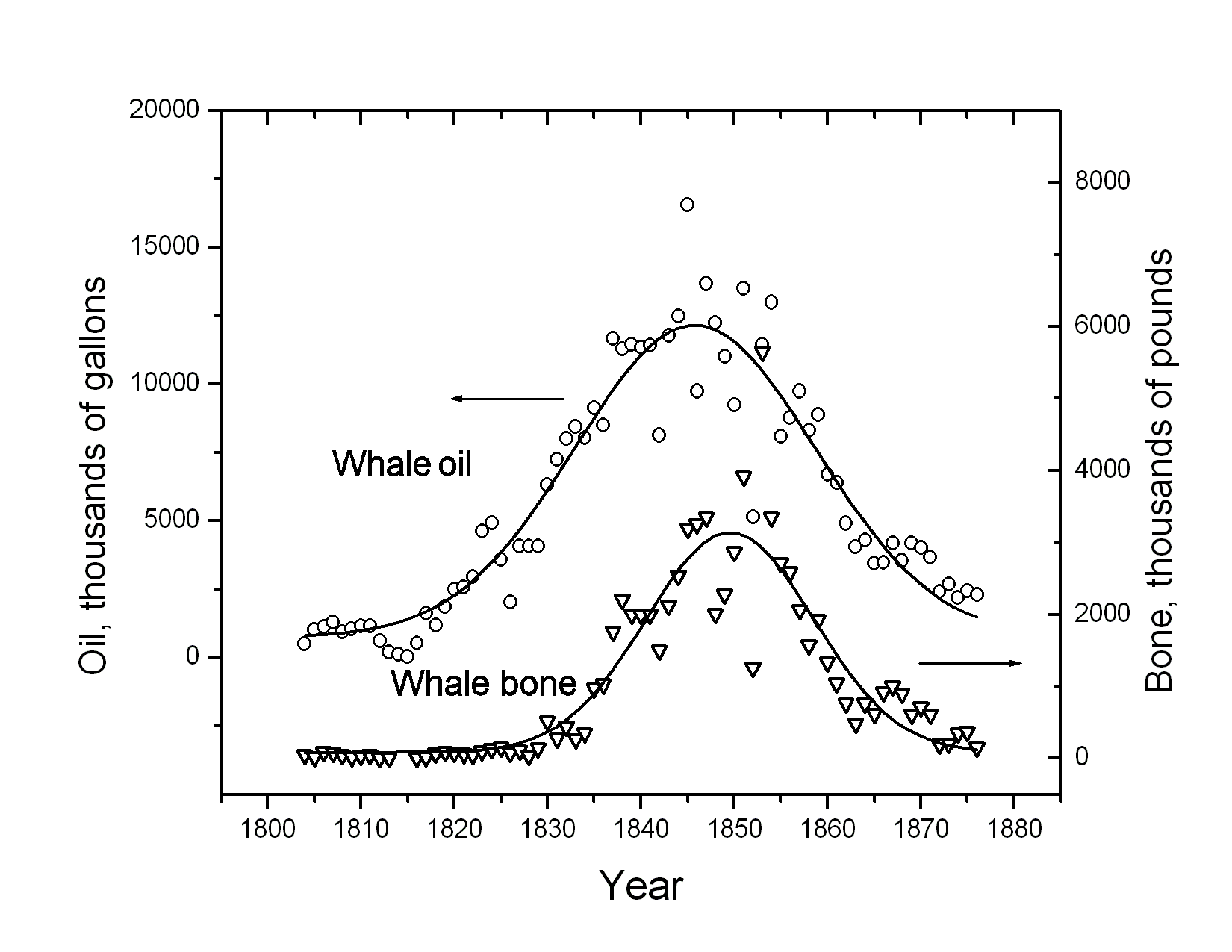
The production curves of whale oil and whale bone in the United States in 19th century (from "History of the American whale fishery" by A. Starbuck, 1878). Both show a clear bell shaped Hubbert's curve. Click to enlarge.
A few years ago, I appeared in TV for the first time in my life. Oil had just passed 38 dollars per barrel and I was invited to speak in a national financial channel as the president of the newly formed Italian section of ASPO. When I said that I expected oil to rise well over 40 $/bl soon, everyone in the TV studio looked at me as if I had just said something very funny. All the other experts there hastened to contradict me and said that 38 $ per barrel was just a spike, speculation, and that prices would soon go back to "normal."
Seen in retrospect, it was an easy guess that oil prices had to rise. You only had to know a little about Hubbert's theory. As I am writing these notes, oil prices stand at around 120 dollars per barrel and may well keep rising. But for how long? The problem with Hubbert's model is that it is good for predicting production, but it tells you nothing about prices.
There are all sorts of economic models that attempt to predict prices, but their record is very poor. So, maybe the answer can be found in historical examples. If we can find a resource that has peaked and declined to zero or near zero production in the past, then its historical prices could give us some idea of what to expect today for oil.
There are many resources that have peaked and declined at the regional level; crude oil in the United States is a good example. But the price of US oil doesn't depend only on US production; it is affected by imports from other regions of the world. So that's not useful for understanding price trends at the global level. What we are looking for is a global resource that has peaked worldwide or, at least, in an economically isolated region.
After much search, the best example that I could find is not that of a mineral resource but of a biological one: whaling in 19th century. Whales are, of course, a renewable resource but if they are hunted much faster than they can reproduce, they behave as a non renewable resource; just like oil. We have good data about whaling compiled in books such as Alexander Starbuck's "History of the American whale fishery" (1878). In Starbuck's times there was no such thing as a "global market" for whale products. But the reach of the whaling ships was worldwide and the effects of whale depletion were felt in the same way by all markets in the world. So, we can take the prices reported by Starbuck as directly affected by the behavior of the production curve.
So, here are the results for the two products of whaling; whale oil and "whale bone". Whale oil was used as fuel for lamps, whale bone was a stiffener for ladies' clothes, as were fashionable in 19th century.
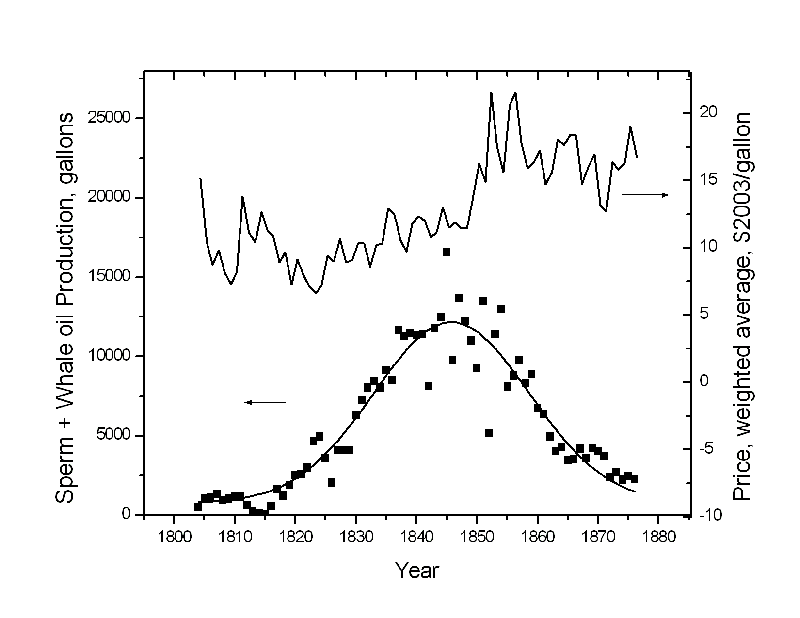
Whale oil production and prices (adjusted for inflation) according to Starbuck's data.
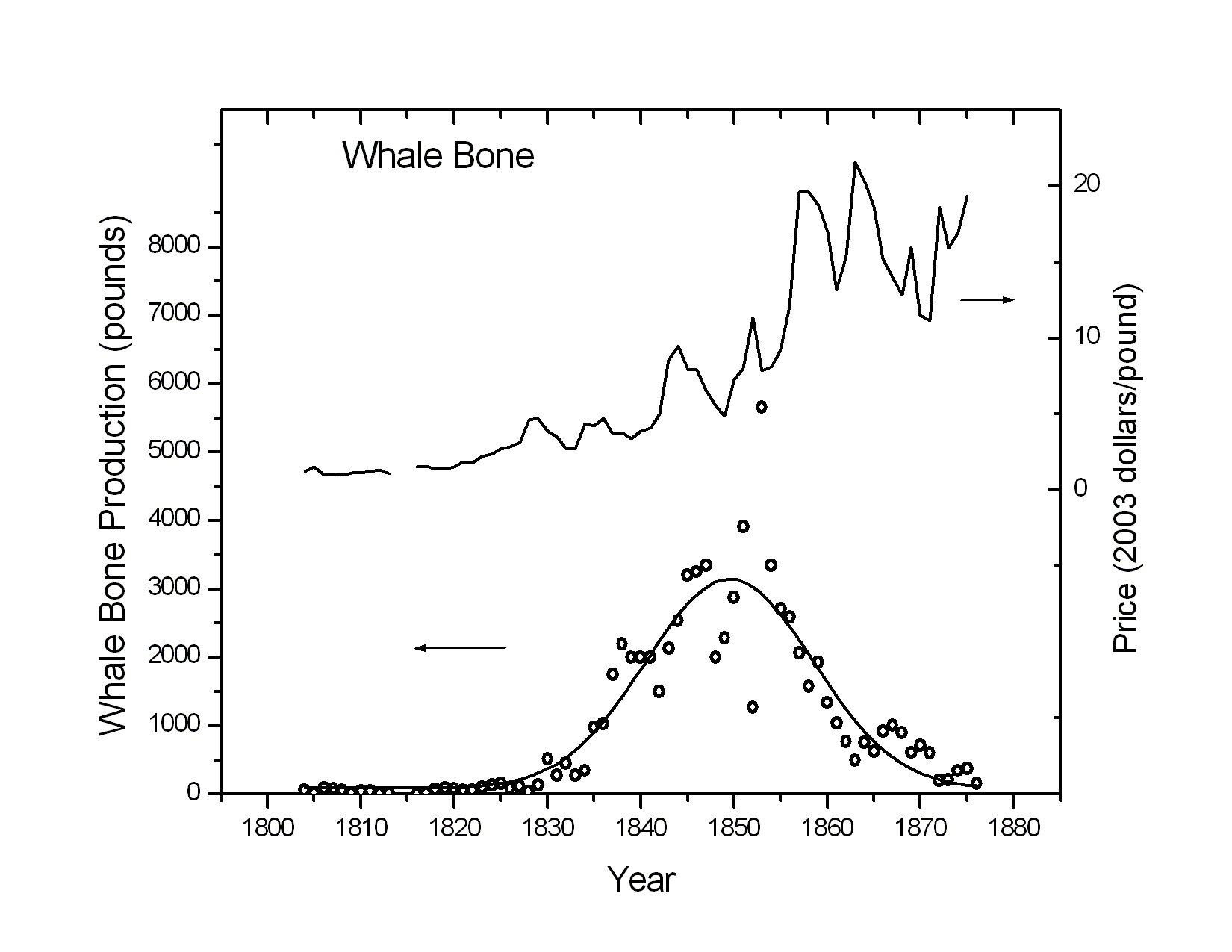
Whale bone production and whale oil prices (adjusted for inflation) according to Starbuck's data.
The results are clear: whaling did follow a Hubbert style "bell shaped curve", approximated in the graphs with a simple Gaussian. Whales did behave like a non renewable resource and some studies say that at the end of the 19th century hunting cycle there remained in the oceans only about 50 females of the main species being hunted: right whales.
Now, looking at the historical prices, we see an increase in the vicinity of the peak for both whale oil and whale bone. For whale oil we see a spike after the peak, for whale bone the trend is smoother. In both cases, the smoothed growth is nearly exponential. We can see this exponential trend in the smoothed data.
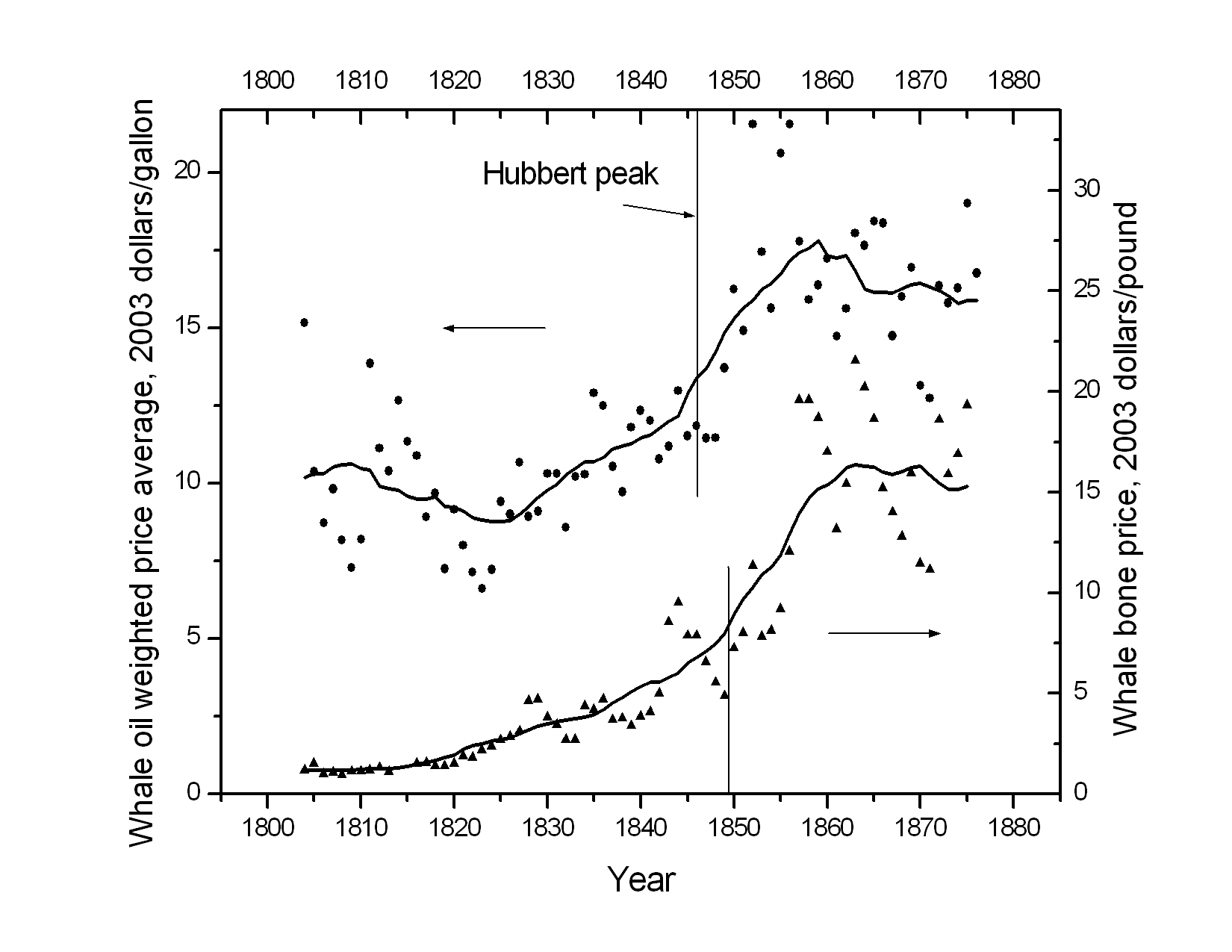
Smoothed whale bone and whale oil prices (adjusted for inflation).
It seems that what we are seeing now for crude oil parallels the historical data for whale oil and whale bone. There are also differences; for instance the prices of whale oil didn't rise so much as crude oil has been doing lately. On the average, for whale oil we see a doubling of the price, followed by a plateau. For whale bone, we see a much larger increase, more than a factor of 10 from the beginning to the end of the whaling cycle. This increase is comparable to what we are seeing today for crude oil.
There is a reasonable explanation for these differences. First of all, neither whale oil nor whale bone were so crucial for life in 19th century as crude oil is today for us. There were alternative fuels for lamps: animal fat or vegetable oil, a little more expensive and considered as inferior products; but usable. Then, starting in the 1870s, crude oil started to be commonly available as lamp fuel. It probably had an effect in keeping down the price of whale oil. For whale bone, instead, a replacement didn't really exist except for steel, which was probably much more expensive during the period that we are considering. But stiffeners for ladies' clothes were hardly something that people couldn't live without.
In comparison, crude oil is such a basic commodity in our world that it is not surprising that prices have risen so steeply. Airlines, for instance, have no choice in between collapsing and buying oil at any price. For other activities, the conditions of the choice may not be so stark, but still we can't survive without oil. If the exponential rise of oil prices were to continue unabated for a few more years, we would be seeing some kind of demand destruction, indeed.
But the historical data for whaling tell us that an exponential rise of the prices is not the only feature of the post-peak market. The prominent feature is, rather, the presence of very strong price oscillations. We can attribute these oscillations to a general characteristic of systems dominated by feedback and time delays. Prices are supposed to mediate between offer and demand, but tend to overcorrect on one side or another. The result is an alternance of demand destruction (high prices) and offer destruction (low prices).
What we are seeing at present with crude oil is, most likely, one of these price spikes. Eventually, it will overdo its job of curbing demand and turn into a price collapse. We can imagine how, in the collapsing phase, everyone will start screaming that the "oil crisis" of the first decades of 21st century was just a hoax, just as it was said for the crisis of the 1970s. Then, a new upward spike will start.
Here, too, the history of whaling can teach us something in terms of the difficulty that people have in understanding depletion. In Starbuck's book, we never find mention that whales had become scarce. On the contrary, the decline of the catch was attributed to such factors as the whales' "shyness" and the declining "character of the men engaged". Starbuck seems to think that the crisis of the whaling industry of his times can be solved by means of governmental subsidies. Some things never change.
In the end, the history of whaling tells us that what is happening now to crude oil shouldn't have taken us by surprise. The future can never be exactly predicted but, at least, it can be understood from the lessons of the past. One of these lessons, however, seems to be that we never seem to be able to learn from the past.
__________________________________________
I reported the results of this study on whaling for the first time at the ASPO conference in Lisbon in 2005. Later on, I published a complete paper in "Energy Prices and Resource Depletion: Lessons from the Case of Whaling in the Nineteenth Century" by Ugo Bardi, Energy Sources part b. Volume 2, Issue 3 July 2007 , pages 297 - 304. You can find it on line here
If you like to play with Starbuck's data, here is the complete set .
Crude Oil: how high can it go? (19th century whaling as a model for oil depletion and price volatility)
PDF version
127 comments
Crude Oil: how high can it go? (19th century whaling as a model for oil depletion and price volatility)
PDF version
127 comments
Personnel
Editors
Contributors
Peak Oil Primers
Archives
- November 2010 (3)
- October 2010 (6)
- September 2010 (4)
- August 2010 (7)
- July 2010 (6)
- June 2010 (7)
- May 2010 (2)
- April 2010 (8)
- March 2010 (4)
- February 2010 (6)
- January 2010 (3)
- December 2009 (5)
- November 2009 (8)
- October 2009 (12)
- September 2009 (6)
- August 2009 (5)
- July 2009 (11)
- June 2009 (8)
- May 2009 (16)
- April 2009 (10)
- March 2009 (7)
- February 2009 (10)
- January 2009 (15)
- December 2008 (9)
- November 2008 (9)
- October 2008 (9)
- September 2008 (13)
- August 2008 (10)
- July 2008 (14)
- June 2008 (23)
- May 2008 (16)
- April 2008 (12)
- March 2008 (16)
- February 2008 (9)
- January 2008 (13)
- December 2007 (13)
- November 2007 (16)
- October 2007 (22)
- September 2007 (8)
- August 2007 (9)
- July 2007 (16)
- June 2007 (8)
- May 2007 (7)
- April 2007 (7)
- March 2007 (10)
- February 2007 (10)
- January 2007 (12)
- December 2006 (9)
- November 2006 (15)
- October 2006 (4)
- September 2006 (5)
- August 2006 (5)
- July 2006 (9)
- June 2006 (5)
- May 2006 (10)
- April 2006 (9)
- March 2006 (13)
Vital Trivia
License

This work is licensed under a Creative Commons Attribution-Share Alike 3.0 United States License.
Interesting, but its probably worth taking it that one stage further. If you look at the inflation adjusted oil price, and ignore the OPEC inspired shock of the 1970-80s then exponential does seem a good fit.
Drawing a smoothed curve by eye and the current run up doesn't look to be significantly like a spike; it looks like its part of the curve. Maybe $20 overshoot. True we can expect various shocks as the system readjusts, but they are as likely to be on up side as the down.
Anyone want to take this table and do a fit? I'm not sure I want to know what it says about 2012
Here's something I threw together a couple of days back for a Uni assignment...
Caveats:
1) I'm no Statistician, this wasn't for maths or stats etc, more comms related - and I don't fully understand R-squared either.
2) The green/blue/red break-years are just from eyeballing - the curve fits are whatever from Excel's suite that fitted best for each segment (but not surprising they're exponential)
A very clever friend suggested I check that the red curve isn't a simple offset of the blue curve - I did, it isn't, the exponential function is definitely steeper. Click for bigger.
Its interesting the good agreement with the different curves.
Its also interesting that the switch to the new curve coincides with the end of the '06 summer bullrun and the disconnect seen in US pump price rises noted elsewhere.
I wonder if someone somewhere had a meeting.
PS the red curve says $150 before year end, easy
The price behavior seems to defy economic sense. The price elasticity is getting LESS elastic as the price goes up rather than more elastic. It has also been more than 3 years since prices started to rise, so longer term elasticity should be kicking in. (and we have reports of record mass transit usage, so we know something is happening). But that is not slowing the price rise.
Worse, the world supposedly had a rise in oil production last fall/winter that broke the 2005 production numbers. Yet the price did not drop back to 2005 levels. No, that was in the middle of this rapid price increase.
Intuitively, what I feel is happening is that in 2002 - 2007 the poorer consumers were pushed out of the market. They had more elastic demand to oil price. Now that they are gone, wealthy consumers are the only ones left. USA, Europe, China. Those remaining are much less elastic.
I think we are going to see a sigmoid price response. Sigmoid Curve Shape
Where the top part of the curve is set by the maximum value for a barrel of oil. A rough estimate of the maximum value comes from GDP/Barrel of oil Equivalent energy consumption. Roughly $600.00 ($2006)
However, it takes about half the energy of a barrel of oil to use that oil (energy for extracting the oil, building the roads, building the cars, maintaining those cars) so at a price of $300 a customer would be trading back to the supplier the whole value they could expect to get from the oil.
I don't think that price can be sustained for long. It can only happen when subsidized by other energy sources. Or when the purchasing country starts selling off embodied energy to pay for the oil. (like selling banks and farmland etc).
What I feel this Post on Whale Oil is mostly saying, is that humanity has no models for what will happen as a major energy source depletes on a world wide scale. We have always had another (often better) choice. Now, at best, we have worse choices (electricity). And what will happen to the price will need to be determined by model rather than by analogy to past events.
The Sigmoid has no meaning other than as a cheap heuristic to subjectively describe an S-curve, see my rant way below. I know that you aren't applying it to describe something like a URR, yet I don't want to propagate the myth that it has some brilliant deeper meaning.
I mean that the prices will have an S curve with a sharp rise in the middle. The low part of the S is when there are more producers than consumers. They bid against each other holding the price low. Prices rise slowly with production costs.
Then peak oil happens.
Now you have more consumers than producers. They quickly bid up the price for this non-replaceable resource. Prices slew rapidly toward the top of the S. I think that is what we are seeing now and why price elasticity is decreasing - which is opposite of expectations.
Prices stop rising when most of the value of a barrel of oil is going to the producer. Prices stop rising because consumers have no extra margin to trade for more oil. The consumer economy has little surplus to grow. Demand destruction is causing contraction (holding the price lower).
I don't think we are at the top of the S yet. I think at $300.00 we will be there.
I agree and this happens for reasons completely different than what happens in a Birth-Death model which produces the textbook definition of a Sigmoid.
Hi JonFreise,
You say "...at a price of $300...I don't think that price can be sustained for long..." In several European countries we are already paying around USD9 per gallon and this I think represents more than USD300 given the pathetically low US taxes.
At USD9/gallon i do not see a great deal of demand destruction here and sales of gas guzzlers such as Porsche & Mercedes are holding up. In fact revenues at Porsche are increasing:-(
IMHO it will take a significant increase, $200/barrel? to noticeably decrease demand.
You have a point about the higher prices per gallon in Europe. But most of that price is tax. And taxes stay in the national economy. In the model I am putting forward, most of the value will be leaving the local economy. However, your point is still valid if the price of oil payed out circulates back in some manner.
or if you print fresh new money to buy that oil from a thin air...
The linear to exponential switch happens in 2002, a scant 2 years after the date Hubbert published for global peak production some 40 years ago.
I just posted an article doing what you suggest: oil price projections out to 2012.
Oil Prices in 2012
Would you believe $900/bbl by the beginning of 2012?
Now try extrapolating Nortel stock from IPO to 1999.
I think your a tad low in the sense your not adjusting for inflation. Inflation adjusted your probably looking at 1200 in 2012 dollars. Other than that about right.
Interestingly, if you shift the 2007 onwards curve upwards to remove the 2006-2007 downwards blip - then you do get a continuous exponential, but with a slight excursion recently. $25-30 offset. The resulting curve shape with dates feels about right, with prices rising $100 a year by 2012.
There is a hypothesis that can be made about this. On an underlying basis as 'possible supply' and 'demand' meet there is an exponential price rise expectation as users fight it out for supply. The market however is very human, certainly far from perfect, and can react to sentiment to introduce shocks into the price curve, offsetting the progress of the underlying price rises. Similar events can be seen around points of recession - the curve trend shape on either side is the same, the period of the shock is chaotic.
Thus the expectation is defined by the general curve, with periods of chaotic drift before the curve re-establishes itself. When does it end? Well I'd suggest that once people realise the available supply is on the way down the rules of the game change and we get a discontinuity in the price curve. I wish I could say I think that's going to be a plateauing, but Instead I think it may well be an upwards jump as active hoarding begins.
Here's another attempt to model ocean biomass and price:
Census of Marine Life
Looks like the typical exponential increase in price, followed by extinction and demand destruction.
Ugo I'd like to correct something, by far the most hunted whale species was the Sperm Whale. Its oil was of better quality and they also produced spermaceti, a liquid extracted from its brain. The Right Whale was the first species hunted by man on near shore excursions on rowing boats; by the second half of XVIII century the Right Whale population in the North Atlantic was probably already gone.
What made the Whale Industry was the Sperm Whale. They were hunted at high sea with heavy sailing ships (called whalers) that on sight of a whale pack would deploy to sea a number of rowing boats called whaleboats.
Each whaleboat had a typical crew of six members, four oarsmen, a harpooner and a ship's mate. Once on sea they would try to get close to the sperm whale the fastest they could, before it divided again in to the deep, with the mate aft at the helm and with the harpooner forward read to fire. When in range the harpooner would strike, trying to hit the whale on its back. If the harpoon was struck right, the sperm whale would then start a frenetic swim dragging the whaleboat by a cable connected to the harpoon. At this immense speed the harpooner and the mate would switch places (a manoeuvre that would sometimes end in tragedy) once forward the mate would try to get the whale boat close the its prey by pulling the cable and when again in range he would try to struck a series of spears towards the sperm whale's heart. Hence the animal would be killed by a ship's mate and not by a contracted man.
At its height (circa 1830 – 1860) the Whaling Industry was possibly the largest in the world and at a scale that never existed. The Whaler would set sail and entail several circumnavigation journeys, returning to home port only when the space to store oil barrels ran out. This would take between on average two to three years to accomplish but some commissions would take longer. Life was harsh and accidents were common,”a drop of blood for every litre of oil”.
Several harpoon types and a spear (second from the bottom).
All the crew members were contracted with the exception of the captain and the ship's mates (usually three). Each man would get paid only at the commission's end based on a pre-established fraction of the oil sale revenue, to which the expenses of keeping them aboard (feeding, etc) would be subtracted. While experienced men, like harpooners, could get as much as 1/20 of the revenues, inexperienced sailors could get below 1/200 of the share. This would invariable result in first timers ending up debtors to the contracting company, being forced to tackle one or more commissions to pay back.
Ugo, I don't know if you ever read Moby Dick, but it written there in black and white that whale hunting was peaking. The book was published in 1851 reflecting the knowledge Melville acquired during half a commission he took years earlier (he mutinied a year or so into it). At some point in the book he compares sperm whale hunting with the bison decimation that took place in North America. He argues that in first place in whale hunting only the less fit specimens are taken and secondly he observes that the sperm whales are answering to the hunt by travelling more in bigger packs and less solo, diminishing the odds of a whaler finding its prey. Using TOD's wording the easy sperm whales were over.
Melville correctly predicted that the Whale Industry would never ran out of sperm whales but was experiencing severe difficulties to keep catch rates of the past. Man has hunted the sperm whale more than any other whale, but still the species is one of the most abundant ones (circa 1 million specimens worldwide) which in relative terms is quite impressive.
Luis, you are going into some interesting details. First, about sperm and right whales, the amount of whale oil produced by right and sperm whales was approximately equivalent over the whole 19th century whaling cycle. But if we examine the populations, right whales were almost completely exterminated whereas sperm whales show just a modest population drop (there is a reference cited in my paper showing these data). That shows clearly how "easy" resources are exploited first and also - i think most important - that the physical amount of a resource is not the only factor in the Hubbert cycle. A modest drop in the number of sperm whales, added to the disappearance of the right whale, was enough to make sperm whale hunting, alone, economically impossible. Hence the Hubbert curve!
And about Moby Dick... yes, thar she blows!! (coming from "the Simpsons?"). I think I remember that Melville does say that whalers would never run out of whales. But I don't think it was because he had an intuition of the Hubbert mechanism. It is more a typical attitude of whalers; you can read similar statements in Starbuck's book. It is funny to note that nowhere in the novel Melville mentions what whale oil was used for (at least, I couldn't find it). For him it was so obvious that it wasn't worth mentioning.
Ah... Luis, I went to look at the data and I must correct myself. The area of the bell curve for sperm whales is smaller than that of the right whales; about a factor of two. So, right whales were more important throughout the cycle. Also, the Hubbert peak for sperm whales came earlier than for right whales. Indeed, sperm whales were more numerous but more difficult to catch.
Here are the data
Ugo, from Encarta you can read:
Wikipedia on the Right Whale:
One of the earlier chapters of Moby Dick is dedicated to whale oil's place in society. Melville explicitly address the issue of lamp oil increasing productivity in other business activities by extending work hours. Something that in his view made all other commercial activities indebted to Whaling. If I recall correctly he also explains the applications of other products like spermaceti and whale bone.
I think the graph you show is gathering all the other hunted species in the same bucket. Beyond the Right Whale (which was easier to catch because was slower) the Humpback, the Grey and the Bowhead where also hunt, so I believe that the second curve encloses the oil from these four species together. This kid's website (grin) claims that the sperm whale was the most hunted of them all.
On the NMFS website you can read:
Obviously Melville didn't knew the Hubbert model (especially so when at the time the Verhulst equation was only 10 years old – grin). But he left very clear in the book that the industry was in serious difficulties and that further growth wasn't possible, all lead by factors external to the whaling business – the whale availability itself.
I bet that the total number of whales harvested since 1900 eclipses whatever is under the peak for the 1800's. Cripes, I think the Japanese hunt Mink whales under the auspices of "research" only to turn it around and use the harvested whale meat as a dog food supplement. http://www.jref.com/forum/archive/index.php/t-21988.html
So much for the vaunted Verhulst equation in describing the URR of a replenishable resource.
(see my rant way below)
"research", I don't think so. Greenpease announced yesterday:
"...
We just released the results of a four-month undercover investigation, and at this moment it's growing into the biggest scandal to ever hit the whaling industry in Japan. It's on the front page of one of Japan's most influential newspapers today. All six Japanese television stations attended our press conference this morning. We're demanding that the government revoke the permits of the whalers as a result of the scandal.
We presented evidence today in Tokyo of decades-old, widespread embezzlement of whale meat occuring under the noses of the public officials who run the whaling programme.
The best cuts of whale meat, used to make whale bacon, are smuggled into crew cabins, preserved in salt, and then shipped home in boxes marked "cardboard" or "salted stuff" to be sold on the black market. We intercepted one such box -- worth up to US$3,000 -- and presented it to the Tokyo Prosecutor's office as evidence this morning.
We have evidence that more than a ton of such whale meat was snuck from the whaling ship this year. One of our informants claims to have heard a crew member boast of building a house on the proceeds from his illegal take.
..."
If you want to support Greenpeace protest to the Japanese government look at this link
http://www.greenpeace.org/international/news/whale-meat-scandal-150408/j...
Ouch!
It looks like the peak i n sperm whale precipitated increased hunt for the right whale. You can see the production of right whales really take of near the sperm whale peak.
I've used the whale-oil analogy many times in the past, but I never thought to do this kind of analysis (partly because I would never have bothered to chase down the data).
This is simply delightful, Ugo. Many, many thanks.
I have been officially baited :)
Consider sperm whale production if coal fired steam turbine ships had come into exsistance while whaling was still the primary source of oil. Just imagine a alternative history for a bit. Where
http://en.wikipedia.org/wiki/Turbinia
Just consider for one moment a steam powered harpoon at the front of this ship.
Next while your at it pour a stiff drink sit down and consider oil production and technology.
...perhaps that would have been termed "Enhanced Recovery Techniques"?
Nick.
That picture is from 1894 the book on whaling mentioned in the article was compiled in 1874.
Only twenty years later. We have been extracting oil for about 100 years the turbina was the technical level
at the beginning.
The technology used to hunt whales on the open sea barely changed over about 100 years limited to to the constraints of wind and wood.
Think about it.
Here's what happened when industrial whaling came to the Pacific in the mid-20th century:
Sequential megafaunal collapse in the North Pacific Ocean: An ongoing legacy of industrial whaling?
This graph illustrates a trophic cascade: once great whales were hunted nearly to extinction, orcas turned to other marine mammals. Eventually, the sea urchin population exploded, and they ate the North Pacific kelp forests.
So not only was the whale population drastically reduced, whole ecosystems were destroyed.
Thanks Barrett for this summary of the industrial fishing situation. There are also books on this subject; for instance "The end of the line" by Charles Clover and "The empty Ocean" by Richard Ellis. And a large corpus of scientific literature.
Fisheries are a nearly perfect example of what economist call "free access" resources, known for a long time. The first study was by Gordon, in 1953. Later on, Garrett Hardin would popularize the concept with the name "the tragedy of the commons". "Commons" are free access resources; fisheries are the best known example.
Fisheries have been studied for a long time and there are many (too many) cases of overexploitation. 19th century whaling is the first global case in history, but there are many others. In another comment I cited the case of the Caspian sturgeon; it is all the same. In most cases, the production curves show the classic "bell shaped", or "Hubbert" curve. I think that the Hubbert model is a generalized description of the exploitation of a free access resource. It doesn't matter if it is renewable or not, it is just destroyed at the fastest possible rate. And things don't seem to be changing
We humans as a species know everything we really need to know about maximum sustainable yield. Yet, time and time again we fail to implement it, prefering to just deplete a renewable resource to near-extinction.
And we think that we are such hot stuff. There may be intelligent life in the universe, but I'm not at all sure that we're "it".
Ugo, thank you for the perspective. For what it's worth, regulation and enforcement efforts are increasing, for example the Western and Central Pacific Fisheries Commission. If what I hear around Fisherman's Terminal in Seattle is true, the Bering Sea fishery is tightly regulated and reasonably sustainable.
Regulation and enforcement efforts must be greatly increased globally, if we're to have living oceans into the future.
Yes, regulation is the second phase of the exploitation of a free access resource. Hardin's "commons" model is valid only for the first phase; the overexploitation one. The studies show that humans slowly arrive to understand how to exploit renewable resources in a sustainable way. The problem is that this phase comes late; after that the ecosystem has been thoroughly wrecked. It is often too late to return to the initial conditions; what is left to regulate is a degraded, low productivity system. Better than nothing, though, and regulation of fisheries is surely to be increased as much as possible
Besides the orcas and the sea urchins, another cause of dieback of the ocean ecosystems was the sudden lack of whale poo.
The numbers are amazing. Three million Blue Whales had a biomass of around 200 million tonnes, and deposited over one Billion tonnes of "fertiliser" per annum into the oceans. This suddenly stopped as almost the entire population of Blue Whales was wiped out in the two decades following World War One. (When the Turbina's descendents were perfected as "submarine chasers"...)
Um, yes. To the extent there were large price spikes and valleys, I think there's a message here. However, the price of oil won't be going down as long as mechanized civilization lasts. There is simply no substitute for it as there was for whale oil. Crude oil will probably still be gaining in value when the human maps have been redrawn with radically different borders. Its intrinsic value as a store of "magic" is nearly unequalled. (Had whale oil allowed man to fly through the stratosphere and smite his enemies with fire from the sky, whales would have been pursued with undiminished vigor, price be damned).
Of course "whale bone" is baleen, which is about the same material our fingernails are made of. It's similar to a resilient plastic. And of course, sperm whales didn't have any. And to correct another minor point by a commenter, spermaceti doesn't come from a sperm whale's brain but from a reservoir in its head which is probably used for regulating bouyancy; it's actually a wax which changes state and thus bouyancy at a temperature which can be regulated by a whale's voluntary control over blood through vascularization in the chamber, I think. A mile down, you'd really want something like that. I think that's what whalers called the "sperm". I can tell you that you really don't want to get it splashed all over you when you're doing an autopsy on a rotting sperm whale; it's enough to make you jump into the bloody water with the sharks, and it will sink into your skin and you'll smell like a whale corpse for weeks.
This is a nice "human nature" point, and my favorite part of this comparison. That, and the fact that the dude's name was Starbuck, which seems almost as big a coincidence as if his first name had been Moby.
Just the whales' luck that the replacements for whale oil would melt the poles, acidify the seas, mess up the currents and destroy their food supply. Which we seemingly are doing. This mess is our payback for being dopamine-pursuing monkeys, but wholly their tragedy. The sperm whale has the largest cerebral cortex - by far - on planet earth. Bowhead whales (a kind of 'right' whale) live to be 200-300 years old, it seems. We have no authority to assume their thinking is inferior to ours by any but ape criteria. The story of the biosphere's destruction this time is a human story, but the possible end of many kinds of self-aware megafauna is arguably a far greater loss than the surplus population of hairless apes. Their story of evolving intelligence and (in all cases so far tested) self-awareness had, for millions of years, been a successful one.
The moot point is, whether Leviathan can long endure so wide a chase, and so remorseless a havoc; whether he must not at last be exterminated from the waters, and the last whale, like the last man, smoke his last pipe, and then himself evaporate in the final puff. —Herman Melville, Moby Dick (1851)
As you read about what we have done in the past our future looks hopeless but in reality its simply that this path of arrogance is now closed. For the first time in centuries absolute greed no longer produces the desired results. We are being force to submit to the limits of this small planet.
"the limits of this small planet" are hardly set in stone by the amount of extractable oil. The limits tend to be a cosmic derivative of the energy radiating from the sun..
Cheers, Dom
"For the first time in centuries absolute greed no longer produces the desired results."
Definitely. How ironic that in this boom of greedy oil use, the oil producing countries and large oil companies are scraping by without profit. It will only get worse for them as the resource becomes more scarce.
I think your missing the point. For about 100 years greed today has lead to even more success down the road.
Certainly it has cost many lives but overall as you point out even today by taking the approach of effectively taking as much as possible as fast as possible the US has become the envy of the world.
Mega profits today do not ensure future results.
Not sure if you see this or not but the golden goose is out of eggs and its time for dinner.
Correct me if I'm wrong, but isn't that Hubbert's point about the discrepency between our money/banking system with fiat currency and finite resources? The system works as long as we haven't reached the limits to geometric growth - for earning interest on money follows the same geometric growth. For once there is no geometric return on money, then the system malfunctions..
No your correct he spent a lot of time talking about this. Thats what makes ensuring that post peak society transforms itself with as little pain as possible almost impossible. The underlying problem is we have to effectively redo our financial system to one that promotes store of value not growth. The best investment would be leaving money in a bank account. Effectively a highly deflationary economy.
Given this underlying problem its tough to see how we can transform. In my opinion the fact we are and the end of a credit bubble and at the start of a massive credit deflation actually makes things harder since the only way I can see to convert is to increase interest rates to force savings to grow as debt deflation continues. Once monetary deflation is well entrenched then interest rates are dropped to zero and the increased purchasing power of less and less money substitutes for interest.
The problem or I guess the goal of the current approach is that by allowing deflationary collapse to occur and keeping real interest rates low leads to price inflation and no savings so the end game with the current approach is most people end up broke with zero money once monetary not debt deflation begins. By monetary inflation I mean cash is king. When this finally happens a lot of assets will be available for pennies on the dollar. But no one will have any money. Or at least none of the common people.
Thus following the long credit deflation/ recession with rising commodities event we end with a classic 1929 style monetary deflation and depression.
At this point sure we probably will adopt a renewable economy but thats the only one going. The problem is all the money ends up in the hands of a few. Of course this might not be considered a problem by those in control of our current money supply. They are not fools and they don't have to be peak oil aware to realize the expansion economy is already dead.
That's not the first time I have encountered the notion that we will soon find all the money in the hands of a few, or even taken to its logical extreme just one person owning all the wealth and every one else in debt to him.
Now the interesting fact hiding behind such a scenario is that the value of money exists only in peoples' minds. And when all but a few people are oppressed by it then it's difficult to see the institution of money (and associated "wealth") being given recognition for much longer by the majority. Hence there would be one or more revolutions ending with some new system under which the wealth would not be in the hands of a few! That's the financial/physical wealth at least; the intellectual and labor-productivity wealth will always be distributed very unequally/unfairly.
A good way to avoid having your 'turn in the barrel' then? ;)
I used to work on sulfur amine boron chemistry.
Whale corpse probably have no comparison. Take DMSO animate it and add some borate amino complexing to make uber solvent that smells like cat piss X 10000 and get a few drops on you.
Rotting whale blubber boiled with sulfur dioxide urea and borax is a pretty good approximation.
Anyway assuming rotting whale blubber is high in ammonia and sulfur we are probably kindred spirits :)
You may not realize it but your talking to the king of stink.
Raise you one rotting whale baked in sulfur :)
Ugo, is there any pattern in these data sets that can tell us how long after the peak the exponential price rise stops?
Kerosene and coal oil replaced whale oil so I would not read to much into the flattening of price.
Although whale oil is a perfect example of logistic behavior of a finite resources with constant technology.
Substitution makes the price behavior after about 1860 or so a bad model for oil post peak.
When does exponential price stops? I wish I knew; there are different possible explanations for the data. As mentioned, price rises for whale oil may have been stopped by the competition of rock oil. Stiffeners for ladies' clothes may simply have gone out of fashion. Or, there may be some internal mechanism that cause prices to plateau after a while. I am playing with models to see if there is something in this possibility. Maybe.
Or, the fashion "market" responded to the increasing cost/decreasing availability of one of it's raw materials. I don't have any of my history of fashion books at hand in my office, but it would be interesting to see how changes in women's clothing tracks against the data shown in these oil and bone charts.
Corsets were worn (by the middle-class and upwards) for quite some time post-peak whale bone - right up into the the WWI period. There was some switching to the use of spring steel (as well as cane and even waxed cardboard) in the late 1880's which is probably attributable to the lack of availability of whale bone (and perhaps the ramping up of spring steel availability).
It wasn't until the 1920's that fashionable women really began to give up the corset (and many older women continued or switched to nearly equally confining girdles.
Not just middle class and upwards. Domestic servant women were generally expected to wear corsets as well.
If anyone else has a hankering for Moby Dick after reading this article there are several free editions compliments of Project Gutenburg (including an audio book version)
http://www.gutenberg.org/browse/authors/m#a9
I read it once years ago. Might be time to tackle it again.
Moby Dick is a very good read. Melville includes a huge amount of technical detail on whaling, much more than a modern novelist could get away with given today's audiences. How much coincidence is it that the cited scholarly article was written by someone named Starbuck and that Captain Ahab's first mate on the Pequod was also named Starbuck?
Can anybody recommend a novel that covers the petroleum industry the same way? I'm thinking roughnecks and roustabouts working the Texas oil fields or maybe something about an offshore platform.
"Can anybody recommend a novel that covers the petroleum industry the same way?"
not in a single book, here are some candidates:
"texas rich" about h.l. hunt (sorry cant find my copy to tell you the author)
"the greatest gamblers" (cant find copy either)
"this fascinating oil business" ball,douglas and turner, dan
The Substitution is Already happening. In the link I gave yesterday the IEA states that 2/3 of the estimated 1.5 million (net, I guess) gallons coming online this year will be biofuels.
First, thanks Greenish and Memmel for pointing out that the lack of a scaleable substitute for rock oil makes the whale oil comparison fall down post-peak. And kd, I believe you mean 1.5 million barrels, 2/3 of which would be 1 mbd, not much more than 1% of current use, and it's already consuming, what, more than 20% of the US corn crop. Biofuels ain't gonna come close to scaling, and that's even before accounting for their very lousy EROEI.
You're right; Barrels (it's just a wee bit early for me.)
Hey, a million barrels, here; a million barrels, there. Pretty soon you're talking a significant.
Don't get all super-invested in Corn. There's Brazilian Cane, Malaysian Palm oil, Texas Algae, and, who knows about cellulosic.
The fact is, a lot of things become viable when oil is at $125.00/barrel.
And, Hybrids; it looks like they really are going to take off.
We'll probably see some of Alan's electrified rail coming online, soon.
There IS a price at which oil becomes a dying industry. I, personally, think we're getting within sight of it.
"And, Hybrids; it looks like they really are going to take off.
We'll probably see some of Alan's electrified rail coming online, soon.
There IS a price at which oil becomes a dying industry. I, personally, think we're getting within sight of it."
Yes but we've been lucky. When I first read Jay Hansen in 1999 he was right. There was absolutely nothing on the horizon at the time. It wasn't until two to three years ago that we had any reasonable chance of mitigating. And it's only a possibility.
There's still no mass manufacture of plug in hybrid.
There's still no massive scale up of wind, nuke and solar.
There's still no massive scale up of electrified rail.
Things are moving, but slowly.
I hope that they pick up pace before we collapse into the maw of a deep recession where many large scale investment projects simply get kaiboshed and we lose a whole decade or perhaps even worse.
Can we have a recession as deep as you envision without a significant reduction in global oil use?
Do large scale government projects increase or decrease during recessions?
Is red tape like the kind that stops nuclear plants more likely to grow or be bypassed during recessions?
In the case of oil, it isn't going to be just substitution of another (renewable) energy resource while we continue BAU. Much of the substitution in this case is going to consist of efficiency and curtailment. The good news is that using energy much more efficiently can make up for a lot of the depletion. The bad news is that combining all of the efficiency that we're likely to achieve and all of the renewable substitutes that we're likely to bring on line won't be enough. We're going to have to make of the difference through curtailments. Yes, some people will be able to substitute a PHEV or NEV, or mass transit, for their SUV. But some people will have to just walk or ride a bike, and some people will have to just stay put and not make trips they would have made under the present BAU. We're just delusional if we think the future will be otherwise.
It's not a question of viability, but scalability. I can enumerate dozens of technically feasible ways to produce alternative liquids, but none is scalable to, nor do they have the EROI of, oil.
"Brazilian Cane". Cane grows only in the tropics. How much of Brazil's land do you suggest devoting to cane monoculture and to the destruction of remaining biodiversity?
"Malaysian Palm Oil" Deforestation for palm oil plantations has already made Indonesia (the main palm oil grower) the third largest CO2 emitter in the world. In addition, even if you took every single drop of edible vegetable oils of all types, including palm, and used it for biodiesel, you'd only supplant 8% of global diesel consumption (and condemn hundreds of millions to death)
Texas Algae. There are enormous challenges to growing algae on any scale that would matter. What is demonstrated on a lab benchtop is not indicative of full commercial operation. The volumes of liquids to be handled alone in algae production makes this enormously energy intensive.
Cellulosic of any commercial scale is a decade or more away, and even the most ecologically destructive estimates of what the US could do (i.e. consume 40% of our Net Primary Productivity under the USDA study) would provide 30% of our gasoline and have no impact on the problem of diesel, naphtha, kerosene, asphalt, lubricants, LPG, or any other petroleum product.
I simply don't understand all these sanguine statements whose implication is further and more rapid destruction of our ecological and environmental services, and for what?
Not in any way being argumentive, there is a large scale pilot plant starting construction near Casa Grande Arizona called XL Renewables. They will be growing algae in covered and lined trenches on 40 acres. The plant will have a liquid flow rate of 1000 gpm with 50 gpm of algae concentrate offtake. It will be broken down to fats, proteins and carbohydrates.
Other than sunlight during the day and a light source at night They are not saying what the input will be. I expect it will be sewage plant tail water. As it is a pilot they are not saying what the efficiences are or any thing else, but at least someone is putting some money into this.
?
Alan's rail,
electric cars,
solar/heatpump/geothermal heating
etc...
Remember, Drake's well (and the beginning of the oil industry) came online in 1859, AFTER the peak in whale oil. Maybe our answer (for all you cornucopians out there) will come in 2012..
Rock oil originally meant this
http://en.wikipedia.org/wiki/Coal_oil
Available well before then end of Whale oil supplies in 1850.
Also gas lighting using coal gas was extensive in the cities replacing whale oil.
http://en.wikipedia.org/wiki/Gas_lighting
The commercial whaling hubbert curve took place in a period when substitution
was available and competitive. The reason whaling continued was it had a infrastructure
in place while substitutes had to build out.
The important part is noting the lag between when substitutes became fairly widely available
and when substitution and reduced demand enough to make whaling a dead business. Its like 40 years.
In any case what I find fascinating is that the chances of a exponential decline in oil production are zero yet this is the model people cling to even though its and more optimistic ones are the only ones that are 100% wrong.
No wonder we keep crashing our civilizations time and again.
For sure, substitution is already under way for many of the low value uses for oil. Process heat and remaining oil-fired generation is getting phased-out(mostly in favour of coal and gas) and rail is booming in the US to the detriment of heavy trucking. I'd expect a move away from heating oil towards heat pumps, cogeneration of various kinds and district heating.
More Substitution:
Deep, deep, deep water Wind Farm in the U.K.
http://thefraserdomain.typepad.com/energy/
And, This: Two new engines (one CNG) from GM
http://www.greencarcongress.com/
The Seven Sisters, Anthony Sampson. Viking Press 1975
Jon.
Upton Sinclair's novel, Oil
The movie ain't bad either.
"There Will Be Blood" with Daniel Day Lewis
Brilliant post Ugo, thanks.
If it wasn't for the advent of kerosene, whale skeletons in museums would be what we would have had left from this amazing creature.
….. and there is always the herring-collapse in the Northern Atlantic taking place in the 1960's. A scrutiny done in 1977 concluded that (in this year) the herring population was down to only 1% as compared to mid 1950’s. Technical advances and faulty scientific recommendations were blamed. The herring is now back some 50 years later ….. in sort of sizable schools ... hopefully lessons are learnt !
Image :Idled herring-fleet western Norway in early 60's
Yes, fisheries are a mine of inspiration for models of extraction. Cod and herring are a case; another one is sturgeon in the Caspian sea. Sturgeon is an interesting case of asymmetric bell shaped curve. It was exploited so intensely that the collapse was brutal. There is no substitute, it seems, for caviar!
Here are North Atlantic biomass trends:
A new look at the interactions between marine mammals and fisheries (or did we we mess up the North Atlantic, and now blame them for what we did?)
The red curves are "fishing intensity," or number of hooks in the water per unit time.
As you can see, we've almost completely fished out the North Atlantic.
Just as a note the UN is expecting world fish stocks to collapse within 50 years. Given that peak oil estimates from such sources are within the same range we can expect collapse to happen much sooner. They don't use the right models for collapse. So we expect that strain on the fishing fleet in the form of increased fuel oil usage as they search for fish to increase quite a bit over the coming years not to mention increases from oil price alone. Next most fish farming uses fish meal from small fish as a primary part of its feed so don't expect fish farming to do much to prevent collapse if anything taking out the bait fish will hasten the collapse of stocks.
http://news.bbc.co.uk/2/hi/science/nature/6108414.stm
Since fish protein is a critical component of the diets around a lot of the world this collapse is probably the biggest issue we actually face right now.
Of course as fishing collapses the fish farms will have to move to more land based protein sources leading to even more pressure on agriculture products.
Even in places where fish is not the primary source of protein as fish prices increase you will see a move to less fish in the diet and more land based meats leading too. ....
A further increase in pressure on agriculture products.
And of course many will lower their total protein intake but this will still result in direct pressure on agricultural products since wild fish catches are harvesting biomass from the ocean not farmed land.
And of course biofuels. And you have to throw in higher chances of severe weather from global warming.
Net result is we can expect over the next few years for food prices to skyrocket.
As more income is devoted to food and fuel less is available for other uses thus economic contraction is practically certain. This leads to lower wages and further increases in the percent of income dedicated to food and fuel.
As far as preventing collapse I don't think its possible however if we recognize collapse of the current system is certain it is possible to have a controlled collapse coupled with simultaneous replacement with a renewable economy.
Since most people that argue we can somehow escape this are also the same ones who would argue against any sort of controlled collapse scenario then I doubt it will happen.
The key given the above post is to actually force the system to collapse this means major tax hikes on parts of the economy related to expansion. This would be a move from fractional banking with major increases in interest rates coupled with quickly moving reserve requirements to 100%. No loans for automobiles for exmaple. Drop support for the road system and move to toll roads. Make gasoline taxes 200% across the board.
Triple income taxes for captitol gains. And move all this money into rail/electric/organic farming. And finally massive carbon taxes and taxes on non renewable goods. This of course assume a real responsible government is in place which is far fetched but by making the pressure on the economy come from taxes instead of intrinsic resource problems we take control of the collapse rate. As long as the taxes are a heavier burden than the underlying natural resource depletion we can head off the effectively certain collapse and control the pain.
In a lot of ways this is the approach that Europe has tried to take time will tell if they where aggressive enough.
Key question: how quickly can a fishery recover with either good management or a ban on fishing, such as is happening with salmon on the US West Coast now?
The graphs above seem to indicate the population can rise quite quickly when fishing is reduced significantly. Good news, if so.
Cheers
I contend that all asymmetry in these curves is caused by differing amounts of dispersion in rates of harvesting in different parts of the world. Sturgeon, like passenger pigeons, are highly localized so that intense harvesting practices can be applied and little dispersion occurs:
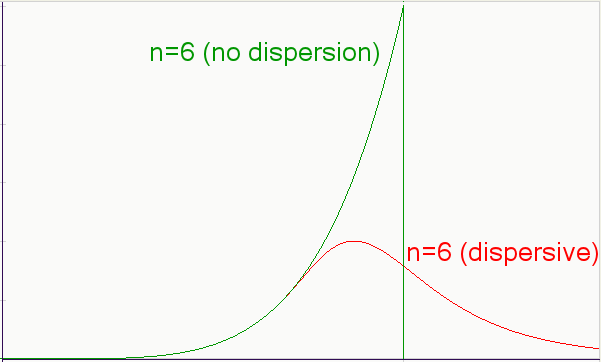
This is all described in the Dispersive Discovery model, posted first right here on TOD last year.
This model in fact was first inspired by the dynamics of passenger pigeon extinction, while I was trying to figure out the differences between human-driven extinction processes and the way that fossil fuel exploration has proceeded.
Dude, I want a Hummer that runs on whale oil! Whale oil - the original biodiesel!
I hope you will help us share Ugo's post--use the available "Share This" buttons or here's the direct reddit link:
http://reddit.com/info/6jihy/comments/
Thank you for a fine article.
The most interesting point for me is the extreme volatility the price exhibited when resource constrained - it has certainly altered my expectations for the degree of volatility to be expected by oil as it gets in shorted supply.
I see much more residual demand remaining after most oil is extracted, as oil will remain useful for many things.
I am confused about the peak in whale oil. You show it in 1845. According to the NYT almanac, the peak in the worldwide whale catch was 1965. Is this because the whales were being taken for reasons other than oil, i.e. meat after the 19th century?
Both dates are correct and refer to different cycles of exploitation. A second cycle of whaling started in the early 20th century, this time for different species of whales and the purpose was meat, rather than oil.
I offer an alternative explanation.
While whale oil from sperm whale for lamp use was not anymore the most important reason for whaling, several other whale carcass products remained in use:
- whale oil as lubricants, later as base for soap
- oil in cosmetics, textile industry
- bone and teeth in various uses
Because the whalers could whale and industrial use of whale oil & bone was on the rise, the growth of whaling continued.
Curiously enough, the meat wasn't used for much more than animal feed consumption, until about 50s after which industrial sailing whale meat factories started offering it more and more to Russian and Japanese markets in quantity. Most countries still do not consider it as human consumable meat.
So most of the history of whaling until to the first warnings of the collapse of stocks (1930s) was about industrial use of whale oil in its various forms.
Meat came later, was of less value in the beginning, geographically confined and didn't contribute overall as much to the whole collapse of the stocks (the damage was already done).
Source: Encyclopedia Britannica (a much better source on this issue than Wikipedia, for once).
Interestingly, when one considers Japan's oft-touted "cultural history" of eating whale, Douglas MacArthur was the creator of Japan's mechanized far-seas whaling industry, as a cheap way to obtain meat for Japan's population after WWII. Many who grew up then remember it as the only meat available in their childhoods, and thus still have a fond remembrance of it. (Although whales were sometimes snared in fishing nets in medieval Japan, whaling per se wasn't a tradition).
While the eradication of progressively smaller whales progressed until WWII, they had a short respite while humans killed one another. Shortly after WWII, a supposedly-scientific body, the IWC, was established to conserve the resource. It was mostly a "tragedy of the commons" scam with the trappings of conservation until non-whaling nations began joining it in the '70's. (The USA's last whaling station was in San Francisco, and closed in 1972 I believe).
The really nasty bit came in a collusion between the former USSR and Japan, which engaged in swapping observers and covertly went aggressively after the supposedly "protected" whale species, decimating them through the '60's and '70's while keeping dual books. This was only exposed after the collapse of the USSR allowed scientists there to make the double set of books public. Japan continues to do bogus whale science to this day.
Peak oil will, hopefully, make far-seas fisheries less lucrative than other protein sources. I hope so, since climate change will fall heavily on the species which rely on ocean currents and the productivity of polar seas.
The second period of whaling was due to oil: it became cheaper to do everything than it used to be. Looting is always cheaper than investing. An interesting bit of economics is that for species which reproduce more slowly than the rate of interest available to exploiters banking their money, one can optimize ROI by wiping out the species as quickly as possible and banking the money. And indeed, this is often human practice.
In the mid 20th century whale oil was a key part of automatic transmission fluid. It would hold a consistent viscosity over a wide temperature range and it took quite a while to come up with a good replacement. Jojoba was looked at as a good substitute.
we do have an alternative fuels- ELECTRICITY!
we can use it in our cars and to light our homes...
And finishing your thought, John15, what will be the energy sources for this new electricity substitute? Coal? Nuclear? Where are the new power plants? It takes petroleum resources to construct and supply them, so they will at some point, sooner than later, become expensive, perhaps prohibitively so. Then, there's that CO2 problem with coal.
Nice article on the whales. I wonder how they feel about humans. I can guess, though.
A modern gas turbine that uses 6 tonnes of material to construct produces 20 MW of shaft power for 100% of the time it is operational.
A modern wind turbine that uses 200 tonnes of material to construct plus a large concrete footing, produces 2MW for about 30% of the time it is operational.
Can we/will we mine and produce the materials quickly enough? I don't know and neither does anybody else.
The difference in energy density (in terms of material use) between the above examples is just to illustrate the scale of the problem of transferring from high E density fossil fuels to low E density renewable energy. Cost counts, if its not affordable its not profitable, if its not profitable no one will produce it.
Wind turbine: 30% x 2MW x 8760hr/yr = 5GWh
Gas turbine:
The gas turbine requires 900 tons of material per year to manage what the wind turbine does with 200 tons per 20 years.
This is why I recommend always checking your intuition - reality is often pretty surprising.
We already are.
Sorry Pitt you seem a little confused. Comparing Natual gas with steel seems a little odd!
Let's take a look at what you said:
My point - which should have been obvious - was simply that wind turbines use fewer tons of mined and produced materials than gas turbines do.
Fewer by a factor of a hundred, in fact.
So it's grossly misleading to imply, as you did, that wind turbines somehow require an increase in the tonnage of mined material over gas or coal power plants.
Of course, that's why you changed the subject to particular types of mined material.
If you actually want to think about the materials requirements for wind power, you should read the US DoE report on getting 20% of US electricity from wind by 2030. In particular, their conclusion regarding steel is:
They estimate 100,000 (large) turbines @ ~400 tons of steel per turbine for 20% of the US's 2030 electricity needs, or about 40M tons of steel. The US currently uses about 1/4 of the world's electricity, meaning getting all electricity from wind would require 20x that amount, or 800M tons of steel.
That's about 7 months of world steel production, to replace all of the world's electricity generation with wind turbines. So the quantity of material still is not a problem. We could go to 100% wind by 2020 without ever using more than 5% of a year's steel output.
Fundamentally speaking, the quantity of materials involved with any plausible amount of wind turbine construction is not an issue, making your view either ignorance or fear-mongering.
Making nuclear even more attractive, I suppose.
Its neither scare mongering or ignorance. I made a statement and asked a question at the end of the statement, which you have (eventually) partially answered, though it took some getting there. I do infact support wind power, but I will not accept we will not have problems scaling it at the rate proposed by some.
Your point about mining natural gas was just nonesense, as I made it very clear it was construction materials in question. As we currently have enough natural gas to go round it is not a limiting factor.
As Matt Simmons has pointed out, the cost of metals is becomming a problem for large construction projects and wind farms are just that.
So, don't just pick out snippets of people's posts, as you frequently do, and use cleverly crafted language to ridicule.
Its that 5% aditional capacity that counts. I suspect most of the world's production is already allocated which is why prices are on the rise. How much of the world steel production is recycled and how much capacity is there to produce from iron ore? (a question not implication of fact).
Pitt, this not what I said, its only part of what I said and changes the context. See below.
This is a classic example of folk picking little bits of a post in order to make the author appear stupid.
6 tonnes of material was specifically referred to as construction material, the latter was a question. Pitt has decided to "quote me" yet omit the word construction. For someone who advises on accuracy when making comments, this is somewhat perplexing.
Prices of everything go up when energy goes up: steel, plastics, copper, silicon, ...
Nuclear needs much less steel, concrete, plastics than wind or any other non-CO2 resource. Nuclear has the largest contribution of highly skilled labor, which is least dependent on energy costs, from all the resources.
Therefore nuclear will take the least price increase from the fossil energy prices going up.
Yet again, as we say with the safety (or rather risks per energy produced) and total life cycle CO2 emissions, nuclear is clearly the best option.
It is completely pointless to analyze the price history of whale oil, since crude oil came along to replace it. That would be like attempting to analyze the price of crude if something like "zero-point" energy were discovered and made into a merketable product. For example, imagine if there was a 10 kW free energy generator the size of a toaster, selling for about $1000. The price of oil would begin falling dramatically. It would not be long before every car was powered by one of these things. (Or a dozen, knowing americans!) The funny thing is, even if we had such amazing technology, we'd still need oil. If for nothing else than to build free energy generators. I doubt the price would fall below $10 a barrel.
But anyway, the point is that I dont see a free energy generator anywhere on anybody's roadmap. I dont see Bill Gates or Warren Buffet donating billions to fund the kind of development required. As long as this is true, you wont be able to compare crude oil price history to whale oil price history.
Hi Icon,
I couldn't agree more. I started reading all this and I thought any analogy between the two was quite a stretch. You can make an analogy out of any 2 things you can think of, merely based on the fact that they are made of matter and follow the laws of physics. A totally pointless discussion.
Jeff
Actually you are completely wrong. If you are to understand a subject it is very useful to have information across a range of different items that pertain, in order to build a comprehensive picture.
Articles such as this, which are well researched, and informative, and which lead to the sort of discussion illustrated above, are very valuable in building such a picture.
The better such a picture is understood then the easier it becomes to identify the questions that must be answered to find the solutions we need in the future.
absolutely correct. are you assuming, slinky and icon, that ugo is not aware that this is not a perfect analogy ? what is wrong with using an analog ?
of course you can go on dreaming about some zero energy device. what is the point of that ?
Japan, which is very poor in energy resources but wealthy in technology, has every reason to put such a thing first on their To Do list.
If such perpetual motion machines were physically possible.
And every bit of physical evidence says they are not. You can rail on about conspiracies all you like, but demanding what Nature does not allow will avail you no more than doing a rain dance in the middle of the Sahara, and for the same reason.
While I am not personally interested in pursuing free energy devices, I think the idea that "free energy" must violate thermodynamics is a little short-sighted. We don't know all there is to know about the universe and it may well be there are ways of tapping dark energy/whatever. If such energy is, in fact, tapapble, you are not violating any law of thermodynamics.
This is a simple point that free energy enthusiasts make often, but that supposed scientists ignore.
Let's not sneer at anything that **might,** however remote the chance, offer a solution.
Cheers
Before you can build a device to exploit energy source X, you must first establish the existence of energy source X.
Proof of e.g. dark energy would yield a Nobel, at the least. Since nobody's picked up a free million bucks for that accomplishment, it's proven to my satisfaction that the free-energy crew hasn't done their homework.
And yet, respectable scientists areound the globe are fairly well convinced dark energy and dark matter do exist.
Strange that.
Still, I used that only as an example, not an exhausted list of potential energy sources. Magnetic fields, etc... Heck, what if the whole Gaia thing has merit? Have experiments not be done exhibiting the existence of the energy template of removed plant parts?
We don't know all there is to know, E-A, so I fail to understand your nearly dogmatic dismissal of of anything not yet totally proven.
Cheers
Yet they have no proof. Even dark matter was discounted in a recent paper which concluded that the increased attraction was a General Relativistic effect of galactic rotation (I do not know if this conclusion was confirmed by later analysis).
Proof of over-unity will come first in evidence from a lab, or from nature. A working device is several steps later, and a producible product is several beyond that. Anyone claiming to have a device before the lab results isn't on the level.
That's the Cooperstock-Tieu model. Fascinating, and I kind of hope it turns out to be the better model. But it has a long way to go before the cosmology community accepts it.
> And yet, respectable scientists areound the globe are fairly well convinced dark energy and dark matter do exist.
yeah, they do exist as parameters in an overly simplistic model. You fit this model to some data and get some numbers for the parameters.
None knows what dark matter is - there are many contradicting hypotheses. The dark energy essence is a pure speculation, basically so far it gets blamed on one arbitrary coefficient in GR equations. In another words, none has a proof for what these things are. Until we know that, any speculations whether these phenomena can be utilized is premature at best.
I was talking to guy the other day about this. He was absolutely sure he was going to run his car on hydrogen using energy from the alternator. Once initially started from a battery, the system becomes self supporting. I think the device was probably dubbed the "Joe Cell". Tried to explain it was not likely to work, but he was having none of it. May be he is right and I just don't believe him.
The question I ask is if you get more out than is put in, the device may well experience exponential growth in output (unless properly controlled) and the device would blow up.
If you get more out then you put in (in a closed loop), you're breaking the laws of physics. Entropy does not allow cheating.
Tell your friend to go ahead and spend his $100 on this device. In a week, when he's flattened his battery and needs and external source to rechage it, you can give him that "I told you so" look.
However, the device I think you're referring to works in tandem with the engine, and not in a closed loop (it has constant injections of fuel from the fuel tank and water tank). The ICE provides power to the battery and runs itself (at ~30% efficiency). This device then uses the power in the battery (loss of efficiency to withdraw the electricity) to electrolyse water (more loss of efficiency)into Hydrogen and Oxygen. The Hydrogen is then burnt (yet more loss of efficiency) in the ICE with regular fuel 'increasing' mileage. The problem is that you have to burn more regular fuel (30% efficient) to produce the electricity that the device is using! If the entire system functioned at 15% efficincy (down from ~30%) I'd be surprised. It's flim-flam/nonsense/slight-of-hand. It's the same act as those travelling salesmen from the Wild West, who sold 'miracle cures', just with a better wed page, some pretty pictures, and credit cards accepted.
There's a wild card in there, and that is that hydrogen (and also oxygen) is a burn-rate modifier for conventional fuels. Accelerating the combustion brings the engine closer to the knock point, where it is more efficient. It does this without advancing the spark.
Not saying it really works, but there is a plausible mechanism and several reports that it has yielded positive results in practice.
Bellister,
With this I totally agree. I was just making the point, that if by some miracle you happened to accidently make a machine that put more out than you put in (which defies all the laws science and engineering I have been taught), it has every chance of exploding and taking you with it (unless you are lucky enough that the mechanism by which the energy is produced saturates first).
From what the guy was telling me this is correct (he was not a friend, I was commissioning a piece of plant for his employer, he was an electrician working with me). So as Engineer Poet says below this may be half plausable. But since a car alternator gives 1 kW max, I would take some convincing enough hydrogen could be generated to make any difference, even if , in theory it does.
Then came the bombshell, he told me he was buying this device (or the plans for it) which would, once started from a battery, run an engine with no external fuel source. I was a little embarassed by his absolute confidence so backed away. I tried to explain it would not work, but he started saying he was getting 6 Faradays, most people only get one (I don't know how a Faraday applies in this case, other than the charge required to split water). I asked a similar question to what EP says below about Japan. His reply was you have to think simple, just wait and see, I will be on television with this. I just said "good luck mate".
Good post, this gave me the motivation to rant on a favorite subject.
The Sigmoid Fraud
Unlike Sigmund Freud, I don't do psychology as a career but I do see something seriously disturbing about the fact that a majority of depletion analysts view the Logistic Function as something that contains some deep and significant meaning.
On the contrary, the Sigmoid curve --as the simplest manifestation of the Logistic-- remains a cheap empirical relationship that describes a value that increases and then saturates below some constrained limit. It indeed does follow from the solution of a non-linear differential equation, but this equation describes the temporal dynamics of a simplistic birth-death model used to describe interacting entities. One can choose populations of biological creatures or concentrations of chemical reagents to plug in to the equation. But you don't insert oil molecules into the equation and expect it to make any sense.
So in keeping with the posting topic let us look at how it might apply to whale oil harvesting in the 1800's. Although Ugo does not bring up the Logistic to describe the saturation, a few commenters do. Fair enough, whales do fall into a biological classification, and they do give birth and die. But whale oil harvesting never tracked a population rise in whales themselves. It actually tracked the reverse. So, instead of calling it a "birth-death" model we should refer to it as a "death-birth" model. The parameter "death" represents the culling of the whale population for oil and any residual "birth" comes about because the whales can reproduce themselves based on the size of their population. Then as an exercise for the reader, one can plug some values into the birth-death equations as described here: Derivation of Logistic Growth.
But then we get to the real twist. Since whales do reproduce, if we play our cards right, then the amount of whale oil that we can harvest has no limit! The URR of whale oil essentially becomes infinite since the cumulative never abates. And unless we harvest the whales to extinction, the Logistic Function will fail miserably in describing whale oil production. (In actuality, cumulative whale oil production likely saturated because crude oil replaced whale oil as a harvestable resource.) See passenger pigeons if you want to get closer to a saturated harvest driven to extinction.
This whole analysis when incorrectly applied to oil exploration and production can induce early psychosis. On the one hand, oil does not reproduce like a biological entity nor does it act like a chemical reagent. So the equations themselves make no sense. But since oil only gets consumed and obeys the rules of a finite resource (abiotic-oil-mental-midgets notwithstanding), it will eventually saturate. So the Sigmoid falls into our lap in spite of itself. The fraud survives in effect only because it looks like an S-curve !
To avoid this mental anguish, I prefer to use the Dispersive Discovery formulation for discoveries and the Oil Shock model for extraction/production dynamics. This approach makes intuitive sense, the math falls out naturally, and you don't have to continue to psychoanalyze insane ramblings of people that live in some freakish world where square pegs fit into round holes and empiricism has the dynamic range of a stupid heuristic. The rise and fall of the oil culture deserves a better understanding than the Logistic can ever offer.
People reproduce its a supply demand equation looking only at supply is incorrect.
What do people "reproducing" have to do with oil "dieing"? Or what does oil "birthing" have to do with people dieing? The Logistic is a birth-death model, and you can't mix apples and oranges unless you take a formal approach and do the math correctly. Hand-wavers need not apply.
Whatever Hubble insults don't make you correct. Go look at the demand side and get back with me.
In my opinion ignoring half the problem demand is not correct.
Unless I get myself banned I can do anything I want. I recall Einstein created so beautiful Gedanken experiments to frame the theory of relativity. You may not like the approach but its not wrong and its not hand waving.
But the Logistic equation derivation only works for populations. The elements of a population are born and die. Oil is not anything close to being a population. The converse of this is if you try to apply the Logistic to biological populations, but instead of making birth rate proportional to the current population, you make it proportional to the cumulative population. Which means that the birth rate becomes proportional to the total number of people that have ever lived! And that means that death also creeps up proportionally to the cumulative population, or you just ignore it because in this framing, consumption is all that matters, so you can call consumption either 'birth" or "death". The only reason the math comes out to look the same is due to the interesting properties of the exponential function. And the difference is that if you apply the Logistic to a cumulative biological population it will always go extinct, whereas if you apply it correctly to a current population, the dynamics will show it transitioning to a finite carry capacity which is not the extinction limit.
But apparently the wish is to apply some human population figure (i.e. supply & demand) to the consumption growth function, but the oil remaining from the cumulative has to figure in as well. This is a huge mess to disentangle. The specific "Logistic" definition requires a homogeneous parameter to solve for, or else a parameter that is at least linearly dependent on the other. Demand is not going to be simply a linear scaling of some cumulative remainder factor.
I will call a truce if you start to say "S-Function" instead of Logistic because it will serve the same hand-wavy or Gedanken explanations, which is basically drawing an S-curve with your hands. Logistic refers to a specific set of mathematical equations that only exists because it has simple symmetry properties. I can disprove the possibility of the Logistic modeling oil production in essentially 3 lines.
1. A Logistic function can not be described as a convolution of two functions.
2. Production comes about from applying an extraction convolution to a discovery function.
3. Therefore, A Logistic can not describe production.
But apparently the wish is to apply some human population figure (i.e. supply & demand) to the consumption growth function, but the oil remaining from the cumulative has to figure in as well. This is a huge mess to disentangle. The specific "Logistic" definition requires a homogeneous parameter to solve for, or else a parameter that is at least linearly dependent on the other. Demand is not going to be simply a linear scaling of some cumulative remainder factor.
The logistic arises from the demand side of the problem. First you accuse me of hand waving then you recognize that its a ugly problem. And your not recognizing the obvious that a forced logistic is chaotic which happens to be my turf. The rest of your statement is probably not correct because the forcing function on the logistic is probably exponential and the real problem is a hyper-exponential chaotic equation.
http://en.wikipedia.org/wiki/Tetration
pushing a logistic.
http://en.wikipedia.org/wiki/Logistic_map
Or to put in laymen term all fucking hell breaks loose the we are toast.
You want my calculations well they say between 2000-10,000 years before we recover from what we have done.
Thats how badly we have messed up.
My only goal is to see that we bounce back in the next 200 years and retain our current level of knowledge.
And your worried about the form of the equations.
1. A Logistic function can not be described as a convolution of two functions.
See forced iterative logistic maps with a hyper-exponential forcing function.
2. Production comes about from applying an extraction convolution to a discovery function.
Production is demand driven limited by physics this is nonsense. If dropping nuclear bombs
down wells worked then we would do it.
3. Therefore, A Logistic can not describe production.
As I said before its a demand equation limited by logistic growth in demand if the demand is biological.
This is the minimum demand push. Production responds to mimic demand on the upside therefore the growth side
is logistic. I never have said that the decline side globally is logistic or even close see my above links.
Its complex but local peaks can be exploited logistically. Global peaks or in previous cases terrain limited resource peaks i.e islands result is tetration driven logistic functions. I'd argue that the exact details of the functional form are irrelevant in this case.
Look at it this way we know from the fossil record and our own history that civilization and species go extinct so a physically obtainable set of conditions exist that force a variable to zero. This is regardless of what the definition of the variable is or the form of the equations.
For lots of reasons the logistic is the best biology has to offer and on occasion its not good enough.
We are entering a time period where the chances of the logistic function not being good enough for a very long time may be true.
The problem is that it has a non zero probability in my opinion well past zero.
I guess I should now explain how peak oil works into this.
The probability of a super bug that kills a lot of people is now basically 100%.
http://www.livescience.com/health/071030_superbug.html
As peak oilmoves forward more people will be packed together as financial conditions
deteriorate sanitation will drop and starvation will increase. Thus ptential hosts for a superbug
will increase exponentially. As populations get decimated you get clustering in more and more isolated islands
of preferred climate. This fragmentation coupled with re-introduction of strains of the super bug that the population does not have resistance for leads to a constant drop in viable populations levels.
This coupled with global warming induced reduction in livable regions and nuclear exchanges leads to pockets of populations that are wiped out directly or drop below the dna mutation rate and succumb to known diseases.
The key is its a 1-2 punch of super bug and environmental fragmentation. It takes both to cause and extinction event. But he probability of this is now not zero no matter how small it is and all the other probable outcomes can be assigned a probability based on a non zero chance of a extinction event. In other words once the worst case has a chance all others have a chance.
Thus once extinction becomes no zero probability for a wide range of other horrid but not species fatal events become non-zero.
Sure you have the chance of a asteroid strike but you should be able to see that this simply forces species into the super bug fragmentation catastrophe. The important point is once the chance of extinction is non zero all other paths also take a non-zero probability. I'd argue that several of them are now certain or at 100% which is not zero.
Ok maybe I need to explain this a bit more.
http://en.wikipedia.org/wiki/Georg_Cantor
If you define zero = 1/(infinity*( infinite number of defined infinities))
Once you extract a number from zero it becomes defined i.e it joins a set and all other numbers derived
from the set become defined. Some may be defined by functions be countable etc allowing you to perform math if you will on them. But the moment you can give a definition for a number it leaves the 0/infinity well and joins mathematics. Math is the only place you can create something from nothing/everything. So the proof of my statement is simply that the chance for extinction is now not zero/everything.
Its like reverse chaos. By definition a chaotic trajectory takes on all values reachable from the definition of the system. Thus once you define a pure chaotic system all reachable values are defined.
As far as I know no equation exists that defines a pure chaotic system all known equations have stable orbits that are dense in phase space. But although its "hand waving" I posit that a purely chaotic system with no stable orbits exists I just by definition cannot write it in the margin of this response.
You get the point.
Super groan
I guess I should finish. By definition perfect chaos == perfect random number in the sense that perfect randomn numbers are a subset of perfect chaos. By definition you can't write a equation for perfect chaos therefore any random number generator reachable from a finite equation has a periodic orbit and can be cracked.
Infinite equations however exist in math. I can write x+x to infinity. But this is just trying to figure out the insurance premium for homo-sapienti post oil on steroids.
"First you accuse me of hand waving then you recognize that its a ugly problem."
In my book, hand-waving is the same thing as talking about the math without doing the math.
The opposite of "hand waving" is "getting your hands dirty". I don't see any mathematics anywhere. The reason I am so (hopefully in a good nature) belligerent about the topic is that no one on TOD will step up to the plate and discuss mathematical modeling on anything but a cursory level. Khebab will, and Stuart will, but that is about it. It may be that we lack some good Wiki capabilities or a markup language for expressing mathematical symbology on the blog, but that is really no excuse to give it a shot.
The logistic and the sigmoid are so simple to describe and solve mathematically, that we could easily get a discussion going to see how extending it to include supply&demand either becomes unwieldy or that it breaks down and looks nothing like what your intuition might tell you.
According to the logistic
dU/dt = kU*(1-cU)
U is the cumulative production with the first term (kU) leading to growth and the second term (1-cU) leading to constrained supply. So if we want to add demand to the equation, we have to add another relationship to how demand interacts with cumulative production, and then we need another equation to show how demand itself changes with time and likely how it feedbacks from available production (i.e. dU/dt). The solution to this is a set of non-linear differential equations, which I can almost guarantee has no analytic closed-form solution. On top of that it may be chaotic and be very sensitive to initial conditions.
Over at PeakOIl.com, jimk is valiantly trying to model some of this stuff.
http://peakoil.com/post639568.html#639568
We really ought to invite him here or get a permament thread going on to evaluate any progress being made in integrating the Logistic model with Supply & Demand.
Correct. I'm a big fan of his work obviously. I think he is right on track.
The problem is how do you model the forcing or feedbacks. Its not clear what the actual dimensions even are.
What are the units on a mixed physical/economic forcing function. For example demand elasticity is probably wrong its demand compression and it has a fracture point. This is from economics once expense exceeds income you will go bankrupt. If they are even 1 penny less then you won't. And of course we still have the problem that most of the markets are misinformed this is changing slowly but overall most people are basing their decisions on incorrect information. At some point of course this changes.
Also I've run across some surprising correlations and feedbacks that I would have never predicted. The system has black swans and blue roses all through it. For example we have a high probability of a Israel/US strike on Iran or limited nuclear exchange. We have a high probability of a political event in Venezuela. These are ones we can speculate on but how many more exist that we have not thought of ?
However if you simply assume that the probability of a path that results in a "bad" outcome is higher than the ones that lead to a good outcome although you can't know the exact route before hand you know it won't be good.
For example I'm confident that we can assign the probability of the US waking up politically to peak oil and taking real action on global warming our growth economy etc etc is zero. Extended to include the rest of the world its still zero. The probability of extinction without invoking nuclear war or a asteroid strike is not zero. So even though all the other intermediate cases are complex as hell the probability distribution is weight ever so slightly towards the bad outcomes.
But then you have the problem that all the good outcomes have wedges to ramp up. Wind power is exciting positive. I'm not a pure doomer just I'm pretty certain from the above that we face tough times ahead.
How tough depends on us. But we do face a non-linear system with chaos weighted towards the worst case scenario with plenty of positive feedback on the bad paths and few on the good paths. In my opinion a misinformed market economy coupled with a financial system geared towards growth is not capable of doing the right thing. I simply don't see how to push the system towards the better outcomes without reorganization.
The best I can come up with is fragmentation and ELP on a regional level. Disconnect the global economy but leave the system design alone then reorganize the fairly isolated units. Economic localization could be done and it just requires taxing based on the distance goods are transported. On a global scale this really just means the world gangs up on china and pulls the rug out from under its economy. Same for India.
This trap has to be sprung fairly soon and I think everyone can see its been set up.
This has to happen regardless we have no choice but to turn off these economies the market will do it if politicians don't do it first with tariffs. If you assume no economic reorganization then the probability of this is in my opinion 100%. Given the nature of the first mandatory dislocation which is collapsing the Chinese and Indian economies its hard to see what happens next. But this will buy time we need to do something else. This is why I think the US begged china to unpin the Yuan and let it appreciate and take the hit of slowing their own economy. I think they missed the window of opportunity by refusing.
I don't think he is on track, but I still applaud his efforts.
But I am certainly glad that I am on the right track with the way I look at oil depletion analysis. I never fell into the trap of looking at the Logistic model or non-linear feedback to explain anything. That has happened to me once before doing my grad school research and I must have subconsciously learned my lesson good. In that specific case a physical phenomena that showed oscillatory behavior could have been explained by a straightforward explanation with stochastic effects or we could have taken the approach of applying some kind of birth-death non-linear model to generate oscillations. It was all kind of exciting and we had a visiting professor of some renown who was working some late nights to try to get us excited into using some of his ideas. Nothing really came of this because it assumed that the phenomena was too collectively deterministic and organized instead of being independently synchronized and stochastically dispersive.
This whole analogy just occurred to me as I hadn't really consciously compared the approach I took in graduate school to what I am doing here, until now, as this stuff is just a hobby for me. But looking at it from this perspective it is really starting to click, and I really feel bad for people that think some sort of truth lies in the Logistic path.
OT: I love you guys/gals.
Great conversation. Utterly fascinating (like many other TOD threads, too). Thanks.
Other than that, I have nothing to add.
There is another supply/demand quantity that needs to be entered into the equation, and that is the excess supply of dollars looking for a place to be invested. The dollar has gone through a great devaluation in the same time frame that oil has gone up. Hedge funds are investing in all commodity markets, not just oil, at levels not seen before. Sovereign Wealth Funds are also trying to invest their declining value dollars. There are more dollars looking to be invested in commodities with limited production than the present system can handle. As a result, commodity prices go up.
It's not the relationship between supply and demand of the commodity itself that is changing the markets so radically but the relationship between surplus dollars and limited commodities. Without this factor, it's hard to explain such a steep rise in commodity prices when supply and demand are not really greatly out of line. As we used to say in farming, any fool can make money on a rising market. As long as there are dollars out there with no place else to go to achieve such a high return, the markets will continue to climb. Until the panic hits.
Money is probably the primary driver actually. First the oil business has to attract investment money vs other potential investments and next it can only attract more investment after proven returns from previous investments. This is true of any business. And overall its probably the limiting factor.
A successful investment begets ( gives birth ) to more investment while losses ( death ) gives rise to the death of whole lines of potential investment money as the loser warns off other potential investors.
This I've experienced first hand. So a driven logistic equation is a good model. The truth is that in my opinion financial investment by itself always works in bubble or speculative mode. It only becomes what we call a bubble when the brakes of waiting for real gains from the previous investment cycle before doing further investment are broken. If the natural tendency towards a financial bubble is tempered then overall system responds to demand at some rate of supply growth. If demand can be faked generally via some sort of fractional banking trick using unrealized gains as security for further investment then your off to the races and have a good old fashioned bubble. Bankers as people are finding out are nothing more then the designated ponzi operators only rules designed to prevent booking unrealized gains as reserves prevent chaos.
The oil industry like the banking industry is also suffers from the problem of booking unrealized gains ie
expectations of future production as reserves that can be traded for money (stock etc). The break on oil is that current production and profits must continue. But you can see the system has a fatal flaw since todays performance requires producing as much oil as possible which lowers future production while the long term half requires that reserves increase at least at replacement rate regardless of the amount of ink and paper needed to accomplish the task.
Memmel I am no mathematician and don't really understand what the logistic is.
I have tried to apply a mental analogue to the situation as follows.
Stage 1
You dump a male and female rabbit into a very large lush field, food is unlimited and the rabbits will breed at rate proportional to the population which is an e^xt type function. If the food reserve is very large the population will go into massive overshoot.
Stage 2
The food supply starts to be comsumed much faster that it can grow and food depletion now becomes proportional to the number of rabbits alive. Since rabbits require food, they die at a rate proportional to the population (or food depletion), an e^-xt type function (population tending to zero as time increases to infinity).
Stage 3
At this point I see two posibilities. 1) The rabbit population kills the grass and goes into undershoot, since you can't have a -ve rabbit population, this is extinction. 2) the food supply and population reach equilibrium and they live happily ever after, at a greatly reduced poulation from the peak.
Since humans don't behave much more inteligently than rabbits when there are shortages that affect their well being, the conclusion is already decided. (those who live in the uk will remember the september 2000 fuel blockades, get what you can while you can and stuff the next person) and now the world has food riots at a sniff of shortages.
It works best if you consider rabbits in a Petri dish where the food supply is truly limited. Everything you said is correct but the simplified Logistic math only works if you assume that the rabbits only die of starvation:
dU/dt = P where U is cumulative and P is current population
dU/dt = kU --------- (Stage 1)
dU/dt = KU*(1-cU) ---------- (Stage 2, they die off proportional to food remaining, have to assume that Food is proportional to Rabbits )
Solve for the Stage 2 and you get a Sigmoid function.
One can't predict in detail what will happen in our complex and unprecedented situation. Oddly, though, all the scenarios outlined here seem to stop short before arriving at widespread human mortality.
Death is coming for millions, even billions, but before people starve to death, they will first go to war. Here is the sequence I expect us all to see:
1) I pray my neighbor will die before I do. (I plan to dismantle his house for firewood, eat his food, enslave his children.)
2) I wait for a few months or years. Nothing dramatic happens to either me or my neighbor, except that we both become hungrier every day.
3) I decide that I must help my neighbor die, or risk dying myself before he does.
4) Widespread death by violence becomes increasingly common, bringing with it universal misery, declining population and eventually some kind of steady state living arrangements.
Sadly, I see no other realistic possibility! Humankind must exist at a drastically lower population if our species and our culture are to survive.
Unlimited war is more likely to break out before mass starvation kills any substantial fraction of us. Nuclear weapons, nerve gas, high-tech remote killing -- they will all be used.