


The Post Peak Car
Posted by Chris Vernon on November 25, 2007 - 7:00pm in The Oil Drum: Europe
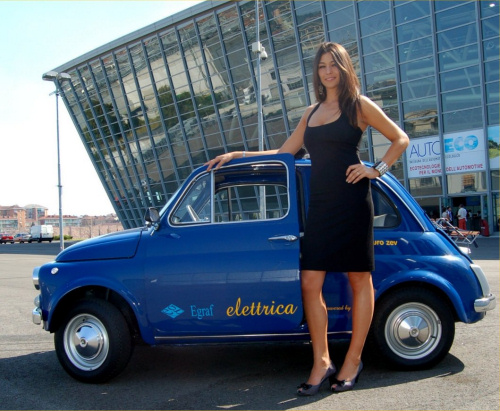
Fig 1. Chantal poses with the little 500 at the Ecoauto fair in Torino, September 2007. It is not a toy car, it is Chantal who is a tall girl.
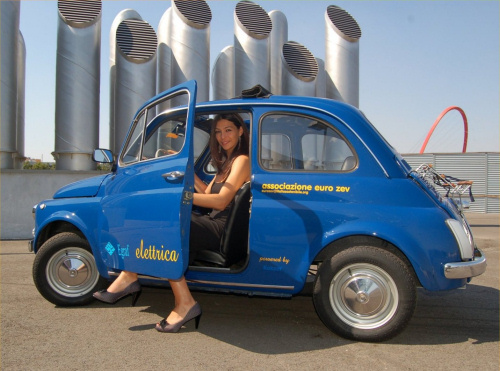
Fig 2. Nevertheless, Chantal can fit in, more or less. Picture taken at the Ecoauto fair, in Torino, September 2007.
It is always a shock when people understand that peak oil is about to arrive (or that it has already arrived). Reactions vary from utter despair to groundless optimism. Some people immediately jump to the conclusion that the great dieoff is just around the corner. Others, instead, are sure that some technological marvel will save us. In both cases, the bottom line is that there is nothing that can be done: either we are doomed, or someone will come up with the miracle solution at the last moment.
But passivity is never a good strategy. We can adapt; and if there are no perfect solutions for the incoming petroleum scarcity, there are at least some that may be good enough. That is why we built our retrofitted, battery powered Fiat 500. We don’t claim it is the first retrofitted vehicle in the world, nor that it is the solution to all problems brought by peak oil. But we do believe that it is an example of a way for maintaining some low cost transportation for the troubled times ahead. It is a true “post peak car” that has the additional advantage that it can be used for focussing people’s attention on the reality of the incoming peak oil
Let’s go more in detail. Why use batteries? Why retrofitting an old car? There is a chain of reasoning that led us to that. As we know, our transportation system runs on liquid fuels obtained almost exclusively from crude oil. With oil becoming scarce, we’ll have to cut on travelling and use more public transportation. But that can’t be the definitive solution. No country of the world has a public transportation system that can completely replace private vehicles. Expanding public transportation to that level would be so fantastically expensive to be unimaginable, especially in the difficult period that will follow peak oil. And, of course, it will take a while before we manage to raze down the suburbs and relocate everyone in towns. Transporting people, then, is only part of the problem: we also need to carry merchandise. You can’t use bicycles to bring food to supermarkets’ shelves. So, we still need vehicles able to carry people and things around.
The rush, right now, is all for synthetic fuels and biofuels. But that’s not the solution. Robert Hirsch showed in his, by now famous, 2005 report that we don’t have enough time and we don’t have enough money for building the infrastructure that would be needed to liquefy coal or gas. And even if we could somehow find the resources needed, that would be the perfect way to ruin an entire planet by generating a runaway greenhouse effect. Biofuels won’t do, either, too inefficient and needing too much land; not a good strategy if we also want to eat. In any case, the old internal combustion engine is so inefficient that we won’t be able to afford to keep using it in the post-peak world. Hydrogen cars could be more efficient, but the technology won’t be ready soon enough and the cost of the infrastructure that would be needed is out of this planet. In short, there is no technology available right now that could be used to make vehicles which don't need petroleum derived fuels and which have the same prices as those we have now.
But, if we can’t have everything, we can at least have something. The post peak paradigm is to do things that work; not perfect, maybe, but good enough. We can have clean and efficient vehicles that don’t depend on fossil fuels if we accept the limitations of battery powered electric vehicles. These vehicles won’t have the range and the performances we are used to, but are efficient, non polluting, already exist, and don’t need a specific infrastructure. The recent development of lithium batteries for traction is a small quantum leap that has greatly improved the energy/weight ratio of electric vehicles. But even the old lead batteries can propel a vehicle far enough to be interesting for an average commuter or for carrying goods around.
The strong point of battery powered vehicles in a post-peak world is their flexibility. Batteries can be recharged with anything that produces electricity. Normally, the existing power grid would be used and, in this case, electricity is still produced mainly by fossil fuels. But that is going to change: the energy that powers the grid will be increasingly produced by renewable sources. It is also possible to conceive stand-alone renewable plants dedicated to recharging vehicles’ batteries. In both cases, the batteries of electric vehicles will also provide an energy storage system; something that renewables badly need.
Despite the advantages of battery powered vehicles, if you shop around for a purely electric car you’ll find that a tiny, electric 2-seater costs more than a traditional compact car. Electric cars are expensive because they are made in small numbers and they are made in small numbers because they are expensive; a classic catch-22 situation. The big car companies never wanted to engage in making electric vehicles in numbers sufficient to escape this problem: surely you heard the story of the ill fated EV1, an electric car first created and then killed by General Motors.
The situation with prices may improve as electric cars gradually enter the market. But, in a post peak world, cars may never be again the inexpensive commodity we have grown used to. In a pre-peak situation, the common wisdom is that scrapping perfectly working cars for new ones is a good idea since, it is believed, it increases the GDP, creates jobs, etc. But in a post-peak world, you can’t afford to throw away things that still work. So, there comes the idea of retrofitting old cars: you change what you must (the engine) and keep what you can still use (the body).
The job of retrofitting an old vehicle is relatively easy. You get rid of the old engine and replace it with an electric one. Coupling the new engine with the old transmission is not the optimum in terms of efficiency, but it is the easy way. Lithium batteries won’t occupy much more space than the old fuel tank; lead batteries are bulkier and will need more creative solutions, but it can be done. Then you need a few more details: a voltage converter for powering the car’s electric system (lights and the rest) and an inverter in order to be able to charge the batteries from an ordinary AC outlet. The result is a vehicle that runs and is much more efficient than the old one. It won’t be able to do the same things that a standard internal combustion engine or hybrid car can do; it doesn’t have the same speed, power or range. But you have a form of transportation that can carry people where they need to go: commute in and out of town and carry goods from the supermarket to home. Even more important than that, a battery retrofitted truck can still take food to a supermarket. Also, a battery retrofitted ambulance can carry patients to the hospital; all that even in the most difficult situation of fuel shortage.
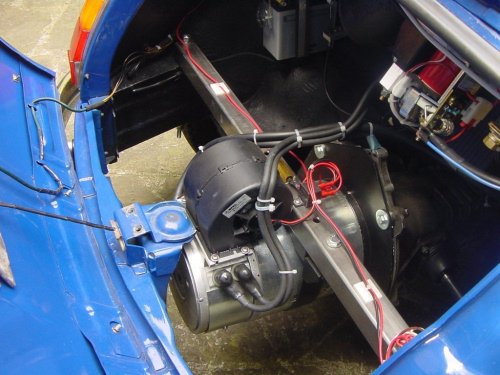
Fig 3. The electric engine of the little 500. It fits easily in the much larger space left by the old engine. Note also the lack of fans and cooling. The electric engine is so efficient that it doesn’t need to be cooled.
We experimented with these ideas using an old Fiat 500. It is a car designed in the 1950s that belongs to the generation of the “cars for the people,” of which the Volkswagen “Beetle” is the best known example. These cars were efficient, light, and inexpensive; much different from the present generation of hormone fattened McCars. The Fiat 500, in particular, was a marvel of engineering. Not much larger than a toy car, it could nevertheless carry four people. It even had built-in air conditioned in the form of a foldable hardtop. They don’t make them any more, but there are still at least two hundred thousands Fiat 500 running in Italy. Many are kept in tip-top shape by owners who are emotionally attached to their old “cinquino” (“the little five hundred” in Italian) but people also keep those cars because they are practical, inexpensive, and reliable. You can still easily find spare parts and, if you are careful to keep the body from rusting, the 500 can keep running forever, or almost so.
So, we took the old Fiat 500 (vintage 1970) which had belonged to Pietro Cambi’s father. We exchanged the old gasoline engine with an electric engine of the same power. We replaced the fuel tank with a pack of lithium polymer batteries. The whole operation took a few hours of work in a mechanical workshop. The result is a car that reaches approximately the same top speed of the original one (around 90 km/h). The electric engine has a much higher torque at low speeds and therefore you don’t need to use the transmission or the clutch pedal. Theoretically, with all this torque available, you could turn the little 500 into a mini-dragster, but the axles wouldn’t survive for long. So, the best way to drive it is gently. If you do that, the car will run for a good 100 km before needing to be recharged. If you consider that the battery pack contains about as much energy as a liter of gasoline, that gives you some idea on how much more efficient an electric engine is in comparison to an internal combustion one. [Ed: 100 km/l = 282 mpg (Imperial), 235 mpg (US)].
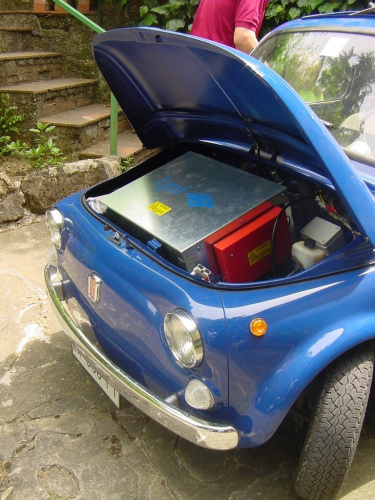
Fig 4. The battery pack. These lithium polymer batteries contain as much energy as about one liter of gasoline. Nevertheless, the engine is so efficient that the car can run for 100 km, if driven gently.
Recharging the batteries of the 500 at a domestic outlet takes a few hours for a full recharge but, in normal use, you don’t completely discharge the batteries, so that about one hour and a half is sufficient. At the present prices of electricity in Italy, a complete recharge costs about Eur 1.2. Since we have a range of about 100 km, it follows that the cost per km of running the car is about 1/5 of what was the cost using gasoline. We also have charged it using the energy produced by the PV panels on the roof of Ugo Bardi’s home. In that case the cost of the recharge is strictly zero.
Our idea with building this car was not just to have fun building a prototype (well, that too!), but to explore a solution for a low cost everyday transportation. We think that what we did is already very promising. The cost of the first prototype was relatively high (more than 10,000 euros); about the same cost of a small electric two seater bought new. However, the main cost was that of the batteries, still in their early stage of commercialization. In the future, we see costs going down with those of lithium batteries. We think that a retrofitting kit for a small car could eventually cost as little as around Eur 6000 - 8000; much less than buying a new electric car. A further advantage with a retrofitted car is that you know that spare parts for it will be available for a long time; something that you can’t be sure about in the case of a new car built by a small producer. In short, after this first prototype, we are already planning to make new ones.
The little retrofitted 500 is related to peak oil in more than one way. One of these is in terms of image. If you are involved with the peak oil movement, you are often accused of being a catastrophist interested only in seeing civilization collapse; of wanting people to return to rural times, only travelling by riding donkeys or camels. But the battery powered “500” is not a problem: it is a solution. Not the only, and not even the best solution to the incoming oil crisis but, at least, something that shows a positive attitude. And we seem to have been doing something right. The retrofitted 500 has appeared in Italian newspapers and in the Italian TV. We also exhibited it at motor fairs and public events. When people ask us “why did you do that?” we mention peak oil and we are bringing people’s attention the concept much more effectively than if we were going around showing bell shaped curves. That won’t change the world, but it is at least something.
Technical data
Vehicle: FIAT 500 F, built in 1970Engine: Separate excitation DC motor, 96 Volts. Nominal power 10 kW.
Batteries: Li-Polymer: 26 elements. Total energy stored 9.6 kWh (the same as approx 1 liter of gasoline).
Weight: ca. 65 kg
DC/DC converter 96/12 volts.
A little FAQ
“Can I do it with my old car?” In principle, you can retrofit any vehicle but the best is to do it with light, compact models.“How much does it cost?” The answer is “it depends”. The main cost at present is in the lithium batteries, but if prices keep going down as they have been doing during the past few years, we estimate that soon a complete retrofitting kit would cost around Eur 6000 - 8000.
“Can I drive it on public roads?” Again, it depends. We know that in Germany, Switzerland and in the USA it is easy to get a retrofitted car approved for road use. In other countries, such as Italy, it is nearly impossible because of the bureaucracy involved (ours runs on public roads because it is a prototype with a special permit). In other countries, you have to check with the local authorities.
“How about insurance?” We found no problems in insuring the electric 500 for a reasonable price.
“Does it need special facilities for recharging?” No, you can recharge it with any domestic power outlet. In some countries you can also use public recharging facilities along the road.
“Is it safe?” The retrofitted 500 doesn’t have all the tricks that the last generation of cars have: airbags, reinforced body, etcetera. It wouldn’t be safe to drive it on highways or at high speeds on any road. But this not a car that is designed to go fast. It is designed for urban or suburban transportation and, if you go slow, then it is safe.
“How does it feel to drive it?” Like an ordinary car, but the only noise you hear is a soft humming and the engine has a higher torque at low speeds. You still have the clutch pedal and the shift lever, but you don’t need to use them, except for backing up.
“How about maintenance?” Almost zero. No oil to change, nothing to lubricate, no tune up needed. Lithium polymer batteries should last thousands of recharging cycles, that is for more than 100.000 km. An electric engine is normally supposed to run for the equivalent of a million kilometers. The rest of the car will last as long as you’ll take care that it doesn’t rust.
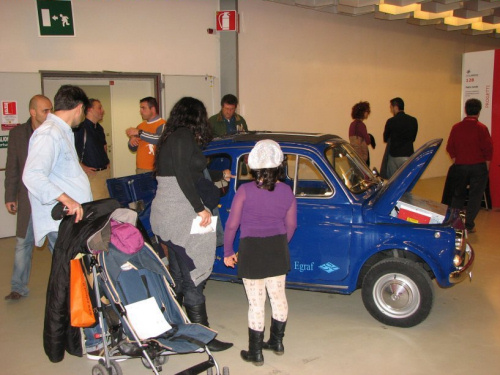
Fig 5. The electric 500 at the creativity fair in Firenze in October 2007. Pietro Cambi is the one at the back, discussing with the guy with the orange sweater.
Acknowledgment
The electric 500 was built with the help and the dedication of a group of people who contributed for free with their time, money, and expertise. Among the people who contributed: Pietro Cambi (commander in chief and owner of the old 500), Ugo Bardi (peak oil theorist and bard of the enterprise), Debora Billi (pasionaria and media manager), Riccardo Falci (electric racer and vehicle assembler), Massimo de Carlo (our battery man), Francesco Meneguzzo (our man in Rome), Corrado Petri (engineer extraordinary), and Ringo Reemberg (tester and international ladies’ man). We also thank Chantal (we don’t know her last name), professional model who agreed to pose with the retrofitted 500 at the Ecoauto fair in Torino in September 2007.Where to learn more
See the site of the non-profit association called “Eurozev” www.eurozev.org
See the little 500 running at:
www.youtube.com/watch?v=KjIOb5m-DDU
www.youtube.com/watch?v=Ee4v7nlUM9M
Previously on The Oil Drum
Saving 20 million barrels a day. The 100mpg hybrid car should be here, now!The electric wheel - a breakthrough in car efficiency
Personnel
Editors
Contributors
Peak Oil Primers
Archives
- November 2010 (3)
- October 2010 (6)
- September 2010 (4)
- August 2010 (7)
- July 2010 (6)
- June 2010 (7)
- May 2010 (2)
- April 2010 (8)
- March 2010 (4)
- February 2010 (6)
- January 2010 (3)
- December 2009 (5)
- November 2009 (8)
- October 2009 (12)
- September 2009 (6)
- August 2009 (5)
- July 2009 (11)
- June 2009 (8)
- May 2009 (16)
- April 2009 (10)
- March 2009 (7)
- February 2009 (10)
- January 2009 (15)
- December 2008 (9)
- November 2008 (9)
- October 2008 (9)
- September 2008 (13)
- August 2008 (10)
- July 2008 (14)
- June 2008 (23)
- May 2008 (16)
- April 2008 (12)
- March 2008 (16)
- February 2008 (9)
- January 2008 (13)
- December 2007 (13)
- November 2007 (16)
- October 2007 (22)
- September 2007 (8)
- August 2007 (9)
- July 2007 (16)
- June 2007 (8)
- May 2007 (7)
- April 2007 (7)
- March 2007 (10)
- February 2007 (10)
- January 2007 (12)
- December 2006 (9)
- November 2006 (15)
- October 2006 (4)
- September 2006 (5)
- August 2006 (5)
- July 2006 (9)
- June 2006 (5)
- May 2006 (10)
- April 2006 (9)
- March 2006 (13)
Vital Trivia
License

This work is licensed under a Creative Commons Attribution-Share Alike 3.0 United States License.
Ugo fascinating article, could you answer some questions:
Lithium batteries: can we mine lithium in sufficient quantities to power hundreds of millions of cars?
Electric cars have been more expensive than traditional cars with Daimler or Diesel engines since Porsche's hybrid in 1901. There was a lot of research on electric cars also during the 1970s again without successfully lowering costs. Is is engine complexity, expensive raw materials or something else?
Looking at figure 4 it seems as though the cargo space is mostly gone. Or was the fuel tank at the front in the Cinquecento?
It seems that the Cinquecento became lighter, is that the case? What's the weight difference?
I also have a question about the AC, how does it work in the Winter? You just close the hardtop?
100 Km per litre at 1.2€. What else can we ask for? Hearing Ugo singing perhaps.
Luis, good question about lithium availability. I should have added a note about this point in the FAQ. Anyway, lithium is not so common in extractable form and there are claims that it would not be enough to make enough batteries to replace the present fleet of cars. See for instance:
http://flashlightnews.org/story582.shtml
This claim is basically correct within the assumptions that the author makes. There is not enough lithium in the world for the automotive industry to keep growing as it has been doing so far: building more cars and bigger ones. For that matter, there is not enough copper for the wiring, not enough platinum for the catalytic converters, not enough fuel (of course!) and probably not enough of several other materials.
But when we speak of a "post peak car" we are thinking of a different paradigm: smaller numbers of cars and lighter ones. Taking into account that lithium batteries can be recycled, I think that there is enough lithium for what we have in mind, that is for maintaining a basic form of transportation based on road vehicles. As we say in the paper, though, cars will never be again the inexpensive commodity we grew used to.
About winter heating, using the batteries for heating the car is possible, but it is a disaster for the vehicle range. Some electric vehicles have independent, gasoline powered, heaters. Fortunately winter in Italy is not very cold, so we don't really need that. Anyway, as I said, it is a different paradigm, it is more like driving a motorcycle or a scooter. In that case you don't expect to have a heating system!
And, well, I could sing if you really want!
Ugo
Ugo Bardi
www.aspoitalia.net
I have an EV Heating system that would both warm the passengers and EXTEND the range of the vehicle.. add Pedals!
I am serious.
I do accept, however, that this would probably not work in many Retrofit EV cars, it would have to be designed for this purpose. (Another Poster suggested I look at http://www.twike.com/english_informations.html when I mentioned this the other day..) I would seriously like to see what kind of range you could develop with the ability of all passengers to 'Help Push their own Cart', since we know we are strong enough to move our own weight at some 20mph.. then add a couple PV panels to the roof for a few hundred watts of regeneration while you're at it.
Thanks for the article!
Bob
Well, let's see. A person in good physical shape can provide a power of around 50 W for extended periods of time. The 500's engine has 10 kW power, but that's an overkill; normally you need just a few kW to push the car on. So, let's assume that two people are pushing; they could provide about 5% of the power needed. It is not much, but surely they would keep warm!
About PV panels on the roof, Pietro is working on the idea. But, of course, it is not enough to keep the car running. It does something, however.
I keep thinking of those times when I've had to push a car and try to steer it at the same time.. this would help then, too!
I guess the comparison that has to be kept in mind is not just the amount of PROPULSION that is getting replaced by whatever pedals and pull-handles that passenger can offset, but in this case, the amount of HEATING energy that would have been needed as well.
Of course, in a thorough analysis, you would include the health benefits, too.. although this argument will still get little more than a cursory nod in the American 'Enriched Flour Health-Muffin' Culture no matter how many lives could be improved and saved with the addition of a modest amount of exercise.. It would be considered 'Icing on the cake', to put it in that current frame of mind, and not one of the bare essentials of keeping our bodies alive.
I would also want pedals to work in a 'Hybrid' mode, where they could be used to push some Amps into the batteries, too, while the car is stationary. This might be further connected to a simple drive connector to the outside of the car, where creative vehicle owners will come up with their own inputs, like their kids swingsets and merry-go-rounds, the dog's tie-rope, a link to a windmill or waterwheel.. like with Plugin Hybrids, I'm a believer in designing in a range of input/output options. All sorts of creativity can then be facilitated.
Here are some 'Panels on the Roof' that are proving themselves today. Surely, they do not Drive the vehicle entirely by themselves, but they are bringing in offsetting power while Driving, While Parked, at the StopLight, etc.. AND, they're waterproof!
http://www.youtube.com/watch?v=zFYpNrbyKCA
Bob Fiske
Actually, a normal person can produce 100 watts for maybe several hours, and even up to 300 for a short burst. Supermen can put out near a kW for seconds. (D.G..Wilson, Bicycling Science, MIT Press). And of course, as you say, pedaling is a real good way to provide warmth on cold days, not to mention, keeping fit!
Now, all this concept needs is my super-duper automatic transmission that allows a constant high speed light motor to match torque demand at any road speed, and we have a winner.
Thanks, Ugo, for a fascinating and very well-written offering. I am enthused!
If by "normal" you mean fit young male, then yes. For the rest of us, sustaining 100W for several hours is an unattainable goal ;)
Fit young European, actually, "Fit" young Americans- seems the right number is maybe 70 watts.
Another observation- when I was a kid slaving away on my father's farm, a sack of feed was 100lbs. I could carry one of them, and some guys carried two at once. Nowadays, a sack of feed is about 40lbs, and people gripe about too heavy.
I figure the evolutionary destiny for homosapiens is a speck of an eyeball glued to a PV powered TV set orbiting the sun. The TV is showing Tarzan reruns.
A sack of cement used to be about 100 pounds (50 kg) when I was a kid. Today they are about 50 pounds (25 kg). Guess if people complain about the weight?
People are getting weaker, fatter and dumber by the minute here in Sweden too. I guess the same is true for the rest of Europe. Sweden might be the most "americanized" country in the EU though.
Has anyone considered using the lead composite batteries made by Firefly Energy? What would be the tradeoffs?
"What would be the tradeoffs?"
Umm...their non-existence?
I can't find the link just now but I believe Firefly recently did a press release saying that Firefly lead acid batteries will be available in 2008 in group 31 truck battery format.
As Alan Drake would say, and I really can't resist this one:
Best hopes for 2008
Carbon - Coventry UK
On lithium production, at interesting start is the table below by USGS (U.S. Geological Survey) giving historical production in metric tons:
http://minerals.usgs.gov/ds/2005/140/lithium.pdf
Part of the problem with lithium is not raw supply per se, but the fact that it is always found in a compound, never as free lithium. It is the 23rd most abundant material on Earth, but must be released from whatever compound it is attached to (there are huge quantities, even in seawater), usually by electricity. I do not know the cost of this.
Ecomomics of course would be a huge factor. To this point the market for lithium has been very unstable, so the price and production has veered based on the need for the substance. Also, the lithium battery makers have made it a stated goal to reduce the volume used as much as possible in the battery, without reducing electric storage capacity, i.e., reduce waste of the material. This is of course beneficial to them, as it reduces the weight and cost of the batteries.
I am waiting with baited breath to see what the A123 batteries can do, as they seem to be at the cutting edge on battery technology, and due to their sales in the rechargable power tool market, are already working at a scale that few other advanced battery makers are (no others that I am aware of.
As far as climate control, that is interesting. Peak Oilers seem to base all scenarios not on a "less fossil fuel scenario" but on a "NO fossil fuel scenario".
This has been a rather recent prostitution of the Peak Oil theory that is extremely disturbing, as it creates scenarios that are frankly just plain wacky, and mathamatical modeling that goes off into what I can only call "black hole" physics modeling, and reduces the validity and the acceptance of the whole peak idea. Remember we used to beg people to recall that "peak" does NOT mean we are out of oil. But those reminders are now ignored even by insiders in the peak movment.
What does all this have to do with car climate control? Well, several years ago, I recall that a Toyota was seen at the companies test grounds that was designated as an "electric car" but it has a tiny exhaust pipe. and an electric plug in port.
This led to hopes that they were working on the vaunted "plug hybrid". Toyota said no, it was an electric car, but it has a small fossil engine for climate control and to drive certain accessories. This is interesting, in that the "fossil engine" could have been natural gas, propane, butane, Diesel, or for that matter, even recaptured methane from waste, some type of biofuel, or gasoline. The volume of fuel consumed would be so small that all current fossil fuel/flammable fuel would be open for discussion, completely altering the economics of the energy market.
I think a small hybrid using the fossil engine for climate control, recharge for range as needed, and to drive some accessories is still a very workable idea, and would create efficiency gains unheard of, even undreamed of, in the history of transportation.
But to accept that idea, one must accept the idea that some, at least some, fossil fuel will still be available in the future.
That is an idea that seems to be no longer acceptable to many in the peak community, astoundingly.
RC
That ultra eco TWIKE electric cycle thing that was mentioned on drumbeat a few days ago has an option for a WEBASTO Airtop 2000 diesel heater.
http://www.twike.co.uk/documents/TWIKE_UK_Prices_2006.pdf
Although, as you point out if you're gonna have a diesel engine in an electric car, it'd be more useful as a generator.
'Course being a small diesel, it could be run of biodiesel to avoid FF.
Which is more efficient - direct fuel burning for heat, or reverse-cycle aircon, which might give you say ideally 2.5 times more heat than the electric used, but you've got all those losses converting to electric...
---
I think your reminder about slow depletion is well made.
I was thinking about that myself just yesterday, and my planning - I think maybe it's got something to do with the news around the economy and artic GW etc, and a feeling of 'might as well plan for the worst now'.
Really not sure - but I think you're quite right on this one - and it's one of the aspects that really annoyed me over at PeakOil.com before I left...
Yet, the people who remind us that there will always be some oil seem to fail to acknowledge the physics of a sphere in space:
FINITE LAND
FINITE FRESH WATER
FINITE CARRYING CAPACITY.
What is truly annoying is this belief that we all be living pretty much as we are except our cars will be small with electric engines. THIS IS IMPOSSIBLE!!!!!
Those people who wish to squander cheap energy in order to perpetuate the techno-fantasy world are essentially sociopaths. They do not care about the holistic effect of continued technology use. They only care about feeding the infantile, grasping technophile's desire for cool stuff.
They would kill off the human species and a hell of a lot of other species just to be able to drive a little blue car with electricity.
INSANE!!!!
Cherenkov,
While I usually would not take the time to even reply to someone who refers to those who differ from his worldview as "sociopaths", what the heck, it's a long holiday weekend, so I will waste some time....
First, I notice you did not enter the discussion of whether peak oil means "no oil", and instead veered into other realms, other problems, essentially restructuring the issue. So be it.
You said "What is truly annoying is this belief that we all be living pretty much as we are except our cars will be small with electric engines. THIS IS IMPOSSIBLE!!!!!"
Perhaps, but we may want to avoid "letting the perfect be the enemy of the good."
At this time, we have people driving large cars with large gasoline engines. While small cars with electric engines" may not be perfect, at this moment, even getting folks to move away from large cars with large engines is a tough enough hill to climb. "The journey of a thousand miles begins with one step" say the Budhist thinkers.....gee, they may be right.
"Those people who wish to squander cheap energy in order to perpetuate the techno-fantasy world are essentially sociopaths."
Leaving aside the name calling, the issue is transportation. This is not normally viewed as a sociopathic human desire but goes back to the roots of human history. That is why most early cities were built near rivers or the ocean. It explains the existance of canoes, sailing canoes, Chinese junks (exquisite engineering there!). It explains the sailing ships, the clipper ship, and finally, the change over to steam, the railroad, the steamships, and finally autonomous vehicles such as autos and trucks. Imagine that, 10,000 years of sociopathic desire for transport!
Now the time may come when people will give up the "sociopathic" need for autonomous transportation. They may have to. If communal transport is truly efficient, safe and comfortable, they may even want to. But that may be awhile away. In the meantime, the attempt at seeking at least a less wasteful path does not seem "sociopathic".
The other three issues you hurled out were,
FINITE LAND
FINITE FRESH WATER
FINITE CARRYING CAPACITY
First, on carrying capacity. I do not know what the carrying capacity of the Earth is. I suspect you do not either, but if you do, I applaud your wisdom.
Population in the developed world, minus immigration, is flat or dropping.
One assumes that if access to birth control and cultural barriers were reduced in the rest of the world, this would be the case there to. Either way, it's connection to using electric cars seems to be only this: If we can use small electric engines instead of giant gasoline engines, the carrying capacity of the Earth may be enhanced.
On fresh water, I am not certain that automobiles are the prime user of fresh water in the world. If I am wrong, correct me.
Much fresh water is wasted, indeed. Simple measures such as low water use toilets, efficient showerheads, and grey water systems can save a great deal of water. Less wasteful water use in agriculture, water recycling in industry, and better catch and use of rainwater all could have huge effects. Would it not make more sense to encourage those than going on wild attacks against mobility? Just a thought.
Finite land. Again, I am certain that highways are not the prime consumer of land. However, it is true that enhanced use of transport makes "urban sprawl" a greater possibility, as we see in sub-urbanization. However, it would be very hard to push the total population back into city centers, as some seem to hope for. The overcrowding was what helped many folks want to leave the city centers to begin with. With a larger population, it would make the Warsaw ghetto seem almost humane by comparison to the city centers we would have if we attempted to force the population back into them. Honestly, many would fight to the death to avoid such a fate.
Verticalization and somewhat greater density in many areas would reduce land use, and of course, more efficient farming practices could create food on hopefully as few acres as is needed for the job. Again, we seem to be veering greatly away from the idea of greater efficiency automobles.
"They do not care about the holistic effect of continued technology use."
?????????????
I can only assume that you must mean that what is needed is a ceasing of "continued technology use". This of course is the "primitivist" and "anarcho-green-primitivist" dream. I will leave it to you to attempt to persuade the rest of the world they must abandon all technology, which for many would mean instant or near instant death. Many will fight you to the death, because to accept your agenda would mean death. They would have nothing to lose.
But, it is your right to attempt to gain converts to your cause. I will not wish you luck on this venture, however, as I am one for whom it would mean a very short lifespan.
You would think I have gone long enough, but I must address one absolutely fascinating thing. The absolute fascinating raw hatred of individual transporation. What causes exactly that to draw out such passionate hatred?
I was talking to a woman the other day, and mentioned that I had used the air conditioning in my home only about 4 days last summer, when I had guests, a summer that was quite hot. She very quickly said that hers was on ALL summer. Even though she was out of the house most of the time, she said, she had cats, and they could not survive a closed house in those hot summer months. Likewise, the house must be kept comfortably warm for the cats in the winter, meaning she does not turn down the thermostat. Think of that, heating and cooling a 3000 plus square foot home for a couple of cats!!
I began to think about the "sacred cows" of humans that escape the raw passionate hate that is reserved only for the automobile:
Pets. How much do they consume in heat, air conditioning, food, medical attention?
Lawns: Speaking of your freshwater, pesticides, herbicides, land. Millions of acres of carefully cultivated land that produces grass clippings!
Appearance: Jewelry, accessories, clothing, leather goods, cosmetics. How much consumed in mining for metals, pearls, silver and gold, gems, animals for leather goods, handbags, billfolds, chemicals for cosmetics?
Exotic foods and wines. So varied I cannot even hope to explain.
Excess packaging on all of the above.
Vacations. How many years would it take for the "little blue techno toy" to match what an airliner would use going to Europe from the U.S. one time?
Do you see what I mean? It is the automobile alone that is the target of an almost psychopathic (opps, I'm getting into your turf :-), hatred.
Is it really the energy use that is the issue? Or is it the idea of personal mobility, the freedom to leave one place and go to another, to seek employment and education at some distance? Does the idea of people, regular people having some freedom to move about strike something deep in the elitist psyche? What exactly....it's an interesing line of thought, indeed...
Oh well, enough fun for tonight! :-)
Great comments Roger. While I understand Cherenkov's frustration with our unsustainable living arrangement, I can only see changes coming in a multitude of small steps, such as the ones to which you refer. The value of this electric car is not as single point solution, but as a foundation for further changes, and as one of many ways to live more sustainably. I think it is more important to laud those things that move us in a positive direction than to criticize them for not meeting ideals. Good job ugo, keep it up.
budr
Thanks, Budr. Very interesting comment, Roger
If there was hatred of personal mobility, then maybe 150 years ago there were elitists who hated horses and all that they represented?
Seriously, this is the second time you mention elitist hatred for ordinary man having a car and thus, personal freedom (first time you referred to Kunstler). You made me think because since I've learned about PO and related energy issues, I started to feel more and more disgusted about cars and car culture in general. Before that, I was thinking of buying a large, new car. Did I become an elitist?
Then it occurred to me that the problem is not in the base premise but in what it degraded to-instead of personal freedom and mobility, you get freedom of crawling through crowded streets in attempt to get to work. If you live in the city where there are never enough parking lots or garages, you have freedom to wander the streets looking for place to park. And as list of "freedoms" goes on, you start to wonder: Is it really worth it?
One other thing that bothers me is inequality and injustice. What about personal freedom and mobility for citizens of poor countries? Is it possible that all 6,5 billion people have a car and "leave one place and go another"? Aren't we all hypocrites and elitists when we believe it is our natural right to have a car that runs on cheap fuel and costs us no more than 10% of our budget?
I would change my mind about all this if I see that it's possible for all the people to have such freedom and that freedom doesn't cost us our environment and the planet. It is nice to believe that maybe if we all drove nice little Fiat with electric engine, everything would be OK. Let's hope..
The issue is do we want as soft a landing as possible, or a hard landing. Anything we can implement today to lesson the effects of the crash will be far less scocipathic than wanting a severe crash.
Irrelevant. World population is increasing, and that is pouring over into developed countries through immigration, that then opens the door for more population growth in developing countries that are now over populated. Allowing for immigration is actually making our over population problem worse.
Richard Wakefield
It's an old Internet truism that you can spot the crazies by their use of capitals and excessive exclamations.
Try that for INSANE Bob.
Rather than look at the nature of personal vehicles and the environment they engender you lot will take the world to the cliff and drive it over in cute little Disneyesque blue vehicles. (plus a FF engine for 'climate control', code I guess for air conditioning?)
A few pen strokes could change zoning and 'city' planing and relatively quickly eliminate the need for those personal energy and material draining devices, but that is not being even considered, much better to build little blue tech band-aids and decry those like Cherenekov who get apoplectic when suffering the idiotic.
I think the copper could be better used in Alan Drakes Trams and trains , what do you think?
I am not under the delusion that what I think will make any difference whatsoever. Nor will the recommendations of a few concerned activists stop the masses wanting personal mobility. It is truly idiotic to think that engineers have any real influence on how people behave.
Technology is a red herring, the elephant in the room is overpopulation. The "technology" to solve that (i.e. birth control) is already in place.
Ask Cherenkov what he is doing about population growth. You will find he has more children than I have.
You have children? I have child:)
Still one more than me ;)
Bob,
I also have no children. So far the combined output of myself and my siblings (4 of us in total) has been 3 children.
The other day I counted and the combined output of all my cousins is less by a fair number than the total of the cousins! We're shrinking! :-)
(I recently saw an interview where it was stated that Matthew Simmons had 4 daughters....I said, no wonder he's worried! :-)
Now, how about pets? :-)
(I have none)
RC
I had 23 uncles and aunts and a dozen cousins, my son has one uncle and no cousins. Terrible time to be born into...alone at the end of the world.
Bob Cousins,
Regarding capitalization. Gosh, I hope you are not saying that punctuation and capitalization are more important than arguing my points, because that would make you the crazy one.
On population growth. Yes, I have two children.
Given your take on technology, I must presume you also lead me in indirect deaths through technological mayhem. That is the irony of such bad thinking. Overpopulation is indeed the elephant in the room. However, you use it as a cudgel to beat those who do not agree with you.
I am actually an advocate for several measures to counter population growth. Fortunately, my humanistic take of life means I will be unwilling to accept the technophile solution of "just keep going out on the limb and hope it don't break." But, break it will. Whereas my solution is the spread of free birth control, anti-growth education, and the immediate reduction of fossil fuel use ala Heinberg's protocol, your solution seems to be, "Hyuck, hyuck, hyuck. Us engimageers cain't possibly have no influgance on no people. That would be just dumb. Let's keep a usin' stuff up and see what happens."
Euphemism Check..
What's wrong with Band Aids? You use that term with a sneer, but if we're suffering this death of a thousand cuts, don't you think a few BandAids might be a useful part of the solution? Yes, we need to think about the Big Picture, too.. but in the meantime, will you be riding in no more vehicles at all? Will you ride in a vehicle that continues to Bleed Petroleum out of our future supply, or will you use some Band Aids where you can?
When you call them 'Cute' (and even your use of 'Little'), you are clearly suggesting that they are useless, irrelevant. The people they carry are Not belittled versions of the millions who have to travel to be part of their daily lives. There are surely those who are heading straight at the cliff. But the People developing these vehicles ('You Lot') are clearly trying to turn away from that fall.
Lots of Copper - Should certainly be used for Alan's plans.. but ALL of it? None of these solutions solves the WHOLE problem, does it? So taking ALL the materials from these vehicles and putting it ALL into the plan you endorse is part of this mentality that still wants to find that mystical ONE thing that will solve it all.. an Understandable, but Unreachable Fantasy. Just like the question high on this Topic that asks if there is enough Lithium to make Hundreds of Millions of vehicles, with the clear implication that 'Your Plan Fails, because it will not replace ALL vehicles'.. An unhelpful direction to take these discussions, resting only on Hyperbole and Extremes.
Bob
Cherenkov does get Apoplectic AND Idiotic AND Infantile when he rants against things he sees as Idiotic and Infantile. I know the challenge of trying to exercise patience with someone who is being IMpatient.., trying to be Mature in the face of a childish conflict.. it's not easy and I hope Cherenkov notices it when he's drawn into this kind of 'Mirror Behavior', as I hope I can keep from being Drawn In myself. Sometimes I manage it..
Thanks, Jokuhl.
I don't need anyone to apologize for my rants.
I am truly tired of the calm talk. The valium talk. The blah, blah, blah, until we all go to sleep while the "adults" accomplish plenty of talk, but no action, or worse, the wrong action.
Infantile is an entire society based on growth, a gimme, gimme, gimme society of little baby hands all opening and closing for what they feel is justly theirs.
Infantile is a country that allows its corporations to put dangerous cancer causing chemicals into its products while Europe bans such products.
Infantile is a bunch of people who feel that they are so important that the rest of the species on the planet can just go bugger off.
Infantile is a user mentality that uses up the planet, uses up different cultures, uses up people. An infant is a user which we tolerate for a time. Why do we tolerate all the "adult" users who keep whining and crying for their toys no matter how quickly it kills the planet, no matter how many future generations suffer horrible lives and deaths.
All of this because we cannot make a plan to stop growth, to stop the cancer, to stop our planet-killing juggernaut. All this because we need a little blue car to haul our fat butts around.
I do not get either idiotic or infantile. Apoplectic, yes. The others no. My points are irrefutable. Physics is on my side. That I choose to mock, to be sarcastic, to be willing to actually call things as they really are, is a calculated ploy. If I return to the somnolent murmurings of the sleepy-headed sheep who keep trying to figure out how to keep the techno-dream going, then I BECOME ONE OF YOU!!!!!
A DAMNED ENABLER!!
Then I would become just like you, one of the "good" Germans who looked the other way while the NAZIs plucked people off the street and beat dissenters to death.
The time to be LOUD is NOW!!!
NOW, while we still have time. Not when the plane is traveling 600 miles per hour towards the ground with only sixty feet left.
NOW!!!!!
Sorry, if my caps made any of the feebleminded here lose track of my points. Perhaps if you weaned yourself from the MSM for a few weeks, you could blow out the pipes and think straight for once.
Cherenkov;
Now is the time. Absolutely. But is it the time to shriek at the people who post on TOD that they are 'The Good Germans'? Actually, we could do worse than trying to be as good as the Germans today.. but I know the ones you meant. Who do you think is posting here? What do you think these people are like in their real lives, and not in the caricatures that these silly names become in our imaginations?
I do hope that if you are so tired of this ongoing Talk-talk, that part of your solution is not just to scream instead. You probably have at least a glimmer of a suspicion in your boiling head that while the short-term effect of yelling is that it turns some heads your way, that the next response if the hollering keeps up, is to move away or at the very least, to STOP listening. So do you have any actions that you feel are worth working towards? Planting food, Teaching Neighbors, Reducing your own consumption.. or are you so concerned that you, like us 'Might be taking an errant step in the wrong direction by trying ANYTHING..' that you've concluded it's better not to do anything except rail against any internet post you object to?
You are not screaming at the mainstream here.. don't believe it. Priviledged, largely Westerners with computers, I'll grant that.. but this is not a crowd that is lulled into a drowsy complacency..
"The blah, blah, blah, until we all go to sleep while the "adults" accomplish plenty of talk, but no action, or worse, the wrong action." - I've heard examples of a great many of the posters here taking real actions, whether it's on their own consumption, on policies and projects, on outreach (which is talk, to be sure.. but you won't hear it if you're expecting anything effective to be broadcast with the Knob turned up to Eleven)
I'm not nuts about insisting that you are infantile.. I actually think infants are very smart and aware, and have largely not yet learned or been forced to shut down or get buried in restimulated ranting and addictions as many older members of our society have had to, what with all the brutality and dishonesty that we grow up within. Infants cry and bawl because they need to get it out.. (probably a lot more when birthed with Western 'Medical Emergency' techniques) so it's actually very appropriate and healthy for them to do so.
"...you could blow out the pipes and think straight for once." You've been blowing out your pipes all along, as far as I can see, and yet Straight is not a word I would use to describe your thinking. You do see what's going on, and I hardly disagree with your points about how broken our basic system is.. but you use it like the hammer seeing everything as a nail to bash. Where will this get you?
Bob
Reading your post again..
'Feebleminded' -
There it is.. it's like people who overuse the MF'er because it seems to sound strong. Do you think that using a lot of Caps and Exclamation marks is an indication that you are NOT being feebleminded?
It's just the opposite.. you continue to weaken your argument and your reputation when you have to synthetically bolster your words that way.. and it seems to be obvious to everyone but you yourself.
Bob
No, we get your point perfectly. You are saying "I am a raving lunatic and I need medical help".
Back in the old days, mentally deranged people would stand in the street yelling at passers by, now they do it on the internet. Plus ca change.
Johkul,
Bandaids are okay used in the right places but if we use them to cover our asses that merely implies an obvious result:)
Those little cars will merely distract and not solve anything and while Drakes solution is better, I doubt that it will in itself solve anything but at least it is headed in the right direction. We are at a point where lifeboat drill is the order of the day but the captain and his crew are drunk and disorderly and the passengers talking of the days amusements. This time it's a festival about tootling about in little blue autos.
Cherenkov might look idiotic and infantile waving and shouting that a big Fossile Fuel behemoth is bearing down on us but less idiotic than those who just send up a lot of piss and wind . Also I like Cherenekov's humour and sense of the ludicrous. I remember a bit of childhood doggerel, to wit:
Gene gene made a machine,
Joe Joe made it go,
Art art blew a fart and
blew the whole machine apart.
We need the art of Cherenekov and his like or Gene's machine will bury us.
"This time it's a festival about tootling about in little blue autos."
No. It's about getting to work without burning oil.. the existence of motorized vehicles is not the problem, it's the misuse/overuse of an otherwise useful tool, running on a dirty and limited fuel source.
We've gotten spoiled by cheap energy into the assumption that we can live with a MUCH greater reach in our daily travels than can be supported. That doesn't mean that cars are intrinsically evil, any more than money would be. It also doesn't mean that everybody will own a car, or even want one as the costs start becoming more realistic.. but it might be that an extended family would own a car, a scooter and a small pickup amongst a dozen or more people, if that's what the economics allowed. Electric vehicles might be carrying Actual Band-Aids, and getting people to hospitals, tho' they'd of course have to settle for 'Toodling' to the hospital, as driving would apparently no longer be possible.
I did like the Fart poem. Thanks for that.
My problem with Cherenkov is that I think his online Persona is wasting a lot of energy, and not having a very useful effect (lousy traction, excessive friction).. while I know that he does have 'some' fans.. it's poor EROEI.. it bugs me, especially since it detracts from other posters' energy as well. He seems to paint this as being the 'rebel truthteller'.. the points themselves are valid, but the volume pushes people away, and I think, devalues the argument in doing so. It's like an abuse of power, where the net result is you're just making your work harder and harder.
Bob
"Theres a place in the world for the angry young man
With his working class ties and his radical plans
He refuses to bend, he refuses to crawl,
Hes always at home with his back to the wall.
And hes proud of his scars and the battles hes lost,
And he struggles and bleeds as he hangs on the cross-
And he likes to be known as the angry young man."
- Billy Joel
If anyone is pissing into the wind, it's Cherenkov.
Sorry, but is also about the infrastructure that makes the automobile lifestyle possible. That cement don't come cheap in FF use nor does all the asphalt and assorted traffic toys as well as the restrictions to sensible modes of travel from walking to rail all screwed by the dependence on personal (NOT PUBLIC) FF transportation devices.
Well let me know when the second coming happens but until then I don't see that there is any poster or group of posters here who can be all things to all men, each of us can have a part to play and I think Cherenkov plays one and does it well, if loudly. Maybe wakes up the dozing, maybe attracts new blood maybe makes you look at what it is that disturbs you by his action. I don't think the problem is fossil fuel or energy and how it is used or even Cherenkov as you seem to think:), I think the problem is US.
For one thing we tend to think our opinions are us and doing that makes them immutable and that makes change very difficult. I think that holds for myself as well as most, if not all, posters here.
Hey Cherenekov, sorry about using your body for a battle ground but needs must as the devil drives :)
I have no problem with opposing the burden we've set up for ourselves, the way our roads and highways are constructed, and the sheer mass of them, at this point.. but as with Population, these will crumble and fade down to a lower level as our energy drops..
that is still not to say, and it would be silly to suggest that we will stop using wheels and motors to move ourselves and our supplies from place to place, and that we will have paths, streets and roads to do it with. As our Legacy load of monster trucks and old I-beams find their way to the smelters, there will be a supply of metals that will be going into rail, into cars of some sort or another- certainly not your daddy's oldsmobile.
A buildout of intercity and intervillage rail is essential, and it's probably inevitable.. just long overdue. But there will be lots of things to move around where there aren't tracks available. I'll bet that a whole LOT of them will be little electric vehicles.. and some of them will be blue.
The article in Drumbeat about Chicago making their alleyways out of Porous Concrete and Asphalt was interesting. Our roads will be fewer and a lot of lanes narrower, and will probably start to get made from other things, including back to dirt and gravel in many many places. But there will still be roads. Do you doubt that?
Bob
You may very well be right, but personally I am hoping for quiet paths in the forest for my sons child, when he has one, and Ayahuasa in his medicine pouch to keep him on that path.
In between as you seem to say just NOISE!!! AND STUFF!!! and likely a lot of blue things, I think mostly people though:)
BTW here is something my wife just noticed about the UN talking about Iceland being the best place to live. Hmmm wonder how many little blue cars in Iceland?
http://news.yahoo.com/s/nm/20071127/lf_nm_life/un_development_index_dc
If not many now, probably many in the near future. With high-temperature geothermal resources to provide electricity, Iceland could be the first FF-free country in the developed world if/when it switchs to all electric transportation. That should add to it's no. 1 ranking for quality of life.
The Blue one is on the second row...
"BR Car Rental has been in operation for over 20 years and has for that period always provided good services and high quality cars.
"There are many thing unique about driving in Iceland. Many rural roads in Iceland are gravel roads not suited to fast driving. Please drive carefully and show other road-users consideration at all times.
http://www.randburg.com/is/cars/
"BR-Car rental is located only 5 minutes from the Keflavik International Airport."
re: Noise!!! .. remember, with an electric car, it's only Noise!
Best, Bob
(My wife just told me I look really sexy when I'm doing the dishes for her. I asked her if she would tell me that I look really sexy when I'm on 'The Oil Drum'.. just try it on for size? But she wasn't buyin'..)
This would be a must in winter climates. You can't drive if you can't clear the frost from the inside of the window caused by you and your passenger's breathing. My suggestion would be some kind of alcohol based heater. Then you can not only recharge the vehicle with your own PV panels you can also make the fuel to heat the vehicle from your waste foods.
Richard Wakefield
If I recall correctly, the Tesla is using an onboard heat pump for climate control. 1 joule of power in, 4-6 joules of heat out. But it should be problematic if it gets really cold outside. But still, for those days you use the electric engine heater anyway.
Evidently you are not familiar with the heating system of the VW van. Under your criteria I would never drive in winter.
About windscreens, possibly a bit of Old Tech would get us there? How about how they once made wind screens? Out of wire mesh window screen. No problem with frost then and to keep warm a goose down quilt and some of the alcohol from that heater of yours should do nicely.
In fact now that I think about it why not petition the government to make winter driving with glass wind shields illegal, that would reduce consumption of petroleum, of course it would also increase the drinking of the ethanol. Seems like some days you just can't win:(
BTW just what do you imply with the term 'waste foods' is that like in the Freak Bros comic book? where Phineas installs a bio digester/toilet in the car to fuel it? And the cop figures that is where they have their stash? Hmm might be fun:)
Currently it's quite expensive to do such conversions.
Google ForkenSwift and you'll find an EV done on a beer budget (I had a Sprint/Swift and loved it) - but it's not streetable.
I'm just waiting for this book:
Zero-carbon car : building the car the auto industry can't get right Kemp, William H.
http://www.autobloggreen.com/tag/ZeroCarbonCar/
Now the company that did the conversion gave me a ballpark quote of $20k just to do an EV conversion with lead acid batteries. It apparently works in the winter; but up here heating in a car at least 5 months/year; if you want to see out the windows and I can't believe that they can make an EV which has enough battery power to defrost the windows. I really don't expect it to have enough energy in the batteries to heat the cabin!
So for about $30k I'm assuming that this car gets heat from it's biodiesel engine. I'm assuming that it's a series hybrid as I've been talking about - around 5hp IC engine to put out the average power needed and provide heat for the cabin.
Still I don't see it as sustainable or really an option for the future. We'll have to do with less energy and that doesn't just mean smaller cars.
Cut the population of the "first world" in half for starters and our energy use by 1/5 and we're starting to deal with climate change and reduced energy availability.
A one child policy here in North America would be a good start; that and stopping massive immigration and the assumption that constant population growth is necessary and good. We need to get our own act in order; not keep on doing what got us into this mess.
It is interesting to notice as the BAU-thinking can emerge also in a “educated enviroment" as is TOD: For istance there is already who is saying that the electric autos are not viable in central-USA as it snows and is so bitterly cold 5 months / year ....
My investment in heating amounts to 65 Euros for the “cinquino” (camping hair dryer 12 volts plugged in an all-new electric lighter plug; it also serves for the Tom-Tom Gps(the odometer is broken and in every case it is important to know how many km left till arrive).
In these days it is not so cold but it seems that this solution is enough to defreeze the windshield at least in the cinquino, already heated by its thermal uman machine (that under conditions of moderate activity produces around 200 thermal W) and is everything needed to cope with the issue.
It is clear that in USA with so much longer and frigid winters, one should think about a real Heater plant, electric or not.
It is also true that one could obtain much better results insulating ceilings and lateral panels of the car.
Reasonably it should not be necessary more that 1 kW of thermal power to heat an average car of average dimensions. After all, with a 1 kW electric oil-radiator You can heat an average room quite well.
If you chose an electric heater it will also decrease the autonomy of the car but not that much: in a typical electric auto, more or less 10% and probably less.
If you still think this is an issue and want a “final” solution there are commercial heaters that use normal Diesel fuel to run, more common being Webasto and Eberspacker (been born for the boats) They are truly powerful and succeed in warming a 40 feet boat in about twenty minutes...
consuming around 0,05 Gall / hour of oil. They have more or less a bike-terminal-exaust sized so can be fitted in a lot of different places inside the car.
Probably in this case, you could be warm and dry with no more than 10 gallons/year.
Pietro Cambi*
*English definitely not mother tongue
Or you could use those 65 € to buy winter clothing. I've ridden my bicycle in negative temperatures, there's no heating, no hardtop or wind shield, and still I survived.
Definitely, in a post peak world this wont be a major concern...
"Or you could use those 65 € to buy winter clothing."
Clothing does not clean a frosty winshield :)
Hi Ugo and Pietro
I first saw your car on www.evconvert.com where I hang out discussing the finer points of electric vehilcle design with other enthusiasts.
I also have a converted EV: http://www.austinev.org/evalbum/752 . I was motivated to buy it when I found out about Peak Oil around 2 1/2 years ago.
It would be a very difficult thing to retrofit all of the existing vehicle fleet and I am not sure if that would be desirable as opposed to electric mass transport. However, like you, I don't want to sit around doing nothing. Tonight I fitted a battery equalising device and will produce a write up about it on the web soon.
One of the most useful things about an electric vehicle is the opening it gives you in a conversation to start talking about energy constraints and sustainability. People take you a more seriously and listen for longer if you have proof you are trying to change your own lifestyle.
Carbon - Coventry UK
Carbon waste life form ( LOL nice nick too)
You perfectly got the point !
Driving the cute lil cinquino I am magically transformed in a cool Guy from the former Cassandreous black future looking Bud.
That is it.
We gotta be the smartest, coolest Guy in the village.
Uh, well, at least trying to look like 8o))) )
Folks will follow, given the situation in the (next) future.
Queques at the gas station?
Uhhh, I dont really care: i recharge at home with my now-not-so-expensive-looking solar panels eehhhh
Yes, uh i am planning to change the car one of this day.
Uh just the car, an used one, for a couplle of bucks or so: i don't actually need motor and the other messy oilly sticky things.
I have already something better to put in.
I am electric for the foreseable future You know.
"Only" problem is to be stolen/ sacked ahem if things get really messy ahemmm.
Pietro*
*no, english is NOT my mother language!!
Pietro, though not your mother tongue, you have a good command of colloquial English. Your posts are easily understood and most readable. I only wish that I was equally
fluent in the Italian language.
In your last paragraph you raise a point that I have been thinking about for some time, namely that if in the future most ordinary people cannot afford to run cars, those that still can by having converted their vehicles to electric or bio-diesel propulsion (like Roger with his elderly Mercedes), will likely be the focus of much malicious attention.
The general attitude is likely to be "if I can't run a car why should they", and a large chunk of concrete coming through the windscreen/shield when driving under bridges is a very real possibility. Also the vehicle could not be left unguarded, as it would be stolen or set on fire.
Another probability is that the vehicle would be requisitioned by the civil authorities "for the public good"
(but of course!).
In the UK during WW11 all binoculars had to be handed to the government for use by the armed forces, as there were only a few small companies (Ross, Wray, come to mind) that actually made binoculars in this Country.
At the end of hostilities some people actually had their binoculars returned to them, usually very much the worse for wear.
Would it be possible to add resistive strips to the windshield (as we frequently use on rear windows) to provide a defrost capability, and if so, how much current would it draw? This would slightly impair the visibility of the driver, so this type of modification might not be legal.
Ford sells the Mondeo model with electric heated windscreen. Legal in most countries AFAIK.
You don't really need heat to keep the windows clear, a fan blowing air from the engine compartment over the windows would keep the windshield free of condensation. There are actually advantages to using no heat even in a conventional car with an ICE, with no heat on the inside the outside of the windshield doesn't get hot enough to melt the snow, and it doesn't get iced down. In some cases you absolutely need to turn off the heat, like in bad weather in winter when the government doesn't allow people to cross mountains on their own.
I quote a translation of an information pamphlet from norwegian road authorities:
"Regulate the ventilation system to supply cool air to your front windscreen."
I don't suppose many would contemplate crossing mountains in blizzard conditions using an EV unless it had a substantial range, so if I was the designer of an EV I would do my utmost to channel what little waste heat there was into the cabin. A more powerful engine than 10 kW would perhaps require watercooling? If so it would be easy to use the existing heatercore in the dashboard in addition to a seperate radiator in the engine compartment for those rare days in summer when you don't need to heat the cabin or defog the windows :)
Uh.
This car is not intended to be produced in the hundreds of millions. Anyone of us perfectly knows the "hundreds-millions-cars" era is definitely over.
In the future, there will be a forced mix of trasportations: some public service (some-it will be very expensive to mantain), bycyles, horses, some self-produced ethanol cars (see Cuba for details). The retrofitted car is just another option, think of it as the "area car": some families, producing some energy, using it when needed.
An electric engine lasts almost forever; batteries, used sparingly, have a long life; car bodies... well, there'll be plenty for free.
We just need to think outside the BAU...
I live atop a mountain about 2100 feet high. I may make a 50 mile round trip a couple of times a week traveling to a town about 20 miles away and about 1200 feet lower in elevation. So I have pretty mountainous terrain to cover. Further, our winters are long, cold, and with lots (several feet) of snow. Can an EV be used in this kind of climate and terrain?
m005E (LOL nice nick) You can do it but it depends on the car and how much want to spend in those batteries...As for me i live more or less 1000 feet above Florence and the lil cinquino has enough stamina to do 3 times up and down ( 3000 feet and about 55 kms or slightly less than 35 miles).
In a flat countryside i can do at least 60% more.
So i guess in an heavier car ( say a VW rabbit or equivalent) with heater on you could need about 20 kWh to do the daily duty y need.
Now, if you use, as you should, LI-Po batteries it's gonna hurt...
But it is viable!!!
Pietro
You're definitely on the right track. The ideal post-petroleum vehicle we envision would be engineered from the ground up: http://letthesunwork.com/joy/idealvehicle.htm
Somebody out there please go start building it so you can get rich!
A correction. The Hirsch report did not indicate that "we don’t have enough time and we don’t have enough money for building the infrastructure that would be needed to liquefy coal or gas." And his second report is an analysis of what he views as viable alternatives to replace oil. My report refutes Hirsch and shows that we cannot make the transition to alternatives no matter how much time we have before oil production peaks: http://www.peakoilassociates.com/POAnalysis.html
Clifford, it seems to me that what Hirsch says can be interpreted in terms of not having enough resources (money and time) to step up production of synfuels to compensate for the decline of crude oil. Then, it is also true that not only we can't make it, no matter what, it wouldn't be a good idea anyway!
Hirsch says that there are alternatives to mitigate Peak Oil impacts if we have 10 years or more. My report says that no matter how much time, alternative won't do it. See pages 16 to 40 of this report: http://www.peakoilassociates.com/POAnalysis.html.
For starters, U.S coal production has peaked and necessary water resources are insufficient. These things can't be fixed no matter the amount of time.
In his second report, he spends an enormous amount of effort studying all kinds of alternatives, but does not look at the real limits of producing them. For example, oil sands will yield not many more barrels per day, and shale oil are dead in the water.
HI CJ,
These seem like important points. I wonder if there is a good way to bring them up to Robert Hirsch himself?
Or, could you possibly write these points up w. references and present separately? (Than as part of your longer article?)
My guess is he is aware of the limitations - perhaps he is leaving it to others to do exactly what you've done (or, say you've done - as I haven't had time to check out your article.)
It seems to me we need to continue with our careful analysis, much as you have done (i.e, say you've done - see caveat above). (Also, perhaps mention Hirsch's co-authors, as well, for the sake of completeness and accuracy.)
I'd like to see this presented for TOD or perhaps as an article for www.energybulletin.net.
Hi Aniya, Thanks for the ideas. If Hirsch and coauthors were aware of the limitations but did not write about them, they would be dishonest and acting against the public interest. Energybulletin published an earlier version of my report, but they won't link to my site. TOD won't publish my report because it is linked to my website, which offers free information but charges for other services, and they won't link my site either. But Simmons site is linked to TOD. Seems like discrimination to me. As a political scientist, I know that good research is not always heard, rather connections and big names get top billing. In this case the public loses. There are no alternatives to oil and it is time for serious risk management now. That message continues to be muted. Cliff Wirth
We, mostly PG, "discriminate" all the time about what content we promote. It's called editorial judgement - sorry you disagree with us.
TOD lack policies and having one person making important decisions on a case by case basis is not wise for such serious matters. Most organizations have a committee to do that. Read my email above. Prof. G is making decisions that will result in many deaths because the research that shows alternatives are not going to replace oil are not getting circulated. How do you justify giving Simmons a link, and not my website?
CJWirth,
you may be right in what you say, but so are TOD editors right in exercising their rights. This is not a committee run public service publication, afaik.
I could also add, that if your aim is to help everybody get on board with your message, you might have more success if you try to get people on board through persuasion, instead of attacking them. That's just my opinion though.
I did find your article (thank you, btw) through TOD, so I don't think TOD has been completely useless for you either.
Best of luck with your work and research. Hope to read more papers from you.
Thanks, I agree.
TOD lacks policies and having one person making important decisions on a case by case basis is wise for such serious matters. Read my email above. Prof. G is making decisions that will result in many deaths, because the research that shows alternatives are not going to replace oil are not getting circulated. How do you justify giving Simmons a link, and not my website?
Hi CJ,
I'd really like it if you could read my first response (see below)- and perhaps just let me know you saw it? And what your response might be, as well.
re: "Prof. G is making decisions that will result in many deaths, because the research that shows alternatives are not going to replace oil are not getting circulated."
My take on what you say here: It sounds like you think this point is critical. Yes? More than critical - essential to having us all (US, the world) deal with reality and move in a positive direction.
I would also say that stating it this way make it sound like you can predict the future, as opposed to this (the deaths) being your concern and your *fear* about a possible outcome.
Can you see how I would take it this way?
There's a difference between expressing an emotion and/or concern and knowing exactly what will happen if things don't go as you/or anyone (speaking generally) might wish. To me, what you're trying to say is "I'm afraid for what will happen if this information does not receive the widest possible audience."
Prof G has done so much work precisely to make it possible for us all to be here - his/(her?) goals appear to be quite the opposite of your fear - namely to be for life and wise decisions.
I agree this is a crucial topic, more generally, regarding the possibilities of mitigation, and what kind of mitigation we are talking about.
I'm curious:
1) Did you offer to write up just this *particular* portion re: "alternatives are not going to replace oil"?
2) Did you offer to allow them to publish this without linking to your site?
re: "How do you justify giving Simmons a link, and not my website?"
It looks to me like what Stuart is saying is that the editors do not have to justify it.
It also seems to me that you'd feel better if they would give you some reasons, and/or make up a policy. I wonder, though, if this would really help. So, they tell you a reason and still don't want to run it. Does this help? Or, is it that what you really want is for them to run it? And/or - would you be happy if they ran a piece by someone else that made essentially the same point?
I'm also wondering: Would you be willing to conform to suggestions they might make in order to have your information be presented in a way that meets their editorial standards?
Is there any chance you might ask this question a different way?
How about the following:
"Are there any circumstances or conditions under which I might be able to share this information that appears to be so crucial? I am willing to do the following: Not refer to my commercial website, following standards of listing my references, and I'll attempt to answer questions directly and politely, without referring to people's motives."
Or some other offers.
These are just my ideas (2 cents).
Aniya;
Very well put. I want to recognize that you are really working to share some of the concepts of Non-Violent Communication, and this was a really good example of how it can be applied.
I don't often comment on your submissions, but I do notice them, and appreciate your continued commitment to this goal.
I think the idea gets lost on this site sometimes that the communication itself is as much what this is about as the energy that the discussion is targeting, and that we will all benefit by learning how to keep the communications working without the energy losses incurred during the chaos of 'Attacks, Sniping, Defensiveness, Turbulence, Battles' etc..
Communication is a great metaphor (to me) for the basic solid-state Unijunction Transistor, in which a Low-power input can exert careful control over a source of raw energy. Similarly, our communications are the Signals which will effect the use of our own bodies' energies, our use of 'purchased energies', and our various communications that can affect countless others' use of energy.
As the director of my old Summer Camp (Chewonki, in Wiscasset Maine) used to say..
"I'm sure we can deal with this in a Mature and Sensitive fashion." -Don Hudson
Sincere Regards,
Bob Fiske
Hi Aniya,
Thanks for your very constructive comments which I am thinking about as I revise/update my report for December. My report uses government and scientific studies to examine the Peak Oil future. Comments on TOD and elsewhere indicate that the report is accurate and especially convincing. As oil supplies dwindle, the nation will experience mass fatalities from exposure and starvation. For the Peak Oil future, risk management/mitigation means reducing the percentage of mass fatalities in the nation. Many studies and observers indicate that Peak Oil impacts will have dire consequences, but these sources are not well-documented and they offer false hopes for energy alternatives. Hirsch and co-authors indicate that alternatives can provide substantial quantities of energy. According to government and scientific studies, this is not true. This needs to be corrected so that the nation faces reality and does not waste time and resources on approaches that won’t work. Because my report uses government and scientific studies, it has the capacity to influence the media and policymakers. Everyone in the Peak Oil community is interested in convincing policymakers; I wrote the report to do precisely that. Posting my report will inform policymakers and stimulate debate on TOD and elsewhere.
I want TOD to link this report and thus to my website, as I offer valuable services for risk management for individuals and organizations that are not offered by anyone else. Some sites that offer similar sounding services are really oriented toward energy conservation or unrealistic approaches that will waste resources. It is difficult to find my website on the Internet even when using the right key words, even though I have been advertising on Google and TOD and circulating my report widely. It is posted on: http://www.energybulletin.net/35449.html
http://www.commodityonline.com/news/topstory/newsdetails.php?id=3723 http://www.atlanticfreepress.com/content/view/2757/81/ and some other sites.
But there are relatively few hits on my site. TOD posts articles by others with links to their site which sells services, but TOD won’t post my article for this reason. TOD links to several sites that offer free information and sell services, as I do. Because my report uses up-to-date government and scientific sources and because it is comprehensive, it is the best Peak Oil primer (my opinion and comments posted on TOD). One of the primers that TOD links to is more focused on dire Peak Oil impacts (and also sells services), so the dire nature of my report (and sales of services) is/are OK for others, but not for me in the question of linking to my report. Their posting of my report and linking to it would increase the report’s exposure and ranking for Internet searches. TOD’s first stated mission is to “raise awareness of energy issues.” My report raises awareness of energy issues: http://www.peakoilassociates.com/POAnalysis.html
Copied to TOD editors.
And discriminate you should. I read Cliff's (cjwirth) tome. IMO, it provide no original research, but goes through the PO story as has been done by others and is done here by editors and contributors. I have suggested to Cliff his work needs critical self-analysis. Heck, why not just go to Matt's LATOC for a highly compelling argument that the world as we know it will come to an end soon and nothing, that is nothing, short of dieoff, can be done to stop it.
Cliff has now for the last few weeks been here very frequently rebutting posts by refering readers to read pg 19-30 of his work. Ideally, he should look at his work, find the reference that refutes the comment, and post that. Heck, that's how the rest of us do it.
It's great he is spreading PO awareness, but one senses TOD is providing a free marketing tool to grow his business. Well, more power to him. I hope posters (ace, Khebab, Rembrant, Stuart, Gail, Alan, WT, Ron, Bob,and on and on and on) who provide analysis without compensation, are prominently cited, not buried in pgs 19-30.
I get the same feeling from that site.
There will be many people angling to make a buck, as is their right, off the peak oil reality but whether their websites deserve a link or not depends on what they are giving back to the world. If it seems to be all about the consulting fees then why bother to link?
Hi John,
You are right, there is no original research in my report. The first sentence indicates that: "This paper examines scientific and government studies in order to provide reliable conclusions about Peak Oil and its future impacts." The report took me 9 months to write because I spent so much time hunting for just the right source. And, you must admit that there are a whole lot of reports there that you did not know about. And I will keep it up, month after month, revising with the comments I get here and updating as I research new reports. But there are some original ideas using the studies to reveal the weaknesses of alternatives and the interdependence of energies, the quicksand explanation (adapted from Chris Shaw) and the gridlock of problems stuff, and stuff in the conclusion. The report does something that no other report does: it uses government and scientific reports to come to reliable/credible conclusions. I use the sources that are most convincing to policymakers and people in the media who won't trust the TOD folks. The GAO report is not so good, but it is credible. When I had no other sources, I used Energybulletin.net over TOD sources, because EB looks bland and not so radical as does the TOD website. I'm serious, I know the minds of the people I am trying to educate. It is likely that for this reason commodityonline.com posted my report. And I've sent it to all of the NPR programs and to the 2 Wall Street Journal journalists who did the PO article (maybe I sent it to them earlier, I don't know), and to hundreds of other people in government and media (individual jornalists at NYT, Bloomberg, Slate.com, Salon.com, Tom Whipple, etc. I am at the computer many days a week pumping this out. Maybe Diane Rehm's staff read my report and shook in their boots, as I do every time I read my own stuff, and then decided to do a report on it. Maybe All Things Considered will consider it after reading my report (yesterday). If you Google clifford j. wirth and NPR you get this: http://www.npr.org/blogs/talk/2007/10/every_morning_at_9_oclock.html
"TON is missing an issue that is becoming the talk of the nation (Peak Oil). And the talk is also that NPR is avoiding an important issue -- Peak Oil. This is a catastrophe that is beginning now with high oil prices. Global oil production peaked in 2006; it is now on a plateau; and now production begins a terminal decline. There are no viable alternatives. This is documented with government and scientific reports at: http://www.peakoilassociates.com/POAnalysis.html
Sent by Clifford Wirth | 7:02 PM ET | 11-12-2007"
My report is a gold mine of studies and information for people in government and the media. It gives them the credible reports and they can cite these with other people, like their editors.
Another reason it took me so long to write my report is that the subject is so depressing I avoided it for days. I have known what was at the end of the line for a long time and don't want to think about it. My research was guided by knowing where to look. For example, I've known since 1982 that shale oil was DOA, so where to get the most credible report, and on and on, day after day.
I admit that I refer to my report, pages 16 to 41 often on TOD, usually because the person I am talking with does not understand some basics. There are many specialists on this site. I am a generalist and sometimes that is useful in getting specialists to focus on the larger picture. For example, I have regularly pointed out some the limits of alternatives/renewables. I am highly skilled in policy analysis and know how to communicate with the government and media. I have spent some $1000 dollars cash on advertising, and $350 on books for Peak Oil preparations and life after the crash (e.g. "When there is No Doctor"/there will be a doctor but no hospital or equipment) and some 100 hours reviewing the books so when they go on my site, it is not a list including some crap, but the good stuff. On my site will be how to make penicillin -- easy to do if you know how, otherwise forget it). I have had no consulting business and don't really expect much. By the time people see Peak Oil coming, it will be all over. I do everything myself and get input/advice from a number of friends and people in state and local government, and I know a lot of people who know how to fix and deal with problems from having taught in the Master of Public Administration program here since 1981. And this is only the tip of the iceberg, but time to stop.
Please do not imply that I am a slacker, a money grubber, and flim flammer.
Hi Cliff,
I absolutely support that you are not a slacker, money grubber, or flim flammer. I know you; You are not in 'it' for the money, you truly believe what you have written. And the time you've spent, short of a year on this, reflects a tenacity and strength that many wish for but fail to have.
Okay, there's my endorsement. Now, you've written a lot, but here's what stuck out (not that other sentences didn't stick out):
"My report is a gold mine of studies and information for people in government and the media. It gives them the credible reports and they can cite these with other people, like their editors."
Gold mine? Cliff, get a grip.
for people in government: Have you approached anyone in gov't? I have frequently in the US. Guess what, telling them woo hee we're all gonna die is, as they say, a non-starter.
credible reports (cjwirth's citations) they can cite? I'm sorry, but no one, repeat no one, will cite you or your references. It's taken me 18 months to understand/accept this, I'm passing that along to you for free.
so, good luck, I will be as critical as ever but supportive of your efforts. There are many people who care, and many in Congress. They just don't want the details.
The commodityonline.com posting supports the notion that credible studies are the key to getting somewhere with Peak Oil. When they posted my report, Chris Shaw wrote to congratulate the editors (posted) for the post (peak oil is bad news for their readers, thus biting the hand that feeds them. Government is my world and I know what works there, these people are literally my former students, now at the FBI, CIA, DOD, congressional staffers, chair of the NH state public utility commission, assistant to NH commissioner of economic development, town managers of many local governments, etc. No one wants to hear the Peak Oil message, but if they want to plan for the future and get someone else on board, I've given them the best studies to do that. More important my report is the best thing to inform them that Peak Oil is real. They can believe and cite the U.S. General Accountability Office and the U.S. Congressional Budget Office etc.
Hi Cliff,
Thanks for your response.
re: "If Hirsch and coauthors were aware of the limitations but did not write about them, they would be dishonest and acting against the public interest."
There are other possibilities, including the limitations of the scope of the report(s). Also, there are several carefully worded sentences that point to the possibilities of unhappy situations, particularly in the 2005 report, the one with which I'm most familiar. I'm uncomfortable w. your use of the word "dishonest".
In particular, I greatly respect two things Hirsch has done: 1) take initiative and 2) make public statements regarding his emotions. (http://globalpublicmedia.com/transcripts/2459).
“So as a result of that work, I proposed to the department of energy that my colleagues and I, two economists, energy economists, that I work with, have worked with in the past, do a more careful analysis of what it would take to mitigate the problem of peaking.”
“…there simply is no question that the risks here are beyond anything that any of us have ever dealt with. And the risks to our economies and our civilization are enormous. And people don't want to hear that. I don't want to think about that. That's a very uncomfortable thing to think about. And I will tell you that it took some time after that realization set in to be able to emerge and try to be positive and constructive about this problem. This is a really, incredibly difficult, and incredibly severe problem.”
It’s of course, entirely possible that Hirsch – and others- might have reached some kind of “courage limit”. (We all are subject to this.) If this is the case, then to me, the way forward is to build on their work and the integrity it reflects.
I have some suggestions about your other issues, for what they may be worth. My two cents:
Re: Energy Bulletin not linking to your site. If they published your article, they may well be open to publishing other articles. If readers want to find your site, they can “google” it. There must be some issue with the commercial services you offer, I would guess, though, of course, I don’t know. So, my suggestion would be to keep writing and to attempt to publish again, if you have some new information or insights to share.
Re: TOD editors’ decision. Well, there’s a point, about Simmons. Did the editors respond to you? I can see some differences, though.
Simmons site is useful information for people to have, as it links to the entire body of his work, including his power point slides, and also has his contact info. Also, Simmons is not attempting to solicit clients. In fact, as far as I understand it, Simmons devotes most of his time to research and is not so hands-on WRT the company he founded.
Also, regarding the idea of integrity – such a tough one. There are many sites that attempt to help people and offer information and advice, as well as forums for people to try to help each other through this, in different ways. I wonder – do you let people know about those sites? (Just curious.)
One other difference - Simmons published groundbreaking research with Twilight in the Desert and is routinely called by the MSM to present the 'peak oil position', and has provided incalculable value to alerting the world to the consequences of PO.
I might add TOD has done the same.
Hi Aniya,
Again, thanks for your good ideas and suggestions. If scientists who are being paid by federal tax dollars are aware of the deficiencies of alternative energies, they must report that. These are life and death matters for 300 million people in the U.S alone. BTW, though you did not say anything along these lines, my report does not indicate that Hirsch et. al overlooked anything. I don't like to get into needless scuffles. In fact, I cite Hirsch et.al as they provide credibility. Same with the GAO report. But as a taxpayer, I am not happy that much money was spent on the 3 reports when they suggest that there are real alternatives to oil. These reports give policymakers false and dangerous ideas that there are viable alternatives, when other government and scientific studies show that these alternatives are going nowhere. I read the Hirsch 2 report and wondered, why all of the work they put in on coal GTL plant projections when coal is peaking and the water is not there for the processing? Time has been lost. The reports should say that the only real direction is conservation and an immediate move away from a consumer economy. These reports do not get consumed by the public directly, and therefore the reports should be honest and discuss population decline directly and actually it would be better to use more accurate terms like mass fatalities from starvation, exposure, and social chaos. The euphemisms have lulled everyone into thinking that things will just be like the Great Depression. The 1977 study by the National Academy of Science "Energy in Transition 1985-2010" http://books.nap.edu/catalog.php?record_id=11771
would have been a lot more effective in galvanizing the nation if they had looked at the consequences of not making a transition to other energies. After reading this report, I was shocked as it was clear to me what was going to happen, but the NAS scientists did not really warn people. This is ridiculous. These folks are scientists, usually with tenure or civil service protection and they can communicate directly. My site www.peakoilassociates.com includes my report, links to many sites, and some basic ideas. I am going to start adding a lot of practical information to it about preparing for Peak Oil. I have been thinking about that for a long time, since age 10 when my father explained to me that the oil age was a speck in human history. I don't think my report is great shakes, as it contains no original research. It is however the only report that uses government and scientific studies to show that Peak oil will be catastrophic and alternative energies won't go far. And some of the stuff about energy interdependency and the gridlock of problems is original thinking.
I used to have one of those little cars while a student, great fun to drive but I think future electric vehicles will be much more aerodynamic in form -check this out:
http://www.aptera.com/
Regards, Nick.
Aptera is beginning to get a bit of mainstream buzz. Obviously if we were willing to completely trash our current transportation laws we could segregate car and tractor-trailer transport (if not ban the latter entirely). Many of the problems of making electric cars safe would be solved. I had hoped that China would move more aggressively along those lines before it got too committed to a Western-style road model. Now it's too late, and the Chinese manufacturers have plenty of bribe money to keep the government from banning gasoline cars or forcing trucks onto specialized routes.
Japan made its mark in autos because in the late '50s its government created a special legal status for cars with 360cc engines, which unleashed a wave of little companies and radical designs. The survivors of that Darwinian process moved into bigger cars with a technological edge just in time for the Energy Crisis. Chinese buyers seem to crave big cars and only big cars. Maybe it's not too late for India, though. An Indian Aptera would probably sell all that could be built.
To offer a correction, the Japanese kei car engine standard is 660cc, not 360. I drive a Daihatsu Mira, one of the most ubiquitous in the class. It is as basic as modern well-engineered cars come. 2WD (though available in 4WD), with 3 cylinders and a 4 on the floor. It handles exceptionally well and despite sluggish acceleration (who cares), it will do 130kmph on the tollway.
Recently Mitsubishi has fasttracked development of it's MiEV, an electric version of the award-winning "i" kei car.
http://www.mitsubishi-motors.co.jp/special/eco/imiev.html
http://www.mitsubishi-motors.co.jp/corporate/technology/environment/miev...
No, it won't save our asses in the long run, but it's a demonstration of how the "happy motoring" world is so overblown that it could be run with minimal change at a fraction of the energy currently used.
Correction: The post says "Hydrogen cars could be more efficient, but the technology won’t be ready soon enough and the cost of the infrastructure that would be needed is out of this planet." Hydrogen cars could never be more efficient as there is a huge loss of energy in using electric energy in converting water to hydrogen and oxygen. See the National Academy of Science report: "The Hydrogen Economy:
Opportunities, Costs, Barriers, and R&D Needs"
http://www.nap.edu/toc
And for many reasons given in the NAS report, the hydrogen economy will never go anywhere.
Is “using electric energy in converting water to hydrogen” the only source of hydrogen? How does natural gas derived hydrogen compare with a steam turbine power station, transmission loss and battery loss?
According to research by Dale Allen Pfeiffer "The Myth of the Hydrogen Economy" (2006) http://energybulletin.net/11963.html "All free hydrogen generated today is derived from natural gas. So right off the bat we have not managed to escape our dependency on nonrenewable hydrocarbons. This feedstock is steam-treated to strip the hydrogen from the methane molecules. And the steam is produced by boiling water with natural gas. Overall, there is about a 60% energy loss in this process. And, as it is dependent on the availability of natural gas, the price of hydrogen generated in this method will always be a multiple of the price of natural gas."
Also, me thinks there is a 20% loss of energy in electric power line transmission and 25% loss in the chemical reaction in the battery, so why not just use a weany natural gas engine?
Natural gas used in a combined cycle power plant converts 60 to 63% of the chemical energy into electrical energy. Standard steam cycle (turbine driven) power plant is 40% efficent. Line losses would be less than 5% as most cars in US are located in cities that are surrounded by power stations, like here in St. louis. Loss in efficeincy of electric motor is about 5 to 8%, but his could be used to heat the car/defrost windows.
So overall efficiency of electric car is at least 55% in taking energy from Nat Gas to propulsion. I think this is equal or better than the hydrogen fuel cell, but without all the infrastructure investment.
No, it's not. Photocatalysis has been known for at least 35 years know, but progress on this front has been relatively slow, considering the potential thermodynamic yield maximum.
Currently there is active research on photoelectrocatalysis, electricity assisted photocatalysis and pure photocatalysis.
However, even if there efficiency/yield/cost breakthroughs in hydrogen production were to happen, we'd still need a way to cut the whole well-to-wheel cycle losses significantly to compete with the increasing electron economy cycle (ref: Ulf Bossell).
Also, the transportation and storage systems for hydrogen are not trivial, and remain a separate engineering challenge.
Of course! But in the post we say that hydrogen is "more efficient" only in comparison to internal combustion engines. Even in that case we use the form "may" because if we do the LCA analysis from well to wheel, then the old ICE is close to hydrogen in terms of overall efficiency. The perspectives for hydrogen cars are extremely poor, sure. Only for applications where range is a critically important parameter, then perhaps there would be a niche market.
What? there's a car in that picture?
With Chantal promoting these types of cars we can have fleet turnover in no time.
And why do Italian women always seem to look better next to cars...must be a Fruedian thing.....:-)
RC
What car?
What sort of Italian men would allow Chantal to leave without getting her last name (and hopefully more) ?
Best Hopes for Beautiful Women,
Alan
Hi Alan,
re: "Best Hopes for Beautiful Women,"
Thank you.
Eh..... well, the story is as follows, as I was told (I wasn't there). Chantal was at the Ecoauto fair in Torino, doing her job of model for someone selling some trick to improve the mileage of regular cars. She saw the 500 and she loved it. So, Pietro asked her if she would pose with the car and she nicely agreed. The result are the photos you see. I don't know if Pietro managed to get her phone number - if he did, he won't let anyone else know it. Alas, I tried to locate her over the internet, but there are so many Chantals popping out in google that it is impossible. Who knows, maybe she reads TOD???
Ugo
No pv charging system?
A request for comments from Europeans with a few years on them!
People forget that Europe has already been there, done that, so to speak.
I am glad this discussion on the European TOD board, because I have always wanted to ask for comments from Europeans who have been through it.
In the period after World War II, 1945 to 1960 let's say, where did European fuel come from?
We must remember the shape the Europeans were in right after WWII. The North Sea was still only a dream. Europe's major nations, France, Germany, Holland, Denmark, Belgium, Italy and the rest of the mainland powers were in ruins, with little ability to negotiate abroad for their fuel supply. Almost Every drop of fuel that Europe used had to be imported.
This was the era of the "city car", the "bubble car" of BMW, the Citroen 2CV, the Volkswagon Beetle, and later the BLMC Mini from the U.K.
I remember from my early teen years in the 1970's seeing the "city car" reborn in the 1970's, some with electric power, and in America, the "Electric Chevette", the American Chevrolet Chevette converted to electric power (with the newer batteries, it would still make a good cheap car to convert!)
So Europeans with grey hair, remind us what it was like to live the "post peak" lifestyle in those years just after WWII. It should be interesting. Thank you.
RC
Interesting question. Is Europe of the 1950s a possible model for a post peak society? What I can say of those times is that I was born in 1952, in Italy. My father bought his first car, a Fiat 600, in 1958 (if I remember correctly). Gasoline was more expensive in relative terms than it is now. That was why we used such small cars in Europe. I must confess that I never had any thought at that time that oil could have been in short supply. Where did it come from? A question that was not asked. For that matter, I even remember that in the 1950s we still used a coal fired stove. I don't remember ever asking myself where that coal was coming from.
Maybe in terms of availability and price of fuel, the 1950s and 1960s in Europe were more difficult than the present years. But it was the attitude that was hugely different. For what I can remember, those were optimistic times, the economy was recovering after the war, it was growing and that was universally considered a good thing. People were happy that they could buy such basic cars as the Fiat 500 or even the earlier 600. Now, can we go back to that kind of transportation? For us, myself, Pietro, and others, the answer is yes. For most people, even in Europe, I am afraid it wouldn't be seen as a pleasant option.
The only thing I can say is that, logistically, on the average, the commuting distance in Europe is not so large as it is in the US (that's average. I know people here who do 140 km round trip by car every day). So, the transition here could be easier. Maybe.....
This varies greatly according to cities in Europe.
Whereas southern Europe is - on the average - much more energy efficient, tightly packed and walkable, the Northern Europe (even cities) is the opposite (ref: Urban Sprawl in Europe - The Ignored Challenge).
Helsinki, the Capital of Finland, is the least transportation efficient of all EU capitals: long distances, sparsely populated and city planning that encourages urban sprawl. Not a complete disaster as the public transport network is fairly efficient and widely used, but a huge energy waster nevertheless.
However, the fate of future mobility will not be decided by Scandinavian cities, but by US, central European big countries and most of all, Asian countries.
Whatever they choose to build will have long lasting impacts on climate, future transport modes, personal mobility and even city planning (ref: Is Urban Transport Sustainable?).
As such, I'm really hoping to see some Chinese and Indian shops coming up with really low cost, low emission and low energy use vehicles.
Otherwise they're likely to continue emulating USA and buying gas guzzlers till that system is completely unsustainable, one way or the other.
In general, I'm surprised that there is still not a Creative Commons / Open Source project for a low cost & well engineered efficient electric car project (or a conversion kit).
There already are similar projects for ecological / energy efficient housing.
Very interesting. I'm glad there are future thinking tinkerers like you. I've been a big fan of the Plugin hybrid route. I was amazed to hear yesterday that a Prius (I have one) uses 20KG of rare-earths. I don't know if that is because
of the nickel-hydride battery, or the propulsion system, but scalability of material requirements might become an issue. I don't think we can get the general population to move towards having less sortof lifestyles. I don't see that happening until the resource constraints start really biting. I'm more interested in the short/medium term time horizon. For that promoting hybrids, then plugin hybrids would seem to be the way to go. If we can stretch out the oil supply a bit, I don't think the transition will be that difficult. I suspect that a good part of the oil production bottleneck may well be that we are now pumping higher viscosity oilfields, i.e. the reserves are not so much the issue, but the rate of access is. This actually works in favor of adaptation, as it makes, peak or peak-lite come earlier, but slows the post-peak decline rate. In any case greatly increasing the oil-efficiency of our economies and lifestyles is of great importance for smoothing the way for this future.
So our task, is to accellerate the market acceptance of carbon-efficient products, versus standard ones. Part of this is cultural. The whole "my-car is bigger/faster than yours", which so pervades our society, would seem to be the bigest obstacle.
The future is electric and AIR
http://www.theaircar.com/tata_agreement.html
For those interested, JPods integrates ultra-light personal mobility with rail and solar power:

There is a synergy between transportation's need for power across a network and sunshines ability to deliver power across the network.
To travel a kilometer requires 104 watt-hours. Solar collectors 2 meters wide gather 1.6 million watt-hours in a typical day, enough for 12,500 vehicles to travel that kilometer.
The basic mechanics were recommended by US DOT in 1975 (PB-244854) as a way to permanently prevent future oil embargoes.
Morgantown was built in response to that oil embargo. It has since delivered 110 million injury-free passenger miles.
They exist now and are expanding. ULTra is building at Heathrow. MISTER building in Poland. Vectus is building in Sweden. PodCars is raising a $1 billion fund in Sweden/California. JPods will open March 1, 2008 at the Mall of America.
Any concerns about short winter days and cloud cover at Mall of America? Minneapolis is 45 deg north.
There are more solar installations in Germany than in the entire US.
Every solar installation, optimum or marginal, is an economic lifeboat.
We will need a lot of lifeboats in the coming days.
Glad to hear your project is getting off the ground.
Thanks. Between our efforts and others, there will be at least 10 networks opening this year. That will set a stage for rapid and radical deployment.
A Google search found no hits for jPods and Mall of America except The Oil Drum, jPods website and residue of self promotion such as "As the inventor envisions it..."
One purged Star Tribune story that mentioned Minneapolis & jPods, but not the Mall of America.
Vapor gadgetbahn.
I hope that Mr James will leave us forever when someone reports that no jPod system is operating at the Mall of America on March 2, 2008.
He has never responded to the technical issue of meeting the Americans with Disabilities Act and how a patron in a wheelchair can evacuate from a jPod stalled in midair.
Best Hopes for Proven, or at least Real, technology,
Alan
I did find:
http://www.roadkillbill.com/PRTisaJoke.html
Alan it is such a same that your interest in rail is limited to heavy rail.
Rail in general has such strong qualifications for being electrified. Why see one aspect of rail and be completely hostile to another aspect?
Automated Guideways and Personal Rapid Transit was the solution recommended by US DOT in 1975 as the way to prevent future oil embargoes PB-244854. Why do you condemn so quickly?
The date we will open is March 1 not 2.
The date we will open is March 1 not 2
Yet this revolutionary technology is being built at the largest mall in the USA and no one but yourself posts it on the internet ?
I went to the Mall of America website and searched for "jPod". NOTHING !
I searched old press releases and found Viking cheerleader tryouts and Suzie Orman book signings at the Mall of America, but nothing about jPods !
I expect you to leave when someone goes to the Mall of America on March 2, 2008 and reports "jPod ? There is no jPod !"
With Minnesota winter weather fast approaching, most construction should be finished by now.
As to WHY I oppose gadgetbahn ?
Because time and time again, highway & automobile interests have hired gadgetbahn sales people to come to town to bamboozle and confuse the issue when a city wants to build workable and useful non-oil transportation system. And then they leave as the votes are being counted, never to return with their super-duper wonderful systems.
Alan
the solution recommended by US DOT in 1975 as the way to prevent future oil embargoes PB-244854. Why do you condemn so quickly?
1) Because all of the experimental systems funded by the feds in response to that were economic disasters and operational failures for the first decade or so of operations.
2) More modern theory shows that the 1975 recommendations were in error.
Alan
It's a great science fiction idea, but takes little account of real world practicalities.
Being "off the ground" is one of the many reasons why it will never be adopted on a wide scale.
MONO-O-RAIL! MON-O-RAIL!
We're guzzling until the end.
http://www.prosefights.org/sellford/sellford.htm
cheers
Regarding retrofitting I would say in-wheel motors would be a more convenient choice for the future. They appear to be more easily installed, also providing four-wheel drive at the same time.
http://www.pmlflightlink.com/archive/news_mini.html
In the late 1970's I remember reading a book on how to convert a WV bug to an electric car. I beleive they had 4 lead acid batteries in the front and 2 in back next to an electric jet engine starter motor that was put in place of the gas engine. Nothing fancy as far as re-gen braking or anything like that. It was a do it yourself project so I doubt many were done, but they did have the prints for a mounting plate to mate the electric motor with the transmission.
An American company sells EV conversion kits for both air-cooled VWs and Rabbits, and they sell many parts for DIY conversions.
"Fig 3. The electric engine of the little 500. It fits easily in the much larger space left by the old engine. Note also the lack of fans and cooling. The electric engine is so efficient that it doesn’t need to be cooled."
What's the thing on top of the motor that appears to be a squirrel cage blower?
Yes, sorry. The little black thing is indeed a fan. I should have said "the lack of LARGE fans".
I don't get it. I did not see a car anywhere I looked in the first picture :)
The electric motor/engine is efficient, but 33% of the mostly coal energy is lost at the power plant, 20% of that energy is lost in power transmission lines, and 25% of the energy delivered is lost in the batteries. Electric motors are more efficient, but we are interested in conservation of resources. Would a two cylinder gasoline engine do much worse than this contraption? And then there is that dirty coal generated with mercury for our fish and our brains, acid rain for lakes and trees, and lots of particulates to melt polar ice faster. The best thing about this little car is it size, but I would guess it does not do well on the crash tests.
See the comments on JPods above. Part of the change in mobility will be to design out the terrible inefficiencies associated with cars in the congested, highly repetitive travel.
Based on riders per day, the most successful form of public transportation is the elevator. Integrating computer networks with roller coaster mechanics we can build networks of Horizontal-Elevators.
At their best, elevators move people less than 1200 feet.
Yes and elevators are more cable cars than automobiles, but the mode of get in, touch a button and travel is highly desirable.
Just as elevators provide mobility between floors, we can provide mobility by the same human interaction between buildings in an economic community.
Automated warehouses use similar concepts to move stored items to and retrieve from specific addresses.
The power losses you describe are true, apart from the 20% loss in transmission lines (try 2-5% in developed countries) and the fact that coal only accounts for 50% of generation in the US for instance. But what is the efficiency of the oil distribution network in comparison? Has anyone calculated the amount of oil used to transport a litre of oil from it's location of production, to the refinery, to the distribution point. This should also include the extra oil used in driving your car to the distribution point to pick it up.
Richard C
Its spiritual heir, the new Fiat 500, got five stars on the European crash test, but is a considerably larger car. Maybe 2400 lbs. Also vastly more powerful.
Small 2-cylinder gas engines are not the solution. You still have to get people to want to live with the thing, and fewer cylinders mean more vibration. Also, as you make it smaller, the volume of the combustion chambers decline faster than their surface area. That's a source of thermal losses. You can offset the loss of power by running the lighter pistons at a higher RPM, but that brings in wear issues. The weight doesn't go down very fast either. The performance of micro-engined cars of the past is not at all impressive given how little weight they pushed around for 60-70 mpg.
The final statement on this subject is the Volkswagen One-Liter experimental car, which scaled down to a one-cylinder turbodiesel of a few hundred ccs, and only 8.5 horsepower. It required exotic, expensive materials for weight control. I would bet anything that an all-electric version could be mass-produced for less, and blow it away on net CO2 and NOX, to say nothing of hearing loss.
The new 500 is such a disappointment. It looks like the fat grandmother of the old model. Another heavy, gas guzzling monster. Yechhh......
But many Americans use safety as an excuse for driving 6000 lb SUVs. (Check it out at troll-infested greencarcongress.com and autobloggreen.com) They're literally engaged in an arms race, each using the threat from others' overweight vehicles as a justification for self-defense. So the five-star crash test rating for a 2400 lb car is an important educational tool.
We always have the issue of purists (or near purists) versus the general public. Most of the people on this site are willing to have smaller vehicles, with less accelleration, and to drive them less. For the other 95% of the population that is a difficult sell. Joe sixpack is not going to buyin to less consumption, at least not in the near term. We have to create near term lower oil paths for the unenlightened masses.
In Europe, where high fuel taxes are not necessarily fatal for politicians you have a huge head start over us mericans. On this side of the pond, a huge part of the demographic thinks unlimited, and cheap gasoline is a birthright. They also believe all kinds of ridiculous myths, about oil company price manipulation, not resource scarity causes high prices. So stuff like cutting fuel taxes by pandering politicians seems to be the kneejerk reaction whenever there is a fuel price spike. We have to be very careful that we don't give this demographic enough political ammunition to again take over the government, as they have sice 2001. The response (to shortage) could well be another attempt to militarily conquer the oil lands.
You can count on that. See for example: http://www.theoildrum.com/node/3265#comment-267753
DailyKos is thinking along these same lines this evening.
http://www.dailykos.com/storyonly/2007/11/25/16832/841
Fantasies of keeping the current personal transportation system going are seductive indeed, in America and in Europe.
While I find electric cars to be attractive in terms of climate change and my own personal immediate future, the more dire predictions about peak oil suggest that the electrical generation infrastructure may not support a world of 9 billion people owning and driving any kind of car at the American or European levels.
Is it really? I won't believe that unless there is some analysis how the production of batteries scales, some life cycle analysis of the carbon inputs and outputs, some convincing story of how a world filled with millions and millions of similar vehicles will function.
Look, I'd love to own one. But basing the design of our world on "I'd love to own one" is how we got in our current mess with gasoline powered automobiles. We're still caught in the seductive attraction of a machine that will take us and a very few other people down the road together at high speeds.
But the real question should be "what happens if everyone would love to own one?"
---
Think deeper and it is not hard to conclude that any "personal mobility solution" that enables high speed movement (like over 35 miles per hour) and involves four wheels and an enormous road and highway infrastructure will make life on Earth impossible. There is no car based transportation system that scales to a planetary level, while leaving life sustaining ecosystems intact.
---
The world of the future is going to be about designing places that obviate the need for high speed car/roadway based transportation, not continuing to build machines and roadways to compensate for the incompleteness and fragmentation of the places in which we live.
MH
I use a solar array to charge mine .....
Gets me to town for errands and home
http://www.austinev.org/evalbum/994
Pietro & Ugo
When I went to Italy many years ago, I saw these very small three wheeled delivery vehicles. Great for narrow streets.
I do not know what are they called. Can you help?
Also have you thought of converting one of these to an electric vehicle?
Grazie
Hi Beaconboy
the 3 wheeled delivery vehicles are called APE , which is the Italian for "bee", in similarity with the much more worldwide famous scooters VESPAs (which means "wasp").
Both still in production as far as i know and widely used in conuntryside, villages and small towns with peasants traditions
Ciao
Grazie Zumze
I will look it up.
BB
Correct. You may also like to know that the APE exists as an all electric version. Someone even managed to fit PV panels on it. Unfortunately, "electric apes" (which doesn't refer to monsters from outer space) are rare even in Italy. EVs are coming, but so far only slowly.
Japan is another developed country with lots of little three-wheelers (at least it did have when I was there twenty years ago). This stuff is bound to make a comeback. And in the Third World they are very present.
The "narrow streets" thing was another element, along with fuel cost, which kept Euro cars smaller than American... but size has been creeping up over the last couple of decades, with the suburbanisation of western Europe, widening of those pesky streets, etc...
I have a strong emotional attachment to the Fiat 500 -- I learned to drive in my sister's (we called it a Bambina). Useful life skills were learned (how to double declutch, for example -- though it's true I don't use that skill much these days). Also taught me transport humility, along with jaunty snarkiness.
Ahhh.... double decloutching! Thanks AlistairC! I had never known how you would say that in English (in italian, we say "doppietta", the same world thad describes a two-barrelled shotgun!).
Yes, emotional times, when you would have to show your manhood to your friends by being able to double-declutch while driving the 500 fast on a narrow, winding road and still keep the little thing glued to the asphalt..... gosh...
I am still double declutching with my 500 built in 1965; the first car I drove in my life; I still use it. It is the car we used with my girlfriend (now my wife) to go seeing movies at the drive-in theater (there never were such theaters in Italy, but I think you understand what I mean). This one is still going with its old engine; it is the next target for electric retrofitting.
As it happens I'm a great fan of the Fiat 500 but I love small engined cars anyway and as I've mentioned before I own a 657cc Suzuki Cappuccino.
This is undoubtedly a great little project and I agree that small electric cars have a place in any future transport mix.
However, what seriously concerns me is that any meaningful increase in electric vehicles will require additional generating capacity. Imagine the impact on the grid of all those commuters coming home and plugging their cars in. It could be considerably heavier than a few million kettles being turned on at halftime in the FA cup final!!
I'm a hydrogen fan.. Always have been and always will be. The logic of hydrogen however it's delivered - gas, liquid, ammonia etc - is impeccable. What I love about it though is that most of the supply chain remains intact. We know it's quite possible to use hydrogen in a "conventional" internal combustion engine. This means that your local friendly garage mechanic doesn't have to acquire a PhD in fuel cell technology.
What's more is that a large number of industrialised countries are already rolling out H2 refuelling stations.
See www.h2stations.org . Zoom in on Europe and for the Brits note the lack of little dots.. Our Govt's commitment to H2 despite it being one of the loudest and most irritating proponents of the need to cut CO2 emissions is pathetic. Talk is cheap... Investing in R&D is not so we don't do it.
Hydrogen can also be produced effectively anywhere there is water and access to preferably renewable electricity. So as a Scot I recognise that being surrounded by and often drenched in water makes a hydrogen led economy a real possibility.
As it happens I'm also into motor racing.. Racing electric vehicles doesn't sound like a lot of fun.. In fact of course it won't sound of anything much.. :-)
Barring the EROEI of hydrolysis, hydrogen requires fuel cells. Fuel cells require a lot of platinum. They may never become affordable.
"As it happens I'm also into motor racing.. Racing electric vehicles doesn't sound like a lot of fun.. In fact of course it won't sound of anything much.. :-)"
Uh well it is not so shure it would not be funny....
For istance an electric kart, for the first time, was allowed to race in a normal 1/8 liter go-kart national race.
These karts are little green monsters woth 60++hp and 100 kilos WITH driver on.
They go 0-60 mph in say 2 seocnds...
Ok the electric kart, same batteries than lil cinquino, was allowed to race but starting last "not to disturb other racers"
Well it stayed behind a little then ziiiipzapppp zippp
it passed ALL other karts and arrived first !!
Here the video of the (historical kind of a)event.
the video starts with warming first lap.
the electric kart is yellow&blue the pilot helmet white not that good video only last part is slighlty clearer it ends whne the electric kart is trying to overcome first kart...
http://it.youtube.com/watch?v=RH46dHCis04
Pietro
Hi Pietro
LOL .. That's cool.
Here's another site that will interest you..
http://www.greenmotorsport.com/green_motorsport/1,1,388.html
However, karting is quite special.. Relatively short races for a start.. I can't somehow see an electric car winning the LeMans 24 hour race!!
In America, we like drag racing. Electrics are making a mark there - especially the car White Zombie and the motorcycle Killacycle. Details are at www.nedra.com.
You own a Cappucino, you lucky bastard. Suzuki was never willing to scale that one up to pass US crash tests. If it were legal here it would be one of my prime candidates for an electric conversion. Unfortunately, the sheer inefficiency of hydrogen-fueled piston engines (as opposed to Wankels) and the size of a hydride fuel storage system make a hydrogen conversion a non-starter in the eyes of most.
There's at least a couple of Cappuccinos been imported recently to the USA and I know of one in Canada. The one in the US is owned by a car magazine editor in California.
I am lucky especially as mine is a 95 model and has only done 23,000 miles.. I imported mine from Japan.
You can still get them...There's usually a few on E-Bay in the UK and the Cappo owner's club has a couple for sale now.. About $6k or less.
As to hydrogen then I don't agree that it's inefficient. Just remember that if there's no petrol (gas) left then who the heck cares if it does less MPG or even costs more..
I've got a better conversion plan which avoids importation costs. There's getting to be a Lotus Super Seven clone industry in the US. But the aerodynamics are a turnoff. No one in the US is making a Lotus 11 clone yet.
Aerodynamics are a trivial issue at less than 35 mph, which is the speed that city streets should be traveled at. Faster reduces range.
I think the featured electric Fiat 500 has a top speed of 90 kph/54 mph.
Alan
Air resistance exceeds rolling resistance and becomes the factor at quite low speeds, 15-20 mph, depending on the car. For lightweight vehicles, air resistance is even more significant then rolling resistance. It's well worth having good aerodynamics on small vehicles.
Very interesting. Might it be that there would be a better market at the other end of the scale. I can't speak for other countries, but in the UK large old cars are much cheaper than small old cars; because only poorer people buy older cars, and they want ones with low running costs.
If you took a large car, preferably rear wheel drive so it would only need one simple motor. Install a similar battery pack to above, also add in a small top-up engine/generator set (500cc-1000cc). Looking at the above figures, I guess the conversion costs would come out about 15,000-20,000 euros, all electric range would be maybe 50-75km, but total range would be much higher.
You would then have a large, fast, high performance car, which would do most of it's commuting on batteries, and would have very good mpg otherwise. All for just E20k.
I think there would be a real market for such a car.
My personal candidate for conversion would be a Reliant Scimitar; fibreglass body, good looks, and a few batteries over the real wheels would actually improve its road holding and handling. And boy would it be fast.
Siwmae pawb (Hiya all),
A few assorted comments on the comments:
JC: I think that the love/hate that I and many deep-ecology cogniscenti feel for modern transport, and more generally for the hitech, hi-energy, hi-demand lifestyle of the Pampered Twenty Percent of the Earth's humans (yes, I'm one) is that it can't go on, and in trying, it's wrecking the luminously-beautiful, life-supporting, beloved living Earth. We don't hate hitech self-indulgence, so much as fear it.
With a lot less humans, and a lot less Koyaanisqatsi (a lot more deep-set reverence for what the great shaman-poet Ted Hughes calls "...Earth's beauty-dress/ Her life-robe....") hitech dreaming, tinkering and practical using will be fine, I suspect. But only with those provisos.
Piero and Ugo: You're poets of the English language! And vividly understandable. Don't change a thing.
Heat in Winter: I'm in my sixties, and I have always pedal-biked in deep frost, as well as balmy Summer, on raw, completely un-faired bikes. After a minute or two, straight out of the house into the freezing night, you're taking thick outer-layer cold-weather clothing OFF, just to keep cool enough. A Winter-night bike ride is a wonderful other-worldly communion experience. Try it!
Twike isn't the only electro-assisted pedal velo-car. There's a huge inventive ferment going on in Europe, and to an almost equal extent in the US on bike/trike-based personal transport, with some truly fantastic achievements already. Young American Sam Whittingham has just pushed the Varna Diablo racing velo bike over 80 miles an hour. Google around velocars and recumbent bikes. A big area with -- I think -- a new golden age started. Google one of my favourites, Jurgen Mages's beautiful creation: the Python Lowracer, and the variants created by a group of stalwarts who've gathered on Jurgen's Python list.
What was life like in post-WW2 Europe? In many ways a lot better than it is now in the over-rich countries. In recent years I've volunteered for a lifestyle which harks back to the simplicities and frugalities of that time. Officially, I live below the poverty line. In truth I Iack for nothing material, and my spiritual comfort is so great that I view my British fellow citizens living the over-rich life with genuine pity at their deprivations. I wouldn't change lives with them at any price. For vivid images of what life was like then for ordinary Brits and other Europeans -- and not so long ago for lots of ordinary USAmericans too -- get hold of a copy of Ramond Brigg's classic kids' Christmas fairy-tale cartoon: 'The Snowman' and study the details of household life that he drops into the background of the story. That's absolutely it. And very happy too. Raymond is of my generation, and one of the proletariat by origin, like me.
How will 'we' sell a seriously more energy-abstemious lifestyle to the multitude of Joe and Jane Six-Packs? Wait five years! The Long Emergency (Google Jim Kunstler's Clusterfuck Nation website, and read his insights) will evaporate the deluded sense of excessive entitlement still enwrapping so many of the still-sleepwalking members of the Pampered Twenty Percent, without the protagonists of controlled energy-descent needing to do much about it at all. Just ride the wave. As Ugo says, be the coolest low-energy dude in the village, and let the chastened ex-entitled come to you for advice. Matt Savinar's LATOC website headline slogan says loud and clear just how the sleepwalkers are being awakened right now: "Deal with reality, or reality will deal with you." The end of cheap energy is here, whether we're prepared to engage with that reality yet or not. And within five years denial and carrying on as 'normal' will not be an option.
Ooooo Chantal! Even over sixty, such magnificent women make my pedalling muscles go weak. Will I ever grow out of it? No, I hope not......
Cofion gorau (Best remembrances), Rhisiart Gwilym
OMG She's beautiful!
oh yea...nice work on the car
lucky devil
;)
An Italian beauty next to a devilish technology afor sale to an unsuspecting public!!!
This is media manipulation at its worst;)
It is not a toy car, it is Chantal who is a tall girl.
Va Va Vroom!
This reminds me of something else that I saw - someone in Utah doing an electric conversion of a VW Golf.
http://www.zevutah.com/page/auto.htm
My understanding is that this project is still ongoing. These folks had previously converted a motorbike to be all-electric.
On the whole I tend to agree with the general philosophy in the story. Such a vehicle wouldn't be perfect, and an all-electric car that is designed from the ground up would certainly offer an improved range and better aerodynamics.
Many people in the U.S. still aren't ready to give up their monster vehicles. If you suggest that they will have to do this in the future, they have all sorts of excuses as to why they "need" it, and these people tend to hold out hope for some sort of technical miracle that would allow for BAU. My guess is that they will give up these ideas when the fuel costs make it no longer practical. Ultimately people will accept a small car if it means not having to walk.
The danger is that in theory it is possible to do an electric conversion of a big SUV as well. Everything would need to be larger of course as those are much heavier vehicles, and the cost of the batteries could be the deal killer.
Hmmm, I wonder if it would work to convert my 1990 Honda Civic hatchback? It is probably a bit heavier than the Fiat 500, but on the other hand, we would only need a range of around 40km/25mi. Maybe I could even do it with conventional lead acid batteries?
I was planning on replacing this Honda with a GEM NEV in a few years. However, the Honda is still in good working order after 165000 mi. The point the author made about spare parts availability from small new companies is an important one; there were lots of Civics made, too, and plenty of parts are available. The GEM would cost me at least $10-12K, could I convert the Honda for a lot less than this?
You probably could. The folks in Utah that I mentioned above were converting a VW Golf, but they gave links to the places where they bought the parts:
http://www.electroauto.com/catalog/adaptors.shtml
and they do list the Civic as one of the cars for which they have an adapter.
Well, when you add it all up, it looks like right now one wouldn't be saving all that much money over buying a new GEM. You would have a heavier duty car, potentially highway-legal, and maybe longer-range, with better spare parts availability. On the other hand, the GEM would be brand-new, built-to-purpose, and being mostly plastic and fiberglass, would be less prone to rusting.
This still looks to be very much a "handyman's special" sort of thing. The thought does occur that for people looking for something to do on the "P" side of westtexas's "ELP" plan, gaining the experience to become a car conversion specialist could have a good future.
Don't butcher your Honda...the 1990 Civics are very good and fuel efficient cars. I have an 88 CRX that has essentially the same engine and it has 270,000+ miles on it. Look in www.iwanna.com and you should be able to pick up a body or one with problems for a song. Convert it and keep your original. If you decide to sell it after you've converted the other, than you should be able to get decent money out of it as gas prices soar. From drifting around looking at these types of things, the Civic is a very popular car to convert - many resources available. Also, GEMs pop up on ebay for ~$6,000 from time to time.
I do intend to keep the Civic as is for several more years yet. I'm thinking ahead in terms of 2012 or later at the earliest.
Link to an Ebay Search for GEMs
Here's a tip, search for "GEM electric" it's the most likely to get you what you're actually looking for.
Currently available.
A GEM e824 buy it now for $4,400...opening bid $2,550 with less than 24 hours to go.
TWO four seater GEMs currently bidding around $3,800 with less than 24 hours to go.
A GEM like thing that's not a GEM "Big man EV" with a supposed 75 mile range currently at $4,000 with about two days to go.
Etc. Just keep your eye out...they're out there.
Unfortunately, the article doesn't mention that Chantal is only 5ft tall. The hole in the roof is for the convenience of taller drivers :)
A Fiat 500 is 1.32m high, and according to my estimate, Chantal is 1.98m tall, which is 6'6".
Looks like Chantal is the taller driver. I wonder how wider drivers would fare ;)
"A Fiat 500 is 1.32m high, and according to my estimate, Chantal is 1.98m tall, which is 6'6".
Looks like Chantal is the taller driver. I wonder how wider drivers would fare ;)"
WoW How WOW!!
That was a GOOD guess indeed, Bob Cousin !!
SHE is actually 1.98 meter high!
With high heels uh well that i guess would be more than 2 meter / 6 feet girl.
It is anyway true that fiat 500 (electric as well as original ICE cars) is not for everybody:
As well as electric cars it is fit only for 90% of the folks out there.
8o))
Pietro*
*
Nope: english is NOT my mother tongue.
Just A note of intrest FIAT's Latest Fiat 500 has won European Cat Of The Year for 2008
Humans are a generalist species which favors extensive utilization of resources over intensive. It is how we colonized the world so rapidly, and it has been a successful evolutionary survival trait in the past. It is why we have urban sprawl, why we lust for personal mobility, why we become efficient only after we're dragged kicking and screaming into it by necessity. Many times in our past history we have bumped up against limits and changed our ways. Agriculture was our solution to the paleolithic overpopulation problem.
Innovation happens at the leading edge of change, when we don't know what will work, and try many things out until we settle on the most successful solutions. Just think of all the different shapes and powerplants the first automobiles had, until we settled on a basic morphology which is now in its Nth iteration.
Now is not the time to standardize. Now is not the time to crown a king, to name "the solution" which all will copy. We're at the experimentation stage and the most important thing we can do right now is to make mistakes. We need to make many many mistakes, for it is out of the mistakes that the solutions will come.
Fifteen years ago I attended a composites conference. At the banquet, I sat next to the director of advanced engineering for GM. I told him that if he was looking for a paradigm shift in his industry, he should hire some farmers, because most farmers have not been to engineering school but find themselves having to solve engineering problems all the time. Because they don't know "the right way" to solve the problem, they come up with very ingenious solutions.
I don't drive and I found myself while watching a man driving his girlfriend home in the rain on a movie on TV the other day, wondering how wierd that is to have an enclosed moving environment just for yourself, encapsualted from everything(it was raining hard in the movie).
It is the same principle that evolution has used for billenia. Whether skin, exoskeleton or borrowed home like the hermit crab, they all have the same purpose.
The little blue car certainly isn't as beautiful as the big girl standing beside it. But small, efficient electric cars will almost certainly be a major wave of the future. I somehow don't expect all the world to switch to electric engines, however. No one automotive change is going to be a global primary replacer of oil burning. It would place an unworkable demand on something - lithium for electric cars, steel for the heavy tanks required on CNG (compressed natural gas) vehicles, agricultural land for any of the EROEI viable ethanols, etc. A massive retooling is soon to take hold of the auto industry. In response to the oil supply problems of the '70s, we did, in fact, retool away from the beloved land barge pretty quickly. The industry is going to have to be nimble again as soon as they get unstuck from the E85 swamp.
I wanted to ask a question here that is far beyond my capacity to figure out.
What is the relative energy cost of converting a gas-engined car to electric versus building a purpose-designed electric?
My own research indicated to me that no car common in the US is really a good candidate for conversion. In Europe and Japan you can find 1300 lb cars - about what I think is needed. However, if Americans buy purpose-built electrics to sit in the garage alongside existing vehicles, that means a lot of steel or plastic fabrication.
If I were sure that conversions could be done cheaply enough, I would argue for tax incentives that favor development of standardized kits for the most reasonable conversion candidates in this country, the Civic and Accord, the Corolla, the Nissan Sentra, the smaller Korean cars, etc. Part of the goal would be targeting model years which are currently grandfathered under inferior emissions standards. Instead of getting them off the road, we want to conserve the energy that went into building them.
As for the mechanics, I'm enthusiastic about wheel motors. Now that lighter motors are available the drawback seems to be the lack of gear ratios for wheel motors. You'd be removing both the engine and transmission to make room for the batteries and controller. The cars I listed are all front-drive, and an effective regenerative braking system would require electric motors replacing the brakes on all four wheels. If that led to 4-wheel drive, rear suspensions might need to be reinforced for the unexpected torque.
I think these cars could be guaranteed a market with rewritten taxi regulations and the spread of car-sharing programs across the land. Instead of getting crushed, they might linger on as 2nd or 3rd cars of the affluent, as prices and fuel availability become more erratic. However, the main reason I want to see things done this way is so that lower-income persons like myself can get to jobs where mass transit is lacking.
Otherwise conversions aren't very interesting. I think the extra advantages of electrics (low CG, high torque, quietness, space utilization) will only be appreciated with purpose-built designs. Maybe we will have to find low-carbon ways to build those cars (bamboo plywood monocoques?), but that's another subject.
Good point, super390, but you need also to ask what kind of purpose-designed car you are considering. There are many ways of putting together something that has wheels and runs on a road. The standard way of doing that, mass produced, body-frame-integral, and other features, is so hugely expensive that I think it will go extinct very soon. If you saw the movie "Who killed the electric car" you have noticed that GM said that the EV1 cost them more than one billion dollars just to make a few hundred cars (I don't remember if they actually say that in the movie - it is written in several sites, anyway). If we were to retrofit a few hundred cars, it would cost - at most - a few million dollars, three orders of magnitude less (!!).
Then, of course, things change if you plan to make a million cars but, as I think we all agree on this list, that time is gone, or nearly gone at least. I think the future is another, and the good techniques for the future are those used for trucks and agricultural vehicles. The frame is made in welded steel beams, on it you build what you want. It is very flexible; good for small numbers and perfectly suited for electric vehicles; sturdy, simple, can be assembled locally. Not surprising, we are working on that idea. This is a more ambitious project financed by the European commission. It is called RAMSES and it is about building an all electric small truck, integrated with a PV system, to be used for agricultural applications. Watch out for news about that!
There is a homebuilt car movement in Britain. Google "locost" to find out about how people try to weld tube frames together to build copies of the Lotus Super Seven. What's remarkable is that, done correctly, the result is a high-performance car. Suspensions, engines, steering and most everything else are scavenged from a donor car.
I think this might be a better way to recycle existing cars into electric cars than a simple conversion, because doing it this way you lose 2000 pounds. I can't weld, so I've been keeping an eye on American Lotus clones. There was a British attempt, by Robin Hood Motorcars, to create an alternative monocoque frame using sheets of aluminum, but apparently they ran into trouble with the new British kit car safety regulations. The advantage of the Super Seven is that by bolting aluminum sheets onto the steel tube frame, you create most of the bodywork, but the result is highly unaerodynamic. If you added a fiberglass bodyshell to solve that, then you get into energy and resource issues since you're no longer using recycled car parts.
I've also seen video on youtube taken from the inside of an electric-powered Lotus clone. I figure at some point one of the many clone companies in the English-speaking nations will create an electric kit using skinny tires and some simple aerodynamic improvements.
With an electric, you could leave that long nose practically empty, providing a lot of crush space in an accident. I think that's an interesting avenue of research.
"My own research indicated to me that no car common in the US is really a good candidate for conversion."
Older Civic are quite popular, and Tercels and Corolla's would be good as well. AC Propulsion has an excellent example of an electric conversion Civic. The problem with super-tiny cars is that you have nowhere to put the batteries (and so must use currently exotic batteries). Civics can carry PbA, that Fiat 500 can't. If you put PbA in the Fiat it'd have enough juice and weigh so much it'd crawl about 20 feet and die.
"The cars I listed are all front-drive, and an effective regenerative braking system would require electric motors replacing the brakes on all four wheels."
Not exactly true. The vast majority of braking is done by the front wheels. This is because a weight shift occurs when you step on the brake. Under extremely heavy braking almost all of the braking force is transferred to the front wheels. There's no reason to believe you can't recoup 80 - 90% of the regeneration from the front wheels alone.
"Otherwise conversions aren't very interesting. I think the extra advantages of electrics (low CG, high torque, quietness, space utilization) will only be appreciated with purpose-built designs."
That we can surely agree on.
I wonder, have many people actually read Cliff Wirth's report (mentioned above in the comments) right through? Sure, no-one can predict the future accuarately, whatever methods they use. So we don't know for sure what's going to happen. But this Oil Drum discussion seems to be morphing into a thinking about ways to continue with happy motoring only slightly smaller and slower than now.
Looking at the sort of information that Cliff's report -- and others -- bring together, my intuition is not to bank on even that being remotely possible for most of us for much longer. The shit is considerably deeper, it seems, than even the better-than-average-informed denizens of TOD and similar sites appear to appreciate continuously. I suppose we all have moments of ultimately bleak clarity about where the Earth seems to be going. (With me, it's most often in the small hours of the night). But then we forget again, and go back to 'normal'.
Sigh........
Rhisiart, your worries are shared by many of us, and they are certainly not groundless. However, in this specific case, I do not think that the retrofitted "500" project is meant by Pietro and Ugo to be a more earth-friendly way to continue with BAU. Rather, as Ugo has explained, it is intended to be a small step in the transition to a sustainable, post-PO system of human transportation. The final goal of the transition to sustainability should be reached along a path directed towards re-localization of activities and exchanges, lesser mobility, and an integrated mixed system of public mass transports and residual, low-impact private transportation. In the beginning I had a reaction similar to yours, fearing that this kind of realizations might deflect us away from the goal of sustainable mobility. But we must disinguish between the final objectives and realistic, step by step, ways to accomplish them. We cannot ask people to simply stop using cars, now, abruptly. It either would not work or would lead to total collapse in several components of our human infrastructures, including the collective means of transportation that we want to rescue and preserve as much as possible. In this view, the retrofitted "500" should not be intended as a means to proceed with BAU. Rather, together with other ideas and tools, it can be a very useful intermediate step, helping to avoid the sudden collapse of the transportation infrastructures and allowing people to readjust, psychologically and materially, to the new situation, as softly as possible, and on a finite time scale. Time is a crucial variable, we need time, at least some time, to organize the soft landing and avoid total collapse. But time is running short. I think that the retrofitted "500" can help in shaping the soft downsizing transition to sustainability, on a reasonable time scale. It is certainly a very small, limited step, but has the great merit of being already available and viable, compared to many of the other alternatives currently under discussion, that are either totally unrealistic or need much longer time scales to be developed.
Besides, the survivors are going to find a lot more electric motors sitting in the post-collapse wreckage than donkeys.
I have never read so much rubbish about convert ing VW's/ honda's to EV. It is point less These cars were never designed to be Elctric.They are to heavy and a waste of resorces If you want EV you have to start with a clean sheet, Small light body, Motor in wheel( no transmission losses) with a small 3-5Kw IC power pack for heat / Boost charge to extend range. As much as i hate them the best way to do this is by the Major Manufacturers They have the technology and Factories. But in the meantime you can park your chevy Tahoe etc and buy a new FIAT 500/Toyota Ayago 1L engine Both have 5 Star crash rating( Most SUV's ARE 3-4 DUE TO STIFF CHASSIS/POOR ROLL OVER) +50 mpg US 4l/100Km and drive a bit less. Instant 75% saving in Gas
Remember they only build the SUV'S because people insist on buying them and think they need 4WD to go to the supermarket. Only farmers should be able to buy 4WD.
?
The Aygo is not sold in the US. The diesel version is impressive, unless the mpg is in imperial gallons, then boo!
(ditto on the Fiat 500 not being sold in the US...the US never gets the good cars)
Hi Rib
I can drive my electric converted Rover Metro now.
It compares well with the very limited commercially available options. I agree it's heavier thank it might be and not perfect but it is not a waste of resources. I can't buy better at the same price point and the vehicle has already been manufactured and by using it instead of a new one I save embodied energy.
It would be nice to buy a sustainably made small EV from Big Auto but I can't.
Here's the science bit:
I can get 14 miles in rush hour traffic on 30% depth of discharge on a 220Ah 96V lead acid battery pack. 220*96*.3 = 6336 Wh divide by 14 miles is:
452 Wh / mile for hilly rush hour traffic with lots of lights. That is including battery discharge inefficiency. Lots of other homemade EVs do better in the 250 - 400 range.
If petrol is around 33 KWh/gal then an old small car like mine with a petrol engine in hills and heavy traffic might make 30 MPG
that's 1100 Wh/ mile isn't it?
You have transmission and generation losses with the electricity. But on the other hand you have to transport the petrol to the local filling station.
the conversion is worth it from this point of view. And then there's Peak Oil which would seem to direct us away from using fossil fuels for transport.
Carbon - Coventry, UK
That's very cool. I'd love to have an electric car. But, Alas, I simply don't have the resources to make one/buy one. I do think electric powered car really is the future.
Until I can afford an EV I'll drive my ethanol converted car. It's over 30 years old, the diffrence on E85 is a staggering win for the enviroment compared to ordinary gasoline. That's the option I have here and now (and I don't use corn derived ethanol).
Hi Pholostan,
Yes, you got what I mean. there are things that can be done right now which don't involve major start-up energy inputs which will reduce our personal fossil fuel usage. Converting existing cars , using smaller cars and driving less are among them.
Carbon, Coventry UK
I think we are on the same page yes :)
I don't drive much at all, and when I do I try to use biofuels.
I've talked about Peak Oil and Global Warming with alot of people. And they are generally very stubborn, nobody wants to do anything. But I think that when push comes to showe, that small electic car that have a top speed of 50 mph and a range of 50 miles becomes attractive, if the alternative is NO CAR AT ALL.
Petrol is quite cheap here in Sweden. Cheaper than in the UK at the moment, despite taxes. I'm a part of a small movement of people who convert their own petrol cars to E85. I'm very interested in electric cars though, as soon as prices drop (or I increase my income) I'll probably try to build one. It is just too much fun not to, and frankly I think it is irresponsible to burn fossile fuels. We know that CO2-emissions are hurting the biosphere seriously, and we know that it isn't alot left of them anyway.
/Martin, Linköping Sweden
I have a question about electromagnetic radiation exposure in electric cars. This is a very real problem in modern life, and I'm wondering if an electric car would require shielding around the motor or batteries. Likewise, does anyone know if subway traction motors, etc, are shielded? What does shielding entail?
Hi ZdM
Very good question. I have been wondering that myself.
There's a lot of chopping of large currents in around the 15 kHz range going on in the control electronics. My car and others like it probably leak quite a lot of radio waves at this frequency and it's harmonics.
I think shielding would probably consist of thin conductive boxes or cages around components and braided or foil shielded wires.
A steel car itself probably shields quite a bit.
I'm not an expert though!
Carbon, Coventry - Uk
100 km per 9.6 kWh is equivalent to about 10 passenger-miles per kWh, at an average occupancy of 1.6 people.
A lightweight electric train or tram could use 2.0-2.5 kWh per mile, at an average speed of 30 mph with a stop every mile and a top speed of 50 mph. (With an allowance for losses, all of the kinetic energy would be captured and stored for re-use in onboard ultracapacitors.) Assuming an average 50% load, or 100 passengers, this is equivalent to 40-50 passenger-miles per kWh.
Even though the Fiat 500 with electric motor is much more efficient than the Fiat 500 with internal combustion engine, energy consumption could be reduced massively, by 75-80%, by switching from the electric Fiat 500 to the electric train.
Third sentence should read:
(With an allowance for losses, all of the kinetic energy would be captured during braking and stored for re-use in onboard ultracapacitors.)
Hi Supercapacitors,
In the real world there are considerable losses incurred during regeneration braking. In my vehicle I expect to recover maximum 20% probably more like 10%. Your trian with supercapacitors with really low internal resistance might make 50% max (my guess) after all of the air resistance, wheel resistance and electronics losses, motor losses.
I think your energy usage estimates look a little bit low.
Well, well worth doing though.
Count me as a supporter
Carbon, Coventry UK
I strongly agree with the hype on electric trains as the best movers for people and goods as well.
in the meanwhile we have (and will have) to make do with some hundred milions of VERY inefficient ICE vehicles
Also a little % converted to electric while would only slighlty change the total consumes could GREATLY BOOST the industry of NEW electric and hybrid cars, lowering the costs for vital components as, say motors and controllers and batteries...
By the ways a speedy check of the impressive and probably best project of electric/hybrid vehicle arriving on the market NOW, the APTERA gave me a good demonstration that electric conversion for SMALL and SIMPLE and ECONOMIC ICE cars do makes sense.
The Aptera, when going electric is declared to have a 120 mile/193 km range with 14 kWh of energy
http://en.wikipedia.org/wiki/Aptera_hybrid_car
While it is an impressive result, if replicable in everyday life it is not so far from the 90 miles range of the little cinquino given the same kWh, beeing about 38% better.
I would be interesting to see what could be the REAL range on REAL highways at CREDIBLE speed, as it is not indicated in waht contest one could reach that range.
The lil cinquino, on the other way, while far from optimizated ( we could do 15% better just changing the motor and the controller) can reach the 65 miles (90 mile with 14 kWh) range at about 50 miles per hour costant speed and has reached REAL range of 55 miles on a quite hilly (say some hunden feet up and downs)primary road from Siena to Grosseto at an average speed of 47 mph.
So WHY there are so little differences between an up-to-date full-of-state-of-the-art-technologies marvel and an old quite conservative conversion like the lil-cinquino?
The reason is quite simple and depends on the fact that the lil cinquino is less than 1000 pounds and the Aptera Type-1 is less than 1500 pounds.
As the aerodynamic drag only overcome , usually speaking, the rolling resistance above 50 mile an hour the so much better aerodynamics of Aptera is not so important at speed less than 50 mph.
This only t show that, given a good economic and efficient ICE car it could become a quite good and economic electric conversion, ALSO if confronted with state of the art projects.
Then one could evaluate, the energy saved in NOT crushing old small cars and NOT building new cars, also if so attractive like the Aptera.
These 8 and some others9 where the ideas behind the lil cinquino conversion.
Uh, this actually is just half of the truth.
I just wanted the coolest car in town and have some pics taken with interesting people *chuckle*
And cool it is indeed.
Especially today that we have 15 F here up on the hills.
8o))
The electric hair dryer is good enough ( 200 watt) to defreeze wind shield while the human being will better be well insulated by himself.
;o)
Pietro
About heating...
Visit sunny Sweden!
In winter the temperature is rotinely below -5 F where I come from. I have experienced -40 F, but admitedly not every year. My parents get -13 F every year, and they live in aproximately the middle of Sweden. I'm in the cozy south now, but -13 F isn't really unheard of. -5 F is more the rule here though in vintertime.
We had about 25 F the other day, but today it was about 35 F. A wet, wet, wet day. Rain rain rain... seems autumn never ends.
Thanks for the support.
What I meant to say was that as much braking energy as possible would be stored onboard in ultracapacitors, with none wasted by rheostatic or frictional braking and also none returned to an unpredictably receptive overhead wire or third rail.
My energy figures include all of the losses you mention and I think they are attainable using the latest technology now available.
Some links:
http://tinyurl.com/cqrvo (1.06MB pdf)
http://www.bombardier.com/en/1_0/pdf/Mitrac_ES_en.pdf (146KB)
http://www.bombardier.com/en/1_0/media/Mitrac_ES.mpg (7.80MB)
I have assumed in my calculations that ultracapacitors would store all of the traction energy required, through the re-use of braking energy plus "topping-up" at stations.
The latter could be achieved using a short length of electrified central third rail, less than the length of a train and energised only when a train is stopped above it.
The track between stations would be non-electrified. Apart from saving resources and eliminating ugly wires and poles, this arrangement would make accidental electrocution impossible.