
 | ODAC Newsletter, Monday 05 November | The Oil Drum: Europe | £1 per Litre Petrol Drives Peak Oil on Mainstream TV |  |
Peak Oil in the Mainstream Business Press
Posted by Euan Mearns on November 7, 2007 - 11:00pm in The Oil Drum: Europe
Aberdeen, often promoted as the oil capital of Europe, has a local newspaper called the Press and Journal that serves the city and Northern Scotland. Once a month, they publish a business supplement called “Energy” that is edited by Jeremy Cresswell.
The impression I have had for a number of years (rightly or wrongly) is that “Energy” has favoured a fairly upbeat and optimistic editorial line on our energy future – though the editor assures me they have tried to carry a balanced perspective. In the November issue published yesterday, three prominent stories caught my eye:
All peaked out and no place else to go but do-o-o-wn
Will the wheels drop off the biofuels wagon?
Simmons spells it out – but when will the ostriches get their heads out of the sand?
Regular readers of The Oil Drum will be familiar with these stories. The point here is that these are published in the mainstream business press. There are excerpts below the fold plus links to the original articles on line. This is good Oil Drum fare, and the article on biofuels, in particular is worth reading.
All peaked out and no place else to go but do-o-o-wn
"PEAK oil is now", proclaims a hard-hitting study of global resources by the German-based Energy Watch Group. Its predictions are dire: global oil output peaked in 2006 at 81million barrels per day, will slide to 58million bpd by 2020 and 39million bpd by 2030.
This is in sharp contrast to the International Energy Agency, which predicts 105million bpd by 2020 and 116million by 2030, though offline, there is a growing view at the IEA that its projections are too optimistic.
Will the wheels drop off the biofuels wagon?
“Harnessing biomass more effectively than we currently do is vital for a variety of compelling reasons, notably global climate-change mitigation and concerns over the long-term availability of oil and natural gas in large amounts.”
“But it seems we're getting things horribly wrong. Two hot examples are the dumping of US-produced, double-subsidised biodiesel on in the EU this year and the failure to realise how much agricultural land will be swallowed by energy cropping, whether for transportation fuels or power generation.”
“The nub is that officials are examining how to prevent support for biofuels in cases where their production involves the emission of more greenhouse gases than would eventually be saved by using them instead of pure fossil fuels.”
“The board estimates that more than 800,000 tonnes of American-manufactured type B99 biodiesel have been imported thus far in 2007, compared with 100,000 tonnes for the whole of 2006.”
“Here we have a situation where the raw feedstock for biodiesel exported thousands of miles to the EU from the US may also have traveled thousands more miles from a third nation producer for doctoring Stateside first.”
“So a fuel that has dubious credentials to start with because of the amount of energy required for its production is not only heavily subsidised, it racks up a transatlantic crossing - and more besides.”
"It is high time to realise that the world community is approaching a food crisis in 2008 unless usage of agricultural products for biofuels is curbed or ideal weather conditions and sharply higher crop yields are achieved in 2008," Oil World said recently.
“So can somebody tell me how it will be possible to grow sufficient food in the future, let alone devote land to energy cropping? I struggle with this equation, as does UN expert Jean Ziegler, who wants a five-year biofuels cropping ban.”
Simmons spells it out – but when will the ostriches get their heads out of the sand?
In a private meeting with Matt Simmons, president of the energy bank, Simmons & Co International, Energy has been told that the petroleum game is up. And even if it proves possible to raise global oil output further, it will be for only a short time. Simmons said he regretted not making his predictions for the future of Big Oil much more dire than had been portrayed in his controversial book, Twilight in the Desert, published two years ago.
"If I was redoing Twilight in the Desert today, I'd sharpen the severity of the warning quite significantly.
Jeremy Cresswell is Chairman - Aberdeen Renewable Energy Group
Editor - Energy - The Press and Journal and a member of the Energy Institute
For those experiencing difficulties accessing the P&J articles on line, the whole Energy supplement may be viewed on line here. This is cool and worth a look.
Over the past couple of years I have sent several emails to the P&J and other national newspapers offering to write articles on energy decline and energy security – and never received a reply. It does seem that Cresswell is well able to carry the energy decline flag on behalf of the Aberdeen mainstream press and I look forward to many more hard hitting articles such as these in the months ahead. But I do wonder when the public and politicians will take note?
Other things going on in and around Aberdeen these days include:
A £395 million ring road and development corridor around the city
A Luxury golf complex to be built by Donald Trump
See also Aberdeen Greenbelt Alliance
I wonder where they will get their energy from?
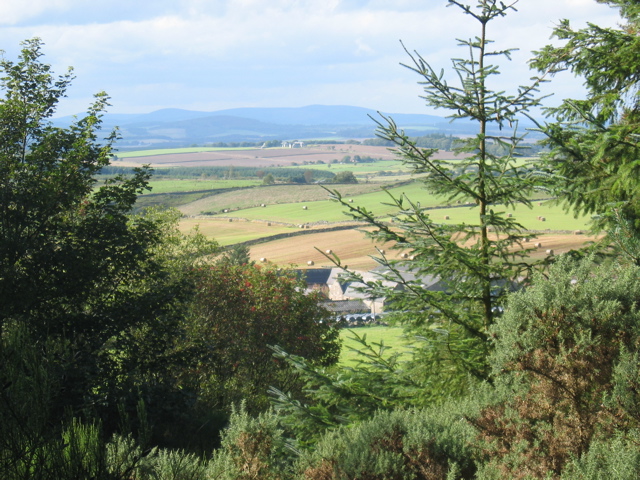
Beautiful countryside to the west of Aberdeen is earmarked for a new highway to be completed by 2012
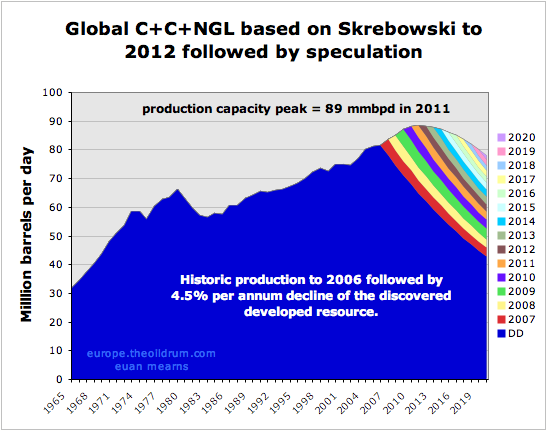
Global oil production looks set to peak by 2011 - if not much sooner! Chart is based on Skrebowski 2007.
A note to all our local and national politicians. West Texas Intermediate just hit a fresh high of $97 / bbl as I was writing this article. This is a wake up call. It is time to start rebuilding our power generation and transportation infrastructure for the new energy paradigm of the 21st Century. Pursuing the fossil fuel paradigm of the 20th Century will doom our society to extinction.
Other reading:
The latest energy news from ODAC
And an article I posted in July and October on UK Energy Security
Peak Oil on the UK Network News from ITN - watch the video, posted by Chris Vernon
Personnel
Editors
Contributors
Peak Oil Primers
Archives
- November 2010 (3)
- October 2010 (6)
- September 2010 (4)
- August 2010 (7)
- July 2010 (6)
- June 2010 (7)
- May 2010 (2)
- April 2010 (8)
- March 2010 (4)
- February 2010 (6)
- January 2010 (3)
- December 2009 (5)
- November 2009 (8)
- October 2009 (12)
- September 2009 (6)
- August 2009 (5)
- July 2009 (11)
- June 2009 (8)
- May 2009 (16)
- April 2009 (10)
- March 2009 (7)
- February 2009 (10)
- January 2009 (15)
- December 2008 (9)
- November 2008 (9)
- October 2008 (9)
- September 2008 (13)
- August 2008 (10)
- July 2008 (14)
- June 2008 (23)
- May 2008 (16)
- April 2008 (12)
- March 2008 (16)
- February 2008 (9)
- January 2008 (13)
- December 2007 (13)
- November 2007 (16)
- October 2007 (22)
- September 2007 (8)
- August 2007 (9)
- July 2007 (16)
- June 2007 (8)
- May 2007 (7)
- April 2007 (7)
- March 2007 (10)
- February 2007 (10)
- January 2007 (12)
- December 2006 (9)
- November 2006 (15)
- October 2006 (4)
- September 2006 (5)
- August 2006 (5)
- July 2006 (9)
- June 2006 (5)
- May 2006 (10)
- April 2006 (9)
- March 2006 (13)
Vital Trivia
License

This work is licensed under a Creative Commons Attribution-Share Alike 3.0 United States License.
To be fair to Jeremy Cresswell, I spoke recently with him and he said that he had been writing about Peak Oil for some years now.
Hello Joe. Perceptions spread over a period of time are difficult to judge. My view has been that Energy and the P&J has suffered from optimistic bias like most of the MSM when it comes to financial affairs. This is not necessarily a criticism since they need to produce a paper that people will buy. And in particular, in Aberdeen, broadcasting the truth about our oil and gas supplies would likely attract some criticism.
The important thing now is that this month they have published some pretty hard hitting articles about PO and alternatives. I just hope that every City and Shire councillor and MSP has read these articles and fully understands what the consequences might be.
I let Jeremy see a copy of this before it was published and he seemed happy with the content.
I can back this up - I've seen peak oil articles (usually in Jeremy Cresswells editorial section Energy Eye) quite a while back. Certainly well before it was mainstream.
Euan:
Oh they wouldn't dare to calculate the carbon footprint of our exported biofuels, would they? Thems are fightin' words!
I'm pleased to say that over on this side of the pond, my colleague Brian Hicks scored some prime time TV business news coverage this week, giving the straight dope on the oil supply & prices side of things. (<doomeralert>Although I should note that he's a much bigger bull on America and her resiliency than I am!</doomeralert>) Check it:
The entire article is here: Is The Alarm Finally Being Sound?
Also, just noticed over on Robert Rapier's blog that the History Channel is going to show a peak oil documentary next week:
Took 'em long enough, but it looks to me like the MSM have really finally come around on peak oil. In fact I'm arbitrarily saying that the turning point was October 25, 2007, the first day that oil closed over $90/bbl. I think that's what finally broke peak oil into the mainstream.
--C
Energy consultant, writer, blogger www.getreallist.com
Euan, I actually noticed the mainstream press in North America starting to talk openly about Peak Oil back in February this year. Shortly after the EIA & IEA & the GAO all talked seriously about this issue. It was a limited discussion in the media, but nonetheless that ice had finally been broken. It is rather incredible when one realizes that Hubbert had first talked about it in the mid-fifties, so it took fifty years before the media started discussing it openly. The irony of it is that we knew then, many of us knew a decade or more ago and now that it is finally mainstream, what has really changed? Our civilization is probably one of the few that could see our demise coming from a long way off, yet our egos (greed) and disbelief prevented us from doing anything. The other irony is that Climate Change & Peak Oil are happening at the same time. I have no doubt that some will one day call this coincidence some sort of devine intervention.
Thanks for the timely post.
Yes, a peak in the economic availability of fossil fuels looks like it could be less than 2 decades away. I'm rather drawn to Lovelock's GAIA theory in this regard.
I think that raises an interest point. It seems that nearly all ideas relevant to our future have been identified by someone, even if they are little known. Do ideas that are reasonably provable always eventually get to mainstream acceptance?
In past ages, generation of new concepts was limited to a handful of scholars. Education and knowledge of the general populace was minimal. There was no media. Information was almost completely controlled through government and the Church.
Now it seems that any and all ideas are out there, and up for discussion, the information revolution starting with printing. A well educated general public can both hear about and contribute new ideas to the pool.
Certainly, palatable ideas travel faster then controversial ones. 50 years might seem a long time, but in comparison it is not bad. Many ideas are older than you think. The greenhouse effect was first described by Arrhenius in 1896. Black holes must be a product of modern science, surely? Black holes first proposed by LaPlace in 1796. The concept of resource depletion goes back to Jevons and Malthus.
Today we have the best ever pool of ideas, covering virtually every possibility and the best ever mechanisms for moving information around the planet and analysing it. It seems that if even a highly controversial idea has merit, it eventually gets into the mainstream.
The second question is, is a gestation time of 50 years too late for us to react? That will remain to be seen.
In around 350 BC the Mayans predicted global calamity in December 2012 via their "Long Count" calendar.
I note many people on this site predicting along the same lines....
Look for more of this connection.
On this certain day in 2012 the the Milky Way will be
pointed directly at the rising Sun (King).
Temples and Mayan cities were laid out, I believe, to
capture thiss moment.
The "door" being opened for the Sun (King) to walk thru
to Polaris (?).
I believe this will also mark the end of the Age of Pisces(?) and begin Aquarius (?).
The vid Zeitgeist covers this in more detail.
All religions are based on rule by the stars.
Arkansaw of Samuel L Clemens
December 2012 will be the end of a very long cycle; it's not a prediction of disaster. That's New Age blarney useful for selling books, author tours, and for workshops and requisite travel packages to the Yucatan for the "spiritual tourist".
Mesoamerican people have a very complex understanding of recurring cycles because they have been observing them for thousands of years. The Mexhika (Mexica, aka the Aztecs) are still watching, though they keep a very low profile. The cultures of these areas understand that life is about constant change.
Climate Change and Peak Oil happening at the same time isn't a coincidence, they both have the same root cause - overpopulation.
Forgive me for not being so optimistic about mainstream media coverage. I am still seeing plenty of articles blaming the high prices on speculators and stating that peak oil has been predicted five times in the past and is always failing to account for technology advances.
Clint
Hey, at least you can plough a golf resort and reclaim te land for agriculture with not too great difficulty.
Ther may be some difficulty called 'money'. It may be great depending on who owns the golf course.
I was discussing with afriend of mine about Biodiesel, but I didn't know the numbers by heart. He claimed that an area the size of France was enough to provide west europe with Diesel. Seemed a bit optimistic to me.
Does anybody have the numbers:
- How much diesel per Ha
- What is the EROEI (+ error margin)
- How much Diesel does europe use?
and if possible
- How much land is available to do this, i.e. not used for food crops?
Thanks
Hello Richard
On the farm I owned until 1996 I grew rapeseed for oil.
Average approx 1000 l /ha) of rapeseed oil. More details can be read here (in English) http://www.folkecenter.net/default.asp?id=9192
Ignoring the finer print you get.
Rapeseed oil approx = 34 MJ/l ;
Diesel approx 36 MJ/l
1 ha = 1000 l rapeseed oil can supply 15.000-20.000 km driven with European! diesel cars. This is close to 1 cars yearly consumption.
So a very simple assumption is 1 ha = 1 car and In Europe there are 1 passenger car per 2 people so
1 Ha = 2 people;
EU 25 = 400 million people = 200 million Ha = 2 million km2 which is 4 times France ( 540.000 km2)!
Currently agriculture accounts for over 40% of all land use in Europe (around 5 million km2)
http://countdown2010.net/archive/agriculture.html
So Passenger car transport alone would need 2/5 = 40% of all agricultural land in Europe.
EROEI for crops like wheat are 4.5-6 if straw is included and Rapeseed is possibly somewhat poorer, because of the lower total yield. Maybe 3.5-4.5.
Kind regards/ And1
I just consulted Robert Rapier who says:
I suspect the land use / land availabiity issue will be as much a clincher for bio diesel as eroei.
Apart from farming effort biodiesel gets a fossil boost from NG derived methanol. If say it consumes 20% unrecovered methanol worth 20 MJ/L that could be a gimme of 4 MJ/L.
The other thing that could kill canola is increasing pesticide resistance. Some say the acrid oil in mustard will compensate for lower yields. I think biowaste gasification based processes like Choren Sundiesel have to be the way to go if the capital cost and logistics can be simplified.
Here are some notes I took from a conversation I had with Pimentel protege Tad Patzek about the potential of biofuels, last month:
Jatropha:
Soy: yields around 500 kg/ha
Switchgrass: Takes 4 to 5 years to grow a mature crop.
1-2 years to establish, then crop for 3 years (adding progressively greater amounts of fertilizer) and then it peters out.
Any way you slice it, with biofuels you wind up depleting the soil.
The U.S. couldn’t possibly even produce 10% of total fuel mix (~2 mbpd) of biofuels…it would be too much. Plus the environmental risks of even a 10% offset would be too high to even try it.
CNG and EVs first, not biofuels! 10% offset using EVs is easy and available right now
--C
Energy consultant, writer, blogger www.getreallist.com
I pretty much agree with that Chris. CNG = compressed nat gas? We've had vehicles running on that for decades in the UK - but not very many of them - no room for golf clubs in the trunk.
Yes on the CNG. I am a little dubious about them too but T. Boone seems to think they have a bright future. I take it he (and others) believe that there is going to be a revolution in converting stranded NG to CNG/LNG as oil depletion sets in.
--C
Rapier also said that if we planted all four billion arable acres of land in the world with the most popular biodiesel feedstock, rapeseed, we could produce just under 30 million barrels per day of biodiesel, or just over a third of our present usage of petroleum. And when we take into account all the energy inputs to grow, harvest, and process the rapeseed into fuel, the net yield will be very low, or even negative.
--C
Anecdotal evidence from France
My neighbour works for a market gardener, who plnted one hectare of rapeseed this year for biodiesel, and is running it through his tractors. Hasn't yet decided whether to plant more next year, or drop the idea (apparently the newer tractors are fussy about biodiesel).
It's interesting because it's purely an economic decision with no subsidies involved (and I suspect, not captured in any statistics). As it happens, this guy has plenty of spare land, currently in pasture, that he could convert to biodiesel if he wanted.
Which leads me to speculate about a trade-off between transport and meat... beef and dairy are the biggest consumers of agricultural space around here. I have given up beef, which is about the most costly of foods in terms of energy and land use. What is the pasture footprint of your average beef-eater, I wonder?
Richard, the eroei for temperate latitude bio-ethanol is around 1.2 at best. I believe bio-diesel is marginally higher, but this is still a hopeless way to try and power an industrial economy.
The land question boils down to whether or not fuel crops can be grown where food crops won't grow, or whether they can be produced from the waste products from food crops - celulosic ethanol et al. In either case, there are serious issues with the amount of energy that needs to be added to get the crop to grow and nutrient depletion of the solis.
The current trend where good agricultural land is being used for fuel crops is contributing to a global food disaster. In addition to food production lost to biofuels, climate change (man made or not) is pressuring crop production and growing prosperity in Asia is leading to more meat being consumed - which eats into plant availability at a ratio of around 7:1 - I beleive.
The future of transportation has to be electric - IMO. Both electric cars and collective transport. The electricity will have to be provided by a combibation of nuclear and renewables, where wind and direct solar look like having the greatest potential.
Re EROEI , Richard and Euan
I agree fully on Euan's conclusions for farmland. And the electric future.
Bioethanol is a terrible waste of land and the food/energy produced in farming. And Bioethanol EROEI in temperate climate is < 1.7 even when including the use of the remains from the ethanol fermentation for animal feed.
What I was exemplifying was the growing of rapeseed for biodiesel, using the straw and rapeseed cake directly for district heating, and using the rapeseed oil directly as Diesel replacement- no Bioethanol involved. The higher EROEI comes mainly from the direct combustion of the biomass coproduced, which can be made with > 95% thermal efficiency. Now back to data.
http://www.folkecenter.net/default.asp?id=9192
1 Ha : gives (optimistic data)
rape seed oil : 37,53 MJ/l x 1086 l/ha = 40,76 GJ/ha
rape cakes : 19,32 MJ/kg x 2000 kg/ha = 38,64 GJ/ha
rape straw : 14500 MJ/ton x 3,9 ton/ha = 56,55 GJ/ha
Total: 135,95 GJ/ha (100%)
Recent Danish energy numbers for growing Wheat (which needs more fertilizer than Rape) (fertilizer, spraying, Tractor, harvesting etc.) are 14.5 GJ/ha and for Barley 13.7 GJ/ha.
(http://ing.dk/artikel/69914); http://www.agrsci.dk/djfpublikation/djfpdf/gvm260.pdf
So you get approx. 40 GJ fuel by spending ca. 14 GJ. Which should give an EROEI close to 3.
Soil will be depleted, when all the biomass is removed. On top of that, rape has to be sprayed with pesticides insecticides/ fungicides or you could loose your crop completely (EROEI = 0).So monoculture is very difficult/ impossible and crop rotation must be used. Altogether not promising for a sustainable future.
Kind regards/And1
.
This is for bio-ethanol, but most bio-diesels using current production methods fall in between the best and the worst (excluding fossil oil of course).
This is from a recent meta-study last year that calculated averages from various studies.
Unfortunately I don't have enough data for sugar cane and various bio-diesels. Also, it'd be nice to have a box-plot of these, but again - I lack the data.
It is quite obvious that even though the fossil oil net energy ratio may vary quite a lot these days depending on country, field, phase, etc, that it is still superior to all known current bio-fuel production methods.
Theoretical paper only productions and theoretical models excluded.
The ratio of energy output to energy input is not a good parameter for characterizing the economic quality of bio-fuels (or any other form of energy production for that matter). What matters is the net energy produced per unit of some non-energy related production resource expended. For the production of bio-fuels the most obvious resource to be concerned about is acres of cultivated land. If the gross energy output from A acres of and is O and the input energy is I then the efficiency with which land is converted into fuel (i.e. net energy per acre) is given by:
η = (O-I)/A = [(O-I)/O]×(O/A)
The term in square brackets is the fraction of the output energy which is left over after the input energy is subtracted out. I call this factor the energy utilization rate µ. Since EROEI = O/I, µ=(EROEI-1)/EROEI. The second factor (O/A) is the land efficiency of gross energy production. This factor is important in understanding the energy productivity of land and it cannot be calculated from energy inputs and outputs alone. The table below converts the EROEI numbers for corn, wheat etc. into energy utilization rate.
I included conventional diesel fuel rather than oil. The 20 to 1 number often quoted is for oil at the well head. Since we do not burn raw crude oil in our transportation engines the correct comparison is to refined petroleum fuels. Refining crude oil is an energy intensive process. The numbers in the table were derived from a DOE report comparing the life cycle energy balance of bio and petroleum diesel fuels. The ethanol outputs per acre were taken from Lester Brown’s book Plan B 2.0.
I am not in any way suggesting that the energy utilization rate µ can by itself be used to compare the economic quality of bio-fuels and refined petroleum fuels. The economic quality of energy can never be determined from energy outputs and inputs alone. In the case of bio-fuel it is clearly necessary to know the gross output per acre in addition to µ in order estimate the energy productivity of land using a specific crop. From the table below it is clear that sugar beets will far outperform wheat even though its energy utilization rate (or EROEI) is only slightly higher. The land intensity of net energy production is the key to understanding the limitation of bio-fuel use. Of course petroleum diesel does not require farm land for its production. The amount of gross fuel output produced per unit of labor or per unit of capital equipment expenditures would be more relevant to determining its economic quality.
Roger, thanks very much for this contribution. I am not an expert in this particular area but two points you are making here are clearly important.
The first is linking productivity per acre to eroei. From the above table, sugar beets looks like the best bet so far. But of course we also need to link in soil sustainability.
The second is the low eroei figure you quote for petroleum diesel. Nate has banged around some low eroei numbers for petroleum from onshore USA and its quite clear that biofuels need to be compared against contemporary petroleum sources - and here I believe we have a bit of a data vacuum.
SamuM - thanks for your contribution too. Its good to get these figures.
Thanks Roger K.
Do you have a good reference(s) on that?
I'd really appreciate it.
I am not sure exactly what references you are looking for. The idea of resource efficiency as the ratio of the net output of a production process to the net expenditure of a particular kind of production resource is a very general economics idea which I have picked up by osmosis. The application of this concept to energy production and the definitions of the energy utilization rate and the resource efficiency of gross energy production are my own (currently unpublished) ideas. At least I have not stumbled on any other writers who analyze energy production in these terms.
If you are interested in the energy balance of refined petroleum fuels, here is a link to the NREL study I mentioned which compares the energy balance of bio-diesel to conventional petroleum diesel. This report is 314 pages long, so there might be more information there than you really want.
http://www.nrel.gov/docs/legosti/fy98/24089.pdf
Too much is always much better than too little. Much appreciated!
This is an interesting analysis. The idea of net energy (or EROEI) is to attempt to look beyond metrics that just parse things down to dollars, in a world when everything can't easily be parsed to dollars.. But land is just one of the inputs that may be limiting. Your 'energy utlilization rate' shows much higher numbers for diesel from petroleum than for biofuels; if you include water or soil in the analysis, the difference would even be greater. In other words, fossil fuels are SO superior to others in many of these respects that we have taken for granted the land intensity, water intensity, soil intensity, etc. Cutler wrote a good guest post on that here
To just focus on EROEI as a replacement for $ROI, falls fallacy to exactly why we shouldn't be using dollars in the first place - its too narrow a metric. Multicriteria analysis that treats water, soil, etc not only as inputs but as potentially as limiting inputs as energy itself will be important. I have a paper will be online soon in AMBIO on this - i can send to anyone who wants a copy.
In other words, fossil fuels are SO superior to others in many of these respects that we have taken for granted the land intensity, water intensity, soil intensity, etc.
I agree completely. Energy is not the only important production resource. Fresh water and fertile soil are in finite supply. We are never going to have enough energy to grind up bedrock to make our own soil. Using such resources to produce energy carries substantial opportunity costs with respect to lost economic production of other types. Single resource analysis of economic production is inevitably inadequate. I will check out your paper when it becomes available.
The key phrase is "current production methods". It is possible to eliminate fossil fuels from the equation by changing production methods. Modern organic farming methods can remove anhydrous ammonia from the equation. Fermentation and partial distillation (140 to 180 proof) could be done on or near the farm using corn stover for fuel. Wind and solar could also be used as heat sources. Final rectification could be done at a central distillery that uses renewable energy. The ethanol can be used to fuel the tractors and trucks needed for production. The same could be done with biodiesel from the corn oil.
Dear Euan,
You, sir, are a fraud and a liar. That is not a picture of any place in Scotland.
Why, you scoundrel, one sees blue in that sky. There is no blue in an Aberdeen sky. As for the apparent sunlight, there is no sun in Scotland.
Scotland is grey, all the year round. Everyone knows that. Everyone. As for sunshine? You are either a travel agent, property developer, or estate agent in real life.
There are only two colours in the country of Scotland. Dismal grey, and the black of night. Stop perpetrating this misrepresentation upon the naïve and gullible. Cease and desist. The truth demands it.
To paraphrase the quote attributed to Mark Twain, "The coldest winter I ever saw was the summer I spent in Scotland."
hahahahahahahah
How did you guess? Here's another one from the same spot looking up the Rhone valley towards Mont Blanc that is just discernable through the heat haze. Note vineyards in the middle ground:-))
There are two other identifiable mountains in the picture - a pint for anyone who can name them.
Well, I'd guess that you were looking west over the Dee valley to the eastern side of the Cairngorms. So the mountains are probably (Dark) Lochnagar, Ben Avon and/or Ben Macdui (or Macdhui depending on what language you prefer).
Am I close? Were you anywhere near Ballater?
When I was a kid, my Mum and Dad took us to Aviemore several summers in a row (Including the summer of the great drought in 1976!) The countryside in that area is unforgettable.
If I'm right you can ship me a couple of cans of Caledonian (if they still make it).
Duncan, you're close. This is taken from the W of Aberdeen, looking west up the Dee valley towards Lochnagar that would be visible here in the central distance on a clear day. Unfortunately we had a heat haze going the day I took this with temperatures getting above 10 C.
If you click on the image to enlrage then digitally enhance you'll see the two well known local hills to which I refer.
As for Caledonian - things have moved on here - we've become cultured and enjoy NZ Sauvignon Blanc and Ozzie Merlot - flown in of course - better than locally produced ales.
Euan, you'll probably find the wine comes in by boat, and the transport energy embodied in it is dominated by the trucking from producer to port, and port to consumer. I would certainly not condone flying wine around the world!
Scotch whisky, on the other hand...
I recently graduated in edinburgh, the university of Robert Louis Stevenson. He described the winters here with the something like the following words:
"the weak die, and the strong envy their fate!"
I'm sure there's worse winters elsewhere, but few places come with less relief in summer I'd bet!
Richard C
From an email I received this morning signed A. Geologist:
That says it all. A professor thinks the world is going to the end, so he spends a few hundred to warn the world and thinks he's done his duty!!! Comedic!
With such a horrifying emergency on the horizon, you would think the professor would devote his time to learning how opinions are formed and transmitted in our societies, join with others with similar concerns about oil and set about the arduous business of persuasion with a little insight.
Hi Asebius, hows the weather in Canada? We had shirt sleaves weather here a couple of days ago - and today an arctic storm from the north with wind up to 90 mph and snow - back to normal. England will be under water tommorow - but lets not get too political here.
I think you do the gentleman here a bit of an injustice. Confronted with indifference and working alone, efforts any individual makes, can seem futile. You don't know how many years ago he did this and how old he is. To send out a lot of mail like that takes a lot of effort - it sounds like this is pre-internet to me.
It also highlights the tenacity that is required to puruse this issue - and folks like Campbell, Duncan, Youngqvist, Laherererer and others must often have felt their mission was futile.
But here we are today, a bunch of amateurs, working together on the end of a high speed DSL connection, maybe bringing pressure to bare. Standing on the shoulders of giants.
But, Euan, a lone expert with the facts has never cut it. The public simply doesn't have the capacity to evaluate his message and they don't know the expert. If the guy can't get any of his peers on board, maybe he's just off in the weeds on his own. Not uncommon.
But, anyway, we are long past the "prophet in the wilderness" phase. In large part thanks to ASPO as you mention.
Asebius: I'll buy in that a lone expert has never cut it. And I have done some study (perhaps you've done more) on "learning how opinions are formed and transmitted in our societies, join with others with similar concerns about oil and set about the arduous business of persuasion with a little insight." Which is why I have previously recommended to everyone and anyone who will listen George Lakoff's little treatise, Don't Think of an Elephant: Know Your Values and Frame the Debate--The Essential Guide for Progressives (c'mon, you can get one used for a lousy $0.61 and you'll read it in two hours...check it!)
But even so, I have found, as have others here, that even a bunch of us joined together (TOD, ASPO) can rarely even gain a voice in the media, while the MSM consistently choose the Yergins of the world. Hell I even found a job writing about peak oil and getting the word out to investors with real money, and I still find that it's a tough row to hoe. It's going against the grain of all the important frames out there, and that makes it something that people automatically disregard.
Now, with oil pushing a record high right now, it's easier at this moment in time to get a few seconds of airtime; see the Brian Hicks appearances I linked at the top of this thread. But let oil sink back to the upper '60s, and I can guaran-damn-tee ya that we'll be nowhere near the radar of the talking heads on CNBC.
As for joining together with others, take the San Francisco peak oil group for example. I haven't been a part of it, but from what I've heard from people who have been, like Dennis Brumm, it was early to the peak oil game, a fairly successful group in some ways, and then it actually dwindled this year. Why is that? Surely all of those people realize that the situation they all feared is coming true? Are they just cowering in their basements? Shopping for arable land? Tuning out because it's...all...just...too...much?
My point is, you can learn all you like about how opinions are formed and transmitted in our societies, and join with others with similar concerns about oil, and set about the arduous business of persuasion with more than a little insight...and still manage to eke out only a tiny purchase on the cultural mindset.
It's tough going out there! Even if you've got the right message at the right time. Big Money has the microphone; we do not. Until Big Money is well and thoroughly invested in the right side of the energy game (renewables) and thoroughly hedged against the risks of fossil fuels, they will not give up the microphone willingly to views on the other side of their strategies. I think to a large degree it's just that simple.
So step one, in my opinion, has been to try to draw investment money into renewables, which also has the advantage of being a profitable endeavor. Win-win-win for me.
But I realize that such choices are not available to anyone. And so to anyone who can do anything, I say: do it! Do your bit, whatever it is. Whatever useful thing you can do to lower the overall energy footprint, learn (or teach) some useful basic skills, or lead us to an all-electric future based on renewables, do it. There's a job for everybody.
So I have to applaud A. Geologist. Maybe his efforts seem Quixotic to you, but for him, he did his bit. That's all I can ask. Hopefully, a "teachable moment" like the one we have right now, with oil pushing $100, will arrive the same day as a letter from "A. Geologist" on the desk of some "A. Journalist," and it will prompt that journalist to do a little actual jouralism, and research it, and he might wind up here on the pages of TOD, and learn a thing or two, and the next thing you know, we might have the story wiggling its way into the mainstream awareness.
Sometimes, it just takes one...in the right place at the right time.
--C
Energy consultant, writer, blogger www.getreallist.com
The past couple of weeks interest is on the rise again (gasp) and people are coming out of the woodwork (not just out of ASPO, heh). It takes a disaster like $100/barrel oil to bring people together, I guess.
There are many reasons why our meetings have faltered, and even been on hiatus except for special occasions.
My take is - I would agree with you, part of it is because it's too much. For me I thought we were going around in circles. It's good to feel like you're learning something new rather than just rehashing what you already have learned. The EROEI of meetings needs to be about 1.0 for it to make them sustainable.
It's not so surprising things slowed for a while, considering energy descent isn't something we learned how to manage in school. And people have other things to do in the real world, and sometimes spouses or partners who don't fully support a peak oil agenda. I'm lately thinking of an AL-ANON sort of group for these people.
Add to the fact that you get a bunch of people together around one topic, discuss it fully, often, regularly, (many of us might not have been "friends" otherwise), and there are differences of opinions no different than we see on TOD.
I know people who want some technology fix, people who want to discuss collapse and what it means now (as I do), I'm also one who wants to talk about overpopulation, people who really do not want to think about collapse now, people who believe in personal lifestyle changes as preparation, people who do not think overpopulation is important, people who are not ready to change personal lifestyles, because the amount of good it does is really small, people involved in civic response (as I've been, though my reasons may not be what people would assume), and, well, that's the idea, you have a mixture that isn't all that cohesive.
It's not all bad there are differences (I'm pretty suspicious when groups of people don't have them). But it can be and is daunting for many folks to give all their remaining energy to a topic when the strategies for how to deal with it are so unclear, and so difficult.
One of the really great things here is we have some very smart and even well-connected folks. And they may even read this (hi! you all know who you are! :) )
Just spoke to a group in Berkeley on Monday, they're new and still relatively a small group of people there. As some things wane, others sprout. Beyond us helping ourselves, though, I'm personally not going to hold my breath and believe we're going to save the world. Or even 8,000,000 in the surrounding area.
Open to suggestions!
Oil depletion is a fact. I don't think you can ultimately have a movement based on a fact. Movements are based mostly on values.
So, once the awareness issue is taken care of, the focus of peak oil mitigation depends on one's politics. It's all about costs and benefits. There is no solution that doesn't seriously damage somebody else's vision of where we should be headed.
I see peak oilers as ultimately a school of thought only. It will give birth to many competing movements. The more political we are, the more we will go our separate ways.
Thanks, Asebius. You seemed to have hit the nail on the head better than I did. Whenever I've heard people talk about this as a "movement" I've had some light bulb going off in the noggin' that it never sounded or felt quite right. I need to analyze better what my light bulbs mean -- as long as they're still hooked up to my brain grid.
Even with any political movement I've been involved with or on the outskirts of, splits along individual perceptions of what the issues are have ultimately had the same effect.
I wrote my senator for a sixth grade social studies project and I got a response and I couldn't even vote.
RobertInTucson
I haven't escaped from reality. I have a daypass.
I am exchanging e-mails with an editorial writer at a major US newspaper. He is working on a long article on Peak Oil and its effects on his region. He said that the prevailing opinion within the media, perhaps until very recently, was that Peak Oilers were kooks. In the past couple of years, working within the media, he had essentially zero success in getting anyone to pay attention to the issue.
My take on the media and Peak Oil:
Net Oil Exports and the “Iron Triangle” (July, 2007)
http://graphoilogy.blogspot.com/2007/07/net-oil-exports-and-iron-triangl...
You do realise he meant people like you who propose conspiracy theories, don't you?
I believe in PO, and even I think Peak Oilers are mostly kooks. Can you imagine how hard it is for neutral people to accept ideas from people who behave like crazies? You are setting up a huge hurdle before even beginning to get the message across.
Telling the media that the reason they won't publish your stories is because they are part of a dark conspiracy is guaranteed to get your correspondence filed under "lunatic".
I understand that TOD has given up with its outreach mission, and no longer hopes to influence general opinion, but repeatedly running articles that say "most people don't 'get' PO because they are stupid animals" is certainly not going to help.
If someone tells you "you sound a little crazy" they are giving you a big clue about the way you are presenting your message. If you want to get acceptance, don't ignore it.
Bob: Contrary to what you were told as a child (and obviously still believe in spite of all evidence to the contrary) the "media" does not exist to inform you perfectly like a cross between Mother Theresa and Ed Murrow. It exists mainly to sell advertising space-the acceptance of this reality is known as a "conspiracy theory" in your universe.
And it is known as the 'Iron Triangle' in this one.
BTW, I'd like to thank WT for sounding like a broken record, as I feel it is needed against something as powerful as the grip the MSM has on the average 'Merkin.' Keep swinging!
To be crystal clear, my media source is in the "kook" camp, albeit in the "Kook Closet." He was saying that other members of the media regarded him as a kook when he brought up Peak Oil.
Regarding my "Iron Triangle" theory, I have never regarded it as a conspiracy per se. I think that the various members of the triangle are simply acting in what they perceive to be their best interests, but the net result is that even at this late date the prevailing message here in the US is that it is a swell idea to buy an SUV to commute to and from large suburban mortgages (e.g., Michael Lynch says that $45 oil is right around the corner).
Hola Bob,
Good point. And all of us could educate the media by following the news and sending letters/comments to the editor/journalist each time we read an article on oil, first can thanking them for addressing the issue and then pointing out that most geologists conclude that we are at Peak Oil production and that a typical Internet search of "peak oil" yields some 7 million hits. And then suggest the primers/reports at www.theoildrum.com, www.energybulletin.net, and www.peakoilassociates.com as places for readers to learn more. Journalists and editors will want to know more than readers and they will do some reading. The same goes for articles indicating that alternative energies will easily replace oil. The key is short letters/comments.
During a recent exchange with one of my brothers he pointed me to an opinion piece by Robert Samuelson ( Washington Post columnists ) which contained the quote "Modern technology and management are widely available, but many societies can't take advantage because their values and social organization are antagonistic. Prescribing economically sensible policies (open markets, secure property rights, sound money) can't overcome this bedrock resistance."
This may be interpreted differently, but to me it is pretty clear he's saying that under-developed countries are just that because they are hobbled by adhering to the wrong policies and practices ("open markets, secure property rights, sound money" is what Samuelson lists here).
My response back to him (my brother) was that we're probably heading for trouble because we are hobbled by adhering to the wrong policies and practices; the ones laid out by Samuelson.
Aside from the jingoistic flavor of the passage it shows an arrogance that is just laughable. You'd think that a paper like the Washington Post could do better.
Ahhh… That old chestnut. Bob, whatever else westexas may or may not do, conspiracy theories rank real low. Seeing as you’ve been here for a while now, are you for real, or are your just getting in touch with your essential troll?
The Iron Triangle isn’t a conspiracy theory. It’s a way of framing the issue. AFAIK, westexas has never, ever, accused the respective “legs” of the triangle of being in collusion. He has suggested their mutually reinforcing aims give them the ability to operate in a way that maximises effect without requiring explicit coherence. But, he’s never suggested the three legs are in some ongoing collusion that would give rise to your suggestion westexas is promulgating theories of conspiracy.
Good God, man, we’re all kooks. Have you seen the way the idiots attack the sliproads onto the M25? They’re not kooks or idiots, their fucking crazy.
Yes, I can indeed. Like the fucking crazies that voted twice for George Junior. Look no further for crazies. You’ve got them in spades.
As for the “neutral” concept, who, exactly, is “neutral?” Go on and wax lyrical, I’d love to have a description of the “neutral.” IMLTHO, for you at least, neutral means ignorant, unaware. Ignorant as in uniformed, not stupid, wilful or otherwise.
Regardless, westexas has never, to my knowledge, behaved crazy. Sure, there was that time on the banks of river in Austin… Only joking. BobCousins, just so you know, I was being serious, not. In true Yoda speak. Only joking, BobCousins. In case you missed it the first time.
Wow. TOD has an “Outreach Mission?” You mean they’re not just a website anymore?
As for the stupid animals, why bother reaching out for the great unwashed when TOD’s got enough that pretend to be “on message,” eh? I’m not suggesting for the moment you’re one of those BobCousins, so please don’t get arsey, if you can refrain.
Thanks for the insight. Are you in PR perchance? Maybe there’s no way of “presenting” the Peak Oil message that won’t sound “a little crazy.” What then, guru of deep communication? What, exactly, then, eh?
Oh, sorry westexas, you’re sounding just a bit crazy, so we can’t talk to you let alone report our findings. Bobby-boy, who’s crazy now, I ask you?
Thanks for your meaningful insights. Guess you’re headed back to that well known lobby street somewhere near the capital of your democratic republic. Take care and remember to look both ways when crossing the road. Remember the Green Cross Code. Stop. Look. Listen. Only then should you attempt to navigate from your pavement to the pavement opposite.
Thanks, thanks, thanks, Goritsas!
A lovely smack-down.
I love how Westexas' implacable equanimity tweaks some guardian's of dumbed down sobriety into intemperance.
On a different note, I am always entertained by people who attack the ELP recommendations as somehow being dangerous, as if living below one's means is some kind of threat to society, and I guess some people find a decision to live below one's means to be threatening.
In any case, given the near certainty of an accelerating rate of decline in world net oil exports, one can choose the ELP path, or listen to the IT ("Iron Triangle").
BTW, I am probably going to write a summary article which has links to my model, recommendation and theory: ELM; ELP & IT, my own "triangle" of sorts.
For new readers, my ELP stuff (and a link to a great gardening article):
ELP Plan (April, 2007)
http://graphoilogy.blogspot.com/2007/04/elp-plan-economize-localize-prod...
http://www.energybulletin.net/5673.html
Published on 22 Jul 2004 by San Francisco Chronicle. Archived on 25 Apr 2005.
Berkeley: Urban farmers produce nearly all their food with a sustainable garden in their backyard
I think you are splitting hairs there.
"Framing the issue", isn't that what the evil MSM are always guilty of?
Westexas wrote:
He refers to a collective purposeful action, it certainly sounds like a conspiracy theory. And what value is telling the MSM it is part of an unwitting "mutual reinforcement"? Absolutely none at all, it will not help your message get across. It's purpose is really a reassuring back rubbing exercise for the kooks. "Why are the media not getting our compelling and vital message?" "Because they are part of a 'mutual reinforcement' which denies it". Yeah, that must be it.
And in the way that the media understands and internet kooks don't, the impression you give is important.
But it really doesn't matter now. The kooky element of PO has guaranteed it will stay on the fringe until some credible official body like the IEA confirms it.
And I mean credible to the media, not credible to kooks like us.
The real real problem is the MSM, and my opinion is certainly influenced by my experience with in late 2005, when I proposed and helped organize a joint presentation by Matt Simmons and Jim Kunstler. Prior to the event, I arranged for an hour long meeting between Jim and the Dallas Morning News. We had a couple of billionaires in the audience, Boone Pickens and Herbert Hunt, but no one in the local media was able to make it. The sole local media coverage was the college student newspaper.
In any case,
So, if you agree to the foregoing, we have the three elements of the "Iron Triangle," and by and large they are not interested in the Peak Oil story. So the MSM reports the happy talk regarding oil supplies that the oil industry group provides.
This does not require the three "legs" of the triangle to get together in a smoke filled room.
I guess name dropping some billionaires names is supposed to impress us, to me it just sounds pathetic.
For the record, I don't agree, but I don't see any benefit debating it.
"I do believe in kooks. I do I do I do believe in kooks."
My point was that Boone Pickens could make time in in his schedule, but despite ample notice of the event, no in the local MSM could find the time to attend.
So, you disagree that the auto/housing/finance sector wants to sell and finance ever larger homes and autos?
You disagree that the MSM wants to sell advertising to the auto/housing/finance sector?
And you disagree that ExxonMobil, CERA and OPEC are telling us that we don't have to worry about Peak OIl for decades?
It's not a conspiracy. It's just the these groups do not find it in their perceived interest to talk about the problem inherent in the expectation of an infinite rate of increase in the consumption of a finite resource base.
Late in the day, as usual. Interesting thread.
How long is it since Gvmts. (developed countries) pay attention to or integrate, or consistently refer to, ‘Science’, in our modern age, in any way?
150 years?
The question is sloppy, too broad, the answer worse. Isolated examples of this or that can be found all over the place. Sumerian priests (at heart administrators and rulers) promoted certain types of husbandry, irrigation etc. Just to go back 4K years.
I was trying to think of an ex. of slow percolation into the mainstream consciousness of ‘scientific facts’ and could only come up with examples of ‘harm’ - what is bad - etc. Such as that in our times, the first powerful Gvmt leader who came out with an anti smoking policy for health reasons was Hitler. He had no success with it at all, except in the tight top Nazi circles. (Reportedly, they refrained from smoking in front of him.)
Today, 60 or so year later, smoking bans are coming in all over the place. Only in public of course. In private...
But smoking is a simple thing compared to peak oil. Still, 50 or more years.
Musings.