
 | Some Notes on The Midwest Renewable Energy Fair, Solar Ovens, And Small Wind | The Oil Drum | DrumBeat: June 19, 2007 |  |
| The Cost of Gasoline around the World | The Oil Drum: Europe | Will OPEC increase supply in the 2nd half of 2007? Or has Ghawar peaked? | |
Lies, damned lies and BP statistics
Posted by Euan Mearns on June 18, 2007 - 11:16am in The Oil Drum: Europe
I almost choked on my whisky when I heard on the UK national television news (13/06/07), a story about peak oil and questions asked about oil reserves figures quoted in the newly published BP Statistical Review of World Energy.
The news item was referring to a story in Thursday’s Independent (14/06/07) (a national UK newspaper) by Daniel Howden titled “Scientists challenge major review of global reserves and warn that supplies will start to run out in four years’ time.” Howden refers to the work of Chris Skrebowski (Oil Depletion Analysis Centre or ODAC) and Colin Campbell (Association for Peak Oil or ASPO). Kudos to Chris and to Colin for getting this news onto the front page.
There’s more…..
Note that the Indepent's server has been very slow on occasions. A pdf of Howden's article may be downloaded from the TOD server here
So what is this all about? If you are unfamiliar with the Middle East OPEC reserves reporting scandal and the culpability of BP and OECD institutions in perpetuating myths about global oil reserves then this is explained below using Saudi Arabia as an example.
In its purestst form, oil reserves accounting follows a simple convention:
Reserves at start of period
Less production
Plus new discoveries
Plus or minus revisions
Equals reserves at end of period
Oil reserves therefore, are a dynamic variable, relentlessly pulled down by production when the rate of new discoveries declines, as it inevitably does in every oil region.
Revisions are a wild card that allows companies or countries to correct for past mistakes or to take account of new technologies that may boost recovery or changes in oil price that may make recovery more or less economic.
Saudi Arabia is the second largest oil producer in the world (after Russia) and is the largest exporter with 2006 exports of roughly 8.9 million barrels of oil per day. This represents 20% of global oil exports and it is therefore vitally important for the World to know for how much longer Saudi Arabia can continue to produce oil at 10 million barrels per day - that equates to roughly 4 billon barrels of oil per year.
The chart shows two lines that provide very different pictures of Saudi oil reserves. Both lines are anchored on 1980 – the year that the Saudi government took 100% control of Aramco – the state run Saudi oil company.
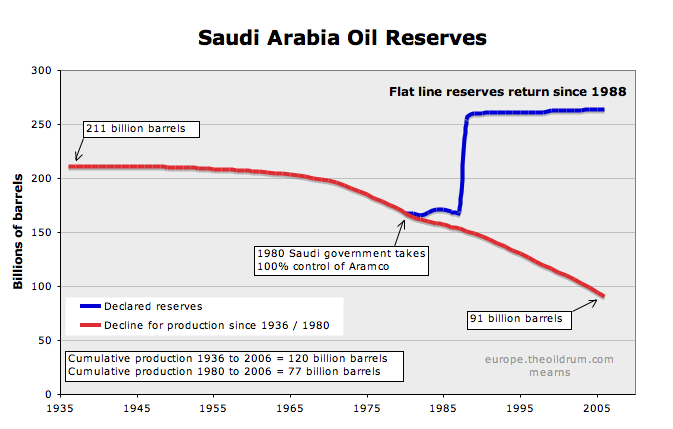
The blue line shows the official Saudi reserves as reported by BP whilst the red line shows how Saudi reserves would have declined since 1980 as a result of the 77 billion barrels of oil that have been produced since then. The red line is then back calculated to 1936, the year Saudi production began and accounts for the 120 billion barrels produced since that time. The red line does not account for new discoveries and revisions and there is therefore scope for the 91 billion barrels indicated reserves in 2006 to be increased or reduced. It is noteworthy that Saudi Arabia has not made any super giant discoveries since 1980 and that new discoveries since 1980 are unlikely to have a huge impact upon the current reserves figure.
There are two main issues with the blue official line. The first is that reserves were substantially revised upwards from 170 to 260 billion barrels between 1987 and 1989. That’s a 53% revision that does not correspond with new discoveries being made. The Saudis must therefore argue that this one off escalation in reserves was due to previous under-reporting or upwards revision based on new technologies such as horizontal drilling and 3D seismic that allows more accurate targeting of oil wells.
The second and more serious issue is that since 1988, there has been no annual adjustment to reserves for production. That flat blue line should at least decline parallel to the red line.
Combined, these two issues suggest that official Saudi reserves are grossly over-estimated. We can say with certainty that the flat line annual return is false accounting, which leaves us in a position of not knowing what the actual Saudi reserves are. I’d suggest that the true figure likely lies closer to 91 billion barrels than the official figure of 264 billion barrels as newly reported by BP.
Those who are unfamiliar with this accounting scandal may be surprised to know that the UAE, Kuwait, Iraq, Iran, Syria and Qatar all follow this same practice.
The reasons for Middle East OPEC countries following this reserves convention are complex but regular readers of The Oil Drum will be aware that ME OPEC may be inclined to report figures for Ultimate Recoverable Reserves (URR) as opposed to remaining reserves. In other words, it seems they report how much oil they will recover throughout the whole history of their oil industry as opposed to how much oil they believe is left to be recovered.
The main reason for writing this short piece is to add my voice to Skrebowski, Campbell, Leggett and others and criticise the BP Statistical Review of World Energy for once again reporting without question the validity of ME OPEC official reserves figures. BP is not alone in perpetuating the ME OPEC reserves myth and the International Energy Agency (IEA) and Energy Information Agency (EIA) are equally culpable.
This is how BP defines Proved Oil Reserves in their statistical review:
Proved reserves of oil - Generally taken to be those quantities that geological and engineering information indicates with reasonable certainty can be recovered in the future from known reservoirs under existing economic and operating conditions.
This definition is just wholly incompatible with the reserves reporting standard of Saudi Arabia and other ME OPEC countries. Whilst I am aware that there can be business and grander political motives for BP simply reporting the data as presented by ME OPEC countries, there comes a point where the interests of business and national etiquette are outweighed by the more substantial interest of the OECD securing future supplies of energy.
Peter Davies, Chief Economist with BP was reported by Daniel Howden as saying:
We don't believe there is an absolute resource constraint. When peak oil comes, it is just as likely to come from consumption peaking, perhaps because of climate change policies as from production Peaking.
If this is an accurate quote it betrays an extraordinary level of denial within BP. I would agree, however, that $200 per barrel might produce a consumption peak. This of course may suit BP but it is not in the interest of OECD economies to permit this to happen.
For so long as BP, the IEA and EIA go on reporting ME OPEC reserves without question then the leaders of the major OECD economies will continue to ignore the energy peril that they are confronted with. Long-term readers of The Oil Drum will be aware that I lean towards the more optimistic end of the energy depletion spectrum. I firmly believe that the energy gap left by depletion in fossil solar fuels (oil, natural gas and coal) may be substantially filled by a mix of renewable solar energy, nuclear power and smart engineering. If the appropriate actions are taken then harm to OECD society and civilistaion, that may be caused by fossil fuel depeltion, may be minimised. OECD governments, however, must take serious action to promote investment in our energy future – and this will only happen when organisations like BP present a refined version of the truth about our depleting supplies of oil and natural gas.
I appreciate that BP may feel compelled to report reserves figures for ME OPEC countries and in the absence of reliable data what should be done? At the very least ME OPEC reserves should not be referred to as Proved Reserves as defined by BP and attention should be drawn to the fact that ME OPEC reserves figures are not declined for annual production. That at least would be a small step in the right direction that would bring greater transparency to OECD planners and pressure to bear on ME OPEC reporting standards.
Footnote: the title of this piece is derived from the saying “Lies damned lies and statistics”. In no respect is it implied that BP are being untruthful. But questions need to be asked if they may be reporting statistics in a self serving way. I might add that in many ways, the BP statistical review is a tremendous source of global energy data. It is just a great pity that it continues to be scarred by the reporting issues dicussed here.
Personnel
Editors
Contributors
Peak Oil Primers
Archives
- November 2010 (3)
- October 2010 (6)
- September 2010 (4)
- August 2010 (7)
- July 2010 (6)
- June 2010 (7)
- May 2010 (2)
- April 2010 (8)
- March 2010 (4)
- February 2010 (6)
- January 2010 (3)
- December 2009 (5)
- November 2009 (8)
- October 2009 (12)
- September 2009 (6)
- August 2009 (5)
- July 2009 (11)
- June 2009 (8)
- May 2009 (16)
- April 2009 (10)
- March 2009 (7)
- February 2009 (10)
- January 2009 (15)
- December 2008 (9)
- November 2008 (9)
- October 2008 (9)
- September 2008 (13)
- August 2008 (10)
- July 2008 (14)
- June 2008 (23)
- May 2008 (16)
- April 2008 (12)
- March 2008 (16)
- February 2008 (9)
- January 2008 (13)
- December 2007 (13)
- November 2007 (16)
- October 2007 (22)
- September 2007 (8)
- August 2007 (9)
- July 2007 (16)
- June 2007 (8)
- May 2007 (7)
- April 2007 (7)
- March 2007 (10)
- February 2007 (10)
- January 2007 (12)
- December 2006 (9)
- November 2006 (15)
- October 2006 (4)
- September 2006 (5)
- August 2006 (5)
- July 2006 (9)
- June 2006 (5)
- May 2006 (10)
- April 2006 (9)
- March 2006 (13)
Vital Trivia
License

This work is licensed under a Creative Commons Attribution-Share Alike 3.0 United States License.
Nice piece Euan.
How did you come to the 120 Gb for cumulative production in Saudi? It is usually referenced at 100 – 105 Gb.
How verisimilar do you think are Campbell’s 160 Gb and Bakhtiari’s 130 Gb for Saudi?
Folks, besides these imperative comments made by Euan consider the following: Iran reports 130 Gb of remaining reserves every year. At the same they struggle to get daily production above 3.5 Mb/d, and more than that, gasoline consumption is being rationed.
How can anyone believe in those 130 Gb?
Luis - 120Gb production to date is based on API Facts and Figures Centennial edition 1959 for 1936 to 1964 and then BP data from 1965 to present. BP is C+C+NGL. How the Centennial edition dated 1959 reports data till 1964 - I don't know.
Are you saying that Campbell estimates 160Gb and Bakhtiari 130Gb remaining reserves in Saudi? If so then Campbell has 61% of the Saudi official estimate and Bakhtiari 49% - and so in those terms they are both substantially lower than the Saudi official estimate.
If we assume the 1980 figure was prepared in good faith, then an upwards allowance does have to be made for new discoveries and new technology - which would nudge the 91 billion remaining upwards towards Bakhtiari.
If memory serves me, Simmons said in Twilight that the Saudis revised their reserves up twice. They were estimated at 110 billion barrels in 1978 and were revised up to 170 in 1980. That, presumably, would take care of the revisions made for legitimate reasons.
Luís de Sousa:
1st I do not claim Iran has 130Gb in remaining reserves.
However, the foreign analysts' opinion seems to be that the current problem with Iran's oil production rate is due to:
- lack of technically skilled workers
- delays in new projects (partially to reasons above/below)
- lack of funding in new projects (oil minister Kazem Vaziri-Hamaneh has himself directly stated this)
These could explain a current lack of production capacity, even without imposing final geological constraints. Of course, for their current wells they must be constrained, otherwise they'd be producing more.
As for the rationing, I think this is a direct consequence of their double-folly:
1) subsidizing domestic consumption way too heavily (gasoline roughly 10 euro cents/liter), which has really accelerated the growth of consumption
PLUS
2) not being able to produce more oil (either through lack of investments/skill or due to geological constraints).
They are in the situation where they are now: they need to export to get money, they need to keep local economy going (cheap oil), which has been financially strangled for so log and they also need to invest in new projects.
I think it is going to be very difficult to do it without several foreign big investment projects and as far as I understand it. USA may be still weighing whether that is the best option for them.
To me the situation for USA looks like this:
Fact: Iran still exports a big amount of oil (roughly 2.5-2.9 Mbpd, I can't find exact data)
Assumption 1: Iran has a lot of unexploited oil reserves (whether it is 130GB or not)
Assumption 2: Iran's own production development is in a rut. If they do not get new projects in the pipeline soon, their production levels could crash (Vaziri-Hamaneh has been quoted as saying 13% p.a.)
Assumption 3: IF Iran's production crashes, that combined with the situation in North Sea, Canada and Mexico, will cause huge strains on the system (pricing, availability, access to right type of refining capacity as wrong type of crude would be brought to market in order to compensate).
So, USA has to ensure that Iran will keep producing.
Options:
1) Attack, take over and start investing.
2) Remove sanctions, threat of war and make Iran an inviting target for investments. Risk terms of PSA and export-end-points => end result not acceptable to USA
I'm not sure the PNAC posse/Israel Lobby allows for option number 2. It's not a "long term" solution for them. Too many risks.
However, attacking might in fact play out assumption 3: removal of Iran from oil market. I won't even try to consider what it could do to Russia/China relations. I'm not 100% sure USA is overly concerned about those either.
Supply-demand margins are very tight now. I don't think they can risk Iran going off-line currently.
So, to be able to attack, USA must enable the world to build build a cushion first. A 1-3 Mbpd temporary cushion? Is that doable?
I don't honestly know, but based on all that I've read here and elsewhere, I seriously doubt it's easy to do.
I think USA, due to their strategic thinking and oil dependency, is between an rock and a hard place in regards to Iran.
They'd love to be able to double Iran's oil production (and so would Chinese, Europeans, etc.)
So, they can't risk production falling to zero due to non-investments or due to military conflict related chaos.
I'm afraid that in the end, they will attack, because that is what they appear to be gearing up to do. Of course, I hope I'm wrong and they'll do this through negotiations.
Sorry for off-topic, but imho, the strategic moves of USA also indicate to me that there are serious untapped reserves of oil in Iran.
That is the worst analysis I've ever read about anything.
It may well be so.
It'd be nice to hear why you think so.
I have a question about the various classifications (proven, probable and possible) of reserves. I understand that the international oil companies are very conservative about what they call proven reserves because of SEC regulations which often leads to reserve growth.
I'm curious, how accurate is the probable reserves at predicting what the actual reserve are after reserve growth? Or, to put it another way, how much of the probable reserves typically end up being reclassified as proven reserves as time passes?
Alan - I am unable to answer your question specifically but the general points you raise about SEC regulations, 1P, 2P and 3P reserves all in relation to ME OPEC reporting standards, is a vital issue to understand.
There is no doubt that overly conservative SEC reporting standards contributes to the phenomenon of reserves growth and that initial 2P/3P estimates will lie closer to ultimate recoverable reserves (URR) than will 1P estimates.
My belief is that ME OPEC countries have in a way estimated 3P reserves back in the 80s - related to production quota negotiations. There is really nothing wrong with that. The problem arises when these are quoted as 1P, giving rise to the expectation that they really have a lot more oil - when they don't. As detailed above, the other problem is the fact that these initial (3P?) estimates have never been declined for production.
Last year I did an article on the reporting methodology of IHS Energy (IHS Data Suggest Kuwaiti and Global Proved Oil Reserves Significantly Lower Than BP Estimates) where they stress that they report 2P and not 1P reserves. IHS reserves estimates, therefore, are significantly lower than BP - especially for Kuwait. I'm pretty disappointed that BP have continued reporting ME OPEC reserves as 1P, on equal footing with the much more conservative definition of 1P used throughout the OECD and I intend to pursue this matter directly with BP in the coming months. IMO the first and most vital step in international preparation for energy decline is to gain acceptance throughout the policy makers within the OECD that a serious problem exists.
1P = proved
2P= probable
3p= possible
In some ways it would make sense that OPEC countries would do just sufficient exploration and research each year to ensure that they could make up for the oil that is pumped. So, if they chose, they could spend more each year on exploration and technological upgrades to upgrade their proved reserves, but they know that doing so would only cause their oil to run out faster at a lower price.
On top of this, they may very well have a significant buffer of "proven-to-themselves" reserves, but choose to report slightly less than this, which allows them to maintain a steady "proven-to-the-outside-world" level.
Is there actually any "official" explanation from OPEC countries as to how they have managed to keep their "proven" reserves remaining steady for so long?
Not that I'm aware of. But I see that as less than 50% of the problem. The core issue is the way that OECD institutions reproduce the OPEC statistics without question. Those inflated reserves numbers are then quoted by political leaders from around the world and provide an excuse for inaction.
We are 100% certain that this flat line reserves reporting is wrong - and it is pretty unacceptable to have a Global energy strategy that is based on numbers which are known with 100% certainty to be false (and that is not pre-judging if they are too low or too high).
It might make sense but it would be an incredible trick to just discover enough oil, or to just tweak technology enough, to replace production.
Not if they maintained a buffer that they weren't telling us about.
In principle 1P reserves in the USA are 90% probability, although sometimes 95% probability is used. 2P reserves are 50% probability or "most likely". 3P are 10% probability. Pre 1989 the FSU seemed to report 3P as if it were 2P. The SEC requires reporting of 1P, so USA reserves must grow over time toward 2P. Laherrere has analyzed the actual growth of a number of fields in the USA and concluded that the "proven " reserves reported are closer to 60-65% probability, ie somewhere between 1P and 2P. The rest of the world is thought to report 2P reserves. In their 2000 report the USGS applied USA reserve growth history to world reserves, coming up with a 1995-2025 growth estimate that is simply nonsense.
A few years back, in reporting Caspian 3P reserves, the USGS arithmetically added 3P reserves of several individual fields to get a region total 3P. Any first year statistics student would know that the arithmetic sum of several 10% probability values moves toward a vanishingly small probability. Caspian resreves are now taken to be near 1/10th of the initial USGS 3P report.
Campbell seems to have accepted SA URR as 260 Gb. As it was in the interest of oil companies to underreport reserves when they ahd way more than they needed, so they could please shareholders by adding some even in years with no discovery, it could be that SA simply revealed the underreported reserves when they had that big reporting jump. (It could be untrue too).
About 11/2 years ago I did a similar analysis to what Euan describes and came up with cumulative production for SA of 106 Gb. That would make 120 about right for now. Murray
What do you mean by "substantially filled"? Do you see that these alternatives can largely make up for oil declines, in the forms of energy currently used by oil (and other fossil fuels) and that energy availability can then continue to be increased indefinitely? If not, then there is no real room for optimism, until the world figures out a way to live without growth in the use of resources.
Sofistek, on this chart, you see that in 2005 oil accounted for 39% of all energy consumed. Following peak, which I see in 2012, the first thing that will happen is substitution from other sources - in the first instance coal and natural gas. This I believe will give way to massive expansion of other sources, in particular nuclear ± certain renewables with high eroei like wind and direct solar. In the same period, higher energy costs will lead to demand destruction which comes in two disguises - simply using less energy (driving less) and energy efficiencies (driving smaller cars and new technologies - efficient electric cars). So no catastrophe there.
Short term, the main threat I see from this scenario is rising energy costs feeding into inflation, interest rates, the unravelling of the debt mountain and growing trade imbalances between energy exporters and importers. These risks are compounded by wrong decisions being made now - such as temperate latitude bio-fuels adding to inflationary pressure on agricultural produce.
Future trouble is then compounded by geo-political risks limiting access to natural gas, existing oil and coal supplies and when natural gas and coal develop scarity value. I believe that peak oil may act as a catalyst for action by OECD economies, but to what extent declining oil, gas and coal energy can be met from nuclear, renewables and conservation - I don't know. It seems there are ample supplies of energy in these sources - what is required is the political will and investment to tap into these resources.
Demand destruction = jobs destruction. So I'm sure that some people would regard that development as a catastrophe. No doubt it's possible to construe a scenario in which only the oil companies, and their employees get hit, but whether conservation and efficiency measures can be that finely targeted is questionable.
I'm not sure what your definition of "ample" is but are you saying that other sources of energy can smoothly substitute for most of the declining oil, for the same uses, and that this substitution can eventually continue providing increasing amounts of energy for the world's societies to resume business as usual?
It's on this final point that I simply don't understand the optimists here. This is a finite planet and resources, renewable or not, just cannot continue to be consumed at increasing rates. At some point that growth will come to an end. And I see no reason, other that wishful thinking, on the part of assumed alternatives, to think such a point is so far in the future that it becomes some distant generation's problem.
I don't agree that this has to be so. But energy price inflation, leading to higher interest rates will certainly lead to jobs destruction.
No I don't think it will be smooth - but how rough it is will be dependent upon the right action taken by national governemnts as soon as possible - and for so long as BP and others persist in reporting drivel, government action will less likely be taken.
In terms of "ample energy" - I don't know the definitive answer but suspect that between wind, solar and nuclear there is sufficient energy to plug the gap left by declining fossil fuels. If that is so, then the limits to a busness as usual model are shifted to other resources such as food (which is of course energy), water, metals and envirionmental sustainability.
Initialy – nice post Euan
Secondly, I have to agree with sofistek as for the consequences of dwindling oil.
The ease in getting hold of oil (eroei) and its dense energy content – are not matched by anything till date – and probable never will.
When comparing oil with today’s wind turbines, PV and other semi-mainstream power alternatives (like the wave-snake of Scotland) – and the concepts of using food for fuel – THIS spell clearly new ways of thinking -and behaviors from all of us.
There will be a “back to the future” scenario – and a lot of today’s newborn babies are farmers … but most parents don’t realize this today.
Correction:
More likely, they're going to die of unnatural causes before they reach farming age.
Sorry, this is not what I prefer. Just what I fear.
" Demand destruction => jobs destruction => farmers generation"
We have spent the last 70 years replacing the people on farms with petroleum-based machines and chemicals. Animals are now the only eyes and ears watching the land, and they are confined to concrete.
Whether we want to or not, we will have to put the people back on the land if we want healthy food, appropriate to our evolutionary adaptation. If we do it soon, and quickly, many babies may grow up to be farmers. If we wait too long, most of us will not grow up to be anything. Sometimes, doom and gloom comes slowly, through nutritional deficiencies, social decay, and economic exploitation.
The future of Growth economics doesn't lie in the actual resources, but in the Perception of perpetual growth.
"If you want Change, keep it in your pocket. You vote for a faux president every four years, but you vote for real corporations thousands of times each month. Your money is your only real vote."
Other have written on how this transition will be made and I agree that the transition is the critical phase. If one looks at the current situation through reports such as the US Civil Engineering 'report card' giving the US civil infrastructure a D grade, it is virtually impossible to conceive of finding enough energy to make the energy infrastructure transition without cannibalizing other already energy strapped parts of the economy. In many ways we are already strapped for 'enough' energy in many areas; a situation arguably brought about by our 'free' market.
I can appreciate the emphasis on 'government action' but the US is held in thrall by a pseudo-free-market religion that will likely cause meaningful legislative action to be put off until way too late. This 'cannibalizing' must take place and the pain is likely to be severe. Intelligent government action (there's an oxymoron for you) would possibly spread out the pain and direct things along reasonably productive lines.
While the back-of-envelope figures might look good for a combination of nuclear/wind/solar/coal, I don't see this transition happening without major pain, if at all because this type of major social pain can easily translate into major social breakdown and short circuit the transition leading to the catabolic collapse that others have talked about.
Euan, I've yet to read a good argument as to why this is not so. Consider that all use of energy is associated with some activity and that all (or most) energy is provided by someone else, for economic gain. Any conservation or increase in efficiency will lead to less economic activity and less energy sales. Both of these will lead to loss of jobs. Of course, some recovery may then be possible, but at a lower level. The answer lies in different living arrangements, not conservation.
That's probably true for electricity generation but I don't think it's true for the uses that oil is put to, because it is not just about the raw energy figures, it's also about the use of that energy. Even in electricity generation, we'd have to keep our fingers crossed that it can be done before we find ourselves in a world of dwindling energy supplies. And the effect on oil based activity will no doubt have a knock on effect on renewables build out.
It's also interesting that you have little confidence that effective and timely government action will be taken yet still remain optimistic that someone, somehow, will manage the transition without too much pain.
Tony
Euan is focused on the technical problem, as most engineer types would be expected to do. He has not attempted to assess the sociological, psychological, and political issues and the fallout from these.
I find many technical types run the gamut between unbridled optimists or at least somewhat optimistic. A far smaller set of technical types are pessimistic. This is because, on the purely technical level, the problems all look solvable if we rearrange things just so. But these people have not examined the psychological, sociological (and by extension, the political) aspects of each of these problems.
Now let me remind you that New Orleans got hit in 2005. In a nation as powerful and wealthy as the US, New Orleans remains at about 50% of its pre-Katrina population with large areas still not rebuilt, with ongoing issues still with its levees and other systems, and other problems. Alan can testify to all of this. Much of what has passed for progress in New Orleans has been N.O. residents bootstrapping themselves rather than external assistance.
Very clearly, the US has the technology right now to have rebuilt New Orleans in the 22 months since Katrina. Yet we have not done so. Obviously whatever is stopping us is not technical in nature. Yet here we are with New Orleans still not rebuilt while the rest of the country is in excellent shape overall in comparison. Why? The problems are psychological, sociological, and political in nature, not technical. If it was just technology, New Orleans would have been rebuilt already. When you understand why New Orleans is not yet rebuilt, then you will begin to understand the limits of technology in saving us.
Ghawar Is Dying
The greatest shortcoming of the human race is our inability to understand the exponential function. - Dr. Albert Bartlett
Nicely put, Greyzone.
"You can never solve a problem on the level on which it was created."
Albert Einstein
GZ - Big Grin - cos my wife is a psychologist - and jointly we are applying for funding to find out why environmentalists are against both wind power and nuclear energy and why the popultaion at large in Scotland seems to be opposed to having electricity in the future.
Great! And it's exactly those sorts of weird questions that mean the problem is well beyond just technical. I mean clearly from a technical perspective, if I can give you electricity with wind and nuclear, why wouldn't you take it when the alternative appears to be no electricity at all? And yet your wife is investigating exactly that oddity.
I have lots of faith in our scientists and engineers. I believe they can devise solutions, though I agree with M. King Hubbert. We need to replace the court astrology of our era (economics) with real science. Let me quote him for you:
The monetary culture is the greatest barrier to stability. Even many engineers believe that if we tweak the system just so that we can continue the happy motoring, endless growth nonsense forever. Innumeracy in engineers! Yet there it is.
Ghawar Is Dying
The greatest shortcoming of the human race is our inability to understand the exponential function. - Dr. Albert Bartlett
Wow, that is a great piece of writing.
Its amazing how well Hubbert understood this problem all those years ago. Its a shame that today, even some members of this board can't grasp it.
I have no problem grasping it, and even agree with much of it, but I don't necessarily agree that the conclusions he draws follow. I wonder if you asked him when he wrote that what the state of the world would be like in 2007 whether he would be able to believe that economies had continued to grow with no immediate sign of stalling in that period.
There's no question that growth fuelled by increased FF burning and mineral extraction is reaching an end, but there are already examples in the last decade of economies continuing to grow and develop even while using less fossil fuels and less resources, and we will all have to learn how to get their eventually. I have trouble seeing why the use of money should make that more or less difficult.
Huh? Of course he would believe that. Oil continued to grow for the entire time just as he predicted. Why would economies stall in that period? The problem would come after the material world stop growing exponentially and the monetary world was still relying on that growth. We may be at that cusp now.
Perhaps then you really don't grasp it.
There are literally hundreds of theories about how money works, and what's fundamentally wrong with and why it can't last forever. And I would agree that many of ways we currently determine the value of money are problematic (especially how to determine how much money there should logically be in existence at any one time - inflation is one of the 'symptoms' of this), but there's nothing inherently illogical about the concept of an abstract means of determining the value of certain goods and services, provided that you can prevent abuse of the system (which is the only real purpose I can see for tying to some physical commodity like gold: but then you have an issue that the total amount of gold in existence constrains the total amount of wealth, which is hardly a desirable situation).
Even worse then that, try "the material world stops growing and the monetary world now simulates growth"
Image over substance, the pig wears so much lipstick that it couldn't be removed with a die grinder while the sheeple march merrily over the cliff.
Can you give references? Are they economies that have simply gone through an efficiency improvement period? If so, it might be possible to continue growing during that period (if it is carefully managed, more likely, there would be a downturn for a while) but long term economic growth and increased living standards (not to be mistaken for quality of life) must be accompanied by increased resource use. Even recycling can't stop that fact (unless everything, absolutely everything, gets recycled and no new finite resources need to be extracted, i.e. static economies).
Tony
It is an "energy efficiency improvement period" that I'm talking about...i.e, improving our ability to translate energy usage into productive growth. I agree that once we get to a certain point of doing this at essentially maximal efficiency, further economic grwoth would not be possible without a growth in energy consumption, but I see that point as being 50 years away at least, and by then we should (hopefully) be in a position to start producing sufficiently greater clean and/or renewable energy.
Well, that's very optimistic and I hope you're right but I doubt we can get efficient enough fast enough, and certainly not without a lot of pain. But you mentioned examples of economic growth using less energy; what are those examples?
To be honest I can't remember where I read that, and the examples were not entire countries - I vaguely recall a group of cities in Sweden being mentioned. There's also a number of industries (e.g. aluminium production) that have boosted output while cutting energy.
Did some sniffing about, and it appears, according to http://www.eere.energy.gov/states/state_specific_statistics.cfm/state=WA, that Washington state would qualify as an example: it's GSP increased at a significant rate from 1991 onward, but it appears total energy usage is down (the stats only go to 2001, but the trend is clear enough). Over a longer term period, Illinois has increased its gross state product at an annual average rate of 5.8% per annum from 1980 to 2003, and yet in the same the average energy usage has stayed virtually constant.
In fact no state that I checked has increased its energy usage anything like its GSP, and most have flat-lined on energy usage over the last few years. This is all without any strong motivation or program to increase efficiency (that I know of anyway).
Yeah, I've heard that there is a city in Sweden that appears to have done this also. Certainly energy intensity has decreased but that may mean that there is less leeway for more savings, in future. However, I don't know how you measure energy use of individual cities, within a bigger national economy. Does it include all the energy inputs for "imports", and energy costs of "exports" once they've left the city. I can see that it's possible to estimate energy use of homes and businesses in the city and the energy in fuel bought in the city, but I can see a lot of "hidden" energy use, depending on the city and the residents' lifestyles. And for city GDP, how is that measured? And are there knock on effects outside the city (e.g. to companies who produce the fuel or other affected services)?
No need to answer, unless you know, it just seems that it will be a tricky exercise but, sure, more could be done with less, no question. It's just that there is a limit there.
Well of course, measuring the energy usage even for a whole country is problematic. No economy is fully self-sufficient except the global one.
As for there being a limit, no question about it. And without cheap, readily available fossil fuels, it will be far more challenging to keep up anything like the pace of growth that has occurred over the least couple of hundred years. At worst, all these means is that the fossil fuel age will have been a one-off "super-growth" period. At best, it will last just long enough to push to the point where we have sufficient non-fossil-fuel energy to keep the pace of technological development up (in fact, we know it's technically possible already, using nuclear power).
Well, I don't think we "know" that. There are divided opinions on it. For fission, it's using another limited resource (apart from the safety and security concerns) - I realise some believe that the resource can last thousands of years, but others disagree. Fusion always seems to be 40 years away.
Uranium supplies only need to last long enough until we have some other supply of sufficient energy. I accept that currently there are no commerically viable reactors that would allow us to provide for our current energy demands for very long, based on known uranium availability, but I don't believe there are any known serious technical hurdles (the main issues seem to be sodium leaks, and the fact that uranium is too cheap for FBRs to be competitive).
Well, you said "we know it's technically possible already, using nuclear power", referring to "non-fossil-fuel energy to keep the pace of technological development up". So I guess you're now saying that nuclear won't, in fact, do that, at least not long term. You're then into the "belief" stage, where someone will think of something to replace non-renewable fuel sources and we'll all grow happily ever after.
I think it's about time we stopped making assumptions about how technologically innovative we all are and, instead, started to figure out how a sustainable society will look and figure out how to get there. However, I'm sure that, as a whole, we'd rather expend resources on trying to keep the wealth increasing and the cars running, until we have no capacity to adapt to declining resources.
FBR reactors have been built and run commercially (albeit briefly), and our best scientific understanding is that the current uranium supplies would be enough to power them for hundreds of years, were they to supply all the world's energy. Hundreds of years is good enough for me: there's absolutely no reason why that much energy can't be enough to build new energy generators using even existing renewable technologies.
I don't think anyone's making assumptions about mankind's ability to be technologically innovative - we have about a million years of proof, for a start.
Sure, eventually we may well paint ourselves into a corner we can't escape from, and our technology (or nature) will get the better of us. We're not going to be around forever, anyway. But I see mankind as being able to achieve far more than it has so far, and I don't believe anyone is ever going to convince us all to stop doing what we do best.
Ideally at some point in the future we can settle other planets there will be places for those that decide they've had enough of technological development and want what you call a "sustainable society". That's purely an issue of choice, and I respect it fully.
So now you're saying that because a few FBRs have been run for a short time (I understand that some have been built by never commissioned) then they will eventually power our planet for hundreds of years. That's one of the assumptions I'm talking about. Yes, we've had a good run but there is no guarantee for FBRs or for any huge technological leaps. It is those kinds of assumptions that could well keep us from making the hard decisions about our futures.
Colonizing other planets? If we had unlimited supplies of energy and a whole host of other resources, we might have been able to think of getting started on that by the end of the century. As we don't have unlimited resources, I don't see it happening at all but there are those who think we should expend even more of our dwindling resources on such a plan (or on mining other planets) in the belief (yes, belief) that it will be possible, and possible in a timely and sufficient manner.
Is sustainability really so terrible that you can't even begin to contemplate it?
I'm not saying that FBRs will eventually power our planet - in fact I highly doubt it. Just that, to the best of our knowledge, we have that technical capability right now. I *hope* that we can do better than current technology, because there are still too many risks with nuclear power.
Colonizing other planets isn't going to happen any time soon, I accept that. 200 years optimistically.
As far as sustainability being "terrible" I don't think you understand my position. My belief is simply that humans are capable of far more technological (and other) progress than has so far been achieved, and that any sort of "sustainable" society that effectively prevented further technological development would be a limiting and unfulfilling destiny for mankind.
Mankind doesn't have a destiny, it has decisions to make about how it wants to continue living on this planet. I think all preconceived notions about what is progress and what mankind is supposed to be here for need to be jettisoned for us to have a chance of avoiding catastrophe. Similarly, we need to stop thinking in terms of trying to "solve" the energy problem in a way that allows life to go on as "normal". Ultimately, this will not be possible, and I wish we could all concentrate on moving toward sustainability, instead of wishing to maintain unsustainability a bit longer.
Technological "advances" are great but unless they are helping us live more harmoniously with the rest of this planet, they are only as useful as Beethoven's 9th (i.e. interesting or emotionally satisfying). Only a couple of years ago, I never thought I'd hear myself say that.
Of course mankind has a destiny - it will go extinct. But before then, there's no reason we shouldn't hope for great acheivements.
I actually suspect we're talking over different time-scales. I fully agree that over the next few decades we'll have no choice but to scale-back a bit, just to survive to the end of the century. But after that, who knows?
As far as "useful" goes though, what's inherently useful about being alive? If there were great music, no great art, no great scientific achievements, then why would I even care about humanity's survival? Just to propogate genes? But you are effectively denying the thing that makes human genes different from, say, chimpanzee genes. Chimpanzees live "sustainably" now - they may well outlast us. But they will never achieve what we have (and of course, it's not at all important to them).
Indeed. And it is only important to you because you choose it to be so. If there were no great "achievements" of the kind you mention, you may not care about humanity's survival but I, for one, would consider it an enormous achievement (probably the ultimate achievement) if we could reach effective sustainability. I can't think of anything greater. That would be a true mark of human greatness and intelligence. And wouldn't that stability provide a platform for other artistic achievements, and who knows what else?
Well, fine, you're welcome to your view. But it clearly does NOT require intelligence to exist sustainably - the only species that have demonstrated "true" sustainability - over billions of years, are very simple organisms, most of them single-celled.
And great artistic achievements are only possible if you have a) the freedom to pursue them, which requires that relatively little of our time is spent pursuing subsistence activies (i.e. a robust economy) and b) the technology to create them with (a violin is a incredibly sophisticated piece of technology!).
Maybe you think it's beyond humankind's capabilities and maybe you're right. We've used our so called intelligence to do a lot of things and discover a lot of information. It's got to the point where we now seem to think it is our right to continue consuming at an increasing pace. That's why it will take a huge dollop of intelligence to reach sustainability from here. Single celled organisms don't have to start from here but we do. There is no doubt that sustainability would be a huge achievement. I can see that you don't think so and don't consider it a remotely worthy aim. If enough people think like you then I don't think we'll manage it and will go the way of the dumbest species that ever went extinct, and we'll do it knowing that we're doing it, which makes us even dumber.
Obviously sustainability isn't beyond humankind's capabilities...we spent the first million years of our existence essentially sustainably (i.e. if the rate of growth during that period had stayed the same, we would have easily gone another million years or so without even getting close to over-consuming the planet.)
I don't think moving the current obviously unsustainable economy to one that has a decent long-term future requires excessive amounts of intelligence, particularly - it's more an issue with convincing people that giving up some of what they have now will prevent a nasty result in the longer term. Even once you have the intelligence to realise the logic of the situation, it's very difficult to overcome our deep-seated essentially irrational behavior which for the most part strives for individual short-term gain over global long-term gain (a behaviour that is exactly what you would expect given the way natural selection works, of course).
Of course it's the sort of behaviour one would expect from organisms. That's exactly why it will take enormous efforts, and intelligence, to overcome that behaviour, before nature starts to take its inevitable course. We managed it in the past, only because we didn't have the bountiful energy that we do now. Once that starts to decrease, we'll have to go back to an essentially sustainable behaviour but the challenge is getting there without a severe dislocation. That will take intelligence.
They dont WANT to rebuild it. They dont want the 'white trash' or the black americans. They lost out. The developers want the tourist bits and bits where money can be made. They will keep the sexy bits and a few bits to house cleaning staff and those required for waiting on tables.
Oh, and some mid range condos to house Blackwater Mercenaries - just in case it happens again...
Lassaiz Bon Temps Roulez.
Now, if it was Jeb's Florida, then no problem: It would have been sorted faster than a wrinkley in bizzare golfing trousers could snarl ' god - damn ! where's my golf cart?'.
As Alan might say: Best hopes for bouncing back after a calamity that should have enraged any decent Nation to action.
I have never seen any point in rebuilding a city that is basically underwater - or will be once the next hurricane comes.
It may not be good politics to say this, but it is common sense.
Frankly, neither do I, because Laisser les bon temps rouler says it all - as ever, the shiftless locals want to sit back while somebody else pays the bills.
First, it's a city that no longer needs to exist. Many, many decades ago, every port famously had its huge army of big, stupid, thieving, ill-behaved brutes to unload ships one or a few barrels or bundles at a time. And poets expended untold hours and endless angst expounding on the myriad troubles that miserable lot (and the sailors, too) got themselves into. Then, starting in the 1920s, containerization came to be developed. Now the army is redundant, and will be forever. A relatively few crane operators will suffice, who could easily commute in from a safe place upriver.
Second, it's a city that has too much land below sea level, and, in the spirit of les bon temps, insists that somebody else should foot the bill. So, for example, the despicable officials, acting on behalf of their shiftless, irresponsible voters, wasted no time getting the Palace of Moronic Entertainment, a.k.a. the Superdome, a.k.a. une partie des bons temps, back into action. But they did nothing else. They have yet to disburse more than a low single-digit percentage of the Federal largesse they have received for reconstruction, even though Mississippi (which is often looked down upon) has already disbursed most of its funds.
Meanwhile, the levees (dykes) continue to be administered, or, rather, not-administered, by a mishmash of agencies including the famously corrupt and incompetent local levee boards, and the inept U.S. Army Corps of Engineers. Create a régie, a comprehensive regionally funded regional authority? Sacré bleu, non, because somebody else should take care of the responsibilities while the irresponsible locals sit back on their bottoms and enjoy les bons temps.
So the only actions I would consider appropriate would be to put the whole area under the control of an unelected receivership board (as happened with New York City years ago) and also strip the venal, incompetent local officialdom of their ill-gotten wealth and throw them in the hoosegow. And use the Federal funds to remove and resettle everyone living below mean high tide, by force if necessary. And impose a 10% regional sales tax, or whatever it takes, to pay for the damned levees in the future, in the event that anyone should be insane enough to want to remain there.
No, I see no point in funding More Of The Same, which is unfortunately what is (very slowly) happening.
I think this might have a bit to do with why New Orleans won't be rebuilt - three landmark hurricanes in four years indicating global changes in storm frequency with the brunt of the change likely to fall on the U.S. Gulf Coast region.
http://www.dailykos.com/story/2007/6/18/05557/9447
The Meat Stick Media won't say it but anyone with a lick of sense perceives it clearly - that region is going to experience the same dynamics the plains states saw during the dust bowl seventy years ago. Population will decline as people seek a stable place to live, businesses will follow or close, and tax bases will shrink. Betting on the Gulf Coast is a loser's move no matter how you slice it.
I think this might have a bit to do with why New Orleans won't be rebuilt - three landmark hurricanes in four years indicating global changes in storm frequency with the brunt of the change likely to fall on the U.S. Gulf Coast region.
http://www.dailykos.com/story/2007/6/18/05557/9447
The Meat Stick Media won't say it but anyone with a lick of sense perceives it clearly - that region is going to experience the same dynamics the plains states saw during the dust bowl seventy years ago. Population will decline as people seek a stable place to live, businesses will follow or close, and tax bases will shrink. Betting on the Gulf Coast is a loser's move no matter how you slice it.
While I agree that many 'engineer types' ignore the social and political aspects of coming energy problems, I disagree that there are definite technical solutions. We are dealing with hugely complex systems that are extremely inter-dependent and I don't think it is remotely possible to assess all the energy inputs needed if one begins tinkering with various models. Simply upping the energy need in one small area can have rippling effects throughout the system. Look at what is happening already with corn ethanol, even though, for the most part, it is still a twinkle in some bureaucrat's eye.
Try conceiving of ramping up wind power and solar power. The energy inputs necessary for this would have to come from somewhere else, and the complexity of ramping up nuclear power would be immense.
Every so often someone mentions the higher rate of fuel costs for shipping from overseas. Inevitably some 'engineer type' jumps in with their calculator and demonstrates how small a percentage of the individual product's cost is represented by this fuel expense. Problem solved, right? What they ignore is the overall increase in expense of every aspect of the shipping from infrastructure manufacture and maintenance down to increased wages for ship crews because of increased fossil-fuel costs. Beyond that, the overall economic effects are ignored. It may very well be that many shipping companies would go bankrupt because of other economic effects causing a vastly disproportionate increase in charges from the survivors.
I don't think there exists an envelope back big enough on which to calculate all the inputs needed to assess the problem in a realistic way. I'm not saying we shouldn't try to get a picture of the energy future, but, IMO there seems to be a positive correlation between simplistic models and optimistic forecasts.
The bottom line is, in my opinion, even if social and political moves are relatively intelligent and well thought out, we still have huge, possibly insurmountable technical problems.
...too much pain.
Well, maybe plugging the gap will be impossible. But if it is possible then
what amount of pain is too much?
Tony - this long emergency will unfold slowly and whilst politicians might not act as soon as we would like them to they will eventually act - and a few years late is better than not at all. I see the huge energy waste we have at present as buffer between fossil fuels and a new energy future.
What political action do you think needs to be taken urgently?
Euan,
I'd like to think that you're right, regarding our energy waste as being a buffer but I think so much of our economies have been built on that waste, that much pain will result from using that buffer.
As far as political actions are concerned, our main problem is that we don't understand the true meaning of sustainability. Politicians only see as far as the next election (assuming that they can stand for re-election) and so can never consider longer term actions. All politicians who pretend to support sustainable societies also cling to the belief that economic growth can continue in a sustainable society. Most non-politicians do also. I put up an e-petition on the UK's e-petition site, but only 10 people have signed it, so far.
I think the best action for politicians would be to educate themselves, and then the public, on what sustainability really means. Once educated, the public may be able to take on board a re-engineering of society along sustainable lines.
Tony
Hi Sofistek
I have signed it for you, it won't appear until I check my email tonight and verify the address. I think I can get more signatures from our local group.
Carbon Coventry - UK
Thanks, Carbon.
I recall that another petition complaining about road tolls got about a million signatures. It's odd that the things that truly matter are ignored. Maybe if my petitiion collected a few thousand, it might get some wider publicity.
Euan, the Easter Islanders cut down that last tree and very probably knew it was the last or nearly the last. Their politicians led them to do this. Those Easter Islanders believed things would be one way and not another yet in the space of a few generations they cannibalized themselves out of existence.
Are you sure that the long emergency is going to unwind slowly? Are you sure that the politicians will act and act in a manner that is positive and not negative? If you are sure of both those things then I want to see your crystal ball. And if you are not sure, then you are making a gigantic bet that is going to impact you, your wife, and your children.
Ghawar Is Dying
The greatest shortcoming of the human race is our inability to understand the exponential function. - Dr. Albert Bartlett
It's not very often you hear a statement like this from anybody. So if I understand you correctly, you're saying that waste is good for the economy.
It's patent nonsense anyway. Statistically all the world's developed economies have decreased their energy usage per GDP over the last few decades.
Read http://www.unep.org/OurPlanet/imgversn/123/weiz.html or anything by Amory Lovins etc.
Yes, but would the GDP per capita have gone up even more if the energy use per capita had gone up instead of down?
I don't believe the energy use per capita has gone down in any developed economies. But it will certainly need to start doing so soon. The nature of economic activity, and even the way we measure it, may very well need to change in an energy-constrained world, but I don't see any logical reason why it can't continue to generate "surplus wealth": i.e., the economic freedom of individuals and organisations to devote their time to activities other than subsistence living (which is ultimately the goal, no?).
One logical reason why economic activity will be constrained from generating "surplus wealth" is from the effects of peak EROEI. As the costs of extraction of the bottom half of the oil drum continue to escalate, we will, by definition, be losing productivity,ie it will be taking more and more energy expended to get a smaller and smaller energy return. I would submit this is not a trivial issue, that this will be an increasing drag on productivity at the macro level, which has been the main driver for what real economic growth we have experienced.
But an "energy return" isn't the goal. The goal is to be able to "do useful stuff": grow food, build shelters, keep ourselves warm/cool, transport ourselves around etc. etc.
We already know how to do all those things using much less energy than we do know, and we'll continue to learn better and better ways of doing so.
We will also learn how to better capture the renewable energy that is available to us. There's no physical reason why we should be able to perfect, e.g., a solar panel that in its lifetime generates 100 times the energy that goes into creating and installing it (they can currently get about 30, I believe, and yes I'm aware of the limitations in calculating this). So I'm not at all convinced we're at peak EROEI by any means.
I'm saying that what one regards as waste may be regarded by someone else as income. Energy intensity is decreasing but energy use overall is increasing. Anyone here can think of many wasteful uses of energy but someone, somewhere, is benefiting from that waste, whether it's the plastic bag manufacture, the power company or the tyre shop. Reducing energy consumption will mean someone gets less money.
Tony
In the scenarios that I've been running (of my 9 lives, I still have two left:-), the slightly falling oil supply will do the oposite than what you're assuming. Of course there will be demand destruction concerning oil. There will also (continue) to be destroyed economies in the 3rd world. But there will be an INCREASE in economic ACTIVITY which will consume even more energy, while creating more energy capacity in all categories, renewable or not.
(More power plants, new vehicles/motors, research and development of alternatives, investment boom because that's where tomorrow's dollar is to be made.)
This will also create an enormous demand for capital, which will mostly be serviced by the good ol' USDollar. (That's why its death knell shouldn't be tolled yet!)
In short, a peticular version of stagflation.
I'm guessing this could last til the middle of the next decade, til disruptive shortages appear. And this is where the (at least partial/regional) discontinuity and failure in many economies and the global economy will occur.
Of course, a sudden disruption on a different sphere (i.e. political / so called above ground factors) whould help bring about a quicker economic collapse, but I have difficulties believing that this will happen at the beginning of the downward slope..
I'd like to point out that the technology to build electrical cars with mileage equivalent of 110 miles per gallon, while using energy that is not currently tapped (night's electrical shift) is Available today. I'll say this again: WE DON'T NEED ANOTHER POWER PLANT TO FEED OUR ELECTRIC CARS, AS ALL THE POWER WE WOULD NEED IS WASTED ALL NIGHTS. Want me to repeat it again? Big Car is not building them yet, but when they see that TSHTF, they will say "oh, ok 'nuff rippin' them off this way, or else we're toast. Let's give them what we backed off for years, the electric car".
To say that electric cars will save the day is a big dumb assumption though. But if people just start building them bigtime and people just start buying them, we might still smooth it out quite nicely.
See, this is not true at all. We're friggin' using bad bad bad combustion engines which use only 15-20% of the so-called "high density energy" that petrol is all about. That so incredibly high EROEI petrol (like 20? 30?) has just falls deep when one considers the waste our cars have of it. Just divide it by 5 or more, and you end up with an EROEI of 5-6. Electrical cars, for example have a much more substantial use of energy, while hybrids try to use them more efficiently.
What is here in confusion is this:
- Doomers claim that More Economics EQUALS More Energy.
Not true. What really happens is:
- More Economics EQUALS More Utilities.
Like who cares how much energy I waste? I'm not that MORE happy if I know that I consume a whole lot more energy than I shoould. I'm a lot more happy if I can DO THE THINGS that I WANT. And I don't want to "eat oil". I want to eat Pineapples and Move Myself to whatever landscape I want to. If people just build things that permit me doing them while energy saving, the better.
2 cents.
greets.
I think you're missing my point (although you sure are trying to make yours!)
Economic activity will increase BECAUSE of building electic cars, for instance, BECAUSE of retooling the auto industry to make the parts, the batteries, etc..
We will need a helluva lot of minerals (mining/very energy intensive) to build all those millions of storage batteries.
In short, there will be a lot of activity (productive or not! - think of all the activity right now going on around ethanol) in all industries effected by the strain on oil supply (don't forget plastics, for instance!). Remember, we're talking about 40% of the world's energy use. Even if we increase efficiencies (using night capacity), we won't be able to replace that w/o building more capacity..
my 4 cents..
That electricity doesn't come from nowhere. The average thermal electric plant has an effeciency of about 30%. Add in transmission losses, charging losses etc and your EV isn't a heck of a lot more effecient than an ICE on a well to wheels basis.
EV's by themselves don't allow us to continue our happy motoring lifestyles, let alone the happy motoring lifestyles that India and China are aspiring to.
Why should it? It's not a new market, now is it? It's the same old car market we have had for decades, for god sake. There is nothing "new" here created. I'm talking about substitution. Instead of complex, super-fragile and always in need of maintenance construction of combustion engines, cars should be built with batteries. It's easier, has much much less complexity and requires less maintenance. It's another world altogether. Even Big cars are aknowledging it right now.
Sure. But we'll stop using a helluva lot of minerals and energy and the likes more by not building inneficient and complex combustion engines. Get it?
I understand, but I still think you should rephrase that with 40% of the world's energy waste. 'Cause we don't need to waste it.
My 5 cents, Peakplus.
That's where you're wrong. We don't use half the electricity at night that we use by day, but you can't shut down electric power stations by overnight, which translates to continuous waste of electricity in all nights. The power wasted is more than enough to power up every car that the USA has, for instance, if those cars were electric. So, in a sense, yes, that power comes almost literally from nowhere.
More, I couldn't care less about thermal plants. Those are doomed. And they are little percentage of the problem. And yes, it is a lot more efficient. Just check out the stats about carbon footprint. Even if electric cars were fed with COAL plants they would still be better than normal gasoline cars. This says it all. If it burns less than CE, it means it consumes less. And it saves the world. QED.
And the future is renewables / nuclear / what have you, so you'd be building cars for the future, not for the past.
So you say. I say it can/could be otherwise. But I'm not GM's CEO, so I really can't promise you anything. Good luck.
My 6 cents, Rethin.
And if you people don't like the build up of toxic batteries, check this air-car out. It is an electric car in disguise, but it stores its power in air compressors. It will be built in India. I think it rocks. And if they have the success they deserve to have in India and who knows in China, the Americantards and the Eurotards will soon have to change their lifestyle and include this in their life's portfolio...
Are you Hothgor? Cause you sound just like him.
If you're not then I'm very worried that their might just be some sort of consipracy trying to pollute the oild drum with asinine ideas like air powered cars.
You've been banned twice now (as far as I can track your sockpuppets). If you're not being payed to do this bs why keep at it?!?
Well I'm SORRY if I don't have your state of mind and ideology. I REALLY don't have a clue of who is that Hothgor. My name is there for anyone to see. I'm Luis Manuel Leal Araújo Dias, I'm Portuguese and I'm interested in the phenomenon known as PEAK OIL. I'm interested because I SEE it is a big thing coming. But I am not a "doomer". I think there are answers available now and that makes me somewhat happy. If only those answers could come in a scale that could change the world in time, even better. But that's my main concern, really. Can it be possible? I believe so. Will it be enough vision and preserverance in the market? Don't know.
I ain't a "consipracy". Don't have a clue of what that might be. And if you don't like ideas that are revolutionary but possible, that's your problem. Fact is, such cars are scheduled to sell by the thousands in 2009. Check it out. Unless the web is lying, I am not.
So this is the way things are discussed here? People speak of things you don't like because they sound oh so positive so you ban them? Well, I don't know why you banned the guy (girl?), but if you are about to ban me for these reasons I'll never return to this site, you can rest assured. Not with my name not with any name. I've seen doomers here saying how 4 billion people are to die and worse, yet I don't see any remarks to what they say. Free speech allows them to say the most racist and despicable things they want, probably because they are "traumatized", poor people. I say something positive, I stink of smugness and you threaten me of censorship. Overall, I thought that this site was about discussion of ideas, not of theming Marvin the Paranoid Android about the mankind's future.
You annoyed me right there.
If only those answers could come in a scale that could change the world in time, even better. world in time, even better. But that's my main concern, really. Can it be possible? I believe so. Will it be enough vision and perseverance in the market? Don't know.
To me it's pretty evident that the suburban consumer will not abandon ,for instance, the 47 trillion dollar experiment (known as American style suburbia) without at least trying some kind of mitigation effort. This could look like hybrids, carpooling, electric cars, motor scooters, Urban rail, air cars or roller skates. But I can't see them walking away from that much lifestyle investment when a substantially smaller investment may allow essential transportation to continue for quite a while.
Sure there will be lots of demand/job destruction along the way. (and I do realize PO goes way beyond transportation fuels) Home values will adjust accordingly, there will be some consolidation and reorganization and we'll probably see more suburban gardening too. Attitudes will be miraculously transformed. (Non negotiable lifestyle negotiations) But if you draw a line between peak oil and abandonment of suburbia I'm pretty sure it's going to cross through vehicle efficiency first.
Alternate 'Mad Max' scenarios involving collapse so rapid that no mitigation can be attempted carry their own futile disincentives for solutions. Given any time at all I suspect mitigation will be tried and where appropriate will be successful. Currently it's too easy for non-solutions to slip by as feasible because there is still just way too darn much cheap energy making it's way to places like the US. WTSHTF tolerance for pseudo fixes will likely diminish in favor of whatever works.
To some degree the issue of electric vs. gas and big vs small is already being decided in the developing world market place. Likely the up chain movement is afoot. Tata's 700cc 3 cyl. diesel 7 pass 'Magic' platform may be the future. Or the 'Venture'. Or a 'Volt' style electric. The Prius is a transitional phase. There are literally hundreds of small electric scooters and NEV's popping up. Small 4 strokes too.
Ultimately, as fuel gets really scarce, the cannibalization of the dinosaurs will ensue. Lots of SUV's can be milked for materials, used as freight tractors and buses, or made into stationary intermittent multi purpose PTO/heat/generator units for basic needs. Point is there are myriad individual strategies out there. Once folks overcome the initial shock and embarrassment of loss of lifestyle, creativity has a way of surfacing. Like someone already said about this PO transition, one thing it ain't going to be is dull.
This is my contribution to a positive solution. I have not been banned (I think that I am well respected in fact), the ideas have been thoroughly discussed on TOD and generally accepted (with reservations by some).
http://www.lightrailnow.org/features/f_lrt_2006-05a.htm
http://www.lightrailnow.org/features/f_lrt_2007-04a.htm
http://www.trains.com/ctr/objects/images/railroad_electrification_1970s.gif
Pumped air has already been discussed and the general feeling is that it is not safe enough. In a collision, the violent release of air will kill people.
Best Hopes for Your visits to TOD,
Alan
Dear Alan:
I'm not interested in "general feeling". Sorry if I seem arrogant or smth else, but the reason is simple to explain. I live in a country where GPL is completely marginalized (one has to put an ugly blue plate in the backside of the car, gpl pumps are rare, one cannot park in subterranean parks, oh so etc.) for "safety" reasons, when it has been proven that current GPL is safer than gasoline tanks. But because people have this "general feeling", a good solution is politically wasted.
All this FUD is completely without backup. Doesn't the automakers realise the safety questions in their air-cars? Because gasoline also kills people, remember? It doesn't just "violently releases air". It explodes. Quoting Tata cars:
I hope that settles it.
Thank you Alan. My pleasure reading many interesting articles and comments by everyone here at TOD. I've learned a lot. I'll see you around.
http://en.wikipedia.org/wiki/Trompe
http://renewableenergy.wikia.com/wiki/TrombePump
http://www.motherearthnews.com/Alternative-Energy/1977-07-01/Harness-Hyd...
Not an option in the conventional sense, but interesting. In terms of Permaculture, much more interesting in wet climates. One topic in Permaculture designs would be capturing water via on-contour swales and feeding ponds/dams, also on the contour. From higher dams, you can use the height drop to collect compressed air for various power use (compressed air tools especially).
Since Permaculture designs reduce the need for power, this really is interesting and something you will likely hear at a PDC. For the techno-salvationist, this clearly won't be reasonable.
Context is important, but compressed air cars do have a limited role.
There is idle capacity at night. But not nearly as much as you think. It's true that if we run the grid full out 24 hours a day we'd make enough electricity to power an EV fleet. But that includes all the peaking capacity. Additionaly the grid just isn't designed for that sort of abuse.
So no, that power doesn't come from nowhere (wasted power at night is only a small fraction of peak load, the rest is gas turbine plants that only run during peak). The US would need to either move almost the entirity of it's oil cosumption to the electric grid, or increase its gas/coal cosumption to compensate.
That's just the US. You have to factor in the rest of the world as well. And if you think our grid is in bad shape, you haven't taken a good look at the rest of the world.
Check again, thermal plants make up 90% of our electricity generation. And no, EV's are not that much more effecient than ICE's once you take into consideration of power generation. I'll have to dig up my numbers but I've worked it out and poste it before. An EV with a thermal electric plant is only slightly more effecient than an ICE vehicle.
BTW, if you are going to reply to me, than don't quote others when you do so. It's misleading and confusing.
Hmmm. Where's your source? My source tells me this:
who killed the electric car
But I can agree it is not the best source I could imagine. Give me your source and we'll develop the subject more.
But I don't have a problem whatsoever with that! In spite of this, it is still better than gasoline. I don't even know how you stick to your wrong assertion. Go to Tesla Motors and educate yourself. Learn how a Porsche-like car that makes 0-60 miles in 4 seconds can have twice the mileage-equivalence of a toyota prius in a well to wheels comparison. More so, you are not stick to petroleum. You can even have your own solar panels and get independent. Or you can vote for someone who builds nuclear power plants. Or windmills.
In fact the rest of the world is in a better shape than the US themselves, not regarding of electricity, but mainly of urban design and standards demand. These people are satisfied if you give them a 60 miles car. Not americans. An american has to have a big big friggin car. And with lots and lots of power. To drive 30 miles a day 40 miles per hour. (who gets this?)
When I once said to an american I drove a car with 57 horsepower, 3 cilinder, he went "and that thing runs??"
So I guess the main problem of yours is american education. Hehe.
They are doomed anyway. They consume fossil fuels. And one of them is petrol, one of which is scheduled to peak anytime soon. More and more, renewables will exponentially grow. Do not underestimate this progress like some doomers do (like Matt). It will not be online in 2010, but if things were "normal", renewables would be bigtime just as soon as 2025. Considering peak oil, I am estimating a surge on renewables which will speed it up even further. I am watching that surge faintly appearing here in Europe. In Portugal, where I live, we are in way to reach the 45% mark in renewables in 2010. That's 45%.
EXACTLY. This translates to: A better car has a better mileage and better carbon footprint in the worst case scenario than a ICE vehicle. Isn't this a no-brainer? Well, it should be.
Sorry. I did divide the two quotes in the "cents" final lines. But it still confuses. Not repeating.
Lets use Tesla's numbers here
http://www.teslamotors.com/learn_more/energy_efficiency.php?js_enabled=1
If we use NG as an electricity source we get a well to station (I assume your outlet) efficiency of 52.5% The Tesla has a vehicle efficiency of 2.18Km/MJ so we get an well to wheel efficiency of 1.14km/MJ.
Crude oil has a well to station efficiency of 81.7%, A prius has a vehicle efficiency of .68 giving us a well to wheell efficiency of .556km/MJ.
But the Tesla number comes from using NG as an electricity source. NG makes up only a tiny fraction of our electricity sources and is used mainly for peak generation. If we use the average effeciency for a thermal electric plant, 31% we get a much different number for the Tesla.
The average thermal electric plant has a well to station efficiency of 31% The Tesla has a vehicle efficiency of 2.18Km/MJ so we get an well to wheel efficiency of .67km/MJ.
.67 for the Tesla is only slightly higher than the Prius at .556.
Third attempt: YOU, not me, you are asserting that a Porsche-like car, which gets 0-60 mph in 4 seconds has, in the worst-case scenario, that is, the scenario of most 20th century and beginning of 21st that relies mainly in thermal plants (doomed to extinction or mitigation, sooner or later), a better mileage than the so acclaimed Toyota Prius, which is a median performance car.
For instance, if you buy solar panels to feed your car at night, carbon emissions are much much smaller (diminishing to the levels of the production of the car and the solar panels).
It also has the clear advantage of no local emissions. Cities are polluted because of cars emissions, creating diseases and unhealthy environments all over the urban landscape.
I'm sorry. This is a no-brainer to me. If a new technology, which is still years to get more matured and refined, and still has to benefit from scale production, still has to benefit from the change of electric production paradigm, is already better performing at the beginning of its entrance on the market, I'm for it. The only barrier left out to conquer is price and availability.
Is it a rest assured silver bullet? Perhaps not. Perhaps there are better. Perhaps this won't work as others have pointed out. But I've seen worse. Way worse.
HaHaHaHa!
Read this .
Do I have to explain to you as if you were 2 years old?
I'm beginning to think that I have.
You could also power your "Prius" or smth else with solar panels in its roof. Payback times are getting smaller and smaller.
Hothgar your rantings are getting even stranger.
First of all, you link is empty. But I am curious how you plan on charging your EV with solar panels at night.
Second of all a cars roof is far far to small to hold enough solar panels to charge an EV. Unless you want to park it in the sun for a week to drive it one day.
As it stands the Tesla barely gets better millage than a Prius using Tesla's own unconfirmed, rosy numbers for a car not yet even in production.
The Tesla is a tiny super aerodynamic vehicle with only two seats. It also has a very expensive 100% carbon fiber body. If you tried this with a steel bodied minivan I have no doubt your millage numbers would drop far below that of even the Prius.
EV's by themselves are a solution to nothing. Got that Hothgar?
The benefit of EV's is that they don't rely on liquid fuels. This gives us the option of powering them with renewables or nukes via the grid. But I wouldn't hold my breath if I was you.
Well, if flexible photovoltaics get good and cheap, a cars roof and hood covered with PV would supply some decent percentage of the power without having to go through the losses of an inverter. It makes sense in a way even though a car parked all day in the sun would only let you drive it for some five or ten minutes.
Right now, they're just too expensive to consider.
Hmm, luis, definitely not your sanest post...would you care to elaborate? (the link is broken).
I did find this story, which mentions using solar panels to charge EVs - but, um, not at night...
http://news.sbs.com.au/dateline/index.php?page=transcript&dte=2006-09-13...
Luis,
You seem to be a little confused about generation capacity unused at nighttime. That big trough on the graph doesn't represent "wasted" fuel, any more than your car "wastes" fuel when it's parked in your garage.
It's true that a thermoelectric plant on a daily duty cycle might need to burn a small amount of fuel towards the end of the night just to get it hot and ready to go in the morning, and it would pull in a trickle of power from the grid overnight to keep the main lube pumps running, to keep the turbogenerator turning over (so the rotor cools evenly) and to pressurize the seals on the generator (the big ones are cooled with hydrogen - better if that stuff doesn't leak).
But a large boiler/turbine plant is pretty well insulated, and it would only cool down by a hundred degrees Celsius or so overnight (from a maximum of about 566 degrees) with all the furnace dampers and governor valves shut. Direct thermal losses (radiative or convective, as opposed to Rankine-cycle thermal losses) are probably only a few percent of full-load thermal input.
It's true that the things are more efficient running flat out, but it's marginal, not a factor of two or three as that graph would imply. In any case, operators try to keep their biggest thermal plants running continuously, as close to full load as possible. Not just for efficiency, either. Once you've got a large, complex piece of rotating machinery up and running, it's far better to keep it that way rather than starting and stopping it all the time. That's when accidents happen.
The smart thing to do is to connect your generator to a hydroelectric pumped-storage plant and fill in the troughs that way. So what if you have to drown a few villages?
Cheers,
PUD.
If I am to believe our friend Rethin, 90% of power generated in the US is from thermoelectric plants. So that's not a small quantity. The graph I showed doesn't start the y axis in zero, if you notice. It shows not that the curve is almost at zero, but slightly more than half the peak point of daytime.
I'm getting more and more curious. I'd really like to see actual numbers and work on them. All I found was that lousy graphic which I agree isn't enough. Anyone knows where to find it?
Hm? Sorry, my english might not be that good but I didn't understand squat. I see there's a sarcastic comic-relief somewhere but I can't even understand it. Not important, I suspect ;).
Greets,
Luís
So, now that you're done promoting electric cars, which seem just fine to me,
Just a question of interest - how much energy is wasted nights?
Now I would love you to take one step back and try to look at the big picture - let's change to plastics:
What are you going to use to substitute for plastic wrap? Well, I'm sure they'll have something and different processes (reusable glass for deposit bottles like here in Germany) - but that will require a good bit of "activity" to get the processes set back up to take care of the situation..
Well, that is funny. Because we were discussing something totally different. We could diversify all this chat to endless "limits to growth" thematics, ranging from seafood, agrarian food, stock, bees, trees, steel, etc, etc, etc.
There are stuff that surely is in big problem. Will it mean the end of civilization? Will an Achilles heel crumble civ? Peak Oil is a contender of that, but I don't believe it is. Now you are mentioning plastics, because without oil, we don't have plastics? Without plastics we don't have cars and so on?
Well, plastics are carbon based, not oil based. So I could say they could be manufactured from coal. And even from gas. But plastics are also very "permanent". We can recycle it. Now, I didn't study that matter much. But I have the crunch that the oil we have left (and I see the down slope of oil extending for centuries), could be used for such stuff, instead of using it for energy production. But I don't know, I am brainstorming, really.
Main problem today is more: We need transportation substitutes. We need energy. And we need them both fast. I'll worry about plastics later (they are a small percentage of oil usage after all).
luisdias, you are definitely coming across (to me) as one of the more sensible voices in the debate - just thought you could use some encouragement!
I definitely agree that plastics etc won't be a major problem, as there still will be LOTS of oil available for quite some time, plus the ability to recycle and substitute. Transport is the major challenge.
Electric vehicles (including PHEV) certainly make a lot of sense given that they don't require a new energy distribution system. However for them to achieve large scale uptake, there will need to be a massive boost in our ability to generate and provide clean electricity.
Whether moving to this will result in a net creation or a net loss of jobs I really couldn't say, but it will certainly require a lot of re-skilling.
Thanks for the kind words, wizofaus. And yes, it is encouraging. Efforts and political will to boost clean energy do exist. All we need is perseverance and continuous investment. Some spare time and good luck. I hope we have those. But like someone from a movie said, "We live in exciting times!"
Cheers,
luís
Well, at least in Western US a high percentage of electicity is generated by hydro, which certainly does turn up & down in short order to meet electrical demand. Water saved in storage overnight or in the AM is definately needed the next afternoon. Very responsive to demand.
There was a comment on TheOilDrum (or possibly a RunningOnEmpty group), a few months ago, that analysed the situation in much detail, concluding that your assertion is unfounded, though it also concluded that it is a myth that addition power generation would have to equal the amount needed for cars. So I think you're wrong, but I get your point. However, you fall into the common trap of figuring some way of doing something and then assuming that it will turn out that way. It will be a long time after we all have electric cars (which itself will be a very long time, certainly many decades) before everyone is using the nightly excess to charge their car batteries. Others have also pointed out other problems with the ideal situation that you envisage. The world will never see an ideal situation, so any optimism on that basis is unfounded.
Tony
Well, I love numbers and I would like to see what you are saying, and I believe you. I've only seen one website mentioning numbers and for what is worth, any electric car that will be made this decade and perhaps the next won't need no extra power plant. But when all cars are substituted, perhaps it will be needed. I thought not, you claim otherwise. I'd like to see the numbers.
No nononononono no no. You misunderstood me. I'm not GM's CEO, and I said it. Thus I cannot promise anything. And surely I cannot predict what will happen in the future market of cars. I am answering to the doom and gloom which is always saying that we don't have choices, markets only work with alternatives and there aren't any. What I am here saying is that yes, there is an alternative, it is not mainstream yet, but it is not that far away. What I am debunking is the common gloom thematic of hopeless mindset and this is not the solution of everything, but a simple example of how pretty complicated things are perhaps an illusion and that reality is much simpler and workable.
What I am debunking is the common knowledge that "petrol" is the very best fuel, with incredible EROEIS, when that is a blatant lie when it comes down to Combustion Engines. What I am debunking is the Matt Savinar's analogy of the human dehydration that with less 5% of water, humans die. Well, our civilization could run with less 90% of oil. And probably be much better.
What I am trying to do is to open minds.
Problems are always here to get us busy. Without problems, what would we do? So that's not the real problem. The real problem is getting out of a permanent doom and gloom mindset and trying to go to the solutions section. Because they exist. And we have to spread that word. Discuss it. Put in the table the problems "others" pointed out. Work it around. Perhaps this is just not your solution. That's alright. It might work better for me than for you. It doesn't have to work for everyone. Perhaps China and India will work out other kinds of solutions. Perhaps France will strengthen their nuclear power even more. Perhaps Germany will strengthen their renewable's sector even more (they have more personnel than the auto industry right now! Who said Peak Oil is all about economy collapse?). Perhaps. Perhaps not. Who knows, right?
Perhaps mankind will only wake up too little too late. But perhaps when we do, we'll see that this is not 1973 anymore. We have real alternatives, and we can use them if we invest solidly in them. If I was human civilization I would say none less than this: "The rumors of my death were obviously quite exaggerated."
I like that attitude! A world with no problems would be a terribly uninspiring and atrophying place to live. Of course, it sounds better if you call them "challenges".
I'm an architect, so I am constantly being put down by "impossible" problems to work around. But I know that solutions always come. It's just not easy at all, it requires time, work, patience and belief. Creative thought I think is the most unpredictable characteristic of mankind, that enables us to work around stuff that we thought it was impossible just few days before.
It is totally chaotic. And so are the "challenges" that lie ahead of us. So it's gonna be a fight I'm going to like to watch / participate.
Sorry, luisdias, I can't find that article or comment quickly but will try again when I get more time. I think it concluded that something like a 50% increase in generating capacity would be needed.
The point of the doom and gloom is that there appears to be no recognition that our societies and way of life require a constantly increasing supply of energy, and other resources. Without such a recognition and corresponding actions, we (or a future generation; it's impossible to predict with accuracy) will certainly experience doom and gloom. Unustainability will have to end some time, so it is simply impossible, on a finite planet, to continue business as usual indefinitely with just another set of resources. Some problems are insurmountable, so let's not try to solve them, adaption is a better policy, long term.
There may be short term alternatives (though I remain to be convinced) but there are no long term alternatives to fossil fuels (or any resources), in the way we currently use them (with or without efficiencies).
Tony
Sure, there are "no term alternative to fossil fuels in the way we currently use them" - but "currently" is very much the key word there. Technology is always changing. Personally I suspect the cheap energy from fossil fuels has made us somewhat lazy and not prepared to do the genuinely hard (and worthwhile) work of determining how to use other sources of energy effectively.
The end of fossil fuels could well be the best damn thing that happens for us - but it will take some pain to get there.
I think the "there" will look very, very, different from the now. We have to think of no growth economies (maybe it won't be called an economy) to get to sustainability. If we don't get to sustainability ... that's a no-brainer.
Tony
Hehe. That's exactly what it will be called, and perhaps for the first time in decades, the name will be the best applied.
I am sure you do understand that this 50% increase would come when two thirds of oil (US total oil imports, for example) would no longer be bought / used. 10mbd * 70 dollars = 700 million dollars / day. So it's not like its a total loss, right?
I understand your point, but I respectfully disagree. I really think we waste a lot, because it has been so cheap and so easy. I think that an increasing economy needs not an increasing energy, but increasing goods and utilities. For example, if you could double the mileage of every car in the states, you would diminish its energy demand by a lot, and not necessarily crumble the economy. Quite the opposite, since the revenue of americans wouldn't leave the country to feed the arabian kitch mansions, but would serve to boost national economy. This is one example. Perhaps the best one. But there are others.
It is called "sustainable growth" and that is possible. To say that we should diminish our ambitions and go cavemen-like again, I do not think it is the best choice we have. Because I believe mankind only has one shot, or at least not much more than one shot. We should try out our best at it. "Do or die" kinda thing. Because all the alternatives suck.
As you're making the point of waste, I don't think you do understand my point. This is further highlighted by:
"Sustainable growth" is an oxymoron. Consider that the continued use of finite resources, or the use of renewable resources beyond their renewal rates, can't be sustained. It's a physical impossibility. Once people come to understand this, there might be some recognition that we need to look for a different direction. Look for the Albert Bartlett lecture on Global Public Media for a better presentation of why growth cannot be sustained.
I think the underlying problem is an inability for many people to envisage a world that is not much like their current world. We do not have to go "cavemen-like" to get to an essentially sustainable society, but it will be very different. Just because any alternative that you can think of "sucks", does not mean that your preferred option is at all possible. You, like most other people, cannot contemplate a sustainable society. Consequently, I don't think there is much hope for us.
It all comes down to what you define as growth. I would think we could all agree the worthwhile goals are increased security, freedom and "well-being". Security against natural disasters, against anti-social behaviours (which includes anything from petty crime to 9/11-style terrorism), against potential individual loss of income etc. Freedom to spend your time pursuing goals other than basic subsistence, which will always include a certain amount of purchasing of consumer goods. Well-being is obviously rather more vague: it's somewhat dependent on the former two, but also includes good quality health-care, education etc. etc.
All these things can only be provided with a prosperous and productive economy, and for MOST of the world's current citizens, to get to that point will require a huge amount of economic growth. Unfortunately as it is right now, the only way we know how to produce solid economic growth for the developing nations is to have it "trickle down" from growth among the developed nations (and the same principle applies within nations - the "rich" effectively generate most the growth, and the benefits flow down, to varying extents, to the rest of us). Now I agree that ideally a better system COULD exist, and ultimately we may end up there, but no-one's managed to find one so far. So to me the immediate challenge is to determine how to produce economic growth with a constrained energy supply and a constrained resource supply. I agree it will require a substantial change in the way our economies currently operate, but not, as I see it anyway, an insurmountable one.
No-one's managed to find it, so far because the rich countries have seen no need to, given the one time bounty of fossil fuel energy.
I don't think we need economic growth to achieve many of the things you mention. Freedom is certainly one thing that is now in decline, despite economic growth.
What is needed to achieve those objectives for everyone is to agree to a sustainable society or set of societies, and use what resources we have to achieve that. One thing is absolutely certain, such a society cannot include economic growth, unless some miracle of growth, without increased resource consumption, happens. I just can't see how it could ever be possible.
Do you think you'd be able to accept some high water mark, for levels of security, freedom and well-being? Whereupon you'd be content for ever? Because, ultimately, we (or future generations) will have to accept that trying to improve those levels without destroying our ability to maintain them will be impossible, on a finite planet.
Well I think you're looking on a very particular time scale to say that overall freedom has declined. I agree that compared to 30 or 40 years ago, the average number of hours that we've needed to work to maintain a particular lifestyle has increased (especially because 2 incomes are generally now needed where 1 was previously), but, at least in Australia, there has been trend in the last 10 years of that coming back down again. Still, I agree there's a lot of imperfections in the way economies are currently structured and their ability to generate the benefits we genuinely care about, and ironing those out will always be a challenge.
As far as not even needing economic growth to achieve those things - in the sense that once everyone has achieved that "high water mark" you talk of, then no, in principle we don't need further economic growth. But we're so far off achieving that, for a vast majority of the world's population, that in the meantime economic growth IS needed. Also, one of the benefits of economic growth - protection against natural disasters - has a high water mark way above what we have now: for instance, I would like to think that at some point, maybe thousands of years into the future, we could confident of surviving a large asteroid impact, or a supervolcano eruption, or a new ice age. Otherwise, what's the point of even worrying whether we'll survive the next 100 years?
One further point about the sustainability of "growth" - I would argue that mankind's "economy" has been continually growing for perhaps as much as a million years. Invention of the spear and other basic tools, control of fire, improvements in clothes, shelter, early agricultural techniques, then much much later the full-blown adoption of large-scale agriculture etc. etc. have all been part of our economic growth. It's really only in the last 50-100 years that the pace and nature of growth has been come to a point that we can clearly see a problem with the sustainability of it. But there has never been an extended time in human history where there was not growth of one kind or another, and it would, I think, be anathema to human nature and our unique abilities to suggest such a thing was desirable. It would be extremely unfortunate if our current pattern of growth ran so hard into nature's limits that we're all set back hundreds of years (accompanied by massive population reduction), but even if that happened, we'd pick up what we had left and continue on. The only thing that would ever truly wipe us out is a natural event of such a scale that there was nothing we could reasonably do about it.
Maybe, but there is no guarantee that it would ever be possible, no matter how ingenious we might become with our available resources. Those sorts of events will happen, but the timescales may (no-one knows) be many hundreds of thousands of years. Let's concentrate, for now, on gaining sustainability in a world where those cataclysmic events aren't happening.
I like to think that we've learned enough to realise that growth is not necessarily a desireable state, since it is unsustainable. However, I don't think we have.
If the "we" in "what we had left" does not include me (or you, or anyone reading this), it doesn't really matter much what happens.
Do you not think that it's possible to live a happy life without the constant growth? Do you not think it's possible to propagate a comfortable existence across society, in a sustainable way?
Of course it would be possible. But would it be desirable? Mankind's greatest and most noble acheivements are those in the arts and in science and technology (if I had to pick two, personally I'd pick Beethoven's 9th and landing on the moon). Neither of those would have been possible without the growth and progress of the preceding millenia.
The human mind is naturally inquisitive and creative. Those attributes, coupled with our ability to retain information and learning across generations, inevitably lead to a forward progression.
Would you really want to live in a stagnant world, with no new ideas, no new creations, no new technologies?
I'd much rather we were wiped out and replaced by another species.
As far as your claim that if "what we had left" necessarily including myself for it to matter, that makes no sense. Even if we suddently all en masse decided to switch tomorrow to a completely sustainable mode of existence, I will still be dead in 50 years. Yes, my primary concern is how we will make it through the next few decades, but I don't see how long-term (multi-millenial?) sustainability is all that relevant in determining that.
I think you misunderstand what a sustainable world could look like. And also mistaking the desireable for the possible.
Whilst many do refer to a post peak world as "going backwards", that is very much subjective. There is no physical law that defines what is "forward" or what is "progress". We define those things. Of course, it's impossible to know what life would be like without the moon landing effort and without Beethoven's 9th, but if we hadn't had those things, we'd never know what they're like. Most people have a pretty good life compared with what they might have had 50 years ago, but you seem to be saying that's not enough and we all want more. Well, on a finite planet that has to stop. There were a lot of contented people around 50 years ago, and lifestyles to aspire to, then. Not much has changed, in that regard.
My comment about the "we" in "what we had left" was a response to what appeared to be an oddly optimistic comment that even if there was some kind of collapse, we'd pick ourselves up and carry on. As though a collapse was no big deal. That may not have been your intention. Personally, I'd rather avoid a collapse by adapting to a lower energy future, instead of trying to keep things going as long as possible. I have kids and, hopefully, they'll have kids before I'm gone. I'd hate to think that they might not make it through the collapse or might be left to pick up the pieces in a shredded society, because we couldn't contemplate not increasing our wealth and consumption for ever.
By the way, my votes would go for things like sustainable methods of agriculture (bio-intensive, whole-systems, etc.) and passive solar house design. With food and shelter being key to our survival, achievements in those areas are far more important than the things you voted for.
Well of course I'd rather avoid a collapse...but human beings don't seem to be very good at doing that. My realistic "hope" is that the collapse we have isn't too bad...maybe like a 1930's style depression but for twice as long. Bad enough to realise we've made some serious mistakes and need to change our ways, but not so bad that billions have to die, and some sort of totalitarian rule, or extend "dark ages" type period takes over.
BTW I'm personally more than happy with my level of material wealth. But I know I'm very lucky - in the top 0.1% of the world. It's hardly fair for me to suggest that the 99.9% of the world that don't have what I do should not want more. Aside from this, I don't necessarily equate increasing our wealth and consumption with "growth". Our wealth will naturally tend to increase anyway with technological advancement, and consumption seems to be one of those things that people just like to do - have money, will buy stuff. Obviously continued consumption will simply become impossible if we can't figure out a way of extracting enough clean energy and recycling available resources, but long before we reach such point, it will become less and less affordable anyway, as resources become rarer & harder to extract. I don't hold an extreme "free market will solve everything" stance, but with the right sort of foresight and government policies to help guide us in the right direction, there's no need for any sudden sort of change. Whether we'll have that foresight and the political will to implement those policies remains to be seen.
Indeed it does.
And there is no need to feel you can't have an opinion on people's wealth just because you have a lot of it. I've been fairly comfortable too, probably in the same 0.1% (given what much of the world lives on) but I think the future will level it out a lot more. Which is probably as it should be. I have a hard time figuring out why I earn a lot more than a farm hand, for instance.
But it would be good if all we had to worry about was a double depression. Only time will tell.
Sorry, I still can't find that analysis. I'm almost sure it was on TheOilDrum but it's a big site and it would have been in a comment to another story. I think it included factors like downtime for maintenance. If I come across it again soon, I'll post here.
Thanks for the effort, sofistek.
Cheers,
Luís
PP - it seems we agree on short term scenario till about 2015 - but then you see "disruptive shortages" where I at least see potential for a gathering pace of energy reform as the facts of the unwinding crisis are plain for all to see. What barrier do you see to on-going adaptation?
finished work, like a good trooper,
made it home in time to greet my wife and kids
(who were on an outing with Oma)
Got bread on the table, fed the baby with mashed vegetables and turkey out of a jar, got the kids to bed, cleaned up a little, got the wife to go up to bed too..
As you can see, I had a lot of time to put together a plausible response.
Where were we?
Scenario for post 2015.
We, the children of the 20th century, have a huge problem in understanding what sort of difficulties are going to be served us over the next decades. It will be the first time since the 17th century that we will be faced (at least in the West) with general shortages.
When we think of troubled times (outside of a war-torn countryside, that is, which most of us can't imagine anyway), we usaully think of the Great Depression. But that crisis is the exact oposite of what is going to hit us. For it began with the situation of having too much (!) After WWI, the partially motorized US and British farmers could not get rid of their wares, which resulted in a depression in the agricultural sector even at the beginning of the 1920s. At the same time though, factories continued being built and lots of new sorts of products were introduced onto the markets. Henry Ford fed the world's car market.
Not only the car market, but every market was simply being over fed - which resulted in a market collapse.
WWII helped (at least the Americans) overcome the lack of demand by redirecting entire economic sectors into the war machine. The situation was helped by wasting wasting wasting resources.
The difficulties that the West is now beginning to face (save PO) are along those lines, this time due to an oversupply by the Chinese, for instance, and due to an aging (and therefore less "demanding") population. Round about 2007-2010, the US should be leading the world in a consumption strike (!) due to the fact that the baby boomers are beginning to retire. Europe (2012-2015 and China, by the way - 2016-2020) is a few years behind on this note, but not too far (Ireland being a special case).
This should correspond with the beginnings of Kondratiev Winter. (Why did I have to bring that up? It will only confuse things !)
But suddenly we're being sideswiped by a crisis of the exact oposite type - one of resource constraints. Instead of continuing to fall, prices are beginning to rise! Economies that would otherwise be prepairing for retirement have to mobilize to build the next wind mill! The German baby boom with its hoard (well, ok, there aren't that many of them) of engineers are being asked to build all sorts of machines to help deal with rising oil prices and increased Chinese demand! They're even talking about reopening the Ruhr coal mines and getting expensive German caol out on the market! And reemploying the graying miners and their children in state of the art mines..
Right now, the waning popular demand is being met by increasing macroeconomic supply restrictions.
For this reason, needs for capital are increasing at a time when the market is being smothered by supply! Long live the USDollar!
The economy is certainly following McKillop's remedy by expanding with rising oil prices.
Now, getting the PO problematique. Supply will begin to fall. If that's 1-2% per year, the economy can adjust, build the systems, the superstructures, while finding the supplies to begin the task of substitution. This is not only "no problem", but invigorating!! Economically speaking, of course.
But not quite a decade from now, Supply will not only be falling around 1% per year. And the lack of exports will certainly compound the issue - 5% less in exports per year?
Now, on paper, 3-5% decrease in exports might be managable.
Why not? Get out the corps and the masses of un- and under employed! Pay me more to work a few more hours! I'm sure my wife would like the extra income..
But such supply restraints don't happen smoothly. 3-5% will not be spread out evenly. Some sectors or regions may not experience shortage. But some regions and sectors will no longer be supplied at all, or only at 50%. From one day to the next.
And that will be when Peak Oil becomes a tangible problem - when the factory producing electric cars can't get parts or energy to get its product off the production line, for instance.
When the chain breaks because of the weak link. What are we going to do to fix the refinery which is waiting on a part which is supposed to be delivered by a company which is waiting on the next man down the line?
Will this be like that everywhere? I doubt it. But in ten years or so, these disruptions will begin appearing everywhere. Welcome to the Soviet Union 1989..
And, of course, our demographic shituation is going to be hitting the fan.
Sorry if I gave more backround to the answer than the answer itself. I'm going to go sleep on it (just heard my wife calling ..-) to see if I can find the logical step between 2014 and 2015:-)
Maybe if I just say that the transition is doable. But it probably won't be done. At least not very well.
Euan, good night, the conversation won't get away from us, I'm afraid...
Cheers, Dom
Munich
Dom - thanks for this very thougtfull view which I find very valauable in helping me to retain a sense of perspective in this rather complex debate that is TOD.
Yes I see inflation at this stage as a major threat.
This is an interesting comment - as you probably know coal mining is a political hot potatoe in the UK and I haven't heard any stories about re-opening deep coal mines in the UK - but won't be too surprised if I hear about such plans before this year is out.
Great depression brought about by over-supply - well I'd need some of my more economically literate colleagues to comment on that - but I I have noted before that the discovery of the East Texas Field in the USA preceded the great depression - and that crashing energy prices were a deflationary factor at that time.
I think most folks agree that a "global recession" is overdue - but certainly not before the Olympics. And the reasons for that recession will be complex - energy prices feeding inflation will be one of those variables.
As for break down of supply chains - I'm not so sure. We currently have so much frivolity and waste that there seems ample scope to prioritise resources to ensure vital industries get the resources they require.
In terms of the spectrum of doom scenarios, I may well lean to the optimistic end - but IMO there is a huge difference for mankind between a recession / depression that has an end leading into a new future and the end of civilised industrial society as we know it.
You analogies with the great depression are valid up to a point, but the world has changed enormously since then in very many ways - technology, materials, communications, global industry, international cooperation (or lack of it which has always existed) - which provides a platform to tackle this problem that wasn't there is the past.
To be continued...?
euan
Euan:
A slight correction and digression, The East Texas Field was discovered in 1931, two years after the Depression started. Prices fell from $1.60 a barrel in 1929 to $0.10 a barrel in 1934 due to overproduction of the field. Then the Governor of Texas ordered theRailroad Commission to stop economic waste by a statewide system of prorationing of production. The Governor, Ross Sterling was one of the founders of the Humble Oil and Refining Company that later became Exxon in a merger in about 1970.
There's a classic history by Michael Habouty and a ghostwriter named (James?)Clark called The Last Boom. Its fun to read, very entertaining and accurate.
"Prices fell from $1.60 a barrel in 1929 to $0.10 a barrel in 1934 due to overproduction of the field."
Meaning that oversupply was thrown onto a stalling market...
The oil business in Ohio looked back to the 1920s with nostagia at the high prices.
I'm sorry to enter your discussion, but it is a very interesting one. The real doubt is if the scenario mr. Dom presents is true or not:
It all is about peak oil. So the question remains: will the industry be able to recover from 18 years of lack of investment on exploration and development in the oil industry, will the OPEC, Russia and Venezuela overcome their production problems, will Iraq start producing as it should have had, or will this situation get even worse and/or this will have no effect comparing to the world wide peak oil phenomenon which will show itself to be incredibly faster than predicted?
Anyone has crystal balls? No? Ok, I'll pay to see then. (as if I had any other choice, huh? :D)
Mainly I agree with you two. Just one thought:
Well, if History is a lesson, I'd say that is as certain as the Sun walking by tomorrow over our heads. But that's not exactly a bad thing. That's what makes it even more exciting, I'm afraid. If WWII had been a walk in the park, it wouldn't have the fascination and the incredible positive spirit it sparked afterwards. Like my coach likes to say:
"They're even talking about reopening the Ruhr coal mines and getting expensive German coal out on the market!"
I must admit that there will be a long way to production (maybe 5 years?), and that it's not very possible opening old mines. New mines will have to be mined..
How serious they are about it, who knows. But I saw it on TV! (Then it must be true!) Of course, I tied it quickly into my PO analysis.
I also admit that I go from being an optimist to being a doomer. I see all sorts of alternatives and possibilities. Why not just switch to electric or air-pressure cars? I'd buy one! But I've also studied the past and see that it quite often (if not usually) goes wrong.
And finally: My economic analysis begins with demographics - as well as with its interaction with technology and markets (Kondratiev / Schumpeter), which indicate real problems beginning about now (Concerning the timing of it all: Michael Alexander - The Kondratiev Cycle and Harry S. Dent: "Great Boom Ahead" (written in the early 1990s) and "Technology Cycles and the Demographic Supercharger" which I haven't read but could probably write it myself based on what I've read from him before..). Of course, neither of them are resource-oriented, meaning PO was not an issue.
Meaning: my PO analysis is superimposed on my other analysis. When I read about Campbell's book ten years ago, I wasn't interested about it, because I saw it as a political issue, not as an economic one.
And since I don't like politics...
Anyway, I see PO as a SYSTEMS problem, much like Hubbert does, and I expect the system to break before it can be fixed. I don't know if the problem lies with our monetary system or not (as Hubbert suggests). I have problems imagining NOT being able to adjust our monetary system to fit an otherwise capable socio-economic system. But I can hardly say that our socio-eonomic system is healthy, because of the demographic (aging West) shituation, because of an unhealthy bubble economy and a greatly oversupplied capital market, because of a lack of a central world-wide regulatory government and the freedoms/excesses exercised by corporations, because of our agro-industry, because of inadequate edu systems, etc..
I think the problems will begin in the US with the bursting of the housing boom. Where will it go from there? Are we a house of cards that will be knocked over by that first domino? Or are we stable enough to brush it asside..
And I see that the 3rd world is already getting a beating (as if they needed another one) by high oil prices.
Again: Before I understood the economic implications of PO, I was expecting (starting before/around 2010) half a generation of hardships. Compare Japan, Germany and FSU of the 1990s, where you get everything from malaise to collapse, resulting from (to a good extent) the demographics.
You might be right that it won't be a supply chain problem, at least not for critical industries, and I have a problem of pinpointing the problem that it will actually be. Maybe it will just be a thousand micro-economic problems, which will break the camels back. Maybe it will be like what is happening in the Third world, where undersupply is rising and drowning one country/region after another - will India, China, the West have their great floods too? Or just the US?
Btw, do you have a remedy for the Third World's energy woes?
What do you think? Are the markets going to save us once exports fall 3-5% per year? Are we just going to switch to the electric or air-pressure car and not have to worry about the rest? Is technology going to guide us on our bumpy road to a golden future where we only have to worry about global warming?
And which whiskey did you choke on, anyway?-)
Cheers, Dom
One last very little thing about those alternative cars. The problem is not that they exist or that they work. The problem is world mass demand of it and availability. Information, first; desire (design, price, utility), second; availability (big car's permission), third. It's not an engineering problem. It's a social-political one. The people goes where the crowd goes.
And if it goes that way, it's an exponential market phenomenon. Exponential curves don't always go the wrong direction :).
Availability IS an engineering problem. Availability means : you can afford it. You can afford it if it can be build with few enough workers : if not, it is too expensive. And you can build it with few enough workers if you have a lot of cheap energy. That's it.
Space flights are available but only for an extremely restricted number of people, just because they are not cheap. And they are not cheap because they need much too many people to work on them, even with the current fossil fuels production. So the fossil fuel civilization has failed to generalize the space civilization promised by SF novels, because it was beyond the physical constraints of reality. The problem with depletion is that much of the current available things will become simply too expensive : of course they will exist but very few people will be able to afford them. And alternative cars are definitively expensive, and will become still more expensive in the future, because their fabrication and use still require fossil fuels at almost any stage.
Concerning the exponential curves, the problem is not the direction. The problem is that they MUST stop after a relatively small number of characteristic times. It holds in both directions.
Euan,
Congratulations on a 200+ commented Post!
Probably the catchy title, don't you think?-)
Cheers, Dom
Sofistek, there is no reason inn principle for your equation. Especially in the USA we are grossly inefficient in the use of energy, and increasing efficiency will create jobs. Also note that renewable substitution of fossil primary energy does not need nearly as much energy. As wind is free we consider the electricity from a wind turbine as "primary". Electricity from primary enery in coal is usually less than 33% of primary. In the USA we use about 80 quads/yr of primary fossil fuel energy. All of this could be replaced by 20 quads of efficiency plus renewable. Of course it will take time, but the task is not as large as most people assume. Murray
I'm not sure what you mean by this. Building renewable energy generators takes extra energy, whilst they are being built. Maybe down the line we can start seeing a saving from this, but I don't know how quickly that would be realised.
At a minumum, "wasted" energy is produced by someone and sold. So the elimination of that waste means smaller sales for someone and this is usually accompanied by loss of jobs or less job growth (which is what a growing population needs).
I'm not sure how efficiency creates more jobs but, if it does, then that translates to more economic activity, which translates to increased use of resources and higher living standards (aka increased consumption). So I can't quite see how this will work.
I'm not saying efficiencies aren't needed, I'm not saying conservation isn't needed but I am saying that a great deal of pain in the transition is unlikely to be avoided. And that pain itself might well cause unrest which can only make matters worse.
I think aiming for the holy grail of continuing business as usual, only using different energy sources, is unrealistic. Eventually, we will have to figure out a different way of life that relies on less energy, at a constant, not growing, rate. I'm talking about sustainability. The "optimists" here don't appear to consider sustainability. If sustainability is not reached, our societies will end. Am I wrong there? If so, please explain how unsustainable societies can be sustained.
What I mean by this is that 3 quads of primary energy in coal yields 1 quad of useable energy as electricity. One quad of electricity from a wind farm provides one quad of useable energy as electricity. We have just replaced 3 quads of coal with one quad of renewable, thus reducing energy needed by the economy on an ongoing basis by 2 quads or 67%, with no unemployment and no negative economic impact
There are many ways we can implement efficiencies, like more insulation in houses, replacing old single glazing with new double glazing, relaying out factories with short fat pipes, building rapid transit networks etc. The list goes on. Some industries will lose jobs, but there will be more than enough new jobs created to absorb those losses, and the gains can stay ahead of new energy demands arising from full employment for decades.
I am sure the transition will be painful. Never suggested it wouldn't. But it will be both possible and economically beneficial as it progresses. Just consider the benefits of avoiding oil imports. Murray
Just off the top of my head
coal miners
transportation companies
turbine manufacturers
environmental controls manufacturers
electricians
pipefitters
ALL people that receive income by supporting or providing services paid for by money going to the coal and electric power generation industry. This is everyone from lawyers and consultants to hairdressers and coffee shops.
I am not saying that it is a bad thing to reduce energy usage/complexity/cost. However, every dollar which is not spent will result in a reduction in economic activity. For an economy which is 100% based upon continuous growth, this is a death sentence.
I don't understand your comment, enviro attny. Sure, you may lose jobs in one sector, but are you not gaining a lot in another sector? The demand is there, so there's always a market for energy.
Could you develop your theory? Thanks.
I should have said 20 quads of renewable after eficiencies.
I would consider myself a (cautious) optimist, and while I agree there's obviously an upper limit on the amount of resources that can be extracted from the Earth's crust, and some sensible upper limit on exactly how many humans can reasonably fit on the planet, I don't see the former being a limiting factor once most resources are recycled (as will inevitably happen as recyling becomes cheaper than extracting), and the latter is realistically never likely to be reached anyway, as declining birth rates seem to go hand in hand with increased material wealth.
The amount of available useful energy to us is virtually unlimited (in principle - although it will require some technological advances until we can practically and economically make use of it), so ultimately it comes down to how smart we can be in figuring out how to convert the resources that are available to us into stuff that humans need (food, shelter, transport etc. etc.). In that sense, the "cornucopian" position to me seems not untenable - BUT, and this is big but, the reality is that politics/human nature is going to make progress very difficult over the next 50 to 100 years - because of mistakes we've made in the past, mistakes we continue to make today, and the time it will inevitably take us to learn from them and change our ways. It seems inevitable that this will be a century of immense upheaval - however, so was the 20th century, and through it all we did manage to make some amount of progress.
wizo - points well made IMO - but not all readers here might agree. Its interesting how time scales are important here - the (w) European generation that has not known proper war or hardship for 60 years now may take badly to the notion that the next 50 to 100 years may have some major bumps along the way.
I would have thought that western Europeans, even of the current generation, would still have a reasonably good sense of what living through major world wars and a depression was like: more so than their American (and even us Australian) counterparts anyway.
To me the best case scenario is something like another major depression: it will be enough to hit us hard, teach us a few lessons, but allow us to pick ourselves up again and forge a hopefully better path for the future.
Perhaps the worst case scenario is a gradual decline where it's barely even noticed that our civilisation and are crumbling away, as that's more likely than not to lead to another extend "dark ages" type period before any sort of renaissance is possible.
But ultimately if we care about the long term future of the human race, technological progress is really the only option. Anything else and we would be wiped out soon enough by any number of possible major natural catastrophes anyway. (Of course, with sufficient advances in technology, we would probably "evolve" ourselves into some species that would no longer be recognisable to us today as Homo Sapiens, and yes, there's always the possibility of being destroyed by our own technology as it develops the capability to turn against us, but we've got far bigger problems to worry about for the time being).
How so? Is there a form of energy that is not currently being used for something and can be (or is guaranteed to soon be) harnessed, without side effects and without using any resources?
Tony
Hi sofistek,
I'm pretty much in agreement with Euan about everything in his post.
One reason I'm rather optimistic is this:
The world economy is growing a very healthy clip of around 5% per year. It has maintained this for the past several years. Prior to 2005 world oil consumption increased by around 2 million barrels per day per year. Since 2005 is has hardly grown at all, in fact C+C oil has actually declined. Yet the world continues it's 5% per year growth trajectory. So in other words, we have already reduced oil consumption by 10% relative to the total world economy, in just 2 years.
Given this it appears that the world could rather smoothly transition to a decrease in C+C oil consumption with an increase in oil prices from todays $65 dollars per barrel to something like $85 dollars per barrel.
I must say that I did not expect this. Market economies appear very resiliant.
Regarding our finite world. Yes it is finite but we are far from the fundamental constraints on our energy supply. We have used a fair fraction of our fossil fuels but there are ample reserves of Uranium, Thorium, Dueterium and lithium in the earth. There is also a ready supply of renewable energy from various sources.
With energy we can get everything else we need.
Every industrialized nation in the world is increasing it's money supply at greater than a 10%/year rate. The fact that GDP in this countries is only increasing by a small fraction of this indicates that we are actually going backwards.
Euan, or I should say MR. Mearns to you, what a very good read you make of the situation in the post I am now replying to, and to me you called one of the single biggest threats dead on, "growing trade imbalances between energy exporters and importers."
You said, "It seems there are ample supplies of energy in these sources - what is required is the political will and investment to tap into these resources." How true, and something else: The talent. Right now, for example, the U.S. does not have enough roofers to keep conventional roofing on commercial buildings maintained. Can you imagine the difficulty of finding the labor and technically trained designers and technicians to install millions of square feet of solar PV roofing?
As a percent of the total population, the number of able bodied young able to do the hard outdoor but also technical work required in the wind, solar, and conservation design building trades is going to be a very real crisis.
The candidates for president should be discussing this RIGHT NOW. There are going to be some great employment opportunities coming. We are talking about the re-engineering of a nation. But do we have the people ready to install the technology we already have?
This is now a race against time: If we can hold the Command, Control, Communication, Coordination functions of the technical/economic system together for about 8 to 10 more years, we will have made past the worst part of the crisis, and be positioned to expand and consolidate the new system we will have by then designed and began the implementation of.
However, if peak comes quicker than expected, or if there is major turmoil that pulls our attention off the task, we risk grave danger. We have already discussed this on other TOD strings....we are accepting the very real possibility that Saudi is essentially peaked, we know the Brits in the North Sea are, Mexico seems to be dropping, U.S. and Alaska production is dropping, and Russia will be able to use most of what it can produce and sell the rest close at hand in Asia and Europe. This means that North America should be viewed as an essentially "stranded" oil and gas market, and prepare accordingly, i.e., a 10% drop per year planned for.
If we are going to do this, we need to be moving NOW. And these obvious dead ends (ethanol, tar sand, etc.) are now pulling us off task and wasting valuable resources (natural gas in particular) Direct solar, through PV and concentrating mirror systems is the first place to go for alternatives, combined with grid based transportation (Alan's electric trains and the radical Plug hybrid series electric of the GM Volt tyep arrangement. Geo thermal heat pumpls to reduce heating and AC load, methane recapture from landfills, sewers and agriculture by product for use as "baseline" fuel to operate sewage and water treatment systems, these are the types of "hands on" savings that cann make a difference now.
Roger Conner Jr.
Remember, we are only one cubic mile from freedom
Roger - "Euan" or CW will do just fine. I agree with most / all you say here.
I agree with this, and there are serious risks with construction capacity. Matt Simmons has referred to this with respcet to oil - and the oil industry was completely wrong footed by how fast the service industry moved to capacity. There is a massive rig building program underway - and so we will continue to see on going increases in drilling - for ever smaller returns.
Demographic structure is of course another issue on a national basis - and the ageing OECD population is storing up lots of problems - pensions, healthcare, tax returns etc. In the UK they have adopted a liberal attitude to migration from East Europe - which I think is a good thing - but this is piling pressure on to the propery market, and whips up some "racist" tensions.
I sense in the UK, the energy debate is shifting slowly from climate change to energy security and energy availablity.
Can you imagine the difficulty of finding the labor and technically trained designers and technicians to install millions of square feet of solar PV roofing?
Yes. It isn't rocket science.
It would be quite easy if other jobs were somewhat scarce {likely in an energy recession} and they paid a fair amount. 9 months of community college ought to be more than enough, if there's one licensed electrician to check things over in the end.
Agreed. Except for the electrical connections and istallation of the switches and inverter it is a pretty simple process to mount the PV array on the roof. Any roofer or carpenter or handiperson can do it - I mounted my own 3 kw system and I'm a psychologist! Then any electrician can make the connections. With the housing industry crashing I don't think there will be a labor shortage.
"This is now a race against time: If we can hold the Command, Control, Communication, Coordination functions of the technical/economic system together for about 8 to 10 more years, we will have made past the worst part of the crisis, and be positioned to expand and consolidate the new system we will have by then designed and began the implementation of."
--Great. Hopefully the Death Star can be saved.
Funniest remark of the day. :D
You forget the impact from global warming, the speed it will evolve in a non linear way, the damage it will do to our economy and the way it is going to physically force us not to follow some of the options you mention. In some parts of Australia, for example, coal fired power plants may run out of cooling water. Similar restrictions apply to nuclear power plants located along rivers, as happened in France in the record summer heat of 2003.
The 450 ppm CO2e stabilization path in the Stern Review
http://www.hm-treasury.gov.uk/media/987/6B/Slides_for_Launch.pdf
which is the only scenario keeping temperature increases below 1 degree C, the threshold NASA climatologist James Hansen http://www.columbia.edu/~jeh1/ says is dangerous climate change:
http://www.columbia.edu/~jeh1/hansen_slippery.pdf
and:
http://www.youtube.com/watch?v=f0hHlxaYNb0
requires a reduction of emissions by 3% pa for a period of 20 years starting in 2010. We need to use oil wisely as an input for projects to de-carbonise our economy.
Hi Euan.
Nice work.
"Short term, the main threat I see from this scenario is rising energy costs feeding into inflation, interest rates, the unravelling of the debt mountain and growing trade imbalances between energy exporters and importers. These risks are compounded by wrong decisions being made now - such as temperate latitude bio-fuels adding to inflationary pressure on agricultural produce."
I think you are right. The threat from an incremental removal of liquids is primarily economic. This threat however is considerable. There appears to be substantive evidence that we are in moving into an economic environment that is changing from one that is dominated by finance to one that is dominated by commodities.
The long bond bull we have seen from about 1981 to 2006 seems over. I believe we are seeing the first stages (in agricultural products) of an incipient inflation that will rage as bad as it did during the seventies. I believe this will be exceptionally broad based and will be one of the worst inflationary episodes in history.
In my opinion (same as yours I think) the primary dangers are:
1. We are in the midst of the biggest financial boom of all time (what von Mises called the crack up boom) primarily fueled by unbacked debt, much of it of poor quality. A very strong bear market in interest rates will bring this down. When it comes down the contagion and positive feedback effects will of necessity be strong, long lasting and pernicious.
2. It seems once oil production has peaked economic growth will be very difficult as raising capital will be difficult in a rising rate environment characterized by an excessive and imploding debt structure, so my guess is these investments may not happen at a strong enough rate to offset negative effects (I think we will be spinning our wheels in effect). Lack of growth, or worse will result in a rapidly rising unemployment rates, which will not take long to get to depression levels (about 25%) both in Europe and here in NA, also hit hard will be industrial production which again will not take long to get to depression era levels (drop of 30% or so).
To me the great depression is a good comparable to what may happen. It is well worth remembering however that the depression period was characterized by many strengths we don't have now. First many people could return to the family farm, which is not possible now. In spite of this there were extensive food programs. Second the US was a rising economic power with a strong sense of personal responsibility, which is replaced today with a rampant materialism and a devil take the hindmost attitude. Third family structure and local responsibilty were much stronger then. Unfortunately the list goes on, and on, and on.
My basic feeling is the risks are far higher now that this thing will unravel than they were during the thirties so I worry that peak oil will be the catalyst rather than the apocalypse itself.
Hope I'm wrong - you're right to be optimistic though.
Infaltionary bust or deflationary bust that is the question? Also recession or depression?
That's pretty much the view I've worked towards - the dagger was not the cause of death but bleeding from the heart.
"Infaltionary bust or deflationary bust that is the question? Also recession or depression?"
I've thought about these questions long and hard.
My take is this:
The monetary authorities are commited to inflation, that is basically their reason for being. While they retain any semblance of control we will see inflation.
Ultimately they will lose as they always have in the past (managing a credit expansion is like squaring the circle - it can't be done).
The only way to stop a credit expansion is to voluntarily abandon the credit creation (and take the enormous pain involved) or see the currency ultimately destroyed (von Mises/Rothbard etc).
In our case there seems to be no backbone to take any pain whatsoever so we will ultimately destroy the currency (or currencies in this case).
This means inflation followed by deflation and abandonment of the current fiat currency infrastructure.
This can only be done in a major depression.
TKF - thanks for this - which is pretty much in line with how I see things - inflation now giving way to deflation as the asset value based boom collapses with asset values?
The one bit of the square circle I still don't get is many major currencies being destroyed together - does this mean a finance based economy giving way to an energy based economy?
I wrote this for a local newspaper. I am not sure if it was published.
---------------
That great white-wash, the BP Statistical Review, is out again, now updated for 2006. Peter Davies, chief economist at BP says reassuringly that although reserves are slightly down, there is no problem with “resources”, the fault is industry constraints and government, not BP of course.
He can say that. He can say anything. The report isn’t subject to any kind of audit, so the veracity of the data is questionable to say the least. The small print at the bottom of page 2 of the review contains this disclaimer:
In other words the review would not stand up to audit; and BP do not even stand by their own information. In addition, how Davies can say “there is no resources problem”, without detailed information of the situation in Saudi Arabia is beyond me. That country’s oil reserve data is critically important. It is also a state secret. He cannot know enough to say what he did with certainty.
Once again we are given the reassuring news that reserves are virtually identical as at the end of 2005; and that the R/P ratio is over 40 years. This is the take away, the part that the masses must hear so that they remain supine and mesmerized by trivia such as the plight of Paris Hilton in and out and in of the LA county gaol.
The problem is that reserve data in general; and in particular the reserve data published in this review, is meaningless; and the publication of it is not just worthless, but damaging, because it misleads. The R/P ratio is one meaningless number divided by another meaningless number. What value people derive from it is beyond me, but I see it faithfully quoted, time and again.
Setting aside the questionable veracity of the data, lets just drill down into the review. We find that of the 54 countries reviewed by BP, that 28 reported lower production in 2006 than in 2005. Of these 28 countries 24 reported reserves that either stayed the same or even increased. Leaving aside countries with OPEC production cuts or internal strife such as Nigeria, we find many of these countries are known to be in decline, such as the US, UK, Venezuela and Indonesia. Clearly static reserve data in respect of countries whose production is in decline is meaningless, because it gives the reader no information about future production. Bizarrley the R/P ratio goes up in these instances.
Incidentally, quite a lot of oil is involved, over 1.3m barrels per day in lost production. If some of the constituent elements of global reserves are meaningless, so is the total. Which figure is right? Which is wrong? It is impossible to tell. It is all meaningless.
Reserve data in this review is anything but homogeneous; and its not just a case of “apples and oranges”. There is a whole fruit salad in there as far as reporting bases are concerned. That is what is so brilliant about not being audited, any old number will do. For instance, the 1980’s OPEC adjusted reserves are included without comment. With the basis of calculation for virtually every oil field included in the review being different, the figures represent nothing. It is not even known if they are consistent on a year to year basis.
This review misleads people. It is reported widely. Students produce earnest dissertations using these dodgy numbers, dutifully entering citations neatly in their bibliographies. Governments quote them in official reports; and make Powerpoint presentations to rooms full of important people who go on to make policy decisions. Oh, I am sure BP’s accountants have been diligent. All the numbers add up correctly; and there is some source somewhere, some of it good, some not so good. The problem is that BS is still BS, wherever it comes from.
BP says production increased by 600k barrels per day in 2006. Maybe it did. The IEA says production deceased by 200k barrels per day. At least the two data sets are equivalent. I wouldn’t make anything of the difference, it is well within margins of error, both for this report and oil industry data in general. The point that wasn’t stated in the review is that oil production essentially is static, maybe even in gentle decline; and has been for nearly 3 years. According to the IEA’s monthly report, production is around 84m barrels per day and has been since October 2004.
Note we have left the BP review behind, because it doesn’t tell us anything useful about oil production.
Saudi production is trending down, and has been since Q3, 2005. So far, it is down 1m barrels per day. Note the dates. The highest prices ever recorded for oil were in August 2006 and Saudi production declined 400k barrels per day in the lead up to that price peak. Surely, rising prices would have encouraged more production, if they could get it out of the ground? There weren’t any OPEC cuts in place then. If the trend is maintained, global production will decline in 2007; and that might just wake a few people up!
SailDog - many good points made with with suitable force. One important issue raised by your comment is the accuracy / relaibility of all the other data in the BP review. The data is so ample, diverse and easily accessible that I love using it. The ME OPEC oil reserves I know to be wrong - but it does raise the question about everything else.
Hi Sail,
I'm not sure what your point is here. You complain that the Statistical Review is misleading, but then you quote (verbatim?) the very clear disclaimer. What else do you want?
PUD
Hi Euan,
Good work! I agree with your statement: “At the very least ME OPEC reserves should not be referred to as Proved Reserves as defined by BP and attention should be drawn to the fact that ME OPEC reserves figures are not declined for annual production”. In addition, it would also be very useful if BP also published proved and probable (2P) reserves separately to proved (1P) reserves. BP should also show NGL reserves and production separately.
It also appears that Saudi Aramco is having trouble converting all of their grossly overstated reserves into production. The two figures below, showing grossly overstated sustainable production capacities, are from Nawaf Obaid’s presentation to the CSIS on Nov 9, 2006.
http://www.gregor.us/CSIS%20Saudi%20Reserves%20and%20Depletion%209%20NOV...
Fig 1 – Crude Production Expansion Projects to 2009 (source Obaid Nov 2006) – click to enlarge
Fig 2 – Crude Production Expansion Post 2009 (source Obaid Nov 2006) – click to enlarge
Aramco has just released their “Facts and Figures 2006” (FF 2006) which has an update on these projects.
http://www.saudiaramco.com/irj/go/km/docs/SaudiAramcoPublic/FactsAndFigu...
Khursaniyah’s capacity of 500 kbd was scheduled for Jun 2007 (Fig 1). Page 10 FF 2006 shows a delayed date of Dec 2007.
Shaybah’s capacity was to be expanded by 250 kbd on Apr 2008 (Fig 1) and by a further 200 kbd in 2010 (Fig 2). Page 13 FF 2006 shows a delay to Dec 2008 for the 250 kbd expansion. FF 2006 does not mention the secondary expansion of 200 kbd. This means that either this 200 kbd expansion will occur after 2011 or will not ever occur. Instead of almost 1 mbd capacity for Shaybah, it will probably be less at 750 kbd.
Nuayyim’s capacity of 100 kbd was scheduled for Feb 2009 (Fig 1). Page 12 FF 2006 shows that capacity moving forward slightly to Dec 2008.
Khurais capacity of 1,200 kbd was scheduled for Mar 2009 (Fig 1). Page 15 FF 2006 shows a slight delay to Jun 2009.
Neutral Zone’s capacity of 300 kbd was scheduled for 2010 (Fig 2) but FF 2006 makes no mention of this project. Has it been cancelled or delayed to start after 2011?
Finally, Manifa’s capacity of 900 kbd was scheduled for 2011 (Fig 2). Page 17 FF 2006 still has it scheduled for mid 2011.
Aramco only has 500 kbd from Khursaniyah scheduled for Dec 2007, Nuayyim 100 kbd for Dec 2008 and Shaybah expansion of 250 kbd for Dec 2008. These crude oil increments will probably only just offset natural crude oil production decline which means that Saudi Arabia’s crude oil production will probably be at about the same rate in mid 2009 as it is now – 8.6 mbd, maybe less. Has Saudi Arabia passed peak crude oil production of 9.6 mbd in 2005? I have to say yes.
Ace - thanks for this very useful summary and up-date. One thing we can agree on is the fact that shortage of men and machines has led to project delays throughout the oil industry for the last 3 to 5 years. This is worth following closely to see if the industry ever catches up.
Ace - thats a very interesting summary - may I suggest you repost it on Drumbeat US?
Hey! What happened to the 250 years we were led to believe the world had?
The 2006 listed capacity for SA was 11 million barrels of oil per day. Recent actual production was close to 8.5 million barrels of oil per day. Supposed capacity and actual production are two different statistics. Capacity on paper does not equate to actual production. Natural decline rates were stated as 5-12% by an ARAMCO official. That is potentially higher than the 500,000 barrels listed above.
From OPEC.org "Downstream refinery expansions - projected"
A previous forecast by OPEC placed OPEC internal oil consumption growth at about 500,000 barrels a year. Thus some of the oil production capacity growth went to replace declines. Other capacity expansion may be needed to fuel internal demand within the individual nations of OPEC.
Well, Euan, nobody except some gullible media folks believes BP's copy of somebody else's (OPEC's) reserves numbers. And those who want to believe will believe, no matter how shady the circumstances.
A bit of outrage, some righteous indignation, always gets the blood flowing though, doesn't it? Works for me!
You could have mixed it up a bit, say chosen the UAE, instead of the usual Saudi Arabia ploy. Variety is the spice of life!
hope all is well — whiskey? —
Dave
He meant he choked on his Glen Morangie.
Cheers, Dom
OK Dave - U ask I deliver. Would you care to comment on this one?
I would probably think that the BP reserves are accurate up to 1985, giving UAE ~10GB of oil left in the ground.
Ask me what time it is, and I talk about net exports.
If the top five net exporters--SA, Russia, Norway, Iran and UAE (collectively accounting for half of world net exports in 2006, EIA Total Liquids)--start declining at 5% per year, with a 5% per year increase in consumption, I estimate that their net exports will decline at a 20% plus annual rate, pretty much down to zero net exports in about 14 years.
A 20% rate would fall between the current export decline in Mexico (16% per year rate, 1/06 to 4/07) and the historical UK net decline rate of 60% per year (2000 to 2005).
Here is a spreadsheet containing all the production, consumption, and export data for the Top 16 Net Oil Exporters. I use 16 in order to include all the same countries for the entire period 2001-2007(Canada and Qatar have switched the 15 position).
I use monthly numbers to provide as much detail as possible. I add NGPL data for the four countries on this list that the EIA provides monthly data for.
http://netoilexports.blogspot.com/2007/06/net-oil-exports.html
It looks like the absolute monthly peak was September, 2005, and as of March, 2007, we have shown an annual decline rate of 3.5% per year in net exports. This is in pretty close agreement with what we saw for 2005 to 2006, on an average annual basis.
Even if we had flat production forever by the top five, and if we have a 5% annual increase in consumption (which is pretty close to their annual rate of increase from 2000 to 2006), I estimate that net exports by the top five will decline at about 3% per year.
Was UK decline mostly based upon the fact that Brent was water pumped and then water logged? (after water logging i am assuming that production fell like a rock)
because the export fall must have been production based rather than consumption based.
The 1 mio. Euros question is : will Russia or the other four show a 5 % annual decline rate soon ?
Norway has already been declining for years and SA showed an 8% decline last year.
Ghawar Is Dying
The greatest shortcoming of the human race is our inability to understand the exponential function. - Dr. Albert Bartlett
GZ - Saudi Arabia declined at 2.3 % last year.
That depends on how you are looking at it, Euan. If you are measuring total 2005 to total 2006 that may be true. But if I compare January 2006 to January 2007 what am I seeing? Westexas has also noted this larger decline when viewed this way. A decline from 9.3mbpd to 8.5mbpd is not 2.3%.
Ghawar Is Dying
The greatest shortcoming of the human race is our inability to understand the exponential function. - Dr. Albert Bartlett
Saudi production declined because of their OPEC role. That is, they cut production to reduce world-wide crude oil inventories which are a bit high. They still have capacity to produce over 10 mmbd. Production capacity will reach 12.5 mmbd in a couple of years with all of the new projects coming on stream.
The Neutral Zone projects would not show up in Saudi Aramco's Facts & Figures because those projects are managed cooperatively with the Kuwaiti Oil Ministry. The project to expand NZ production by 300 kbd is an old issue to revive operations in the northern sector of Safaniya field. This is the sector which was operated by a Japanese company, but was taken over in the late '90s. That area is now operated by a wholly owned subsidiary of Aramco. The Japanese spent no money up there for many years before the concession expired.
Chevron operates the onshore portion of the Neutral Zone which should be running ~ 200 kbd. This is another area where there's been little capital investment because the crude is such low quality. That capital is better spent elsewhere.
Your statement has been debated endlessly here before you even registered. There is also extensive evidence to the contrary that suggests that KSA's declines this time may have wholly or at least in part not been voluntary.
Read the archives. They are your friend.
Ghawar Is Dying
The greatest shortcoming of the human race is our inability to understand the exponential function. - Dr. Albert Bartlett
I was there and was a part of Aramco's planning & marketing program. The idea that they cut back production because they did not have the prod'n capacity is incorrect.
Just because this was debated by those who didn't have all the facts doesn't make the conclusion correct.
http://static.flickr.com/55/145186318_27a012448e_o.png
http://www.energybulletin.net/16459.html
Proof, please.
Otherwise you are an anonymous poster on the internet making claims which you cannot or will not support.
If you cannot prove your position, then you cannot expect us to take you seriously.
So... where's your proof?
Ghawar Is Dying
The greatest shortcoming of the human race is our inability to understand the exponential function. - Dr. Albert Bartlett
Fine. I'll leave this little hamster wheel to all of you then.
WT
Your ELM is convincing and somewhat scary. But one must question if oil consumption in the exporting countrys really can go on expanding X(5)% every year for about X(14) years until the exports are down to zero.
The global economy surely should be in contraction pretty soon after PO has had its initial effects. I have problems with believing, that it wouldn´t eventually have a negative effect also on the oil exporting countrys, curbing their oil consumption.
So IMO one shouldn´t make any ELM predictions with certain percentage numbers(like 5% consumption increase yearly), at any length moore than perhaps five to max ten years or so.
After that we are in uncharted waters. Some countrys could effectively stop all exports in order to preserve their oil recources(Russia comes to mind for example). We could have wars, depressions and so on. Other export countrys could uphold exports, but who would the importers be? And so on with question after question.
CONCLUSION: ELM should IMO only be made for a shorter timeframe. 5-10 years or so? For a longer time period it can´t be reliable due to all unknown factors.
Several points.
As oil prices increase, one would expect, at least in the short run, to see consumption in exporting countries increase. Regarding the top five, their 2000 to 2006 increase in consumption was about 4.5% or so per year, but from 2005 to 2006, their increase in consumption was 5.5%. So, the rate of increase in consumption is, as we would expect, accelerating, e.g., foreign car sales in Russia going up at 50% per year.
In any case, for the ASPO paper--what I have labeled the "Export Brief" (See "Pelican Brief")--we are going to use two long term consumption numbers, 2.5% and 5.0%.
But the key point, which dawned on me in early January, 2006, is that declining net exports are basically a mathematical certainty. The only real question is at what rate is the very lifeblood of the world industrial economy draining away in front of our very eyes?
BTW, as I have said several times, I'm not really doing original work here. Simmons, Bartlett, et al, made the same point long before I did.
One of the major exporters, Norway, has a stable population AND the world's highest gasoline prices ! (See article three days ago),
Not surprisingly, although production is declining, oil revenues are up and domestic consumption is basically flat.
Norway is also saving and investing their oil surplus (minor aside, they are building a hydropower plant in Chile among other investments) and not spending it on domestic consumption (some does leak through of course).
Anyway, I would submit that Norway does not fit your ELM, just HL :-( which is bad enough.
$8/gallon will do wonders to constrain oil consumption.
Best Hopes for Norwegian Hydropower, their third energy export after OIl & Gas,
Alan
PS: Could we elect some retired Norwegian politicians ?
westexas,
I have been following your ideas about the fall-off in net exports for awhile now, and I find your logic unassailable.
From the perspective of an importing country, such as the USA, it goes to the heart of the problem.
If net exports cease in 14 years, the consequences are going to be right out of Dr. Duncan's Olduvai Gorge.
Have you put all of your points into one article yet?
Flavius Aetius
We are working on a paper on predicted future net oil exports.
Very Nice! Looks just like the other one! But a different country... There's more than one guilty party.
And so I've got up a head of steam on XL. This is probably one of the best. Note how Kuwaiti official reserves did decline for production 1980 to 1983.
Does anyone have IHS Energy reserves estimates for Saudi Arabia, UAE, Iraq, Syria and Qatar?
Qatar is a special case, as I recently covered in
The Little Sheikdom That Could
But then again, few here read over at ASPO-USA. Sigh.
Didn't Kuwait just recently state that official reserves were 48 billion barrels?
If they did, and you have a reference to an official source that would be good to know.
How's this?
http://today.reuters.com/news/articlebusiness.aspx?type=tnBusinessNews&s...
The PIW statement has been discussed before. Euan doesn't seem to want to accept it because it is not "official" but Euan appears more than happy to accept all the ballooning OPEC reserves of the 1980s. Since the Kuwait parliament even debated the PIW statement and then afterwards the Kuwait government said that actual reserve figures were of strategic interest and therefore not open to the public, all the optimists want to discount the PIW statement.
*shrug*
There's nothing you can do there. Euan isn't going to accept it so just move along. This is one more example of why we need transparency in world oil reserves and it's also an example of why we will never get it.
Ghawar Is Dying
The greatest shortcoming of the human race is our inability to understand the exponential function. - Dr. Albert Bartlett
Rethin - thanks for the link which of course we've seen before. It seems that the Kuwaitis have not adjutsted ther official reserves as yet - and hence BP have not adjusted what they report.
"It seems that the Kuwaitis have not adjutsted ther official reserves as yet"
Don't hold your breath.
I have no intention of being an apologist for Peter Davies or for Saudi Aramco for that matter. However, what do you think Peter and BP should do for that important piece of data on Saudi reserves? He has no access to independent data. What should he do; ask Aramco to lend him their computer simulations each year? He has absolutely no information which could even pretend to be better than their numbers.
As for their numbers, the crux of the differences are in the original estimates of recoverable reserves and the latest updates. Anyone who has ever done this knows that such estimates contain a lot of art as well as science. More importantly, they are a function of prices and technology. That is, the original estimates in 1980 were likely based on oil prices in the teens and versus today's $50-$60/B prices. Most important is that recovery technology has changed. The estimates in 1980 were based on no waterflood, yielding recoveries in the high teens and today's estimates are based on recoveries in the 30-35% range. Thus one has the same reserves today as in 1980. Is that suspicious? Well yes, but do any of you have the data to prove otherwise? Most of what I've seen here is highly speculative.
Carl - water injection in Ghawar started in the early 1960s. You are right that new discoveries and new technology and higher prices need to be built in to reserves estimates - covered in my piece.
The main thrust of my piece is to recognise that BP have a need to report some reserves figures for ME OPEC countries in their annual stat review. My main complaint is that they report these figures as Proved Reserves. I would argue that ME OPEC reserves estimates should be recorded differently in the BP Stat review, e.g. Official NOC oil reserves estimates, and a foot note added pointing out that these NOC estimates are not declined for annual production and are not adjusted for new discoveries and revisions.
NOC = national oil company
Euan,
When water injection was first used in Ghawar, it was gravity fed. Now, they are ramming in down at 3000 psi or so. With more water pressure, the oil surely comes out faster. But how much does it affect the ultimately recoverable amount beyond that achievable by gravity flow? There is also oil that gets bypassed, and damage to the reservoir, etc.
When water injection was first used in Ghawar, it was gravity fed
Can you provide some support for that assertion please?
The Voelker thesis, page 53 (his numbering).
Thx
The combination of waterflood and seismic imaging wasn't used in a meaningful way until after 1980. Yes there was pressure maintenance going on, but not with the sophistication to double ultimate recovery, as the Saudis claim to have done simce 1980.
From Aramco's point of view, they do adjust the reserve figures for annual production and add new discoveries and revisions. Because their reservoir modeling enables them to sweep oil more effectively, they are leaving less than anticipated behind, in essence making revisions to reserves every year. Would this withstand scrutiny by DeGolyer? Maybe not, but then Peter Davies doesn't know that for sure.
We are pushing prices much higher than 50-60, more like 60-70.
Waterflood increases rate of production, Someone correct me here; but it cannot increase the overall recovery %. After a certain point you end up pumping more water than oil, and then oil extraction crashes.
If someone has the Brent P/Q by Q plot for monthly data, plot it with a logarithmic x and y axis. Looks pretty cool.
Waterflood increases rate of production, Someone correct me here; but it cannot increase the overall recovery %
Well, yes it can. Water injection maintains reservoir pressure, without which the wells stop flowing to surface, or start flowing mostly gas at uncommercial flowrates (if you're careless enough to go below bubble point pressure in a large part of your reservoir volume).
Thanks!
Makes more sense now.
This is a very important point, and we can see how improved technology has kept the Lower 48 decline rate down to about 2% per year and the North Sea decline rate down to about 5% per year.
In 1972 Aramco was injecting Ghawar with 2000 PSI water injectors.
http://www.saudiaramcoworld.com/issue/197306/oscar.for.an.oilfield.htm
Oilfield waterflood was a mature technology, with all the theory thoroughly worked-out, by the late 1950s. Type "Buckley-Leverett", "Henry Welge" and "Dietz Stability" into Google and you'll see. All the North Sea and North Slope fields developed in the 1970s were set up to waterflood from the word go (i.e. as soon as enough production wells had been drilled to fill the pipeline). Honestly - waterflood isn't such a marvellous or high-tech thing at all, at all.
Rib
Hi Euan having seen the figures last week from The BP review I was tempted to ask my self what all the fuss about Peak Oil was about Or were we over reacting on TOB.
Glad to see your opinion.
As you are In England and might Have SKY Satelite. You may be intrested RTE the Irish state Brodcaster are to do program to night called Future Shock " End of oil" @21:30 It is Done by an Econimist! he has most of the picture i.e. peaking now or within the next 5 years.But he still thinks there will only be a small correction and that renewables will make up the short fall in oil and does not see any issues with the figures comming out of Saudi.
Peter Davies, Chief Astrologer with BP was reported by Daniel Howden as saying:
We don't believe there are any limits to growth. When all the resources of the planet have been consumed by an exponentially growing population of humans, the increased demand will cause the market to simply provide a new Earth.
Surely Deodand, you have done some basic Economics? Just like Peter Davies
Everything can be found at the right price. You just have to get those stoopid Geologists to look in the right place.
Clearly we have been looking in all the wrong places. Like sedimentary basins. When we should have been looking in abyssal plains, or Pre-Cambrian shields.
You know, like the Scilian Ring complex for abiotic oil.
But like all liars, his shoes will cost more than your house... And thats all that will matter to him.
'a few more years, a few more years and then the best pension in Britain outside the house of commons... Just stay on message... a few more years...'.
Mudlogger, you thinking are too small. The theories of true economists are not in the least restrained by the physics of matter and energy. Who needs abiotic oil theory when you have Julian Simon and the ultimate free-market fantasy: pure Cornucopian alchemy?
Just wish upon a star.
Quotes from:
http://www.mnforsustain.org/daly_h_simon_ultimate_resource_review.htm
Providing a new Earth would only give another doubling time to us, that is around 20 years with a +3 %/yr growth......
Euan,
thank you for an interesting post.
...............
This blog
http://energikrise.blogspot.com/2007/06/1-dykk-i-bp-statistical-review-2...
just published some more diagrams about world oil production based upon BP Statistical Review 2007 for the years 1965 to 2006 showing collective development of decline in oil production for 19+ countries and the development in the reserves for those same countries for the years 1980 to 2006.
Scroll down and there is a diagram showing growth and declines for group of countries for the years 1985 to 2006.
Since the value of the dollar on the world market is not predictable, the price per barrel of oil is not predictable.
So much time is spent analyzing oil and so little in analyzing money. If I had to guess, I'd guess that oil will stay in a range between 25 and 60 Euro's per barrel. If the dollar falls below parity with canada or, say 1.15 dollars per euro, inflation in Saudi Arabia, Russia and China would throw us into recession and we'd probably see the 25 Euro price.
The huge expansion of oil demand in the US was a dollar trade phenomenon. It took place under the unique circumstances of a strong dollar, Low interest rates, low taxes, massive overcapacity, low refining margins and trade policies that cannot continue forever. The countries involved, Saudi Arabia and China are more concerned with internal political stability than rational sustainable trade policies.
But inflation is the trump card. In the end, it is what will break oil.
Off topic: Anybody think this 600M bbls of light sweet from Ghana is significant?
http://news.bbc.co.uk/2/hi/business/6764549.stm
Significant for the Ghanians and the shareholders in Tullow oil and partners. Insignifnicant in the PO debate - which anticipates ongoing oil discoveries - but of decreasing size and frequency.
jbunt
J. Craig Venter (human genetic code) believes that he is within weeks or months of creating the world's first free-living artificial organisms in his laboratory. His company, Synthetic Genomics, Inc. has already filed controversial patents on synthetic bugs, which could make fuels such as ethanol or hydrogen. Says Venter: "I joke that I'm going from the gene king to the oil king." Venter imagines creating organisms worth billions or trillions of dollars. [Most recent issue of Business Week]
What do you think? Obviously, the guy is not an idiot.
Who will feed the bugs? And with what?
No, the Venter is not an idiot. Quite the opposite. But his degree evidently isn't in the biological or ecological sciences. Offered the fact that the US consumes 40 Quads of petroleum a year and that we have only 80 Quads (average--the estimate ranges from 70 to 92 Quads) of total biomass in the entire United States, including roots), he might wonder exactly what contribution his super-bug might make. A quarter of that biomass is our food system; another quarter our wood system. What trade-offs do you think he would propose to find biomass to substitute for some portion of the 40 Quads of oil energy?
His billions or trillions of dollar are just that, his imagination.
Is that 70-92 the amount "in place", to transplant an oilfield term, or is it the amount that grows and gets harvested and renewed every year? If not the latter, do you have it please, or (better), could you point me at a suitable data source?
To be precise: are you saying that if we tried to replace 20 million barrels per day of petroleum by burning any and every scrap of vegetation, from the mightiest redwood to the merest blade of grass, in the US, this year's crops and next year's seed included, then we would end up with a sterile desert in
Two
YEARS?!?!?!?
I would have guessed multiple decades. I can't believe we've gone so far beyond carrying capacity! Why aren't we panicking?
Some of us are.
A few have even hoped that everyone else doesn't figure it out just so they don't panic and screw those of us that are.
When you run the numbers, it always seems to come out as 'uranium or death', at least in my opinion.
Meaning that we need very large scale exploitation of nuclear fission, right away---in addition to everything else---just to make it over the hump of the next 50-100 years.
Uranium replacing fossil fuels? has anybody ever thought of how to build a nuclear plant without ANY fossil fuels, I mean without coal, natural gas and oil AT ALL ?
Just imagine a TV reality show : you are plunged in the deep jungle in Africa with a wealth of natural resources, all minerals you need, copper, iron, uranium, titanium, all kinds of metals - except fossil fuels. You must build a nuclear plant.
Of course it won't happen soonly - just in a few hundreds years. But it will happen, definitely.
I thought Peak Oil wasn't about oil ending, much less coal and gas. I thought it was about that point in history where oil is produced more rapidly than ever. So I don't see your point at all. Even in the downward slope there will be petrol. And lots of coal and gas. Chill a little. At least enough not to get panic attacks. Those aren't pretty.
I believe that a large fraction of underground coal mining machinery (as opposed to strip mining) is electrical in nature, not fossil fuel powered. They use generators above ground for the power but the generators could run on anything. It would not surprise me in the least if other underground mining operations worked the same way.
Ghawar Is Dying
The greatest shortcoming of the human race is our inability to understand the exponential function. - Dr. Albert Bartlett
Drop me next to Inga. 4 GW of hydro now (a bit over 1 GW open, the rest under construction from memory).
First major power generation project would be Grand Inga (40 more GW). 44 GW of steady renewable power (half watershed is above equator, half below, giving offsetting rainy seasons).
Electric smelting, etc. are quite doable.
Probably build more dams if more power is needed for a LONG time.
Best Hopes for Hydroelectric Power,
Alan
If you are going to cleartop every mountain and burn your last redwood, why not just stick a humungous geothermal plant in yellowstone and run everything with electrickery?
As indicated by Chris's quote on this slide, we have had some wacky views expressed about global U resources.
One thing for sure, the oceans contain a lot of U. Any views on new technologies for extracting that U?
Re: Any views on new technologies for extracting that U?
I'm not a specialist but I'm having trouble imagining a practical process that could filter so much water. Also, such process won't be 100% efficient.
Here is a good link on the status of Japanese research:
http://npc.sarov.ru/english/digest/132004/appendix8.html
Plucky, this is the amount of energy captured annually by all plants in the US, including both the human-controlled portion (food and wood industries) and the rest of nature. There's only so much nature can do with photosynthetic efficiencies. An accountant could point out the contradiction in the attempt to replace the extraction of a stock of millions of years of stored solar energy with current solar income. And of course, if you harvest a good portion of our biomass in one year, you won't get as much the next year unless you put some of the energy back in the form of fertilizers.
A good overview can be found at The United States of America meets Planet Earth.
And the energy stored in plants is the gross amount. Spend energy to harvest, transform, process, liquefy, distill, and transport it, you end up with much less. So we have about a year's worth of total petroleum energy stored in our biomass.
If Venter could sell one quarter quad as liquid fuel, he'd be obscenely and astonishingly wealthy and powerful and well known. That would be enough for him.
Breaking News, (and this is NOT joke,
John Hoffmeister, CEO of Shell, was interviewed by ABC News "Nightline" in an episode broadcast at the end of the day on June 18th, 2007, as part of his multi city public relations campaign to defend the oil industry and improve it's corporate image. He was in Jacksonville FL at the time.
Hoffmiester was asked about the issue of oil supply and he replied in absolute terms:
"I submit that we will never run out of oil and gas."
ABC Journalist: "Never?"
Hoffmiester: "Never"
ABC Journalist: "By 'we', you mean the human race, never?"
Hoffmiester: "Never"
Hoffmiester went on to make the assertion that the issue was that oil companies were not allowed to drill where the oil was obtainable.
Hoffmiester specifically made reference to billions of barrels of oil obtainable on the Outer Continental Shelf of the United States, "more than 30 years production".
Comment: This was on "Nightline, a major news outlet, and was an extremely hard blow to the Peak Oil community, whether they know it or not. It combines with the "No Peak In Sight" ads of Exxon Mobil, the remarks repeated right here on TOD by the CEO of the American Petroleum Institute" that if peak "ever" occured it would certainly be after 2040 or longer, and of course the recent BP statistics.
It is obvious that the oil industry simply does not accept the peak oil argument in any way. It is becoming increasingly hard to believe that men of this level, already late in thier career with little to lose would simply be able to perpetuate an outright lie of this magnitute if they knew better. To repeat, I am becoming convinced that the oil industry simply does not acknowledge the existance of possible Peak Oil at anytime in the lifetime of anyone human old enough to read these words.
For the Peak Oil believers and spokespeople, they are near having to face a very serious question: Facing such a powerful and certain adversary, should the effort at what is called by the peak community "mitigation" be refocused and promoted in a non-peak related way, i.e., as an environmental, national security, and economic issue instead of through trying to create "Peak Awareness"
If the goal is to reduce consumption of fossil fuel, there may be no choice but to completely shift focus of how it is to be promoted as a goal, if real concern about energy security is not to be dismissed as irrelevent, and even "fringe".
Roger Conner Jr.
Remember, we are only one cubic mile from freedom
Here is the link:
http://abcnews.go.com/Nightline/story?id=3290515&page=1
(btw, read the comments...)
If his claim is that there are billions of barrels of oil still existing on the entire continental shelf... then he is probably correct, no?
However, he is counting on the audience being innumerate. He is hoping that people out there who know how to divide will not take the total resource and divide by the annual world consumption. He is especially hoping that those familiar with oil production don't chime in and talk about production rates and costs.
The reason most of the world will simply accept BP's statements, or the CEO of Shell's claims, is that to truly understand the issue requires an investment of considerable time in background reading and subsequent thought that includes some appreciation of mathematics. Most people have neither the time or interest.
It is so important that those concerned about Peak Oil stay on topic when addressing others, if there is to be an effective counter-measure to the propaganda. Running off on tangents and favorite hobby horses (e.g., overpopulation, the errors of capitalism, the evils of fractional reserve banking, etc.) only fuels the confusion.
A further thought: those comments on the ABC blog reinforces my thinking that the major news media have been totally incapable of truly enlightening the general public on this issue (yeah, what's new...) . Unfortunately a television company would find it unprofitable to do what is necessary: have a daily 30 minute television show that explicitlyy refutes false beliefs on this single topic. The audience would be too low to support advertising rates.
I think Roger Conner has got it right. We need to concentrate on some of the effects of declining imports and production in the world in order to appeal to enough people to make a difference. The best ones in the US are national military security and the probability that fuel prices will go to $8 or more a gallon. We're not going to run out of fuel, we're just going to run out of fuel we can afford.
Shell has now temporaly abandoned its oil shale project as uneconomic without $90 a barrel. Nobody else has anything but a pilot plant.
Also Chevron has not elected to complete the Jack 2 well as yet. Devon and Chevron are drilling another asessment well this fall. The wells are projected to cost around $100,000,000 dollars, and the well completion equipment for operating in 7,000 ft of water hasn't been invented yet. These are rumors off the street in Houston-but they sound very realistic to me.
Ther really are billions of barrels in waters that the majors can't drill. But, they are in deep water and have challenging production problems. The US production is 40 % of our consumption. And we loose the arguement if we challenge cornucopians with reserves. But on flow rate and exorbitant costs for consumers with erratic supply we have them nailed.
I do not think it will be necessary to refocus the debate. Global production has remained flat for nearly 3 years and people are beginning to notice. The IEA has called on OPEC to up production. If Saudi production trends remain in place all will be clear within 12-18 months, maybe even sooner.
The wailing and gnashing of teeth will then really start.
BTW, an update of the comparison between EIA STO forecasts and actual production for the two past years that I posted some months ago.
As you can notice, EIA has kept predicting a rise in production in the next few months... that never really happened. Again they predict an increase of +2 Mb/yr in the last quarter 2007, which seems quite unlikely regarding the reluctance (and most probably unability) of OPEC to raise its quota.
Are there any geologists/engineers out there to refute the possibility these reserves exist, even if the current technology is not in place to extract them at any price?
A novice, to say the least, on proven reserves. A question: Doesn't the level of proven reserves reflect the amount recoverable as the price of oil varies, i.e., the higher the price the larger the reserves??.
I would argue this is why one reason Peak Oil fails to resonate with most of the population. When a senior executive from a major oil company states in the public forum there are billions of barrels of oil globally, and in particular in the deep water continental shelf off the United States, such that we will never run out, the majority of the public will unquestionably believe him. I can see why they believe him. If anyone should know he would, and it should be an easy fact to check since petroleum engineering and geology should be able to confirm their existance (not withstanding secrecy issues surrounding deposits with little or no access for political reasons). Add into the mix the government are the reason these reserves are going untapped, and the fact they WANT to believe him, is the perfect security blanket.
The problem lies of course at what price are they viable. This for me is the crux, not the fact will run out of oil but the price at which such deposits become commercial...if it is $200, $300 or $500 per bbl, so be it. That should have been the question asked of the executive. 'If you had the permission to extract these deposits do you currently have the technology to do so, and if so at what price do you think it is economically viable?'
This is the mantra folks like CERA repeat time after time, the deposits are there and improvements in technology will make such deposits increasingly viable at prices considered economic in todays money. At the moment I could say wishful thinking but I cannot prove them wrong in the longer term.