
 | The Coal Crunch is Materializing | The Oil Drum: Europe | Countdown to $200 oil (3) - no gas tax needed...erm, right... |  |
Energy Strategy for ETH Zurich: A Critical Review
Posted by Francois Cellier on May 4, 2008 - 10:00am in The Oil Drum: Europe
40 professors of ETH Zurich, one of the most highly reputed and visible technical universities on this planet, belong to the Energy Science Center, a collaborative effort created in order to study the challenges that lie ahead in terms of resource depletion and the effects exerted by our presence on the global dynamics of our planet. Currently, the potential ramifications of peak oil and global warming are the Center's main focus.
A year and a half ago, six of the professors decided to define a new Energy Strategy for ETH Zurich, to determine how ETH, through research and educational activities, could contribute to finding solutions to these rapidly emerging and ever more pressing issues.
In February 2008, they published the results of their collective efforts in a brochure that can be downloaded from the web in either German or English. Last week, they finally presented the results of their studies to the broader public in a special energy science colloquium entitled 1 t CO2 and/or 2 kW per Capita? Strategic Goals and Transformation Paths for the Energy System of the Future. The presentation (in German) can be downloaded from their website in streaming video format.
This paper provides a critical review of the seminar talk presented by Prof. Boulouchos, who spearheaded the research effort, as well as of the recommendations made by the committee.
Fossil Fuel Depletion: How Fast Will It Happen?
Prof. Boulouchos started out by talking about the proved fossil fuel reserves. To this end, he relied on a graph from the BP Statistical Review of World Energy 2007:
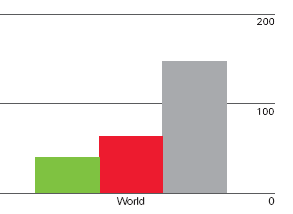
The report shows that there are currently 40.6 years of proved reserves of oil (green), 63.3 years of proved reserves of natural gas (red), and 150 years of reserves of coal. We were informed that these numbers carry an uncertainty factor of two, i.e., the true reserves may be twice as large; and we also learnt that the real reserves of coal are probably considerably larger than the proved reserves of 150 years, most likely more than 200 years and possibly closer to 300 years.
Hence, we were told, there is no urgency. While we shall eventually run out of fossil fuels, it will not happen during the next 10 years. Don't worry, be happy!
Although Prof. Boulouchos did tell us that these reserves had been calculated with the assumption of continued current consumption levels, the broad public, only too eager to receive good news for a change, is unlikely to fully appreciate this en-passant qualification.
Has the committee at least been consistent in its message? The answer to this question is a clear and unambiguous no. Prof. Boulouchos showed us a graph according to which the world population will continue to grow until roughly the year 2100, leveling off at about 10.5 billion people (cf. Appendix A); at the same time, the population of Switzerland will grow proportionately, leveling off at 9 million people. In addition, we were informed that, 50 years from now, there will be 3 billion cars roaming the surface of this planet instead of the 800 million cars that we have now. Yet, current consumption levels (on which the predictions are based) equal zero growth: The population is no longer growing, and neither is the per capita consumption of resources.
In all likelihood, the public will take away from the presentation the impression that peak oil is not happening any time soon. There is really nothing to be worried about. We can continue to use oil for 40 more years. By that time, we shall have the technology available to switch to gas and continue for another 20 years; and after that period, we will somehow switch over to coal and continue for 80 additional years. By that time, we shall have thought of something else.
The public, including some politicians, may not even know that at this point in time, we are using 35.76% oil, 23.67% gas, and 28.41% coal to meet our needs, and when we replace oil and gas by coal, we shall need at least three times as much coal as we are currently using in order to have the same amount of energy available. Consequently, the remaining 80 years will shrink to a mere 27 years.
Prof. Boulouchos did not tell us anything about the Hubbert curve (cf. Appendix B). He did not tell us that peak oil occurs when there is still as much oil left in the ground as we consumed up to this point; i.e. from the beginning of the oil age. He did not tell us either that in order to ensure a "robust" annual growth of 3.5% we would need to produce more oil during the next 20 years than all the oil we have pumped out of the ground since the beginning of oil exploration.
Finally, Prof. Boulouchos said nothing about the decreasing EROEI in oil production. He never mentioned that the "low hanging fruit" has already been harvested and that producing the remaining oil is becoming increasingly difficult and costly both in terms of money and energy invested. He never pointed out that we cannot produce the remaining oil fast enough to support our addiction to exponential growth much longer, nor did he make us aware of the fact that we are now on the plateau of oil production. He avoided broaching the subject that once we fall off the plateau, which invariably will happen within the next few years, the countries of the world will be in a fierce competition for ever faster dwindling resources, a competition that is ultimately unwinnable.
When Will Peak Oil Occur?
World oil production is almost flat by now. A number of scientists maintain that the peak oil event (usually defined as the maximum amount of oil produced per time unit) occurred in 2005. Others speculate that the peak hasn't been reached yet, and that a slightly higher maximum output will be reached anytime during the next year or two. However, most oil professionals agree that peak oil is essentially taking place as we speak.
Yet, the precise moment of peak oil production is irrelevant. Since production is now flat while the world population is still growing, the per capita oil consumption is already decreasing. Peak oil could alternatively be defined as the moment of maximum per capita oil consumption. That moment, however, occurred already in 1979. At that time, the world-wide per capita oil consumption was at an all-time high of 2.2 liters per person and day (cf. Appendix C). In the meantime, it already decreased to a value of 1.8 l/person/day, a reduction of 18%. With the world population still growing, it is very unlikely that this number will ever rise over and above its peak value again, except if a large segment of the human population were to die rapidly as a consequence of either a world war or a world-wide epidemic.
Why did the moment of per capita peak oil consumption come and go almost unnoticed? It happened because most of the oil (both in absolute terms and per capita) is being consumed in the highly developed nations, whereas population growth occurs primarily in developing countries. In this respect, the peak of oil production is still somewhat relevant because at the moment of peak production, the decreasing availability of oil will start to impact Europe and the U.S as well. As oil is no longer available in sufficient quantities to meet the demands of even financially strong customers, the price of the commodity will rapidly increase, leading to turmoil in world markets.
Already this week, we are getting a glimpse of things to come. We learnt that in 2007, more rice was produced worldwide than in any previous year, and yet, there is suddenly a shortage. The present shortage of rice occurred because the increase in production no longer matches the increase in population. The lack of available rice on the world markets had to be counteracted by moving rice out of the national reserves and putting it on the market, thereby rapidly depleting the (relatively modest) reserves. As a consequence, the rice producing nations put export limitations in place to make sure that sufficient quantities of the staple remained in their own countries to feed their own population, which in turn led to a further decrease in the availability of rice in importing nations.
Clearly, the same pattern will occur with respect to the oil as soon as we fall off the plateau. Oil exporting nations will withhold a larger portion of their oil in order to satisfy the needs of their own industries and people. Consequently, the decline in the international oil trade will be steeper than the decline of oil production alone.
We cannot know with certainty when the world will fall off the plateau, but it will happen within the next decade, most likely sometime around 2012 or 2013. Thereafter, we will be marching irrevocably down the rear end of the Hubbert curve. The result will be high unemployment coupled with a high inflation rate, social disruption, widespread famine, and a worldwide depression that will dwarf the ravages of the Great Depression of the 1930's.
Should we thus be worried about energy depletion in general and peak oil in particular? I certainly think so. Although Prof. Boulouchos did not explicitly lie to us, he presented correct facts in a deceptive fashion that could easily mislead an unsuspecting and uninformed public. In my view, it is highly questionable for a professor of a reputed institution such as ETH to imply that peak oil and peak food are minor problems that will occur in the distant future, and to deny the magnitude of the crisis we are about to face. ETH, as an institution, is trusted by both the government and the Swiss population as a source of reliable information, and it has a powerful influence on both political and social policy formation in Switzerland. As such, its professors ought to feel the obligation to tell the truth in a clear and unambiguous fashion, even when this truth is very difficult to deal with.
How Much Energy Can We Consume?
In his presentation, Prof. Boulouchos stated that the energy arriving at our planet from the sun is larger by two or three orders of magnitude than our needs. We currently consume only a tiny fraction of solar energy directly. Hence, by increasing the percentage of solar energy in generating electricity, we should be able to cover our energy needs indefinitely. In his perception, the goal of a 2000 Watt society, embraced by Switzerland during the last decade, is unnecessary. We can easily afford to continue consuming 4-5 kW per person.
In order to assess the correctness of this assertion, we need to review where the demand of a 2000 Watt society came from.
If we divide the current total energy use of this globe by the total population, we end up with a per capita value of roughly 2 kW. Thus, in order to facilitate a more equitable distribution of the available energy resources, rich nations should reduce their energy consumption to allow the developing world to consume more energy.
Yet, will even 2 kW of energy per person be available 50 years from now? In order to answer that question, we need to look at the current energy mix. Worldwide, energy is utilized in practically equal parts for electricity, transport, and climate control. Roughly 2/3 of our electricity is generated from fossil fuels, while almost all of the energy used in transportation and climate control that is not electric is derived from fossil fuels. According to BP, we obtain 87.83% of our total energy needs from fossil fuels. More precisely, 35.76% of our total energy consumption is oil-based, 23.67% is based on natural gas, and 28.41% is based on coal.
50 years from now, most of the oil and gas will be gone. Hence close to 60% of the currently available energy will no longer be available. Unless we come up with new sources, the per capita available energy will be below 1 kW world-wide 50 years from now, even if we assume that the population remains constant in the meantime.
What does the situation look like in Switzerland? The percentage of energy invested in electricity, transportation, and heating is comparable to world averages. Luckily, we produce very little of our electricity (less than 2%) from fossil fuels. 65% of our electricity is hydro-electric, and 30% is produced by nuclear power stations. Yet, almost all of our non-electric transportation needs are covered using oil, and also most of our heating systems are oil-based. According to BP, 43.45% of the overall energy used in Switzerland is oil-based, 9.31% is based on natural gas, and 47.24% is based on sources other than fossil fuels. Switzerland uses very little coal (0.34%).
Yet also in Switzerland, more than 50% of the current energy will be gone 50 years from now. Furthermore, Switzerland produces 21.72% of its energy from nuclear power stations. Since the Swiss people are in favor of moving away from nuclear power, only 25% of the currently available energy will be left by 2058. As we are now consuming 6 kW of energy per person, we can reasonably expect to have only 1.5 kW per person available in 50 years time without the oil, gas, and nuclear power.
It is easy to see that the proposition of a 2000 Watt society was based less on the desire to achieve an equitable distribution of available resources than on a rational estimate of the constraints that we face as we go about the business of developing energy resources. The assumption that we shall be able to continue using 4-5 kW per person is unrealistic, unless the Swiss population decreases by at least a factor of two.
Evidently, we should endeavor to develop alternative sources of energy. Increasing investment in solar and wind energy is definitely a worthwhile goal. Yet, the probability that we can replace 75% of the currently available energy by developing alternative energy sources within the next 50 years is literally zero.
A rather realistic possibility does exist that we may have more per capita energy resources at our disposal due to an accelerating decrease of the world population.
Peak oil equals peak food. As the food resources of the planet are no longer sufficient to feed the entire population, food exporting nations will withhold more of their agricultural products to feed their own people. Consequently, international trade in food items may, 50 years from now, be a small percentage of what it is currently.
Unfortunately, there is no hope that Switzerland can continue to feed its population of 7.5 million people without massive food imports. During WW-II, Switzerland had only 4 million inhabitants, an agricultural area twice as large as it is now, and 7 times as many farmers. Switzerland was able to feed its population barely on a diet of 1800 calories per day.
Thus, the Swiss population may be considerably smaller 50 years from now, and under those circumstances, the per capita available energy may not be as big a problem as it seems now. Yet, the prospects regarding how such a feat is achieved and the costs in terms of human misery are downright terrifying.
Emission Of Greenhouse Gases
Prof. Boulouchos told us that the global warming problem is much more important and urgent than the energy depletion problem. In his view, it is human nature to exploit all available resources, i.e. all of the remaining coal will eventually be dug out of the ground and burned, unless we find alternative sources of energy that make burning the remaining coal unattractive. Since the resulting CO2 remains in the atmosphere for at least a century, this is a problem that must be tackled urgently. We don't have much time.
In accordance with the recommendations made by the Intergovernmental Panel on Climate Change (IPCC), the Committee came to the conclusion that the emission of CO2 must be reduced to a level at or below 1 ton of CO2 per person per year. Prof. Boulouchos went on to state that if we are able to attain this goal without decreasing our high energy consumption level, then high energy consumption per se is unproblematic. Hence, a preferable goal for Switzerland for the year 2100 ought to be to reduce the emission of CO2 to 1 ton per person per year, rather than reducing energy consumption to 2 kW per person.
I agree with the committee that the CO2 emission is an important facet that needs to be addressed. Moreover, reducing our greenhouse gas emissions to safe levels will not occur automatically. We need to actively pursue the goal of reducing the CO2 emissions. Consequently, the goal of a 1 t CO2 society is indeed a very useful goal. By contrast, the energy contraction will occur whether we want it or not. Unfortunately, reducing our CO2 emissions does not by itself remove the real and present danger to our society caused by the impending fossil fuel depletion.
Let us look a little more closely at the relationship between the two goals. To this end, we shall study yet another measure of our impact on the planet: the Ecological Footprint. At the current time, humans on this planet use, on average, 2 hectares per person to support their lifestyle. Yet, there are only 1.8 hectares per person available. In other words, we are clearly living beyond our means.
Comparing the three metrics, we see that on average, the world population is consuming 2 kW of energy per person, is emitting approximately 4 t CO2 per person per year, and is making use of 2 hectares of land per person. By contrast, Switzerland is consuming 6 kW of energy, is emitting 5.5 t CO2, and is using 6 hectares; while the U.S. is consuming 10 kW of energy, is emitting 20 t CO2, and is using 10 hectares.
As a ballpark figure, 1 kW of power corresponds to 2 tons of CO2, which in turn correspond to 1 hectare of land. The relationship is not perfect because the CO2 emissions depend quite a bit on the energy mix. Switzerland is emitting less CO2 because it features a below average percentage of coal in its energy mix.
A rigid constraint is the total surface of the planet available for human activities. If we were to increase the percentage of bio-fuels within the energy mix, land use per consumed energy would increase. As we cannot increase land use any further, the total available energy would decrease. On the other hand, if we increase the percentage of coal in the energy mix, CO2 emissions per kW of energy would increase. In order to keep CO2 emissions down, we would have to reduce our energy consumption.
Our goal should be to keep the energy consumption high while reducing both the surface area and the CO2 emissions per unit of power. This can only be accomplished by increasing the percentage of clean energy (solar, wind, tidal, geothermal) within the overall energy mix.
This is also what the committee recommends. ETH should thus increase its research and educational efforts in furthering and promoting clean energy.
Getting More Bang For The Buck
As we have demonstrated, an energy crunch is inevitable as fossil fuels become less available. Switzerland will not be able to maintain its current level of per capita energy consumption through the 21st century, unless the population decreases together with the available energy. In all likelihood, we shall have to live on 2 kW per person within 50 years.
Does the reduction in available energy necessarily imply a reduction in comfort? This is not the case as shall be shown.
Currently, Switzerland spends roughly 1/3 of its energy on non-electric transportation. All of it is oil-based. Let us discuss the energy efficiency of our current transportation system.
A fuel engine, be it a gas engine or a Diesel engine, has a maximum energy efficiency of about 35%, i.e., only 35% of the energy content of the fuel is being converted to locomotion. The remainder of the energy is lost. Yet, this level of efficiency is only achieved during times of maximum acceleration, which is rarely the case. Most of the time, the engine is operated just slightly above idle. Under such driving conditions, the energy efficiency of the car is reduced to somewhere around 20%.
In addition, the average car in Switzerland weighs 1350 kg, but transports only 130 kg of useful load (passengers and luggage). Hence, the "pay load" is below 10% of the total weight. Thus the overall efficiency of the car is somewhere around 2%. 98% of the energy stored in gas or Diesel fuel is wasted in the process.
How can this figure be improved? First, electrical vehicles have considerably higher "fuel" efficiency. It is quite feasible to attain an efficiency of 40%. Furthermore, by reducing the average weight of the car to 900 kg, it is possible to increase the percentage of useful load by 5% from 10% to 15%. Thus, the energy efficiency of the average car can be improved by a factor of 3 from 2% to 6%. We thereby save 20% of our overall energy without any significant reduction in comfort.
The heating of houses is another area where significant energy savings can be achieved. 50% of our oil, i.e., another 22% of our entire energy, is wasted on low-temperature heating. By constructing more new houses to minergy or minergy-P or even minergy-P-Eco standards, a lot of energy can be saved. Just a week ago, Prof. Leibundgut, another member of the Energy Science Center, informed us in the previous Energy Science Colloquium that it is now possible to construct a minergy-P-Eco building that is energy neutral, i.e., that delivers as much (solar) energy back to the grid as it draws from it. The construction costs for a minergy-P-Eco standard house are only 18% higher compared to the construction costs for traditional (high energy wasting) houses.
Of course, Switzerland has many older buildings that are under monument protection and that cannot be upgraded to a minergy standard. Yet, it should become mandatory that new buildings are constructed to at least minergy if not minergy-P standard. Also, laws should be implemented that, during the renovation of existing buildings, make it mandatory to spend a fraction (e.g.18%) of the total renovation costs on improving the energy efficiency of these buildings. In this way, Switzerland could easily save another 15% of its energy without any reduction in comfort.
A further 10% of the overall energy could be saved by other means, e.g. by improving the energy-efficiency of appliances, such as light bulbs and refrigerators. In this fashion, 2 kW per person 50 years from now might feel more like 4 kW per person in the present.
Yet, with respect to housing construction, even more savings are possible. During the process of construction alone the same amount of CO2 is released into the atmosphere that the house will emit during a full 50 years of its existence, respectively its use. The production of cement is the worst culprit contributing to CO2 emissions associated with construction.
As long as we live in a growth economy, a significant fraction of the total energy is spent on the continued growth of the economy and not on its maintenance. As we undergo the transition from a world of exponential growth to one of sustainability, the energy that is currently being spent on growth is freed up.
For this reason, 2 kW in 50 years might actually feel more like 6 kW now. To put it differently, the coming energy crunch will require adaptation, but at least in the long run, does not necessarily have to bite. Unfortunately, adaptation takes time, time that we don't have. Peak oil is now, and we aren't ready to face it.
Luckily, as we adapt as a society to the decrease of our energy resources, and as we forcibly reduce the percentage of fossil fuels utilized in our energy mix, CO2 emissions will be reduced concomitantly. Quite possibly, a level of 1 ton of CO2 emissions per person per year may be achievable not by the end of the century, as proposed by the committee, but already within the next 50 years.
Sustainability: When And How?
We can be confident that sustainability will be attained. Our planet will see to that, whether we like it or not. We have no say in whether it will happen, and even relatively little say in when it will happen. The only thing that we can influence is how it will happen.
Sustainability means zero growth: zero growth in population as well as zero growth in per capita resource utilization. It also means zero interest for our investments.
As a species, we worship growth. We absolutely hate sustainability. It runs counter to everything we were taught and believe in. It threatens our drive for expansion and multiplication, for the gratification of our personal wants, and our greed for ever increasing profit and wealth and power. Yet, sustainability is inevitable. We can only choose whether to live in sustainable misery or in sustainable comfort.
Key to a relatively comfortable transition from exponential growth to steady-state conditions is getting rid of our addiction to oil as fast as we can and rapidly increasing our investments in clean energies, first among them solar and wind.
Yet, installation of new energy systems takes time, which we unfortunately don't have any longer. We should have listened more than 30 years ago when Hubbert told us about world peak oil hitting us around the turn of the century. We should have listened when Forrester and Meadows told us about the potential risks of a massive die-off starting around 2030. We did not. We continued with our dance around the golden calf. Life is good. Why worry. When problems arise, we'll think of something. We have always been good at that.
Exponential growth has been with us since the beginning of human history, and it has served us well. It has given us incentive and motivation to always strive for a better future. Exponential growth has always been our friend, but now, it has become our enemy.
We always knew that we were in an exponential growth race against finite resources, but this knowledge was purely abstract and mathematical. It did not concern us directly. Now, the limits to growth have become real and ever present. We are driving our vehicle at high speed into a brick wall. We see the wall ahead of us, but rather than hitting the brakes hard, we close the eyes and press the accelerator down a little deeper to listen to the power of our engine one more time. It feels so good. The sound is hypnotizing.
François E. Cellier
Institute of Computational Science
ETH Zurich
Appendix A: Logistic Population Model
The population graph that Prof. Boulouchos showed us is based on a logistic fit of past population data. To this end, available population data are fit to the differential equation model:
dP/dt = a * P + b * P2
with unknown coefficients a and b. The resulting population growth model is shown below:
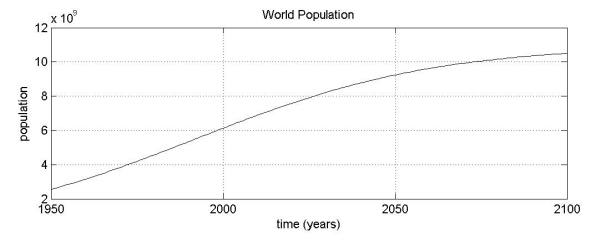
MATLAB code generating this model using a least squares fit can be downloaded from the web.
It is a shallow extrapolation model that does not take into account the effects of resource depletion on world population development. An improved (deep) model can be obtained using the System Dynamics approach advocated in Limits to Growth. However, Prof. Boulouchos' talk was based on the simple logistic population growth model presented above.
Appendix B: Hubbert Extrapolation of World Oil Production
M. King Hubbert proposed a simple logistic model to predict future oil production. He predicted in the mid 1950s that U.S. oil production would peak around the year 1970. His predictions of future U.S. oil production turned out to be highly accurate. Hubbert subsequently predicted in the 1970s that world oil production would peak around the year 2000.
A Hubbert oil production model can be formulated as a logistic model, whereby the logistic curve is being fitted to the total produced oil, i.e., to the integral of the curve that describes the annually produced oil.

The black curve (a) shows the historical data of world oil production from 1930 until 2006.
The blue curve (b) shows a Hubbert extrapolation model that is based on the last 22 years of historical production data. The model postulates that the peak of world oil production will occur around 2012. The model predicts further that the total amount of oil ever to be produced is 2445 * 109 barrels. Out of those, 50% have already been produced, i.e., still to be produced are 1222.5 * 109 barrels. This number is consistent with the proved oil reserve figures published by BP. According to BP, the proved oil reserves are 1209.5 * 109 barrels.
The red curve (c) shows a constant exploitation model. This is the oil utilization model, on which the oil reserves of 40.6 years are based. According to this model, we continue to produce and consume oil at the current level for 40.6 more years, after which time it will be all gone.
The green curve (d) shows an exponential growth model. To obtain it, I calculated the average exponential annual growth rate over the last 10 years (1.58%), and postulated that oil exploitation shall continue to grow exponentially. Using this model, the remaining oil reserves will last for another 28 years only. After that time, the oil will be gone.
The constant and exponential growth models are not plausible. As we near the end of oil exploitation, it will become exceedingly more difficult and expensive to produce the remaining oil. Hence, the Hubbert model is the most plausible of the three models by far.
The Hubbert model is also the most benign of the three models. Any discontinuity in oil production, as stipulated by the constant and exponential models, would surely lead to a total collapse of our society at the moment when oil exploitation ends.
Yet, this knowledge does not help us very much. It goes against everything we grew up with. Like true addicts, we do everything we can to prolong exponential growth for just a little while longer.
MATLAB code generating these models can be downloaded from the web.
Appendix C: Per Capita World Oil Production
I took the world oil production of Appendix B and divided it by the population calculated in Appendix A. In this way, I obtained the per capita amount of oil available for consumption.
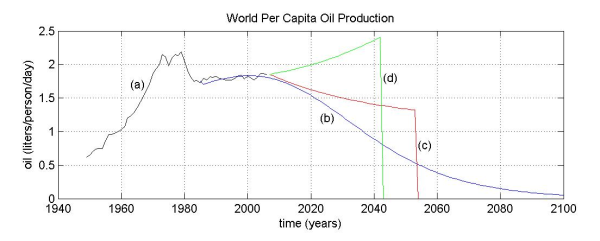
The model shows that the peak in per capita oil production occurred in 1979. At that time, 2.2 liters of oil per person and day were produced. This peak value is unlikely to be attained ever again. Even using the constant model, the per capita oil production will decrease, because world population is still growing. Only the exponential growth model shows a temporary recovery of per capita oil production that leads to a short period of yet higher per capita production values just prior to the total collapse.
MATLAB code generating this graph can be downloaded from the web.
Personnel
Editors
Contributors
Peak Oil Primers
Archives
- November 2010 (3)
- October 2010 (6)
- September 2010 (4)
- August 2010 (7)
- July 2010 (6)
- June 2010 (7)
- May 2010 (2)
- April 2010 (8)
- March 2010 (4)
- February 2010 (6)
- January 2010 (3)
- December 2009 (5)
- November 2009 (8)
- October 2009 (12)
- September 2009 (6)
- August 2009 (5)
- July 2009 (11)
- June 2009 (8)
- May 2009 (16)
- April 2009 (10)
- March 2009 (7)
- February 2009 (10)
- January 2009 (15)
- December 2008 (9)
- November 2008 (9)
- October 2008 (9)
- September 2008 (13)
- August 2008 (10)
- July 2008 (14)
- June 2008 (23)
- May 2008 (16)
- April 2008 (12)
- March 2008 (16)
- February 2008 (9)
- January 2008 (13)
- December 2007 (13)
- November 2007 (16)
- October 2007 (22)
- September 2007 (8)
- August 2007 (9)
- July 2007 (16)
- June 2007 (8)
- May 2007 (7)
- April 2007 (7)
- March 2007 (10)
- February 2007 (10)
- January 2007 (12)
- December 2006 (9)
- November 2006 (15)
- October 2006 (4)
- September 2006 (5)
- August 2006 (5)
- July 2006 (9)
- June 2006 (5)
- May 2006 (10)
- April 2006 (9)
- March 2006 (13)
Vital Trivia
License

This work is licensed under a Creative Commons Attribution-Share Alike 3.0 United States License.
A sad tale Francois, were the incompetent rule in spreading the contextually wrong information. I agree with your analysis on most of the points. However, I find your following statements a bit suprising:
1)"Peak oil could alternatively be defined as the moment of maximum per capita oil consumption."
This does not incorporate efficiency gains that have been made over time, meaning that the
effective' maximum per capita oil consumption is probably higher then the 2.2 liters per person figure you quote.
2)"We cannot know with certainty when the world will fall off the plateau, but it will happen within the next decade, most likely sometime around 2012 or 2013. Thereafter, we will be marching irrevocably down the rear end of the Hubbert curve. The result will be high unemployment coupled with a high inflation rate, social disruption, widespread famine, and a worldwide depression that will dwarf the ravages of the Great Depression of the 1930's."
Although I agree that this is a possible outcome, I wonder what your factual basis is for the strenght of the results you state. I am not too sure whether widespread famine, social disruption and a worldwide depression that will dwarf the great depression will occur.
3)"Of course, Switzerland has many older buildings that are under monument protection and that cannot be upgraded to a minergy standard"
Why can this not happen? Perhaps it is difficult, perhaps laws need to change? but Not sounds like impossible to me.
This is potentially true, and I alluded to the effects of improved energy efficiency also in my article. However, remember that these are world-wide statistics.
It is certainly correct that neither here in Europe nor in the U.S. has the per capita consumption of energy decreased over the last 30 years. Energy consumption goes hand in hand with CO2 emissions, as long as you don't change the energy mix, and CO2 emissions are still increasing both in Europe and in the U.S.
However, the situation is different in many third-world countries. There the total energy consumption may still be growing, but the per capita consumption is shrinking, even if you adjust the numbers by a suitable energy efficiency factor.
It is the most likely outcome.
Famine and social disruption are already starting in some densely populated third-world countries like Haiti, Bangladesh, and the Philippines. Economically weaker countries are more vulnerable than European nations; thus, the problems will start earlier in the third world. Yet, also Europe won't be able to escape these problems in the longer run because of its population density. Europe cannot feed its current population without food imports.
Finally, the banking sector is already in a very bad shape, experiencing problems that are systemic and for which there is ultimately no cure. Banking without exponential growth doesn't work.
Of course, it is possible to maintain exponential growth in the financial sector, if you compensate for it by inflation of equal magnitude, and this is likely what will happen. However, even inflation will not be able to save the banking sector.
I don't know what will follow, but it is evident to me that a breakdown of the banking sector will cause immense societal stress.
Switzerland hasn't participated in a war since the times of Napoléon. Consequently, our inner cities were not destroyed for many centuries.
Most cities were destroyed several times during the dark ages, as the houses were originally built from wood, and these cities burnt down every once in a while.
Yet, all of our cities have down-town centers where almost every house is more than 500 years old. This is our cultural heritage. Therefore, most Swiss are in favor of our monument protection laws. It is also one of the prime reasons why tourists come to visit, bringing money to Switzerland and creating jobs.
These houses were not constructed using bricks. The people simply were looking for stones of suitable sizes and placed them one on top of the other. Although the walls are often more than 1m thick, the insulation is very poor. There is air flow through the walls, and even more so through old doors and windows. Those are also under monument protection. Our neighbor, he owns a beautiful half-timber house from 1750, wanted to replace his old windows by double-pane windows. He didn't get a building permit, because the new windows would "visibly change the character of the house."
You say that as if it were a new occurrance.
In order to draw the conclusions you are from that observation, you need to demonstrate that the current shortages and/or disruptions are significantly worse than other, similar ones we've seen in recent decades.
Otherwise, you're just projecting your personal faith onto anecdotes.
You're factually mistaken.
The EU-27 produced roughly 15% of the world's major food crops (grains and oilseeds) in 2006, with just 7% of the world's population. By value, Europe is the world's largest food exporter.
That you believe something does not make it true, no matter how "right" it sounds to you.
Do you have any evidence for this?
As we've seen, things that you believe are not always true. Accordingly, a rational observer is unable to take your personal faith as evidence of the truth of a proposition, and must ask you for external corroboration.
And you're suggesting that this attitude would persist even in times of lethal energy scarcity?
What is your evidence for arguing that the Swiss will willingly and with full knowledge of the alternatives engage in such suicidal behaviour?
Sure there is: find evidence for your beliefs
If you just cycle thoughts around in your head, you can get thrown very far off track. If you require evidence to back up statements, you'll stay in reasonably close contact with reality.
And you'll find that reality is less dire than you think.
Almost every time I fact-check something I see breathlessly claimed in online discussions, I find the truth is less extreme than the assertion, regardless of the issue or the viewpoint doing the claiming. That is just as true with regard to peak oil, regarding both its timing - it'll happen sooner or later, but we've already passed many predicted dates - and most especially regarding its effects.
The most common cause I see for wildly unrealistic predictions of effects is pretending, against all evidence, that nobody will do anything about it. You make this same mistake:
Your "conclusion" that Switzerland will have 75% less energy in 50 years is, frankly, nonsense. You assert that the current dislike of nuclear will persist even when half of Switzerland's energy is vanishing...why? What is your basis for that assumption? You assert that no meaningful amount of alternatives such as wind or solar will be installed in the next 50 years, despite their track record already proven in nearby Germany and Spain...why?
You're assuming a fictitious world where nobody will do anything to prevent their own demise...why?
You're a computation professor, you've been trained in logic, you know how to make a better argument than that! Would you make those kinds of leaps of (il)logic in a paper you were submitting for peer review?
As a peer reviewer, I would not accept a submission with those kinds of unsupported assumptions; why do you expect people here to?
Some very good points.
I view this paper as a manifesto to younger generations. I believe these generations need to grasp the idea, that there could be possible famine, even in Europe. We need to prepare.
However, I agree that societies will change when they will be well aware of PO. But why do you think that time to react isn't like yesterday? Maybe we have run out of time to perform a gradual transition.
In my town (Koper, Slovenia) we are building giant shops, roads, suburbia like there is no tomorrow. Is this a smart thing to do? People have absolutely no idea.
BTW: I am sure that governments are fully aware of PO, but they rather look the other way (for obvious selfish reasons) than actually do something.
Oh shit yes, this is so true it should be on the banner of every site like this.
"Solar PV never produces more energy than it took to make!"
"Solar PV can be made for a dollar a watt!"
"Nuclear is perfectly safe, just put the waste in a barrel and bury it."
"Nuclear is really dangerous, everyone near the plants is heaps more like to get cancer."
and so on.
So, as Pitt says, when we meet statements like,
"We're facing a dieoff."
"Science! and The Market! will save us the trouble of actually doing anything."
we have to be sceptical...
Are you actually trying to say anything?
Perhaps your nom de plume should read Pittbull the Elder.
I myself found Francois' article stimulating but you are certainly correct in questioning his assumption that for Switzerland nuclear energy is dead in the water. If the cost of fossil-fuel-generated electricity continues to skyrocket consumers' attitudes to the pros and cons of atomic power may change radically. After all, it was access to cheap and abundant fossil fuel that enabled the innumerate general public to be ueber-fussy about imagined risks of exposure to ionising radiation in the first place. When the cheap fuel goes, the ueber-fussiness may also fade away.
As to peer review, perhaps you are a little too harsh. On the other hand, perhaps harshness is just what the doctor ordered. The problem is that it's hard to combine peer review with life's running commentary. Time's accelerating arrow doesn't make it easier either.
On the subject of teaching and learning, I found a wonderful passage in Schopenhauer the other day which TOD readers might find interesting:
[Schopenhauer, On The Basis Of Morality, pages 72-73]
Docendo disco: 'I learn by teaching'
Semper docendo nihil disco: 'By always teaching I learn nothing'
Replace 'teaching' by 'blogging' and you'll see what I mean.
Pitt, those who do not realize that the social disruption in the third world is worse today than at any time in the last century simply haven't heard the news. Every third world nation on earth is diminishing natural resources. I cite Haiti as just one example.
That was in 2003. It is far worse today. Water tables all over the world are falling, in some places meters per year. Rivers are drying up. In 1997 the mighty Yellow River of China failed to reach the sea for seven months of that year. On the banks of the Aral Sea once sat the largest fish factory in the USSR. The Aral Sea does not exist anymore and the rusting factory sits on a dry salt bed. The water was diverted to grow cotton but now the cotton fields have salted up and they produce no more than before irrigation. (Source: When Rivers Run Dry
It is the same story all over the world. Lake Chad, in Africa, is now a shrunken shallow mud hole. The Sahara Desert is expanding miles each year.
All this is due to an ever expanding population, especially in third world countries, a declining water supply, and most of all a declining food supply due to higher cost of food and the production of food. And of course the root cause of much of the cost of food is due to increasing petroleum prices. This drives up the cost of food production.
Pitt, just news.google "food riots" and you will immediately understand that the situation is far worse (worldwide) today than it has ever been in history. Sure there have been deadly famines before, some causing the starvation of millions. But those were all local phenomena. This is by far the worst worldwide crisis in history.
People simply can no longer afford to feed themselves. The millions, perhaps as many as one billion people who live on less than a dollar a day simply cannot afford to buy food. Worldwide it is worse today than at any time in modern history. This is not surprising since there are more people alive today than ever before.
Ron Patterson
I was more thinking in terms of Rumsfeld's "old" Europe: UK, France, Germany, Switzerland, Austria... These nations have a high population density. They have also a high degree of industrialization, i.e., the amount of arable land available per capita is relatively low.
Europe maintains excellent agricultural equipment and is rich enough to buy as much fertilizer as the land can use. Once Europe can no longer import as much fossil fuel as we would like, we won't have as much fertilizers available any longer (as producing them consumes lots of energy) and we shall have to rely again more on manual labor. At that time, the high population density will become a problem.
Switzerland is in a particularly bad shape. Our statistical population density is a little lower than that of France or the UK, for example, but 30% of our land is covered by ice and snow, while another 30% are steep slopes at high altitudes. Thus, the available per capita arable land is lower than in most European countries.
I know for a fact that Switzerland cannot feed its current population of 7.5 million people under local conditions, because Switzerland was barely capable of feeding 4 million people during WW-II with seven times more farmers and twice as much arable land.
Thanks to CAP, the EU was a major food exporter at least as far back as 2000, before most of "new Europe" joined.
You are simply wrong in your assertion that Europe - new or old - cannot feed itself.
World nitrogen fertilizer production requires a paltry 4% of world natural gas consumption, and fertilizer is much easier to ship over water than LNG for power plants. Natural gas will be available to produce fertilizer for a long time.
Not, of course, that it's necessary - the natural gas is just used as a cheap source of hydrogen, and nuclear-fired electrolysis could be used for that (and currently is, in small amounts). Making all the world's fertilizer via electrolysis would require just 4% of the world's electricity, and it's a perfect application for soaking up intermittent power from wind or solar.
There is no evidence that rich countries will be suffering a long-term fertilizer shortage any time soon.
(a) You don't know that for a fact, because you don't know what the effect of 65 years of agricultural technological advances is. Per-hectare yields have grown enormously since WWII.
It's important to be able to realize what you don't know, since that's the most fertile area for learning.
(b) It doesn't matter anyway. Switzerland is in the middle of a massive food exporter, and there's no evidence trade by electrified rail is going to go away any time soon.
Between the massive nuclear sector in France and the heavy investment in wind and solar by Germany (and now Spain), only about half of "old Europe"'s electricity comes from fossil fuels, meaning reductions in fossil fuels alone aren't enough to black out Europe.
Let us check on some data.
Here is what Switzerland has to say:
Here is some relevant information from the UK:
Here are some predictions from Germany with its heavy investment in solar and wind energy:
Finally, some interesting data from nuclear France are reported here:
Why the predicted shortfall of electricity in much of Europe starting around 2012?
In part, it can be explained by the generally growing economy. People are wealthier on average, and they buy additional items that consume electricity, such as air conditioners and second homes.
However, a big part is also a beginning pattern of replacement energy that can be observed. More people replace their central oil heaters by heat pumps that consume electricity.
As the fossil fuels are being phased out, the demand for electricity will be growing sharply, and there are currently no power plants in place to satisfy this growth in demand. Even worse in many countries, new power plants won't be built in time to meet the rising demand when it is predicted to occur.
As we've seen, things that you believe are not always true. Accordingly, a rational observer is unable to take your personal faith as evidence of the truth of a proposition, and must ask you for external corroboration.
That you believe something does not make it true, no matter how "right" it sounds to you.
It's important to be able to realize what you don't know, since that's the most fertile area for learning.
Because they haven't been building enough capacity, of course.
Which is irrelevant to my point about large-scale non-fossil generating capacity already existing in Europe, so I can only assume you've jumped into this non sequitur in order to "prove" me "wrong" about something.
Unfortunately for you, your links don't support what you seem to be saying - they make it clear that the collapse of the European grid is highly unlikely. Let's take your link for Germany, for example, and show the context you so carefully omitted:
Key features here:
I'm sure such beliefs exist, but you've so far failed to point out any instances.
I'd be glad if you had, since then I'd learn something, but considering how you seem to be more focussed on getting back at me for pointing out your mistakes rather than actually learning from them, it's not clear you're up to it.
Not at all. I only applied a technique of mirroring (Winnicott/Spotnitz) to show to you how condescending you sound.
If I have money that I don't need right now, I may deposit it in a bank account against the promise of a fixed interest rate. Thus, leaving the money in the bank promises exponential growth.
Evidently, the bank must be able to reinvest my money in some business that offers a higher interest rate, i.e., faster exponential growth. Without it, the bank cannot pay the salaries of its employees, and the cost of constructing and maintaining its buildings.
Thus, banking is invariably linked to a pattern of continued exponential growth.
The only way how this can be offset is by accepting an inflation rate that equals the interest rate that the bank is paying for its investments, but in that case, the customer has no longer any incentive for depositing his money in the bank.
As long as we live in an economy that grows exponentially, banks can indeed pay out interest without losing money in the process, but once we have reached steady state, they can no longer do so.
And that interest rate will be - at least in the countries where I have accounts - below the rate of inflation.
In nominal terms only.
In other words, your number will get bigger, but the value of that number will shrink, thanks to inflation.
Sure - it could invest it in production that gets a zero real rate of return, which is the same as a nominal rate of return equal to inflation. Since it's paying you less than inflation, it earns money.
Would you rather lose 4%/yr or 2%/yr? Some interest is better than none.
You may believe nobody would put money in a bank at an interest rate lower than the inflation rate, but millions of people in the real world are in exactly that position right at this very moment in both Europe and the US.
i.e., your argument is based on an assumption, and that assumption doesn't fit reality. Now would be a good time to reassess your argument.
EDIT: just to be clear, your error here is in confusing nominal and real rates of return. If you get a zero nominal rate of interest there's no incentive to give your money to a bank, since you could just stuff the money under your mattress. By contrast, a zero real rate of interest is still valuable, since it corresponds to a (nominal) rate of interest equal to the rate of inflation.
Why should I engage in suicidal behavior, as long as there is an alternative?
It is true that at the current time, people (including myself) have some money invested at interest rates that are lower than the inflation rate, but this is a rather recent phenomenon.
Last summer (2007), I sold some stock, because I believed that the stock market would experience a period of instability, as it meanwhile has. I looked into alternate investment opportunities, and I bought some European bonds, which at that time offered an annual interest rate of 4.5%, and I bought some Swiss bonds, which offered an annual interest rate of 2.5%. At that time, the inflation in Germany was at 1.7%, and the inflation in Switzerland was at 1.2%.
In recent months, the inflation rates have skyrocketed because of the higher cost of fuel and food, i.e., I may now lose some money (in real terms) because of this.
If you look back in time, at times of high inflation, people did not put money in the bank, but rather invested in tangible goods, as they were able to protect themselves a bit better against the effects of inflation in this fashion.
During hyperinflation, people as soon as they got their paycheck ran to the nearest store to spend their money on something they could use, such as a loaf of bread.
I wrote explicitly: "without the oil, gas, and nuclear power," i.e., under the assumption that Switzerland will let go of its nuclear power.
Will this happen?
I agree with you that the Swiss people will change their attitude towards nuclear power, once the alternatives become unavailable. However, all of our current nuclear power plants will have to be decommissioned within the next 50 years. Thus, new power plants will have to replace them, and this doesn't happen over night. It takes at least 10 years from the initial planning until a new nuclear power plant starts producing electricity.
Whether we will have nuclear power stations in operation in 50 years time will depend on how fast the people of Switzerland get to feel the crunch and therefore can be convinced to change their attitude.
Another potential problem is that the uranium mines currently in operation produce just about as much uranium as is needed to feed the current power stations. A rapid increase in the number of nuclear power stations world-wide is not feasible either, because of the limited production rate of uranium.
Alternate energy sources will hopefully compensate for some of the shortfall, but it cannot compensate for all of it; not by a long shot.
The world currently consumes more than 85% of its entire energy in the form of fossil fuel. The total amount of solar and wind energy together covers currently less than 0.5% of our total world consumption according to the IEA.
Let us assume we manage an annual growth rate of 7%, i.e., a doubling time of 10 years. Under those assumptions, we may be able to cover 16% of our current energy needs by solar and wind power 50 years from now.
In my view, this scenario is overly enthusiastic.
By some enormous coincidence one must imagine. Its must be absolutely impossible to raise production levels.
Application to electricity is expected to take 7-8 years in the US and 5-6 years in China, so 10 years is by no means a physical limit.
Wind passed 1% of world electricity generation last year (it was 1.3%). Not really disagreeing with you here, just providing some hard numbers.
Why? The average annual growth rate of wind over the last decade has been 30%, and solar has been growing faster.
It's folly to project that rate of growth into the far future, of course, but it's also folly to completely ignore reality and assume an arbitrary growth rate picked to give a pre-determined result.
When you buy your first car, the percentage of new cars suddenly grows by an infinite percentage.
As long as a technology is small, i.e., an increase consumes relatively little financial investment in absolute terms, you may see high growth rates of 30% or more.
As a technology matures, it will become impossible to maintain those growth rates.
For a technology that binds a significant percentage of financial investments, a growth rate of 7% is phenomenal.
Under the conditions of a generally shrinking energy environment (and thereby a generally shrinking economy) due to the depletion of fossil fuels, a growth rate of 7% is illusory.
Of course not. If energy is the lifeblood of the economy as many assert here, including you apparently, then when fossil fuels begin to decline, energy will capture the lions share of investment and other sectors of the economy will be sacrificed.
I agree completely. Money is an abstraction. It is energy that is being invested. Even with high 10:1 energy returns, an energy source cannot grow very quickly or it's growth consumes all the energy it would have provided.
Some citations:
[Pearce, J.M. 2008] ‘Thermodynamic limitations to nuclear energy deployment as a greenhouse gas mitigation technology’, Int. J. Nuclear Governance, Economy and Ecology, Vol. 2, No. 1, pp.113–130.
[Mathur, J. 2004] "Dynamic energy analysis to assess maximum growth rates in developing power generation capacity: case study of India", Energy Policy 32 (2004) 281-287.
Three cheers for Pit the Elder. Thank you, thank you, thank you!
Dear Francois,
I spent two months during the summer of 2000 at Reza Abhari's turbomachinery laboratory at ETH. Upon arrival I gave the secretary my visa card and asked her to order Colin Campbell's book from Petroconsultants. I also handed Reza Abhari (who is in the task force) a copy of the article by Campbell and Laherrere which appeared in Scientific American. While there, I shared an office with a graduate students who had come to Zurich from Lausanne, and he was already then aware of the oil issues, having been told about them by his teacher at Lausanne. I have also discussed this issue with Lino Gusella (who is in the task force), while he was on a sabbatical at our university two years ago.
What is happening in Zurich seems to be the same as elsewhere. My observation is that the people in mid-career are in an institutional straight-jacket. First, they will defend what they are doing at all costs. Second, when the political climate changes, they will jump into the bandwagon claiming that they have always been there. This is to impress on the people around them, that they have had a clear vision all along. This is a survival strategy. Many admit to this in private.
best, Seppo Korpela
Does my article sound alarmist? Maybe it does. However, there is no way around it.
I was raised at a time that still knew scarcity. I still played with colored wooden cubes rather than remotely controlled fire-engines. My wife still had to wait two entire years before she finally could wear the hotly desired red snow boots trimmed with fur after her cousin had grown out of them.
When I was small, Switzerland consumed 1 kW of power per capita. When I was a teenager, the Swiss per capita power consumption had risen to 2 kW. Now we consume 6 kW.
Easy access to luxury items has improved throughout my whole life. Now, most people of Europe and the U.S. live in a state of luxury that even the kings of our past hadn't known.
I had the good fortune to live in the one generation that knew more luxury than any generation before it, and probably more luxury than any generation after it, and it was all due to the availability of fossil fuels.
The generation of my nephews and nieces already grew up at a time when luxury items were readily available. They wrote down their desired items on long wish lists, and come Christmas, these items were bought for them.
When my nephew at the age of 16 came to visit us for a month in the U.S., his parents sent him off with $300 to spend on souvenirs of his choice.
The generation of my grand-nephews and grand-nieces doesn't even know what waiting for a desired item means. They utter a wish, and immediately, the item they want is being bought for them.
Last year, a new shopping center, called SihlCity, opened here in Zurich, complete with a movie theater featuring 10 screens. The center makes U.S. malls look shabby in comparison.
When I wander through SihlCity, I always ask myself how such a structure will be heated and illuminated after the end to cheap fossil fuels. How will the builders of this palace ever recuperate their investments?
Yet, the large majority of Swiss shoppers is totally oblivious to the consequences of the coming resource depletion and even to the issue of resource depletion as a whole. Electricity comes out of the wall outlet, and food comes from the Migros. It has always been that way.
Hence I consider it my duty to alert the younger generations to the changes in their lifestyles that are destined to affect them very soon.
Francois
Its funny you say this. My wife and daughters are shopping addicts, again there is a genie (me) who makes it all come true. In the UK we have numerous shopping outlets (Trafford in Manchester, Meadowhall in Sheffield Metro Centre in Gateshead to name but three), many have sprung up on the outskirts of cities and attract people from far and wide. I too wonder how many of the happy go lucky shoppers ever consider how much energy it takes to sustain this carry on. I suspect the answer is within the counting capacity of a parrot, and I am just a nutter sitting there thinking weard thoughts!
"Hence I consider it my duty to alert the younger generations to the changes in their lifestyles that are destined to affect them very soon."
I wonder about shopping centers too. Maybe they will serve as food shelters.
Young people are absolutely oblivious. However - that would only change substantially, if media and government would inform them. Information is not in the best interest, because it would disrupt BAU (business as usual).
I am not very optimistic.
I've always thought that the instant availability of water from taps and electricity from wall sockets was one of the reasons why we waste those resources.
As to how soon people will awaken from their consumerist slumber, I'm reminded of Robert Crumb's cartoon of a dazed post-apocalyptic man sitting in front of a non-functioning TV with its plug in his hand.
Francois, thanks for an informative article about the linkages between energy supply and population growth!
You said that "As a species, we worship growth. We absolutely hate sustainability. It runs counter to everything we were taught and believe in." Do you think that it's possible for the human species to grow in ways other than by accumulating children, assets, wealth, profit and power?
On peak oil, I still believe that the world crude oil and lease condensate (C&C) production peaked in 2005 at 73.8 mbd, on an annual basis. There is a chance that C&C could peak this year at just over 74 mbd as shown in the chart below. I have also placed a simple logistic for population on the chart.
As oil supplies decrease, institutions advocating a stable population may become more prominent. As an example, this one is called Population Connection (formerly Zero Population Growth) http://www.zpg.org/
click to enlarge
Of course it's possible. We know this because there are societies that do this.
Such tribes are typically small and have no true hierarchy.
Communists!!!
;)
Cheers
Excellent overview. The fixation on climate change mediation and ignoring PO as too pessimistic for public consumption is everywhere. If the current oil, commodity and food price and supply trends continue another year I think that shyness will disappear or those professors and experts in the media and elsewhere will be replaced with people like the author of the above, Francois Cellier, and other TOD engineers, economists, scientists and lay people who are familiar with reality. Heads will roll just like at the banks and in governments. The public will demand solutions and then our day will have come to offer them.
You are evidently a better man (or woman) than I am. I don't have any good solutions either ... only one that is hopefully a little less painful than most others.
Powerdown.
Permaculture up.
Denser energy efficient housing.
Total recycling/no waste (scraps, rags, whatever).
Minimal protein consumption,eggs perhaps.
Universal Gardening.
Handtools, crafts revival, local manufactures.
Cultural resurgence. Learn to entertain yourself, your neighbours, your community. People who live through Main Stream Media are not independent thinking.
Die off is only inevitable if we presume that so-called TPTB, i.e. our corporatist/ government/ media masters dictate our deeds and moods, e.g. war propaganda, advertising for mass consumption.
When the centralized system breaks down we have to step into the breach with solutions that don't involve corporate sponsors and laboratories but good old human ingenuity at neighbourhood levels. Grassroots activism. People will thrive on personal repsonsibility for their own lives and communities after decades of being consumer zombies.
"Live Free or Die."
I agree that globalization will be the first victim of the end to cheap fossil fuels.
Soon the time will be over, where it makes sense for Canada to ship its shrimp by airplane to Thailand for cleaning and peeling, to then have it shipped back to Canada also by airplane for sale.
Soon it won't make sense any more for Switzerland to ship its recycled paper to China for further processing.
We'll need to redevelop local production facilities.
Unfortunately, this won't solve the problem either, because Europe cannot feed its own population without massive food imports. The population density is too large. Only some of the younger countries, like those in the Americas and Australia, have still enough arable land available to feed their population.
Famines have been recurrent events throughout human history. Maybe, you should read up on the Great Famine of 1315-1317. It happened because of overpopulation. Yet, Europe in those days featured less than 20% of the population it has now.
For many centuries, human world population hovered around 1 billion people. The population only started growing dramatically during the 20th century, and this would not have happened without ample availability of cheap fossil fuels.
Around 1900, the average life expectancy world-wide was 27 years. Of course, people didn't die in their 20s even then. Life expectancy was so low due to horrendous infant mortality.
What you advocate is a return to the (actually not so) glorious old days. I agree that this might happen, but if it does, it will invariably be accompanied by a drastic reduction in world population.
Hence also your prescription is a recipe for massive die-off.
Great article, Francois.
On a somewhat related note I (not so) recently came up with a list regarding the potential of each region to make it through the bottleneck. When creating the list I calculated food production ability vs. population, available water, domestic energy sources and resources, technological possibilities and the potential of the army. The timeframe is 15-25 years from now. The list looks roughly as follows:
1) Russia
2) US+Canada
3) Scandinavia
4) Australia + New Zealand
5) Europe other than Scandinavia
6) South America and Asia other than Russia and Chindia
7) China and the Koreas
8) Middle-East
9) India
10)Africa
What would you modify in this list?
It is difficult to come up with an easy recipe for judging the robustness of a given region to the changes ahead.
On the one hand, economically weak countries are more vulnerable to the effects of societal stresses than richer nations, just like people with generally poor health conditions are more likely to catch and die from the flu than more healthy people.
On the other hand, not every nation will experience the same amount of societal stress as a consequence of the changes ahead.
A country like Bangladesh is in a very bad shape, because the country is already hopelessly overpopulated; the people of Bangladesh are among the poorest on this Earth; they already now depend on food imports and won't be able to pay for these imports any longer as the food prices are rising; and finally, they are extremely vulnerable to rising sea levels. Hence the societal stresses caused by the end to cheap fossil fuel (and cheap food) as well as the effects of global warming will be felt tremendously. Also large stretches of Africa are in a very bad shape.
On the other hand, a tribe of mountain people somewhere in the mountains of Thailand, people who don't use much energy now and feed off local produce exclusively will hardly notice either Peak Oil or Global Warming. Also Cuba is in a fairly good shape, because the Cubans essentially already went through their own version of Peak Oil. They are already aware of energy scarcity and use the few resources that they have available to them much more economically than most other places on this planet. Furthermore, Cuba is in the tropics, i.e., the Cubans can grow food year round, and therefore don't need to pay for food storage either in terms of money or in terms of energy.
Some nations in South America are in quite good a shape due to low population density. For example, Argentina is currently producing five times as much food as the country needs to feed its population of 30 millions. They also have both oil and gas and are net exporters of energy. Hence Argentina will be in a much better position than most of Europe.
Finally as we pass through Peak Oil, the price of oil will rise. Consequently, there will be a (temporary) shift of wealth away from the oil consumer nations to the oil producer nations. Because of this additional wealth, the prime producer nations, such as Russia and Saudi Arabia, will be able to keep their economies going for a while longer, which will place them in a much stronger position in terms of world economy. Whereas Reagan outspent the Soviet Union in the late 80s, Russia in the coming years will be able to outspend the U.S. and Europe, because they now produce more of the remaining expensive oil.
I agree with everything you've just said. I also think along those lines you mentioned. However, I didn't want to come up with a foot-long list with 50 items, just wanted to give you an overview. I am also not too high on Europe - I don't think we as a 'community' will make it. Furthermore, I don't really trust present borders. I think the map is going to change a lot in the coming decades.
That being said, I have to think Russia is #1. They have oil and gas, they have some coal, nuclear, etc. They are getting richer by the day and it won't stop all of a sudden. The population density is very low and they are more than capable of growing their own food. Russians are a patriotic bunch - it will help them a lot. And last but not least they have a potent army to use, just in case. Oh yeah, and something they don't have: debt.
The US+Canada came second. Why? Population density. More than enough domestic energy if you combine the two countries. Sure, less energy than those guys there use now, but still a lot more than they need in order to survive. Water is an issue in some places, but the continent as a whole still has more than enough. I'm pretty convinced North-America is going to see its fair share of troubles, but I doubt those are going to be as permanent and severe as we Europeans are likely to face. (Albeit the amount of shotguns there will be a pain in the ass.)
New Zealand and Australia are great places to be - unless the Chinese want those places. I'm not sure they can defend themselves down under.
The Middle East...sure, they have oil. But other than that, they don't have much. As long as the oil is there they are rich - or at least they will be able to buy (barter) food. After the oil is gone... what do those guys have? A not very comfortable desert. I think in 20-30 years they will start seeing huge problems there.
I may agree with you however on South America. They deserve better. Where would you put them? #3? #4?
Also... where would you put Europe? I'm in Hungary...
(Oh. One more thing. Your work regarding Modelica. (Stella). I'm not an expert on the issue but my wife (a mathematician and programming engineer) just started to look into it a lot deeper than I ever have (or could). She says it's a wonderful piece of work. She doesn't like the implications of the model... but it's very hard to argue with facts.)
I find it incredibly depressing that an 'expert' like the above professor can mislead politicians. When I read the intro I had a moment of hope: "Ah, the Swiss are doing something - let's hope this influences my [UK]government."
It seems hard to campaign for awareness, because a layperson like myself is going to be "outvoted" by a professor, however misleading his information on Peak Oil is. Why didn't he do some research - when I discovered peak oil in 2004, it didn't take too long for me to decide that it was the true picture.
It is beyond me, how intelligent people who should know better, keep thinking based on useless R/P ratios.
Any physicist/engineer should see through that instantly.
Anybody who uses R/P ratios to tout that there are no issues, gets completely debunked in my view.
I meanwhile applied the same analysis to BP natural gas data.
I had to set up the logistic model a little differently. Rather than identifying two unknown parameters, a and b, as before, and validating the remaining gas reserves from the resulting model, I accepted the BP proved gas reserves as correct, and identified a logistic model of the form:
dG/dt = k • ( 1 – G/Gmax ) • G
with the single unknown coefficient k. G(t) here represents the total gas produced up to time t. Gmax is the total amount of natural gas ever to be produced.
The black curve (a) shows the historical data of world gas production from 1930 until 2006.
The blue curve (b) shows a Hubbert extrapolation model that is based on the last 22 years of historical production data. The model postulates that the peak of world gas production will occur around 2024, i.e., 16 years from now.
The red curve (c) shows a constant exploitation model. This is the gas utilization model, on which the gas reserves of 63.3 years are based. According to this model, we continue to produce and consume gas at the current level for 63.3 more years, after which time it will be all gone.
The green curve (d) shows an exponential growth model. To obtain it, I calculated the average exponential annual growth rate over the last 10 years (2.55%), and postulated that gas exploitation shall continue to grow exponentially. Using this model, the remaining gas reserves will last for another 38 years only. After that time, the gas will be gone.
All of these models assume that gas will not be used as replacement energy for oil, once peak oil has passed. This assumption is not very likely, as it is cheap and easy to replace oil by gas both for heating and transportation.
We can see this already now in Argentina. Regular gas (I shall henceforth refer to it by the name petrol to distinguish it from natural gas) is very cheap. It currently costs 65 Cents per liter. Yet, natural gas (methane) is yet cheaper. Calculating oil equivalence at the consumer side rather than the producer side (as BP does) by evaluating how much it costs to drive 1 km on petrol and on methane, we conclude that 1 “liter” of methane costs only 22 Cents in Argentina.
Any engine that can run on petrol can also run on methane. The converter set is cheap and can be installed easily in any regular car. Due to the price difference between petrol and methane, almost all cars sold in Argentina come with a factory-installed converter set, i.e., the same car can run alternatively on petrol and methane. Usually, people in Argentina start their car up using petrol and run it for the first 2-3 minutes on petrol, because methane is less efficient than petrol as long as the engine is cold. After that, they run on methane, until the methane tank is empty. One tank filling lasts for roughly 120 km. If they don’t come across a gas station in time, they switch over to petrol and run on petrol until they get to the nearest gas station.
In Europe, conversion to gas would be a bit more expensive than in Argentina, because the standard catalytic converters are optimized for petrol rather than methane. Air pollution regulation would require exchanging the catalytic converter as well, and a converter optimized for methane costs roughly three times as much as one optimized for petrol. However, this can be done, and if the petrol becomes too expensive after peak oil, European countries could decide to follow the model of Argentina.
If oil gets replaced by gas, the remaining gas will evidently be used up more rapidly.
I also calculated the per capita gas consumption.
The Hubbert model shows that the peak in per capita gas production will occur in 2016, eight years from now. At that time, 1.4 m3 of gas per person and day will be produced. We are currently at 1.3 m3 of gas per person and day.
MATLAB code generating these graphs can be downloaded from the web.
An energy strategy for the future made of 40 professors sounds impressive indeed. And so is the result, at least partly. I like your comments about the construction of houses, insulation is very essential! But what is most important is that we make a message such as this known to the wide public. The energy debate needs input from all sources, only then can we achieve a truly enlightened society.
On http://www.futurenergia.org you can find interesting thoughts about the future. What is extraordinary is that the website provides a platform where school children can integrate with specialists such as professors, Friends of the Earth campaigners and industry representatives. The outcome is very interesting and the scripts from the live web chats that have been performed gives the reader a good insight of how the generation of the future thinks and acts.
Mathias Nilsen – Blueprint Partners
An interesting document from them, their brochure. I have some responses to it here.
Peak Oil: Not The Death Of Growth, But The Birth of It.
Francois Cellier's post is actually a fascinating one for the interesting chess game of numbers relating to production, consumption and growth. It allows us to take a look at the game board as it currently stands. The post uses a great number of words to end up saying that we must consume less oil (however considering his references to Prof. Boulouchos remarks concerning solar energy, it is not clear whether or not Mr. Cellier assumes we must use less energy, as distinct from oil. Mr Cellier's post makes a common mistake seen often here on TOD: It assumes that energy means fossil fuels. The remarks below are very telling, in that they depict Mr Cellier's understanding (or perhaps we should say simplification) of Prof. Boulouchos position:
"We can continue to use oil for 40 more years. By that time, we shall have the technology available to switch to gas and continue for another 20 years; and after that period, we will somehow switch over to coal and continue for 80 additional years. By that time, we shall have thought of something else."
One has to love the assumption that we will march through every possible fossil fuel before even beginning to attempt to think of something different! We will do ANYTHING to resist the horror of attempting to use the hated renewables!
Of course, nothing could be further from the truth. Prof. Boulouchos points out the staggering possibilities of solar energy, which in some locations and using the most efficient designs is already nearing grid parity with fossil fuels, renewables providing power without the burden of greenhouse gas emissions. If carbon release is appropriately taxed, renewables are already becoming a bargain. This does not even touch upon the variety of renewables other than solar, including methane recapture from a dizzying variety of sources, both plant and animal wastes, timber byproduct, landfills, etc, and wind and geothermal systems that are potentially vast. Even Matthew Simmons now discusses ocean power.
All this leads us to this sentence by Francois Cellier:
"He did not tell us either that in order to ensure a "robust" annual growth of 3.5% we would need to produce more oil during the next 20 years than all the oil we have pumped out of the ground since the beginning of oil exploration.
The oil companies may want to believe and want us to believe that growth in consumption will be "more oil during the next 20 years than all the oil we have pumped out of the ground since the beginning of oil exploration", but no one who is technically literate believes that this is going to happen, whether the oil is available or not.
I seldom go out on a limb and make predictions, but I would bet some small sum of money (since all I have are small sums!) that there simply WILL NOT be 3.5 percent annual growth in oil consumption worldwide for any more than 5 of the next 20 years, and again, it doesn't matter whether the oil is available or not, it simply is not going to happen. To believe such a thing is to be completely blind to the technical developments occuring NOW and accelerating at a dizzying pace, the liabilities of oil use, and the increasing worldwide resistance to oil based on greenhouse gas emissions. Oil is rapidly becoming simply not worth the trouble in more and more applications, and product designers are designing AWAY from oil, not toward it. As the next cycle of power consuming products come to market (many of them already locked into release dates around 2010 to 2012 and many more to follow that) oil consumption will begin to drop.
We have seen this before. A look at the electric power production of the U.S. gives us a portent of things to come:
http://www.eia.doe.gov/emeu/25opec/sld014.htm
Or home heating:
http://www.eia.doe.gov/emeu/25opec/sld013.htm
What we have seen since the 1970's is oil being pushed out of each and every sector of the U.S. economy. We know of course that this was done in many cases by substituting natural gas. In other words, the "dash to gas" predicted by Prof. Boulouchos has already occured, in Europe even more than in the U.S., but the fuel switching to gas in the U.S. has been staggering if we count from the 1970's. So great has the move away from oil already been that it really only rules in one sector of most developed economies: Transportation.
There has been discussion of changing transportation to natural gas for decades. T. Boone Pickens refers to his belief that this would have happened years ago as one of his greatest faulty assumptions.
Now, with natural gas production becoming more difficult, and Europe in an uncomfortable dependent relationship on Russia for gas, it is almost certain never to happen. The great age of fuel switching from one fossil fuel to another is probably over. Gas at $11.00 per mm/btu is no bargain, and the price could go even higher.
The final fuel switch will have to be to electricity and those often scoffed at renewables. This is why the fossil fuel industry and their spokespeople, both paid and unpaid, must scoff at and slander the potential of renewables. They know that the age of growth in the fossil fuel industries is over, whether or not the growth of world economies is or not, and whether or not the growth of energy production (as distinct from fossil fuels) is or not.
How much "growth" is "possible"? You be the judge:
http://upload.wikimedia.org/wikipedia/commons/3/35/Available_Energy-2.jpg
Is it possible that Peak Oil and the possibility of renewable energy does no portend the death of growth but the birth of the first real growth than humanity has yet known? Growth based on clean energy falling from the star upon us everyday, year after year, decade after decade, century after century, millennium after millennium? Growth built upon endless energy from nature, not on slavery, exploitation and abuse?
It comes as no surprise that those who hate the concept of growth and prosperity for all humanity on philosophical grounds must slander the possibility of renewable energy no matter how cheap it may become.
What we are now seeing are endless strings of rhetorical questions. Questions are asked not to gain information, but to reinforce sets of beliefs and assumptions already held. Is infinite growth possible? There is no clear probable answer to that question is there? Do you mean we will continue technically until we move into space and inhabit other planets? Is "infinite" anything predictable in human affairs? Should I even care about the possibility of "infinite" in policy making or planning? No one can even begin to guess the conditions that will prevail 200 years from now, only 3 generations down the road. Alvin Toffler pointed out in the 1970's that all the history of civilization was only 800 lifetimes long, given the overlap from from one generation to the next. Could the pioneers of the industrial age only an eyeblink behind us relatively speaking, even imagine the technical advance that would occur less than 200 years after the Industrial Revolution? Yet we bog ourselves down in rhetorical arguments about "infinite growth"...how many angels can dance on the head of a pin, was it ever decided? But the world moved on, and left behind the "intellectuals" who wasted their lives and intellectual power away in such arguments.
As a tool of visualization, "peak" is very fitting. Whether there is a surplus of oil still out there in the ground or under the sea or not, the age of oil, for a multitude of reasons, is nearing peak if it is not already there. Oil (and fossil fuels in general) no longer drive technical advance, and are no longer viewed as the fuel of the future. The fossil fuel industry, like a running elephant that has been shot, will run on momentum for a very long time. After all, there are still working steam trains in operation, a small handful of them that have soldiared on for nearly a century after they were built. There will probably be a small handful of gasoline or Diesel vehicles still soldiaring on just after the year 2100. But the "oil age" is now in it's declining years with it's best and most glorious years behind it. We always knew this day would come. Did anyone believe that we would never move forward away from this age? If we do not we will perish. It's that simple, peak oil or not. There is one great philosophical point that those who are horrified by the prospect of peak never, never understand:
It is not change that assures decay and death. It is the lack of it.
Thank you
Roger Conner Jr.
Good post, Roger.
I wanted to take on one segment in Francois' post about growth myself, while I think you covered it.
"Sustainability means zero growth: zero growth in population as well as zero growth in per capita resource utilization. It also means zero interest for our investments.
As a species, we worship growth. We absolutely hate sustainability. .."
To Francois,
Thanks for the efforts in writing this article. There is much to learn from it, but as far as this Growth statement that I've clipped from it, I wanted to say that Growth IS a central and vital part of being a living creature. I don't think it's 'Growth' itself that deserves targeting, but 'Cancerous Growth', 'uncontrolled growth' perhaps. We have in Energy, in Toys, in other material goods a number of cumbersome Tumors to support at this point, and this heretofore 'cheap' energy keeps the blood flowing to it. While I agree that these 'Growths' will have to be cut away in great numbers to return to a proportional life, what that Surgical Weeding is doing, as far as I'm concerned, is to enable 'Healthy Growth' ..
Your statement that 'We Worship Growth' reminds me of how, in our Western schizms we sometimes 'Worship Sex', albeit not in a balanced or a healthy way. The solution is not to demonize sex or growth, but to put it back into its fine place in our lives, and remove the fantasies that have twisted it.
Respectfully,
Bob
To extend the point a little, I think that continually reemphasizing this mantra of 'Zero Growth' is a diversionary sort of language to use when in fact there are all sorts of things that need to be growing, including our gardens, our solar and wind installations and companies, our sharing of solutions, our own muscular strenghths and lifestyle habits. I don't think you are, in fact, denying any of this, but when talking of informing and inspiring people to action, it works against the message if this theme of 'No Growth' continues to be the motto.
Semantics, possibly, but important semantics.
Bob Fiske
No, Bob, it is not.
Of course, we need to grow solar and wind installations to offset the dwindling fossil fuel reserves as best we can, but we cannot grow even those installations indefinitely.
Let us assume that we currently have one windmill every 100 km2. We wish to grow the number of windmills by 7% annually, i.e., we'll double the number of windmills once every 10 years. Thus, 10 years from now, we'll have one windmill every 50 km2, 20 years from now, we have one every 25 km2, and in a few more doubling periods, we'll have one windmill every m2, which evidently isn't feasible as one windmill occupies more space than that.
Any growth, even linear growth, is not sustainable forever against a finite resource. Ultimately all material growth needs to stop, because our material resources are finite.
Hence world population must stop growing, and so must the per capita consumption of material goods. This is inevitable. The mantra of perpetual growth is an illusion.
Of course, we'll always grow vegetable, and we'll always have children, because we consume the veggies that we already grew, and because people are dying of old age.
Zero growth doesn't mean that nothing grows any longer. It only means that, on average, creation and destruction of material goods must become equal.
Zero growth doesn't mean zero birth rate. It only means that the birth rate must equal the death rate.
Francois likely has a broader perspective of growth. Growth also includes technological growth as it pertains to extracting fossil fuels. Which implies that we will be able to extract the last remnants that much more quickly.
It's simple math really.
Under the assumption of exponential growth of the consumption of a resource, more of that resource is being consumed during each doubling period than during the entire history before.
An annual growth rate of 3.5% gives us a doubling period of 20 years, i.e., 20 years from now, we shall consume exactly twice as much of that resource as we consume currently. Consequently, we consume more of that resource during the next 20 years as during the entire history up to now.
Where does the figure of a 3.5% growth rate come from?
Our governments tell us that we need an annual growth rate of the GNP of better than 3% in order to keep our economies alive and kicking. Japan, for example, claims that the country is in recession any time the GNP is not growing by at least 3% annually.
Also, Prof. Boulouchos predicted that by 2050, i.e., about 40 years from now, there will be 3 billion cars in circulation compared with currently 800 million, thus roughly four times as many. Hence he assumes a doubling period of approximately 20 years, i.e., an annual growth rate of 3.5%.
40 years from now there will be 3 billion cars? Are you sure? What if GM is correct in asserting that they will sell "auto piloted" cars within 12 years? If such a vehicle were to exist, why would I pay to own a car if I could request delivery to any location, at which point the car would leave to park itself or to handle the request of someone else? One vehicle might serve hundreds of passengers per day and give substantial discounts for ride sharing.
Science fiction perhaps, but when you fall for the professors extrapolation of current technology 40 years into the future, you appear to be naive.
Jack
"There will probably be a small handful of gasoline or Diesel vehicles still soldiaring on just after the year 2100. But the "oil age" is now in it's declining years with it's best and most glorious years behind it. "
Maybe and maybe not?
In a recent TOD post it was pointed out that of all the solar energy arriving at one acre of ground for one year only about 1/10th of 1 percent (0.1%) makes its way into the ethyl alcohol produced from that one acre field. Pretty lousy energy conversion.
But, if all that solar energy were converted to electrical energy with a solar thermal power plant and the electricity used to disassociate CO2 and H2O into C + H2 + O3 and then used to convert the C + H2 into synthetic gasoline and diesel fuel what would be the effective energy conversion percentage? We currently have all the technology to accomplish this process, but pretty energy inefficiently.
Production of synthetic gasoline and diesel fuel by this process would be carbon neutral (not including construction of processing facilities) and would eliminate the requirement to make massive infrastructure changes as they would use the present facilities.
Currently the political wisdom(?) is to put all our research funds into dead end things like ethanol, biodiesel, nuclear fusion, etc... Very little of our research funds are going to long term sustainable solutions because they have "no constiutanties (sp)"
There are at least 2 programs the I have heard of, but all my efforts to acquire more information and URLs have been unsuccessful to date.
If we could generate enough extra solar electricity, we could manufacture synthetic crude oil and pump it back into our depleted oil fields for long term carbon storage. The original crude oil lasted for millions of years in those oil fields and I see no reason why the synthetic would not last equally long periods. And we would then have it available for emergency energy use in the future.
Could it happen? Maybe. Will it happen? Considering out penchant for politically driving headlong at full speed into brick walls - Hummmmm.
How much could we afford to spend to improve the efficiency of these processes which would make it possible to produce 100% of the liquid fuels in demand entirely in the USA/Europe? How much would zero petroleum imports financially benefit the USA/Europe in one year, 10 years?
Just thinking about the possibility of that would probably give JHK indigestion?
You totally misunderstood me. I am all in favor of renewables. I don't hate them at all.
Yet as I already wrote in another response, the current contribution of wind and solar power together covers just about 0.5% of our total energy consumption. You may be able to increase the energy produced in this fashion by a factor of 10 or even 20 during the coming 50 years, but certainly not more than that. This would still leave you with a meager 5-10% of solar/wind power. Adding geothermal and tidal power to the mix doesn't change the equation fundamentally.
This doesn't mean that we shouldn't do it. We definitely should do it. Yet, all of the alternate energy sources together won't be able to avoid the energy crunch that is being caused by the fossil fuel depletion.
I agree with you that we should tax the consumption of fossil fuels more highly to promote the use of renewables. Unfortunately, our governments do just the opposite. Currently, the U.S. government is considering to cancel the solar/wind subsidies, whereas two of the presidential contenders promote the introduction of a summer gas tax removal.
I agree with you that the oil age is coming to a close. For many years, the growth rate of oil consumption has been around 2.7% world-wide. However, this number has come down in recent years. Now, we are almost flat already. I doubt very much that we'll ever see a growth rate in oil consumption of even 1% again.
Replacement technologies might include gas on some occasions, but other technologies will hopefully win out in many sectors. For example, I foresee that the Swiss will soon replace their currently predominant oil heating systems by electric heat pumps, hopefully supported in some cases by geothermal systems on the primary side and/or thermal solar systems on the secondary side.
The problem is that this will lead to a substantial increase in demand of electricity, and there are currently no power plants in place that are capable of meeting this growing demand. The Swiss government therefore predicts brown-outs to start around 2012.
In transportation, plug-in hybrid vehicles may finally become available, and I predict that many Swiss will jump on the opportunity to own such a vehicle. The Swiss have been for many years already at the forefront of embracing new technologies when they become available.
Of course, plug-in hybrids will once again increase the demand for electricity.
The problem is that replacement technologies can be used to replace one source of energy by another, but they don't increase the total amount of energy available.
Growth has been that high only 3 times in the last 25 years (EIA), with average yearly growth of 1.3% over the last 25 years, and 1.5% over the last 15.
It was 1.3% between 2006 and 2007, and is shaping up to be 1.4% between 2007 and 2008 (based on IEA projections of average 2008 oil consumption being equal to production seen in Q1 this year; EIA says demand was up by 1.0% between 2006 and 2007).
You vastly understate the large efficiency gains that those replacement technologies entail.
Heat pumps, for example, have a coefficient of performance of about 3 (ground, air), even in Canadian weather, meaning that every 1 kWh spent produces 3 kWh of heating. 30% of European energy use is for space and water heating, meaning that heat pumps could reduce Europe's energy requirements by around 20%.
Similarly, electric vehicles require about 0.35kWh/mile vs. 22mpg. At 36kWh/gal, a regular car requires 36/22=1.7kWh/mile, or almost 5 times as much energy as an electric vehicle powered by nuclear, wind, or solar. About 40% of world energy use is for transportation, predominantly cars, meaning that 20-30% of world energy use could be removed by switching to electric vehicles.
Those two technologies alone could reduce the amount of energy required by the world by a third. You're brushing off very significant factors.
This is all fair and true, but it does not address the point that I was making.
First, as you replace oil by electricity, either for home heating or for transportation, you need additional electricity that has to come from somewhere.
Everywhere here in Europe we are currently running at or very close to capacity on electricity production. Hence we'll need additional electricity - lot's of it. Where does this electricity come from?
We still need to replace the fossil fuel that we no longer consume by some other source of energy that has to come from somewhere.
As of now, I don't see projects in place anywhere here in Europe to provide that additional electricity fast enough to be available when we need it.
Second, it is true that heat pumps and electric vehicles have a considerably higher efficiency than oil heaters and gas engines. However, you also need to take into account the efficiency factor of producing the additional electricity.
If we produce the additional electricity out of fossil fuels, we haven't gained much, because the efficiency of a gas-fired thermal power plant is somewhere around 55%, that of an oil-fired thermal power plant is somewhere around 50%, and that of a coal-fired thermal power plant is somewhere around 45%.
If we produce the additional electricity using a nuclear power plant, we are doing even worse, because the efficiency of the nuclear power plant is somewhere around 35% (it operates at a lower temperature).
Third, in either of these scenarios, we aren't solving the basic problem, because we are still consuming either fossil or nuclear fuels, which we are running out of.
In the long run, the only way out of the dilemma is producing more electricity, much more electricity in fact, from solar and wind, but as I explained elsewhere, I don't see that we can keep up with the rising demand in the short run.
Very good article.
However, the section below in bold (my emphasis) puzzles me:
Did you mean to say that?
Yes, I did. Maybe I could have turned the sentence around:
High energy consumption allows us a comfortable life style. Energy consumption per se is not negative. Only the consequences of high energy consumption under the conditions of the current energy mix are negative. This is, by the way, consistent with what Prof. Boulouchos says.
The main issue that I have with his presentation concerns his assertion that plenty of energy will be available for at least several decades. This simply isn't true.
The broad public is oblivious to the problems that we are facing, because these problems do not yet manifest themselves in any significant fashion. We haven't seen energy shortages yet in Switzerland; we haven't seen famine; and we haven't seen any other types of restrictions. The majority of the Swiss are wealthier and can afford to buy more luxury items than ever before. So why should they be worried?
The problem is, it won't stay that way. Those of us (like almost everyone here at TOD) who concern themselves with these issues on a daily basis recognize the consequences to the end to cheap fossil fuels, and therefore, it is our duty to alert the public to these consequences.
There are no easy answers and probably, there are no satisfactory answers at all, but being knowledgeable of what is ahead enables us to prepare ourselves better for the harder times to come.
Preparations take time and money. You cannot develop alternate sources of energy over night. Thus, if we start preparing now, we'll be better off than if we don't prepare. We would have been yet better off, had we started preparing 30 years ago.
Francois,
Thank you for your stimulating and thought-provoking essay.
You write:
I'm skeptical. Goals are a dime a dozen -- just like 'values' and 'attitudes'. The independent variable is not the energy consumer's 'goals' but the availability of fossil fuels. Per capita carbon dioxide emissions will decline only when consumers can't afford to buy hydrocarbons. All else is delusion.
It is energy availability that drives consumer behaviour, not vice versa.
Quite apart from that there is the Big Issue That Nobody Ever Mentions -- the 'tragedy of the commons' as played out in the irreversible dismantling of the Kyoto Protocol. Why don't you draw it up? One of the chief reasons individual countries fail to take adequate action to combat climate change is that they are aware that they will reap only a fraction of the benefits -- and that scarce resources might be better spent on protection than on prevention. For example, it makes a lot more sense for the Netherlands to invest in improving its dykes to protect the country against rising sea levels than in reducing its CO2 output to the same end. Even if the Netherlands reduced their CO2 output to zero the impact on rising sea levels would be marginal. Being virtuous on the carbon front just doesn't pay.
For the Swiss, it would be wiser to invest in flood protection than in CO2 emissions reduction.
Perhaps the climate change motto should be let's get real -- if you can't prevent, protect.
Basically agree with your statement here on protection vs. prevention.
Out on the 'net there is floating around a calculation of whether the average American could ever get down to the 1t CO2/yr/capita. Point being, even in colonial times the rate was higher because of the deforestation of the eastern part of the US.
It is highly unlikely the atmospheric concentration of CO2 will stop rising until man simply gets post peak-coal and post peak-deforesting, with those points being defined by human expansion of fuel use as long as possible.
Thus, adaptation (and protection is a specialized form of adaptation) is required, to live in a future Earth with a climate modified from that to which we have been acclimated these past several millenia.
Indeed.
If you look at slide 20 of a Powerpoint presentation of mine (the source of this graph is from a presentation of Christian Azar's at last year's Alliance for Global Sustainability meeting in Barcelona), you notice that the CO2 emissions of the "evil" USA (Kyoto deniers) in the seven years between 1997 and 2004 have increased by 7%, whereas the CO2 emissions of the "good" EU nations (Kyoto supporters) have risen by only 6% during the same time period.
The reason is simple: the US overall economy has experienced a real growth of 7% during these seven years, whereas the EU has seen a real growth of 6%.
As long as we don't change the energy mix, our CO2 emissions will grow and shrink strictly proportional to our energy use.
By phasing out fossil fuels, we will drastically reduce our CO2 emissions, but if we replace oil and gas by coal (without carbon capture), our CO2 emissions will grow dramatically.
However, Prof. Boulouchos is correct in his assessment that the CO2 emissions are a real problem that needs to be addressed by legislators and scientists alike. The fact that we failed to do so in the past must not prevent us from trying to succeed in the future.
Thanks for your reply, Francois.
Your contributions are a pleasure to read -- I'm still working my way thru them!
Being somewhat computer illiterate, I am unable to extract your figures. Usually on TOD it is possible to click on the figure so it presents in its own box and then save it as a non-web based file. I would like to use the last two figures appropriately referenced in my own peak oil presentation.
D
daniel, if you are on a PC, right click and hit save as. if you are on a mac, ctrl-click on the graph and save as...then save to your desktop.
I agree absolutely that creating economic and social institutions that can function in a healthy manner without composite growth of the overall economy is essential to creating a sustainable future. However, I disagree that we worship growth and hate sustainability. The problem is that many people simply do not understand the implication of the 'normal' functioning of the economy. I had a recent discussion on the growth issue in an alternative energy forum in which some technocopian was arguing in favor of aggressively increasing our nuclear and renewable energy capacity in order to keep the economy 'healthy'. I said that I agreed that we needed to develop non-fossil sources of energy, but that if we did so in the context of a goal of continuously increasing per capita income into the indefinite future, then these so called clean energy sources would not prevent eventual economic and/or ecological disaster. I told him that if your goal in keeping the stock market 'healthy' is get through your lifetime without major inconvenience and to leave future generations holding the bag of ecological disaster then your position is at least logically consistent, but that if you care about the long term future of humanity then you need to confront the problem of growth in addition to the problem of alternate energy technology.
The technocopian was absolutely furious that I had accused him (as he thought) of not caring about the future of humanity. "Where the hell to you get off making nonsense claims like that? Of course I care about humanity's future." Both his anger and his claim to care about our long term future were quite genuine in my opinion. The problem is that economic growth is not really perceived as physical growth. If a middle-aged individual were 10 meters tall and still growing this would obviously be a disaster. But getting a decent percentage return on your monetary investments is like having potatoes for dinner. "What? You don't want me to eat well?".
The operations of private finance capitalism have become internally normalized to the point where it is impossible for many people (even those who are genuinely concerned about the finite nature of the earth's resources) to think clearly about them. My father for instance is an environmentalist, and he is fond of Lester Brown's Plan-B, in which book Brown promotes the idea of making the economy "tell the ecological truth" by taxing ecologically destructive behavior and thereby making product costs reflect the full environmental cost of their manufacture. "But, Dad," I say to him, "What if the ecological truth is that we need to manufacture and transport a lot less stuff? Within the context of private finance capitalism such a change would imply a huge recession and massive unemployment. If we want our 401K funds to go on rising at 8% per year forever then tax shifting is not a sufficient solution." He nods his head when I say things like this but I can tell he does not really 'get it'.
I do not believe that my father's hopes to fix private finance capitalism originates in a desire for constantly increasing wealth. My father is a man of action, and when he sees a problem he want to take practical action to fix it. His resistance to the idea that private finance capitalism is structurally faulty comes from his (correct) perception that changing these fundamental structures will require a social revolution and a fundamental shift in the power structure of society that cannot take place a great deal of political struggle and turmoil. Therefore he clings to the hope of a technocratic solution which will bring about a 'green' version of BAU.
BAU is going to vanish. The desire of money to make money cannot continue to be the driving force behind manufacturing infrastructure investment (This fact does not mean that money has to disappear, however.). Voluntary simplicity and mutual support must be the the primaery economic operating principles of any reasonably democratic sustainable society. I do not necessarily claim that democratic societies will emerge from the coming transition, but being philosophically a democrat deep in the marrow of my bones I have to hope that such societies are possible. If our primary concern as individuals and families is to hang on to what we have got as long as possible and the devil take the hindmost, then the transition to wealth maintaining economy (as distinguished from a wealth increasing economy) will be as painful as possible.
The failure of capitalist economies to grow as a result of peak oil disturbances will disturb the mechanism by which photovoltaic factories get financed and built. Along with wind turbine factories and so on.
I hope that there will be one more bubble economy pushed by the worlds central banks... a green bubble to over build the way housing has been overbuilt in this past bubble. Then at least there will be some excess bits and pieces around for some sustainable energy.
If one follows what central banks and economic planners are doing...one might think they are freaking out right now. How to fix commodity inflation (fuels and food) with asset deflation (housing and everything else)? They don't know how to do it.
The economies are how we get our energy delivered right now. The communist command model didn't work too well and the magic of the invisible hand doesn't seem to be good at long term thinking.
So the delivery system may be where it breaks down.
And of course, will bombing Iran by US warplanes verticalize that nice plateau we are now sitting on?
Am I correct in my understanding that the reference to average per capita power consumption in KW is actually describing kilojoules per second?
I've seen other discussions of per cpaita power consumption use the KW metric, but how that relates to energy use per unit of time is about as clear as mud.
I don't think I speak alone when I say that it would be a great service to laymen everywhere if discussions such as these make it explicitly clear exactly what consumption per unit of time is being expressed.
Cheers,
Jerry
Jerry McManus writes:
I second that. It's incredibly frustrating to have to cope with this haggis of measurement units. Thanks for bringing up the subject of "all you ever wanted to know about watts but were afraid to ask" ....
Sorry. I hoped to be unambiguous and employ those measurement units that are most commonly used.
Energy is measured in Joules. Energy per unit of time is called power. It can be measured in Watts = Joules/second, but sometimes, people prefer to measure it in Joules/day or even Joules/year.
The same problem arises when you talk about oil consumption. You can measure it in gallons/day or in gallons/year.
It gets even more confusing with methane. Usually, methane consumption will be measured in cubic meters per day (m3/day) or in m3/year.
However, when you wish to compare different types of energy among each other, you need to convert one type to a somehow equivalent amount of the other.
Oil companies usually like to deal with oil, i.e., they convert the consumption of natural gas to "oil equivalent" gas consumption, measured again in gallons/day or gallons/year.
The conversion factor can be calculated in different ways. It could be calculated e.g. by looking how much electricity you can produce by burning methane vs. oil, or it could be calculated by checking how much methane is needed to drive a car across a certain distance compared to using oil.
BP applies its own set of conversion factors without fully explaining how they derived them. Within the different types of fossil fuels, these conversion factors make at least some kind of sense, but they even get applied to hydroelectric and nuclear power, where they make very little sense in fact.
Then you must be confusing your terms:
By your own definition kW is a measure of power, not energy.
Adding to the confusion is the fact that most people's electricity bills are measured in kilowatt hours (kWH), which like the Joule is also a measure of energy. My typical electric bill for an average month usually reports that I used about 8 - 10 kWH of energy per day (that's actually probably more typical of an average European than an average American), or about 4 - 5 100 watt light bulbs left on all day and night.
How does that compare to the world average per capita power consumption of 2 kW discussed in the article?
Cheers,
Jerry
Jerry,
you may take it for granted Francois doesn't confuse power and energy; talking about 2 kW energy per person was maybe just a little bit sloppy.
As for your energy consumption, the 400-500W of electricity are of course just a small fraction thereof. The idea is that you also have to count the energy consumed by your car, your heating, etc. Production and delivery of all kinds of goods that you consume are also counted as they need energy as well. That's how you would arrive at something like 5-10kW, depending on your lifestyle.
peterkarl at Zurich CH
Read my comment again. I never said I thought Francois is confused, I only said he confused his terms, which is, as you say, sloppy.
You are also confusing your terms, watts is a measure of power, not energy. You also misunderstood my question, I wasn't asking how to calcultate my total power consumption, I was only asking how energy consumption, using my electric bill as a handy example, is translated into equivalent units of power consumption, which would allow at least some sort of comparison, albeit a limited one as you have pointed out, to the world per capita average.
Your comment seems to suggest that my 8 - 10 kWH of energy consumption per day equals 400 - 500 W of power consumption per day, which also agrees with my lightbulb example, but nowhere in the article does it say that the 2 kW world per capita power consumption is measured per day, which means both you and Francois have failed to answer the question that started this thread, which is: what is the consumption per unit of time that is being expressed?
BTW, I don't own a car, the heating, cooling and cooking in my small (300 sq. ft) flat are all electric, I work at home on the computer (also electric), and I walk to the local supermarket where I buy mostly fresh food. So unless you can make the case that the other items on your list (and you left out the big one which is hot showers) are the bulk of my energy consumption, then my electric bill is in fact a reasonable proxy for my lifestyle.
Cheers,
Jerry
I am an electrical engineer by training. I don't confuse energy and power. However, I was indeed a bit sloppy when I wrote 2 kW of energy. It is 2 kW of power.
In everyday talk, people use power and energy more or less as synonyms of each other. They talk about power flow when they mean energy flow, for example.
However, you did indeed confuse power and energy. Power is energy flow. It is measured (in "international units") in Watt = Joule/second, because the standard unit of time is seconds. Alternatively, you can express energy in Joule = Watt*seconds.
As long as you stick to the standard "international units" of kilograms, meters, seconds, and Volts and derive all other units from those, you never get funny conversion factors.
Which entity has time attached to it, power or energy? The answer is, it is the energy hat has time attached to it. If you consume 2 kW of power, this means that you consume 2x24x60x60 = 172,800 kJ of energy in one day and 345,600 kJ of energy in two days, i.e., the energy consumption is a function of time, whereas the power consumption is not. You are constantly consuming 2 kW. You aren't consuming 2 kW of power per day.
Thanks for clearing that up. My laymans understanding of the difference between energy and power, and how they are measured, has been considerably advanced by this thread.
Cheers,
Jerry
To speak of "energy use of 2kW per person" is not incorrect. It means, "our energy use is two thousand Joules per second per person."
Let me be a bit more specific here. According to BP, Switzerland generates 21.72% of its energy from nuclear power stations and 25.52% from hydroelectric power stations. Yet, both hydroelectric and nuclear power are only used to produce electricity, and we get about twice as much electricity out of the hydroelectric power stations as we get out of nuclear power stations. Hence BP's conversion factors don't make sense.
BP claims that Switzerland generates overall 47.24% of its power from hydroelectric and nuclear power plants. Yet, this is only because they calculate, how much oil would be needed to produce the same amount of electricity. Yet, water power comes from mechanical potential energy, i.e., the "caloric content" of water power is irrelevant.
If you look at corresponding Swiss government statistics, you find that the numbers are very different from those that BP uses, because the Swiss government converts everything to "electricity equivalent" rather than "oil equivalent."
To this end, Switzerland calculates, how much electricity could be obtained if we were to burn all of our imported oil and gas in thermal power plants to produce electricity. According to those statistics, the percentage of hydro and nuclear power in the overall energy mix would be somewhere around 30%, with nuclear making up 10% and hydro making up 20%.
Thus, the numbers end up vastly different depending on the conversion methodology in use.
"Rice producing nations put export limitations in place to make sure that sufficient quantities of the staple remained in their own countries to feed their own population, which in turn led to a further decrease in the availability of rice in importing nations."
In other words hoarding of rice occurred due to a shortage, a parallel for what some believe will happen with oil.
I am pleased that Jerry asked the question - but he did not get a clear answer. I still don't know whether the allowable use of energy is 2 kW per hour, day or year!
Another point that I think is important is the allowable global temperature increase. James Hansen suggests an upper safe temperature increase of 0.5 deg.C., which equates to approx. 320 ppm carbon dioxide in the atmosphere (we are currently around 385 ppm). This is supported in the recent Australian authored report 'Climate Code Red' which suggests that because the extent of positive feedbacks is not known the Bali(Nov.2007)temperature limit of 2 to 2.4 deg.C may become 3 or 4 or 6 or 10 degrees. The Swiss Professors appeared to think that 500 ppm carbon dioxide in the atmosphere would be OK!
Finally, it seems to me that it will be necessary to ration energy use - so much per person per week (month? year?). 'Climate Code Red' states that we must go to zero carbon use now if we are to enable the earth's natural carbon dioxide absorption mechanisms to reduce the concentration back to 320 ppm. This implies reliance on electricity from renewables or nuclear sources, hence we must ration the available energy and cut out frivolous uses (like air conditioners?). I know this will be inconvenient, but it will concentrate the mind, and I'm quite sure that many people will quickly construct solar thermal devices to provide some degree of winter warmth in at least one room in their home. They will likely also put their overcoat over the blankets on the bed at night for extra warmth (as I used to do when a child in the UK) (I am now in Southern Ontario). If the Inuit could live in igloos, then I think I can live in a cool house too.
It's 2kW all the time.
A "joule" is a unit of energy. A "watt" is one joule used over one second.
It's like speed. A "mile" is a unit of distance. A "mile per hour" is a mile travelled in an hour. So that the wattage of an appliance (usually measured on a sticker on it) is like its mph.
The 2kW society is one where all the energy used by people over a year is equivalent to 2,000 Joules used by each person each second.
You are perhaps confusing the kW with kWh, or kilowatt-hours, which is the unit your electricity is billed in. A kilowatt-hour is simply 1,000 Joules used every second for an hour. A 2kW society would be 2x 24 = 48kWh/day, or 17,520kWh annually.
But that's total energy use. Nowadays, about one-seventh of our energy use is electrical, the other six-sevenths is fuel in cars, etc.
By comparison, for electricity inefficient Western countries like the US or Sweden use about 12,000-25,000kWh per person annually, more efficient ones like Denmark, Germany and France use 8,000kWh or so. So we can set the Western average as about 10,000kWh in electricity, and another 60,000kWh in other forms of energy. So we're basically 10kW societies.
I suppose the idea is that if we go entirely electrical, we'll use our energy more efficiently.
So I was correct in my understanding that kW per capita is describing kilojoules per second, as I stated in the original thread, but I think your example of 48 kWH per day is easier to relate to, for the reasons given earlier. Thanks for the confirmation.
Cheers,
Jerry
I think that power is a more useful measure than energy. It is the peak power demand that determines the size and number of power stations. Peak oil is really about peak oil flow, the maximum number of barrels of oil per day, or maximum oil power.
Kilowatt-hours per day is also a measure of power, but I prefer plain kilowatts as they are simpler to understand. Once one knows what's watt, so to speak, there can be no confusion. Kilowatt-hours require a unit of time to be meaningful, e.g. kilowatt-hours per hour, kilowatt-hours per day, or kilowatt-hours per mile x miles per hour. However, it is easy for the unit of time to be be omitted, leaving a fairly meaningless amount of energy.
I assume that the average power per person of 2 kW excludes power derived from food, in other words the 2 kW is external non-human power. An adult human body uses about 100 W, less for children. Therefore the average external power is at least 20 times that needed to keep a person alive. For industrialised countries with average power of 5-10 kW, the external power factor is between 50 and 100 which means there is surely plenty of scope for reducing non-human power.
It depends on your point of view. Your power company (or should it be energy company?) charges you for the total energy that you have consumed over the last month, i.e., for the integral of the used power over time.
This is correct, but the reality is even a bit more complex than that.
If you install solar collectors on your roof to preheat your water, i.e., you produce thermal energy locally that you consume immediately again, this energy is not counted in the statistics, because it never passes through any energy counter. The same is true for photovoltaic systems that are not connected to the grid.
As far as the government is concerned, it doesn't matter whether you seemingly use less energy because you like to take cold showers and sit in the dark, or because you heat your water locally and produce the electricity for your light bulbs privately at your home. The government only accounts for energy that changes hands somewhere in the process and is being paid for.
Furthermore, the government only accounts for energy that is being consumed within Switzerland. If I buy a Renault car that has been produced in France, the energy needed for assembling my car never enters the statistics. This is called here in Switzerland "gray energy." As Switzerland imports more goods than it exports, there is a positive flow of gray energy into the country.
It is estimated that the energy accounted in the 5.4 kW per person that we are currently consuming represents roughly 60% of the total energy consumed (still excluding the energy consumed through our food).
The following statement is relevant to most of the topics on this forum:
power is the critical thing not energy
P = dE/dt (1)
∫dE = ∫Pdt (2)
E = Pt for constant power (3)
For all sorts of reasons non-human power consumption must be reduced. Available power will decline anyway in future so we won't have a choice. However that does not mean necessarily that energy consumption needs to be reduced wherever non-human power is used, as equation 3 shows. The same amount of work can be done with less power by taking more time.
Equation 3 also means there is no such thing as an energy crisis. If there is a crisis at all it is a power crisis. Given enough time there is enough energy to do anything that really needs doing.
It looks like an Export Rice Model (apologies with respect to the Export Land Model)!
This past February 1st, at the IVT institute of ETH Zurich there was a colloquium - which I happened to attend - whose title was
After peak oil - do we have to rebuild our cities? (German language, but the graphs should be easily understood):
http://www.ivt.ethz.ch/news/20080201_seminar_wegener_4.pdf
The speaker was M. Wegener from Dortmund, Germany. Right in the beginning, peak oil was very shortly presented as a fact, in order not to loose time. The lecture was a breathtaking account of a simulation study performed upon order by the European Union, a project called STEPS.
Basically, the study was concerned with mobility behavior in Europe as a function of future fuel price development, dealing with 3 scenarios, two of them consisting of 4% and 7% per annum fuel price increase. I don't know the details of the simulation models but they were quite general. With regard to mobility behavior, the result was that people will change their habits quite a lot, moving their living place to where they work or vice versa (I don't know how you would simulate that). Another result was (in figures for each scenario) that individual transportation will dramatically shrink and use of pblic transportation will increase accordingly. There was also a prediction of GNP development which resulted to be rather unsensitive to fuel price. The time frame was 1970 through 2030, using the past for calibration. The model reminded me somewhat of the World model used for 'Limits to Growth'.
Why do I mention this lecture? It's because it may tell us something about peak oil awareness. Nobody of the audience was surprised at all. The seminar room was more than full because of the important topic. I recall the question of an attendant concerning shopping behavior, because huge shopping malls continue to be opened at and near Zurich; The answer was crisp: some of them 'on the green lawn' will just close down if there is no adequate public transportation.
So, it seems that ETH people have two souls in their bosom. The most important thing is of course that one can continue to do interesting research. The message told to the large public, however, continues to be 'don't worry, no problem ahead'.
peterkarl at Zurich CH
Thank you, Kiashu. Now I know how much energy I can use. 48 kWh per day. The rate (mph) at which I use it can be variable.
My home, a bungalow built in 1984, is passive solar, air tight (to the best of my ability) and super insulated (R36 in the walls, R 60 in the ceilings); the basement, insulated on the outside, has R20 polyurethane on the top 4 feet of a 10 inch thick, 8 ft. high poured concrete wall, and R10 down to the footings. In the winter I use about 30 kWh electricity per day plus about 3 cubic meters (30 kWh) of natural gas in a gas appliance installed in the basement rec room. This gas fire supplies comfort heat to 3 rooms in the basement (via open doors) and background heat (average temperature about 62 - 64 deg.F.) to the ground floor. All the internal ground floor rooms are insulated R12 , and all the rooms are fitted with doors, so that we heat to comfort level only the rooms we are using. In the summer months we use about 15 kWh/day of electricity. (no air conditioning.)
I have just taken delivery of 2 x 170 W solar PV panels which I intend to use for fans and water pumps (plus some emergency LED lighting). I would like to install about 30 kW (peak) solar thermal panels to heat water stored in a 5400 l water tank installed in the basement (the wife says NO!) to serve as background heating for the winter months (this will allow me to terminate the natural gas supply!). Life gets interesting, don't it!
Not quite 48kWh a day just for electricity as it is today. That's 48kWh a day of ALL energy IF it were generated renewably.
There's a lot of energy use which we can't easily control, but which nonetheless produces emissions and/or benefits us. The lights in the street outside my house benefit me, and they're powered by a coal-fired generator. The bulldozer and trucks and jackhammer and so on used to make the road outside my house, this roads benefits me, but those things powered with diesel produced emissions. And so on and so forth.
So the 48kWh per day is not my own personal use of electricity and that's that. It's everything done in my country by me or on my behalf directly or indirectly.
Of all electricity use, about one-third is domestic. Total energy use directly controlled by the household (eg the transport you choose) is about the same. So you could take that as your guideline - 1/3 of 48kWh/day, or 16kWh/day - again, that's total energy use, to be supplied renewably. That 16kWh renewable has to do your heating, cooling, lighting, cooking, transport, everything.
It doesn't sound like much that 16kWh renewable as total energy use, but is achievable with solar hot water, lots of walking, biking and public transport and so on.
See the one tonne CO2 lifestyle for one approach.
Francois Cellier wrote:
Would you care to define an upper limit for that?
The sky is the limit, or rather the sun.
Most of our available energy is ultimately solar energy. This includes all of the fossil fuels (fossil sunshine); it includes hydroelectric and wind energy; and it includes biomass.
The amount of sunshine reaching our planet provides in principle considerably more energy than we'll ever need. Unfortunately, the energy density is fairly low, and therefore, it takes a lot of effort (i.e., time, money, and energy), to build and assemble installations that would enable us to harvest a significant percentage of the solar energy arriving at our planet.
Unfortunately, we are running out of time, because our fossil fuels are getting depleted, and without these fossil fuels, we may no longer have the energy available to quickly build large numbers of solar energy installations.
Sometime in the far future, humanity may once again be able to support a high-energy society in a sustainable fashion, but in the short run, this is not feasible. We cannot construct alternate energy plants fast enough to compensate for the shortfall of fossil fuels.
Consequently, we shall experience a significant energy crunch within the next few years that will reduce our ability to produce food, and will likely lead to a significant reduction in human population (i.e., a die-off).
Francois,
I have enjoyed reading your comments. While you are certainly not the first to see pending doom behind every rock, you have shown perhaps as much willingness as anyone to suspend reason to make your arguments. You need to pretend to have the opposite point of view while reading what you have written.
"It takes a lot of installations (i.e. time, money and energy), to build and assemble installations that would enable us to harvest a significant percentage of the solar energy arriving at our planet."
We have already built countless installations for the express purpose of harvesting a significant quantity of the solar energy arriving at our planet. Over the past 100 years or so, the amount of land in the USA covered in trees has increased somewhere on the order of 80 million hectares. The main reason for the increase was that many small farms are no longer needed to grow food. We are living during a time of plenty when 2% of the US population grows more than enough food for 100% of all Americans. The foolishness of putting corn oil in cars has contributed to a crunch during a short term business cycle, but we can and will grow more food. The foolishness of food based ethanol will eventually cause its demise and free 30% of the US corn crop for food consumption.
If your pending doom analysis were correct, we would at least have some years to prepare as we used up the 80 million hectares along with hundreds of millions of hectares of other trees.
In the USA, many a car dealer has reached the decision to not accept big SUV's in trade. This is a sign of awakening to the problem. For the first time in decades, more cars are being sold in the USA than are "light trucks". If the problem were as dire as you suggest, something like more than 50 million SUV's would likely be parked at a savings of millions of barrels per day. The fellow who is losing at a game of strip poker does not take off his pants first. We are no where near dire circumstances, we are still wearing our pants. We are in a process of evolution, not of revolution. If we need to change faster, we will.
By the way, total world liquids production are running around 87 million boe per day (as posted on the TOD monthly report) and will reach 93 million per day in a couple of years (assumes the completion of the mega-projects on the Wiki list and depletion of about 4.5%).
In an early comment, you stated that globalization would be the first victim of the energy crisis. This comment almost jumped off my screen as being upside down and biased. Globalization is an example of increased efficiency of use, not the other way around. The reason to ship goods halfway around the world is to put them at the location where they have the most value. Shipping cost are often virtually nil compared to the increased utility of the goods (the value of bananas before shipment is a tiny fraction of their value after shipment).
It cost a tenth as much energy to ship goods by train as it does by truck and a tenth as much to ship by ship as by train. Your mention of shrimp being transported by air is perhaps an example of excess but the overwhelming volume of goods are shipped at a very tiny fraction of the cost in your example.
I recommend that you take a look at a basic drawing of supply and demand curves, where consumer and producer surpluses are noted. As I recall, Wikipedia has a set on a page about tariffs which shows the lower cost to consumers when markets are opened to imports. When any good is sold, it is virtually always true that the buyer would have paid a little more if necessary and the seller would have taken a lower price if necessary.
The available price is pushed down by globalization. The goods are shipped only upon the expectation that the transportation costs will be more than offset by the increase in the value of the goods at the new location. An extra high price of fuel, makes the price of goods grown or manufactured at an inefficient location all the more susceptible to more efficiently produced goods with the shipping cost attached.
Put another way, the reforestation of millions of hectares of trees is a direct result of relatively lower transportation costs. It is foolish to grow strawberries in New York hot houses when express trains can deliver from Florida at a small fraction of the total energy costs.
I appreciate your passion. Thank you for taking the time to write.
Jack
This is very true ... in an energy-rich environment. As long as there is enough energy available to do anything and everything with it that you consider useful to do, your priority will be on maximizing profits.
However, once the total amount of power is insufficient to do everything, you'll need to make choices. Which projects will you enable with the available power, and which others will have to wait or must be canceled altogether?
It will now become a question of maximizing the utility of the available power, and not maximizing profit.
As long as it is still "cheaper" (in terms of energy, not money) to grow your strawberry in Florida or maybe Bariloche rather than in a greenhouse in upstate New York in spite of the additional cost (once again in terms of energy, not money) of transporting the strawberry to their destination, you may choose to continue doing it ... at least for as long as eating strawberry is still high enough up on your list of things to do.
Unfortunately, as power becomes less abundant, the list of things that can still be done shrinks rapidly as well, and eating strawberry may no longer be on it.
This is true. Rural USA/Canada are in a fairly good position, because of their low population density and because of their local natural resources.
North-America still produces both oil and gas, and this will help softening the economic/societal impact of Peak Oil to some extent, and also its other resources, such as its large wooded areas, will definitely help.
However, the societal stresses will nevertheless be felt in a very painful way. The US alone, with 5% of world population, consumes 25% of the overall energy resources, and does so by being more wasteful in the use of energy than any other nation on this planet except for some fiefdoms along the Persian Gulf.
It will not be possible to continue in this fashion. Also in the U.S. of A., energy conservation will have to become and will become a prime focus.
Americans currently consider it their birthright to be as wasteful as they can afford to be. They will get very angry, when they are being told that they need to change their ways. Remember the old saying: A fed bear is a dead bear. America is a very well fed bear.
You are wrong on this one, rather dead wrong! The sky, more accurately the atmosphere, is indeed the "limiting" factor. Anymore energy reaching Earth from Sun would charbroil the planet with all its flora and fauna.
On average 30% of the incident solar energy is reflected right back into outer space. Of the 70% which is initially absorbed, in thermal equilibrium (keeping the land and water at an average temperature of 14ºC, 64% is radiated back by the clouds and atmosphere, and the remaining 6% by the ground (both as infrared). The problem “global warming,” occurs when radiation is "trapped" and it oscillates back and forth due to increased GHG in the atmosphere.
See also Earth's energy budget
http://en.wikipedia.org/wiki/Earth's_energy_budget
Contrary to what you believe, it is very fortunate indeed that the incoming energy density from the sun is fairly low. Try getting closer to the sun, or peeling the atmosphere! Simple math, basic biology and common sense tell us if the initial incoming energy density is increased, the planet would start broiling, baking and eventually toasting.
There's absolutely zero evidence to support this "hypotheses!" In fact, based on what we already know about the planet and its fragile ecosystems, it could never support Kardashev scale and its sci-fi concept of "technologically advanced civilizations." [Large numbers of people can't live in space stations indefinitely, other than in Star Trek.]
If I were betting person, I would put my money on “die-off” occurring from "Heinz 57" varieties of factors other than the “significant energy crunch.” The chances are, however, none of us would be there to collect!
best
NOT Max
I wrote that humanity may be able to support a high-energy society in a sustainable fashion. I never said that humanity would consist of 6.5 billion people by then.
Let us look at the numbers. Mankind is currently living on 2 kW of power per person on average. However, we don't do this in a sustainable fashion. If we deduct all of the fossil fuels and nuclear power, we end up with less than 200 W per person. As far as I am aware of, there is currently no nation on this globe, where people live on average on 200 W per person.
Yet, the number could be easily increased, if only there were less people. If there were 1 billion people living on this planet instead of 6.5 billion, we could live on 1.3 kW per person on average. That may be a bit uncomfortable, but manageable.
If we look back in time, humanity was living for many centuries in a sustainable fashion. World population hovered somewhere around 1 billion people; humans bred like rabbits, but there were always famines and plagues to take care of the problem.
We didn't use much energy. We burnt some wood to cook our meals, and we burnt some more wood to keep warm. Transportation was done either on foot or (great luxury) by horsepower. We lived sustainably in a low-energy environment.
If we do nothing (as may well be the case), we'll end up living under similar conditions once again within the next 100 years or so. As I wrote in my article: sustainability will be achieved - the planet will look to it.
Yet, it doesn't have to come that way.
I doubt very much that this planet can carry more then 1-2 billion people in a sustainable fashion at any energy level. More people will simply continue to degrade the resources of our planet further: we'll continue to fish out our oceans, cut down our forests, and overuse the available arable land.
Yet, as long as the human density isn't too high, we don't have to live as miserably as our ancestors did. If we somehow manage to keep the electric grid up and the birth rate down, we can live more comfortably on a higher-energy diet.
Anything that we do over and above bare survival in the historical fashion is a plus, and we should be able to do a lot, given enough planning and time.
There are 35.
Or if people build non-fossil energy options, like wind (30% annual growth for the last decade) and solar (45% annual growth).
Which, unsurprisingly, is the path people in the real world are taking.
While I recognize that that assumption underpins your entire argument, that unfortunately doesn't make it any less absurd.
Would you care to justify this assumption of yours that humanity will sit there idly in the face of known and feasible solutions as civilization collapses due to increasing energy shortfalls? If you fail to justify that assumption, your argument is little more than begging the question, and will utterly fail to convince virtually anyone who doesn't already believe we're doomed.
If you assume nothing will change, you are guaranteed to be wrong. Things are already changing; for example, Europe added more wind capacity last year than any other type of generation capacity - 40% of all capacity added in Europe last year was wind...and for the first time ever Europe accounted for less than half of new wind capacity worldwide.
You can argue that there's not enough time to make the necessary changes; that would be a valid argument (although not necessarily a correct one). If you argue that nobody will even try to change, though, you're wrong before you even start.
Thank you very much for the information. I wasn't aware of this data. It is not entirely trivial to use the data, as the per capita energy consumption is given in Million Btu rather than in Watts.
Hence I extracted the relevant data and converted it for you to Watts:
The energy-poorest country is Chad. The per capita energy consumption in Chad is around 10 W, i.e., 1/200 of world average. Peak Oil probably doesn't matter much to the people of Chad, but Peak Food does.
My suspicion (assumption is too strong a word) that nothing will be done except talking is based on past observation of world politics.
Take the U.S. for example. Surely the current U.S. administration is aware of the issues surrounding Peak Oil. It consists to a large percentage of people from the oil industries, including Bush and Cheney.
Yet, their official message to the public still is, Peak Oil is a no-issue, and global warming is also a no-issue. Don't worry, be happy.
They claim to be doing something to curb dependence on foreign fossil fuels, but make sure that whatever is to be done will happen sometime in the far future during another administration. In fact, the U.S. government does a lot to boycott progress in getting away from fossil fuels.
Let us look at Britain. Officially, they support action to reduce fossil fuel consumption and greenhouse gas emissions, but they don't put the money where the mouth is. In the end, they do essentially nothing but talk.
Let us look at Germany. Mrs. Merkel is strongly in favor of reducing the consumption of fossil fuels and the emission of CO2, but only as long as it doesn't put any jobs in danger.
At the end of the day, everyone is still waiting for the economy to fix the problem. Once we are beyond the peak and once the price of fossil fuels is sufficiently high, demand destruction will set in and people will move away from fossil fuels, because it no longer makes economic sense to use them.
That is what I mean by doing nothing.
.
This is true. However, it doesn't mean that we cannot make use of the energy arriving at the surface of the planet to work for us.
Sunshine arrives at the surface of this planet in the form of light. We can either capture that light (radiation) and convert some of it to electricity directly (using a photovoltaic process), or we can convert some of the light to heat, and use that heat to do work for us.
Ultimately, it all boils down to thermodynamics. If there is a temperature gradient, we obtain a heat flow, and some of the heat flow can be converted to free energy to provide work. If we don't make use of the heat flow, diffusion will eventually equilibrate the temperature values, thereby reducing the heat flow to zero.
Whether we make use of some of the energy in the process or not makes thermodynamically no difference. The end is the same. Ultimately (with or without using it), the energy will be converted to heat at equal temperature.
Of course, we must be careful not to change the ratio of absorbed to reflected energy very much. If we were to paint the entire Sahara desert black, for example, more of the solar radiation would get absorbed, which would change the thermodynamic balance of the planet and lead to global warming.
Yet, we could captivate enough solar energy for all of our needs by "painting" only a tiny fraction of the Sahara desert "black," and if we want, we could offset that change by "painting" a similar amount of desert "white."
Mankind can significantly influence the thermodynamic balance through greenhouse gas emissions (due to the trapping effect), but I doubt that we'll ever be able to influence the balance in a significant way by directly changing the surface color of the planet. It can happen indirectly (e.g. by additional snow fall during an ice age), but not directly, i.e., by technological means.
In other words, we can -at least theoretically- use as much sunshine as we want to produce electricity and desalinate seawater.
In principle, the sun provides enough energy for all of this, but in practice, we may not be able to make use of that energy within a sufficiently short time frame, because even now, we don't have enough power available to produce new solar power stations sufficiently fast to outrun the depletion of the remaining fossil fuel.
Fair enough ... and of course, I was aware of this when I wrote my remark. The low solar energy density is "unfortunate" in the sense that it makes it more costly (both in terms of money and energy invested) to harvest this energy, but it is also very "fortunate," because otherwise, we would all be Kentucky Fried Chicken.
Francois Cellier wrote:
Human activity, the most important factor, is missing from your equation!
Of the 24 ecosystem identified by the Millennium Ecosystem Assessment Synthesis Report[PDF 6.47Mb] at least 20 are highly degraded and are collapsing.
They are failing because of excessive human activities that have been intensified by the excessive use of ENERGY.
Humans' intense activities are therefore spelling their own doom. GHG and all other secondary ills generated by the use of ghastly fossil fuels, comprising the largest share of the energy mix currently used, are a double whammy! [Fossil fuel pollutions intensify the positive feedbacks!]
Visualize the following:
What happens when one ecotourist per day visits a fragile ecosystem situated in, say, the Amazon rainforest?
What if 2, 2^8, or 2^16 ecotourists visited the same place every day?
What if most of them flew to the nearest airports on a green [!] airline and drove to the rainforest in 4X4 SUV’s, which, incidentally, operated on less harmful [sic] fuels like propane, or PV-charged batteries? [What if they all stayed there for a week, a month ...]
Now imagine the entire planet as being that fragile ecosystem because that's exactly what Earth is like and what is happening to it!
[Note: of the 6.67billion people on the planet, only a tiny fraction drives a 4-ton vehicle; whereas large numbers live, to all intents and purposes, on "suspended animation."
Hint: while there’s little merit to let the world population rise above its current obscene levels, most of the population account for little action!]
Thanks to Pitt the Elder for providing the EIA link to the 35 or so nations that receive less than 200W per capita.
Fair enough.
We destroy our environment in many ways, not only through the emission of greenhouse gases. Sustainability means to live in a state of flow equilibrium, i.e., it doesn't mean to take nothing; it means to take only as much as is being regenerated. We need to stop degrading our ecosystems.
Yet I maintain that energy per se is not the culprit. On the contrary, energy when properly used can help us achieve a sustainable lifestyle under decent living conditions. It is true that we have been careless about how we use the available energy, and maybe it is human nature to be careless when we seemingly "can afford" (in very short terms!) to get away with it.
The fact that MRSA shows up primarily in hospitals doesn't mean that we should close down all hospitals. It only means that we need to be more careful about how we manage them.
Brilliantly put! AND I concur fully with your position on this.
That is where your argument becomes circular. What is the upper limit to the amount of work (energy consumed) humans can do on the planet without ruining it? [There are both a physical as well as a philosophical slant on this, if you will.]
Have you ever noticed the baselines on a tennis lawn before and after a tournament?
Try standing under a 100W incandescent light bulb placed about 20 cm above your head for a few minutes. Then try a 1000W bulb, if you have access to one (they use them in some hotel bathrooms).
[Or imagine the difference between the two in terms of the heat dissipation!]
What happens if everyone on the planet used a 20,000W heat blower at the same time for an hour, a day, a week, a month ... (assuming it was technically feasible!)
Here's another example:
"Nuclear power plants in Britain kill billions of fish each year, according to a recent report by a scientist from Oxford University.
"Peter Henderson, an environmental researcher, has compiled data that suggests that damage to Britain's marine fish stocks caused by coastal power plants using cooling systems that draw water from the sea is more severe than previously thought."
http://www.practicalfishkeeping.co.uk/pfk/pages/item.php?news=1661
[Note: Most of the fish are killed by heat, some by other mechanisms.]
Consuming energy, doing work, is synonymous with the nature of human and his impact on Earth.
1. All human activities affect ecosystems. (Fact)
2. Intense human activities degrade and destroy ecosystems. (Fact)
3. Energy accelerates human activities. (Fact)
Unless an upper limit is defined for the total amount of energy (power) that could be consumed on the planet without degrading and destroying the ecosystems, it would be meaningless to talk about sustainability.
There’s an estimated 2500 ZJ of uranium and 400ZJ of fossil fuels (coal, oil, gas) within our planet. [No debunking of Peak Oil intended!] http://en.wikipedia.org/wiki/World_energy_resources_and_consumption
If left unused, the fuels have little or no effect on the ecosystems (save for socio-political implications). What’s the maximum rate at which you could consume this energy without broiling the planet? 10TW, 100TW, 1,000TW?
If MRSA began to show up ONLY in hospitals, and no degree of hygiene management eliminated it, do we still keep them open and treat the patients there, or change the way patients are treated without sending them to the hospitals?
I agree that this is a relevant question to which we currently don't have any good answer but should try to establish one.
When we talk about a 1t CO2 society, we talk about the amount of CO2 that we can emit in a sustainable fashion. Yet, this number is hard to relate to. Consequently, it makes sense to calculate an equivalent amount of energy that we can consume, e.g. 2 kW per person, in order not to surpass the CO2 emission limit.
The energy number may change over time depending on the energy mix that we are currently using. At our current energy mix, Switzerland should actually be consuming only 1 kW of energy per person, in order to stay within the 1t CO2 emission limit. Other nations, countries that receive a significant percentage of their energy from coal-fired plants, should only consume 500 W per person to stay within the 1t CO2 emission limits.
Our long-term goal ought to be to find an energy mix (more solar and wind) that will allow us to increase the per capita energy that can be used without violating the 1t CO2 emission limit.
Similarly, we ought to define sustainability goals for other issues beside from greenhouse gas emissions: fresh water usage, fertilizer usage, fishing, you name it. Each of those issues ought to give us an upper limit on how much of it can be done in a sustainable fashion.
Once we have established these technical limits, we can calculate from them corresponding energy limits. The upper sustainable energy limit is then the smallest of all the individual energy limits, and our goal should be to keep that number as high as we can by optimizing technology and resource management.
This has been an exceptionally productive conversation!
Best
Not Max
No. It is the smallest. Let us say, you have three separate issues. Issue #1 allows you to use x kW of energy, issue #2 allows you to use y kW of energy, and issue #3 allows you to use z kW of energy. If you don't want to incur any damage at all, you can only spend the smallest of the three amounts x, y or z. If you were to take the largest number, you would incur damage in all areas except for one.
Now, how these equivalent energy limits are to be determined, that I don't know. In the case of CO2 emissions, it is clear how to do it, but in other areas, this is not so clear.
Fair enough - the keyword here was separate issues [tasks performed singularly within the same system.]
Otherwise, IF you were "allowed" to perform Tasks A, B and C (say, light your workspace (A) while you assault the keyboard (B) as the coffeemaker boils the water (C) in the kitchen) within a given system, were x, y and z represent the upper limit for each task respectively, then clearly
x + y + z kW would the upper limit to the total energy you could use within the system without causing any damage (the sum total of x + y + z + 1 kW would not be allowed).
I know of a couple of energy models, one reiterative and the other dynamic, which use multiple mechanisms that measure temperature, stress and other criteria that affect the ecosystems (and verify the "best" simulation against the actual data, past and present), but am not sure whether the author(s) would be willing to commercialize or even publicize them.
Will let you know, if I receive additional information concerning the models.
I would certainly be interested receiving more information about these models. As you may know, modeling and simulation of dynamical systems is what I do for a living.
I had no idea. But it's interesting to know about your affliction. :)
Right, which is why we assume Kardashev scale projections come with similar growth in technological capacity, capital, and wealth. Theres absolutely zero evidence to support your hypothisis that such engineering is impossible, and ample evidence that indicates its plausible.
Someday. I'm sure there will be growing pains.
Where?