


The financial crash has a simple cause and a simple solution
Posted by Jerome a Paris on March 16, 2008 - 10:01am in The Oil Drum: Europe
[UPDATE] JP Morgan agrees to buy Bear Stearns for $2 a share (Stock closed Friday at $30).
Also, Fed cuts rates (on Sunday) from 3.5% to 3.25%.
The WSJ has a decent article describing the current financial crisis and pulling no punches:
Debt Reckoning: U.S. Receives a Margin Call
The U.S. is at the receiving end of a massive margin call: Across the economy, wary lenders are demanding that borrowers put up more collateral or sell assets to reduce debts.
The unfolding financial crisis -- one that began with bad bets on securities backed by subprime mortgages, then sparked a tightening of credit between big banks -- appears to be broadening further. For years, the U.S. economy has been borrowing from cash-rich lenders from Asia to the Middle East. American firms and households have enjoyed readily available credit at easy terms, even for risky bets. No longer.
The diagnosis is no longer, as still a few weeks ago, of a "softening" of the economy, with troubles limited only to arcane financial markets:
Bob Eisenbeis, a former executive vice president of the Federal Reserve Bank of Atlanta, says the problem is more than an inability to find ready buyers for assets. "It is time to step back and recognize that the current situation isn't a liquidity issue and hasn't been for some time now," said Mr. Eisenbeis, the chief monetary economist for Cumberland Advisers. "Rather, there is uncertainty about the underlying quality of assets -- which is a solvency issue, driven by a breakdown in highly leveraged positions."
A crisis of liquidity means that you have assets, but cannot sell them in time to pay the debts you have. A crisis of solvency means that the assets you have are worth less than what you owe. It is often hard to tell which is which (is your asset illiquid because it takes time to sell, or because it is worth less than you are expecting to get for it?). A liquidity crisis can turn into a solvency crisis, if people are forced to liquidate assets in emergency fashion, and thus to drop prices to raise cash as quickly as possible - thereby creating market prices for these assets that are lower than before, and putting others that hold similar assets in the situation where their assets are suddenly worth less.
But we had an underlying solvency crisis from the start, given the unrealistic lending that had taken place - such as the "ninja" loans (no income, no jobs or assets) that were provided in the heat of the mania and which could only ever be repaid if house prices kept on going up. Asset prices were propped up only by the fact that people were able to borrow unreasonable amounts of money to bid for them, and were able to borrow such amounts only because they were seen to be acquiring valuable assets - ie the whole thing was a grand illusion, sustained by a collective loss of common sense, helped with massive dollops of self-interested propaganda by the financial, construction, real estate and media industries.
Now it's the same thing, in reverse. People cannot borrow, thus cannot bid for assets, whose prices fall down as they need to be sold - and those deep in debt need to sell (ar dump the assets to banks that then need to sell). As prices go down, all loans based on collateral dry out - and more generally banks are getting stingy as they struggle with all those doubtful assets on their hands, so lending dries out. This is what's called "deleveraging" in the case of the hedge funds, and it's as painful for financial assets as it is for real estate.
Kenneth Rogoff, a Harvard University economist, says the current difficulty has many mothers -- the housing bubble, the subprime problem and the fact that the value of U.S. imports has long outstripped the value of exports. The current account deficit -- the broadest measure of the trade deficit -- burgeoned, and the U.S. needed to borrow ever larger amounts of cash from abroad to fund it.
For years, Mr. Rogoff and like-minded economists harped that the U.S. current account deficit was unsustainable. But despite the belief that it would necessarily reverse, it kept growing through the first part of this decade, going from 3.6% of gross domestic product at the end of 1999 to a record 6.8% at the end of 2005. Lately, the deficit has seen a slight narrowing, but the combination of credit crisis and the economic downturn may have proved the catalyst for a faster, and potentially more dangerous, adjustment.
As in the first paragraph of the article, this is the closest this article, which correctly describes the current winding down, comes to the underlying cause, but it's simple: the country was living on foreign credit.
But I get the feeling that this is part of an attempt (likely to get louder as things get worse) to blame the "foreign" bit rather than the "credit" bit.
I hope I'm wrong, but as we begin to see loud calls for bailouts (unfair, as they reward the bankers that created the problem in the first place, but, you see, the alternative is worse), the availability of a ready-made outsider scapegoat is likely to be irresistible.
And yet, the fact remains that the problem is not who provided the credit, but the fact that it was provided in such large amounts.
Because that sea of debt had one real purpose: hide the fact that income for most are stagnating.
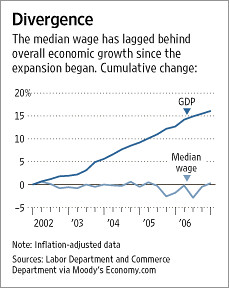 I never tire of posting this graph of the "W economy", because it summarizes in a nutshell what happened: growth happened, but was not shared widely. Thanks to wage stagnation, made possible by the threats of outsourcing and offshorization, and by consistent policies over the last 30 years to deregulate and liberalise markets, starting with labor markets), the fruits of growth have to a large extent been captured by a very few - but this has been hidden because consumption was propped up by readily available debt and the apparently growing virtual wealth of homeowners.
The problem is that, while a lot of that growth was illusory (and is now unraveling), the wealth re-allocation that took place thanks to it was very real, and, in particular, the mechanisms ensuring that an ever grower share of the pie get into a few privileged hands are still in place, and will bite even more harshly as the pie shrinks.
In short:
The middle classes got a shrinking share of a growing pie, apparently staying somewhat ahead.
Now, they are about to get a shrinking share of a shrinking pie.
The current economic consensus - that of "labor market reform", of "unsustainable liabilities of Medicare", of "protectionism is the ultimate danger" -is that of those that think that economic prosperity is correctly summarized by the value of the Dow Jones Index. That consensus has not really worried about income inequality, and has seen increased leverage as a sign of ever more efficient financial markets rather than of a bubble. That consensus is part of the problem, not part of the solution.
And you see that all the currently proposed remedies are focusing on ways to make the pie be (or rather, look) bigger than it can - more money injections, more cheap debt, more support for the financial sector.
They are the problem, not the solution.
Too much debt and not enough income was the problem.
And the solution is simple: stop debt (this is happening on its own anyway). and boost income.
How do you do that when there isn't enough money around?
By creating real activity rather than the highly-leveraged money-shuffling 'arbitraging' kind.
And, as it were, there is a sector that is "real" and has an urgent need for action: infrastructure, and in particular energy-related infrastructure.
A plan that focuses on a few simple things:
- massive public support for energy efficiency refurbishment of existing homes;
- a massive, New Deal rural-electrification-scale plan to build renewable energy assets and the corresponding grid infrastructure;
- a similarly massive plan to develop smart public transportation, both locally and intercity;
Spending the money currently wasted in Iraq on these 3 things alone would provide a real boost to the economy in the sectors that actually need it, would reduce oil&gas consumption and carbon emissions, and be an actual investment for future generations, as opposed to the current drain on the future that's been engineered via debt used on mindless consumption of junk.
Add in plans to boost the minimum wage (especially in the relevant sectors) and tax imports of carbon-rich goods, and you'd have a pretty damn good economic - and geopolitical programme.
The problem is the most of America's population has been living, by design, above its means. It is kept dependent, fearful and distracted while problems are pushed into the future and, coincidentally, a happy few profit handsomely. This was not sustainable and, indeed, it is crashing down around us. The good news is that the solution to this financial crisis will also go in the right direction to solve the even bigger problems of global climate change and resource depletion. And hopefully, economic hardship will prove to be a bigger motivator for action than anything else.
Personnel
Editors
Contributors
Peak Oil Primers
Archives
- November 2010 (3)
- October 2010 (6)
- September 2010 (4)
- August 2010 (7)
- July 2010 (6)
- June 2010 (7)
- May 2010 (2)
- April 2010 (8)
- March 2010 (4)
- February 2010 (6)
- January 2010 (3)
- December 2009 (5)
- November 2009 (8)
- October 2009 (12)
- September 2009 (6)
- August 2009 (5)
- July 2009 (11)
- June 2009 (8)
- May 2009 (16)
- April 2009 (10)
- March 2009 (7)
- February 2009 (10)
- January 2009 (15)
- December 2008 (9)
- November 2008 (9)
- October 2008 (9)
- September 2008 (13)
- August 2008 (10)
- July 2008 (14)
- June 2008 (23)
- May 2008 (16)
- April 2008 (12)
- March 2008 (16)
- February 2008 (9)
- January 2008 (13)
- December 2007 (13)
- November 2007 (16)
- October 2007 (22)
- September 2007 (8)
- August 2007 (9)
- July 2007 (16)
- June 2007 (8)
- May 2007 (7)
- April 2007 (7)
- March 2007 (10)
- February 2007 (10)
- January 2007 (12)
- December 2006 (9)
- November 2006 (15)
- October 2006 (4)
- September 2006 (5)
- August 2006 (5)
- July 2006 (9)
- June 2006 (5)
- May 2006 (10)
- April 2006 (9)
- March 2006 (13)
Vital Trivia
License

This work is licensed under a Creative Commons Attribution-Share Alike 3.0 United States License.
Jerome - in 1990 we sold a flat in Oslo (Norway) in a property market in free fall. The year before our flat would have been worth about 1.2 million NOK. From memory it went on the market at offers over 850,000 NOK and we thought if we got well over it wouldn't be so bad. In the end we sold for 650,000 NOK - and were pretty gutted - though we got out with about as much as we had paid and paid off our loans etc.
The moral of this story is that in a rising market you go for "offers over" in a falling market the reality is "offers under".
I agree entirely with your comments about miss allocation of investment funds in complex financial derivatives etc - instead of investing in the real economy. Spend money now on energy infrastructure that will make a difference to everyones future should be the call going out from McCain's and Obama's camps.
The problem with wages you describe may be even worse. Flat wages have been supplemented by consumer debt backed by rising asset values. That credit may no longer be on offer - indeed debt may have to be repaid - and with rising prices stemming from high energy costs and a plumeting currency - the GBP £ will win the race to become the basket case currency of the year - fueling inflation - many families are in for hard times.
But in fact they don't know what hard is. When I was a lad I was lucky if I got a chocolate bar for Christmas.....
There is a major cause for the world financial crisis, Alan Greenspan. Of course, the world economy had to slow down, but Greenspan made certain that it would fall like a stone in a well.
After years of reseaarching it, I have one word to describe the culprit: Reaganomics--What George H. W. Bush correctly described as Voodoo Economics.
My prescription for its solution remains the same: Massive rollback of the US Empire and use of the monies saved to finance the energy and trasnsport programs Jerome mentions. But that will not be enough as radical change must also occur in the USA at the federal level of government, in the way elections are conducted, and in the organization of media.
It goes deeper than that. We need to rollback and redefine the things we consider 'success' and 'progress'. More and bigger stuff than the next guy has to stop being advertised, on Wall St and on Main St, and we have to recognize (which perhaps needs marketing) that social relationships and freedoms on top of ample basic goods are what bring us the most long term satisfaction. Competition is part of who we are, but we should eschew the conspicuous competition for yachts, sportscars, and more digits in ones bank account and change our competitions to more healthy, less impactful endeavors like sports, games, information, knowledge etc. The American people are not bad, nor stupid - they have just been fed the wrong type of message for a generation or so. There is a large disconnect between perception and reality, which is currently the biggest problem.. (We did what?!!!)
Hi Nate--I agree we need a Culture Shift. But to accomplish that, we must reform the corporate media which sent the "wrong" message in the first place. Not that anyone comments on what I write, but I've written about the need for a paradigm change since I joined theoildrum.com almost at its inception. Such a change requires behavioral change by the body politic, as you've pointed out in your essays. Since the late 1990s, I've wrestled with what ought to be the goal of the new, Post-Modern, economy--one not based on money. Knowledge and Wisdom ought to be the goals of a cooperative culture/society that relegates (discredited, old-culture) wealth formation to the commonweal and its promotion. Such a culture does go against some attributes of the human animal, but it also stimulates other attributes buried far too long, IMO. We've seen what the power of media can accomplish in generating the current dilemma; it can also be used to help us solve the dilemma, but radical change is required.
Karlof - here is someone in France with the same thought:
France seeks new growth measure
http://news.bbc.co.uk/1/hi/business/7177100.stm
Hi pondlife--Thanks for the link. I'm not the least surprised that Stiglitz is involved as I've been following his course since he quit the World Bank in the late 1990s. Nor is it surprising that the IMF would make such recommendations. The French are quite right to determinedly resist such policy advice as it would work to destroy the commonweal they've struggled to achieve.
So often, the US economy is measured by the number of new single family homes, which is invariably an incentive to further sprawl.
Former California Governor Jerry Brown said something similar in the 70s; we need to not just focus on money income but psychic income. Growth that is meaningful to the individual and the society should be focused not just on economics but on spirituality, wisdom, and happiness.
And I, being somewhat naive, thought there was some chance that this might occur. Didn't happen and, if anything, we are farther from that ideal now than we were in the 70s.
Excuse me for being cynical, but as the financial shit hits the fan, people will become even more fearful and greedy and their brains will lose all capability of dealing with these problems in a manner that fully recognizes things like peak oil, climate change, the environment, and personal psychic growth.
Before you can build a new house, you need to tear down the old one.
"But to accomplish that, we must reform the corporate media which sent the "wrong" message in the first place."
The wrong message is now engrained across the generations. We have been suckers, for the most part - muppets, with someone else's hand up our rear ends (excus3e the visual). I'm all for changing that, but it will be a hell of a fight... minor changes will be purely cosmetic.
the media controls which messages we sheeple are to see, hence: Obama approval ratings. As far as I can tell, the media machine has already crowned Obama as King!
The sheeple are too concerned with what the media tells them, from Britney to Dancing with the Stars. The news is only sensationalistic, not exactly newsworthy. The commercials are only designed to get you to part with your money. thats all. The media is largely controlled by corporate, corporate runs this country, not the self serving politicians. these politicians seem to be more concerned with steriods in professional sports and pork barrel projects rather than fiscal leadership. we are doomed!
Nate,
I made the transition from business (chem plant manager) to the boondocks (among other jobs, the elementary school custodian) over 30 years ago. My experience indicates that it requires developing a new reality to succeed and be satisfied. This is almost impossible for most people.
A good example of this is when our city friends (MD, architect, college professor and similar occupations) visit us in the boondocks: They enjoy the serenity, the beauty, etc. but they always ask what we "did" meaning activities. It doesn't do much good to say "we live" and that life and work are mostly one.
Eventually, people may realize they have been screwed. See Charles Smith's essay When Belief in the System Fails http://www.oftwominds.com/blogmar08/belief-fades.html
But, they won't have spent the time considering alternative realities to prepare themselves mentally for the change - whatever it may be.
I think one thing that would help to transition is a security blanket. Perhaps, similar to the one posited in Ecotopia.
Who knows.
Todd
Agreed, we need to Bhutanize our system, and begin striving for a higher GNH (gross national happiness) instead of a greater GNP.
If ‘we’, instead of focusing our competitive drive on producing something more efficient than the other guy, had spent all our competitive energy playing football and chess, we would likely have starved to death by now:).
On a more serious note, competition only makes us worse off when some amongst us can improve their relative ranking by banning and prohibiting others from competing as vigorously as they otherwise would.
The causes of the current credit meltdown are too much regulation, not too little. Were it not for various levels of governments’ ability to, through zoning laws and the like, make the simple act of providing a roof over ones head, almost prohibitively expensive, we would not have had a debt run-up to begin with. Guaranteed. Strip away all regulation involving building and construction, and there would be an immense supply of dwellings, likely several per head.
In every unregulated industry, overproduction is the norm. The simple fact that not all providers judge future demand with equal accuracy, with some inevitably over estimating it, ensures that. Only in regulated industries like housing, health care and education, can those better off and politically connected prevent this from happening, in order to maintain their own power and status as gatekeepers to a scarce resource.
Simply get government at every level out of people’s lives, decisions and wallets, and a society at our current technological sophistication would provide an absolute overabundance of virtually everything to virtually everyone. There is simply no reason, other than the vanity of the political classes, for government to play a larger role in people’s lives today that they did when America was first formed.
As I’ve written before, a Californian real estate market devoid of regulation, would likely have the vast majority of the population living in huge condos in one of a wall of 40-60 story high-rises stretching from Cape Mendocino to Cabo San Lucas. With high speed rail running the length close behind. While the ‘rich’ would likely still live ‘better’, by occupying larger, nicer equipped units on higher floors, even the so called ‘poor’ would at least have a spacious beachfront condo. Not too shabby compared with the kind of rat infested projects our ‘progressive’ overlords currently see fit to provide them with.
Huh? The poor would live in rat infested slums - not beach fount condos
I once thought somewhat along these lines. I don't now. Government, in its regulatory guise, does serve the purpose of not letting people screw up the lives of other people. Can you imagine what the land around a chemical plant would be like in the world you describe? Love Canal would be a beautiful meadow in comparison.
The world, and people, do not run how Ayn Rand would have us believe it would if government would just keep its hands off. Government does good things. It also does incredibly bad things, but that's where we, the people, are supposed to enter the picture.
Karlof1, I expect that American opinion will gradually change as it becomes apparent that there will be no 'upward mobility' in their futures. TPTB have used upward mobility to give Americans the impression that no matter how dense the individual there remains the opportunity for riches. Once that veil is gone, caused by a replay of the great depression, I think we will see a sea change of real politik, accompanied by a return to popularity of populist and left leaning politicans. Heuey Long, Eugene Debs, etc, come to mind.
Once the general population realizes that their opportunities for a 'better life' are severely limited they will turn to politicians saying that wealth should be spread eqitably among the population, and not be hoarded by the few. Globalization will unwind because of severely constrained economies. A return to nationalisim might ensue once Americans see what globalization has done to their country, their jobs, their lives. Militant union organizing and activity, now strictly channeled into 'company unions', will rise again. Strikes will come back into vogue when workers are not able to feed their families with their paltry pay. MSM will lose their viewers if they don't cater to the new wave of populisim...so MSM will change to continue to generate revenue and stay in biz. The right leaning politicians that have convinced people that 'unions are bad and socialistic', and limit opportunities for advancement, will not remain popular, except among the haves.
Judging from availability of FFs in the US, and the amount of debt owed by all governments and individuals in the US, the coming economic collapse might be much worse than 1929. The US has been dependent on the savings of other countries to provide an unsustainable level of spending by individuals and various US governments. That is going to end.
Hi River--I don't think we have the time for "American opinion [to] gradually change." Further, the elite will dig in their heels to avoid the sort of needed paradigm change I describe above as it is totally against their albeit very selfish interest as Lasch described in Revolt of the Elite. The contrived political dialog generated for the presidential election is a case in point, as were the examples provided during 2000 and 2004. IMO, Americans are dominated by media more than any other polity. For that polity to change with the rapidity required, the structure of media must be destroyed and rebuilt.
Actually, the scenario you envision, while positive and to be hoped for, is probably less likely than a further descent into fascism and even more extreme free market "solutions". I think that is the plan, but I will hope for the best.
*Voodoo Economics*
Well, my article was originally more polemic and political, and I toned down that angle for the TOD version, but I mostly agree with you. Deregulation and the ideology of greed, disguised as freedom, is what's at the bottom of all this.
"Deregulation and the ideology of greed, disguised as freedom, is what's at the bottom of all this."
Now thats calling a spade a spade and IMO what the world needs more of both now and more importantly later when it starts up again after the crash.
The price of freedom and the American Dream is a boom and bust economy. But since the country was founded on those principles, can a change of culture ever happen?
The weird thing is that all the macro economic stuff is reasonably well understood, and the US has the definitive example of how bad it can get when things go wrong, the Great Depression (Bernanke's pet subject apparently). Yet deficits and debts are allowed to expand willy nilly, while successive administrations watch it happen.
Yeah-real wierd. How much money do you think Hank Paulson would have if the USA fed guv had never run deficits? A hint-it wouldn't be 700 million. This deep rooted belief that everyone who controls the USA is stupid is utterly ridiculous. To shake it, try ignoring what they say and try to observe what they do.
I was assuming that the people "in control" are smart, which is why it looks weird. At some point, there should be some intellectual realisation that things are going out of control and require negative feedback. What you appear to be suggesting is that money trumps any nagging doubts that people might have. I suppose you are right. Everyone takes the money and hope the system doesn't crash on their watch - in fact take a little extra in case it does crash!
The implication is that a free society based on market principles can never be sustainable. Socialism, anyone?
No, you were assuming they are logical.
Free market principles my arse. Privatize the profits, socialize the costs.
Noam Chomsky: The Free Market is Socialism for the Rich
Hello Jerome--I looked around DailyKos and eurotrib.com for a link to your non-TOD version. I, and I'm sure others, would very much like to read what else you had to say on the matter. And thanks very much for your efforts and analysis, even though it would be great not to need them.
I was going to write that nothing massive would help, because it only ramps up the throughput and it's the throughput at diminishing marginal returns that has put us into this fix.
That would have been a hasty mistake, because massive rollback is the necessary strategy as karlof1 points out. Radical change in the USA at the federal level of government - yup - and it's not only the federal level that is illegitimate. But it might not change into a good thing - careful. Change in elections, change in media. Those presuppose a change in the societal memes by which we organize ourselves.
How bad a situation are we in? On a scale of 1 to 10, where do you put yourself in appreciating the situation? I got asked those yesterday - fascinating because really that asks one to judge how much one doesn't know. I figured I was around a 3. Along those lines, I highly recommend Byron's "The Path Through Infinity's Rainbow" - reviewed by Carolyn Baker in a Drumbeat maybe a week ago.
Byron writes very clearly and is easy to read. There is no fix, no matter how massive, other than fundamental social - if not biological - change. Covering New Mexico with solar PV and girdling the earth with HVDC will not work unless we first change our society. As Dawkins puts it - the next evolutionary step is the meme - assuming, of course, that we can take such a step.
cfm in Gray, ME
Hi Dryki--It's good to know that at least one other person openly agrees. Now we just need to convince 200 Million citizens of the Metropole.
Huh? What about the rest of the world?
Sorry. It wasn't my intention to snub the rest of the planet. It's just that only US citizens get to vote in US elections; thus the need to convince them.
Karlof1,
There are at least three of us. I, too, have been writing about the need for a fundamental paradigm shift since I started posting on TOD. Carbon taxes, construction of public transportation systems, rail electrification, renewable energy subsidies, etc. are ineffectual bandages on external sores as long as the internal cancer of competitive accumulation rages on unchecked. And in fact these bandages are not being applied because the growth of the cancer is sucking up the necessary resources.
The social and political solution to our problems is conceptually simple (if not operationally so): Voluntary simplicity and mutual support. I am not holding my breath, however, waiting for such ideas to receive any respect.
Roger,
One of the main reasons people/society will not change is because they have had no exposure to other realities. As I noted up thread, our friends don't even understand our life in the boondocks. Look at TOD posters, there are only a handful of us who are actually "doing it."
Right now I'm out there cutting firewood (I came in for a break.)now that yesterday's snow has melted. When I get burned out on the wood, I'm putting the cover back on the strawberries to be followed by gopher patrol. Compare these activities to the millions who are getting fat asses eating junk food and watching TV.
Todd
Today my family made cheese with a group of friends. I worked in the greenhouse and planted some spinach. Getting 4-5 eggs per day from the hens. My wife is reading out loud to the kids right now instead of turning on the dvd player.
Like you, I have not found that my extended family comprehends this much, though a lot more people around town are taking up new hobbies and starting new cottage enterprises along these lines.
It helps that the world beyond seems to be falling apart. Folks want a sense of control over important things in life.
This 'financial crisis' may well prove to be the Big One, the greatest 'crash' in history, potentially worse than the Great Depression, a slump we may never recover from. Unfortunately it doesn't have a simple or single cause, and the solutions are anything but simple, to think otherwise is perhaps a comfort, but an illusion.
ditto
A short time ago expressing negative thoughts about St. Alan Greenspan at best earned one a reputation as a krank. More likely one was thought to have psychiatric problems or to be a Communist.
A short time ago expressing heterodox economic opinions on TOD provoked a flurry of knuckle-rapping posts by doctrinaire Austrian professors, effectively forestalling discussion.
For most of the population the range of permitted thought is narrower than in Brezhnev's USSR, and this has been the case for a generation. Only a crisis has created some space for thought. We are all poorly equipped with intellectual tools to address that crisis.
Well, my newest post is about Greenspan, the bubble man: wrong but unrepentant
Oh my! You read our scribblings!
Having received such an honour I had to read your link. Scout's honour, promise to read European Tribune more often.
AFAIK you work in the financial system at a fairly high level. I am boggled that someone with an evident brain can function or be accepted in such a venue. In my time I have known two friends who functioned somewhat at your level; each tolerated because it was known the primary allegiance was to alcohol and thus free-thinking could be no threat.
Greenspan and looting indeed. What I should expect from a disciple of Ayn Rand.
Right on.
Read and understood. Right on right on right on my brother. Thank you.
Specifically, in 2005 Greenspan exhorted lenders to be creative in extending credit to as many as possible. It seems clear now this was with either malice aforethought, given what he had done to interest rates (literally creating free money for banks to lend), intending to create a bubble and sweep ever greater wealth in to the hands of the top 1%, or out of utter stupidity. I don't buy that he is a stupid man, so I go with the former.
This thesis is supported further by the Bush/Cheney admin ending reporting of real inflation and M3. Hiding those two numbers hides a LOT that is obvious to all. Those two numbers tell a hell of a story.
Anywho... Same thing happened before the last Great Depression.
Culprit #1: Former Federal Reserve Chairman Alan Greenspan was no smarter than a fifth grader.
More of a clarification than a disagreement: ninja (and "self-certified" loans in the UK) started off as "no provable income, no jobs or assets" and was based on the entirely sensible realisation that many self-employed people, consultants, etc, didn't have a guaranteed monthly income stream in the way the employed do but many were consistently brining in enough money to pay a mortgage. But what started off as "you convince a good faith mortgage broker that, although you can't document it, you're a good risk and they'll sign off the forms" became "mortgage broker gets commission up-front regardless of long term loan viability, so why shouldn't they not sign off almost anyone for almost any amount". So one key lesson is that people will figure the way to score best under the specified reward structure, so come up with rewards tied to long-term planning.
As someone who may be self-employed in the future, I'm very much hoping that self-certified mortgages don't vanish from the market, just become meaningfully assessed again.
Those self-assessed, as well as five times (and more) annual income, and "buy to let" mortgage schemes are largely responsible for the unsustainable increases in UK property prices over the last few years.
I'm not denying that. One very wrong factor was that people were allowed to "opt for" self-cert even when they just had regular jobs with payslips. But the fact remains they were initially created for the very sensible reason that people who couldn't produce some sort of guarantee that their income stream was large enough (and anyone self-employed might have their customers dry up completely in some extreme circumstance so they don't have the GUARANTEE conventional mortgage paperwork requires) nevertheless in general had enough money to pay the mortgage every month but couldn't fit into traditional mortgage lending checklists. My understanding (it was a couple of years before I was financially able to even think about looking for a mortgage) was that you had to provide an explanation to the mortgage broker and he had to genuinely believe you before he'd sign off a self-cert mortgage. The ONLY reason I hope self-cert stays is for those self-employed people who are going for sensible multiples of their average wage, not to enable lying about income to increase the amount you can get to insane levels.
Quite amazed that you just take a person's word for it. In India, if you cannot produce payslips, then you need to show a copy of your last 2 years tax returns as proof of income.
Srivathsa
Yes, same in France - you need pay slips or tax returns (or both). It's the one thing (together with the fact that banks won't let you have more than a third of your proven income as debt service) that makes me think that the real estate prices in France are somewhat more sustainable in the medium term than in other bubbly economies - or at least that banks won't go down under because of them.
Slightly off-topic but . . . no French real estate bubble, or at least a manageable bubble, and a highly electrified transportation system fueled largely by nuclear power. Would you say France is in better position than most countries to weather the unfolding financial-system-meltdown/PO crisis, or are there other factors offsetting these advantages?
Thanks.
Possibly a less bad situation... but road transport, like elsewhere, has grown a lot more than rail transport, and rail is good for passenger transport rather than merchandise, these days.
On the plus side, France also has a nice agricultural surplus, with highly productive land - hopefully even so with less oil input...
In Switzerland, Pay slips, with work contract, tax forms, bank account open to scrutiny, a certificate of moral probity (no drugs convictions, prostitution, etc.), an empty police / penal blotter (parking violations allowed), and if self employed or ‘older’ or ‘different’ heavy life / health insurance, which may if missing be imposed by the bank, that is suggested but in fact a condition.
However, comparisons are maybe not apt. In the canton in which I live, in Switz., less than 15% of ppl own their own homes. Home ownership is exceptional, and the exceptions are not only the rich or upper classes - just exceptions, of many different kinds. Farmers, old estates, co-ops, small-holders, movie stars, bankers, and even campers (who own the ground they camp on.)
It's very easy to get fake payslips etc. several companies advertise in the Sunday press.
AKA fraud, a prosecutable crime.
In the UK, if you don't go the self-certified route it's generally 3 years signed-off accounts with average level of net profits being at a level suitable for the mortgage. Given that in the first couple of years you're probably investing in business expenses, growing your contacts, etc, you can probably forget the first two or three years as having a profit level high enough, so it's about six years after starting the business before you can apply for a mortgage. However, what's relevant to paying the mortgage is whether your future income stream is likely to be stable, which low figures in the initial years have little predictive bearing on.
When I say "self-cert" I mean that documentation that fits a mortgage-droid's checkboxes doesn't exist (which made it very difficult for self employed to get a mortgage twenty years ago), but both sides are genuinely convinced the income steam is suitable. The more abusable forms should go, I agree.
It was interesting to note a complete lack of attention to the UK's growing trade deficit in Alastair Darling's budget last week.
That increase in deficit caused, in part, by our increasing fossil fuel imports as North Sea oil production continues its inexorable decline.
Meanwhile, our brain dead news media is still talking about an "uncertain economic future". I think most of us here are pretty certain about the direction our economies are headed.
You obviously missed PM Gordon Brown on Radio 4 last week. He assured me that we are entering...
“a new era of opportunities for all… a new age of ambition; a chance in the first decades of this century to build the Britain of our dreams”…
His dreams are our nightmares.
An age of opportuninty to pull together as a community!
An age of ambition where we compete with our neighbours at vegetable growing.
In chance in the first decades to completely reorganise society!
That is what he meant.
Marco.
In this article on "UK Energy Security" I try to quantify the growing trade deficit from declining oil and gas production.
http://www.theoildrum.com/node/3130
When I look at the oil and gas price assumptions used then, these seem hopelessly optimistic = $80 / bbl for 2008 - hahahahhahahaha.
Things must be much worse than depicted here. The only light on the horizon is that the US seems to be in much worse shape than we are. We can gloat over comparative misery.
I agree with everything you said. But the US has lower population density and a great deal more oil and gas left than UK. Even though we burn through it at an atrocious rate with only a pittance going towards long term infrastructure - and even if we were to tighten our belts to the maximum, we couldn't get by on our own oil. (Scotland will be better off than England for much the same reasons).
Next decade we will see what we are made of, all of us, irrespective of country. I still have hope, but the sooner the truth of our situation is articulated, the sooner we can get over the denial and arguing and roll up our sleeves.
Actually, there may be something to that. Short of starvation, percieved relative advantage over others is what humans find satisfying. Perhaps the US gov't should do (or simulate) an EMP burst to take out communications infrastructure and start USSR-style propaganda. If soccer moms were reassured that all the other countries had been destroyed in nuclear retaliation, they could feel downright smug about eating rats & rice.
This is offered mostly tongue in cheek, but really all that's necessary for happiness (in most) is to believe that others are more miserable. When americans stop believing that, watch out.
Woody Allen a Jewish American writer/comedian once said: "There are only two legitimate states of human experience: Misery and Horror. Therefore if you're simply miserable you should be grateful."
Misery loves company so if you happen to be well off it's a real good idea to keep it to yourself. In other words if you drive a Mercedes its time to trade down to a Chevy subcompact.
By the way the main stream media in the U.S. has already passed the USSR in propoganda - that's why TOD is read by growing numbers of enlightened citizens. MSNBC/FOX News/CNN are infotainment for the masses.
When you go to work and listen to the water-cooler chatter you quickly realize that the average Joe doesn't have a clue why all of this is happening. I keep my opinions to myself because my views are "so depressing".
I think the financial crisis is sort-of a different topic from Peak Oil ... but from a US-Centric perspective (all I can offer since I live here), I think it was a path chosen in the wake of the -first- energy crisis in the 1970s. Our strange relationship with the Middle East became progressively stranger, and has mutated and metastasized into what we have today. The notion of a balanced budget disappeared ("we just need to get through this crisis, and prosperity will return, and then we can repay the debt"). Petrodollars replaced precious-metal dollars, but without a clearly defined ratio.
By the 1990s or early 2000s this abandonment-of-budget was shared by millions of "middle class" homeowners, but industry was moving to where cheap energy (and cheap labor) still existed, and we have entered a period of a "service economy". But the trade imbalances have continued -- the Internet and the Dot-Coms didn't save us (whoda thunkit, they can do that stuff just as easily in India). Now US agriculture is facing higher petrol costs, and that economic pillar is crumbling.
It was inevitable that these macro-economic issues would eventually filter down to the bubbas in the McBurbs.
As I have previously noted, IMO there will not be nearly enough exported energy available to generate the economic activity necessary to pay off US debts or to generate the projected stock market earnings, which leads to two questions:
What is the intrinsic value of the 100 largest financial institutions without the 100 largest oil fields?
What is the intrinsic value of the 100 largest oil fields without the 100 largest financial institutions?
I foresee serious problems ahead for people trying to make a living off most non-food and non-energy investments. BTW, I agree with your recommendations.
WT
Is the answer to your first question may be zero, and the answer to the second may be tending towards to the value of life itself.
This is what bothers me about the UK. What is the real value of our financial sector, as opposed to the value our politicians tell us its worth?. If we have no energy, can't grow food we're stuffed. Real value is from minerals to; warmth, shelter, clean water and food. Money has no intrinsic value.
What about knowledge, technology and infrastructure? Are they not worth anything anymore? While I think things are not looking good, I don't think it's too late to move back into engineering and energy sectors.
I'm also interested in how people think technology/the internet could potentially help us. We have fairly large dense cities which are easier to 'wire up' to allow people to work/learn from home/nearby and also deliver produce to. Also most cities are on the coast which allows for cheap delivery/transport on the sea. We also have a big advantage in being native English speakers, so much of the knowledge is available on the internet for free in a language we can speak.
We also have fairly plentiful renewable energies (wind,tidal,wave) the option for nuclear power (at least in the short to medium term) and lots of fresh water for farming. Sure we might have to cut our lawn, walk the dogs or, god forbid, get public transport. Basically stop wasting money on entertainment, 'lazy' services (dog walkers etc...) and time consuming red tape.
Without energy to exploit knowledge, technology, or infrastructure, the three are pretty much valueless. Computers do not create anything. They are tools to help in the creation of things. We could give everyone in the world a computer, internet connection, and let them merrily type away. At the end of the year, we would all have starved to death. I say this even though I work as a software engineer.
As to "wasting" time on dog walkers, etc, what happens to the people who have those useless jobs when everybody decides to abandon their use? What happens when all those people don't have any money to pay for the things that the "useful" people create?
I meant that they should be retrained and put in more useful jobs. In a crisis it becomes a lot easier to mobilise the workforce into important areas, and computers/technology/internet help us do so quickly. Computers also help us minimize the amount of energy we need to do things.
The new Intel CPU uses 30 watts under load, and a monitor another 30 watts. They allow people to work/learn from home saving vast sums of power on transportation and many man years on working out solutions only using the amount of power they could generate themselves.
There is plenty of oil, it just production can't keep up. Food will be the last thing people stop buying, and we earn more than enough to pay for new power stations (we could also pay for the work force with an Greenback Dollar type fund) and can produce enough food during a down period if we stop buying frivolous items and move excess workers to help farmers (core supplies) etc...
So, Bear Sterns has financial derivatives on its books that are roughly the size of the entire US GDP?
http://globaleconomicanalysis.blogspot.com/2008/03/bear-stearns-bankrupt...
Massive Derivatives Mess At Bear Stearns
Bye Bye Miss American Pie.....
WT: The ironic thing is that the company playing the role of White Knight (JP Morgan) is the wildest cowboy of them all. IMHO, to paraphrase GWB, "the shmuck taxpayer will pay ANY price" on this one. The only problem is that you could literally drain the coffers of the entire economy to bail out these boys, and within a month they would be in trouble again. The USA has been letting the 12 year olds load up on Meth and Jim Beam and drive the family around in the minivan.
At this site we used to point out that we needed to discover another 3 or 4 Saudi Arabias' worth of oil. Now we're discovering that our banks are hiding another 3 or 4 Americas worth of debt.
1) You will see that the quote refers to notional amounts of derivative exposure. Imagine I buy $100,000 of one year Euro futures, then use that to buy back one year dollar futures. I have $200,000 in derivative exposure. However, I have no risk because they are exact opposite trades and hence offsetting. The top line number is meaningless.
2) Derivatives are not debt.
"As I have previously noted, IMO there will not be nearly enough exported energy available to generate the economic activity necessary to pay off US debts or to generate the projected stock market earnings, which leads to two questions"
Prove it.
Our outlook for the top five net oil exporters (about half of current world net oil exports):
http://www.energybulletin.net/38948.html
The 2005, 2006 and estimated 2007 net export data for the top five are as follows (EIA, Total Liquids):
2005: 23.5 mbpd
2006: 22.7
2007: 21.7
While some smaller exporters, like Angola, are showing increasing exports, there are also smaller exporters like Mexico, on track to approach zero net exports around 2014.
In addition, there is increasing evidence that coal and natural gas reserves--and especially exported volumes of coal and natural gas--are overestimated.
An even more serious problem seems to be that we soon are falling to the bottom of the net energy cliff. If the same trend is valid as for the North American natural gas which can be reasonable it is all over by 2015! As nuclear power needs rather much inputs it will alaso be hard to keep going. Large scale wind power is also costly to build and much of the worlds electricity is now coming from burning fossil fuels in power stations.
Well, there's always hyperinflation.
If you like this little crash, you will LOVE the Peak Oil crash, coming this year! And we will all have a front row seat.
A front row seat?????
We are all in the same boat!. Unless you have a 5 acre bolthole in some hidden
valley with good water, soil and secluded enough so that no machete weildinig ex-suburbanite
can take your food and rape your chickens.
Marco.
Yes, A very large boat with severe corrosion in its bottom. A few on board know the bottom is about to fall out, but most are partying and are oblivious. In this instance ignorance is definitely bliss!
rape your chickens.
Thanks for the laugh !!
Since, just minutes ago, I was continuing research for a similar bolthole - with chickens - it really highlights the circumstance some of this encompasses by making light of it.
I find that making light of the issue helps keep me sane. It takes real guts to follow through in your mind the full ramifications of a steadily decreasing energy base. It's amusing sometimes when I talk to other poeple intelligent enought to 'get' the problem, come to their own conclusions, then watch as more than half of them thrust their heads sand-ward!
Then if it's someone I would rather keep as a friend we resume talking about Britney Spears and the plight of the Minkhe whale. If i don't like them I make funny twitching facial expressions and politely excuse myself to the bathrooom with some tin foil and a couple of pencils to stick up my nose.
Marco.
Please continue providing sanity. We need it.
Heh.
Note to self:
: get a bunch of gaddamned ugly chickens.
heheheh.
Hopefully, this won't get deleted. If it does, I will completely understand.
This guy goes into a brothel, but it's so busy there's nothing available. The guy's really desperate, begs for anything.
"Well, we got a chicken."
"A chicken?!"
"Sorry. That's it, fella."
"Ah, alright. How much?"
"Fifteen bucks."
"Fifteen bu..! Damnitalltohell...."
He hands over the chicken and is sent into a bare room with a bright light to do his business, where he does, indeed, spend quality time with the chicken.
The next week the same guy goes in again and they're so busy he can't even get the chicken.
"We got a show, tho."
"A show?"
"Yup. Live."
"How much?"
"Five bucks."
"What the hell..."
So the guy goes into the theater where the show commences. There's a silhouette of a man spending some quality time with a goat. Grinning, he turns to the guy next to him and says, "How desperate do you have to be, eh?"
"You think that's bad?" says the other. "Last week there was some guy up there with a chicken!"
The original is a little coarser in language. :)
In a world going crazy, laughter is the best medicine.
Cheers
Good one-keep them cumming.
Yet another Oildrum discussion diverted into discussions of sex with chickens.
Chicken-raping is serious. It's why they cross the road. I once had this housemate from Alaska up near Fairbanks somewhere, and he had stories to tell. Apparently "chicken sexer" isn't just a job up there, it's an adventure, and he would describe his technique in detail upon request. Which was apalling, but also hilarious because his wife was a prim and proper liberal who was always looking down her nose at us construction workers. The "chicken thing" was a nice counterbalance at parties.
However, it isn't just warmth-seeking Alaskans who are that pragmatic; the book Reading Lolita in Tehran notes that the Ayatollah Khomeini wrote a scholarly discourse on (rhymes with chicken-plucking) in which it was not only highly recommended as a way to avoid sinning, but tips were given on just who could reasonably eat the deceased rape victim and who shouldn't.
Really.
If Clinton had been that forthcoming, the BJ wouldn't even have been news.
I won't have a front row seat. I just shook hands on purchasing a 40 hectare ranch in a valley with a stream running through, taxes $60 per year, spring water, 2 meters of rain per year, temps 50 to 90, got coffee on it, citrus, sugar cane, 2 cows, 2 horses. Plan to sell the cows, get some chickens, get some wild rabbits and set em free, get rid of the coffee and plant macademia trees and Maya nuts, get rid of the cane and plant beans, squash, carrots, peppers and stuff. Yes, I'm crazy, I know. Come join me. clifford.wirth@yahoo.com
My wife and I would be happy with an acre or less! With the things I'm reading about intensive farming, hydroponics, aquaponics, etc., just feeding yourself just isn't that hard. What seems to be hard is making it work as a source of income. I'd be happy with just having a roof, self-sustaining food supply and water. A little extra to buy this or that now and then, perhaps. The wife, though, she's wanting to be part of a community. I think the idea makes her feel safer. Makes sense, of course.
Cheers
PS, ever seen "The Postman" with Kevin Costner?
Yup, but the original book by David Brin was better written (although the movie version was much closer to a vision of collapse from now instead of from 25 or so years into the future).
peak oil is at least 3rd or 4th in our list of problems.
Do you consider resource deplation (non-oil), population explosion and climate change, (amongst a backdrop of financial collapse) to be numbers 1,2 and 3 on your list?
I would not be so quick to try and rank them all! It's all a game of paper, scissors, stone,water to me. (that kids game you play with your hands - presume you know what I mean)
Resource depletion, toxic planet, cancerous growth, climate change, economic inequality - those are the five I use. They are all intimately related each to the other, but listing as five fits what one can keep in the head and provides different rhetorical angles. They are not orderable and cannot be dealt with independently.
If we are to evolve memes and change our way of thinking and the society that implements that thinking, then we need to put the point of the argument on "growth". That the only smart growth is shrinking. Then the others start to become tractable. We're adults - time to stop growing. And if we shrink our numbers, then there is more sunlight for each of us and that can be turned to healing the damage we've caused (if we shrink enough and fast enough).
While it makes sense to me that we are at an evolutionary crisis, that meme stuff is purely speculative. YMMV. Enumerating the 10Million names of God might work just as well.
cfm in Gray, ME
I have a hypothesis. After speaking with a friend at one of the above mentioned firms tonight, I asked him how this will all turn around - how firms like Lehman, Piper Jaffrey, Jeffries & Co, etc. will make money again in the future, let along command large multiples of earnings? His answer was leverage - too much leverage was a bad thing, but Wall St needs leverage to make money because the normal returns weren't high enough.
If this is true, and anecdotally I believe it is, then this credit hyperexpansion is a natural and predictable sidecar to peak oil. Once aggregate net energy peaks (and this is the 'hypothesis' part, as I can't prove this though believe it to be true), then the traditional economic engine that combines natural resources with technology and energy to create magical economic growth starts to sputter. In order to maintain a certain level of growth in the system, especially in the 'service' side of things where many of the brightest and most ambitious of our species make their way, borrowing in increasing amounts to juice returns that once came from basic industry is a natural response for a large group competing for 'more'.
If one can earn 4% but by borrowing 10 times ones principle can turn this into 10-15%, especially if the 'perceived risk' is low, then it will occur. Some variation of this is what happened. Maxing out in energy surplus is going to cause us to borrow from somewhere, - we've already tried the banks - that probably won't happen again for quite a while so expect further borrowing to come from the poor, the environment and the future.
Nate, it's called 'running on fumes.'
it's called "money making money"
This is a non-starter from the get go, to begin with, never gon'a happen.
It would be like believing that energy can begat energy wtf?
Every culture and religion has addressed this, but every time we convince ourselves that this time it's different.
I entered this forum touting a tech that defied the 2nd law of thermodynamics even though I had worked with engineering and physics for 18 years. Yes I was an ASS.
If you believe that money can make money you too are an ass.
Great observation.
....so expect further borrowing to come from the poor, the environment and the future...
This sounds like junkies I've unfortunately had to deal with on occasion over the decades. They will do Anything, lie, cheat, steal, assault, etc... to 'borrow' some cash for a fix. Even throwing a junkie face first down a cement stairwell doesn't deter them from their appointed rounds for very long. They are beyond reason. Death however works dandy. And since junkies love to prey on each other, this is often a win, win situation for society.
This financial event horizon we are rapidly approaching, at a minimum, will make Wall St feel, at least for a while, like it was thrown face first down a cement stairwell. But just like a junkie, it won't stop it's addiction, only the Grim Reaper is capable of that.
Jerome
Meanwhile, W soft shoes his way into retirement. At least, O and H have been pushing the whole green jobs things very hard, which would include alternative energy infrastructure.
For the time being, we will be heavily bleeding capital no matter what with the level of oil prices. Further the Fed is increasing debt to solve the debt crisis. Is is really possible to stop this meltdown, regardless of the tools used? Infrastructure is a long term approach and will not stem the immediate crisis but it must be done.
Regardless of what we do, am I correct is saying that we will have to go through a period of moderate to severe economic pain? And by we, I mean the bulk of the American people. Truth, regardless, will not be coming from the politicians any time soon.
The complexity of the continuing financial juggling to avert a meltdown, I'm sure, is dimly perceived by most people as a form of magic. Is this just a way to hide the impotent wizard behind the curtain?
Jerome. Your bottom line, it seems, is that it is time to get real. Do you mean that there is nothing in the financial bag of tricks, and I do mean tricks, that can fix this thing?
The complex financial juggling, is a way of preventing Wiley Coyote from looking down. As long as he doesn't look down, gravity cannot assert itself. So keep up distracting him, for if for one moment
EEEEooooooow!
Yep, I pretty much mean that. We're suffering from too many bag of tricks, and more of the same, however smart, will not work. Deleveraging means what it means, and it's happening now in any case.
Melt-in-your-mouth cotton candy comes to mind.
That's just one of many problems. Another is that most of us don't know how to hold a hammer. We have the Mexicans do that for us. If money is made available for insulating houses I doubt the accounting class of Americans will be lined up for jobs. If they do they'll be competing with Mexicans. The profits will be skimmed by top management, as always.
Next time you drive along a freeway undergoing expansion, take a look at how few workers are involved.
Windmill generators are going to be produced in China even if the RMB doubles against the dollar.
Smart public transportation needs to be built by smart engineers and technicians. We've offshored that kind of work for the last twenty years. We've become financial engineers - an you can see the results of that.
I think your solution is admirable in principle yet completely naive about the realities of our situation.
Good analysis by Jerome: corporations were allowed by the free-market libertarian brainwashed politicans to transfer technology to cheaper overseas markets while filling US consumer with easy debt.
How many mammoth fortunes were made in this wholesale gutting of America?
Walmart, Dell, etc.
It is well known that for the entire world to support the lifestyle of the US and OEDC would take 3 or 4 Planet Earths.
The globalists have made that delusion a possibility in the minds of the Chinese and Indian people. These impossible expectations have been reinforced by a globalized media-Internet. Meanwhile international corporatists feed the delusion with capital and the promise to keep opening 'unfair' markets. As long as these yearnings persist there will be a tight market for oil and oil importers will be throttled.
The overall effect has been to accelerate Peak Oil by one or two decades.
Only chance in my view is for a severe economic depression to occur freezing international trade, along with a huge state effort to develop not only renewables but particularly unconventional oil(oil shale, tar sands) and to a lesser extent ethanol, because the only solution to an energy crisis is more energy in the pipeline.
That being said, it may be that it is TOO LATE already.
Sadly, I would have to agree. Building infrastructure, or anything else for that matter, during a deflationary depression is highly unlikely. Credit is already evaporating far faster than central bankers can pump in liquidity, and the rate of credit destruction is accelerating all the time. In other words, deflation has already begun. IMO we have already reached 'critical mass' and tipped over into a rapidly self-reinforcing spiral of margin calls, defaults, sales of distressed collateral, depressed prices and further margin calls. Those margin calls will reach down the 'financial food chain' until the directly affect ordinary people - with the tightening of credit, margin calls and ultimately the calling in of loans.
Ordinary people won't necessarily even have the money they need to purchase the necessities of life, let alone anything beyond that. The private sector won't be interested in building anything when risks, and therefore long term interest rates, will be so high. (With credit spreads exploding, much higher longer term interest rates are inevitable.) The prospects for earning a profit will be minuscule compared to the present time, as those to whom companies sell goods and services will not have the money to buy them.
The public sector will be completely inundated with requests for assistance at a time when tax receipts will be falling off a cliff, and the ability to extract higher taxes from those still able to pay will be decreasing rapidly. I can't see much public sector investment in infrastructure - even for maintenance, let alone new construction - when all public services will be over-stretched and probably collapsing.
IMO there are no viable solutions, other than living through a long period of depression and eventually emerging from the other side, with greatly diminished economic capacity due to the effects of economic upheaval on energy supply. Our long credit expansion has created multiple and mutually exclusive claims to the same underlying pieces of real wealth pie (as opposed to dividing the pie into ever smaller pieces, as currency inflation would have done). Now that the expansion is over and contraction has begun, that underlying real wealth will inevitably be fought over. There is nothing that can be done to prevent this.
The dynamic is Enron-esque, meaning that a rapid implosion is approaching. Already we are seeing the market beginning to pick of banks one by one, and it takes little time for self-sustaining momentum to build up. If you're interested in daily coverage of the situation, click on my profile for the link.
Stoneleigh, with the exception your deflationary call, which I expect will still be correct, your writing over the past year has been prescient and for the most part spot on in articulating this crisis.
Thank you.
We are at the 11th hour where the players in charge will dictate which of the two evils they consider to be lesser. The trend of the past decade has been to opt for little-to-zero short term pain in lieu of long term (but as yet unseen) large pain, which would point to unlimited bailouts. I suppose this could be described as 'steep discount rated culture'. But as the red grains of sand pile up, soon they will all be connected. On the other hand, discipline needs to be shown so there is confidence in the system.
Were I in charge, I would allow JPM to buy BSC for a song, strip it of its prime brokerage and any assets of value, payoff the creditors and bondholders, and let the shareholders take the loss. At some point, hopefully sooner rather than later, excessive risk has to be shown to have a very bad downside. Just like capital punishment isn't really done to 'punish' the wrongdoer but to act as a deterrent to future wrongdoing, we need to send a message that taking too much risk, even if everyone else was doing it, has consequences.
I suspect a middle ground will be reached, but I get the sense that Paulson et. al. are quite aware of the moral hazard, and won't just bail out everyone that lines up at the door. We are certainly caught between a rock and a hard place. How quickly this could turn into a series of bank runs I shudder to think.
Nate, I'm sure you must recognize the intertwined nature of the finances of BSC with the rest of the market. Their trillions of derivatives represent counter-party interdependencies and the other parties are holding their breath right now (maybe even turning blue...). I don't see how doing what you suggest would stop the cascade of the grains of sand.
my suggestion is a hybrid of discipline and bailout. No way does Bear Stearns culture or employees, with possible exception of prime brokerage and back office, fit with JP Morgan - thats like pool sharks joining a polo team. I meant that any action should not be conveyed as a 'bailout', but that the entity itself be allowed to fail, as in, Bear Stearns name no longer exists as viable entity. But confidently assure that creditors will be paid. We have to balance the knifes edge of letting bad debts fail, while giving people the confidence that the greater system is still intact. Tough act.
Someone in power will have to make a judgement call - whether to let the cards fall where they may, or hold everyones hand until there is no confidence left in the US dollar or bond market (rest of world would quickly find out that we wouldn't just twiddle our thumbs for handouts in such a scenario). I don't have any easy answers because there arent any - but I personally fall on the side of taking our lumps sooner and starting to have some integrity and accountability. But as Stoneleigh points out, there may not BE a solution.
Thanks Nate - I've always found your work valuable too. The psychological underpinnings of our predicament (or set of predicaments) are generally underappreciated and need to be explored. I'll keep reading anything you write :)
I don't think there's a real choice here when it comes to inflation versus deflation. Deflation can easily outpace central bankers, especially once market psychology has turned, as their actions will be increasingly interpreted as signs of desperation. When fear truly rules, nothing can stand in its way - not even greed. We're not quite there yet, but are getting very close IMO.
Well there remains at least a small possibility, that the Fed will, publicly or not, bailout every large bank or institution that gets in trouble. This could be happening as we speak. 2-3 senior people at JPM get the nod from Fed officials to go ahead and buy Bear Stearns and that there will be 50-100 billion transfer as needed if something goes awry, etc. If this happens repeatedly we suddenly have trillions more dollars floating through the system, even in the face of lower economic growth and confidence. If they choose THIS path, then I don't see deflation, but I sincerely hope they are not that shortsighted and that things aren't that bad. Some of these mortgages in the 200-400k range held by a guy in St Paul who works for e.d Honeywell aren't going to zero.
The free market champion USA nationalizing the financial system? Thats a weird thought.
It will expose the reality: America has never been about free enterprise. It's been of the rich, by the rich, and for the rich ever since English joint-stock corporations (royal monopolies, no less) founded many of the colonies. Rich people throughout history have never hesitated to reach for monarchy, theocracy, or fascism during a crisis when they calculated a momentary advantage over the liberal-capitalist theology that they normally sponsor. The boss of subsidy-whore Archer Daniels Midland said back at the turn of the century that America hadn't had a free-market economy in a half-century. Well, that half-century was when America was at the pinnacle of its wealth & power.
I may be dense, but I still don't see how these electronic dollars get into the hands of John and Jane Doe for the spending needed to 'boost' the economy. I believe that hundreds of billions may be created by the Fed only to evaporate into the black hole of the mangled monster of a financial system.
They don't have to end up in hands of John or Jane Doe to be inflationary.
I don't see this administration doing anything but. Where's the logic? This group is all about the corporates. That's been obvious from day one. Remember, less a violent revolution, they will survive.
Remember that the '29 crash was engineered.
Remember that the Fed was created by trickery and our standard of living has been dropping ever since.
No, they will not be doing anything for you or me. Period.
Cheers
Our standard of living was a lot higher in 1945 than in 1913. And it was far higher in 1970 than 1945. But in 1971, Texas peaked, we began to let Bretton Woods collapse, and OPEC required that purchases be dollar-denominated. 1971 is the turning point in our standard of living.
The corporations loved life before 1913! The right to build sweatshops stateside, the right to send mercenaries and the National Guard to gun down strikers, the right to jack up private utility company rates every winter as the poor froze. Of course they made more money after they lost those sickening aristocratic privileges, but subsequent generations of fatcats never rested in the belief that the economy functions best when property owners are above the law. I refuse to part of any movement that glorifies the robber baron age.
Can you provide any documentation of your claim that OPEC required oil purchases to be dollar denominated? I think this is an urban myth.
It wasn't OPEC that demanded oil be priced in dollars it was the US! Having the pricing in USD (US dollars) means that foreigners have to buy USD in order to buy oil - this is a huge advantage for the US. There have been some attempts in the past to move away from USD like Saddam.... Now the USD is tanking there is talk about pricing in Euros.
Coming off the gold standard ushered in floating exchange rates and allowed the politicians to inflate the money supply thus pretending we had growing wealth year after year.
Nowadays the chief robber barons are the financiers who have used cheap money to leverage, i.e. increase their greedy speculating while knowing if it all goes wrong then the government cannot afford to let them fail and will bail them out. It was the same before 1929. I saw today the former top three at Swiss bank UBS will be paid about 90M USD despite writing off about USD 18 billion.
Stoneleigh, do you see a devaluation of the dollar coming...like the devaluation FDR did in the early 1930s?
No, the Roosevelt devaluation was after the Hoover and Coolidge upvaluation. Roosevelt didn't even counteract the upvaluation since 1914. Corn, cotton, copper, crude oil, etc, were all selling for less than before the WWI and 1921 and 1929 economic effects.
That is not nearly the case today. We are going to have a really major economic adjustment, not a minor 1933 type.
I think we'll be looking at at a series of competitive devaluations globally over the next few years - an expression of beggar-thy-neighbour policies. I don't think a dollar devaluation is imminent now though. In fact, I think the dollar will increase in value on a 'flight to safety' in the not too distant future - a surge that could be very sharp due to short covering. I think the euro will show a substantial decline at the same time, as cracks begin to show in a eurozone under considerable stress thanks to regional disparities.
I'm not so sure that it need necessarilly be an either/or proposition (deflation vs. inflation); might we not end up with some of both?
Simple Econ 101 supply & demand analyses would suggest that if there is a shift in the supply curve of energy as it becomes more scarce and expensive to produce, it will become more expensive. This will also impact the supply curves and thus prices of goods with high energy inputs, such as food. We are seeing exactly this unfold before our eyes.
Where does the money to pay those higher prices come from? Some of it is in the form of lower quantities demanded (AKA "demand destruction"). However, the demand for energy and food are relatively inelastic, so many consumers will pony up the additional dollars required. So where does that money come from? If we assume a stable money supply for a moment, then the only place it could come from is a shift in the demand curves of all things other than energy and essential energy-intensive goods. This includes a wide range of discretionary goods, it includes housing (hello!), it includes the labor market (hello!), and it includes the demand for investable savings (hello!).
Thus, it is quite possible -- and indeed predictable -- that we would have both increasing energy and food prices ("inflation" for those) at the same time that we are seeing declining prices for durable goods like housing, investment instruments, wages, and discretionary goods ("deflation" for these).
The problem with this simplistic analysis, of course, is that on the one hand the Fed is trying to inflate the money supply as quickly as it can to try to hide the deflation and obfuscate the whole situation. On the other hand, because "money" and "debt", if not exactly the same thing, are nevertheless closely intertwined in our modern economy; the accelerating decline in the value of investment instruments and the durable goods that collateralize them is thus serving to deflate the money supply.
These opposing forces are in a neck-and-neck race, and it is difficult to predict which will win out. We do know that governments in general have a strong aversion to deflation. We also know that the present Fed Chairman built his academic reputation on the thesis that the big mistake in the Great Depression was the reluctance of the Fed then to hyperinflate; he has also all but gone on public record declaring his intention to not make the same mistake. Thus, I think it a pretty safe bet to assume that the Fed will at least TRY to assure that hyperinflation wins out over deflation. Whether it CAN manage such a win, or whether excessive and imprudent lending and leverage have already hyperinflated the economy so far that the forces of deflation will overwhelm all efforts that the Fed might attempt to counteract with inflation -- that is very much an open question.
My sense of the situation is that the Fed will continue to pull out every tool in its toolbox, including tools that have never been used before and tools that nobody -- not even the Fed's governors -- even knew that they had, in a continuing effort to inflate the money supply to counteract the deflationary trend. Unfortunately, such efforts will only serve to drive down the value of the US$ relative to other currencies, and since so much US energy is imported, this will serve mainly to drive up the rate of inflation in energy and food prices rather than doing much to mitigate the continuing decline in the value or discretionary goods, durable goods & housing, wages, and investments. Eventually, the toolbox will be empty, the dollar will be all but worthless, and so will the value of most discretionary & durable goods, housing, wages, and investments. Energy and food will be sky high, and it will be difficult for people to come up with anything valuable enough to pay for them.
I could be wrong, of course, but it sure looks to me like this is the pathway we are on.
You've just shown the basics of what's wrong with Capitalism and its for-profit monetary economy. It appears my old philosophy professor was correct in predicting a Dark Age II prior to the emergence of the Poat-Modern Age; although, there is a slight chance that implementing the radical change I opine will mitigate Dark Age II.
We've been in Dark Age II for quite some time now.
I've argued to all and sundry over the last 35 years that this period would come to be known as the "New Dark Ages".
There is nothing that can be done to prevent this, as long as we keep our capitalist system. Everybody seems to agree that capitalism doesn't work, although many of the posters on TOD try to come up with ways to fix it. Extreme crisis requires extreme measures. (If you're afraid of the word revolution, go read the U.S. Declaration of Independence). Some kind of democratic socialism (not like the european "capitalism-with-a-human-face" social democracies that some people call socialism) is the only way to survive. A society that is run by the people democratically and cooperatively, where anybody who wants to get rich is looked on the same way we look at a child molester. That the socialist experiment failed in the Soviet Union doesn't prove much; look at all the false warnings about when peak oil would occur. Did they disprove the theory of peak oil? (I have a friend who is a retired geology professor who thinks so). A hundred years ago, Russia was a backward absolute monarchy, just emerging from feudalism. They were defeated in the First World War, had two revolutions, a civil war, and were invaded by the United States and a group of other countries. The United States and its allies were defeated, (that's why you won't find it in the American history books) and the last American troops were withdrawn in 1921 .Twenty years later, they were invaded again by the Nazis, and had their country destroyed and 25 million of their people killed. And then they had to endure the mad arms race with the U.S. Is it any wonder they couldn't compete against the U.S., with all those burdens?
Some of the best arguments I have seen for socialism have been in TOD comments, but everybody seems to be afraid to draw the necessary conclusions from their own arguments.
Except that the USSR wasn't socialist. It was, like China, another form of dictatorship. You want democracy? There are lots of tribes that actually do share everything, even the children. The trick? they don't have layers of leadership. They usually just have an elder, not even one actual leader with wieldable power.
It can be done, but no on the scale of billions.
Cheers
That's the key: we keep falling into the trap of building bigger organizations that can accomplish more miracles of technology and comfort, and every damn one of them must impede on somebody's liberty.
Hunter-gatherer tribes are normally acephalous, meaning decisions are made by consensus and dominant personalities can't pass their advantage in power to their children. But hunter-guatherers can't operate a complex property-based economic system, no matter how clever the individuals are.
Conversely, a pack of wolves can bring down a buffalo despite lacking speech and large brains. The problem is that it requires a brutal system of one alpha wolf continually biting and intimidating the others until he is overthrown in trial by combat. By applying overly-large brains and communications humans can solve such survival problems by cooperation instead. But that's never enough to satisfy us.
There is no connection between sharing everything and democracy. Communal sounds like the right word.
Democracy isn't everyone having an equal voice? I beg to differ.
Cheers
Do you think there's any chance of getting rid of the private banking industry and having governments spend money into circulation by organizing the kinds of investments Jerome would like?
No. That's why you need a public banking industry, like the Bank of the South Chavez has started. But such public organizations must be kept separate from government, yet subject to government oversight like public utilities are. And like public utilities here in Oregon, their directors must be elected. George's Building and Loan in It's a Wonderful Life is an example of a public bank.
The history of human nature shows that corruption will occur if the conditions for its occurance are present, which is why my answer is no to your question. It would be fine for the local government's treasury to reside within the public bank, but it would be very unwise to have the public bank reside within government. As soon as a government starts doing business, then it starts to become useless as a government. As my primary evidence for this charge, I put forth the long history of corruption in the US federal government, which today is massively rampant to the tune of hundreds of billions of dollars. Government is fit for management and oversight, not ownership.
Banking is over my head. But Henry C. K. Liu over at the Asia Times has discussed the idea of sovereign credit, which was once the principle behind American paper currency. Congress controlled the printing of "United States Notes" (red Treasury seal, like old $2 bills) based on the sovereign credit of the United States. Simultaneously, the Treasury issued silver and gold certificates based on some relationship with the supply of silver and gold coinage, and "U S Bank Notes" (brown seal) were printed by the Treasury with a blank space, then delivered to thousands of local banks to stamp with their own name. I don't even begin to understand why all these forms of paper money co-existed for decades or why the red and brown-seal notes were terminated.
"The Great Decline", I'm calling it. Sorta looks and feels like the Great Depression, but with no upturn on the other end, just a leveling off at a permanently lower level -- IF we're lucky (smart having already been crossed off).
The so "abused" middle class is in small but growing numbers dusting off the covers on the small SPARE car that they keep and occasionally taking the small car instead of the large one.
The "Classic" that they have restored, now gets a drive only on alternate weekends.
Unlimited Coronary bypasses, unlimited kidney dialysis, unlimited hospital admissions (at $200K per incident) - still freely available at taxpayer expense - no waiting lines.
Heaven forbid, if retail Gasoline stays >$3.25 / gallon a few more "Small" (& that is a relative term) vehicles may appear on the road (you know like the Cross over SUVs, the small SUVs and the occasional Corolla).
The sky is falling ladies and gentlemen - There is a rumor that this summer temperatures at all McDonalds, Malls, Offices and Residences will be set at 67 instead of 66 F. You may have to take off your jackets in the summer - What will happen to the "Professional Business Look"
Anyway, my Prius, which was considered by many to not be "economic" when I bought it in 2005, is looking like a better investment all the time. And, remember, all savings in gas are tax free. A penny saved is more than a penny earned, especially if you are in a high tax bracket.
Interesting corollary: The most effective pay increase is an expense cut
From one of my web pages:
Reducing Costs is like Increasing Revenue
$50
We don't normally think of individuals as running on profit margins, but perhaps a similar table could be constructed that would be meaningful for households instead of businesses.
The problem with a cost cutting strategy is eventually you cut all costs down to zero and put yourself out of business. Cost cutting and in particular labor cost cutting is at the heart of America's economic problems. You can only chip away at the bottom of the economic pyramid before the parts higher up start sliding down. I once asked a businessman who was complaining about teacher salaries just how little money do you want in your customer's pocket when he walks in the door? The rise of the American middle class in the 1945 to 1975 time period was because organized labor was able to gain an equitable share of their own productivity gains. Nixon opened the floodgates of foreign goods and Reagan busted the unions and its been downhill for the working people ever since.
"Anyway, my Prius, which was considered by many to not be "economic" when I bought it in 2005, is looking like a better investment all the time."
We love our '04 Prius and still feel it was the best choice we have made in a long time... especially with gasoline now at $3.75 a gallon.
Our net metered PV system produces an excess of around 600 kWh to what we use every year and at 250 WH/mile (the expected plug in Prius efficiency) that means 2,400 miles of 100% electric driving every year.
Now this is dependent on our dollars still being worth something in 2010 and my wife still having her job to drive to every day. IMO both of those things are dubious at best.
Todd
Todd - can you loan me a couple of bucks?
Just kidding!
The Prius may not be all it seems:
http://driving.timesonline.co.uk/tol/life_and_style/driving/used_car_rev...
I had to laugh this week when the Daily Mail compared an ungreen Merc 4x4 family with a green Prius family. The former did around 4,000 miles per year, the latter 22,000. Even using the most pessimistic assumptions about the Merc's CO2 emssions, the Prius family generated way more CO2 every year.
"Jevons' Prius" strikes again.
Interesting comparison in the link. Perhaps the higher compression ratio possible in the BMW diesel allowed it to beat the Prius.
I had rented a Corolla a couple of years ago (2-3) and I believe that high 40s (mpg) is possible with careful driving (& A/C if needed). That is darned close to the Prius and at much lower capital cost.
Most people also want a "cool" car and the Prius beats the Corolla in that regard (after all Cameron Diaz was an early adoptor). So its worth the extra USD 10K IMO ;-)
Leaving overall emissions aside for the moment, it's worth noting that with a Prius it's possible to convert it to run completely on electricity via an after-market modification, as a group of us in Silicon Valley are doing as a group.
http://www.ourpower.org
It is for this reason that my wife and I just picked up a Prius two weeks ago despite knowing that there might be other cars available that, strictly on a mpg-comparison basis, might outperform the Prius.
BTW, I don't for a moment believe that plug-in cars will do more than make a very very small dent in overall oil consumption before the bottom drops out. We purchased the car to be able to have mobility when the gas lines start growing.
Also, I'm converting a 94 Geo Metro to all electricity and we're selling our two ICE-only cars. One is for sale on craigslist as I write and the other will go up as soon as Mikey the Metro is complete.
-André
I build educational exhibits, about 4 years ago I did an exhibit that compared large SUV type vehicles with small efficient ones. the variables were the number of passengers and city or highway driving.
An SUV with 4 passengers had a much lower cost per passenger mile than the small car with only the driver.
The other issue is speed which was not factored in.
I do have an older less effiecient vehicle but do not drive it very much. my commute consists of walking down a few stairs to the basement.
Jerome, excelent post. I recall a discussion I had in the late 1970's about the United States balance of trade, and the probable long term consequence if the system was not changed. It is now 30 years later, the system, far from changing has gotten much worse, and the potential disaster will effect everyone in the world, not just the United States.
For the last generation successive American governments have followed the policy of shrinking the manufacturing sector of the American economy and exporting jobs to low wage countries, to mask domestic inflation. While Chinese manufactured goods have kept American prices down in the short run, the printing of dollars to purchase those goods is highly inflationary, and the chickens are starting to come home to roost.
The American solution of course, will be to take bankruptcy, individually and corporately if not collectively. There is an old American solution to bad debt. Sell it to foreigners, and then stiff them. Life will go on, even if the dollar will be no longer almighty. Americans will start manufacturing things again. We will make our own can openers, and the Chinese will have to pay their workers decent wages, and issue hundreds of millions of credit cards, or their economy will go into the tank.
It's a lot quicker to kill your manufacturing abilities than it is to rebuild them. Could take decades and multibillions, and I suspect the U.S. is out of both now.
OTOH, continental Europe might survive, especially if they cut loose the U.K. Save yourself, Jerome. Just leave us here with a canteen and don't look back.
"t's a lot quicker to kill your manufacturing abilities than it is to rebuild them. Could take decades and multibillions, and I suspect the U.S. is out of both now."
we have record exports AND exporters are having a tough time finding workers.
link?
Peak Oil transition plans to a sustainable low energy global economy are dependent on using the 'platform' of current financial
investment structures. These structures appear to be crumbling as we speak. Pretty hard to fund Alt energy projects with 'vapor' assets. It's even harder to make a loan when most of the 'adults' in the current banking system can't give you an honest and Accurate estimate of what a mark to market value is of the 'assets' they are using to back their loan activities. Bankers at this point can only loan hollow promises of 'full faith an credit' of the taxpayers backing up their respective central banks.
If I can expect to live another 25 years, and I promise you my future paychecks for the next 50 years to cover your loan to me, do ya think that's a good deal?
Well, the future paychecks of entire countries for the next fifty years don't begin to cover the leveraged derivatives sitting out their like financial time bombs.
So where's the funding scheme for Alt energy?
I agree. The funding for Alt energy and other infrastructure projects is close to impossible at the moment. We're barely covering the existing expenditures of our government--foreign central banks took just $575 million of the U.S.'s March 13 auction of 10-year Treasury notes (they took $4.9 billion of these notes at the February auction). If we weren't in so much debt, we could print some money. But the USD, for example, is already dangling by a thread.
Greenspan's mistake was in not realizing how close we were to peak oil, and he has made comments that indicate he understands this. (I have a link around here somewhere to a quote that says something like: "We expected oil to peak later.") The energy supply growth that would have taken care of all this debt never came.
"The energy supply growth that would have taken care of all this debt never came."
IMHO,this is at the core of the Alt energy funding dilemma. The financial press and political 'leaders' have yet to break the news to the general public that their current standard of living and more importantly, their growth in GDP, is fundamentally tied to the energy supply. Even the most basic awareness of this critical relationship is absent from public discussion.
Until the MSM breaks open this story, Alt energy funding will be DOA in budget decisions. The military budget is enormous and does not even contribute to Alt energy solutions in even small ways.
Every military base in the world could have been a show case for Alt energy (wind, solar, geo-thermal, etc..) on security reasons alone, i.e. not dependent on external sources of energy (supply lines) to function and perform it's respective missions. This was not even done, it was deemed 'easier' to secure far flung oil supply lanes for untold billions (trillions?)
Printing fiat money at this point in history is suicide, you might have gotten away with it in years gone by but in light of PO decline, this course will be a magnitude or two more toxic than anything seen in the historic record.
Greenspan made no mistake. This is deliberate.
cfm in Gray, ME
http://www.financialsense.com/fsu/editorials/straka/2005/0901.html
You link to a policy paper by Greenspan. That suggests he is operating in good faith. I don't agree. I don't think this crisis he helped create had much to do with putting the US back on gold standard; it had to do with looting every dollar and destroying anything remotely suggestive of society, public welfare or community. Deliberate class warfare.
cfm in Gray, ME
"American consumers might benefit if lenders provided greater mortgage product alternatives to the traditional fixed-rate mortgage."
Alan Greenspan, 2004
Hello losthorizon--"So where's the funding scheme for Alt energy?"
I assume you mean the USA. The total rollback of ALL aspects of the overseas US Empire and closing its governmental counterparts while converting the arms industry to manufacture alt energy is the only real solution offering any chance of success as it transfers about one Trillion dollars per year to the necessary task at hand.
I see no indication from any of the Presidential candidates that this is even a remote possibility. Obama even wants to increase the number of troops we have by 100,000. And he's the "peace" candidate. Sheeesh.
Right. Battling it out right now for the dubious honor of taking on Senator Warmonger in the fall are Senator Machiavelli and Senator Talk.
All of us ordinary people here in the USA are so very, very screwed.
karlof1, I agree that rolling back the overseas empire would be essential. However, it ain't gonna happen. And that's one of the reasons why I'm so pessimistic about our future. I see optimistic posts here from antidoomer and others and I think, "well, that nice...too bad we'll go down shooting instead of funding that." One article I saw recently claimed that the security industry is expanding faster than alt energy. That's about all you need to know about how this is going down.
I think things are going to have to get really bad before the elites who run the US can be forced to change direction. They aren't nearly bad enough now, which is why the presidential candidates who didn't support the elite concensus were brushed aside pretty quickly.
Maybe the next president and congress will surprise me, but I'm skeptical. A lot of people want to blame this all on George Bush. But, as bad as Bush has been, this goes back, as Jerome points out, to the US response to the 70s.
Hi Shargash--As a student of the causes of our dilemma, I'm not an optimist and share doomers's forebodings. As I've written, change will be forced on whoever the next president is--even McCain. I perceive events as accelerating as the Great Ponzi Scheme unravels for the fundamental reason that the US Dollar is no longer a store of value. By November, it's very possible for the dollar to have lost another 100% versus the euro for a ratio of 1:4. Westexas's geometric progression of commoditiy prices seems a given. If so, then the US political landscape will be vastly altered in unforseen ways.
The dollar has never been a good store of value since 1971 when the gold backing was abandoned. Compared to when the Fed was established in 1913, the value of a current dollar is about 1 cent according to a recent article I read. I'm not proposing going back to the gold standard because then there would be no way to finance the Empire or to inflate out of the current predicament. I doubt the Europeans will let us devalue the dollar another 100% compared to the Euro. They will have to cut interest rates or lose the American market which is important for their exporters.
Geometric progressions are dangerous things. This is the essence of the Peak Oil dilemma. They can not go on for very long due the real world implications. At some point, usually quicker than one thinks, they collapse because the final percentage increase is in reality a large multiple of the original percentage increase even though the percentages are the same. This is due to the shifting base problem. Percentage increases or decreases, while apparently the same are not, and can not be compared, added or subtracted.
Our arms industry is no longer the arsenal of democracy. It can't mass-produce simple things, but it can make tiny quantities of very exotic things.
During World War II, it was converted civilian factories that did the heavy lifting, plus some new factories built by public-private partnerships like the Willow Run plant. Collectors of M-1 carbines favor the ones made by the National Cash Register Co. and the Rock-Ola Company. These are the kinds of factories that were shut down by Wal-Mart's China policy.
The housing industry is closer in nature to what is needed, but it will blow away like dust before a new President can put it work on thermal solar or wind turbines. Logic says that we have the main components built in Mexico, then truck them across the border and have undocumented workers complete the installation. I don't think there's any support for that yet.
"So where's the funding scheme for Alt energy?"
first make the case that it is in fact a problem.
It is interesting to look back historically at cultural presumptions and how they reflect on current times. Donald Fagen (the singer/songwriter with Steely Dan) produced a song about twenty years ago called IGY (International Geophysical Year) on his solo album Nightfly where the lyrics satirized the optimistic notions about the future:
I.G.Y.
Standing tough under stars and stripes
We can tell
This dream's in sight
You've got to admit it
At this point in time that it's clear
The future looks bright
On that train all graphite and glitter
Undersea by rail
Ninety minutes from New York to Paris
Well by seventy-six we'll be A.O.K.
What a beautiful world this will be
What a glorious time to be free
Get your ticket to that wheel in space
While there's time
The fix is in
You'll be a witness to that game of chance in the sky
You know we've got to win
Here at home we'll play in the city
Powered by the sun
Perfect weather for a streamlined world
There'll be spandex jackets one for everyone
What a beautiful world this will be
What a glorious time to be free
On that train all graphite and glitter
Undersea by rail
Ninety minutes from New York to Paris
(More leisure time for artists everywhere)
A just machine to make big decisions
Programmed by fellows with compassion and vision
We'll be clean when their work is done
We'll be eternally free yes and eternally young
What a beautiful world this will be
What a glorious time to be free
When the song became a hit the larger share of the FM audience had no idea that the song was a satire.
Dang! I thought I was the only one singing the song for vacuum-tube trains going super fast from here to there. Too bad I am so disorganized that I have lost track of the heavy thinking justifying this oft-scoffed idea. Do keep in mind, this sci-fi favorite has real merit. Don't dismiss it just to brush off its shady friends.
And while I have the floor, ever so briefly, I shall repeat my mantra.
Solar thermal electricity in the copious deserts of the world
high voltage dc transmission lines from deserts to populations
pumped hydro storage both ends of HVDC.
everything running on solar THERMAL from the desert (NOT PV, NOT PV, NOT PV NOT PV--Y'all hear?)
Pay for it by NOT DOING WHAT WE DON'T WANT OR NEED. war, soda pop, advertizing, fat cars, CEO'S and all that. I have a little list.
Now, back under the rug.
I hate to be such a kill-joy but I think all of this mania about a "solar revolution" being a silver bullet to all of the current (and future) pain is just flat wrong. We aren't going to simply apply the necessary adjustments to the machine and happily motor into the future.
We are in the beginning of systemic failures not merely a "rough patch in the road" as "W" would have us believe. We are addicted not only to cheap oil, we are addicted to optimism. There are not enough Tony Robbins can-do motivational seminars to raise this boat.
Can we see a collapse of the current suburban drive-in Utopia not as a step back but as a way forward? Face it - We are not going to reform this system. It will have to fail before we will ever start the hard work of rebuilding. Obama/Clinton do not have the answers. McCain wants a return to the fifties when the U.S. international hegeomony was unquestionable. They would all be laughable if they weren't so pathetic.
What's happening is the cash rich nations (China/Japan/OPEC countries) have lost faith in America's credit worthiness.
This is one crises that we're not going to be able to borrow our way out of.
"Can we see a collapse of the current suburban drive-in Utopia not as a step back but as a way forward? Face it - We are not going to reform this system. "
yes, really tough reforms like buying more fuel efficient cars, car pooling and taking the bus.
Which we failed to stick with as soon as Reagan told us it was okay to pig out again.
(The big cuts in oil prices secretly engineered by Reagan and the Saudis to cut off the USSR's export bonanza didn't hit until '86. Yet carpooling, mass trasit and other simple conservation measures were completely forgotten, I recall, by '84, despite the brutal effects of the recession on ordinary Americans who could have used the savings.)
More likely, our "solar future" will look like rolls of the last of the aluminum foil being applied to cardboard boxes to create makeshift solar ovens, and window glass from the door windows of parked cars with permanently empty gas tanks being scavenged and recycled into solar collectors for hot water and space heating. Maybe some towns can round up enough mirrors from enough homes -- and certainly from the interior decor of all the banks and upscale offices once they've closed -- to cobble together a small CSP plant to generate enough heat to melt and re-work what little recycled metal is available.
Wind energy will consist of propellers scavenged from permanently idled (empty fuel tanks) airplanes, cobled together with whatever generators they've scavenged, and mounted on now useless microwave or cell phone towers.
This, I'm afraid, is getting closer to the type of alternative energy infrastructure investments we're actually going to be able to manage.
Aw, go on! Take a look at people who use a lot less energy than we do, and see all the good things they do, have done. Tractor- ox cart trains in India, wood gas fuelled cars in Europe during the war, farm engines running on methane digesters made of dirt. Houses that stay warm with no heating systems (I have one) and so on and on.
BTW, my solar house is a hole in the side of a hill, with glass from the dump. Many cold days in winter it is TOO HOT. In summer, it is comfortable. Houses like that were described by the ancient Greeks.
I think we're pretty much talking the same thing: lots of shabby cobbled together things from scavenged and recycled components, using the initiative and ingenuity of millions of individuals. The bright and shiny future of sleek, high-tech, massive corporate alternative energy facilities is being canceled due to lack of funds.
Gentle Cough!
No we have posted about Planetran some time ago. I seem to remember the topic (trains in vacuum tubes) has been brought up more than once. I still think it is a good idea, and there has been some work done on it, but the Swiss seem to have grabbed the initiative.
Has anyone else considered this?
Bank holiday Monday? Armageddon Tuesday! Now where is that change I pulled out from the front seat of the car the other day? John
NOT! Dow up over 400 points today on top of Mondays gain.
Ouch for my shorts.
I think the best thing that could happen is for US bank regulators to start reviewing and consolidating banks. In many ways this is what the Federal Reserve is now doing.
The Big Fish are going to be eating the small fish shortly.
Bear Stearns was an appetizer. Lehman Bro?
TPTB are going to cannibalize their own from here on out. Like survivors on a desert island, Citigroup will be fantasizing about what JPMorgan tastes like with a good BBQ sauce.
(Deutsche Bank with sour kraut, Bank of America with a nice mint jelly, feel free to add your own culinary combo...)
There is no honor among thieves.
Jerome-
Excellent analysis. I agree that the immediate problem is just as simple as you say: too much debt and not enough income. I think it's worth mentioning two related, and more long-term issues in addition to this immediate problem: the (slow but well underway) breakdown of the US-led system of economic colonialism post WWII, and the diminishing marginal returns on investment in US worker productivity.
In the Post-WWII West, the US created several institutions that created a de-facto system of economic colonialism, from the IMF and World-Bank system system of denominating loans in dollars to the petro-dollar system to the overt practice of supporting dictators in resource-rich third world nations that were happy to enrich both the US and themselves at the expense of their own nation. This system is breaking down both because the "colonies" are rejecting the system, and to the extent that they aren't doing so, there is competition for the new colonial master (e.g. China's growing interest in Africa).
Second, the US economy is experiencing diminishing marginal returns on investment in US worker productivity. Just to pull numbers out of thin-air, say a US factory worker makes $20/hour and a Chinese factory worker makes $2/hour. What justifies this disparity? Is the US worker 10 times as productive as the Chinese worker? No. In the past, US factories had either better management, more advanced productivity-enhancing equipment, etc. Today, that advantage, that once may have actually justified most of the disparity in wages, has mostly evaporated. Are we better educated? We were, once, but probably not anymore. Is it even possible to have a primary education system that justifies a 10x wage disparity? I don't think so. If there is one area where the US may still retain a significant structural advantage over many parts of the globe, I think it is that our system is better at encouraging a balance of conformity and discipline with rebellion, creativity, and outside-the-box thinking. That's great in the "knowledge economy," but maybe not so great on an assembly line, and either way, that magical combination seems under threat...
Either way, I don't think that either of these is the immediate cause of the current crisis, but each has helped to erode the "buffer" that the US economy once enjoyed leading up to the present crisis, and each will make any substantial recovery much more difficult...
jeffvail - Thank-you for a well reasoned comment. When I consider what you point out as the wage disparity of 3rd world workers $2.00 an hour to the U.S. worker who needs to make $20 an hour to maintain lifestyle my mind races to scenarios that
a. wages in 3rd world nations rise to match our wages.
b. wages in the U.S. fall precipitously to become competitive with the 3rd world.
c. the 3rd world standard of living rises and our 1st world nation falls to meet in the middle.
(1) In this scenario the U.S. in effect becomes a 2nd world nation.
Should I buy a lawnmower and fire my gardener?
or
Should I sell my house in the burbs (at a huge loss BTW) and move to a condo in the city?
Hi joemichaels--I would have your gardener convert your lawn and every other sunfilled space into a small farm. You might even start your own neighborhood food not lawns association.
Nah, your wages don't fall, just the incomes and assets of the rich people.
Some of your costs get smaller, like your mortgage. Some of your costs get larger, like your morning coffee. The dollar falling to the level where the Chinese are actually willing to buy stuff from us only affects the stuff we buy and sell overseas.
Like coffee, crude, copper, and cheap Mexican labor.
The problem is that Intellectual Property is easy to pirate (Movies, Software, Pharmaceuticals, product design....). China has very bright and smart engineers, chemists etc. who would do quite well if China were to honor the WTO type agreements that they have signed. They need to do that and also gradually move to float the Yuan, thus permitting currency movements to balance external trade.
I hope that they do that and also move to stop abuse of citizens of their own country who are not part of the ethnic majority.
The US is well on its way toward becomeing another Latin American nation, and the influx of Hispanics only has a tiny bit to do with that. The crony capitalism, banana republic style of governance, increasing disparity in wealth and income between the tiny elite and the masses, deteriorating infrastructure, inflating currency, ailing economy, etc., etc.
The only thing we have yet to see is the military coup d'etat, probably on its way sooner than we expect. Just like the old tire commercial: "Sooner or later, you'll have Generals"
Yes-the USA is transitioning toward its future status as a richer,more powerful Mexico. IMO the USA had a choice between transitioning, post peak to becoming more like Sweden or more like Mexico and the Mexamerica path has been chosen by the elite.
What if we're hitting diminishing absolute returns? Where a dollar invested in the context of our society, economy and environment returns less than a dollar? Where the harder one works the behinder one gets.
That has to be a direct consequence of depleted resources. The Great Unravelling.
cfm in Gray, ME
I never tire of posting this graph of the "W economy", because it summarizes in a nutshell what happened: growth happened, but was not shared widely.
I'm gonna have to say no the the rising GDP claim. How can one claim rising GDP when much of the money spent was borrowed. (Borrow and spend GOPers VS Tax and spend Democrats) George Ure over at Urban Survival writes often about how the spending on the war effort masks many sins.
a massive, New Deal rural-electrification-scale plan to build renewable energy assets and the corresponding grid infrastructure;
Not gonna happen. Because such a move would not consolidate power (and therefore profits).
The problem is the most of America's population has been living, by design, above its means.
*clap* *clap*
The GDP growth is real, so long as you measure it in fiat currency. :)
Basically, we've had 25 years or so of fake growth. Now we have to give that growth back to bring things back into balance. It represents a huge amount of money (well, fiat currency) that isn't backed by anything real. IMO, we only have two choices. One is to destroy the excess money by inflating the currency. The other is to destroy the excess money through deflation. Like it or not, money destruction is coming.
Bernanke is busy trying to prop up growth, but that is a fool's errand. There's been no real growth. It is all fiat currency asset price inflation. That means what he's really trying is destruction through inflation. That will be very painful, and it will lead to a very ugly place. Better that he should embrace destruction through deflation. That will also be very painful, but it could leave us in a better place to rebuild from.
Shargash - You make reference to "fiat Currency" several times. Are you referring to fiat currency as dependent on the legitimacy of a government to back the currency? I have no doubt that the U.S. government will retain the policy of accepting U.S. dollars for the payment of taxes but what happens if other governments or economic actors (players in a market economy) no longer accept the U.S. dollar as payment for debt. Can the U.S become bankrupt? How? What are the long term and short term implications for the U.S. dollar in free-fall?
I see Bernake's attempt to force liquidity into the system to jumpstart the economy and banks into lending and borrowing again leading to the following scenario:
"a government may be oblivious to the root cause of hyperinflation (excessive increase in the money supply). Worse still, a government may be aware of the cause, but choose to ignore the problem as it is not one that will come to light in its current political term".
Is the current administration trying to put the problem into the future?
"Can the U.S become bankrupt? How?"
By defaulting on its debt as many other countries have before--most recently Argentina. Free-fall is another term for hyperinflation. The policy of all administrations since Reagan is to push the financial burden into/onto the future. That future is now. Maybe now that the WSJ has broached this very unpopular topic there will be some discussion by those wanting to be saddled with solving the problem as president.
Argentina is not comparable to the U.S.. Argentina's debt was denominated in dollars which had to be earned. U.S. debt is denominated in dollars which gush from the Fed's electronic printing press at the press of a button. There will be no Argentinian style default in the sense of not paying debt. The debt will be paid albeit with funny money. The President has little to do with this, except as regards fiscal policy, since the Fed is independent and in charge of the money supply.
So "the debt will be paid albeit with funny money." So what happens if noone buys treasury bonds and the Fed continues to print money? Hyper-inflation? If so who will suffer and who will be spared?
The Fed must provide enough liquidity for the financial system to function - and the Fed will do that in spite of the efforts of those with contrary special agendas.
What we import in the US is trinklets and Luxury items e.g. processed food. The US is a major raw and bulk food exporter. There is also massive overuse of liquid and other FF because they are cheap. Make them expensive and people will adapt - with a lot of grumbling and crocodile tears from the usual suspects.
You've just perfectly described a 3rd World economy.
How many 3rd World nations of the 150 or so that are out there have managed to get out of that trap? And how many did so while importing expensive energy?
Is the current administration trying to put the problem into the future?
I think every politian puts off problems to the future candidate.
Well, its not like they will get tar and feathered or impeached over such.
(The actions you get in trouble for seems to be Sexual)
Great post Jerome. I agree with your planned steps, but how to fund them…?
I believe that, as in US energy use, there is huge waste in financial use.
Trillions spent on insurance (all categories) yet only a fraction applied to the relevant needs.
Trillions shuffled around in the stock market yet I believe I read that less than a quarter of that money goes to "real activity" as you say.
Trillions are funneled out of real activity through interest and taxation.
Trillions are wasted on big government.
All of these areas of waste represent "making a living" and indeed are considered the most desirable methods for doing so as once one has tapped into the flow of $ it just keeps flowing.
Until these areas of financial waste are publically called out and ostracized they will continue to hobble society.
Perhaps a separate economy for those "smartest guys in the room" who insists on playing these games.
Give them a currency to play with but make it clear that it is not legal tender for participating in the productive economy of REAL ACTIVITY.
Cheers
Most mammals in the wild have 'parasite loads'. I watched a friend once doing a study on wood chucks, wrap a wood chuck in a towel containing ether (the woodchuck's head was not wrapped for obvious reasons) He got about 60 ticks off that medium--small sized mammal. I was surprised by the number, I didn't think a creature that small could sustain the blood (energy) loss of that many parasites. He said it was fairly typical load, they have had a long time to acclimate to this 'drag'. However, the level fluctuated and if it went too much higher, it would kill the young woodchucks being exposed to their mother's tick load. It would act like a population control to woodchucks. Supply and demand.
Wall St is looking more like an unacceptable parasite load on the global financial body and an inhibiting presence to funding Alt energy projects.
Making bets on top of bets on top of bets on top of bets...looks like pretty unproductive 'work' to me.
Perhaps we need a societal application of "Frontline".
At a core level, Economy is Ecology
Whats happening now is like a reverse sheep dip with the sheep are being fleeced while Bo Peep takes kick backs from Wile E. Coyote and like Shari Lewis with Lamb Chop the Gov still has its hand up the sheeples ar$$.
WOW! I think I just set a record for mixed metaphores
Remember, above all else in these uncertain times my children:
Don't count your chickens before they cross the road
I love mixed metaphors
It's a tenet of parasitology that the parasite is adapted to the host, not vice versa. I don't see that happening soon financially.
Next time you're butchering your buck, check the non-tick ectoparasite load as they jump while the carcass cools. And the bots and other internal larvae.
"American household debt has more than doubled in a decade to $13.8 trillion at the end of 2007 from $6.4 trillion in 1999".
This is just unbelievable. The US is absolutely debt addicted.
From the above comments and post I can only infer that a revolution must occur to effect the proposed changes as said changes are not in the interest of the current chief stakeholders (TPTB) who control the casino.
However the military industrial complex and big energy along with the finance and advertising industry who control the government(is the government really) could see it in their best interest to survive a possible revolution by becoming flexible enough to invest in a Green Jobs Infrastructure Program (GJIP) as True Patriots(TPs), conveniently "exposing" the Herbert Hooveresque Bushie Neocons(HHBNs) as traitors (token fall guys) and leaving them to hang (literally if necessary) Nuremberg Trial Style(NTS) while they(Occult Skull and Bones and CFR members) can steal quietly away and take over the heights of the New Green Economy(NGE), which will be the same old Military Industrial Financial Advertising Governemnt Complex (MIFAGC) under a different banner.
This trick will fool the naively trusting populace for a long time, just as the old tricks did from 1930s New Deal through all its various transformations from WWII and Great Society and Morning in America to New Economy did but just as certainly it will fall apart as it has every time like with Post Civil War Railroads/Oil/Coal/Cars/Electrification era and the Post Revolutionary war Canals/Slaves/Cotton/Coal/Steam- and Sail Boats Era have before them.
All superficial changes led from above and from without, not touching on the fundamentals of human nature are doomed to fail. However people never give up, as it is their nature to "Try and Try Again" (TATA).
Small Scale Farming Is Becoming Sexier Every Day
By Randy White
Editor, Lawns to Gardens
So... do you like it hot, dirty, and full of heavy breathing?
Then pick up a shovel and get to work! Many Americans still haven't accepted the idea of growing their own food on whatever plot of land they have available. It seems most people still expect the Federal government is supposed to help us ween ourselves from mono-culture, which is of course laughable. We all know deep-down that America has crashed into the rocks of reality, but why give up when we can play until the end of the game?
There are many positive things we can all change about ourselves to fix this place. It starts by getting off our butts, turning off the TV, and checking out our lawn / soil conditions. But until all media programming concentrates on turning Americans into farmers no matter where they live, my questions are:
- What percent of Americans are at least making an attempt to grow ANY food at all? Herbs? Carrots? Anything?
- What tools are available to help non-farmers enjoy the benefits of farming?
Watch this funny video on farming for a spirit lifting hoot: http://www.youtube.com/watch?v=_pDTiFkXgEE
I love that video. And sure, while I am a cynic, I do believe there are those of us who will do what we can to make it without crying for someone other than ourselves to save us. (Note to Christians: What Would Jesus Grow?)
Fun facts:
44% of gardeners increase their time spent outdoors due to their garden.
58% of gardeners increase their fresh fruit and vegetable consumption each day.
83% of gardeners save money on food because of their garden.
75% of gardeners share extra produce with people who don’t live with them.
44% of gardeners meet new neighbors as a result of their garden.
And if you don't have the first clue how to get delicious veggies to pop out of the ground and into your mouth, do yourself a favor and head over to www.growveg.com. GrowVeg is one of the most valuable tools on the Internet, and I'm excited to announce the formation of a GrowVeg and Bright Neighbor partnership (coming soon!).
GrowVeg will help non-farmers plan their gardens better than just about any other tool you will find, and it comes with a free 30-day trial. Try it out before we reach this future:
[youtube=http://www.youtube.com/watch?v=WGoi1MSGu64]
Brilliant analysis and lots of equally brilliant comments to follow. This is why I keep coming back to read TOD.
But could someone explain some simple economics to an engineer.
1. Some days ago there was a comment asking why pump prices for gasoline weren't following crude prices and the answer provided seemed to make sense at the time. The answer being that raw-crude price only amount to about half of the pump price, the rest being refining and marketing costs plus the uncertain profit margins at each stage and that these costs are being squeezed and profit margins lowered to keep the consumers spending.
However later on I started thinking laterally, can they really do that? What about feedback effects? Oil isn't just some commodity like chewing gum. It is the price of the most important source of our energy that affects everybody and everything in every way. Exploration, extraction and refining costs will go up a certain fraction of the crude price hike. So will the marketing and transportation costs as well as every workers personal energy costs. Crude going up inflates people's wages as well as the profit margins and expectation of returns of investors.
The price at the pump affects the whole economy, which in turn causes the further rise in crude price through increased costs at every level. And the current financial meltdown just accelerates this mechanism. So in my opinion the real reason for subsidising the pump prices isn't just the fear of demand destruction but a very abrupt hyperinflation of the whole economy.
2. What's so special about the euro? I'm no currency expert but I've been following the markets closely for the past weeks and the fall of the dollar seems to have all gone to the price of gold, whereas euro seems to be stable in this equation. People are relying more on euro then gold?
Hi ransu--I think you answered your first question yourself. As for the euro, the Eurozone is now the largest and most stable economy on the planet, which provides the current stability of the euro. Crucially, it is perceived as a store of value, which is why gold and other commodities are being bought. But most commodities cannot function as a medium of exchange; that's why we have coins and currency. Perhaps the best currency to own is the Gold Dinar, which is backed by both gold and oil. The ruble is also very inviting.
Econ 101: Three necessary attributes/functions for money to be viable: 1) Medium of Exchange; 2) Unit of Account; 3) Store of Value.
The fundamental difference between the Great Depression and the coming Great Decline is in the former crisis the dollar retained its store of value.
The most important factor (but, by no means, the only factor) in the relative value of a currency is "Trade Balance," and perceived Future Trade Balance. Europe is in much better shape in the immediate term as regards Imported Oil.
Europe may, however, not be in quite as good a shape, long-term. They've gotten themselves locked into Diesel, and the Continent doesn't have a good BioDiesel crop.
Euorpe also has a problem with NatGas dependancy, which is why I see the ruble as a good forex play. Ultimately, although in the long term we are dead, the most viable international currency will be one backed by the most non-fossil-fuel energy producing economy. There will also be local currencies, whose prevalence I expect to grow.
I really like the sound of your plan -
I'd say we're making darned good strides on points #2 and #3 right here, right now. We've just opened Investor Relations over at the Stranded Wind Initiative, and its not because we're hoping, its because they're already starting to email from all over and the locals are phoning my mom to get my cell number or, in one case, chasing me down the hall at a local conference while I was going to the bathroom, apparently because they thought I was leaving early and didn't want me to escape.
The time is ripe for change but we're taking what might be seen as an usual direction - rather than selling any bits of the increasingly visible web site we're turning it into a fraternal organization to provide support for local "lodges", with the assumption that the lodge members are going to go off and instigate projects similar to the one we're pushing in Graettinger, Iowa. That isn't very dotcom of me, but I think its absolutely the right move - the volume of employment associated with an ammonia/greenhouse hybrid like the Graettinger Pattern Greenhouse is going to get support from all sorts of directions in a rural community - no need to fight for political visibility - we'll have our own private army soon enough, talking amongst themselves, calling, writing, and in general demanding action. Wind & solar, ammonia as a means of time shifting and transporting the energy, and local twelve month food production no matter what the weather, using a production method that can't help but create plenty of jobs. They might not be the best paying jobs in the world, but they'll be clean, safe, and they'll really contribute to quality of life in a world where food costs are spiraling upward.
Here's a little quote that pretty much describes our current economic system and its inevitable consequences. Think about it for a minute or two.
"Capitalism is the privatization of profit and the socialization of loss."
Jerome, As an American having been apart of the W economy for these past 7+ years I completely agree with your article's assessment. However, nothing will change while W is running the show. In fact he still thinks keeping things set up as they are is the best recipe to pull the economy out of its current situation. So we must at least wait until either Mc, or H or B are in and see if one of them has a different approach, possibly even similar to your recommendations. Mc appears to be content with keeping the W approach. H or B at least want to invest in alternative energy. I know Mc gives that idea lip service, but I just don't see it happening with a continuance of the Iraq war and its associated expense, which he obviously plans to continue forever.
Unfortunately what happens in this country is the Dem prez candidate always leads big, then the fear game is played and people start to move towards the Rep. candidate and then in 2000 there was a stop to the recount in Florida and the 9th person on the Supreme Court gave it to the Rep as a reward for instilling him, and then in 04 Kenneth Blackwell in Ohio and the corruption of Diebold gave that state to Bush and the presidency. So the Republicans have been rewarded for stealing those two elections, and thus will do whatever they can to steal the 08 election as well.
It will seem like someone new will get in, but as time and fear play out it will get closer, and then some corrupt act will give it to Mc and we will all suffer more of the same. Unfortunately its as inevitable as the changing seasons.
Going Bankrupt Why the Debt Crisis Is Now the Greatest Threat to the American Republic!
“If you begin in 1789, at the moment the Constitution became the supreme law of the land, the debt accumulated by the federal government did not top $1 trillion until 1981. When George Bush became president in January 2001, it stood at approximately $5.7 trillion. Since then, it has increased by 45%. This huge debt can be largely explained by our defense expenditures in comparison with the rest of the world.”
Where is the Money? Let’s Get it Back!
“Trillions of dollars are missing. Where did it go? Who has it? Let’s act on what we learned the last time around – “Crime that pays is crime that stays.” This time, let’s ask and answer the right question: “Where is the money and how do we get it back?””
The long demise of Glass-Steagall
"A chronology tracing the life of the Glass-Steagall Act, from its passage in 1933 to its death throes in the 1990s, and how Citigroup's Sandy Weill dealt the coup de grâce."
"A plan that focuses on a few simple things:
* massive public support for energy efficiency refurbishment of existing homes;
* a massive, New Deal rural-electrification-scale plan to build renewable energy assets and the corresponding grid infrastructure;
* a similarly massive plan to develop smart public transportation, both locally and intercity;"
I agree. In general, I think what we need is something quite New Dealish and most definitely post Bushish.
Gotta nod to West Texas about the available energy situation. We'll need our New Dealish policies to involve labor to try to solve those energy problems, in my opinion. As for the rich getting richer and the middle class/poor stagnating -- it has to stop. The rich already have a huge comparative advantage and don't need any more than they already have. Preying on poverty, at this time, amounts to enforced homelessness and, possibly, starvation. A very ugly way to get wealthy. In the end, it's cannibalizing human infrastructure as a means of wealth generation. You'd have to go back to the 19th century to find such backward views.
My two cents.
Oh and as a guy who lives in an apartment, makes money selling books and doing public presentations, and drives the most fuel efficient car I can get on the cheap, things haven't really gotten all that much worse for me over the past couple of years. Strangely, my life seems to have been composed of a long string of crisis after crisis. So the current situation doesn't seem all that odd to me. My current societal contributions include an electric scooter, a balcony garden, and zero natural gas use during the summer (when cold showers are refreshing).
Cheers!
Rob
Derivatives the new 'ticking bomb'
“The fact is, derivatives have become the world's biggest "black
market," exceeding the illicit traffic in stuff like arms, drugs,
alcohol, gambling, cigarettes, stolen art and pirated movies. Why?
Because like all black markets, derivatives are a perfect way of
getting rich while avoiding taxes and government regulations.”
Although there are too many problems to solved in this land of liberty, lawmakers are about to tight this nanny state even more:
Obese people wont' be served any more. Typical US tragedy!!
Should this pass, scales will appear at the door of restaurants, people with BMIs of 30 or higher won’t be allowed to be served. And to comply with government regulations, restaurants will have to keep records of patrons' BMIs.
Link: http://junkfoodscience.blogspot.com/2008/01/no-fat-people-allowed-only-s...
Hi euro--I went and read that item posted 1/31/08. Investigated the blog further and found this at the bottom of the blog-owner's intro: "Science isn’t scary. It brings reassuring good news. Through uncovering the evidence, I hope you’ll come to know there’s really nothing to fear about your body, the foods you eat, how you live and the world you live in, after all."
Breaking News about Fed action and J.P. Morgan buys Bear Stern just coming through now.
CNN
And to top off the tetter-totter are all the illegal financial transactions convienently swept under the rug by the SEC and others. This man knows well these things and has this to say here, http://www.thesanitycheck.com/BobsSanityCheckBlog/tabid/56/EntryID/690/D... about the WSJ item and the sale of Bear Stearns for $2/share noted below.
Press Release Source: JPMorgan Chase & Co.
JPMorgan Chase To Acquire Bear Stearns
Sunday March 16, 7:05 pm ET
NEW YORK--(BUSINESS WIRE)--JPMorgan Chase & Co. (NYSE: JPM - News) announced it is acquiring The Bear Stearns Companies Inc. (NYSE: BSC - News). The Boards of Directors of both companies have unanimously approved the transaction.
The transaction will be a stock-for-stock exchange. JPMorgan Chase will exchange 0.05473 shares of JPMorgan Chase common stock per one share of Bear Stearns stock. Based on the closing price of March 15, 2008, the transaction would have a value of approximately $2 per share.
So the end of the world didn't happen after all, unless you are a Bear Stearns shareholder or employee. What a disappointment! Maybe all the doomer porn in this comments section is just that. At least we all got off on it. Tomorrow's another day and another possible collapse. Ain't doomer porn fun!
Good point-collapses are only real if they are over and done with in 24 hours.
Yes, we should focus on the 10% of value that remains of this rather large investment firm, not the 90% that seemingly disappeared over the weekend. Whew, bullet dodged. Sleep tight.
Re YOY share price, 1% remained, 99% vanished. Luckily they were taken over by the firm that loves to play Russian roulette with shareholders' (and now taxpayers') money even more than they do. Problem solved-thank god for the magical power of the invisible hand.
The Yahoo Finance news release gives it this way:
"JPMorgan's acquisition of Bear Stearns represents roughly 1 percent of what the investment bank was worth just 16 days ago. It marked a 93.3 percent discount to Bear Stearns' market capitalization as of Friday, and roughly a 98.8 percent discount to its book value as of Feb. 29"
Should we now use this as a measuring stick for the economy as a whole? Can we assume, by the above implication, that the real value of post "sub-prime crisis" real estate assets are roughly 1% of what they were on Feb 29? If so, I will take that fine 4 bedroom, 4 bathroom, full basement $250,000 home I was looking at on Otter Creek in Vine Grove KY for $2500 thank you very much...why heck, to help out the country, I will pay a "wildly inflated" $10,000 bucks for it...that's 4 times the market value, and I am using Bear Stearns, a long standing major banking house as the pricing guide...hey, it's only fair, I had to use it's "market value" when I wanted to buy shares in it in prior years, right?
O.k., parody over...
Such is the type of logic that occurs in a market
downturn, but it just don't work in the "real world" does it? The great thing about extreme bear markets is that they have one thing in common with extreme bull markets...all logic fails. It's the same kind of "pricing logic" that now causes normally sane people to say that crude oil is worth, heck, maybe 4 or 5 hundred bucks a barrel!
What this proves is that pricing is much more about psychology than about rationality. In boom times everything is worth whatever folks will pay for it, and more, and it will only go up in the future. In the downturn, prices are bad, EVERYTHING is mispriced, we need to GET TO "REAL" VALUES! (as though anyone has a monopoly on knowledge of "real values".
Of course, at TOD, "real value" is supposedly determined by one thing and one thing only: Oil.
There is no other value. Note that "energy" is always descrbed as pretty much: Oil. The idea that there are other types of usable energy is regarded as a joke, a great source of derision to the poor fool who points out that oil is simply the combination of hydrogen and carbon in a particular combination that makes it extremely usable by method of the simplist chemical process known to humankind, i.e., burning. That there is the possibility of using the two most common elements in the universe and on Earth, carbon and hydrogen, in any more advanced way that burning it is met with howls of laughter here. Of course, we all know there is NO WAY that there is enough energy available for any possible advance or growth:
http://en.wikipedia.org/wiki/Image:Available_Energy-2.jpg
In this, the posters at TOD have everything in common with the stodgy old banking firms such as Bear Stearns who had more faith in endless real estate bubbles than in technical advance in the labs and shops of the world. Like many of the folks here at TOD, it's about looking down, at real estate and minerals extraction and if the growth of the old sunset industries can't grow, there will be no growth. High tech solar and renewables, not doable, it will always be just a sliver, despite the vast wealth available to the human race falling on our head everyday. Efficient electric vehicles and plug hybrids? No, it's not a real factor...I recently saw a post on TOD that laughed off the "only" 1 million hybrids out in the world...."only" 1 million the poster said! It was barely over a decade ago that there were NONE!
But, there are the builders of the new age, looking up. Developing a whole new way of living. They are not the bankers, but the pioneers of technology, who know how to use REAL tools such as wrenches, welders, voltmeters and computers to model a way forward, as opposed to using financial tools to try to rearrange paper, and hope to come up with a few percent profit as the vultures of a
dying age.
But we are in one of those periods for now, when logic fails, and "faith" in the ability of the human mind (as opposed to the mind of the banker, whose humanity is still in question!) is lost.
And so, we will weather yet another downturn from which it is said (once again) there will be no recovery THIS TIME, IT'S DIFFERENT, the mantra of extreme bear markets and extreme bull markets is heard throughout the land.
But, at the end of yet another one of the "it's over, this time it's different" periods, the patient "blood in the streets" investors will do what they always do, step in, and own the future, having bought it on the cheap. And the average schmoe will be saying "IF ONLY", "if only I had bought x at x per share, I would be set for life!"... "IF ONLY I had seen this coming! Who knew these new energy alternatives could grow like this, I thought it was all pie in the sky, that's what the business magazines said!"
Of course, these are the same business magazines that have just missed the value on one of the biggest and most venerated banking firms by 99%. You gotta' take them seriously, right? :-)
RC
Roger the value of Bear Stearns is massively negative in the probably in the hundreds of billions of dollars. The stock payment was at best a token. Comparing a company to a asset is incorrect. Some of Bears assets are valuable some have no value. Its property alone is worth far more than 2 dollars a share.
Now here is the problem whats worth what ? And better who is next ?
I'm so glad I don't have a mortgage your extrapolations despite the false premises may well prove to be not far from the truth. Actually its not clear that a lot of these homes have value since stripping them of copper wood and other metals may not be enough to cover converting the regions back to farmland. So 2,500 for a 4/3 sounds pretty steep to me scrapped its worth maybe a 1000 and reclamation costs are probably 4-5k for 1/4 a acre so your talking 10-20k cost an acre for reclaimed subdivision giving the house a zero value fixtures would be coming out of your ears so its just scrap value. The asphalt from the street and the copper and aluminum are probably the most valuable thing in suburbia.
memmel,
Thanks for the reply, interesting remarks, and demonstrate what I was referring to...that a 4 bedroom luxury home can be seen as either worth a quarter of a million bucks, or zero, depending on the mood your in and the view you take of the future. I am confused about why anyone would convert the region to famland, though...the central KY area is up to it's eyes in farmland, much of it sitting at rest and not even being cropped. By the way, the same is true of houses. Behind where I live, there is a nice old three bedroom frame house sitting on almost half an acre. It is empty, as the old gentleman who owns it keeps it for his grandchildren. If they get married, then they have a rent free place to live. This is not uncommon in our area, with many farmers breaking off quarter acre parcels of farm to put a house or mobile home on for children and grandchildren.
And we are a "poor" state. When it comes to economics, often the microeconomic situation matters more than the macroeconomic...I am often glad I am not in one of the "upmarket" suburbs, and like you, have no mortgage :-)
RC
As oil prices increase and transportation etc costs increase local food production esp for no grain crops will again become important. You only have a limited numbers of ways to make money off land. Grazing, Fish, Crops, Wood. Trees take a long time to grow and clearing out suburbia for grazing land probably is not going to happen. Fish ponds are expensive. So the only use for land that would warrant restoring it is crop land.
I guess I probably did not make myself completely clear 4-5k and a lot of labor to clear out suburbia vs simply using current cropland that is probably better and potentially cheaper makes suburbia even worse its effectively useless. I agree with you for the most part that clearing it and returning it too farmland probably does not make a lot of sense. Its better for most people to migrate back to areas such as Kentucky that have have a more reasonable distribution of land and people. Remember I live in Irvine CA and watch good farmland ruined every day.
Its a bit strange but I think we will see a rising tide of reverse migration back to the Ohio/Mississippi valley region almost and exact reverse of Grapes of Wrath.
I happened to be looking in the Northern CA/Oregon region myself but one thing that struck me hard was that a lot of these little towns are very dependent on the housing industry either directly through lumber or indirectly via growing crops that are perishable and require cheap transport. From what I can tell although this area has a lot of natural resources its going to get hammered by the housing downturn. If not this they are bedroom communities for the large cities.
So I'm not so sure a lot of these places are going to make it over the next few years.
I'm a big fan of ELP but even once you hit the community level of a small town getting back to real localization won't be easy and the interim will be painful.
So your not in a bad place at all. And I suspect a lot of people that think they have mitigated peak oil are in for a rude awakening.
"as opposed to using financial tools to try to rearrange paper"
reminds me of a quote...
(Introduction to The Hitch-Hikers Guide to the Galaxy)
AKH
Hi x--From your comment, it's very difficult to tell if you read the linked blog or not. I will, however, assume you know nothing about naked short selling or understand what a failure to deliver is or understand how and why the options market maker is "allowed" to break the law on a continual basis or that all these things have ruined hundreds of businesses and their shareholders or that you know anything about the 1934 SEC Act that defines what constitutes illegal securities manipulation or that you know that Bear Stearns was one of many Wall Street firms doing the above for years without being held accountable and was just bought by another equally guilty of doing same.
My point was that there's a whole lot of dirty laundry under the rug that serves to compound the severity of what's to come. You of course are free to not believe any of this and continue to farm your land. But the public purse is being used to bail out firms that deserve Enron's fate; and as a taxpayer, you'll feel the pinch.
If we live in a country where you and I have to pay $30 for a share of Bear Stearns, and a special friend of the government named after a robber baron only has to pay $2 a share, wouldn't you say something very important has already collapsed? Like the principle that we are all independent actors in a free-market economy and equal before the law?
But since that isn't true does it mean that something importnat hasn't collapsed? Whew that's a relief.
Jack -
JP Morgan consolidated a number of smaller steel companies and created U.S. Steel. J.P Morgan has his name on J.P. Morgan and Company and it's bank Morgan Guaranty Trust and Morgan Stanley an investment house not to mention numerous libraries and museums. J.P. Morgan supported laws that allowed laissez-faire and fought the creation of laws opposing monopolies. Anti-trust laws were by and large created because JP Morgan had been so thoroughly ruthless in his business practices. Historically, JP Morgan has been considered the model for robber barons.
So Jack, what do you consider untrue?
Jerome, thanks for writing this clear summary of what's going on.
Your plan for re-invigorating the economy by investing in energy infrastructure is clearly the way to go.
However, I refer you to America's Gilded Age:
The potential similarity is striking, isn't it?
"The potential similarity is striking, isn't it?"
Except that was the beginning of the fossil fuel era.
Re: Except that was the beginning of the fossil fuel era
Wow! I didn't know that. Can you fill me in?
When I consider the monetary system currently in place, I see parallels to the energy crisis.
First of all, both are unsustainable systems. Both systems are poorly understood by the majority. Most people don't want to hear about the problems, instead taking the ostrich approach. Both systems are headed for disaster.
The difference is that the faulty monetary system could be abandoned in favor of a sound system with positive benefits to humanity, while the alternative to unsustainable energy dependency is likely to bring much human suffering.
The basis of our faulty monetary system is debt. When gold and silver were money, they were tangible assets which could not readily be created or destroyed. Since new money had to be mined at great expense, the money supply would only be expanded when the market demanded a greater supply, and even then, the expansion was slow. When we abandoned this system for the benefit of bankers, bank debt was imposed upon us as money; this could be expanded with almost zero cost and controlled by politicians, bureaucrats and bankers instead of the by market place. The principal dangers of debt money are two; it can be expanded rapidly, depreciating its value, or it can be made worthless by default of the issuer.
We have already seen the systematic destruction of the value of money (you call it inflation) by a continual expansion of the supply. Compare what basics cost today with what they cost 100 years ago.
We have only once during that same 100 years seen the massive destruction of money by default of the issuer, and that was in the 1930's. This is the nature of the monetary crisis we face today. Except for the relatively insignificant amount of base metal coins circulating as money today, all the rest is bank debt. Federal reserve notes (bills of credit) are the liabilities of the Federal Reserve bank. Your checking and savings accounts are bank debt. None of this bank debt is backed by anything; you cannot go to your bank and demand anything other than a different form of bank debt (like when you cash a check, giving up your checking account balance in favor of Federal Reserve notes or visa versa). As long as banks remain solvent, the shell game of money being loaned into existence goes on and on, all for the benefit of bankers and for the interest enslavement of the public. But bankers are not necessarily financial giants (which is why they need the monopoly of loaning new money into existence to prosper). They now, through foolish decisions, have many assets on their books which are bad, which brings into question their solvency, and when they are insolvent, they default on their liabilities to you.
As the public becomes aware of the danger of the loss of their checking accounts and savings account at banks, they panic. Under the present monetary system one of the alternatives is to take the relatively safer liability of Federal Reserve Notes in preference to savings and checking accounts. Another alternative is to pass on the bank liability to someone else in exchange for something of greater perceived value like gold and silver. As more and more panic the exchange rate changes so as you may have noticed the price of gold and silver have been climbing.
As banks and other financial institutions shutter, their own fears drive them to reconsider the practices they followed in better times. They, like you, seek safety which means avoiding risky loans; credit standards are tightened; loans become more difficulty to get and interest rates adjust accordingly. The engine of money expansion slows and the asset prices (like real estate) driven by prior loose lending standards falter.
Given the simple facts that the average person does not have a clue, that most politicians are dumb and/or are in the pockets of special interests, and that bankers have a desire to continue their privileged status in loaning new money into existence at interest, it is unlikely that financial disaster will be avoided.
We face the twin problems of a failing faulty monetary system and a depleted faulty energy dependency system. Either would be sufficient to bring unimaginable human suffering; together, wow!
These are the things out of which come wars, both foreign and civil.
Henry,
Tying the dollar to gold may "sound" like sound logic, but it's not.
Money is the way we irrational humans "value" other people and things.
If you are profession X, you get M dollars per hour.
If you are profession Y, you get N dollars per hour.
If you are profession XXX, and Spitzer is your customer, you get 1K dollars per hour.
If you are a famous movie actor or jock, you get 100K dollars per hour.
It's all very simple and very simple minded.
1 .How do we build in energy efficiency ?
Have a competition Nation / world wide.
Build homes / offices / plants where the cost of energy, gas for heating, electricity for light, power is let us say 10 times the current share of home expenditures.
Otherwise we are playing at it, retrofitting crap antique houses with band aid wheezes to cut drafts boost ceiling insulation is just going off half cock.
Then when the competition is over we introduce a whopping energy tax on building and transport and cut income taxes. Comcemtrate the mind wonderfully.
2. "Spending the money currently wasted in Iraq " - wsted - you mean all that money is going nowhere ? Surely someone is benefitting, ven though ti isn't the Iraqis - massive chunks are finding there way back to the land of Uncle Sam.
All so very true. I am often kept awake at night worrying about this. Unfortunately, very few of us here in the US even begin to uderstand the fiscal disaster that we have created. (not to mention the issue of oil!) My husband and I are both of high intelligence and have 2 small children. We are starting to research a permanent move to another country. I figure by the year 2040, it will be much too late & others will have the same idea. I feel so guilty for bringing a child into this messed up country.
I might feel better if I thought we had any chance of fixing some of our major issues, but I don't see it happening. Right now, people want to vote for the candidate who promises to lower our taxes. The populace is stupid, and most people don't want to hear the truth. We will never elect anyone who will tell us the truth and actually take the painful steps to correct the situation. True, we might actually begin to act years and years from now when the truth can no longer be denied, but by then it will be too late. Does anyone else think moving to another country is the only real answer for us?
Just a short hint concerning "stagnating purchase power":
As far as I know in the USA the market basket, which defines the Consumer Price Index or the inflation index does NOT include energy consumption (unlike e.g. the market basket used in Germany).
So probably the real inflation is considerably higher than what official numbers tell.
This way the US statistics hide the issue of a rising "energy poverty" (a term used by the UK Government in its energy efficiency agenda).