
 | USA Grain Exports - Where to, how much? | The Oil Drum | CLJ08 closed above $104 today...in the next 60 days, the front month price of CL will... |  |
Book Review: Gusher of Lies
Posted by Robert Rapier on March 5, 2008 - 11:00am
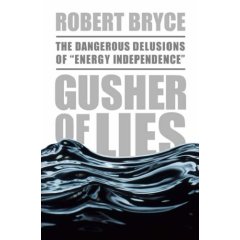
I have been a fan of Robert Bryce’s writing for a long time. His style is witty and entertaining, and he is a debunker-extraordinaire. His newest book, Gusher of Lies: The Dangerous Delusions of Energy Independence
If you aren't familiar with Bryce, he is the Managing Editor of Energy Tribune, a cornucopia of energy news and analyses (and a regular stop for me), as well as the author of several other books topical to energy. For more, here is his biography from Amazon:
About the Author
Robert Bryce is one of America's foremost energy journalists. He is currently the managing editor of Energy Tribune and a contributing writer for the Texas Observer. The author of Pipe Dreams: Greed, Ego, and the Death of Enron
, and Cronies: Oil, The Bushes, and the Rise of Texas, America's Superstate
, he lives in Austin with his wife, Lorin, their three children, and a hyperactive bird dog named Biscuit.
In the book, Bryce takes on many of the myths that are ingrained in the collective psyche of politicians and the general public. He explains why we are so attracted to the idea of energy independence, but then spends the bulk of the book arguing that the idea of energy independence is delusional.
He takes on Thomas Friedman, calling him the loudest, most influential, and least informed proponent of energy independence. Amory Lovins is also a target; Bryce points out that Lovins testified before the U.S. Senate in 2006 that we could make cellulosic ethanol for $18/bbl. (For more on Lovins, see Bryce go after him here). He targets the delusions of both Democrats and Republicans, suggesting that neither major party is serious about addressing America’s energy needs. As Bryce states (and this would be a good description of my own position): “I am neither Democrat nor Republican. I am a charter member of the Disgusted Party.”
Thoroughly researched, with hundreds of references, the book is full of thought provoking and interesting facts. One of the most interesting bits to me was a table showing just how dependent the U.S. is on a wide range of strategic materials. We are at the 100% dependence level on quite a few of them. But the book's real strength lies in the myth-busting. The book debunks such energy independence myths as: 1). We can farm our way to energy independence; 2). We could abandon the Persian Gulf if we achieved energy independence; 3). Energy independence would reduce the flow of money to terrorists. For a flavor of Bryce’s writing – including some of the themes he tackles in the book, see his Washington Post editorial:
5 Myths About Breaking Our Foreign Oil Habit
In this editorial, Bryce writes:
With oil prices still flirting with $100 a barrel, everyone is talking about the need for "energy independence." Late last year, President Bush signed the Energy Independence and Security Act of 2007; Sen. John McCain has declared, "We need energy independence"; and Sen. Barack Obama has called for "serious leadership to get us started down the path of energy independence."
This may all be good politics. But the idea that the United States, the world's single largest energy consumer, can be independent of the $5 trillion-per-year energy business -- the world's single biggest industry -- is ludicrous on its face. The push for energy independence is based on a series of false premises. Here are a few of the most pernicious ones...
While you will often find yourself nodding in agreement while reading the book (or thinking "I did not know that"), there will be things in the book that each reader will disagree with - and perhaps sharply. You may raise your eyebrows at Bryce’s assertion that energy independence is not desirable. I read that, and I thought “Not achievable any time soon? Sure. But not desirable?” Some won't like his take on Peak Oil. Some will feel that some of his writing on terrorism is a digression. I disagree with him on the subject of carbon taxes (more on that below). And corn ethanol supporters will need to round up an army of lobbyists to address his chapter on ethanol.
The ethanol chapter alone is greatness. [Full Disclosure: Bryce referenced me a number of times in the book, but especially in the ethanol chapter. You could thus argue that I have a conflict of interest in this book review - if that makes you happy ;)]. Bryce goes further than I ever have by tying all of the arguments up in one neat package. He covers the subject from angles I have barely touched upon. I can probably now retire from ethanol debunking, because after reading the ethanol chapter I thought “There’s nothing left to debunk.” (In fact, progress on the ethanol FAQ I have been working on ground to a halt after I read Bryce's ethanol chapter. He covered everything I covered, and more.)
This is not a Peak Oil book. Peak Oil is covered over just a few pages, and the subject is treated agnostically – or maybe even slightly atheistically. The Oil Drum does get a mention in this section, as well as peakoil.com and hubbertpeak.com. But if you are expecting a long discussion of peak oil, that's not what this book is about.
There was a time when I couldn't see an iota of difference between Bryce’s positions on various energy topics and my own. It seemed we agreed on everything – right down to small details. However, Bryce gradually abandoned his position that we needed higher carbon taxes, and this is an issue upon which we now clearly diverge. And it took me a while to really pin down why we now disagree on this issue.
I am looking at the issue of carbon taxes through Peak Oil lenses. I see carbon taxes as a way individuals and individual countries can ramp down their energy usage so they are less impacted by supply shocks. I think is more concerned about seeing policies implemented that will increase energy supplies, rather than those that reduce demand. This became clear to me when reading his chapter on energy efficiency. Bryce also feels like it will be impossible to make the tax revenue neutral such that it isn't regressive. He feels like the U.S. will be putting ourselves at a competitive disadvantage to the rest of the world if we pass higher carbon taxes.
However, to that I say that Europe already has very high carbon taxes, and I don't believe it is a coincidence that they drive much more fuel efficient cars, don't have a lot of suburban sprawl, have excellent public transportation, have about half the per capita energy consumption of the average American, and yet still enjoy a very high standard of living. They are more insulated from price shocks than we are, because they are less dependent on fossil fuels than we are in the U.S. But because of the fossil fuel usage habits of the U.S., enabled by a long history of cheap fossil fuels, the world will approach peak oil much more quickly. I see high carbon taxes as a way of slowing down that approach and subsequent decline.
Furthermore, I don't believe Bryce is consistent on this issue. At one point in the book, he writes "Motorists respond to high fuel prices", and then he gives examples of how sales of fuel efficient vehicles have taken off as fuel prices crept higher. Isn't this something we should have been encouraging all along with higher fuel prices? He reiterates this in a section on Brazil, when he points out that Brazil imposes much higher fuel taxes, and this helps explain why their per capita usage is so low. If Brazil can deal with higher fuel taxes, I expect that we can as well in the U.S.
Concluding, I highly recommend this book. It is the best overall book on the reality of the energy situation in the U.S. that I have read in a long time. In fact, specific to that topic, it is probably the best book I have ever read. There are arguments that you won't like. There are some minor errors (e.g., Saudi's claimed oil production capacity was reported as their oil production). And even after reading the book I still feel the attraction of energy independence. But I didn't find a whole lot to quibble with as I read the book.
Contact
- Content: editors at theoildrum dot com
- Tech support: support at theoildrum dot com
License

This work is licensed under a Creative Commons Attribution-Share Alike 3.0 United States License.
Oak Ridge puts possible biofuels Imports from Latin America as high as 38 Billion gpy by 2017.
http://www.ornl.gov/info/press_releases/get_press_release.cfm?ReleaseNum...
LOL.
The thing about engineers and scientists is their perfect willingness to cite unmoored facts as if they are helpful.
What they don't say is, "If we cut down the rain forest and destroy the lungs of the planet, we can plant millions of acres in automobile food and thus kill everyone. Hooray for the automobile!"
Unless the automobile gains sentience soon and can grow its own crops, it will die with us.
Cherenkov,
President Lula states that Brazil has approx. 150 Million Acres of fertile, non forested land lying fallow, as we speak. Colombia seems to have plenty of non-Rain Forest Coca Bushes.
Folks, There are, literally, Billions of acres of usable land lying fallow around the world. We have over 700 Million Acres of land in the U.S. that is loosely defined as "Grazing" land. This is in addition to the 440 Million acres we define as "cropland." In the "Cropland" is 36 Million Acres that we pay farmers NOT to Farm. There Are Issues. BUT, "Available" Land is not one of them.
I disagree with this to the extent that less land should be used to grow food and biofuels, and more land should be used to restore ecosystem services and suck carbon out of the air. There may be some methods of food and fuel production that are carbon sinks, but optimizing carbon sequestration is different from optimizing food production.
Yes, you might say that there is really no such thing as land 'lying fallow' as the 'weeds' and trees it is now supporting are an increasingly vital part of the overburdened ecosystem.
Kdolliso,
Not to be too blunt, but you could not be more mistaken.
Spend some time studying up on the Brazilian Cerrudo(sp) that President Lula is speaking of. It is not hard to see that exploiting this land will only have a short term benefit and will result in long term adverse consequences. Not to mention that as the Amazon rain forest shrinks and becomes more arid that the Cerrudo will become even more arid as its rainfall comes primarily from evaporation in the Amazon.
As one who grew up in "grazing land" I can assure you that if this land was suitable for any other agricultural use it would already be being used for that. We are currently having millions of acres of land being downgraded from grain production to grazing due to it no longer being fertile enough for grains. In many areas grazing land is no longer suitable for that use either. There are large acreages in the West and Australia that fit this description.
The reason there is a government program (CRP) to pay farmers not to use land is that (in general of course as scaming goes on everywhere) the land under this program was unsuitable for most kinds of cropping and the environmental consequences of continuing was not acceptable. Such land is really more suitable for grazing.
One can go on for hundreds of pages, which are all out there to find and read, about how our current forms of agriculture are way beyond sustainability already. Not to mention that the world is pretty much hell-bent on making the situation worse as fast as we can. Don't want to miss any opportunity for a short term financial gain. After all, we don't owe our children and grandchildren anything. When was the last time they did anything for us.
Wyoming,
Anecdotes, of course, abound. However, let Me give one.
I drive through Arkansas, from time to time, and observe tens, if not hundreds, of thousands of acres of good, fertile, formerly-rice land sitting there and drawing CRP Dollars. It is, quite simply, a natural resource that is being wasted.
Add into the mix Pioneers statement, yesterday, that they expect to increase corn, and soy bean yields by 40% in the next decade, and we are Awash in wasted Potential.
Sounds like the Green Revolution. Which is now collapsing in a heap of high fertilizer costs, drought, and overshoot.
kdolliso,
Yes they do, however I have studied this and you clearly have not. Sure there are CRP acres not in use that could be put inito good production. Thus my comment about scaming the system. It proves nothing. You are talking about many millions of acres that you seem to think are just being wasted because we are not growing something on them. This kind of opinion was underestandable in the 1800's when there was a virtually complete ignorance of how the natural systems functioned. It is not excusable in todays world. No one who has spent any time studying the various scientific disciplines that cover how life exists and sustains itself on this planet would even think of arguing that it is a good idea to fully utilize all arable land in the world. It would be suicidal. Taking Pioneers statement at face value is not a good plan. Look into the effects of over using land. There will be serious consequences for doing what the current plan proposes. It is hard for us today to understand how utterly humans have transformed the world if we have not lived long enough to see it or studied well enough to understand what has happened to it.
Human agriculture is long past the point where current practices can be considered susstainable in any way. We are degrading the land at a significant rate and thus having millions of acres fall out of production every year. This land is damaged and much of it will take millenia to recover, if ever. If humans just took the amount of virgin land into cultivation that replaced the same amount of production land we are having to abandon each year it is straightforward to see that even that is not sustainable.
It all boils down to a choice between short term gratification or taking into account future generations.
A great problem runs through these types of issues in our culture. The argument between development and conservation has been morphed into one between liberal/conservative or democratic/republican. Politics always twists complicated issues to some percieved advantage. Once it is successfull in a new labeling those who are proponents of either ideology seldom if ever actually check into the facts again. If they ever had in the first place. These issues are independent of politics just like morals and ethics are not owned by individual religions. I grew up a republican in one of the most conservative places in the US, but I have always believed that we did not make this world and we do not own it. We have a moral obligation to take care of it just like we have an obligation to protect children who cannot take care of themselves. Those who would destroy it through either ignorance or greed must be opposed because it is our joint obligation. Our children and grandchildren on into time will pay the price for our failures far beyond any accounting we might personally recieve.
Well said....
The World turns, with or without U.S.
BZ
"Folks, There are, literally, Billions of acres of usable land lying fallow around the world."
Bullshit.
Which is not to say that some small part of these 'fallow' acres could not support a crop like hemp, which provides food and feedstock for useful products. Roadsides would be a good place to start.
As for the land farmers in the US are paid not to farm:
"The Conservation Reserve Enhancement Program (CREP) is a voluntary land retirement program that helps agricultural producers protect environmentally sensitive land, decrease erosion, restore wildlife habitat, and safeguard ground and surface water."
This program is a small recognition of our need to regain the economic advantages of nature's service industry. To waste these services so that some jerk can make a few bucks producing ethanol, a process which lowers economic efficiency no matter what land it uses, is beyond stupid.
http://www.fsa.usda.gov/FSA/webapp?area=home&subject=copr&topic=cep
RR: Good review. I'm going to request the book at our local library.
The CREP is/was a scheme to take farmland out of production, and lower the cost to the government of price supports. Period.
You and the rest of your ilk working intentionally, ignorantly or indifferently to bring on the die-off, to further degrade the natural environment, and to exacerbate inefficiencies in the economy certainly seem to know no shame.
The incessant repetition of falsehoods such as the idea that 'spare' arable land is bountiful suggests that your efforts are more intentional than the result of ignorance.
Many people have worked for many years to reduce the destructive impacts of industrial agriculture. The CREP was a significant victory for them and us.
Don't feed the troll!
Are you totally out of your freaking mind or what? You gotta be crazy. To view things from your shrunken perspective (oh, what's a few million acres here or there)is why we're (the rest of us, not yu) in the predicament we're in. Let me guess, you voted for the shrub.
Jeff
kdolliso,
I'm skeptical of this supposed claim by Lula. The people ripping into the rain forests are destroying the rain forests to get more grazing land. Why are they doing this if lots of already cleared rain forest land could be used instead?
Land used for grazing is not unused.
Futurepundit, they're logging the rainforest to get the logs.
After the logging the grazers move in for a couple of years; then the subsistence farmers give it a go for another three or four years. Then it's over. Back to nature.
Robert --
The Bryce stuff sounds good as far as it goes. It's strange that he starts off his Washington Post editorial with
and then doesn't say another word about why the oil price is at that level. That's a very large blind spot.
Obviously a smart guy, but he needs to think this through.
best,
Dave
I'd say Bryce has a blind spot on climate change too.
I read my first Bryce essay over at Counterpunch. Here is the essay I'm referring to:
http://www.counterpunch.org/bryce02082008.html
For those who want the short version, he states:
He is agnostic about global warming, and he criticises the greens/lefties who think we can reduce our carbon footprint and maintain some semblance of our affluent lifestyle. He states:
1) energy efficiency will only lead to greater consumption of energy
2) renewable sources just can't scale up to meet future energy needs
3) Biofuels are a joke - they can't come close to replacing fossil fuels.
He then says that we need to increase fossil fuel energy supplies because that is the only way to lift the world's poor out of poverty.
I sent him an email, saying that I agree with his points 1, 2 and 3, but:
1) Resource exhaustion may make increasing supplies impossible
2) Climate change impacts could be large enough to offset any benefits of increased energy usage
His response was polite, but basically a brush off. It was pretty clear to me he doesn't believe in either peak oil or (or peak energy) or in climate change as a serious problem, and that he isn't really interested in discussing those topics.
This shouldn't take anything away from his messages about energy efficiency, but I would be skeptical of any policy proposals he might offer in light of his views on peak oil/energy and climate change.
He is agnostic about global warming, and he criticises the greens/lefties who think we can reduce our carbon footprint and maintain some semblance of our affluent lifestyle.
While I am not agnostic about global warming - as I have said I think the scientific consensus is overwhelming - I think his position on this issue is similar to my own: He doesn't think there's anything we will realistically do about it. The evidence he cited in the book backs him up. For instance, a small minority of the original signatories of Kyoto are actually meeting their targets. If even the most committed can't or won't do it, what hope is there for the Chinas and Indias that promise to greatly increase emissions? CO2 concentrations in the atmosphere just continue to go up year after year. None of our efforts to date have changed that curve a bit.
Here is the depressing reality:
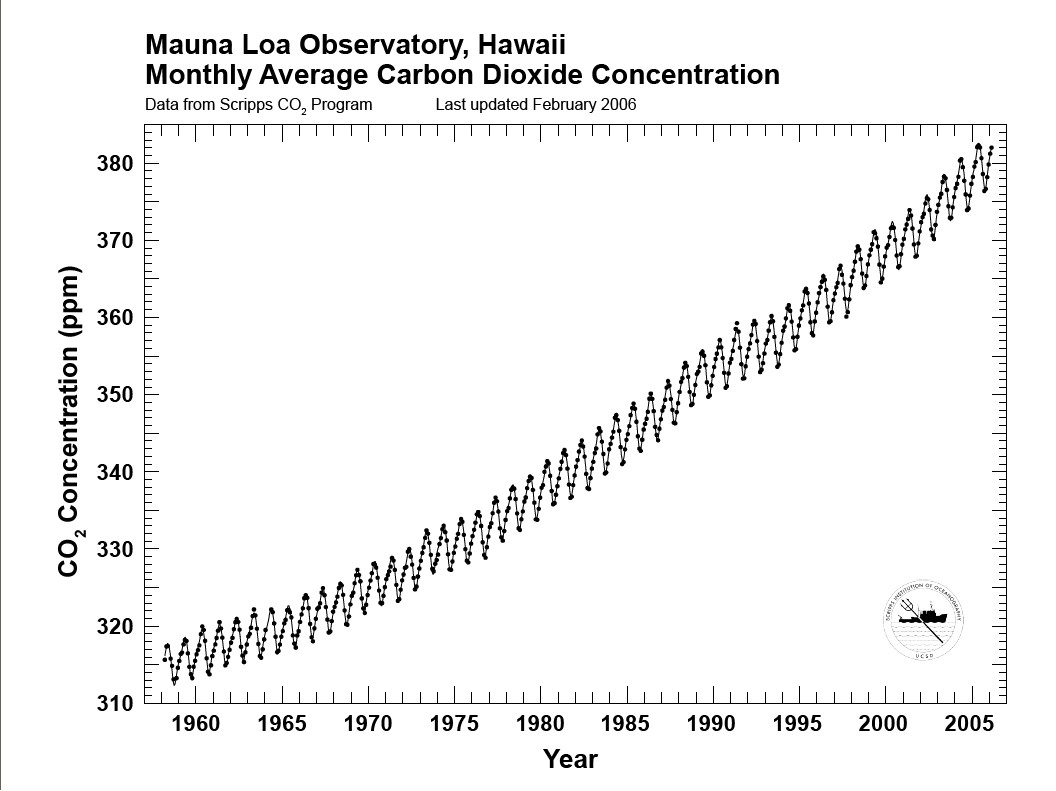
That doesn't give me any reason to believe we are going to solve this problem.
I had the opportunity of talking to an IPCC climatologist one time and he told me after the presentation what you could probably only mention in private. He had showed a chart of co2 emissions scenarios with the highest bringing us up to 1000ppm in 2100. He said that the scenarios were created 6 or so years ago and if you look at what the actual increase has been, it was considerably higher than the highest emission scenario. So, I don't think people will respond until it's an outright crisis and god knows how many people will die before we figure it out, which we might not.. Sorry, I'm just a realist...
Hi Robert,
His position is clearly not similar to yours - he has claimed to be agnostic about human induced climate change, not convinced that it is happening. In practice, this difference may not matter much, since, as you say, the world is clearly not serious about trying to reduce emissions. I agree with that position.
However, I do not agree we should aim to increase fossil fuel supply in the hope of bringing the world's poor out of poverty. There is a difference between realizing the world won't do anything to mitigate climate change, and proposing we pump ever more CO2 into the atmoshpere by extracting ever more oil, coal and gas. He doesn't actually say he wants supplies to increase, but he does say the developed nations have a moral obligation to help the poor get realiable and cheap energy. And it's pretty clear he means oil, gas and coal will be the energy source, so I don't know how you can avoid that conclusion after reading his article.
First off, there isn't enough of the stuff to achieve what he wants. In his Counterpunch article, he asks the question, if CO2 emissions are bad, then what are the poor to do? It's a good question, but one he basically ignores. He simply says it would be morally wrong not to raise the standard of living of the world's poor, and that requires energy, and that requires fossil fuels.
The obvious response is how, exactly, can we do that if fossil fuel supplies are about to decline due to resource exhaustion? More energy for the poor would indeed be nice, but it isn't a realistic position to take. He sees the problem with people who tout biofuels as the answer to high oil prices, but fails to see the problem of peaking fossil fuel supply.
Secondly, the more we push for growth, the more damage we do to the long term carrying capacity of the planet, and the greater the immiseration of future generations. Just because someone is poor today, doesn't mean they can't be even poorer in the future. His unwillingness to consider the downside of climate change, and only consider the plight of people who don't have access to enough energy to lift them out of poverty, is a real problem.
Maybe the best thing to do is keep the party going as long as possible since the consequences can't be avoided. If we've imbibed enough beer that we'll die from alcohol poisoning in the morning anyway, we might as well have another shot of tequila now. But these things should at least be acknowledged, there should be a sense of intellectual honesty. In my (admittedly limited) exposure to Mr. Bryce, he just doesn't want to consider the possible nightmares that peak energy or rampant climate change may wreak on the Earth.
Again, I agree with his criticism of a lot of the blather about biofuels will save us, or energy efficiency will save us, etc. Right on, Mr. Bryce. But his overall thinking about energy use and its consequences is still a bit muddled, IMHO.
His position is clearly not similar to yours - he has claimed to be agnostic about human induced climate change, not convinced that it is happening.
What he has written on the subject is that he is not convinced, but he is not unconvinced either. That's what agnostic means to me - not that I am not convinced of God, but that I just don't know.
What he explained to me is that he simply hasn't delved into the matter. I am OK with that. Personally, I haven't delved deeply into the science, but being a science type myself, I put a lot of stock when there is an overwhelming scientific consensus.
Hi Robert,
Well, OK, he hasn't looked into it. That's fine, as far as it goes, but not when you start taking sides in policy debates where climate change has something important to add to the conversation.
It's a simple point - if you're going to make assertions about what is the best course for energy policy (his take is the poor need adequate access to fossil fuels to lift them out of poverty), then you should take responsibility for educating yourself on the relevant issues.
I agree that there has been little progress to date on reversing the trend in this graph, and the the future prospects for doing so are daunting. However, I object to the technique, employed all too often on this blog, of presenting a time series graph and stating with certainty that the historical trend will inevitably continue. Has it been forgotten that the basic premise behind this blog is that one time series trend, namely oil production, will soon reverse a 150-year history of rising production and go into decline? Perhaps all such charts should contain that disclaimer, so common to financial marketing, that "past performance is no guarantee of future results."
Has it been forgotten that the basic premise behind this blog is that one time series trend, namely oil production, will soon reverse a 150-year history of rising production and go into decline?
And then there's coal.
That's the problem. It isn't just based on that graph. It is based on the politics of the situation; the reality of how people and governments use energy.
But if the Peak Coal pessimists (David Rutledge, Energy Watch Group, etc) are correct how can the trend line on this graph continue? It won't continue from burning more oil and natural gas.
It will continue upwards, it is just that depletion will eventually arrest it. That's my argument: That the trend will stop only when we run out of the fossil fuels that are causing the trend.
So when does the trend stop? Sure, depletion will stop and reverse the trend. But when will CO2 emissions peak? It seems to depend on when we hit Peak Coal.
If the peak is soon then we can stop worrying about how to adjust to melting polar ice caps. If the peak is 70 year from now then I want to invest in ocean front property before it becomes ocean front.
But when will CO2 emissions peak? It seems to depend on when we hit Peak Coal.
Maybe. On the other hand, there's a lot of oil shale, and you can burn it straight out of the ground, just like coal. A number of countries are doing just that today. I don't believe any one has decisively ruled out a big oil shale burn by the U.S. and China. I don't believe clathrates have been decisively ruled out either. Or in situ gasification of the massive undersea coal deposits in the North Sea.
But when will CO2 emissions peak? It seems to depend on when we hit Peak Coal.
The rate of emissions may peak then, but the accumulation in the atmosphere won't stop. It will continue to rise as long as we are burning fossil fuels, unless some kind of equilibrium is established with the ocean.
With a sufficient temperature rise, the oceans will go from carbon sink to carbon source and it won't matter if we continue to burn fossil fuels or not. Methane clathrates and thawing permafrost may be an even earlier tipping point.
1) energy efficiency will only lead to greater consumption of energy
He makes the same Jevon's-based argument in the piece on Amory Lovins. However, this argument will self-destruct in the face of energy supplies which can't increase, like liquids in the post-peak period. At that point, efficiency *can't* lead to greater consumption of liquids. The role of efficiency will be to maintain functionality while using decreasing amounts of liquid fuel, and Lovins approach will be vindicated.
I think Devon's argument is fairly close to bunk even with growing energy supplies. There's a strong saturation point for most energy uses.
For instance, nobody went and converted a room to a walk-in freezer when the efficiency of freezers improved by around a factor 5 since the 60's.
People used the money they saved on refrigerator electricity and bought plasma TVs and took trips to Europe.
They also bought that beer fridge in the garage, and that chest freezer in the basement etc etc
" The role of efficiency will be to maintain functionality while using decreasing amounts of liquid fuel,and Lovins approach will be vindicated"
You are assuming, of course, that we will behave like rational beings and won't waste whats left in shoot 'em up bid to control whats left.
History argues Lovins approach DOA.
To me it seems correct that Jevon's Paradox breaks down in a post-peak world when assessing the world in aggregate. However, an individual entity (household or company or even country) might still be able to demonstrate Jevon's Paradox even as worldwide energy use declines.
In other words, Jevon's Paradox is an easily observable phenomenon that comes into play inside of certain contexts.
As for the validity of Jevon's Paradox (per Soylent's comment), simply replace "energy" with "money" and you can see the same phenomenon. If you save $30 on a purchase on which you expected to spend more, do you run to the bank and put it in a savings account? Or do you spend it on something else? That could be viewed as a form of Jevon's Paradox, too.
Moreover, Lovins has been advocating efficiency in an energy abundant world, which is clearly the world Bryce was commenting on. Lovins has been beating the drum for efficiency when a better way to have focussed effort, in my view, would have been to advocate efficiency WHILE decreasing the overall amount of energy used. Efficiency by itself is not up to the task before us.
-André
www.InspiringGreenLeadership.com
Does anyone else remember some stat about CA's energy use staying flat despite growing population? This was attributed to increased efficiency. This helps Lovins argument & undermined the paradox (unless I was dreaming or something).
The number you are referring to is California's energy use per capita, which has stayed flat due to its aggressive and pervasive energy efficiency programs.
On the face of it, it seems like it would undermine Jevon's Paradox — but it's not so simple. The energy saved by a business, for instance, could have gone into expansion of the business and the hiring of additional people. The energy use per capita of both the business and the state would have stayed flat but the overall energy use by both went up.
Something like that has occurred as California's population has continued to increase, the size of its economy has increased and its overall energy use has increased. At that point though it's difficult to attribute the growth to efficiency measures, the sunny climate or the phases of the moon.
-André
I strongly disagree that increased FF use is the only way too improve the quality of life of the poor. The poor use so little energy per capita that renewables that are locally generated could easily double their quality of life. Dependence on imported oil only worsens their attempts pull themselves out of poverty. This is especially true as prices continue to rise. In many countries with oil exports the benefits accrue to a small elite group who have zero compassion for the many poor of their own nations. OTOH renewables are more diffuse and labor intensive than FF and therefore of more benefit to the poor. Renewables can create many more jobs than oil and coal use and these jobs will still be there when the oil fields run dry and the mines peter out.
Odd, my library calls it "Delusion of Energy Independence" for some reason. Placed a hold, thanks for the tip.
That piece on Lovins is quite a zinger. Always liked Amory's rap - who could argue with efficiency? Alas. “My rule of thumb is to double his cost estimate and divide his energy saving estimate in half to get something closer to reality.”
That piece on Lovins is quite a zinger.
It's a zinger if you're willing to tacitly (and fraudulently) assume, like Bryce, that supplies of liquid fuel can grow forever. If they can't, then Jevons is wrong, Lovins is right, and efficiency will be priority #1.
It's a zinger if you're willing to tacitly (and fraudulently) assume, like Bryce, that supplies of liquid fuel can grow forever. If they can't, then Jevons is wrong, Lovins is right, and efficiency will be priority #1.
Nah, the zinger part was to point out that despite the fact that Lovins' predictions have been consistently wrong - and badly wrong in many cases - he continues to be lauded as a genius.
While I am likely to agree with him on the delusions of energy independence from the supply side, I find it delusional to believe that we can always import and substitute to achieve ever higher supplies.
Our goal should be as energy independent as possible using renewables and increasing efficiency by orders of magnitude. The economy needs to be as closed loop as possible (with a nod to entropy) with materials use, and to run solely on ambient solar and its derivatives.
Anything less than doing this will lead to no more money, no more profits, no more economy because the planet will become pretty uninhabitable in a few decades.
He sounds like a brilliant fellow with a blind spot for climate change. Hope that changes.
It is, of course, true that we cannot attain energy independence as long as our energy requirements are any where near where they are now.
But it's equally obvious that we will ultimately attain energy independence when our requirements are sufficiently reduced, however that comes about. Obvious because who will we be dependent on? At some point, the oil and gas will be gone (no longer economically extractable.)
Our gov't does not and never has seriously believed that we can attain energy independence -- that's why we have the war on terror, which is nothing but a war for control of oil (and gas).
The point that remains is that our current way of life is entirely unsustainable without oil and gas. One way or another we will retrench. We'll see where we are when the smoke clears.
Tangentially, we have the War on Drugs not because the government feels there is the need or an opportunity to wipe out illegal drug use, but because it provides a great excuse to funnel pork-barrel funding to law enforcement agencies at all levels of government. It gives cover to politicians who want their "tough on crime" ticket punched. When was the last time any elected congressman or senator voted against any aspect whatsoever of the "war on drugs"?
Speaking from personal experience, I can tell you the attitude held by many law enforcement types at high levels of state government is, "there is no War on Drugs." At least they are able to admit the truth in private although you will never find a single one of them willing to be candid with the public.
There may be some who claim "there is no War on Drugs." But looking at who is incarcerated by the biggest jailer in the world, there are plenty of pow's from this particular non-war.
1 in 100 U.S. Adults Behind Bars
http://www.nytimes.com/2008/02/28/us/28cnd-prison.html
It makes as much sense as America throwing a taxi driver in Guantanamo while it continues its 28-year alliance with the king of Saudi Arabia and the Army (not people) of Pakistan to drive Islamic peoples as far to the Right as possible. Or killing a million or more Vietnamese for being Reds while selling grain to the Russians and plotting with the Chinese against the Russians.
Hmm, maybe I've hit on a pattern. We have always been at war with Eastasia.
Part of the problem is that maybe we are mis-interpreting what the phrase actually means.
"War on Drugs" is thought to mean "waging a war against 'drugs' which is shorthand for 'the illegal drug industry'".
But we would not parse a similar statement in the same way, such as a "war on the countryside" or a "war on the seas", which we would think means a war waged over the land or over the water against an unnamed enemy.
The "War on Drugs" is actually being implemented as "a war waged on top of the 'illegal' drug industry against an unnamed enemy".
That unnamed enemy is your individual personal liberty. And the fallout of the "War on Drugs" is that drugs are cheaper and more easily accessible than when the war began.
The "War on Terror" works the same way. It is being implemented as a war waged on top of the terrorism infrastructure against an unnamed enemy. The enemy again is your liberty. And the fallout is that terrorism and anti-US sentiment is more widespread than before the war began.
Yes. While better technology in areas like increased efficiency of solar panels is welcome, a parallel effort needs to be focused on defining a way of life that is achievable based upon the assumption that we will have drastically less energy of all kinds, especially that derived from oil and other fossil fuels.
We could start by recognizing that maintenance and growth of our military industrial complex is not sustainable and is a positive hindrance to making the kinds of investments that our needed. We are seriously beefing up our expenditures on preparing to fight the next perceived menace, China in addition to our bloated war against terror which mainly serves to feed the public trough for the well connected.
Perhaps it would be a more efficient use of limited resources if we moved to a way of life that was not dependent upon foreign oil and all the wars required now and in the future to make those supplies available to the U.S.
Intellectual ponifications of the arrogant kind ignore the possbility that a 4th generation substitute fuel from a genetically modified microbe could be scaled up to supply this country with enough fuel to be energy independent. Fact is, if that is possible, then we could become exporters of that energy.
I really dislike such heavy handed declarations that we are simply stuck were we are now, and that nothing can change that current position. It's so lacking of imagination and the possibility of great innovation.
Don't get me wrong. I know the Peak Oil situation we are in, and am as concerned as the next person regarding how our economy will continue in a healthy manner via current high fuel prices and possibly even higher in the near future. However, I went from being a doomsday, pessimist of the worst kind, to a person that sees that this is just a rough time period in which we will move on to a next generation fuel.
If we just went through the tech/information age of computers, and we are now in the DNA mapping, DNA splicing, protein mapping era then it only seems logical that some form of scaled up 4th generation fuel producing microbe will replace oil, and when it does not only will we greatly reduce our emissions of CO2 causing global warming, but we will clean up the air and yes, become energy independent. That's not being in denial, but positively looking for solutions based on new technology that is very promising.
I'm a Peak Oiler with a positive vision of the future. Join that vision and let's collectively get out of this rut!
That's certainly a possibility. But if you can't tell me whether it is a certainty in 2 years, 20 years or 200 years, then how can I plan for how to survive while waiting for the miracle? It's like Hitler trying to finish his jet-powered wonder weapons with ten million vengeful Russians marching to Berlin - there's no fuel, there's no pilots, and there's no 1946.
Using any sort of microbe to "produce" energy sounds great, but the critters don't actually create any new energy source. The primary energy source would likely be some sort of biomass and the microbes might convert that to something like oil, i.e., a liquid fuel. The big sticking point with all this is what sort of conversion efficiency will be possible. Or, are the microbes, such as algae, going to take in sunlight and convert that energy the liquid?
So far, algae systems have not proven successful because of the larger problem of collecting the sunlight, often in open ponds of water with the algae growing within them. That means there is an absolute limit of output per meter of surface area, which happens to be the result of the fact that the surface sunlight is about 1000 w/m^2. Plants have evolved to capture only a few percent of this energy, the rest going into various non-productive pathways, including competition with other wild plants and bug. Monocultures are unstable and only work with intensive management.
With algae (and probably with other microbe systems), a big issue is contamination of the monoculture with wild type algae, which won't produce the desired oil like product. The cheapest algae systems investigated used unlined "race track" ponds, which required nearly flat ground and were open to the air. The contamination problem means that the system must be closed, which then implies building some sort of containment structure, such as a sealed greenhouse. The cost of the containment structure is likely to be as big as the cost of a solar thermal concentrator system or next generation PV systems. Think "cost per m^2" for basic building materials, such as concrete, glass and steel, all spread out under the sun.
E. Swanson
Given the failure of oil algae I wonder if there is a Lipids Limit akin to but much less than the Photosynthetic Limit. A quick but assumption laden calculation suggests that wild native grasses might store 40 MJ of energy per square metre per year as combustible products. For an unfarmed oilseed like wild mustard the oil heating value might be as low as 2 MJ/m2/yr, which is only microwatts on a continuous basis.
The main conclusion is to concentrate on cellulose as a feedstock not oils and starches, even maybe for aquatic plants.
I apologize that I don't have the source for this, but it might be useful for someone nonetheless since the discussion is on energy from the sun and how much can be captured:
The sun radiates 300 000 000 000 000 000 000 000 000 W
the earth receives 81 000 000 000 000 000 W
we need 13 000 000 000 000 W
forest captures energy at 0.25% efficiency
corn stalks capture energy at 2% efficiency
photovoltaic cells capture energy at 20% efficiency
-André
The only *arrogance* here is with any such belief in the jinni of genetic modification to save us!
How about you consider what Dr. Erwin Chargaff, one of the fathers of nucleic acid and gene research, said about such thoughts:
"Our time is cursed with the necessity for feeble men, masquerading as experts, to make enormously far-reaching decisions. Is there anything more far-reaching than new forms of life?... You can stop splitting the atom; you can stop visiting the moon; you can stop using aerosols; you may even decide not to kill entire populations by the use of a few bombs. But you cannot recall a new form of life... The hybridization of Prometheus with Herostratus is bound to give evil results..."
For all you genetic engineering junkies, I suggest you all fly to another planet and do as you please, but leave this planet alone with your DNA erector sets.
Failing that, please read The Arrogance of Humanism, by David Ehrenfeld so as to remove once and for all the rosy tint off any such tech-salvation glasses stuck on your face.
We are not know it all Gods and it's well past the time we stopped pretending we were!
Nature is always mutating and sorting. Bacteria are always recombining DNA (which is why bacteria form a web, not a tree, of life). Bacteria and viruses transfer DNA to multi-cellular organisms, which is why such things as endogenous retroviruses exist.
Chargaff is just demanding that humans not do what nature has always done, probably because it offends his religious sensibilities. We should treat this with all the respect it's due: derisive laughter.
:-)
The problem with energy independence is that it implies unlimited supply. Americans had energy independence pre-1970s, and then our consumption grew past domestic production and finding of new reserves. Surprise surprise. I agree with Robert. Carbon taxes and other measures must be used to curb growth of consumption in order to maintain any sort of independence.
D
It frustrates me that otherwise thorough analysts rightly identify the need for demand-side measures, but then seemingly unthinkingly advocate a carbon tax in that role. TEQs represents a more clearly thought-through demand side policy instrument which is explicitly designed to deal with peak oil as well as climate change, and which is being closely examined by the British Government, if only for climate change reasons at this stage.
For a comparison between a simple carbon tax and TEQs see pp. 32-36 (PDF pp. 19-21) of David Fleming's Energy and the Common Purpose.
I agree that perhaps we can become energy independent eventually and that while corn ethanol is a scam, that cellulose ethanol does hold some promise. I do not think the future is going to be anything to celebrate about if we take on our pro-growth view, lets make money and focus on economic-growth. The fact is ethanol, nuclear and other alternatives will do nothing but put off another crisis till a decade or two later when everybody will be on some forum called the grain-pouch and talking about the impending crisis of usable land combined with the effects of Climate Change. I think our main goal should be sustainable policy's, because and end to population growth and traditional economic growth does not mean an end to prosperity. Economic growth due to technological advancement is the only sustainable form of economic growth. We need to realize this before the four horsemen ride in laughing at our stupidity.
Some billion or so years ago, photosynthesis was the solution to the lack of available energy. An aeon or two later, this led to the Oxygen Catastrophe in which a huge fraction of Earth's lifeforms went extinct.
This time we're talking about technologies, not lifeforms. Vacuum tubes and draft animals have been pushed out of primacy into tiny niches; I think we can manage if this happens to today's technologies a few decades hence. Have some perspective.
As I mentioned in Mr. Bryce's blog, his belief that energy independence is impossible is an absurd notion to say the least. Genesys, LLC has recently received a breakthrough patent and will demonstrate the simplicity of producing hydrogen from wastewater or seawater using a new technology called RET (radiant energy transfer) which is ECONOMIC and efficient. Unfortunately, Mr. Bryce is not an engineer or scientist so his credibility is limited when it comes to technology solutions. Spreading the gospel of impossibility detracts from the mission to create a sustainable society and leaves people with a sense of no hope. This is classic naysaying of which we have too much in today's world. There is hope and I suggest to our dear friends and readers to take a look at their web site, www.genesys-hydrogen.com for more information about their vision and technology. They have a video at their web site as well as a copy on YouTube. You will probably be hearing more from them in the future.
What's so magic about a steam electrolyzer? It doesn't generate useful energy -- its just an efficient way of turning water into hydrogen and oxygen, and that process still costs you energy.
Do you do anything except push this gadget?
The RET technology is not electrolysis nor is it steam electrolysis. You are obviously not an engineer or scientist so you have no qualifications to make such ridiculous comments. I suggest you read the technical papers on the web site and also watch the video. You need an education in physics, chemistry and thermodynamics. Taking cheap heat and waste water to produce hydrogen and oxygen is very useful both economically and in terms of efficiency. For your information, it takes energy to create any fuel including gasoline. I challenge you to name me a process that converts one form of energy in the form of a raw material for a fuel (that also includes crude oil) that does not expend energy in order to make it a higher valued fuel. Learn some thermodynamics!
I am an engineer, and one of the first things I noticed (besides the handwaving) is that you don't know the difference between a Carnot cycle and Rankine cycle. Then there's a quote from here:
This follows from nothing.
It looks like you pulled a lot of stuff out of thermo and chemistry textbooks to give yourself a sciency veneer, but there's no "there" there.
Thank you Robert for this review - "Gusher of Lies" looks like a "must read".
But in recoginizing the impossibility of 100% energy independence (i.e. self-sufficiency for everyone in the entire USA), we should not throw out the baby with the bathwater. We - i.e. you and I, dear reader - should be promoting SPECIFIC STEPS instead. Examples:
Recreational "energy independence" is entirely within the reach of every American. It really is quite simple - just say "NO" to burning gasoline to play and amuse ourselves! It is astonishing that we-the-people have not begun to talk about the idiocy of fossil-fueled play.
Millions of children could achieve "energy independence" on the way to school and their extra-cirricular activities. It's called "walking" or riding a bicycle, and choosing things to do that are within walking/bicycling distance.
Millions of families could choose "energy independence" on the way to church. It would make a lot more sense to pray for our soldiers in Iraq and elsewhere in the oil-rich Mideast and Central Asia if we didn't burn imported gasoline on the way to worship.
We could make our yards and gardens "energy independent" too - and greatly improve our physical health by using Armstrong power rather than gasoline-fueled gadgets to do simple jobs like mowing lawns and tilling the soil. Most families with a small patch of yard could harvest some "energy independent" foods items that require ZERO energy to grow and transport.
And how about "energy independent" clothes drying? Sporting activities? Vacations?
The list of practical steps towards "energy independence" goes on and on. Some are things we can do right away, some require a bit of planning (carpooling) and some will take longer (choosing to move within walking distance of a grocery store, for example.)
Just imagine what we could do if we were SERIOUS about this! If we stopped making excuses, stopped passing the buck, stopped waiting for someone else to solve our problems for us. Maybe we COULD stop importing oil! After all, US domestic oil extraction is still more than 6 mbd - that's plenty of oil for things that really matter.
Hans Noeldner
I agree with this completely. Let's stop talking, and start doing ... or not doing, in the case of using internal combustion engines in any device, be it car, weed eater, lawn mower, or what-have-you.
It isn't easy to give these things up if you've depended on them for a long time. But it is doable.
Peak Oil is covered over just a few pages, and the subject is treated agnostically – or maybe even slightly atheistically.
Robert, this is a very glaring omission considering the use Bryce makes of Jevon's Paradox. By claiming that Jevon's Paradox will continue to be relevant, he is essentially claiming that liquid fuel supplies are infinite. Just curious, but does Bryce ever discuss the possibility of, or measures for dealing with, the decline of any energy source?
Robert Bryce is a cornucopian, corporate PR-journalist and a pal of arch Peak Oil denier Michael Economides.
Don't even try to untangle his arguments. His brain doesn't work.
http://www.energytribune.com/articles.cfm?aid=796
http://www.theoildrum.com/story/2005/8/25/19286/2085
Wait a sec.
If Bryce is a cornucopian and JD is too then...
Argggh! Something is wrong here!
I read some of JD's peak oil debunked once, I read an article called why EROEI doesn't matter... then I stopped reading that blog.. some people are just too into the classical school of economics. rooster's laying egg's... sigh
And I am kicking around putting an essay in the queue of why EROEI does matter. I better go check JD's essay out.
Perhaps that was misleading, it was called EROEI misconceptions and an other aticle about EROEI why it won't leading to collapse. I think what he is saying that in terms of money it would be logical to use an EROEI negative energy source, but I think that the cost of energy in dollars in the long run will reach the true cost of energy so there will be a dollar/joule ratio that will depend upon the avalibility of renewable energy from a region, assuming dollars are still around. I think he ignores the thermodynamic perspective too much.
http://peakoildebunked.blogspot.com/2005/10/136-will-declining-eroei-cau...
http://peakoildebunked.blogspot.com/2005/08/4-eroei-misconceptions.html
Anyway, I think JD is quite a bit off on this subject.. he seems to take the position that it doesn't really matter.. I disagree to say the least..
Cheers,
Crews
I'll be looking forward to your article robert
Robert Bryce was interviewed on Sunday March 2nd
by Ian Masters -- Radio KPFK: Background Briefing
http://64.27.15.184/parchive/pls.php?mp3fil=11258
Interview starts 40:25 into show and runs about 20 minutes
Robert,
First, thanks for the interesting post, I will be puttng Bryce on my reading list as time allows and try to clarify his position in my own mind.
The problem with "debunking" is that sooner or later you have to admit to what you are "bunking". :-)
In other words, if I debunk energy independence, I am by implication supporting energy dependence. But dependence on whom, or what?
If I "debunk" renewables, then I by implication must be supporting non-renewables, unless there is a third option available (such as use no energy, either renewable or non-renewable...despite the bicycle worship here on TOD, that option does not seem realistic in anything resembling a modern world)
If debunk the need for change, then I must by implication be supporting the status quo.
Let us assume that energy use will grow or at least sustain itself at current levels. We have to ask how long we can afford energy dependence, having ruled out energy independence.
Currently, the oil consuming nations are being bled to death by a money flow that is soaring into the trillions of dollars per year in our ceaseless effort to retain energy dependence. Would the cost of energy independence, assuming it is possible, be any greater?
You mention Brazil, which due to it's greater efficiency of use, lower living standard, and recent efforts in offshore oil exploration is now a net exporter of oil, and even talking of joining OPEC.
Will Brazil's new status as net exporter somehow destroy Brazil?
http://en.wikipedia.org/wiki/False_dilemma
If debunk the need for change, then I must by implication be supporting the status quo.
If I debunk corn ethanol claims, does that mean I support the status quo? No.
Currently, the oil consuming nations are being bled to death by a money flow that is soaring into the trillions of dollars per year in our ceaseless effort to retain energy dependence. Would the cost of energy independence, assuming it is possible, be any greater?
I agree 100% with you there. Bryce's argument is that the money will still flow to them, it would just come from other sources. But the point is, the money wouldn't be flowing rapidly out of the U.S., damaging the economy.
Thanks for the reply Robert... on the corn ethanol, you said "If I debunk corn ethanol claims, does that mean I support the status quo? No."
That's true, but corn ethanol is only one of many possible alternatives. My thinking was in terms of much braoder catagories, i.e., renewable vs. non-renewable, or independence vs. dependence. One has only one of the two broad catagories to choose from, there is no viable third third choice.
On the money issue: I have said before that there is only one worse scenario than " the oil is not 'out there', and that is "the oil is 'out there'. If the oil is "out there" wherever "there" happens to be, it simply means that we continue in the depletion treadmill, trading away our national destiny, being bled to death financially, and prostituting our international policy in a never ending spiral downward into slave nation status trying to get it. At some point, pride alone should force us to seek alternatives. It actually should have already happened many years ago.
RC
ThatsITImout, you are brilliant! Major logic errors regarding issues surrounding peak oil have been committed on TOD posts since I first found this excellent site. In my former incarnation as "practical" I have protested many times. RR has consistently been the source of many of them and now has apparently found an accomplice in the author of a Gusher of Lies. What is it about engineers that makes logic such a foreign concept to them? There is more to analysis than fancy data and equations. Logic sits on high outside locating the source to prove some arcane point. Someone has said that if you torture numbers they will confess to anything and that is what has been going on in the anti ethanol debate IMO. Data, numbers and equations are subject to the errors of logic which is in a separate domain beyond numbers and equations. Logic rules all. Errors of logic can invalidate the results of even the the most perfect data set and overrule the most elaborate and exquisite equations.
Major logic errors regarding issues surrounding peak oil have been committed on TOD posts since I first found this excellent site. In my former incarnation as "practical" I have protested many times. RR has consistently been the source of many of them and now has apparently found an accomplice in the author of a Gusher of Lies.
You have become a complete waste of time, and quite frankly, are a liar. Every time you make an asinine claim or character assassination as you do above, I always ask you to back it up. Then you slink off for a few days, and come back and say the same thing over again. Rebuttals roll off your back as if they had never happened. You repeat very stupid claims again and again.
Then again, what should we expect? You are, after all, making a fortune off of this scam at the expense of the rest of us. You have to justify your actions - if only in your own mind.
A review of Bryce's book in today's New York Times:
http://www.nytimes.com/2008/03/07/books/07book.html
I would tend to regard a book entitled 'Gusher of Lies' as a literal gusher of lies and not even open it.
Having read the review above, the author seeks to prod, challenge and stupify the Peak Oil and Green communities a la
TV-sophist John Stoessel.
The basis of these con-games, is the idea that 'you can figure it out' based on the facts they present, the same idea as sleight-of-hand.
We REALLY don't need to waste our time with their 'paradoxes'. For us rubes, the rule is 'Fool me once, shame on you, fool me twice, shame on me.'
Don't listen to them.
For example:
"The problem with corn and other alternative fuel sources boils down to cost and output."
The price of ethanol $1.20-$1.50 is less than oil, $100/42= $ 2.38.
The output of corn-ethanol is less than petroleum, therefore corn ethanol can never replace petroleum in cars( though sugar cane ethanol did so in Brazil).
Fuel made from switch grass, another potential solution to the energy problem, costs a lot to produce, delivers a lot less energy than petroleum and would require, like corn, vast areas of farmland to meet a meaningful percentage of current energy needs."
Cellulosic ethanol costs $1.90-$2.25 to produce, less than oil.
http://en.wikipedia.org/wiki/Cellulosic_ethanol
'Delivers a lot less energy' means energy conservation. We won't notice it if we raise our fuel economy from 20 mpg to 35 mpg.'
There's farmland and there's cropland. Farmland includes pastures. US has .5 billion acres of land for crops but .6 billion acres of pastureland for cattle-almost all meat, very few dairy farms are considered pure pastureland. There's also another .5 billion acres in forests.
The above link says that 100 million acres will make enough ethanol for 25% of current
gasoline production.
What this should tell you is that we are prodigiously wasting gasoline.
Come to think of it posting facts to refute
paid liars for free is a PRODIGOUS waste of my time!
Cheers!
corn ethanol can never replace petroleum in cars( though sugar cane ethanol did so in Brazil).
Wrong. 90% of the transportation fuel in Brazil is petroleum, per their own transportation statistics.
Cellulosic ethanol costs $1.90-$2.25 to produce, less than oil.
LOL! You are at least a factor of 2 off:
http://i-r-squared.blogspot.com/2008/03/cellulosic-ethanol-is-dead.html
We find that subsidy levels are needed in the range of $0.22 to $0.78 per gallon for corn ethanol, $1.97 to $2.90 per gallon for biodiesel, and $1.55 to $2.11 for cellulosic ethanol.
Researchers from Iowa State.
You were saying, as far as "shame on me" and "sleight of hand?" Go look in the mirror.