


France and Italy: is nuclear power the way for energy independence?
Posted by Ugo Bardi on March 25, 2008 - 9:58am in The Oil Drum: Europe
This is a guest post by Eugenio Saraceno, member of ASPO-Italy and consultant for energy sources management.

France's nuclear power plants produce almost 80% of the nation's electricity. In contrast, nearby Italy has no nuclear plant in operation.
One of the main arguments of the present debate on energy is whether a nuclear energy program should be restarted or not. We can use the cases of Italy and France as a way for evaluating whether it is a good idea for a non nuclear country to get nuclear plants.
Italy is probably the only country in the world that has dismantled by law the existing nuclear plants. It was the result of a referendum against nuclear power that was held twenty years ago and that led to the stopping of all nuclear energy activities in the country. The only nuclear plant that was under construction at the time, Montalto di Castro on the Tyrrenian coast, was converted to natural gas. In the following years, the Italian government shut down the remaining nuclear plants even though it this was not required by the results of the referendum, probably due to economic and security considerations.
So, nuclear power was completely abandoned in Italy in the 1980s and the country focused on hydrocarbons for the generation of electricity. Years of low oil prices helped this trend but, after 2000, with rising oil prices the debate on nuclear power restarted. Nuclear supporters say now that stopping the Italian nuclear program was a mistake and that new nuclear plants will have to be built because of the very low price per kWh produced. The debate is ongoing in the Italian TV and in the press and, recently, the leading candidate for the right wing party for the coming April elections, Mr. Berlusconi, has stated that, if elected, his government will restart the Italian nuclear program.
In contrast to the case of Italy, France is engaged in the most ambitious nuclear program in the whole world, achieving the maximum ratio of nuclear energy to total electric power production, near 80%. France has 63 GWe of installed nuclear power, 58 reactors over 19 sites.
For a comparison, first of all let's see some data about the energy consumption in both countries.
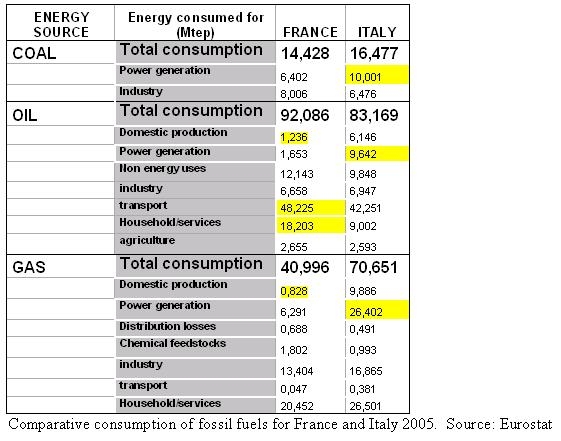
All data in the table are for the year 2005. Look at the yellow boxes for a quick assessment of the relevant differences and similarities between the two systems. Coal consumption is nearly the same for France and Italy, while oil consumption is larger for France, especially for the transport and household sectors. However, natural gas consumption is lower in France by nearly 30 Mtep. Italians have to burn about 26 Mtep of natural gas in order to generate electric power. This is the relevant advantage of nuclear power: without nuclear, the French would have needed 75 Mtep extra of natural gas.
However, it is also clear that nuclear energy cannot satisfy all energy needs of a country. So, even though France has nuclear power, the country still has to import coal and hydrocarbons (natural gas and oil derived fuels) whose prices are not influenced by the presence of atomic power. So in 2005 the energy imports bill for France and Italy was nearly the same, 37,5 G€ for France and 38,5 for Italy.
We can also compare energy prices in France and Italy. Here are the relevant data.
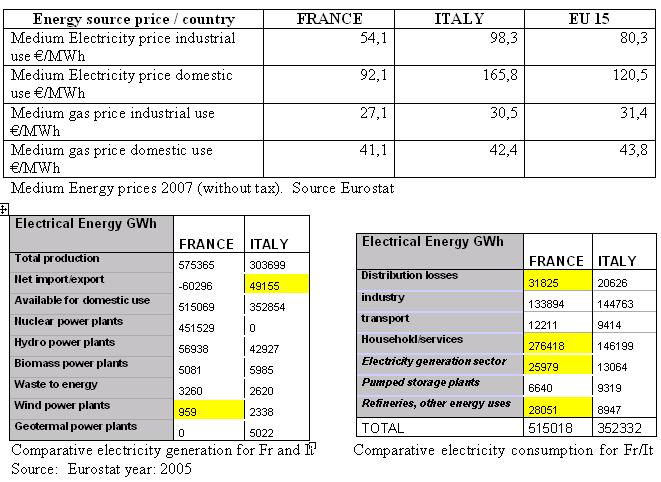
Note how oil products have nearly the same price in both countries. Natural gas prices for both France and Italy are very similar and lower than the EU-15 mean. The real advantage for France is the low cost of electricity, lower than the EU-15 average and much lower than in Italy. Again, we see that nuclear energy has an effect on the prices of electricity, but not on other energy sectors.
France is a large net exporter of electric power while Italy is the largest net importer in Europe, mostly from France, directly or via Switzerland. France produces electrical power mainly by nuclear energy and hydropower. Italy mainly burns gas in combined cycles or oil and coal in steam turbine plants. Italy has also a good quota of hydropower and the best geothermal production in Europe. The electricity use table shows consumption in various sectors. This time the yellow boxes are all for France. First, look at the distribution losses and plant services consumption (electricity generation sector). These data describe the efficiency of electricity generation and distribution services processes; this ratio is 11,2% for France and 9,5% for Italy. The scarce attention for efficiency in France is probably due to the abundant and cheap electricity available. Considering final uses, the interesting point is the huge French household and service consumption sectors, nearly twice as large as in Italy.
Surely electricity is cheap in France, but what is the real cost of the nuclear kWh? As a first approximation let's consider the whole French production as if it was all nuclear. Then consider that electricity consumption of France is partitioned into two nearly equal parts, industrial (at an average price of 54,1 €/MWh) and domestic (at an average price of 92,1 €/MWh), so the average income for producers is 73 €/MWh. This cost is the maximum possible cost for nuclear energy; otherwise operators couldn't make a profit. The value fits well with IEA World Energy Outlook 2005 that estimates costs between 60-70 €/MWh for nuclear electricity. This value is very far from values of 20-30 €/MWh reported from some optimistic sources. These values could be justified only by means of unrealistic assumptions, such as plant lifespan over 35 years, medium plant availability over 7500 hours per year, interest rate under 5%, building time time less than 5 years, building cost less than 2000 €/kW and others.
It appears that electricity prices in France remain low thanks to the huge past investments in nuclear power. French Families and small firms pay for electricity very low rates, nearly half than what Italians have to pay. On the other hand, they enjoy so much these good rates that household and services consumption of electric power is double than in Italy. So, in the end, French and Italian people spend the same in terms of their electricity bill. Evidently, Jevons's paradox is valid also for nuclear power: if you have something cheap, you tend to waste it.
As a last relevant point, let us consider the problem of nuclear fuel availability in the coming years. See below some data in the figure
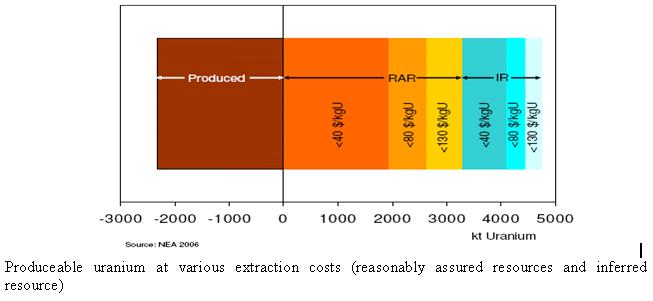
Produceable uranium at various extraction costs (reasonably assured resources and inferred resource)
EDF (Electricité de France), the Franch nuclear utility, estimates that there exist economically exploitable uranium reserves for 60 years of present consumption (67 kT/year). This fits well with the on uranium by energy watch group (EWG). And then? And what if many countries step up their nuclear energy production? A research effort is ongoing on new nuclear technologies such as fast neutron reactors and more efficent uranium mining methods, even from seawater. But concrete results on these issues seem to be very far, Commercial fast neutron reactors are expected to be on the market in 2040; perhaps too late to have an effect on the scarcity of mineral uranium. Uranium from seawater was experimentally obtained in small quantities, of the order of kilograms. We do not see a program for commercial exploitation of the industrial quantities that would be needed, of the order of ktons. Moving to mineral uranium very low concentrations (<0,1%) is possible, but there is a minimum value of the concentration that can be exploited because the energy required for mining it would exceed electric energy that could be obtained from it. The EWG reports that this limit is 0,01%, others report lower values but it is clear that today we have a strong uncertainty on the availability of mineral uranium and, as a consequence, on the role of nuclear energy in the future. This could be the real reasons for the modest growth of the nuclear sector in the last few years.
In the end, we see that complete independence in energy production with nuclear power was not reached by France, nor Italy could hope to reach it by revamping its old nuclear program at this point. To reach the French level of nuclear energy production, Italy would have to build almost 20 GWe of nuclear power, spend over 40 G€ and this would take some 10-20 years. Doing so, Italy couldn't hope to become independent from hydrocarbon imports since we see that France couldn't do that, either, despite all her nuclear reactors.
Energy independence for countries that have (or plan to build) nuclear energy could be obtained increasing the cost of electricity costs in order to avoid wasting power and using the extra incomes for financing energy efficiency and substituting hydrocarbons using plug-in hybrid or all electric veichles in urban areas and heat pumps for household and services. Obviously, this has not been done in France: in no country of the world politicians become popular by raising prices of utilities. So, France has not attained energy independence, despite the huge effort made on nuclear power. Whether the return to nuclear energy planned by Italy and other countries can do that, is all to be seen.
References
Several resources have been utilized for the preparation of this paper. Statistics on the energy use in France and Italy have been derived from the Eurostat site
http://epp.eurostat.ec.europa.eu/portal/page?_pageid=0,1136239,0_4557144...
Specific data about italy have been obtained from
www.terna.it
www.mercatoelettrico.org/GmeWebInglese/Default.aspx
www.snamretegas.it (Italian gas utility)
www.autorita.energia.it
Specific data about France came from
www.rte-france.com
www.edf.com
www.gazdefrance.com
www.areva.com (French nuclear utility)
www.prix-carburants.gouv.fr/index.php?module=dbgestion&action=search
Data about uranium production and costs have been obtained from
www.world-nuclear.org/info/uprod.html World uranium production
www.uxc.com/review/uxc_Prices.aspx Uranium prices
The study by the energy watch group cited in the text can be found at
www.energywatchgroup.org/fileadmin/global/pdf/EWG_Uraniumreport_12-2006.pdf
A general discussion on the cost of nuclear energy (in italian) can be found at http://www.aspoitalia.net/images/stories/coiante/coiantecostonucleare.pdf http://www.aspoitalia.net/images/stories/coiante/coiantenucleare2.pdf
Personnel
Editors
Contributors
Peak Oil Primers
Archives
- November 2010 (3)
- October 2010 (6)
- September 2010 (4)
- August 2010 (7)
- July 2010 (6)
- June 2010 (7)
- May 2010 (2)
- April 2010 (8)
- March 2010 (4)
- February 2010 (6)
- January 2010 (3)
- December 2009 (5)
- November 2009 (8)
- October 2009 (12)
- September 2009 (6)
- August 2009 (5)
- July 2009 (11)
- June 2009 (8)
- May 2009 (16)
- April 2009 (10)
- March 2009 (7)
- February 2009 (10)
- January 2009 (15)
- December 2008 (9)
- November 2008 (9)
- October 2008 (9)
- September 2008 (13)
- August 2008 (10)
- July 2008 (14)
- June 2008 (23)
- May 2008 (16)
- April 2008 (12)
- March 2008 (16)
- February 2008 (9)
- January 2008 (13)
- December 2007 (13)
- November 2007 (16)
- October 2007 (22)
- September 2007 (8)
- August 2007 (9)
- July 2007 (16)
- June 2007 (8)
- May 2007 (7)
- April 2007 (7)
- March 2007 (10)
- February 2007 (10)
- January 2007 (12)
- December 2006 (9)
- November 2006 (15)
- October 2006 (4)
- September 2006 (5)
- August 2006 (5)
- July 2006 (9)
- June 2006 (5)
- May 2006 (10)
- April 2006 (9)
- March 2006 (13)
Vital Trivia
License

This work is licensed under a Creative Commons Attribution-Share Alike 3.0 United States License.
How much of its uranium does France import? I'm just interested to know how much energy independence France actually has.
75% from Niger I hear. Just like Saddam was supposed to. Don't know the amounts.
As a former French colony, I suppose France thinks Niger is a fairly safe bet but it's hardly energy independence. I keep reading this (energy independence) about France's nuclear project but it just doesn't ring true if they have to import most or all of their fuel source. I suppose they have their fingers crossed that unrestricted global trade will go on for some time.
Iraq, Egypt and Nigeria used to be British colonies, Venezuela a Spanish colony, Libya Italian, and... yet...
If I'm building a reactor that I expect to last 30-50 years, I want to make sure I've got fuel for it for that long. Or at least half that long.
Occasional "visits' by the French Foreign Legion keep Chad, Niger, etc. more French than most former colonies.
In addition, one can store a LOT of urabium in a small volume (and I suspect that France has several years worth stored) and France is reprocessing (successfully) limited amounts of spent fuel, another source of reactor fuel.
Alan
According to this paper, Canada is the number one source, Niger second.
http://www.uic.com.au/nip28.htm
The author and editor of the original article have not addressed the point that their comparison of France and Italy ignores a 21% variance.
France's GDP is 21% larger than Italy.
So using similar amounts of coal or other energy is ignoring that France has 21% more GDP to support.
The overall level of nuclear as part of overall energy is represented by that 21% of GDP.
Sounds like Italy should import nuclear electricity from France since conservation would give the French some to spare. We don't know which is going to go up in price the most in the next 20 years, fossil fuel or nuclear.
Since I didn't catch the relative population numbers I'd like to see projected average household costs in euros under a range of assumptions. These could include extrapolated per capita energy usage, conservation/electric transportation modified usage and with different fuel price scenarios.
Italy does import electricity from France.
It's pretty funny to be boasting of being nuclear free when you import the electricity from nuclear reactors in the next country.
Yes, it is true that "80%" of electricity isn't 80% of energy. Even assuming a lithium-ion vehicle fleet, electrified railway system, and electric heaters & factories, they would need to at least double the number of plants. Especially if France remains the largest electricity exporter in Europe.
If Italy tries to catch up, hopefully they'll build several dozen at a time, and they'll be fast reactors. The Super Phenix was producing power at less than twice that of thermal neutron reactors, and that cost is expected to drop with Gen-IV Fast Reactors:
pg. 14:
http://www.ne.doe.gov/pdfFiles/genIvFastReactorRptToCongressDec2006.pdf
France already has enough depleted uranium lying around to power those for thousands of years.
It will be interesting to see how things play out, but either way nuclear is much more promising than wind. The biggest issue, it would appear, is just building the plants fast enough.
I'm not at all sure why you would hope for this. All experience with fast reactors to date show a more expensive fuel cycle, inherently less safety, larger capital costs and larger maintenance costs. Not to mention they're entirely unnecissary given the vast amount of uranium availaible.
If we pursue breeder reactors, liquid fluoride thermal reactors with the thorium fuel cycle offer a much more plausible fuel cycle. If we absolutely need hard spectra reactors, liquid chloride reactors are far more reasonable.
I'm not talking about fast breeders. Rather, fast-burners:
http://www.nationalcenter.org/NPA378.html
http://www.ans.org/pi/ps/docs/ps74.pdf
All fast neutron reactors suffer from the same problems, weather they're burning light water reactor fuel or breeding their own.
Theres no future in any liquid metal fast neutron reactor. Any of the problems they adress, fluid fuel reactors do much better.
If they are such brilliant technical solutions, then why is nobody building them? Can you give an example of an experimental reactor based on this approach?
They've been prototyped at ORNL in the molten salt breeder reactor experiment. They haven't been pursued basically for reasons of political inertia. Liquid metal fast neutron breeders were first to be developed and swallowed the lions share of the funding. In the halcyon days of the cold war, the dual use nature of LMFBRs for rapid plutonium production may have been attractive as well.
As for why no ones building them today, basically no one needs breeder reactors now. If these reactors are to succeed they need to be more than simply better at fuel utilization and waste production. But capturing the several billion in capital for developing a new reactor along with navigating the minefield of licensing an entirely new design isn't something I see private capital pursuing, at least not in the united states.
http://thoriumenergy.blogspot.com/
I don't think we need a new-fangled molten metal breeder reactor to begin with.
Jimmy Carter commissioned the Shippingport light water breeder reactor in 1977(250 MW), which breeds U-233 out of thorium and a thorium/plutonium MOX starter fuel and it ran until zombie Reagan shut it down in 1982.
Countries like Norway, the US, India and Australia have lots of thorium and you get 50 times the energy per pound in a breeder reactor.
http://www.thoriumpower.com/files/Thorium_Fuel_for_Nuclear_Energy_by_Kaz...
Carter, probably our first Peak Oil president started half a dozen
technologically sucessful mitigation efforts in his few years in office( such as Great Plains Gasification).
Is it technologically possible to maintain our lifestyle with breeder reactors?
It may be(for a couple hundred years).
3% of ALL US energy comes from nukes(3 quads), so we would have to increase the amount of generation 12 times(~36 quads), assuming that 2/3 of the base energy of fossil fuels is lost and we'd covert every thing(electric cars, trains, heaters, etc.) to electricity.
Is it desirable?
Breeder reactors are extremely radioactive as is their waste. Accidents
could contaminate large areas.
They would make excellent terrorist targets and paranoid governments would make our lives (more)miserable.
http://news.bbc.co.uk/2/hi/programmes/cooking_in_the_danger_zone/6638351...
If we chose nukes over renewables we continue on our current wasteful track, but with renewables we will move into a lower energy future, better in balance with nature.
You're severely mistaken in your points. The U.S. gets 8% of its overall energy from nuclear, 20% for electricity. Plants are not vulnerable to terrorist attacks due to their robust containment dome. The fuel supply is 'virtually limitless' using low-grade ores from granite or ocean water in fast neutron reactors. It is more desirable to have hot waste, since it decays quickly. The half-life of strontium-90 is only 28.8 years. The whole point is that you're destroying transuranic actinides, which are the long-lived wastes of LWRs.
If you would like to learn more about nuclear power, I highly recommend the new Cravens book, which was written using expertise from Rip Anderson, one of the most highly regarded nuclear experts in the world.
http://cravenspowertosavetheworld.com/
Severely?
You're correct that it provides 8% of US energy--I didn't count all the energy wasted by nuke-steam generation. The point I was making is that society would save energy by changing to electricity;
40 exajoules of petroleum replaced by 8 XJ of electricity plus 23 XJ of natural gas replaced by 18.4 XJ of electricity(less with heat pumps) plus 22 XJ of coal replaced by 7.3 XJ of electricity plus 2.6 XJ of electricity from nuclear, totaling 36.3XJ of electricity. So we would increase from 2.6 XJ electricity to 36.3 XJ or 14 times. So increasing nukes by 14 times is not that much.
You seem to think that there is plenty of uranium to supply all society's needs using ground up granite or seawater, a few parts per billion or less but that's idiotic based on simple EROEI. If you have to mine 100 times more rock to get the same amount of uranium out of it you end up with an EROEI of well under 1, in other words all the energy would be used up in giant mining and processing operations.
The Energy Watch Group says the world has about 70 years of uranium based on current use rates.
http://www.energywatchgroup.org/fileadmin/global/pdf/EWG_Press_Uranium_2...
Then you say this...
This a very good reason to go with thorium reactors, which is why I posted what I did.
There is (almost) no transuranic actinides with thorium breeder reactors.
http://en.wikipedia.org/wiki/Nuclear_fuel_cycle#Actinides_in_a_thorium_m...
Craven is a green-to-nuke convert like James Lovelock which means that they are likely to overlook the dangers of nuclear power just as you do.
I hope this helps educate you(deuterium) on the advantages of thorium breeder reactors over uranium type reactors.
I think it is cleaner than the current U-235 units and as I mentioned Europe has large reserves of thorium.
As old technology(1977), it probably isn't sufficiently cool for a nuke lover such as yourself but thanks to JC, it has shown to be practical in a light water reactor. Everyone knows liquid metal reactors like Monju too dangerous.
Yet another advantage for thorium is that it burns hotter and so the nuke plant efficiency could be increased a bit.
Of course you forgot to that all thorium is stable Th-232 and therefore
can be converted into fissile U-233 in the reactor where as less than 1% of uranium is fissile U-235, so most of the fuel Th-232 can burnt.
Majorian,
37% of energy consumption in the U.S. is in the form of electricity. 20% of U.S. energy is electric. Do the math. Obviously nothing is 100% efficient, even for coal plants heat is lost. But for electric energy consumption, 20% is from nuclear.
As for your insistence that we will run out of uranium, you need to distinguish between U-235 and U-238. U-238 is 99.3% of uranium, which is important when using low-grade ores. The fissioning of a uranium atom unleashes 210 million electron volts-- 50 million times as much as a carbon atom. So yes, you can yield net energy.
http://www.ans.org/pi/ps/docs/ps74.pdf
My point is that we don't measure nukes in pounds of uranium but in electrical output. Yes, I ignored thermal outputs of nuke reactors for that reason.
As far as U238, I'm glad you understand that uranium from seawater or granite rocks could NEVER be supported by a once-thru, non-breeder program. In fact there is NO FUTURE for a nuke program based on a once-thru non-breeder process given the fact we have 70 years of virgin U-235 left. Once you buy into nukes, you have to buy into breeders and they are an order of magnitude more dangerous that the current nuke technology. Does that make you pause?
There's several misunderstandings here. The 70 years of LWR fuel we have left are based at $130/kg from current mines based on IAEA estimates, not probable resources that are exploitable at say $1000/kg. Uranium prices contribute to less than 1% of the total cost of nuclear power, and the industry can bear the cost of much higher uranium costs. The energy costs of mining as shown from the Rossing mine in Namibia are tiny compared to the output of the produced uranium from even very low grade ores. Future reactor regimes will have to compete on more than just fuel efficiency.
Second, the notion that breeder reactors are an order of magnitude more dangerous is just misinformed. Fast neutron reactors have inherent control problems that require more passive safety because of their high prompt neutron ratio, but there are techniques that in aggrigate can make fast neutron reactors safer than modern LWR regimes. But really, breeder reactors don't require fast neutron reactors at all except to run entirely on transuranics. Thorium breeder regimes can run entirely in the thermal spectrum.
Sodium cooled fast breeders are dangerous as well as expensive. In contrast the LFTR is very safe - safer than LWRs - and potentially less expensive than LWRs.
There appears to be some confusion here. I agree with you that thorium is a promising energy source, and India is pursuing the liquid fluoride salt technology to utilize thorium-232. However, in the case of uranium-238, the decision has been made to use sodium, lead, and helium gas. Liquid fluoride salt is ONLY for thorium, not U-238. See for yourself:
http://www.ne.doe.gov/genIV/neGenIV7.html
Sure, but liquid fluorides aren't the only fluid fuel regime. There's problems with FLiBe with plutonium solubility above various concentrations, but I believe it can handle some Pu load without serious problems.
However liquid chloride reactors offer much better chances of utilizing a hard spectrum than liquid metal reactors.
ORNL ran U233, U235 and Pu239 in the MSRE at the same time.
Thanks. But I am not so sure that molten sodium or lead reactors are all that horrible.
One real problem with liquid metal cooled reactors is their reliance on solid fuel in a reprocessing regime, which entails something that is a necissarily costly fabrication process compared to mined uranium in LWRs or no fabrication at all in the case of fluid fuel reactors.
Lead cooled reactors (or rather lead-bismuth eutectic reactors) are sort of awful because these eutectics are very heavy and hard to pump, corrosive, and the bismuth is highly prone to neutron activation into whats essentially the most radiotoxic substance known, Po-210.
Sodium cooled reactors of course have sodium fires and associated extra capital costs. Theres also the problem that the core is completely opaque to imaging so its hard to see what state the core is in.
Finally theres the inherant safety problems of any critical fast neutron reactor: Delayed neutron component. The delayed neutron component of fast reactors is vanishingly small compared to thermal reactors, such that the reactivity swings are on the order of miliseconds rather than minutes, so scramming the reactor becomes sort of a lost cause in the event of a criticality excursion. I think this can be managed, but fast reactors are allways inherently less safe than thermal reactors.
I was a proponent of the IFR at one point. I've since changed my mind.
Take a closer look at my links. The Integral fast reactor, now Gen-IV, is just as much a burner as a breeder. These reactors offer proliferations resistance. They can consume LWR waste or weapons plutonium, or U-238.
I'm quite familiar with the IFR. Its still far less desirable than LWRs. You have to do offer a significant advantages above the LWR beyond fuel utilization and waste production given these are tiny components of the price of nuclear power production. IFR doesnt adress these issues.
Dezakin,
I agree with you that Sodium reactors have been more expensive than LWRs, and that we should pursue thorium. However, there are high hopes that most of the issues involving industrial sodium have/will be worked out with the Gen-IV program. One of the goals is to make Sodium reactors commercially competitive with LWRs, and several nations envisage them replacing LWRs over the coming decades. So clearly, we have a lot of options. Explore more for LWR fuel, get the cost down for Sodium, Lead, and Helium reactors, or pursue Thorium. All should be done, in my opinion.
This sort of begging the question is a bit ignorant on nuclear fuel supply issues, which have been covered ad nausium multiple times before. The nuclear fuel estimates are made from current mines at $130/kg per the IAEA estimates, and then many outside the industry postulate that the 60 years of supply will be ultimately exhausted at that point. This doesn't take into account that at twice the price there are nearly ten times the exploitable resource base, that nuclear power production is largely immune to uranium price swings (less than 1% of the price of nuclear power is related to uranium ore prices) and there hasn't been much exploration for uranium for the past 50 years simply because there's so much of it.
This really is a strawman argument. No ones arguing that nuclear power alone is capable of displacing fossil fuels simply because the value of fossil fuels more than just electricity production. If you have a magic energy source that requires distribution networks of electric transmission lines and centralized production but is otherwise free, you still would consume hydrocarbons because they are cheaper for the purpose of many fuels.
But obviously if fossil fuels decline, nuclear can meet the demands of industry. Where France is much better positioned than italy is in coping with declining natural gas and oil resources, which is what I thought this site was purported to discuss.
This sort of policy advocacy is venturing nearly into political ideology. Many belive markets can often allocate the resources best and such rationing programs will simply create black markets, inefficiency, corruption, and waste while depriving people of wealth. Perhaps politicians can simply spend the revenue saved on electricity on such programs directly from the coffers of the larger tax base, or perhaps these programs are entirely unnecissary and will find their own place with the gradual rise of hydrocarbon prices.
The type of energy independance the author seems to be refering to is impossible as long as people are rational. No one would pursue X resource independace simply because many resources are distributed unevenly throughout the world and its cheaper to trade for products than not to. This is the case with Frances uranium today as well as fossil fuels throughout the world.
This: This sort of policy advocacy is venturing nearly into political ideology.
Is followed immediately by this:
Many belive markets can often allocate the resources best and such rationing programs will simply create black markets, inefficiency, corruption, and waste while depriving people of wealth.
I would have separated the two with a sentence or so, and the reader might not have noticed.
They're supposed to notice. Its the other side of the ideological coin. The point is that such an argument isn't going to have a right answer while people have political opinions.
Show me one really, truly unregulated free market. Show me one market that isn't influenced by goverment policy in one way or another or that isn't hampered by geological or geopolitical factors. Show me one market that isn't being influenced by industry cartels.
Free markets are a fantasy. They don't exist. Zip. Nada.
Narcotics are pretty much a free market, and the international arms trade is just about free.
The type of energy independance the author seems to be refering to is impossible as long as people are rational.
This is simply an assertion, with no signs of rationale. Costa Rica, Iceland, and the US, for example, each have a high degree of energy independence with respect to their electricity supply.
Its simply a statement about the rationality of trade. The US has ample supplies of coal and doesn't need to import it. This isn't a policy of independance by design but simply having the resources.
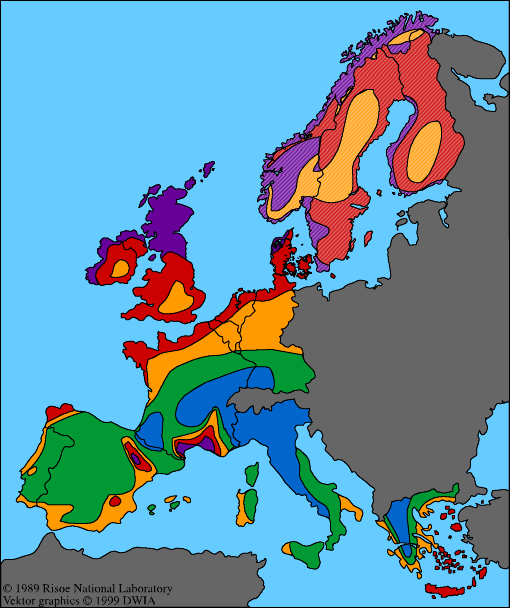
Actually, the US does import coal. France's policies are certainly one of design, as they have a number of energy resources available to them (i.e., French hydropower = 66.9 TWh, with a gross potential of 183 TWh). And add to that France's coal reserves, wind power potential, solar potential, geothermal power potential, and one can readily see that nuclear was a choice that had little to do with national resources.
Solar Power Potential

Geothermal Power Potential

Wind Power Potential (purple = best, blue = least)
France wanted to acquire an independent capacity to build nuclear weapons. Independent from the US that is, and unlike the UK's 'special relationship" nuclear capacity. Hence the focus on breeder technology and reprocessing. They achieved this goal by the end of the 1970's.
"Actually, the US does import coal. "
Sure, but it exports more.
The point is, the US has more than enough coal for it's needs.
With the price of fossil fuels as it has been over the last twenty years, there was no reason for France to seek total energy independence.
To critique a program for something it was not designed to achieve, and further to assert that because that objective which was not sought has not been reached that it is somehow impossible in the future is entirely unreasonable.
The provision of cheap and abundant energy can only be a good thing, and over the next few years as fossil fuel shortages bite then the relative inefficiency of French electricity use means that France will be able fairly easily to economise and use the savings to power, for instance, electric cars like this one:
http://www.gizmag.com/ukp14000-thnk-city-electric-car-ready-for-showroom...
UKP14,000 TH!NK city electric car ready for showrooms
The savings I have in mind would include, for instance, the French program of installing air heat pumps to multiply the efficiency of electricity for heating severalfold - they are currently installing 50,000 a year, and can easily step that up as fuel costs rise.
This is without building further reactors, which they could certainly do.
As upgrades become needed to the present reactor base then that in itself will increase capacity greatly, providing further possibilities to substitute fossil fuel, now that it is economic to do so - the fact that ff was so cheap was the real reason this has not already happened.
Citing only one source, which is an advocacy group opposed to nuclear power, EWG, also does not give a full picture of different views of uranium resources.
Here are alternative views:
http://www.uic.com.au/nip75.htm
Uranium supply
http://www.uic.com.au/WNA-UraniumSustainability.pdf
WNA-UraniumSustainability.pdf
Thorium can also be used, which is far more abundant.
The figures drawn together are useful, but the conclusions are downright bizarre.
France is 'guilty' of building an extremely safe source of abundant and cheap energy, and has not yet turned her attention to substituting fossil fuels with it, as they were so cheap it was not worth the bother.
Who is the better placed to weather coming shortages and high prices of fossil fuels, France or Italy?
This confounds figures from different times.
The IEA estimates from 2005 are, presumably, for new build. Let's have a look at how 'unrealistic' the lower estimates for cost are.
Plant lifespans over 35 years: Present plants were designed for a lifespan of an estimated 40 years. Experience has shown that this can usually be extended, and new plants by Areva now have an estimated lifespan of 60 years.
Median plant availability of 7500 hours: This comes out to around 85%, far less than the figures of over 90% regularly obtained, although possibly not in France, as electricity is often in such over-supply that plants are switched off - but it would not seem to be an over-challenging target if the power was needed, say when fossil fuels were in short supply or very expensive.
Building times less than 5 years: in series production France basically built the whole of their present fleet in 17 years, so why is this unreasonable? Latest designs are for repeat production of the same parts.
Interest rates under 5%: Recession, partly due to high fossil fuel costs, make this target in Europe at least seem eminently possible.
Building costs less than 2000Euros/kw: The current Finnish reactor being built has so far spent around $4bn, final costs look like perhaps $6bn. so that is around Euros 2400kw for this 1.65 GW design.
This is for the first build of a new design, and was redesigned as it was being built by an inexperienced Finnish workforce, so just how unrealistic is 2000Euros/kw for a series build of an established design?
Nuclear power in France has clearly been a fantastic bargain, and towards the bottom end of the cost range given, not the top as is asserted, and as fossil fuel costs rise can only get better - and it already turns out electricity at half the cost of that in Italy.
This difference will only increase.
France is also well along in electrifying transportation.
1) 1,500 km on new trams in the next decade. Towns of 100,000 will have trams.
2) SCNF will be 100% electrified (goal of 20 years set on 1/1/2006)
3) Three new TGV lines under construction ATM.
Best Hopes for EoT,
Alan
The USA uses 0.19% of it's electrical generation for transportation. I noted that the data presented shows France uses 2.37% of it's electricity for transportation.
Does the cost of electricity in France factor in the costs of eventually decommissioning the reactors, disposing (well, longterm safekeeping actually) of the spent fuel and reactor materials?
If not, what will that add to the cost?
Yes. These are longterm liabilities, with the most expensive being decomissioning of the reactors. The longer the reactor life, the smaller these liabilities proportionally are, especially with discounting.
Spent fuel disposal is also accounted for. It would be much cheaper if France didn't bother with reprocessing and geologic disposal and instead simply pursued dry cask storage for several centuries.
Probably not. They have been using their decommissioning funds to buy other utilities and are probably badly underfunded even if those purchases were considered liquid assets. http://www.greenpeace.org/raw/content/international/press/reports/nuclea...
Chris
You're citing greenpeace? You're serious?
You don't have to be serious to be right.
Here's one..
"Finances
In order to carry out the projected surveillance, a budget of 12 to 13 million francs a year until the year 2300 will be necessary. M. Kaluzny, director of Andra, has wondered himself: “Do financial instruments guaranteeing such revenues for three hundred years actually exist?” [LeMo l.xi.95]. "
http://www.francenuc.org/en_sites/lnorm_csm_e.htm (last comment at end of page)
Found while looking into the 'Turpin Commission',
"At the beginning of 1996, the government nevertheless set up an “independent” scientific commission, which submitted its report July 16, 1996. According to the commission, presided over by M. Turpin, the CSM will not be able to be released for unrestricted use after 300 years as planned, and the cover installed by Andra cannot guarantee confinement. The commission recommended completing the cover that was under construction and then installing a definitive cover composed of natural materials. The waste should not be removed: “Such an operation would have a radiological cost (…) and its inconveniences and risks are greater than the inconveniences and risks of storage.” Following this report, the government announced that Andra would draw up a new dossier to be submitted to a new public inquiry."
..I'm rarely serious.
EdF would be well advised to take a couple of hydroelectric dams, with expected lives of 300+ years (heavy maintenance every 50 or so years) and devote all revenues from these dams to nuke clean-up.
They will produce something of value for long enough, and any lost value from currency, etc. will be made up by future revenue.
Will the dedicated mission last so long ? That I do not know, but the resources can be dedicated to this goal.
Alan
Especially when you're not even wrong. The cost of storage are very small, especially with discounting.
If you cite either Green Peace or Storm Van Leeuwen in a nuclear discussion, you've already shown you care more about religion than science. The founder of Green Peace, Patrick Moore, left his organization for this very reason.
You could say the same about any industry funded source, too. But I'm sure these types of organisations are much less biased than Greenpeace, right?
http://www.sourcewatch.org/index.php?title=Industry-funded_organizations
And Patrick Moore was not the founder of Greenpeace.
If they're so bad, it won't be hard to pull up sources to refute what they're saying, right?
Unless of course what they say is actually true, in which case you're just reduced to saying, "oh, they would say that, but they're all poopyheads."
Seriously, can we get beyond primary school in these discussions?
If they're wrong, demonstrate it to us. Otherwise, STFU.
The problem is its been demonstrated numerous times before, here on TOD and other places, such as an independant critique by the University of Melborne.
http://nuclearinfo.net/Nuclearpower/WebHomeEnergyLifecycleOfNuclear_Power
Your link isn't to a Melbourne University study, but to a discussion by a pro-nuclear group of a study by Vattenfall, a Swedish energy company who gets about a third of its energy from nuclear.
Asking a nuclear energy operator to assess its own EREOI, pollution and so on... well, I'm not surprised the result comes out nice for them.
It's like asking Bear Sterns to give a credit rating to its own held derivatives. We know how that ended up.
At least they've changed their tune a bit. Before they were claiming an EROEI of 93. Now they are saying a non-nuclear energy input of a little more than 1% of output. They are still trying to hide associated emissions though. That site has been debunked here a number of times. Perhaps they are listening. If they are getting the fuel from France then the actual EROEI is probably less than 7 or so calculated on the same basis as one would for a solar thermal plant: http://www.ases.org/divisions/electric/newsletters/2006-04.html#roi
Chris
Well, EROEI doesn't worry me much, so long as it's above 1:1. All other things being equal, if it's got a low EROEI then you just build more plants.
What matters is whether the source of the input energy is a depleting one or not, or whether it depletes an essentially renewable resource (like water or timber), and associated environmental issues such as aquifer depletion, greenhouse gases, and so on.
I realise that our current wasteful industrial society requires phenomenally high EROEIs - so that we have enough to waste on having our houses chilly in the summer and womb-like in the winter, enough for plastic wishbones and having our cars idle at drivethrough burger joints. But I don't give a shit if we lose all that, I just want us to have a modern civilisation with trains and internet and MRI scans and so on, and that basic civilisation requires a far lower EROEI than a wasteful one.
I think EROEI does relate to environmental issues but often in a secondary way. The scale of energy production is affected by EROEI and so low EROEI often means larger environmental impact. If we consider the emissions involved in ending fossil fuel use, how much fossil fuel do we need to invest to get a non-emitting energy source, then EROEI is important. But, the speed with which this can be done is more important and while EROEI can be a bottleneck, often it is other aspects that prove to be the hold up. Reactor cores are fabricated in Japan and the rate of production seems pretty low for example. http://www.bloomberg.com/apps/news?pid=20601109&sid=aaVMzCTMz3ms
As an aside, I was interested that they use scrap to make reactor cores but use ore of known source and quality for making swords. I wonder what quality assurance they can provide for reactor cores if they are using scrap?
But, with renewables, both EROEI and the efficiency of gathering the renewable energy are important. Very high EROEI for ethanol production does not help all that much with the problem that plants don't convert all that much of the sunshine that falls on them so that the environmental impact comes in where your concern is, overuse of land and water.
Chris
That's often true, yes. But it's not a perfect correlation. So really when discussing each technology, it's just as easy to say that it has X EROEI and has this or that particular environmental, social, and economic effect. If you try to use the EROEI for a shorthand then all the industry PR shills hired by netvocate will come along and nitpick, and it just gets tedious.
I notice that you've decided David Martin is a payed advocate for nuclear power while he denies it. His denial seems a little suspect since many of his posts disparage renewables with faint praise and often contain false information about renewables. However, it is possible to get him to stop responding to posts if you just stick to the truth for long enough.
EROEI does seem to draw a certain amount of schtick. I feel it helps with some aspects of understanding of energy issues though.
Chris
I think the accusations of "being a paid shill" exaggerates the value of this forum. I do not think the solar and wind proponents on this and other sites are "paid shills". The reason is that there is not enough money or influence in play. 40-80 people interacting on the discussions. The Euro oildrum getting about 3000-5000 pageviews per day. Only 10% or less really going through the discussions.
Minimum prices per click, often referred to as Costs Per Click (CPC), vary depending on the search engine, with some as low at $0.01. 500 pageviews for $5.
http://en.wikipedia.org/wiki/Pay_per_click
The oildrum discussions are no follow. So almost no traffic is going anywhere. The people in the discussions are mostly not having opinions changed. Chris, MDsolar clearly has not changed his opinion - even when someone points out his EROEI errors. Everyone keeps pushing the same doomer or non-doomer points.
It is a gathering point for people to talk at each other.
Some information can be useful to newbies. But they can also get all the info from all sides in a less biased way from many internet sources (wikipedia etc...). So of the 40-80 people actively talking at each other and say ten times the readers only 10-25% might be influenced. With self selection, the majority are already peak oil etc... inclined.
The nuclear industry as other in the energy industry on lobbying politicians that can actually have impactful legislation.
http://depletedcranium.com/?p=480
http://www.opensecrets.org/lobbyists/indus.asp?Ind=E
Why would any company spend money to have someone shill here or on the internet ? They spend where the rubber meets the road. Getting the right senator or governor etc...
Anyone who is a paid advocate spending hours on theoildrum should be sacked for incompetence.
I have not made up my mind about David, other than he seems to doctor quotes similar to the way Steve Milloy fabricates stories. Your point about lobbying makes some sense, however PR runs a bit broader than that with efforts to sway public opinion through false fronts such as junkscience.com http://www.sourcewatch.org/index.php?title=Steve_Milloy
Since it is the purpose of TOD to sway opinion on peak oil, a bit of parasitic use of the site on well funded issues such are global warming denial or nuclear power advocacy does not seem such a stretch as you make it out to be. And, David's obsequious style does smell of unspoken agendas. But, perhaps you are correct that TOD is so unimportant that everyone here, aside for Jerome, is an unvarnished amateur.
BTW, I have changed my views of EROEI and have acknowledged mcrab for the correction. If you have any other issues please feel free to raise them: http://mdsolar.blogspot.com/2008/01/eroie.html
Chris
At the end of the day, Chris, responding to 'Looney Toones' like you and Kiashu is a waste of time.
You sought to argue that nuclear reactors should be sited with reference to extreme projections for sea level rise in the next 300 years - when the reactors have a lifespan of 60 years and a decomissioning period of 20 years!
Just build the next reactor a little higher, already!
A case could be made that both yourself and Kiashu are shills for the coal industry, since the obvious lunacy of your other proposals leaves little alternative to the use of coal.
However, this is too unkind, as it is apparent to impartial observers that you both suffer from delusions and a disconnect with reality - btw,have either of you taken on board that my first choice is always conservation?
Since both of you argue from entrenched prior positions, and ignore anything which contradicts your prejudices, dialogue is unrealistic.
Your 'stick to the truth' is in fact 'impenetrable stupidity'.
Congratulations, may you both have your reward in whatever heaven bigots go to.
David,
It is customary for you to engage in name calling to evade core issues. What is at issue here is that you seem to have doctored a quotation from New Scientist to insert uncertainty about understanding of the mechanism of the termination of ice ages. You have not provided a link showing that the quote you gave is verbatim and does not have inserted language which was not present in the original that emphasizes uncertainty.
http://www.theoildrum.com/node/3610#comment-307816
This behavior is completely dishonest and ruins the possibility of a debate on issues as well as wasting people's time answering your disinformation. If you have a link showing that this is not what you have done, provide it now. If not, all that can be done is to point out that there is clear evidence that what you have to say is not spoken in sincerity.
The accusation that seems to come from a talking points list that those who do not favor nuclear power support coal is yet another example of this type of behavior. In fact, numerically, attempting to rely on nuclear power to avoid coal burning leads to more coal burning than pursuing the alternatives for the same purpose. Parroting nuclear industry talking points is not dialog or informative except to further expose the nature of your posts.
Chris
a decomissioning period of 20 years!
100 years (planned) to decommission is common#, as are life extensions. In addition, there are special cases like Brown's Ferry 1, that had a fire and it was about 30 years before it went back on-line, add a 20 year life extension and 112 years for decommissioning (what will be the "reality on the ground" in 2179, the possible "site clear" date for BF 1 ? A twelve year delay seems quite reasonable) and the "site clear" date will be MUCH later there than what the engineers estimated at the first concrete pour (about 1970).
# Worker exposure to radioactivity, with the resulting health effects, is much lower if one simply waits. So many utilities prefer to wait. Plus the fiction that monies in escrow will grow faster than inflation and any cost overruns in decommissioning will happen after the manager is long dead and gone.
You are losing credibility with ad hominem attacks and mis-using quotes, if true, even more so.
TOD is an intellectually rough place, a "meat grinder", but there are still understood rules.
I find the claim that waiting for nuke (the USA can, at best, build 8 new nukes in a decade) is a formula for more coal burning. In many ways nuclear advocates are the coal industries best friends (for at least the next 10 to 20 years, then the table may turn).
In the particular case of the UK, the current default solution of "wait for nuke" is the most expensive one, advocated by those that claim to be VERY concerned about costs. For the costs of blackouts FAR exceeds the costs of any renewable, and conservation
Best Hopes for reflection and cooling off,
Alan
Alan, it appears that you have not read some of the comments directed at me, including that I am shilling for the nuclear industry.
I re-iterate that I strongly support both conservation and renewables, and of course possible sea-level rises should be taken into account when assessing siting of new reactors.
It is rarely advisable though to base engineering decisions on the most extreme projections, particularly as is we have to we could build sea-walls and so on.
I suggest you look more carefully at the terms I have been addressed in before you put the accusation of ad hominen attacks at my door.
Alan,
The London Dumping Convention does not permit the dumping of nuclear waste at sea so I used a shortened decommisioning time consistent with Humboldt Bay 3. Admittedly, Humboldt was not so hot since it did not run all that long. Your emphasis on limiting worker exposure is probably the most important thing to consider. For present reactors like Seabrook and Turkey Point, shutting them down within a decade so that they have time to cool off before they have to be removed to higher ground might make the most sense. There is quite a bit of effort now attempting to understand how quickly the sea level will rise and it may be that we will have more specific estimates within a decade or so. The paleoclimate data suggest that we should expect around 5 meters by the end of the century but there are no adequate models yet to go from the specific land ice configuration to a sea level rise rate because we don't yet know how to model icesheet collapse. We should also be looking at the change in the seismic prognosis owing to the mass redistribution associated with sea level rise to find out if there are reactors in previously seismically calm areas that would need to be rebuilt to a higher seismic specification. Reactors that are further inland may also be affected by sea level rise.
Chris
Just do a google search on "Storm Van Leeuwen." `Nuff said.
In Chapter 11 of the Working Group 1 IPCC report: http://www.ipcc.ch/pdf/assessment-report/ar4/wg1/ar4-wg1-chapter11.pdf
In figure 11.5, Italy can expect a 12% reduction in annual preciptation towards the end of the century and a 40% reduction during the summer months. France is already beginning to stuggle with lack of cooling water for its reactors in the summer time. Reliance on thermal generation that requires water cooling would seem to be a poor option especially for plants that are intended to be used beyond 2050 or so. Green Peace has pointed out problems for coastal nuclear sites in the UK owing to sea level rise which may also translate to Italy to some extent. The coastal Medeterranian could be 3 to 4.5o warmer as well leaving less room for mitigating the effects of thermal pollution if sea water can be used.
Chris
Easily mitigated by just increasing the discharge temperature in many rivers.
Not exactly a plausible opposition to nuclear power specificially because it simply means planning for anticipated sea level rise, and theres no plausible model that postulates a sea level rise so significant that capital costs become exhorbant. This is just noise from Greenpeace, who are ideologically opposed to nuclear power. What goes for nuclear power plants would also apply to all seaside infrastructure anyways and would be a rather minor problem compared to the much bigger picture of flooded cities.
Er, what? You're worried about thermal pollution in the sea? Several hundred gigawatts in something that regularly radiates several thousand terawatts?
As I've said before, you seem to be very uninformed about the issues involved in nuclear power. Thermal pollution is are already a problem and will grow as water resources dwindle. Increasing the temperature of rivers can kill them. Similarly, coastal sites can be damaged by thermal pollution. Green Peace is looking at the effects of six meters of sea level rise, a quite plausible level, and enough to make a number of sites unusable for nucelar power.
Chris
Damn you're insulting. Increasing the temperature of rivers can change them certainly, but I'd hardly call the Amazon a dead river even though its much warmer than rivers in Europe.
Greenpeace is hardly credible, and neither is six meters of sea level rise in anything less than several centuries.
http://en.wikipedia.org/wiki/Sea_level_rise
I think posts like this illustrate the incredible complacency of many people. The first comment appears to think that the entire globe is the same, with the same niches carved out by exactly the same species and so making all habitats the same as an existing habitat will, therefore, have no impact. The second ridicules any argument based purely on the source of the argument, whilst citing Wikipedia (admittedly a useful source of info for the lay person) as an authoritative source for assuming that sea levels could not possibly rise quickly enough to cause a problem for a few generations.
I think posts like this illustrate you just don't like me or rather specifically my views.
The first rebuttal is a strawman. The second is completely ignorant of the credibility of Greenpeace's arguments (which wasn't even cited so how can I even rebut them) with respect to the IPCC or any climate models.
You simply said to heat the river more by raising the output discharge temperature. The system's thermodynamic efficiencies and temperature limits aside, you've unfortunately chosen to denigrate the positions of those who question your assertions. Your blinding allegiance to the nuclear industry's positions does little to convince others who are not in a similar (obviously vested) position.
They are. Run the numbers of the delta T change of a couple of degrees. The thermodynamic efficiency doesn't drop noticably.
My vested position is only having reliable power. Sorry, I dont own any interests in nuclear power production, nor am I paid for my views.
You have not in the past provided any reasoned rebuttal to what Greenpeace has said about UK coastal reactor sites but I will link it again. http://www.greenpeace.org.uk/media/reports/the-impacts-of-climate-change...
I do not know of any cases when Greenpeace has intentionally provided false information while a fraction of the cases where the nuclear industry has done so are well documented through the regulatory actions taken against them across the world. Further, Greenpeace argues its position in good faith while the nuclear industry tends to used deceptive methods, e.g. hiding associate carbon emissions from nuclear power generation by failing to acknowledge the fungibility of electricity on the connected grid.
Chris
From a blundered press release:
"In the twenty years since the Chernobyl tragedy, the world's worst nuclear accident, there have been nearly [FILL IN ALARMIST AND ARMAGEDDONIST FACTOID HERE]"
http://www.washingtonpost.com/wp-dyn/content/article/2006/06/01/AR200606...
Again, no reasoned rebuttal. Why did you complain about not having the link posted for you again if you are not going to respond? The study seems quite sound as with other studies commissioned or undertaken by Greenpeace. Perhaps this is the reason you scoff rather than debate. You have no answer.
Chris
In your empty verbosity there lies little to which to debate. You're debating the credibility of Greenpeace as a source, which no respected journal would cite. Greenpeace is an advocacy group, and as such draws up 'studies' that cherry pick data when not outright inventing it, which are inflated pieces of nonsense for maximum political/emotional effect. Looking at their estimation of the death toll of Chernobyl, where they had to resort to modeling lower life expectancies due to depression, is enough to make any reasonable person shrug their shoulders in contempt.
But no, you're right. The Greenpeace study is entirely reasonable even though it is wildly out of line with every projection by climatologists to date.
Scorn should rather be reserved for the nucelar power industry and its special pleadings not to count all deaths attributable to the Chernobyl disaster. There is clearly a simple solution to the problem of huge disruption caused by nucear accidents. Derate the reactors to 100 MW so that accidents are fully containable.
You should read the study since it cites projections of 6 meters of sea level rise so your objection is clearly false.
Chris
World Health Organization numbers for Chernobyl seem the best to me.
50 dead up to 2005 from Chernobyl. Many cases of thyroid cancer but only about 9 died. The risk of 4000 deaths during the 3rd, 4th and 5th decades after the event.
Although it gets tougher and tougher to clearly link a death to an event 30,40 or 50 years ago.
How many depression events are from world war 2 in the 1970s, 1980s and 1990s.
Might some of the depression incidents be related to family members of coal miners. Several hundred coal miners die each year in the Ukraine.
Maybe people are getting depressed about possible peak oil or worrying about sea levels. People in other places without Chernobyls get depressed too. So what is the incremental level of depression ? How about other seemingly bigger incidents ? The asian tsunami. By Greenpeace logic the 100,000+ or so direct deaths from the Tsunami will be swamped by the depression deaths that will follow in the years ahead. If it were in the same ratio then all of Thailand is doomed.
Your preference may indicate a bias since that report is somewhat too narrowly focused to give an overall view. The cancer death estimates in the TORCH report are likely more representative.
Your example of the tsunami seems a little strange I think. The water has already returned to the sea, but the fallout from the nuclear accident lingers, continuing to affect economic activity throughout Europe.
Chris
http://www.guardian.co.uk/business/2008/jan/13/nuclear.nuclearpower
However,
So an extra 2% cost per reactor to beef up flood defences. Hardly appears to be a show stopper, does it?
mdsolar:
No, anti-nuclear activists never try and twist the truth to match their prejudices:
I doubt it is linear, but 2% per meter comes to 12% for 6 meters and 50% for the 25 meters that me might expect by 2300.
http://journals.royalsociety.org/content/l3h462k7p4068780/fulltext.html
A study that only addresses a meter seems profoundly shortsighted.
Chris
If the sea rises 25 metres nuclear reactors will be the least of our problems. It will be armagedon all round. Why single out the nuclear industry?
The planning horizon of nuclear power intersects with large scale sea level rise. Building plants with an expected 60 year life and a minimum 20 year decomissioning time at current sea level can lead to a condition where they only run for half their expected life and thus default on their publically guarantied debt, doubling the cost of power to society. requiring plants to be sited at least 70 meters above current sea level can avoid this issue though I expect most new nuclear plants to default on their debt obligations for other reasons in any case.
Chris
Damn that has to be one of the most idiotic statements I have read to date on this site!!!
Green Peace is looking at the effects of six meters of sea level rise, a quite plausible level, and enough to make a number of sites unusable for nucelar power. - Chris
Six meters? My word! Why is Green Peace singling out nuclear power plants as a problem? Should not Green Peace be warning us to move our costal cities inland instead of fidgeting about nuclear power? Chris' observation is a primary example of the special case tactic of the pro-coal, anti-nuclear lobby.
The solution to thermal pollution is greater thermal efficiency. Generation IV nuclear technology can operate at thermal efficiencies as high as 60%. Even higher efficiencies can be achieved if residual heat is be used for the desalination of sea water.
Charles,
You have not understood how long a nuclear power site is expected to be used. Since nuclear power has subsidised insurance, the market does not speak freely on this. Insurance for other buildings is being withdrawn in places where sea level rise will lead to large losses. So, nuclear power siting has to be a matter of policy. The new South Texas reactors, which have been put on hold, should be examined for this problem as the cooling pond there is liable to rupture from storm surge with only 5 meters of sea level rise. An inland site would make more sense for a new build.
As you know from reading my blog, the opportunity cost of nuclear power is very high and it thus promotes the continued use of coal compared to the lower cost higher EROEI alternatives. Since you tend to promote currently unavailable nuclear technologies, I would think that you would support a ban on new nuclear power until fossil fuel use is ended and your preferred technologies are available.
I see from your blog that you used to live in Oak Ridge. Do you happen to know the Carters? I used to be friends with one of June Carter Cash's nephews when I lived there.
Chris
Are you adressing price anderson? This is liability insurance, not property insurance.
Loan guaranties are essentially an insurance subsidy. They make the loss of the plant irrelavant.
Chris
Er, no. If the plant disapears, the book value of the utility drops. You're mixing apples and oranges.
Chris, I don't think I knew your friend. I am aware of your assessment of the alleged inefficiencies of reactors. Reactors that convert thorium 232 into U233 are of course 100 times more efficient in their use of nuclear fuel than conventional LWRs, thus you ought to be wildly excited about them. In addition thorium conversion reactors are capable of double the thermal efficiency of of LWR's and the residual hear can be used to desalinate sea water. So are you an advocate of nuclear efficiency? The only technology I promote was one which was successfully demonstrated at ORNL in the 1950's and 1960's. I have extensive documentation of that technology in Nuclear Green, and there is far more documentation in Energy from Thorium.
One of my favorite placed to go there was a pizza place that had a honkytonk piano, with thumb tacks in the hammers and group that wore red an white striped suits and straw hats. The used to sing "Rain Drops Keep Falling on my Head" very well. I don't remember the name of the place though. I think it was kind of a hangout for people from the lab.
I kind of feel that the use of graphite in the molten salt reactor was a bad idea and the ongoing clean up from the experiment has of course been horribly expensive. But, I do look forward to nuclear power that does not rely on fission, other than spallation of lithium. This may have some pretty exciting applications and it appears to be on track, following the timeline that was hammered out during the Carter administration. We might have put more intensive effort in over the last thirty years or so, but, back then we thought we had more fossil fuels and were not as aware as now of the problems with fossil fuel use. Still, other alternative energy efforts undertaken at that time seem to be ready for rapid commercialization so we can do without the old cumbersome nuclear technology and don't have to have fusion to stop fossil fuel use now. It will be a nice plus when it is ready.
The two points I was referring to in the blog are that first, with nuclear power's low EROEI, solar and wind accomplish an energy transition with half the associated carbon emissions. Second, they also can grow much more quickly and thus give a much shorter duration fossil fuel tail. Both of these aspects make the opportunity cost of new nuclear power too high. Here is the link again: http://mdsolar.blogspot.com/2008/01/eroie.html
Chris
Modern designs are homogeneous lacking external moderation or rely on D20 or graphite pebbles to avoid issues with graphite warping from neutron damage.
Oh christ, this innumerate nonsense again.
Again you display your ignorance I see. Modern designs have not been implemented.
Low EROEI sources produce more associated emissions. This is a very simple concept but you seem not to be able to grasp it. This is similar to many other aspects of you posts. Try to learn to use a calculator if you are having difficulty. The sign with two vertical dots with a horizontal line in between means division. That little clue might get you started.
Chris
Your EROEI formula garners most of its supposed output from multiplying by the thermal efficiency of power plants (even though then you aren't even measuring energy return anymore) and takes France as an example, with the primary energy cost being diffusion plants. The problem with your analysis is these diffusion plants are supplied with nuclear power. Nonthermal sources such as photovoltaics, wind, or hydro using your method of deriving energy payback would have a proportionally larger emissions share at a set energy return level than thermal sources if all else is equal because the conversion of thermal energy to electrical energy is in iteself non emitting.
But you can continue to convince yourself that your little formula actually means something about sustainability or emissions if you like.
I addition to a calculator, which you apparently require to perform the simplest artithmatic, I would suggest also a pair of spectacles so that you may read what is written. The comparison is made with centrifuge enrichment, not diffusion. Further, you are promoting deception. Solar panels may be constructed entirely with hydro power producing no associated emissions, and many are because hydro power is currently the least expensive form of generation. Same goes for aluminum. However, life cycle analysis counts the mix of generation on the grid, not the specific power source when calculating associated emissions except for the exemption nuclear power carves out for itself. This is very dishonest on the part of the nuclear power industry and you, in repeating it here, participate in that dishonesty. Essentially, the nuclear power industry is saying, we deny low emissions power to the grid to enrich uranium, boosting the emissions of grid power, and keep the low emissions for ourselves for our calculations. Everyone else must use the artificially higher emissions mix. But, this is quite obviously the incorrect approach to the calculation since the enrichment plants run on electricity and are tied to the grid. The nuclear industry then publishes these falsely derived numbers to promote itself to government bodies, essentially committing perjury, in order to extract loan guaranties and other benefits at public expense. These types of practices indicate deep corruption in the nuclear industry and throw doubt on every other area where they ask for public trust, including matters of nuclear safety.
Your argument about steam being non-emitting is about as screwy an argument as I've ever read. It seems clear why you are so easily duped by the nuclear power industry. You lack the capacity for critical thought.
Chris
Oh the hipocracy is rich!
Hrm, I suppose you're referring to the emissions required to forge the turbines, or you honestly dont understand my argument.
But, continue on with your agenda. You allways do.
The MSRE clean up problems are a consequence of the political process that lead to the shutdown of the MSRE in Oak Ridge, and the fact that the AEC did not fund post operation aspects of the program.
Your EROEI cauculations do not apply to a molten salt thorium-uranium cycle reactor. U233 produced in such a reactor is an output, not an input of the energy production process. Hence 99% of the energy produced by a MSBR has virtually no energy input associated with it. It is possible to build MSRs without graphite. Thus the EROEI of a LFTR would be far better than the EROEI of solar and wind generated electricity.
It is possible to build a LFTR without graphite.
I'm not sure how the program ended but finding a better way to handle the fuel would have been a good thing. It seems to me that the next step in the program should have been a complete redesign to avoid the 4 year core swap. The clean up issues also point to problems with fuel stability that need to be addressed. If the program was not prepared to take those kinds of steps, then ending the program might not have been so much political as just practical. Many proof of concept projects get compared with others and end up not going forward even when they work. There is a national security obstacle now. We don't use breeders in the US.
I agree that avoiding isotopic enrichment whould help with the EROEI of nuclear power but there are other energy inputs and I doubt it would be possible to match the EROEI of hydro while wind and solar will likely get there. I have used nuclear industry numbers to make the comparison on how well they can do using centrifuge enrichment with what thin film solar does now and it seems pretty clear that nuclear power has greater associated emissions to build out to a capacity to replace fossil fuels, and, since it takes longer, fossil fuel emissions from energy use are also greater. I don't see any particular role for molten salt reactors in replacing fossil fuel use. They would not be available in time, similar to fusion. If they had application in the naval reactor program they might find a place, but there one is not too concerned about EROEI.
Chris
The MSR clean up problem points to a 30 year history of AEC and Energy Department neglect. The problem was known for 30 years, but nothing was done about it. Still due to the inherent safety of fluoride salts, the problem was localized. If you base your entire judgement on EROEI, you miss the enormous land use requirements, the effects on wild life habitat, the cost of installation materials, and the large labor expenses associated with renewables. Dam location where hydro production is economically viable have long since been taken, and the actuarial evidence is that hydro is far more dangerous than nuclear power.
Wind installations are by name plate megawatt are at least as expensive as nuclear power, and they produce 30% of the electricity that a nuclear installation does. Windmill per produced MW are far more dangerous than nuclear plants.
PV installations produce electricity 21% of the time in most of the United States. No one has kept track of PV related accidents but the death and injury rates are surely higher than nuclear. ST is to new to have a track record, but its advocates make big claims.
I think you are mistaken to attribute deaths owing to failed dams to electricity generation since the dams are also built for flood control and irrigation. One needs to balance lives saved owing to successful flood control against lives lost owing to unsucessful flood control and I suspect that the balance is favorable to flood control.
Estimates of deaths from the Chernobyl accident range pretty high. I've heard of one construction accident death for wind. Nuclear power plant construction also has dangers, but sometimes accidents go unreported: http://www.osha.gov/pls/oshaweb/owadisp.show_document?p_table=news_relea...
So, it is difficult to know what is going on there. This kind of cover-up activity seems par for the course for the nuclear industry, part of the reason it needs more regulation. Of course, nuclear power has a history of radiation fatalities in addition to construction accidents.
Chris
The MSR clean up problem points to a 30 year history of AEC and Energy Department neglect. The problem was known for 30 years, but nothing was done about it. Still due to the inherent safety of fluoride salts, the problem was localized. If you base your entire judgement on EROEI, you miss the enormous land use requirements, the effects on wild life habitat, the cost of installation materials, and the large labor expenses associated with renewables. Dam location where hydro production is economically viable have long since been taken, and the actuarial evidence is that hydro is far more dangerous than nuclear power.
Wind installations are by name plate megawatt are at least as expensive as nuclear power, and they produce 30% of the electricity that a nuclear installation does. Windmill per produced MW are far more dangerous than nuclear plants.
PV installations produce electricity 21% of the time in most of the United States. No one has kept track of PV related accidents but the death and injury rates are surely higher than nuclear. ST is to new to have a track record, but its advocates make big claims.
I'm not sure what you mean by "efficiency" in this context, and the "100" figure seems suspiciously round.
The two basic points here are:- that thorium reactors can't operate alone, but only as part of a uranium and breeder reactor cycle, how much thorium you can use is limited by how much uranium you're using; and that the thorium reactor will tend to both produce very strong gamma rays requiring a lot of shielding, and for the fuel to contaminate itself and require nontrivial and dangerous reprocessing.
In detail:
Thorium is not itself fissile; left to itself, it won't decay or produce any energy the way uranium will.
The reaction in a thorium reactor is,
Th-232 + n -> Th-233
Th-233 -> (22.2 min, beta) -> Pa-233
Pa-233 -> (27.0 day, beta) -> U-233
Now, note a couple of things here. The first is that you need a slow neutron from somewhere. In current designs, this is supplied by a chunk of plutonium. How do we get plutonium? Well, from conventional reactors. So we can never have only thorium reactors, we need some conventional reactors to get plutonium for them. This then takes away from the efficiency of thorium reactors. In the same way that you get less net energy from oil drilled from three miles down in the seabed than oil drilled from the surface, you get less net energy from the plutonium-thorium coupling than you would from some imaginary thorium-only reactor. And so the EROEI isn't as high as it first appears.
So the use of thorium is limited by the availability of plutonium. Countries wanting thorium reactors will have to either produce their own plutonium in conventional reactors, or get plutonium from somewhere else.
This creates obvious weapons proliferation difficulties; if we're not willing to let countries have uranium enrichment facilities, we certainly won't be willing to let them have plutonium. The U-233 can also potentially be used in weapons, though
Still, weapons aside the amount of plutonium limits the thorium reactors. So when the uranium runs short, the thorium reactors won't be able to run. This may not be as big a problem as it first seems, since with the uranium fuel cycle, if it costs us more energy to extract the uranium from the ground and enrich it than we'll get from it in a reactor, then we won't bother. But if we want it for some other task - like a thorium reactor - then uranium ores at very low values of richness look useful.
Alternately you can place a thorium fuel in the middle of a uranium reactor, but again you're limiting the thorium cycle to the uranium cycle.
The second point is that there are side reactions in the thorium reactor.
Th-232 + n -> Th-231 + 2n
Th-231 -> (25.5 hr, beta) -> Pa-231
Pa-231 + n -> Pa-232
Pa-232 -> (1.31 day, beta) -> U-232
Thorium has a remarkable 27 different isotopes. Apart from Th-232, the most common and long-lived isotope of thorium is Th-230. We then get,
Th-230 + n -> Th-231
Joined with the reactions above, we get more U-232 produced. This is important because with U-232 in the reactor we get,
U-232 -> (76 yr, alpha) -> Th-228
Th-228 -> (1.913 yr, alpha) -> Ra-224
Ra-224 -> (3.64 day, alpha & gamma) -> Rn-220
Rn-220 -> (55.6 sec, alpha) -> Po-216
Po-216 -> (0.155 sec, alpha) -> Pb-212
Pb-212 -> (10.64 hr, beta & gamma) -> Bi-212
Bi-212 -> (60.6 min, beta & gamma) -> Po-212 or alpha & gamma) -> Tl-208
Po-212 -> (3x10^-7 sec, alpha) -> Pb-208 (stable)
Tl-208 -> (3.06 min, beta & gamma) -> Pb-208
We thus get very energetic gamma rays coming from the thorium reactor. 6cm of concrete will absorb 50% of gamma rays, compared to just 1cm of lead. This is the reason that people suggest liquid metal or salts as coolants for a thorium reactor.
The buildup of the U-232 contaminant thus damps the thorium reactor's cycle. You can reduce this by exposing the thorium only to the slow neutrons, getting more U-233, but then the reactor produces less energy. So either you have a relatively low-energy producing reactor, or else you produce a lot of energy but then have to reprocess the fuel.
Reprocessing the U-233/U-232 mix to remove the U-232 contaminant will be problematic because of the gamma rays.
It's also this that makes U-233 unsuitable for weapons production - after a month or two it produces so many gamma rays that you'll kill the workers handling it and the various reactions with the warhead shell and such will mess up the U-233 so that the explosion's likely to "fizzle". So if you make a U-233 warhead you have to use it straight away. Nonetheless, it can be done - the US tested a U-233 nuclear weapon in the mid-50s.
The U-233, like Pu-239, is not by itself suitable as a fuel for nuclear reactors. Both can be used in MOX reactors, but U-233 is less suitable because it produces intermediate and slow neutrons, and thus produces more contaminants, again dampening the reaction, and by the way producing more radioactive waste.
So I don't know on what basis you're saying it's "100 times as efficient". I think perhaps you're not really aware of exactly how these things work, and just read some PR piece saying how awesome it all was.
Since my father developed the fuel formulas for both the first and second MSR, holds a patent on a MSR fuel formula, I have a preference for the conversion of thorium in a MSR. Putting thorium in a MOX reactor is a step back technologically. In a MSR you can basically use up 100% of the thorium. A LWR will burn about 0.8% of the uranium that comes out of natural ore. Thus the MSR is about 100 times more efficient using the potential energy of thorium that a LWR is in using the potential energy of natural uranium.
My father demonstrated that Pu239 can be used as a fuel in a MSR, as it was in the MSRE. The MSR is ideal for the conversion of Th232 into U233 with either slow or fast neutrons.
It is possible to convert Th232 into U233, by two processes that do not involve the production of neutrons in a reactor, but that is beyond the scope of this discussion. There is no reason to separate U232 from U233 in a MSR. Indeed the presence of U232 is often pointed to as a desirable feature. As for U233 being an undesirable reactor fuel, ORNL scientist including Alvin Weinberg, who patented the Light Water Reactor and my father who helped to develop the LWR before working on the MSR for many years would disagree with you. It would, of course, be a misuse of thorium to add it to Light Water Reactor fuel.
Magic?
In the US in the 1970s they had LWBR with a seed of 20% U-235 surrounded by a blanket of Th-232 and U-238. Such a design is favoured in making the U-233 produced even less suitable for weapons, though it rather ruins the usual purpose of a thorium reactor, which is breeding U-233 fuel.
Recently Russia has been focusing on a U-233/Pu-239 MOX fuel, it gives them something to do with their weapons-grade plutonium (about 150t sitting around radiating uselessly and dangerously) and byproducts of their conventional reactors.
The US company Thorium Power has been working with the Russians on a new design using WER-1000 (light water reactors) with a Pu-239 core and a Th-232 blanket. The Pu-239 is not an oxide, but a pure metal allowed with Zr; it's about 10% Pu-239, from memory - and Zr-Nb alloy cladding. The thorium is an unalloyed metal. The advantage of this design is that it can use existing reactor designs.
The Indians in their trials of thorium have used LWRs and PWRs.
The Germans tried a pebble-bed reactor with some Th-232 in it in the 1970s, but they got only about 75% the energy of the WER-1000 efforts.
I don't know of any trials of Th-232 in molten-salt reactors, though with salt reactors there are designs and conceptual studies. Often MSRs have graphite moderators; combining molten salts with graphite does not seem desperately safe compared to some other reactor designs.
So the actual trials of thorium as a fuel have mostly been in light water reactors, and/or with MOX. Now, if you want to say those people are all stupid, I am willing to agree with you - as a subset of the stupidity of using nuclear power at all.
But I suppose everyone favours their own patents. Especially if they involve the magic transmutation of elements outside a nuclear reactor without the production of neutrons.
Magic? - Kiashu
Hardly. Spallation and fusion-fission hybrids.
ORNL research conducted in connection with the MSRE demonstrated that Thorium could be used in a molten salt reactor, and that it could ve converted into U233 at a better than 1 to one ratio in either a one fluid or a 2 fluid system. Research conducted in connection with the MSRE showed that protactinium could be extracted from the fluoride carrier salts, and then returned to the reactor in the form UF4.
You can find a discussion of the Thorium fuel cycle in Molten Salt Reactors here:
http://lpsc.in2p3.fr/gpr/english/MSR/MSR.html
A brief discussion of the MSRE is found here:
http://home.earthlink.net/~bhoglund/mSR_Adventure.html
Spallation? Breakup of radioisotopes due to cosmic rays? You'd have to be a patient man to get much useful product out of that process.
Fusion-fission hybrids? I assume you don't mean nuclear weapons; that leads to radiation problems that I think even DaveMart would take a step back from.
So you mean fission-fussion reactors? Well, for the benefit of the not-so-enthused-by-physics in the audience, that's a proposal to breed fission fuel in a fusion reactor basically by blanketing the thing with uranium of whatever type.
Well, when they can get a fusion reactor to run for more than five seconds - say, at least a day or two - then this might be relevant. Until then, we may as well be dreaming about carbon buckyball nanotube "beanstalks" taking us to orbit.
At least the molten-salt reactor has had a single test reactor and some computer simulations. Fission-fusion hybrids haven't got beyond mathematics on paper.
You must be the guy who told me when I was a kid that I'd have a flying car when I grew up. I'm still waiting, you bastard! :p
"Spallation? Breakup of radioisotopes due to cosmic rays? You'd have to be a patient man to get much useful product out of that process." - Kiashu
Kiashu, do you still ware high button shoes? You are so behind the times! Which is not shocking considering how much of a Luddite you are. Here is a link on Spallation Neutron Sources:
http://en.wikipedia.org/wiki/Spallation_Neutron_Source
This link discusses the use of Spallation in the conversion of Th232 to U233:
http://www.world-nuclear.org/info/inf35.html
"Well, when they can get a fusion reactor to run for more than five seconds - say, at least a day or two - then this might be relevant." - Kiashu
We were discussing your claim that it was only possible to convert Th232 to U233 using neutrons from conventional reactors. First, even in a 5 second burst the fusion reactor can provide neutrons for Th232 to U233 conversion, though admittedly this is not a large scale conversion source at the moment. I did not claim that. Here is a Japanese paper on the concept:
http://wwwndc.jaea.go.jp/nds/proceedings/2005/shido_s2.pdf
This early paper discusses thorium breeding concepts with Fusion/fission hybrids:
http://www.paulhager.org/libertarian/FFhybrid.html
Even Hans Bethe was interested:
http://www.physicstoday.org/vol-32/vol32no5p44_51.pdf
Kiashu, You ought to throw up your hightops and catch up with the times.
Good points!
However, my understanding is that a thorium-plutonium/MOX reactor breeds at a ratio of 1.0, i.e. you need plutonium to start breeding but once started it produces as much 'fuel' as it consumes( no additional MOX) all you need to do is add a small amount of thorium-MOX.
All the thorium in a breeder can become fissile, so little fuel needs to be added (and waste removed for reprocessing).
A molten salt thorium breeder reactor has been proposed for thorium which is said to simplify reprocessing U-232.
And as I think you pointed out above, except U-232 most thorium cycle daughters are short-lived.
If that assumption is correct, given thorium's other relative advantages ( producing few transuranic actinides and greater efficiency from higher burn up, greater reserves, etc.), I would say Europe would be better off going to thorium then continuing with uranium.
I don't see where you come up with thorium produces more waste than a comparable plutonium breeder or even a regular LWR( remember everything that comes out of a once thru nuke is 'high level waste' by definition).
http://en.wikipedia.org/wiki/Nuclear_fuel_cycleuranium.
I do question the desirability of turning to nukes to make more energy for us.
The level of radioactivity inside breeder nukes is far higher(dangerous) than in current reactors and even worse, it will provide 'cheap energy' causing us to be profligate with the earth's dwindling resources.
They will maintain BAU which is destroying the planet.
Nevertheless, the nuke option has not been put to rest by the advent of renewables and their use is largely a moral question and therefore especially slippery.
A 6 meter rise is very implausible because climate engineering is very cheap to do. Either Gregory Benford's proposal or Oliver Wingenter's proposal can keep the seas from overrunning nuclear plants.
The claim is that warming can be delayed by a decade. I'm not sure that this does much. Interesting though.
Chris
With climate engineering we could bring on an ice age. Benford's proposal scaled up will freeze the planet.
You seem remarkably confident about your information on nuclear power issues. I wish I could be that sure about anything!
Thermal pollution is a problem, but probably a lesser one than other disruptions of watersheds by human action. If we cause a stream or river to dry up, or dump a toxic chemical, or even a strong estrogen mimic, that is a real problem. New power plants do not have to use river discharge for cooling. Cooling towers, cooling ponds, or even district heating, where business and homes receive their heating requirements from waste heat are all viable options.
Ocean cooling does not have to be vulnerable to sea level rise. Take a look at Paluel in France:
It looks to be a good 50 meters above sea level.
Also, as far as thermal pollution of the ocean goes, I imagine that green house gases will have a much larger impact on both coastal and deep ocean waters than the discharge water from power plants.
Some nuclear stations on the other hand are within a few metres of sea level, see Dungeness in the UK for example. A continuous operation is needed to shift shingle from one side of the ness to the other to prevent the site being threatened by erosion.
http://en.wikipedia.org/wiki/Dungeness_Power_Station
Several more UK sites, all of which still operating are on the coast, are near sea level.
About 75 meters. http://www.geog.sussex.ac.uk/BAR/publish/Phase-1-final-Controls%20on%20c...
Chalk does erode so I think it would make some sense to get a geologist to have a look at how the erosion rate might change. That plant seems to have a troubled history so early closure may make sense in any case. http://www.ecology.at/nni/index.php?p=site&s=215
Chris
Thermal pollution aside, one limiting factor of any water-using power plants - whether nuclear, coal, hydro or whatever - is the amount of fresh water available.
With climate change and changing rainfall patterns, depletion of aquifers for agricultural and residential use, the amount of fresh water available for power generation is likely to decline. In various parts of the world a lack of fresh water has already threatened or strained power supplies. Here in Victoria, for example, recently our power generation emissions went up because there wasn't enough water in the hydroelectric dams, so we had to rely more on the coal-fired systems which did have some water.
Long-term, just as it seems foolish to rely on any particular depleting mineral resource for our energy, it also seems foolish to rely on ones using fresh water.
The coastline in this picture is anything but stable. Higher sealevels will lead to faster erosion and so does the more immediate climate change effect, more volatile weather.
Easily mitigated by just increasing the discharge temperature in many rivers
Not so easily mitigated by the fish.
Best Hopes for Environmentally Responsible Mike Operation,
Alan
Really if power needs rise... too bad. Get new fish that like warmer waters.
Ruin the planet?? No problemo, just get a new planet.
Don't like the argument? No problemo, fight a strawman.
You call lots of things Strawmen, Dez. Is 'Ruin the Planet' a Strawman? How? We are ruining the planet. At least the Biosphere part of it that we all depend on to live.
"Get new fish" ? Get a new education.
Was the argument that he avoided based on 'If power needs rise..'? Just like your sanguine take on the waste issue, if you're willing to compromise the stability of our ecosystems and our waterways for more power, the time it takes the repercussions to come back at us may let YOU off the hook, but our kids and grandkids do not deserve to spend their lives trying to clean up our messes, trying to find food supplies because shortsighted engineers and economists didn't think they had to worry about the long-term effects of their projects.
Yes, the perfect nuke engineers response
Environmental damage be dammed !
And what happens when the plant goes off-line to the "new fish" ?
Alan
Really, we're arguing about waste heat in rivers. They aren't fabrige eggs, and the environmental damage of slightly warmer rivers is tiny in comparison to that of hydroelectric dams or irrigation projects. I just cant get that worked up over warm rivers any more than I can get worked up over the effect of wind turbines on birds or the view.
If you do care that much, there are alternatives to higher discharge temperatures, I just don't think the concern is really worth the effort.
Yes, the perfect unthinking enviro response! "all change is bad". Never mind that warmer waters are almost always more conducive to varied and productive wildlife.
No. 'Change' is not the problem here.
If you slow your your car from 70 to 0 in a hundred feet, that change your body can handle. Make that stop in 2 feet, and you're dead or really hurting.
The speed we've been warming up environments with waste heat does not give populations (that tie into a system that keeps US alive) time to adapt and adjust. Just cause you like hot showers and dream about the robust tropics doesn't mean that Salmon Eggs do, too.
"... warmer waters are almost always more conducive to varied and productive wildlife." Tell that to the great coral reef.
Natural History has a motto, 'The only thing that stays the same is change'.. they understand change very well. You should study some real environmental science before issuing lines like that one.
Bob
Yes, the perfect nuke engineers response
Environmental damage be dammed ! - AlanfromBigEasy
Alan why are anti-nuk fanatics such odious idiots. My father who was a reactor chemist for many years, spent the last years of his career, as an environmental researcher. He was an early investigator of the problem of Radon from natural sources in the home. You comment is so uncool!
There are some responsible engineers in the nuclear field, but an attitude that "just get different fish" and "warmer waters are always better" (just ask salmon, the highest value fish to be found in fresh water, if warmer water is better) is an all too common attitude in the industry, and a good reason for society not to trust or value their judgment, since their values are completely out of sync with mainstream society values. (And the "new fish" die off when the nuke goes down in the winter.)
What is "uncool" is the attitude on some (not all) nuke advocates.
BTW, I do advocate a safe responsible nuke build-out. In the case at hand, I think Italy ought to start building more nukes, as fast as is reasonable and safe, up to at least 40% of their capacity
Alan
Alan, its simply a matter of perspective. Warmer discharge waters in a river disrupting a local habitat for fish just strikes me as a tad less of a concern than the disruption from hydroelectric dams. If the river temperatures are really that disrupted, its an environmental cost to be sure. But the notion that no benifit is worth the cost is just as unreasonable as the attitude that the value of river habitats being zero.
Even with the increased mutation rates due to the additional nuclear pollution, the fish will have a hard time adapting to such a rapid rate of change.
The sea level rise problem is easily avoided with cheap climate engineering measures.
I think you need to change the title and some of the text.
Energy independence is not about being fossil fuel free, nor vice versa.
It's possible to use no fossil fuels, but import all your energy, or import all your sources of non-fossil fuel energy, for example uranium. You are not "energy independent" then.
It's also possible to have your economy entirely fossil fuels, but get them all domestically. You are then "energy independent".
From the text, it's plain you're talking about "generating electricity without fossil fuels" rather than "energy independence". They're two different things.
What would France do if they had a diplomatic argument with Niger and could no longer import their uranium? Would we see a uranium war to match the oil wars we've had? Being able to not worry about that - that's what "energy independence" really means. When another country has you by the balls you're not independent.
Replacing fossil fuels with nuclear because you're concerned about resource depletion is not a wise course. If you accept that Mineral Resource A will deplete, then you must accept that Mineral Resource B will deplete. Replacing fossil fuel with nuclear makes exactly as much sense as replacing coal with gas - which is also being done in many countries, though their aim there is to meet aerosol and greenhouse gas emissions standards, rather than any concern about depletion.
It constantly stuns me that on a site which is all about the depletion of one mineral resource, people imagine that some other mineral resource will last forever - or last so long nobody need worry about it.
All mineral resources deplete. If we rely for our energy on mineral resources which deplete, then our energy will deplete, too. It's only rational to rely for our energy on things which don't deplete in the lifetime of a species - say, a million years. That gives us wind, the sun, the water and the heat of the Earth itself.
It's possible that further technology will mean that some particular mineral resource will deplete at a much slower rate. However, given that our first lot of mineral resources is going to be running short over the next few decades, we need a replacement over those few decades. So we're best to focus on things which we know work now. Again that gives us solar thermal, solar PV, hydroelectric, tidal, and geothermal. Wave power unfortunately is not proven, nor are a whole swag of fancy PV, ocean thermal difference, etc etc. I wouldn't rely on those, either.
Not necissarily, even if nuclear fuel supplies were assured to deplete soon. You only need nuclear fuel supplies to last longer than your anticipated infrastructure. If we went on a nuclear power building spree and ran the entire world entirely on nuclear power, we would need some 500 million tons of uranium to last 20000 reactors some 100 years. After that the infrastructure needs to be replaced anyways, weather its by more nuclear because fuel supplies are still avaliable or by solar, wind, fusion or leprechaun power.
And nuclear. There's 160 trillion tons of fissionable thorium and uranium in the crust, with average rock having over 10 times the energy density of burning coal. If you use thorium regimes at 1 ton per GW year, you can't last less than 16 million years because if you try to burn it faster you're power output is greater than the solar flux and earth starts to melt.
That's a fair response. However, there are two responses to that.
The first is that the way we start we'll tend to go on. Just consider fossil fuels - with the clear knowledge that they're depleting, the world's response is slow, probably too slow to avoid serious disruption and chaos in the years ahead; we already have a resource war over it.
So if we choose to rely on another depleting mineral resource, we're likely to face the same problems in the future with that as we're doing today. Reluctance to change, resource wars, etc. Fifty or a hundred years from now we get a website called The Uranium Drum.
The second is that we have to ask, "okay, are there are other alternatives?" And there are. All alternatives to fossil fuels have problems, and have technology promised that won't have these problems, and so on. So from them we need something to differentiate them. And a clear line of difference is that some of them use depleting resources (nuclear), or are typically conducted in such a way that the actually-renewable resource is made to deplete (biomass). Others still may work well in principle but are really unproven (breeder reactors, thorium, wave, ocean thermal difference, etc).
So setting aside the ones using a depleting resource, or a renewable resource in a depleting way, and looking only at proven technology, we're left with things like solar and wind and geothermal.
Kiashu, Did you not read my comment on the Lemhi Pass thorium find? The United States has an assured thorium reserve that will supply 100% of its energy needs for hundreds of years.
I appreciate your point of view. Some might argue that geothermal is depletable, because you have to keep drilling new wells (owing to the fact that rock is a poor conductor of heat). And wind and solar installations don't last forever either.
I don't feel that many here are arguing that all of our energy could or should be supplied by nuclear, forever. They are arguing that, despite its well-understood problems, it might provide a valuable bridge to the future (one of many - and all such bridges, not just some, may be needed, soon). To argue otherwise you'd have to come up with show-stoppers, not just philosophical arguments regarding depletion. Everything we make or use, including our lives, is depletable.
A particular geothermal site is certainly depletable, but that does not mean that geothermal in general is depletable. The point was made earlier that uranium doesn't have to last forever, only as long as your power plants will last. Likewise, if a particular geothermal site depletes, so long as it takes longer than the lifetime of the particular geothermal system put on it, that's okay. "The heat's tapped out." "That's okay, the machine is about to die anyway."
The difference is that geothermal generally is not depletable on any human timescale.
It doesn't make much difference to the world generally, though. We use around 2TW of electrical power, and another 13.5TW of other energy sources. Current installed geothermal is about 8.5GW, and it's estimated there's another 100GW of potential. So geothermal will always be, globally-speaking, small potatoes.
Wind and solar absolutely dwarf it in capacity.
You should read more of the comments. Many people are saying pretty much that.
Usually only as conceptual arguments. I honestly don't believe the majority of the energy for civilization will come from fission 500 years from now, just that its capable of running all of civilization for millions of years. I dont think it will or that it should, because the sun pumps out 10^26 watts that we dont bother with at all today.
But nuclear power today has demonstrated larger capacity than alternatives and is the most likely plausible bridge to alternatives. The argument from the prophets of doom that none of the alternatives work is easily answered with the fact that it doesn't matter because the bridge extends long enough that it doesn't matter if they do or not.
For the next century, nuclear offers serious advantages. If solar or wind outcompete nuclear thats fine, but I'm wary of solar and wind simply because whenever they've been offered up as the alternative to nuclear in the past, it largely led to larger dependance on fossil fuels. Maybe its different now, but I dont think thats a good gamble.
The "bridge" will take too long to build !
On site manpower in the USA will limit the build here to 8 nukes in ten years, for example. Add large forgings, valves, etc.
As I have said before, nuke is best used as a secondary, late wave of replacement for FF. Build as many nukes today as we can safely and economically do (no more Zimmers & Bellefontes) and "Rush to Wind".
Alan
As was shown by France, thats simply not true. Its not your favorite model I know, but it does show it to be doable. Unless by too long you mean less than 20 years.
Look you've made your case, but your case is based on at least as many assumptions as the case that nuclear can supply global power demands.
What would France do if they had a diplomatic argument with Niger and could no longer import their uranium? - Kiashu
The might send out teams go geologists to look for thorium deposits in France. Thorium Energy, Inc. recently announced the discovery of a 600,000 tons of proven thorium oxide reserves at Lemhi Pass, which is situated along the Idaho/Montana Border. In addition to the proven reserve, Thorium Energy, Inc. states that there is another 1.8 million tons of probable thorium reserves in the Lemhi Pass. The Lemhi Pass proven reserved, assayed at 25 to 63 percent thorium oxide (ThO 2) per ton of raw ore, could supply the entire energy requirements of the United States for 400 years. The probable thorium reserve could last for over a thousand years. http://www.thoriumenergy.com/index.php?option=com_content&task=view&id=1...
France would airlift in the French Foreign Legion and settle any dispute over uranium supplies.
Alan
Why would they bother? Fungible supply from many countries.
Old habit.
Just one unit of the Foreign Legion. Note the history of actions.
http://www.globalspecialoperations.com/ffl.html
Alan
Mea culpa, they might very well.
But it'd be a lot more trouble than simply purchasing it from a different supplier or a middleman.
According to the IRIN (even less reputable than Greenpeace, I know) one can be sure that the people living in Niger do NOT profit from the Uranium resources.
http://www.irinnews.org/Report.aspx?ReportId=74738
Not sure anyone's going to dispute that. Developing countries rarely benifit from their resources when the world gets hungry. Why this is the case is a seperate discussion altogether, though I would favor the argument that developing countries have endemic corruption that is aggrivated by influx of foreign capital. Or that foreign capital promotes corruption. Or some sociopolitical/economic argument thats sure to have people promoting diametrically oposed sociopolitical/economic arguments.
Good points as far as it goes.
I'll hit on a few high points from other responders first.
If there were a diplomatic fallout between france and niger, there would be no particular need for a "uranium war". France could easily import the uranium it requires from Canada, Russia, or Australia. In addition to that, sea water extraction has been shown to be economically viable in pilot projects at an estimated $210/kg. That is very probably low however, even if we assume that that number is low by an order of magnitude, and the final cost will be $2100/kg, in the closed fuel cycle with 1 kg of uranium providing a final total energy of 3.5 million kwh, that gives a uranium cost of .06 cents per kwh. Or alternatively, they could easily meet their own needs by agreeing to accept spent fuel from any nation that currently has an open fuel cycle. For instance, the US once through fuel cycle produces enough "waste" to run the entire french reactor system 5 times over (yes, I know not all of the french reactors wil accept mox fuel).
As for the "60 years". As one reader pointed out, that is at current prices. This is similar to saying that once the eroei of oil drops below 100, no more can be produced. It totally neglects reprocessing in the 60% of the world that currently adheres to a once through cycle (multiply the total reserves by 5). It neglects breeding, thorium, new discoveries, and new technologies. 60 years is a LONG time. I'll grant that until we have a coherent constructible plan that extends beyond that we should continue to work toward that goal. However, given that we have a need energy in the near term, it'd be irresponsible to not take advantage of the one thing that we currently know works.
As for "nuclear does not displace all energy usage". Of course it doesn't as things stand. Some coal will always be needed in the metallurgical industry for alloying properties. However, as the price of fossil fuels increases, the desire to replace them with nuclear produced electricity increases. Much of the coal and gas that is used at current in france could as easily be replaced with electricity if the price per btu (calorie) were comparable. In addition, every kwh that is produced by nuclear power is one kwh of hydrocarbon fuel that is available for higher value uses such as transportation.
The longer we delay the demand destruction due to peak oil, the greater the chance of "new technology" mitigating the problem. PHEV automobiles are fast approaching viability and will greatly increase demand for grid electricity while simultaeneously greatly reducing the need for oil. Getting to that bright future means going nuclear. it isn't the best option, it is the ONLY option.
You realise that you could take your post, put in "oil" for "uranium" and "coal-fired stations" for "nuclear reactor" and you'd get more or less the same arguments made by the peak oil deniers...
"Country X could easily import oil from another country instead."
"Current oil reserves are only at current prices; if the prices go up, so will the reserves, oil will be found if the price is high enough."
"Your thinking on oil reserves neglects efficiency, unconventional oil, new discoveries, and new technologies. 60 years is a LONG time."
The blind spot's absolutely stunning. Now, if you were a peak oil denier I could see that you'd not understand that uranium is finite, too. That's consistent. But I don't understand how you could think that oil is finite but uranium isn't. I don't understand why you'd dismiss oil industry talk of wonderful new undiscovered oil reserves and uninvented oil extraction technology, but accept breathlessly the idea of undiscovered uranium reserves and uranium burning technology.
It's bizarre.
I guess that means you wouldn't throw a lifeline to someone swept away in a swollen river. They'll probably die anyway in 60 years time so why bother?
No, I would throw the person a sturdy rope, rather than a rope which was fraying and coming undone.
A depleting resource is like a fraying rope. If you've ever climbed, you know that you never take a fraying rope - it's just not worth the risk. You take one you know is sturdy and sound.
If the fraying rope were the only one I had to throw to the drowning guy, then of course I'd throw it to him. But I've got a pile of ropes by me, so I'm not faced with that choice.
If nuclear were our only option compared to fossil fuels, then of course I'd say, "let's do it." But it's not. We have other options. It's not like the sun, wind and water are some untried technology that we're not sure if they work.
You may not realise it, but the industrial revolution didn't start with coal. The first powered cloth mills were powered with water wheels.
Renewables are fine, if you ignore costs and don't take account of the fact that no-one has real practical experience of running a whole modern society on them.
It may be fine in 50 years, when according to your arguments we will be running out of fuel for nuclear reactors anyway, but at the moment the technology is too immature, so nuclear could bridge the gap for us at least, even leaving aside the very powerful arguments that this in fact greatly underestimates uranium and thorium reserves, or the possibility of improving power use in more advanced reactors.
The only real disagreement is that some of us would use conservation, and renewables wherever the become practical and fairly economic, but have an extra string to our bows in providing energy whilst combating global warming, as we would use tried and tested nuclear power too, especially in cold and fairly sunless in winter northern regions.
There were real and compelling reasons why the industrial revolution moved on from water to coal power, and the fact that you could not choose your site with water was one of them.
Northern Europe has poor renewable resources and long winters.
In this environment nuclear power makes a compelling case.
Again we see different standards being applied to nuclear and renewables.
Both pro-nukers like yourself and uber-greenies do it. Technology of the favoured type is considered to be "proven" the moment someone's looked at it in a lab for five minutes; the unfavoured type is not "proven" until a whole continent has been run on it for a century.
It's only fair to use the same standards for both.
Uranium-burning nuclear fission reactors are a proven technology. Pebble-bed, thorium, fast breeders and so on are not. Forget about fusion. However, the uranium-burning nuclear fission reactors use a depleting mineral resource as fuel.
Biomass, wind turbines, photovoltaics, solar thermal, hydroelectric, geothermal and tidal are proven technologies. Wave power, ocean thermal difference and so on are not. However, biomass as currently run using a renewable resource in a depleting fashion (ie they cut down more than they put back).
Northern Europe has little sun, but a lot of wind and tidal and hydroelectric potential; southern Europe has more sun, and less wind and hydro potential. Obviously each area would use what's suitable for itself.
But as always, I say we ought to leave it up to the people. In a referendum, each electorate would choose what its power source would be: coal, oil, natural gas, nuclear, solar, wind, and where suitable one or more of biomass, hydro, geothermal, tidal and wave. A final box to tick would be "nothing" so they've the choice of having nothing in their backyards, but no electricity, either.
Leaving the choice up to the people, I can't help but wonder if wind turbines would look so ugly to them then, and if any region in the world would choose nuclear or fossil fuels.
Uranium-burning nuclear fission reactors are a proven technology. Pebble-bed, thorium, fast breeders and so on are not. - Kiashu
This depends on what "proven" means. We do have operational serial produced fast breeders producing Pu239 and electricity in Russia. These reactors have a sucessful operation history going back over a generation. That would suggest that the fast breeder is a proven technology. There have been repeated successful experiments involving the production of U233 from Th232. These experiments constitute a proof of concept. An experimental reactor demonstrated that U233 could be produced from Th232 at a 1 to 1.01 basis. This would be proof of concept. No one has offered a theory or experimental findings suggesting that U233 cannot be produced from thorium at a ratio of greater than one for each atom involved in the chain reaction. Proven is a questionable word in science, falsified is the important one.
I don't have a problem with looking at the debate in the terms you suggest. Present third generation reactors can still do a fine job in providing energy, even if it is for a more limited time as you suggest(it isn't! Even without breeders!).
So many critiques of nuclear are forward looking, for instance, we are fine for fuel now but will run out in fifty years, or that putting waste in dry casks is fine now, but should not be relied on as it could cause problems for future generations, that it is inevitable that future progress in nuclear technology is looked at to deal with them, and it is entirely legitimate to do so.
Forward-looking critiques invite forward -looking answers!
Also if you rule out forward looking statements regarding technology, there is really no case at all for renewables - they all rely on often fairly extreme projections of what we can presently do.
I know that for some reason you consider costs unimportant, but most arguments for renewables are along the lines that the stonking costs now will be abated by future progress, for instance in managing power grids, building DC transmission lines and so on.
The special pleading seems to me to have come from those who are arguing for renewables at all times and everywhere.
As for the argument 'let the electorate decide' that appears to have had limited appeal at times to many of the anti-nuclear people, who have often been prepared to use any means, legal or illegal, and certainly including the most tendentious reasoning to impose their will.
I am confident that the tide ns now moving very strongly though in a nuclear direction, but nevertheless debate should be joined so that any reasonable objection should be fully considered, and given it's due weight.
For instance, thermal emissions are a real issue, although no more than for coal, and care should be taken in deploying plants to minimise the impact - for that reason I would certainly favour using solar technology, probably thermal, to meet peak load in desert areas such as the American south west - I would just deploy technologies where they were suitable, as renewables are very much geared to local conditions, and I would not push renewables beyond their capabilities, for instance by going for providing base load with solar thermal until more experience is gained and costs are reduced.
type is not "proven" until a whole continent has been run on it for a century
The technologies I advocate most, electrified rail, bicycles and walking meet that criteria, or come damm close.
Best Hopes for Mature Technologies,
Alan
"Biomass, wind turbines, photovoltaics, solar thermal, hydroelectric, geothermal and tidal are proven technologies. Wave power, ocean thermal difference and so on are not. However, biomass as currently run using a renewable resource in a depleting fashion (ie they cut down more than they put back)."
There's another variable to be considered in the "proven technology" discussion. Proven TO DO WHAT.
Uranium burning nuclear with some thorium and a closed fuel cycle is proven to provide safe reliable base load generation at low cost per kwh. It is also proven to be poor at load following, capital intensive and politically volatile.
Wind turbines are proven to provide low impact fuel-less relatively inexpensive kwhs. It is also proven to crash grids when it is overused.
Biomass is proven to provide moderate cost kwhs and to be pretty good for load following. It is also proven to inflate food costs.
Photovoltaics are proven to produce exceptionally high cost kwhs that are useful for peak production in hotter desert climates in wealthy nations where a/c is commonly used. Solar thermal is the same, just a little cheaper.
Hydroelectric is proven to provide the lowest cost kwhs on the grid. It is also proven to be fully exploited and not expandable in any meaningful way.
Trapped pocket geothermal is proven to be great where you can get it. Hot rocks geothermal is unproven totally. Trapped pocket geothermal needs exploration and may be expandable.
Now, since the question here is how to replace the bulk of the power generation (the niche currently occupied by coal), we can reasonably eliminate the unreliable sources from the list of proven technologies that may be applicable here. Therefore we can eliminate wind and solar from the discussion Solar being primarily a peaking tech in certain climes, wind being a nice supplement. Hydro is tapped and since biomass is being overconsumed, there's certainly no room for expansion.
That leaves geothermal (which needs geological exploration in a time when all our drill rigs are still busy looking for oil and has a questionable maximum production), a bunch of totally unproven techs that have barely been tested in the lab let alone real pilot projects, and.... nuclear. It is NOT the best option, it is the only option.
Hubbert was amongst those who argued that whist oil will indeed peak, for practical purposes uranium and thorium supplies will last indefinitely, so presumably by your reckoning he had a stunning blind spot.
Fossil fuels are a special and limited case, only formed under specific and limited conditions.
So, you're arguing that
a) Hubbert believed that uranium and thorium supplies will last for ages, and that
b) Hubbert was right about oil, so he must have been right about uranium and thorium, too, and that
c) therefore DaveMart in saying that uranium and thorium will last for ages must be right, too?
This is known as the argument from authority logical fallacy. "A prominent person said it, so it must be true." Which is of course bollocks.
But let's pretend that it's a logical truth, not fallacy: if it turned out that Hubbert in the end thought something else, then you'd have to believe that, right?
If you are going to quote a man and make an argument from authority, it's because to consider his last-held opinion; people change their minds, after all. And in fact, Hubbert supported nuclear power in the 1950s, began to have reservations because of the waste problem in the 1960s, and before his death in the late 1980s opposed it, and supported solar power. Should we believe his opinion held in the 1950s with little information, or his opinion held in the 1980s with much more information?
In an interview in 1989 just before his death he had this to say,
That is, Hubbert didn't know much himself, just what an expert told him, and he couldn't get the details to verify them himself because they were secret. He thus based his assessment of uranium, thorium and their usefulness on... well, faith.
He goes on to speak very critically of their waste-disposal techniques, putting them in earthen holes and just hoping they wouldn't leak, etc.
So he tells us - again and again in the interviews - that the AEC has a history of avoiding the waste problem. And he says further,
He goes on,
He goes on to talk about seeing solar thermal in 1971 and being convinced it was practical.
He also later mentions a paper he gave titled "Engineering in a Non-Expanding Society", saying,
In other words, Hubbert was arguing that while nuclear has a large energy potential, it will never be handled safely, and so we should focus on energy from the sun, and set aside the idea of an endlessly growing economy which throws away a lot of resources.
Now, if you wish to continue arguing that Hubbert is always right, I am prepared to agree with you. But perhaps you have now decided you are not so fond of the argument from authority fallacy.
Of course you might now wish to argue that Hubbert didn't know what the fuck he was talking about. But that raises the question as to why you quoted to support you a person whom you believe was ignorant and wrong.
You are switching grounds.
The waste debate has nothing to do with 'peak uranium'
I am not arguing that because Hubbert said it is is automatically correct, just pointing out that he is amongst those you consider seriously misinformed.
He was seriously misinformed in the 1950s, when everything was secret.
For which no-one can really blame him.
If you're not arguing from authority, why would it matter that Hubbert in particular was wrong?
What matters in the end is that you said a guy supported nuclear, and in fact he didn't once he had all the information.
Face it, you fucked up again. Your PR agency should find someone more competent at shilling for nuclear.
I don't know whether this sort of comment and language make you feel like a real man.
It doesn't make you one.
Since I support both nuclear and renewables and am not employed in advocacy, then the shill comment is not only an attempt to be wilfully offensive, but absurd.
Indeed, since you support renewables but not nuclear, the term shill would be better applied to yourself, although I very much doubt anyone would pay you, so fanatic is perhaps more appropriate.
Your abusive language just serves to show to readers that you are aware that you are loosing the argument, as does your non-response to Charles pointing you to massive new discoveries of uranium - when the facts alter, but your opinions don't, it is obvious that they are the result of prejudice not reason.
You did not even attempt to respond, knowing that you have no answer.
I paid you the compliment of trying to take the 'issues' that you raise seriously, and respond to the best of my ability, prepared to learn as well as teach.
It is now clear that you have essentially religious issues, and are beyond reason's reach.
I doubt that you have convinced many who are not similarly blinkered.
Good day to you.
Hehe.
I didn't respond to Charles' comment about reserves because
a) it was unsourced, and
b) I never said that we had X tonnes or Y years of reserves; I merely said they were finite. That remains my point, and it remains true.
So I say, "our reserves are finite, and depleting" and someone says, "oh but we have X million tonnes!" Yes, so what? It's just like all the articles we keep seeing in the paper about how Brazil discovered a gazillion barrels of oil three miles underwater and six miles under layers of granite and salt, so therefore there's no peak oil - whatever the reserves the fact remains it's finite and will peak.
Same's true of uranium. When will it peak? I wouldn't know. But it's finite and will peak. And the people saying it'll last thousands of years are relying on unproven technology - in some cases, like the guy talking about "fission-fusion hybrids" - on stuff that's never got beyond mathematics on a piece of paper. So my instinct is that it's unlikely it'll be thousands of years of supply we've got.
But hey, my instinct could be wrong. Maybe we have 10,000 years of supply. Still, that leaves us with all the waste, and concentration of the resources in certain countries with the ensuing geopolitical dramas like we've got now in Iraq, and the proliferation problems, and so on and so forth. Seems like an awful lot of hassle when there are alternatives without any of those problems.
It's just stupid to abandon one finite peaking resource for another finite peaking resource if we have something better, something renewable and nondepleting and nonpeaking.
I'm also an imperfect shill for renewables because I dismiss wave power as unproven, and biomass as conducted in a non-renewable way. Plus hydro is a bit dodgy with all its emissions from the cement and flooded valleys, decaying organic matter, etc. A proper shill would have blind praise for them all, and apply different standards to their favoured technologies and their unfavoured technologies.
Which of course is what the pro-nukers do, and what many greenie hippy types do.
On the one hand you dismiss discussion of unproven technology, which is fine when talking about the next 5-10 years. But then you go on to talk about 10,000 years as if technology is static which is absurd.
So either talk about 5-10 years with relatively static technology and political situation or talk about 10+ years where technology and other factors can radically change the trajectory.
10,000 years nuclear operation with the current inventory of nuclear reactors is absurd.
5-10 years relatively static
10-20 years new reactors (and new renewable tech too and new mining methods for fossil fuels and new efficiency tech etc...) can and will be introduced and would have substantial impact
20+ years too far out to discuss in terms of business and political policy, except for long term general planning. All the long term research projects can then be brought into the discussion because there would be the time to get them going.
5,000 years is finite in the same kind of long range planning sense as the pyramid builders.
500 years was enough time to colonize North America using really old tech.
the whole petroleum industry has really only been important to the world economy for about 100 years.
20 years to swap out significant parts infrastructure with a major push (like France going to 80% nuclear)
50 years at a leisurely pace.
100 years if you are just accidently letting certain change happen.
In the 20-50 year timeframe, then electrification of rail or building fusion-fission mixed systems or advanced fission are all options that can be promoted. Electrification of rail is still tiny in terms of the overall economy. People talking about solar being the way to go are also talking 20+ years for a major difference. It is now less than 0.1%. Fission- fusion hybrids have over 90% of the proposed system is there (the fission part, only 1 in 16 need to be the fusion/neutron transmutation part).
There are funded fusion projects with hardware built and generating plasma. IEC fusion ($2 million and on seventh generation prototype which is working now). Neutron generator sources with older fusor tech are sold and used.
$50 million for Tri-alpha energy colliding beam fusion project. Hardware is being built.
More than just math on paper.
There are plenty of well funded projects for high burn fission reactors, beyond paper.
Russian government has announced and funded plan for 42 nuclear reactors by 2020. 7 are already in construction phase. 8 have had millions of dollars prep work done. Already has one fast breeder since 1981 (600MW) and will have 800MW version by 2012. Will be making more and more of that type and selling some to Japan and South Korea.
China planning and funding similar build. 60GW by 2020.
If millenia of resources is not enough then although solar power has billions of years of supply how about the silicon and other materials for the current solar panels. Remember you cannot develop new technology for the next thousand or million years. They need metal frames. Metal is finite. Solar with the current tech is not infinite either.
Sorry, addenda:
You were trying to make the case that those who did not think peak uranium was very relevant did not understand the implications of peak oil, I believe.
Hubbert was likely to understand very well the implications of peak oil, but did not think that 'peak uranium' was relevant on any human time-scale. He might have been incorrect about this but surely shows that because you think peak oil is real, you don't have to believe that peak uranium is relevant.
How he felt about nuclear waste is not germane to whether we are going to run out of uranium.
Kiashu are you arguing that Hubbard's 1956 account of American uranium and thorium resources was inaccurate? It would be inaccurate if his estimate of the uranium and thorium resources in certain geological strata was too high, but I have never seen anyone argue that. It is not that Hubbard's estimates have proven wrong, rather no effort has been made to test Hubbard's estimate. Why? Because Uranium resources have been too plentiful and inexpensive to require searching for further reserves. This issue is quite separate from Hubbard's view of nuclear power.
My argument is that Hubbard's estimate of American Uranium and Thorium resources is not an error. Indeed you do not argue that it is.
There are empirical reasons to see Hubbard's 1956 forecasts as accurate. I have in several comments pointed to the astonishing Lemhi Pass find. It takes something less than a ton of Thorium to produce a GWy of electrical energy. How many years can the 600,000 tons of assured thorium reserve at Lemhi Pass supply the United States with 100% of its energy requirements? There are in addition to the assured reserve, a 1.8 Million tons probable thorium reserve at the same spot. When is that likely to run out? And once that runs out we can assay the Conway granite of Vermont.
I recently reviewed a list of wind generator accidents. Those things are dangerous. Far more dangerous than reactors. No one keeps track of the illnesses, the injuries and the deaths associated with solar generated electricity, and horror stories about solar cell manufacture related pollution are starting to emerge from China. In contrast the ESBWR is estimated to have a risk of core meltdown once every 29 million years, and its safety features for coping with the very unlikely core meltdown are far superior to those of the Three Mile Island reactor, whose core meltdown produced 0 fatalities, 0 injuries, and 0 cases or radiation related illness.
Nuclear power has superior safety and environmental record when compared to wind or solar power.
I've not seen any report of his estimating ultimate recoverable reserves of uranium and thorium. I've yet to see a link referencing it directly online, or a mention in any book. I can't say whether his estimate was good or not as I don't know what it is. And I won't trust the word of someone who calls him "Hubbard" - it's Hubbert, you're confusing him with the founder of a money-making cult. Not even knowing his name does not suggest a thorough reading of his work.
If someone points me to Hubbert's original paper, if it exists, or a verifiable quote from it, I can comment the details of his estimates.
But speaking in general terms, I'd argue that since he said he had poor information at the time, it's very likely that his estimates were inaccurate.
The ultimate recoverable reserves must be determined on an EROEI basis. At some point in richness of ore, it takes more energy to extract the uranium from the overburden than will be got from the U-235 after enrichment and chucking it in a reactor.
Whether that point of richness is 1%, 0.1%, 0.01% or whatever I don't know. But Hubbert didn't know, because he didn't have the information, had no idea how much energy was taken in milling, cladding, and so on. That was all secret.
An assessment of data based on incomplete data is very likely to be wrong. This is why his estimate of US oil peaking was quite good, but his estimate of world oil peaking wasn't so good. He had lots of US information, but much less information about the world.
So Hubbert, considering all the facts he knew at the time, supported nuclear energy at one point, then with thirty years' more experience and knowledge opposed it. If you're going to toss his name around, remember that.
Whether it runs short after 100 million tonnes or 1,000 million is not really that important. It's trivial to get your spreadsheet and run through rough numbers for scenarios to show that just as for oil, adding recoverable reserves doesn't change the overall picture much.
So you say X reserves, but don't mention ore richness and so on; this is like an oil executive saying there are 6 trillion barrels of oil in the ground - maybe so, but how many in a place with an EROEI above 1?
Anyway, at some point the stuff will run short and be non-viable as an energy source. As with oil, coal and natural gas, so too with uranium. I say again: if nuclear were our only option for the next decades, I would of course support it. But it's not. We've got other stuff that works.
I'm not interested in urban myths of wind turbines killing people more often than nuclear reactors. From TOD's guidelines,
Until you do so, your deadly wind turbines go in the same basket as "solar PV never makes back as much energy as it took to create it" - the basket of Stuff Someone Just Plain Made Up.
Kiashu, I believe that I already provided links earlier in this thread. I appologize if I forgot to.
http://www.energybulletin.net/13630.html
Now for the energy that is released by the fissioning of a given amount of uranium (or thorium). As indicated in Table 2, the fissioning of 1 gram of U-235 releases 2.28 x 10⁴ kw-hr of heat, which is equivalent to the heat of combustion of 3 tons of coal or of 13 barrels of oil. One pound of U-235 is equivalent to 1400 tons of coal or 6000 barrels of oil. Within narrow limits the same values are valid for U-238 and for thorium.
Using the foregoing data, the uranium equivalents of the fossil-fuel reserves of the United States are shown in Table 3. The energy of 358,000 metric tons (l metric ton is equal to 10 grams or 2205 pounds) of uranium is equal to that of all the fossil-fuel reserves of the United States. In Table 4 it is shown that the uranium equivalent of all the coal, oil, gas, and water power to be consumed in the United States during 1956 amounts to only 553 metric tons.
In addition to the uranium used as fuel, there is also an amount which must be permanently tied up in inventory in the reactors and processing plants as indicated in Table 5. This is estimated to be about 600 metric tons per million kilowatts of generating capacity. The present capacity of the United States is about 100 million kilowatts, which would require an inventory of about 60,000 tons of uranium. The inventory per ton of uranium consumed per year is about 740 tons, so if the fuels and water power of Table 4 were entirely replaced by nuclear power, the inventory requirements would be about 410,000 metric tons.
It is clear, therefore, that during the period in which the power capacity is expanding the requirements of uranium for inventory will greatly exceed those for fuel. When growth ceases, the annual increment to inventory will become zero. The relative requirements of uranium for inventory and for fuel of an expanding nuclear-power system are shown in Figure 27. The initial rate of expansion is taken to be 10 percent per year, with the power capacity becoming asymptotic to 500 million kilowatts.
_________________________________________
The so-called "low-grade" ores are the phosphate rocks and the black shales which have uranium contents in the range of ?0 to 300 and 10 to 100 grams per metric ton, respectively. Even so, such rocks are equivalent to 90 to 900 tons of coal or 390 to 3900 barrels of oil per metric ton for the phosphates, and to 30 to 300 tons of coal or 130 to 1300 barrels of oil per metric ton of rock, for the black shales. Even granite, as has been pointed out by Harrison Brown (1954) and by Brown and Silver (1955), contains about 13 grams of thorium and 4 grams of uranium per ton, which is equivalent to about 50 tons of coal or 220 barrels of petroleum per metric ton of granite.
What quantity of uranium in rocks of these various types may there be? An indication of the order of magnitude may be obtained by a glance at the map in Figure 28. The Colorado plateau, which is the principal producer of the high-grade ores, has an estimated ultimate reserve of the order of 50>000 to 100,000 metric tons of uranium. The large supplies, however, are to be found in the so-called "low-grade" ores of the phosphate rocks and he black shales. The Phosphoria formation alone, it is estimated from a recent paper by McKelvey and Carswell (1955), contains about ?400 million tons of uranium. Another 0.5 million tons, at least, can be obtained from the phosphate rocks of Florida and the neighboring states.
The Chattanooga shale in Tennessee contains a stratum, the Gassaway member, about 5 meters thick whose average content of uranium is about 70 grams per metric ton (Kerr, 1955). With a density of 2.5 metric tons per cubic meter, this would amount to about 175 grams of uranium per cubic meter, or to 875 grams per square meter for the total thickness of the member. Then for an area of a square mile the uranium content of this member would be 2.3 X 10⁹ grams or 2300 metric tons. This does not sound impressive, and in fact, as compared with contents of the more familiar metallic ores, it is a trifling amount; nevertheless, the energy content of this member per square mile is equivalent to 30 billion barrels of oil, or to five East Texas oil fields. Uranium-rich black shales of Devonian-Mississippian age, which correlate with the Chattanooga, are widespread in the Mid-Continent area as well as in Tennessee and the neighboring states. In addition, the Sharon Springs member of the Pierre shale of Cretaceous age occurring in an extensive area of North and South Dakota east of the Black Hills is also rich in uranium. No attempt has been made to determine the amount of minable uranium which these shales must contain, but since their areal extent amounts to several hundred thousands of square miles, their uranium content would appear to be as much as several hundred million metric tons.
Well-defined thorium deposits, on the other hand, are comparatively rare, being found principally in placer deposits of monazite sands. One belt of these deposits extends north and south along the piedmont of North and South Carolina. In addition to the reserves in already established environments, there remains another category, as yet unevaluated, of potential reserves of both thorium and uranium in minor accessory minerals of alkalic igneous rocks and carbonatites (intrusive limestones) which are widespread in western United States.
From these evidences it appears that there exist within minable depths in the United States rocks with uranium contents equivalent to 1000 barrels or more of oil per metric ton, whose total energy content is probably several hundred times that of all the fossil fuels combined. The same appears to be true of many other parts of the world. Consequently, the world appears to be on the threshold of an era which in terms of energy consumption will be at least an order of magnitude greater than that made possible by the fossil fuels.
As remarked earlier, experimental nuclear-power reactors are already under construction in several parts of the United States, and in the United Kingdom, the U.S.S.R., and elsewhere, and nuclear-powered submarines are in successful operation. It will probably require the better part of another 10 or 15 years of research and development before stabilized designs of reactors and auxiliary chemical processing plants are achieved after which we may expect the usual exponential rate of growth of nuclear-power production.
The decline of petroleum production and the concurrent rise in the production of power from nuclear energy for the United States is shown schematically in Figure 29. The rise of nuclear power is there shown at a rate of about 10 percent per year, but there are many indications that it may actually be twice that rate.
--------------
In order to see more clearly what these events may imply, it will be informative to consider them on a somewhat longer time scale than that which we customarily employ. Attention is accordingly invited to Figure 30 which covers the time span from 5000 years ago - the dawn of recorded history - to 5000 years in the future. On such a time scale the discovery, exploitation, and exhaustion of the fossil fuels will be seen to be but an ephemeral event in the span of recorded history. There is promise, however, provided mankind can solve its International problems and not destroy itself with nuclear weapons, and provided the world population (which is now expanding at such a rate as to double in less than a century) can somehow be brought under control, that we may at last have found an energy supply adequate for our needs for at least the next few centuries of the "foreseeable future."
On Thorium in Conway Granite:
http://www.pnas.org/cgi/reprint/48/11/1898.pdf
A quote:
“Thus the importance of the present work on the Conway granite lies in the indication that tens of millions of tons of thorium are available when the need for vast amounts of higher-cost nuclear fuel becomes pressing. These amounts may be compared to the few hundreds of thousands of tons of previously estimated thorium reserves. It is reassuring to know that the long-term future of nuclear power is not limited by the supply or by a prohibitively high cost of fuel. Furthermore, the Conway granite may become even more important considering the likelihood that improved extraction techniques may make the thorium available at costs well below the $100/pound estimated in preliminary laboratory experiments. It is also possible that larger amounts of lower-cost thorium might be realized by locating high-grade ore reserves such as the Lemhi Pass, Idaho, area may prove to be, or by finding a large granitic batholith more economic than the Conway.”
And from Thorium Energy, on Lehmi Pass,
http://www.thoriumenergy.com/index.php?option=com_content&task=view&id=1...
"The Company’s reserves consist of 68 separate resource claims, each consisting of approximately 20 Acres, located in the Lemhi Pass Region, which is situated along the border between Idaho and Montana. Included in the Company’s claims are significant mining veins, which contain 600,000 tons of proven thorium oxide reserves. Various estimates indicate additional probable reserves of as much as 1.8 million tons or more of thorium oxide contained within these claims. The Company’s claims also include significant deposits of rare earth metals."
-------------
Metallurgy tests conducted in the region estimate that the average mine run grade is approximately 5% or more of thorium oxide (ThO 2). In fact, vein deposits of thorite (ThSiO 4), such as those that occur in the area of the Lemhi Pass, present the highest grade thorium, mineral, and are believed to contain approximately 25 to 63 percent thorium oxide (ThO 2) per ton of raw ore. Thus one ton of thorium ore could potentially yield as much as 500-1,200 lbs. of high grade thorium oxide (ThO 2), as compared with less than one percent of raw Uranium ore that is typically utilizable. The deployment of Lemhi Pass Thorium represents a more economically feasible source of nuclear grade ore than Uranium deposits."
Do you think that I made this all up?
Hubbert on nuclear vs solar, as narrated by ASPO's Steve Andrews this week (Hubbert quotes from 20 years ago in italics) :
http://www.energybulletin.net/41892.html
I'm very keen on solar too, especially solar thermal.
At it's simplest it is nearly criminal that residential solar thermal panels are not being pushed for all they are worth, and at a utility scale fully support efforts to refine the technology - I particularly like Ausra's approach.
However, it is still early days - in that respect if you visit the 'Energy Blog' look out for posts by Steve, who works in California in that field.
The first base would be to demonstrate economic peak load capacity, perhaps with an hour or so's storage, and then a more realistic assessment on it's ability to provide base load, again initially in the South-West of the US where it is readily available.
I just don't count on technologies until we have them pretty well developed - residential solar thermal comes under that category, utility scale not as yet.
In areas like Australia proposals to put PV on the roof of cars also seem well-advised, not to provide motive power but to keep the interior cool when they are left standing.
You may also have noticed if you happen to have visited here that the UK is not quite as sunny as Australia! ;-)
You realise that you could take your post, put in "oil" for "uranium" and "coal-fired stations" for "nuclear reactor" and you'd get more or less the same arguments made by the peak oil deniers...Kiashu
This argument ignores the multitude of uranium and thorium resources that can be tapped. http://www.uic.com.au/WNA-UraniumSustainability.pdf
See my discussions:
http://nucleargreen.blogspot.com/2008/03/today-nuclear-power-offers-larg...
http://nucleargreen.blogspot.com/2008/03/cost-of-recovering-uranium-from...
In 1956 M. King Hubbart noted, Hubbert then noted that even low grade uranium and thorium ores such as the phosphate rocks and the black shales have uranium content that ranges from 10 to 300 grams per ton.
Hubbert then stated, “such rocks are equivalent to 90 to 900 tons of coal or 390 to 3900 barrels of oil per metric ton for the phosphates, and to 30 to 300 tons of coal or 130 to 1300 barrels of oil per metric ton of rock, for the black shales. Even granite, as has been pointed out by Harrison Brown (1954) and by Brown and Silver (1955), contains about 13 grams of thorium and 4 grams of uranium per ton, which is quivalent to about 50 tons of coal or 220 barrels of petroleum per metric ton of granite.”
http://www.energybulletin.net/13630.html
Hubbert further observed:
he Chattanooga shale in Tennessee contains a stratum, the Gassaway member, about 5 meters thick whose average content of uranium is about 70 grams per metric ton (Kerr, 1955). With a density of 2.5 metric tons per cubic meter, this would amount to about 175 grams of uranium per cubic meter, or to 875 grams per square meter for the total thickness of the member. Then for an area of a square mile the uranium content of this member would be 2.3 X 10⁹ grams or 2300 metric tons. This does not sound impressive, and in fact, as compared with contents of the more familiar metallic ores, it is a trifling amount; nevertheless, the energy content of this member per square mile is equivalent to 30 billion barrels of oil, or to five East Texas oil fields. Uranium-rich black shales of Devonian-Mississippian age, which correlate with the Chattanooga, are widespread in the Mid-Continent area as well as in Tennessee and the neighboring states. In addition, the Sharon Springs member of the Pierre shale of Cretaceous age occurring in an extensive area of North and South Dakota east of the Black Hills is also rich in uranium. No attempt has been made to determine the amount of minable uranium which these shales must contain, but since their areal extent amounts to several hundred thousands of square miles, their uranium content would appear to be as much as several hundred million metric tons.
Geologist investigating the Conway granite of Vermont reported thorium findings consistent with a reserve many millions of tons. http://www.pnas.org/cgi/reprint/48/11/1898.pdf
"The blind spot's absolutely stunning." - Kiashu
Yes it is. It is clear to those who can see that the United States has by itself, sufficient recoverable uranium and thorium reserves to last it for at least 10,000 years.
Charles,
Don't forget Uranium & Thorium in Coal! Our coal plants actually emit more radiation than nuclear plants because of uranium & thorium in the coal, which contains more energy than the coal itself. And yet, we built all these coal plants because people were afraid of radiation!
http://www.sciam.com/article.cfm?id=coal-ash-is-more-radioactive-than-nu...
No. I acknowledge that there may at some point come a "peak uranium". However, failure to take advantage of the time that that buys us would be insanely irresponsible. It would in fact be the equivalent of the world ceasing coal and oil mining on the day that Hubbert first analyzed peak oil!
Wind is good and should be deployed as rapidly as possible until it runs into engineering constraints (20% approximately). Solar is manifestly *not* ready for primetime, hydro is tapped, wave, tide and all the others are still on the drawing board. We have exactly *1* technology that allows significant reductions in fossil fuel consumption and that is nuclear. We frankly need the energy to bridge while those "not ready for primetime" technologies mature.
Failure to use it because we *may* have fuelling problems in 3 generations, after every plant we build today has been decomissioned is insane!
I don't understand why you'd dismiss oil industry talk of wonderful new undiscovered oil reserves and uninvented oil extraction technology, but accept breathlessly the idea of undiscovered uranium reserves and uranium burning technology.
It's bizarre.
Actually it's a step up the energy density ladder ..
And in the right direction for a change ..
Triff ..
I've read read so many reports on the availability of Uranium ore it's enough to make my head spin - different amounts, a little, a lot, 60 years worth, less than that. Then there's fordprefect saying that "It neglects breeding, thorium, new discoveries, and new technologies. 60 years is a LONG time" Well, maybe, but basing future supplies on "new discoveries, and new technologies" doesn't sound wise to me. And there' no actually working commercial breeder reactor either. And no fusion come to that. When the situation is as it is, it seems we have to plan with what we know, rather than design future energy policy on a warp drive powered by Dilithium crystals that is just around the corner!
And what if there is never a working breeder reactor? Or fusion? And I haven't read anyone disagreeing that Uranium is finite. But even before then, how will the cost and availability of oil affect the extraction, transport and machining of fuel rods and so on? So the big question is "Are we looking at sustainable energy generation and use" or are we just looking to slap yet another big sticky plaster on an energy addicted society?" Judging by the comment "The longer we delay the demand destruction due to peak oil, the greater the chance of "new technology" mitigating the problem." it seems like that latter.
And of course there's still the waste. Our current industrial processes produce so much waste into the environment which cause troubles enough, but nuclear waste still has no solution. And in a world moving lower down the total energy ladder, where will the energy come from to process that waste? Is the nuclear industry going to generate electricity to be used to handle its own waste products - given that when the last pound of nuclear waste is produced, by definition there will be no nuclear electricity to process it with, that means it's relying on other sources of energy to clean up its own mess!
Why do people hardly ever discuss demand reduction and changing our entire view on energy use? To consider stopping being so obscenely profligate with it and learn to enjoy a fulfilling and meaningful life with less. Were people dark and dismal in their lives 40 years ago when we used SO much less energy? I can't help feel that it's a "boys' toys" thing going on here with everyone desperately trying to work out how to keep Alton Towers running, all our cities flooded with light all night long, motorways illuminated from dusk to dawn, 20 pointless electrical appliances being used (and manufactured!) for every home and on and on and on. When do we grow up and say "Enough is enough. Let's step back from all this and rethink things". As someone said recently "It's hard to find a sustainable way to support our unsustainable lifestyle".
Were people dark and dismal in their lives 40 years ago when we used SO much less energy?
Can you quantify that? Per-caput, for the UK in 1967? I take it from the Alton Towers ref that you're a Brit...
Consumption of Solid fuels in the UK dropped by 90% between 1970 and 2001
Gas consumption over the same period rose by 300%
Oil use increased slightly.
Transport energy consumption has almost doubled since 1970, the largest sector being air which has tripled.
This increase in total consumption is despite a 27% increase in the efficiency of domestic refrigerators between 1990 and 2001 (must have been a BIG jump between 1970 and 1990!) and despite domestic heating and insulation efficiency savings of 48% between 1970 and 2001. Also, the domestic figures are distorted by the fact that so many people eat out more than was the case in 1970 and a lot more take-aways.
This information is from the government's report "Energy Consumption in the United Kingdom". I'm sure the gaps would be wider if we went back to 1960.
Of course there was squalor and deprivation in the 60s and 70s, but then that's true today only its nature has probably changed. The thing is, that as someone who grew up through the 60s and 70s I never felt that I wanted for anything (I got my Raleigh Chopper bicycle!) except a better stereo and a Lamborghini Countach (I rapidly grew out of that one when I saw the price tag!) and my parents were by no means well off. I had loving parents, a great brother, I played on the beautiful Norfolk beaches, went to village discos, played board games with friends, cycled with my mates, went to the pub, listened to my records, went to the little local funfair, watched a bit of TV, read books. I didn't sit there thinking, "Hmmm - I would be so much happier if I had an electric carving knife, or my own TV, or a VCR, or a juice extractor, or a car, or an Xbox, or trips to the USA, or a freezer. I could go on. Today, it seems almost impossible for someone to imagine life without these things, except as some horrible dark age from which we have escaped. I don't have a TV, or VCR, or a freezer or even a mobile phone (the horror!). My life does not feel impoverished. The main problem is that the PR gurus really kicked in big time during the 80s and onwards and now it seems that these things are 'must-haves' (don't you just love that phrase - ironically of course, it invariably refers to a totally ephemeral luxury item that will perhaps makes things seem a little better in your life until it's ousted by the next 'must-have' in a never ending cycle of acquisition and disposal).
Have a look in Mark Lynas' "Carbon Counter" book on pages 68 and 69 where he lists the typical electrical appliances you would expect to find in a typical 1970s home and a 2000 home. The difference shows a big part of why that energy graph just keeps on rising ...
Only for those who have already decided that no conceivable answer will satisfy them.
You can just follow the practise that France has for the last many years with great success, where fuel is reprocessed to reduce it's volume, kept underwater for a few years and then held in dry-cask storage.
It is far too valuable a resource to bury, and will be used by future reactors that we already know how to build to provide huge amounts of power.
At the moment if you powered all your electric needs by nuclear means, one person might produce over their entire lifetime around one and a half kilograms of nuclear waste, and future reactors are on course to reduce that enormously:
http://nextbigfuture.com/2007/12/fuji-molten-salt-reactor.html
You might like living in the dark, but there is no reason at all to do so.
You're right.
There's no need to live in the dark. The sun comes up every day.
And there's that nice radioactive glow...
I like it that the project is an American, Russian Japanese collaboration. Doesn't sound very harmonious.
And what if there is never a working breeder reactor? Or fusion? And I haven't read anyone disagreeing that Uranium is finite.- KiltedGreen
First there have been many sucessful breeder reactors, including thorium converters. In 1981, it was demonstrated with the Shippingport Reactor that even a conventional LWR can convert thorium into fissionable U233 at a 1.0 to 1.01 ratio. As a another comment has already noted uranium is recoverable from the sea at a very modest cost. The uranium in sea water is constantly being replenished frpm the 40 billion tons of uranium in the earth's crust, so for all practical purposes uranium in the sea can be recovered for tens of thousands of years. Thorium is 3 to 4 times as plentiful as uranium.
Actually, there is a working fusion reactor, we can tap into it by hanging out our washing :)
I do all the time. For example... You might also be interested in these people.
This is intellectually a very dishonest thing to say :
So, in the end, French and Italian people spend the same in terms of their electricity bill. Evidently, Jevons's paradox is valid also for nuclear power: if you have something cheap, you tend to waste it.
This may even be a true statement, however you shouldn't brush over the little detail that the french people have more value (electricity) from that price.
Also keep in mind the minimum electricity usage : the poor are (much) better off, electricity-wise, in france, with nuclear energy.
Also the environment is better off in france. Research, too, is better off : there's a good reason they're building ITER in the south of france, almost centered between 5 nuclear plants.
EDF (Electricité de France), the Franch nuclear utility, estimates that there exist economically exploitable uranium reserves for 60 years of present consumption
I would interpret this statement in that uranium is the answer for the next 50 (or even 40) years, which is great since oil is about to fail in 5 years.
40-50 years of reliable electricity supply (france) beats the crap out of 5 years of reliable electricity supply (italy) (if they even make 5 years). Also it provides the time needed for solar (or, it may snow in hell yet :-p) nuclear fusion power. In short : it gives France the time to either switch to solar or wind or waves, time that Italy won't have.
France exports 18% of it's electricity, basically because it has to. Without exports, she could not operate such a high % nuclear.
Without these exports France could not run so many nukes. (France alone in the world has tried to modulate nukes to load follow, with poor results I was told).
Also how is the "80% nuke" calculated ? I see lots of coal and gas burned to make electricity in France (compared to Italy).
Subtract electricity exports (assume 100% nuke), and what % of power in France is from nukes, % hydro, % thermal ? 74% by my calcs.
IMO, Italy should get 40% of her electricity from new nukes, and build more geothermal as fast as possible.
Anything much above 40% nuke will require much new pumped storage in Italy (or Austria/Switzerland), or an export market for electricity at night.
Alan
Alan, I really can't follow your argument that because at the present when fossil fuel costs have been historically low, that present French practise somehow provides an upper limit to the percentage of electricity it is possible to provide by nuclear means.
Suppose, for instance, that France decided to really limit fossil fuel burn and substituted nuclear energy for much of the current ff burn for heating.
That would mean that they were vastly over-supplied at night, and especially in the summer.
If they have any sense at all it should not be difficult to make use of that surplus power.
For a start in France when the weather gets hot a lot of people die, as air-conditioning is a lot less common than in America.
They might actually encourage more use in the summer.
Then of course there is your idea of pumped storage, which could help to spread load - they have no bothered too much at the moment, as they could easily export their surplus, but should neighbouring countries switch to more nuclear France, unlike Britain, has plenty of suitable sites for pumped storage, I believe.
Thirdly, electric cars are now becoming practical:
http://www.gizmag.com/ukp14000-thnk-city-electric-car-ready-for-showroom...
UKP14,000 TH!NK city electric car ready for showrooms
This would mean a vast storage system, created at no cost, as the cars would pay for it.
Forthly, modular designs like the pebble bed reactor would mean that it is a lot easier to switch power down or out.
None of these possibilities were worth it whilst fossil fuels were cheap, , but rising prices mean that even a very inefficient use of surplus power such as turning the excess electricity into hydrogen would be cheaper than using fossil fuels.
The landscape will alter as those increases in cost work their way through the system, making a lot of choices which weren't worth pursuing in the past economic.
Not that our slightly different perspectives make a real difference in the subject under discussion in this thread, as both of us would see the fastest possible build by Italy as their best choice at the moment - we can worry about whether to go above 40% when we get there!
Very quickly,
Using vehicles as storage on a large scale is VERY unproven human behavior (my $ are on failure). And they are NOT a "given".
Finding productive uses for unneeded electricity is *NOT* simple and easy to do ! Every summer, Iceland lets 150 MW go to waste.
More French air conditioning would make things worse, not better. More load following FF burn to feed the demand. Nukes and a/c simply do NOT mix !
Geothermal heat pumps are slightly better, because it does increase 3 AM demand in the winter. And nukes can be taken off-line in the summer for refueling (six or so weeks per reactor).
Look at the fossil fuel consumption #s for electrical generation, France vs. Italy. France uses less, but not *FAR* less FF to generate electricity. Max Nuke appears to be a medium, rather than dramatic savings of FF.
Minus exports, France appears to be 74% nuke, 12% hydro & other renewable, but FF consumption appears to be high for the limited TWh produced. I suspect that FF plants are run for spinning reserve and load following, and VERY inefficiently.
Alan
At the relative price of nuclear versus fossil fuel at present, let alone in future, letting some power go to waste would still be cheaper than using lots of fossil fuel.
I can't understand your comment about air-con and nuclear not mixing - I don't know the figures for France, but in the UK at least peak in the winter is nearly 4 times higher than minimum in the summer, so air con would simply levelise the load from summer to winter to some extent - it is not like Arizona or something, where the summer load is way higher than winter, even in France which is on average warmer than the UK.
Fossil fuel consumption at the moment is based on historic cheap costs, and does not indicate what would be needed if they get a lot more expensive.
Since current batteries in, for instance, the link I gave, need several hours to charge, it would seem likely that most would do it overnight - metering to charge different rates at different times of day is already done in the UK, I am not sure about France.
It would seem trivially easy to set up electronics in the car so that they normally do not start charging until a certain time, and switch off at a certain time, unless over-ridden.
Matching the daily & weekly# load curve for air conditioning (almost zero @ 5 AM, when it can be only 80 F/26,7 C in New Orleans) to maximum load between 2 and 6 PM (weather variable, also weekday/weekend).
A thunderstorm goes through a major city (say Houston) and load drops 1 GW in a few minutes.
A high pressure system settles down and a/c demand can almost double.
Alan
# Most office buildings are not a/c Sundays & Sat PM. One cannot not shut a nuke down for the weekend.
New Orleans winters are not nearly as cold as those in Northern France.
If you built nuclear up to around the winter peak you would have ample power for air-conditioning in the summer, and the extra sales would improve the economics of the build - of course, you are perfectly correct in the far different conditions in the southern states in America, where solar power for peak load would seem to be a good choice - anywhere north of Spain, peak is winter, not summer.
have ample power for air-conditioning
Without a MASSIVE build-out of pumped storage (and adequate transmission), NOT SO !
A/c demand fluctuates in a weekly, daily and hourly way that is an absolute mismatch with nuke (steady as she goes).
A summer storm moves through Paris and 3 GW of demand disappears in 40 minutes ?
A high pressure cell stays stuck over France and a/c demand is twice what is was last year at this time (and half of what it will be next year).
A/c demand falls on August 1 when everyone takes off for holiday ?
EVERY day, a/c demand goes from zero at 5 AM to a maximum sonetime between 2 and 6 PM ?
Nukes are ill prepared for anything but a steady constant load (the load can shift from Lyon to Italy, but it needs to stay constant).
Alan
One possibility for dealing with the inability of nukes to load follow would be to run manufacturing operations on a 24hour/day basis. This scheme would be unpleasant for people forced to work the off shift, but might still be preferable to deindustrialization.
Of course if we were willing to abandon our committment to growth (my favorite subject) and concentrated on producing what we really need as efficiently as possible, we might be able to compensate people who have to work at odd hours. One week out of four you have to work the night shift and the following week you get vacation. Abandoning constant growth as our primary objective gives us a lot more flexibility in dealing with increased energy costs.
Just a thought but what about large scale marine pumped storage? Say build a dam across a sea loch and use surplus summer power to fill it and then use the power in winter. There must be some good sites in Brittany. Also some good sites in North West Spain. I have often thought that several of the large Scottish sea lochs would be good sites. Norway - well there are numerous sites. A large facility able to produce several thousand MW would address the spinning reserve issue.
Also demand management could go along way to addressing problem perhaps?
http://www.dynamicdemand.co.uk/grid.htm
If there is one thing guaranteed to the the Oildrummers going at one another like cats in a sack, it's the nuclear issue.
I had always been extremely sceptical of the value of nuclear power ... until I came to TOD and found out that France produces so much electricity with it, without apparent mishap.
Personally I now consider the argument closed. Nukes appear to work very well.
Of course, it's a question of doing it right, i.e. like the French do, rather than, say, the British, who just dump the waste any old how so that it leaks like nothing else ...
If you are in Britain, the press might give you that impression, but they are lying to you. Natural gas is 25 times more costly than uranium, and hard to find; uranium has in the past two years been being found at a rate of, I guess, a billion barrel-of-oil-equivalents per year. Certainly many times the consumption rate.
Some countries have handled nuclear fuel waste less adequately and some more so, but there seems to have been no occasion of actual irradiation of any neighbour as much as as granite kitchen countertops in such neighbour's houses typically do. The waste can in principle do harm analogous to that which fossil fuel wastes, e.g. carbon monoxide, do routinely, but it never actually does.
Let the baby light matches in the fuel storage room!
You may well be right, but personally I would never trust any of the Anglo-Saxon peoples where engineering is concerned, allied to which is their obsession with short-term penny-pinching at the cost of quality of outcome.
Boeing does a better job than Airbus.
Alan
In what? In hiding its pentagon run governmenet subsidies? In corruption?
There have been many rumours over the years about problems arising
in France from improper disposal of nuclear waste, and the Greenpeace
findings recently published in New Zealand certainly indicate that all
is far from being well.
With regard to the comments made about Anglo-Saxon engineering, whilst
radio-active leaks have occured in the UK, at least they have been
reported in our media which is much less sycophantic to TPTB than the
French equivalent. If in doubt about this note the very frequent links
to the British newspapers and BBC given in postings on the Oil Drum.
It seems that some of the posters on this site are determined that
nuclear-power should be rapidly expanded regardless of any environmental risks, rather than reduce their expectations of continued over inflated living standards.
Anyone who believes that nuclear-waste storage problems have been
surmounted should take the time to study the UN report on this subject, which makes grim reading.
Heaven help us all if/when nuclear power is widely adopted by
third-world countries, most of which are riddled with corruption.
How do you think the risks compare with not having enough power?
Bucolic fantasies of a return to a simpler way aside, six and a half billion people short of power are going to get pretty nasty, not to mention that our failure to rapidly expand nuclear power over the last 30 years is likely to already lead to global warming, and has caused countless deaths by the use of coal.
Renewables are not ready for prime time, and unless you would like a seriously hot planet with all the deaths that would cause a realistic risk assessment is needed.
Do you think renewables are risk-free?
http://nextbigfuture.com/2008/03/deaths-per-twh-for-all-energy-sources.html
Rooftop solar power is more dangerous than Chernobyl.
There aren't any perfectly safe alternatives on offer, just balances of risk.
Obviously I guessed wrong about something; it couldn't be only a billion. Trying again ...
The IAEA has released one free tidbit of its otherwise expensive Red Book: known reserves of uranium have increased 17 percent in two years. If the total two years ago was the 4.7 million tonnes Martin Sevior noted in these pages a year ago,
then they must now be up to 5.5 million tonnes. That would be 400,000 tonnes per year over two years, so 40 billion barrels-oil-equivalent per year.
It should be noted that the whole cost of finding and extracting one of these BOEs is much less than just the finding cost of a B of actual O.
Oxygen expands around boron fire, car goes
Your information on boron is terrific.
I wonder if you could elaborate on the following points:
Is anyone, or any group, looking into using boron as you suggest? If not, any idea why not?
What would be your guessimates of the economics?
Any idea of comparisons between solar and nuclear as a power source?
Would it be practical to use excess power from, say, French reactors to provide energy for producing boron off-peak, or would you need the massive, specialist site of 20-30GW you mention? How massive and expensive would the equipment to turn boron oxide back to boron be?
And how does the energy efficiency compare to making hydrogen, excluding transportation issues?
Thanks again for a very thought-provoking read.
"then they must now be up to 5.5 million tonnes. That would be 400,000 tonnes per year over two years, so 40 billion barrels-oil-equivalent per year."- GRLCowan
This is hardly the end of the matter. The world supply of "depleted uranium" and "nuclear waste" contains well over 2 million tons of U238. There is enought energy in this U238 to power the world for over 200 years without any further mining. The Russians have demonstrated sucessful fast breeders.
http://en.wikipedia.org/wiki/BN-600_reactor
The Japanese have paid a billion dollars for Russian fast breeder reactor plans.
I must add that I am not a big fan of fast breeder technology, there are probably better ways to d things, but fast breeders demonstrate that the reactor based production on new nuclear fuel is an available technology, and has to be considered in any discussion of future energy.
Finally the use of thorium 232 or U238 conversion reactors to produce new fissionable fuels, will solve the problem of nuclear waste.
Obviously I guessed wrong about something; it couldn't be only a billion. Trying again ...
The IAEA has released one free tidbit of its otherwise expensive Red Book: known reserves of uranium have increased 17 percent in two years. If the total two years ago was the 4.7 million tonnes Martin Sevior noted in these pages a year ago,
then they must now be up to 5.5 million tonnes. That would be 400,000 tonnes per year over two years, so 40 billion barrels-oil-equivalent per year.
It should be noted that the whole cost of finding and extracting one of these BOEs is much less than just the finding cost of a B of actual O.
Oxygen expands around boron fire, car goes
Imagine if the oil industry could discover 40 billion barrels per year for exploration costs of around $150m.
France has some waste leakage problems as well. Butter from Normandy and Champagne may already be contaminated.
http://www.scoop.co.nz/stories/WO0606/S00198.htm
Testing of these products would be a good idea but avoiding them until proper testing can be done is about all that can be done for now.
Chris
Re the comment there have never been any breeder reactors constructed: The first nuclear power plant to produce electricity in the US was the Experimental Breeder Reactor-1 (EBR-1) at the Idaho National Labratory in 1951 that used plutonium as fuel and sodium as a coolant. It operated for 12 years. The EBR-2 was a scaled up (62.5 MWt)demonstration reactor built with its own reprocessing facility. Between 1964-69 five cycles were reprocessed, proving the concept. Congress shut down 2 in 1994.
There was another comment to the effect fast neutron reactors are unsafe; not so as they have a stron negative temperature coefficient possible by the use of metal fuel - not uranium oxide pellets used in thermal reactors. In 1986, Argonne (in the presence of international observers) shut off the sodium pumps and turned off all the reactor's safety features. The core temperature shot up, but the negative temp coefficient of the fuel held the temp at a level that could be drawn off by the convection flow of the sodium. The reactor never went critical, and, an hour later, was restarted and operated normally.
What killed the breeders was the crash in the price of uranium during the 1980s and 1990s.
Russia's BN-600 sodium-cooled reactor has been operating since 1981, and has the best operating and production record of all Russian nuclear plants. The Japanese paid $1 billion for the technical documentation of the BN-600. (The Russian BREST reactor using liquid lead should be up around 2010.)
The Generation IV International Forum has, since 2001, been studying reactor designs that are expected to come into use around 2030, and four of the six designs deemed worthy of pursuit are of the fast neutron type - they may be burners or breeders.
India should have its first thorium-powered demo plant operating in 2010. Sorry for typos - gotta run.
The verbal sound that we would "run out of uranium in xx years" has been so often discredited that it does not even deserve to be discussed any longer. It also immediately downgrades the quality of any article about the matter.
How exactly are we going to run out of a material that can be mined (with a positive EROEI) from almost any rock in the Earth crust? Are we running out of rocks already? A material that can be reprocessed or breeded in virtually limitless quantities?
I think if opponents of nuclear power want a meaningful discussion they need to concentrate on issues like safety, waste management or non-proliferation. By repeating the same baseless claims like some kind of self-reinforcing magic, brings their credibility to the ground and only shows where they are coming from.
Another issue I have with the article is disinformative facts posted "by the way". Since when 35 years is "unrealistic life span"? EPRs for example is designed for 60 years, and virtually all 3rd generation designs are 40 years and up. Most of the old reactors in the US were initially designed for 40 years, but some are now refurbished and granted extensions for up to sixty years.
"How exactly are we going to run out of a material that can be mined (with a positive EROEI) from almost any rock in the Earth crust?"
Eh? From David Fleming's "Lean Guide to Nuclear Energy", as an example:
Granite
It has already been explained above that granite with a uranium content
of less than 0.02 percent cannot be used as a source of nuclear energy,
because that is the borderline at which the energy needed to sustain the
whole nuclear energy life-cycle is greater – and in the case of even poorer
ores, much greater – than the energy that comes back. But [James] Lovelock is so
insistent and confident on this point that it is worth revisiting.
Storm van Leeuwen, basing his calculations on his joint published work
with Smith, considers how much granite would be needed to supply a 1
GW nuclear reactor with the 200 tonnes of natural uranium needed as a
fuel source for a year’s full-power electricity production. Ordinary granite
contains roughly four grams of uranium per tonne of granite (4 ppm or
0.0004 percent). One year’s supply of uranium extracted from this
granite would require 100 million tonnes of granite (assuming, very
optimistically, that you can get the granite to yield as much as half the
uranium it contains). So, Lovelock’s granite could indeed be used to
provide power for a nuclear reactor, but there are snags. The minor one
is that it would leave a heap of granite tailings (if neatly stacked) 100
metres high, 100 metres wide and 4 kilometres long. The major snag is
that the extraction process would require some 650 PJ (a petajoule =
1,000,000 billion joules) energy to produce the 26 PJ electricity provided
by the reactor. That is, the process would use up some 25 times more
energy that the reactor produced.
As for the comparison between granite and coal: well, a 1 GW coal-fired
power station needs about 2 million tonnes of coal to keep it going for a
year, compared with 100 million tonnes of granite. Far from the
practically-available fuel capacity of a tonne of granite being five times
that of a tonne coal, it is 50 times less. Lovelock’s calculation is adrift by a
multiple of around 250.
The only thing worse than repeating the claims that Uranium is running out is using Storm and Smith to make your argument.
Which Ugo unfortunately tries to get away with in the main article:
When we follow his reference to the Energy Watch report we find the following source for the 0.01% limit:
After all the nuclear debates on TOD in which their work has been critiqued, it should be almost unnecessary to remind everyone yet again that uranium at Rossing, in Namibia, is mined at an ore grade of 0.035%, with an energy cost of 0.1% of the energy generated. The forthcoming Trekkopje mine, also in Namibia, will mine uranium at an ore grade of 0.01%. Reality continues to make a fool of van Leeuwen.
The article isn't high quality, but unless Ugo is an alias, its not his sloppy writing:
This is a guest post by Eugenio Saraceno, member of ASPO-Italy and consultant for energy sources management.
I stand corrected...as does Eugenio.
As for the quality of the article, I've noticed that the wilier anti-nukes tend to shy away from van Leeuwen and Smith these days. It's been far too wildly debunked to be credible and tends to damage the credibility of those who reference it. Of course this doesn't stop some, like Eugenio, who daisy chain back to it by linking to an article that links to article that links back to http://stormsmith.nl.
This continued virtual debunking of the van Leeuwen and Smith study reminds me of how "Limits to Growth" and the Hockey Stick were ridiculed so much that it, wrongly, became "perceived wisdom" that both had been thoroughly rebutted.
van Leeuwen continues to work on the issues and some of his rebuttals to some criticism is available via the stormsmith web site. Of course, rebuttals attract counter rebuttals, and so ad infinitum, but I wonder if his work will turn out to be largely accurate, later vindicated by further study or actual data. Only time will tell.
In the meantime, the two authors of the report continue to be ridiculed by the nuclear zealots, building up that perceived wisdom.
Seriously, Rossing mine data destroys the stormsmith 'study'.
So far as I can tell, the EROEI I get from their table G.42 counting construction and simultaneous fuel chain inputs agrees pretty closely with EROEI estimates endorsed by the World Nuclear Association for diffusion enriched uranium, the majority of current power production. So, I would say that the areas of disagreement are on the energy costs of disposal and clean up. These are things that are not well understood at this point and so conservative estimates are probably well justified since the deferral of these costs indicates there are some problems. Criticism here of the mining model focuses on data from a single mine and thus may not be representative of the broader situation they are trying to model. The form of mining costs that they adopt is certainly pretty standard and we may be certain that for the same ore grade there will be a spread of costs from mine to mine and those mines that have a higher cost are probably not operational yet. Thus, there is a fairly good chance they have come in pretty close to the overall picture if current mines are outperforming their modeled average performance. One would be worried if the average matched the natural cherry picking that occurs when favorable sites are selected for mining, e.g. those with a low overburden. Of course, if we take heed and phase out nuclear power, then only the easy uranium will be mined just as only the easy oil has been drilled until recently and we won't fall into the trap they are warning us about.
Chris
Ah, the David Fleming argument that somehow dry cask storage is going to consume enormous energy reserves.
If you were going to cherry pick your data, you wouldn't use Rossing mine. At 300ppm its got among the lowest ore grades in the world of operating uranium mines.
The Supreme Court would seem to agree with Fleming I suppose....
The low ore grade is why you continuously harp on this as a counter example to their curve. However, another data point at the same ore grade that falls above their curve tends to justify their curve. We don't expect that to be the first data point owing to selection effects. Those selection effect place data below their curve initially if it is the correct curve. Thus, you counter example is just what is expected rather than a counter example.
Chris
From David Fleming's "Lean Guide to Nuclear Energy" - KiltedGreen
I love you guys who think that David Fleming knows more about resources than M King Hubbard did. For example Fleming tells us that it is hard to breed thorium, but he really does not offer us a clue why a four step breeding processes should be so difficult. He appears to be clueless about how reactors work so he keeps telling us how hard this is and leaves it at that. Fleming tells us how we are going to run out of nuclear fuel, and then tells us how what a terrible problem nuc;ear waste will be, never noticing that the real problem of "nuclear waste" is the presence of reactor grade plutonium in the used reactor fuel pellets. Fleming fails to notice that reactor grade plutonium can be a source of neutrons, but he thinks that U232 and Th229 are neutron emitters.
http://nucleargreen.blogspot.com/2008/03/david-fleming-on-thorium.html
Fleming also thinks that keeping "nuclear waste" cool is such a big problem that it will catch on fire, and that the world will have to be evacuated. I have had my laugh for the day. KiltedGreen it isw a measure of how desperate you are to make your clearly absurd case that you relie on a clown like Fleming.
akes such incredible mistakes that he no sane person
"...That we would "run out of uranium in xx years" has been so often discredited that it does not even deserve to be discussed any longer." Agree completely. Also true for any other metal. No for-profit mining company is going to waste money exploring (especially drilling) for more ores than they immediately need (next 20-30 years say). The net present value of money spent to discover ores that you won't mine for 100 years is simply too small. Using declared years of reserves as the basis for a "we're running out" scenario displays basic ignorance of the economics of the metal-mining industry. (Edit: states that tax or threaten to confiscate declared reserves are a special case - there you might see almost no reserves drilled and delared.)
Unlike fossil fuels, metal ores are formed by any number of processes, under a wide range of physical and chemical conditions, including very deep burial and surface exposure, and metals are not destroyed by use. It is of course true that we're using the easiest-to-mine, highest grade ores first, so that future mining is likely to be much higher cost in terms of energy (and so is future agriculture and everything else).
Uranium is a special case, inasmuch as it is an energy source itself, as noted by many contributors. One thing that hasn't been noted is that not all granites contain the same amount of uranium. Fractional crystallization of the minerals in granite (analogous to fractional crystallization of salts in an evaporating ocean basin) concentrates uranium in the residual silicate melt, so that some granite bodies contain many times as much uranium as others. The especially enriched bodies are what we might someday be mining.
And oil supply will be 130Mbbl/day in 2030.
:)
>No commercial fast neutron reactors until 2040 ?
Try 1981 or earlier.
BN-600, constructed by the Soviet Union, 600MWe. (operating and started in 1981)
Russia has restarted working on the BN-800. Expects it to be done in 2012 and will be exporting to Japan and other places.
India: 2002 the regulatory authority issued approval to start construction of a 500 MWe prototype fast breeder reactor (PFBR) at Kalpakkam and this is now under construction by BHAVINI. It is expected to be operating in 2010, fuelled with uranium-plutonium oxide (the reactor-grade Pu being from its existing PHWRs) and with a thorium blanket to breed fissile U-233.
High burn fuel with modified coating and shapes can be used in existing reactors and new reactors.
U.S. Department of Energy's Idaho National Laboratory, in partnership with three other science and engineering powerhouses, reached a major domestic milestone relating to nuclear fuel performance on March 8. The research to improve the performance of coated-particle nuclear fuel met an important milestone by reaching a burnup of 9 percent without any fuel failure. The team has now set its sights on reaching its next major milestone -- achievement of a 12-14 percent burnup* expected later this calendar year. [2008] Maximum capsule burn-up > 18 % FIMA (172.8 GWd/t) Fuel Stack, 134.5 GWd/t 14%,
GWd/t is Gigawatts per day per ton of fuel. 14% burnup is about 134.5 GW days per ton of fuel. Most current reactors are in the 20-50 GWd/t range.
France had a 2006 study looking at converting existing light water reactors to high burnup 60-100 GWd/t It could be technically done, but one of the main issues is whether it is economic to be done at the time. Easily done with higher enrichment. Using the better coatings and annular fuel geometries would sidestep the need for more enrichment.
The comparison of raw amounts of fossil fuels and energy ignores the GDP difference between France and Italy.
http://en.wikipedia.org/wiki/List_of_countries_by_GDP_(nominal)
From 2006, France 2.252 trillion versus
Italy 1.852 trillion.
France has an economy that is 21.5% bigger.
350 page NEA (nuclear energy agency) report on accelerator driven systems and fast reactors
France established ANDRA as the national radioactive waste management agency in 1991 and renewed for 15 years in 2006. The 2006 renewal, also affirms the principle of reprocessing used fuel and using recycled plutonium and uranium "in order to reduce the quantity and toxicity" of final wastes, and calls for construction of a prototype fourth-generation reactor by 2020 to test transmutation of long-lived actinides.
France's EdF uprated its four Chooz and Civaux N4 reactors from 1455 to 1500 MWe each in 2003. Over 2008-10 EdF plans to uprate five of its 900 MWe reactors by 3%. Then in 2007 EdF announced that the twenty 1300 MWe reactors would be uprated some 7% from 2015, within existing licence limits, and adding about 15 TWh/yr to output.
The [34 of them] 900 MWe reactors all had their lifetimes extended by ten years in 2002. The twenty 1300 MWe units were extended extra ten years' operation conditional upon minor modifications at their 20-year outages over 2005-14. The fact that power uprates are approved, all those 1300MWe reactors are going to get extended again for another ten years in 2015.
Plant lifespans now for new reactors are usually 60 years. Almost all of the older reactors are getting extended well beyond 35 years. Plant availability in the US is over 7500 hours per year.
Areva's view in 2006
Most of the old reactors in the US were initially designed for 40 years, but some are now refurbished and granted extensions for up to sixty years.
And a shocking number of US commercial nuclear plants have been shut down well before their initial license lifetime due to operating problems and the poor economics of replacing steam generators, turbines, etc.
I don't know what you call a 'shocking number'
Here are the reactors which are closed:
http://www.eia.doe.gov/cneaf/nuclear/page/nuc_reactors/shutdown.html
You will note that that gives a total of 12 reactors closed, excluding those which never went online.
There are currently 104 reactors in operation in the states.
they do not give precise details of the reasons for each closure, but they occurred in an era of very cheap fossil fuels and when regulation was the most overbearing and intrusive, with multiple authorities each with their own ideas of supervision, so it probably was just not worth while struggling too hard.
Why did you choose the US instead of France? Their industry is much better run.
Greetings,
Some three weeks ago there was (email) discussion about:
"...considering running three debates / open threads on the following themes.
...Safety of nuclear- operational, decommissioning, waste disposal and
terrorism
Economics of nuclear - eroei, fuel availability, reliablity, life cycle costs, reliance
on weapons programs?
Alternative technologies - liquid salt, breeders, pebble bed,
accelerators etc
Euan Mearns and then Chris Vernon were to gather input from some to establish 'lead-in remarks' to each of the above topics.
A little over 2 weeks ago I made my submission on the topic of high level radioactive waste, its production in nuclear reactors and the apparent lack of concern for its eventual fate-
I now ask the powers if this new topic is part of that original plan; if this topic is to be considered the "Economics of nuclear" debate as presented above; if the other topics are forthcoming.
This topic is already receiving responses that co-mingle all of the above 'issues' into this thread making it quite difficult to follow the various topical flows. I hesitate to further compound this difficulty by presenting my previous submission here...
...but it need be submitted someplace - Euan, Chris, Ugo?
SkipinBluff, I feel that we have been jerked around. Maybe we need an alternative venue for this debat. This thread, however, from my view point has made progress.
It seems there is never a problem here in obtaining moderation for articles critical of nuclear power, even one as misconceived as this, where as advancednano remarks it decides that fossil fuel inputs between Italy and France are equal, without taking into account that the GNP of France is over 20% greater - perhaps due to their cheaper electricity, in part?
Articles which support nuclear power however seem to present insuperable difficulties - after all, it is far easier to try to ignore a strong case than to answer it, and perhaps it presents problems to weave in the usual casual misrepresentations against nuclear power when confronted by a full article - for instance the present articles' assertion that a 35year life for a nuclear power station is 'unrealistic', when they routinely last up to 60 years, or previous assertions that renewables could do the whole job of providing power without need for nuclear, without the slightest basis for that claim at any reasonable level of practicality.
I am willing to host the debate at nextbigfuture.com.
No mention here of the problem of the WASTE. I wouldn't want it my backyard, would you?
What do you do with the waste?
Tell me stories about salt mines and the distant future and why we shouldn't care because we'll all be dead.
Nuclear power take enormous resources to create the plants that eventually are toxic and must be dismantled. EROEI?
More lessons in entropy. And of course, China is building about 100 nuke plants and they're locking in contracts with the Australian companies that have most of this toxic fuel. Ultimately, it's gone and we move on, leaving another deadly mess behind for future generations.
What a thoughtful, beautiful species we are! Able to sort out what is CHEAP, but nothing else matters. We know a bargain when we see one, like bacteria in a petri dish.
Quoting stiv:
Which is my overriding concern - what we ofttimes see in these discussions are economic concerns and engineering breakthroughs with NO attention paid the the underlying natural laws - the laws of physics that cannot be broken, modified or ignored.
In a dry storage cask? Sure. The waste heat from it would be handy in the winter also.
You seal it in a dry storage cask and store it aboveground on site for several centuries and either reseal it then or reprocess the spent fuel into new fuel and mineral resources.
Decomissioning of power plants are fairly straitforward.
Decomissioning of power plants are fairly straitforward
If you wait long enough.
Dismantle the non radioactive parts first (except the admin building). Wait several years and then dismantle the mildly radioactive parts (more of these with a BWR than a PWR). Wait 50 to 100 years and dismantle the "hot" parts.
Otherwise, worker exposure to radioactivity is a real pain, and expensive as well.
Ontario Power refurbed their newest deactivated plants first, QUITE expensive. Now they are refurbing older plants, that have been off-line for a decade plus. Much cheaper. Worker exposure much lower.
Alan
The decontamination of the old Brit A-bomb sites in the outback was almost comical
http://en.wikipedia.org/wiki/British_nuclear_tests_at_Maralinga
They tried to vitrify the soil with high amp currents but the machine blew up when it triggered a buried stick of dynamite. Coincidentally both sites had nearby oil and mineral discoveries years later; the Northwest Shelf gas field and the Olympic Dam uranium deposit.
I suggest a $5 sign 'Do not camp here'.
The one and a half kilograms of nuclear waste that each person would produce for enough electricity for a 70 year lifespan has been dealt with safely in France for many years.
It is put under water for a couple of decades, then stored in dry casks.
It is a valuable resource as it still contains most of it's energy, and we know how to reuse it and greatly reduce it's toxicity.
Future reactor's will do much. much better:
http://nextbigfuture.com/2007/12/fuji-molten-salt-reactor.html
This kind of design did not attract much funding during the cold war as they are no good at all at producing weapon's grade material.
Here's the thing. The waste is not particularly hazardous. The images people have of things like 3 minutes in the same room being lethal are what happens if you are sharing space with either the active core or the fuel immediately after removal. Once it has sat in a pool of water for a year, it is at a level where continuous exposure to it becomes fatal. After 10 years it is at a level where EATING it causes cancer.
There is a great misunderstanding of radioactive decay. The long half life isotopes HAVE long half lives because their radioactivity is quite small. The short half life isotopes are nasty, but quickly gone.
The biggest problem isotopes are the fission products sr90 and cs137
SR 90 has a half life of 28 years which means that in 100 years a block of pure uncut sr90 will be 87% inert lead. Exposure to it is not danger so long as it is wrapped in a minimum of..... wait for it.... tin foil. Just don't season your TV dinner with it and you're not in danger.
The next Biggest "boogyman" of rad-waste is cs137. CS 137 has a half-life of 30 years, so it decays at much the same rate as sr90. and once again, it is a beta emitter, so once again, wrap it in tinfoil and it is acceptably shielded. Once again, don't eat it and you'll be fine.
Would I like it in my back yard? Well, day 1 out of the reactor, HELL NO! After 1 year when it has cooled down enough not to need water cooling? Not so much, keep it at the reactor site. After 10 years? Sure, bring it on by.
Now, next question is one of VOLUME. 100 tons of LEU goes into a reactor core. 1 year later, 100 tons of irradiated fuel comes out. in a sensible system, 5 years later it would go for reprocessing, at which point the fission products are separated out and 96 tons go back into the damned reactor! so only 4 tons of "waste" were responsible for the production of 1 GW YEAR! This is the energy produced by 1.4 MILLION tons of coal. So, the question is, would you rather have the approximately 5 million tons of co2 in your air, or the 4 tons of contained waste in yucca mountain?
Not exactly. Sr90 and Cs137 are relatively high energy beta emitters, and produce gammas from braking radiation. While less damaging to internal tissues than alpha emitters, these are harder to shield against. Sticking it in concrete or maintaining a distance of several yards is a good idea.
I would love to have nuclear "waste" in my backyard. Bury it say feet underground and wrap it in a thermoelectric generator and I could power an all electric home as well as a few electric vehicles. I may even turn a profit selling power back to the local utility.
Apparently we can bury all our CO2, too!
It's amazing. We can just bury everything and we'll never see it again, like Jimmy Hoffa.
Regarding the graphic titled:
Am I correct in thinking that 'Extraction Costs' used in this way imply that greater energy can be expended so that more ore can be worked enabling the processing of lower grades? If this is the case then I think we may have a problem as Extraction cost does not necessarily mean more actual work can be done.
To look at some scenarios wrt higher prices I see three cases resulting from an increased end commodity price and bearing in mind PO:
Company A) makes a bigger profit than previously, its margin gets bigger, it can invest more in searching for the commodity and creating more extraction infrastructure, alternatively more of the profit is put to use converting lower ore grades opening up new resources for extraction [presumably this is the base case that we have experienced up untill now on which all our models of resources vs price are modelled]
Company A) still turns a profit but its operational expenditure is mounting due to resource scarcity of oil -if the margins are insufficient it may not be able to invest in any more exploration and has to stick with the higher grades it already has. Also, it may not be able to borrow money to create new infrastructure due to higher interest rates, etc.
Company A) Admits that in theory there's a lot more of the stuff out there but even at these higher prices it is simply uneconomic to extract given the high oil/energy prices used in the process -even the higher grades are becoming uneconomic. E.g. even though $200 Uranium might sound like boom time if your extraction costs are $300/lb it might not be worth it...
I see this as a major issue for all commodities that rely on oil for extraction and where the Economic resources avaialble theory begins to break down.
Can anyone name a commodity that does not in some way rely on oil? [Consider: extraction, ore processing, transport, purification/shaping]
In short -other than temporary spikes- perhaps the ever decreasing commodity prices of the past century+ are more to do with the ever decreasing cost of energy and mankinds application of it to the extraction process.
Nick.
Hi Nick.
Currently mining uses around 12% of the total energy costs of nuclear power, which in turn are about 1.35% of total energy produced by the plant over it's life:
http://www.world-nuclear.org/info/inf11.html
At those figures, we could easily make synthetic fuel to mine if we had to, and still have plenty of leeway!
Point is, nuclear power economics are barely affected at 2000 dollars per kg for the yellowcake. At $5000/kg the fuel cost would start to become important. Fossil fuel scarcity makes nuclear MORE desireable, not less. 1 nuclear power plant can displace billions of cubic feet of methane consumption or billions of tons of coal, these energy resources can be converted to liquid fuels and offset the cost of the fuel used in extracting the U. Never walk away from a triple digit eroei :)
Furthermore, much to most of the mining equipment is electrical in the first place!
I seem to remember reading something like that elsewhere -say at $1000 the price per KWh is on about 50% more or something than at $100...
So does that make Uranium / UMiners a good investment or is there so much of the stuff out there it will never get to those levels? (Its already gone up almost tenfold hasn't it).
I guess we will transition to much more economical vehicles (Hybrids) and eventually all electric once batteries improve -The Carbon Age will be over, it will be The Electric Age.
Regards, Nick.
P.S. I read this about Inertial Electrostatic Fusion which may be promising: http://nextbigfuture.com/2008/03/iec-fusion-visitor-report.html
"(Its already gone up almost tenfold hasn't it)."
The market was flooded with cheap weapons grade plutonium and highly enriched uranium from weapons disarmament as well as a slack in the expansion rate of nuclear power which sent prices plumeting. Even before the uranium bubble popped at some 140$/lb recently it wasn't quite up to historical high levels when adjusted for inflation. Now it's hovering around 70-90 $/lb.
And the world will be okay at $1,600/bbl oil, too!
I get so tired of the comparisons between oil and nuclear fuel. With reprocessing, the price of the finished electricity goes up by a whole 1 cent/kwg for every $25,000 of increase in the price of yellowcake. Now, is it your contention that an extra 1 cent per kwh is just too much for the economy to bear? Is it your contention that we will have trouble finding uranium at $25,000/kg? Didn't think so.
Sigh.
1 pound of natural uranium is ~100 BoEs with decent burn up. With reprocessing and good burn up it can correspond to several hundred barrels of oil. With breeder reactors a pound of uranium is ~5 000 BoE.
At ~70$/lb We're talking ~1$ per BoE with a naive once through cycle, a few tens of cents with reprocessing and good burn up and with breeders we're talking ~1 cent per BoE.
It seems generally assumed in this discussion that energy costs of extraction must go up as grade goes down. This is not necessarily true, especially for chemically reactive metals such as uranium and copper. Higher-grade ores are generally ground up and then concentrated (using their physical properties) in a mill, so that all of the ore mineral (typically uraninite for uranium, chalcopyrite for copper) can be recovered immediately (as a marketable concentrate) at a guaranteed profit at today's prices. Lower grade ores are typically chemically leached by running oxidizing (or acid or alkaline, depending on the nature of the ore) solutions through them either in situ or on a leach pad. This leaching technology is cheaper in terms of energy expenditure, but complete extraction of the disseminated metal can take months or years (during which time metal prices can decline), and valuable byproduct elements recovered in a mill may be missed. If energy costs become too high, more ores could be treated using leach solutions. So high energy costs (up to a certain point) don't necessarily spell the end of mining, except perhaps via demand destruction (lack of a market for the product). I would speculate that uranium, as a direct energy source, and copper, as an electrical conductor, are less likely to experience such demand destruction than many other metals.
Re storage of nuclear waste in salt: Since 1999 the Waste Isolation Pilot Project (WIPP) has been receiving (mostly military) transuranic waste near Carlsbad, NM. A shaft was driven about half a mile into a bedded salt formation and storage caverns created. There have been 6,000 truckloads of waste deposited at WIPP. Once full and abandoned, the salt (which is plastic at depth)will totally seal off the depository. The salt bed has not moved for 250 million years.
Radioactivity for high level waste is down by a factor of 1,000 after 40 years. If the actinides are burned out in a fast neutron reactor, the waste will be no more toxic than natural uranium after about 400 years. Long-lived fission products (technetium-99 and an isotope of iodine - forget which - are not very radioactive - because they have a long half life! If all the reactors in the US were run for 60 years, the nasty technetium and iodine would fit in a closet and produce radiation heat equal to half a hairdryer.
These statements are utterly false...
First statement- It takes 10 half lives to reduce the amount of radioactive material present by a factor of 1000.
The last two statements- state your case with hard data based upon sound physics and using the exponential radioactive decay law with continuous production of the fission products. Please.
I will post that which I had hoped would be part of the three part topic I discussed above.
Please, I can fairly neutral on nuclear power - but only if serious, scientific (not engineering) attention is applied to the 'problem' of fission product waste disposal.
But first, I must eat my very late lunch...
Er, yeah. Not even wrong. Most of the hot stuff from out of a reactor has half lives of less than 4 years...
Hrm, lets see... at 1 ton of fission products per GW/year with some 500 power plants, 30000 tons of fission products... of course most of it is xenon... lets see the fission of 1 gram of U235 yields 27 mg... .027 * 30000 = 810 tons. The iodine yield is so tiny to be rather unremarkable.
http://en.wikipedia.org/wiki/Technetium
810,000,000 g / 11 g/cm-3 is / 1000000 is some 73 m^3
Perhaps a bit much to fit in a closet. Perhaps 10 of them.
Hi Skipinbluff - great minds think alike - serious debate on nuclear issues is to be welcomed.
Unfortunately some seem to have prejudged to such an extent on the issues that the ostensible argument presented are mere red herrings, and no conceivable answer would satisfy, or alter in any way a more or less religious conviction.
On the actual issue to hand, I would feel that the reason for the discrepancy is that the used fuel rods contain a whole variety of materials, with different decay rates, with most of the radioactivity coming naturally from those with the shortest life.
So most of the radioactivity comes from this short lived waste -iodine 131 for instance has a half life of 8 days!
http://en.wikipedia.org/wiki/Radioactive_waste
If the average half life in the material in spent fuel is 4years, then you come up with the figure of 1000 fold reduction in 40 years - as is given in this link:
http://www.world-nuclear.org/education/wast.htm
SkipinBluff You are talking about the half life of you call "nuclear waste,"rather than the half livces of individual chain reaction daughter isotopes and the decay chain that leads eventually to stable daughter isotopes. At the end of the decay chain you eventually find something that is not waste at all. Thus a lot of isotopes which you call"nuclear waste," in a leognth of tome that varies from a a few days to many centuries becomes something that is useful. Isotopes like U238 can be recycled in a reactor. "Reactor Grade Plutonium" and residual U236 can also be recycled in a reactor. In fact, so called "spent reactor fuel" works fine as reactor fuel in CANDU Reactors, so both the term "nuclear waste" and spent reactor fuel" are misleading. Much of the so called "nuclear waste problem" is more of a problem of policy, economics and attitude, rather than a inherent problem for nuclear power.
The so called "nuclear waste problem," reflects the technological primitiveness of the nuclear industry. There are technologies that would solve the "nuclear waste problem," and both the reactor manufacturers and the government regulators know about those technologies, but drag their feet, because significant investments have been made in obsolete technology.
Critics of nuclear power recognize the problems, but instead of catching on that this problem is due to an effort to prolong the life of an obsolete technology, the critics use the problems created by bad technology as an excuse to write off nuclear power. This is folly in its most extreme form.
We see the critics of nuclear power clinging to the discredited work of "Storm-Smith" and David Fleming. If it quite obvious that the critics of nuclear power are intellectually bankrupt. They keep going back to the same discredited sources because they have nothing left to argue with. As DaveMart has noted, supporters of the discredited anti-nuclear ideology are among the editors of the Oil Drum, who realized that the supporters of nuclear power have won the debate, so they avoid providing a venue where its conclusions can bew ratified.
That appears to be more or less true. I think the Oil Drum editors are a bit agnostic but do not want to scare off their big doomer/environmentalist audience. For whatever reason, there has been a systematic bias against nuclear in the articles presented. I do not think they have ever posted an unabashedly pro nuclear piece even though it is clear that the nuclear supporters are winning over many members of the TOD community. There have obviously been many anti nuke articles, like this one that tries to put an anti nuke spin on a situation that is obviously a showcase for why we need more reactors. My favorite example was when Leanne posted an anti nuke editorial from a obscure Pakistani paper and declined to post a comparable pro nuke editorial that appeared about the same time in the New York Times.
Sterling:
While I agree with the gist of your argument that anti-nuclear articles are prevalent, I can think of two past articles that are pretty much unashamedly pro-nuclear:
Is Nuclear Power a Viable Option for Our Energy Needs? Guest post by Martin Sevior posted by Prof Goose.
Nuclear Power for the Oilsands Guest post by Brian Wang, posted by Stoneleigh.
I think "Is Nuclear Power a Viable Option for Our Energy Needs?" was not pro nuclear but even handed. A pro nuclear article would have answered the question in the affirmative. That one just says there are no technical show stoppers. The other one is a very narrow application.
Here is the New York Time opinion piece I referenced above: America Needs France’s Atomic Anne. That is the kind of advocacy piece that we routinely have for virtually all other energy alternatives on TOD.
Chris Vernon posted David Fleming anti-nuk essay, without looking for a pro-nuk response. That strongly speaks to me of an anti-nuclear bias. Vernon still does not seem to see a problem with "Storm-Smith."
Go start The Yellowcake Drum if you feel you can't get a fair hearing here.
Or write a pro-nuclear article and ask the editors to publish it. Hell, even I got published here, so their standards aren't painfully high :)
Less whinging and self-pity, more interesting articles, please.
Self-pity? I pity you that you are not learning "about energy and our future".
I feel like part of a community on this site. Why should we not give a fair hearing to the one energy source that has the potential to scale up to provide most of the world's energy and dramatically reduce green house emissions?
The editors should attempt to provide a full range of information "about energy and our future". After all the anti nuke articles, they should find a few pro nuke ones. This should not be a popularity contest for people's favorite option. I wish I could write well enough or had the time to do one myself.
While nuclear's share of total electricity generation in the USA as an aggregate is only 20%, ten states exceed 30%, and Vermont is almost at French levels:
Vermont 75.1%
New Jersey 53.2%
South Carolina 51.1%
Illinois 48.8%
Connecticut 48.4%
New Hampshire 41.7%
Virginia 38.1%
Pennsylvania 34.5%
North Carolina 31.8%
New York 30.1%
Source: Nuclear Energy Institute, State nuclear generation and fuel share, 2006
Greetings,
What follows in this post is simply my intended introduction - to state the concern, three probable futures for nuclear fission power generation and, of course the definitions for my terms. Additional posts will continue with my concerns.
*****
There are at least three expressed goals for the increased use of nuclear fission to provide us with useful supplies of electrical energy as fossil fuels go into decline and anthropomorphic global warming becomes manifest and increasingly more threatening.
1) To quickly increase the number of nuclear power plants and electrical output from them over the 21st C. allowing coal and natural gas fired plants to be phased out while sustainable and renewable sources of electric energy can be developed and employed to satisfy all electric power needs. As we move into the 22nd C., we can then begin to phase out nuclear power based upon fission energy.
2) To develop sufficient electric nuclear power generation as quickly as possible to provide base load requirements into the foreseeable future. Renewable modes of electric generation and renewable/sustainable fuels can then be developed and employed where practicable and affordable.
3) To quickly adapt nuclear power as the predominant source of energy while moving to a *totally electric* society.
It can be argued there is little (if any) difference between the last two above. However, if nuclear waste disposal is a major issue and concern then the distinction becomes manifest - in the second goal the generation of nuclear waste could be maintained at a nearly constant level while the third could lead to growth of waste limited only by supply of nuclear fuel.
The first goal requires waste management of a diminishing waste supply but over a relatively long time... in terms of the human life span.
It is my position here that nuclear waste disposal is a major concern for all of the above goals and that some posters to TOD have been in error to claim that the ‘issues’ have been resolved.
I will present first the physics of nuclear fission and decay processes and the relevant aspects of nuclear power generation followed by the associated human health risks (in summary only); finally a review of the literature to reference what I perceive to be the errors in interpretation by the above posters.
I will be using the definitions for “high-level radioactive waste” and "spent nuclear fuel" from the US Nuclear Waste Policy Act (NWPA) found at this site:
http://www.ocrwm.doe.gov/documents/nwpa/css/nwpa.htm
(12) The term “high-level radioactive waste” means—
(A) the highly radioactive material resulting from the reprocessing of spent
nuclear fuel, including liquid waste produced directly in reprocessing and any
solid material derived from such liquid waste that contains fission products in
sufficient concentrations; and
(B) other highly radioactive material that the Commission, consistent with
existing law, determines by rule requires permanent isolation.
(23) The term "spent nuclear fuel" means fuel that has been withdrawn from a
nuclear reactor following irradiation, the constituent elements of which have not been
separated by reprocessing.
I will not be addressing the issues of the actinic (and transuranic) fractions of the spent fuel but only the fission decay products - the high level radioactive waste (HLRW) as defined in (12) above.
Here is the second part of my original contribution - Dezakin, you are correct in your calculations but missed a point in my response to chainsaw4wood. You addressed his 'technetium and iodine' third sentence but not his second. However, while addressing the third you concerned yourself with your remarks by considering only the fate of a single years accumulation of HLRW. This, from you and others, raises a serious concern for me which is addressed by the following:
The Physics of Nuclear Fission and Power Generation
I refer you to the link below directing you to my post of February 10 to TOD where I detailed the results highlighted below.
http://www.theoildrum.com/node/3609#comment-302447
For every Kg of fissile fuel that undergoes fission approximately 970 gms of highly radioactive waste isotopes are produced.
1 GWe continuous power generation will produce 8.76 GKWhe energy per year, consume about 900-1000Kg of fissile fuel and produce about 850-950Kg of high-level radioactive waste (HLRW). This waste is a mixture of isotopes with greatly varying half-lives (decay rates) ranging from fractional seconds to 1My+ some of which are gasses - which means that the total amount present in situ is less than the above and is closer to 750-800 Kg.
The daughter isotopes will each undergo radioactive decay following the exponential decay function given by A(t) = A(initial)e^ct with c being the individual decay rate of each and related to the half-life by c = -0.693/(half-life in years). However, and this is critical to the understanding of the problem of HLRW, while the fission products undergo their individual decay rates and deplete, more HLRW is being generated at the rate given above - about 850-950 Kg/8.76GKWhe.
It is this detail that is most often overlooked when discussing the amount of HLRW that need be disposed of. The exponential decay function must be reconsidered and modified when the isotope undergoing decay is also being produced. For simplicity, if the rate of production is held constant and is represented by “S”, then the amount of that isotope present after a time t is given by the exponential function:
A(t) = [A(initial) + S/c] e^ct - S/c where c is as before, the negative decay rate of each isotope undergoing decay.
Because c is negative -S/c is a positive quantity and e^ct will go to 0 with increasing time, leading to the constant value -S/c for the amount of HLRW accumulated and eventually maintained with a constant yearly production rate.
As stated above, each fractional isotope in the HLRW has a different half-life (HL); each will accumulate to a different limit as time progresses; but a feel may be obtained for what occurs by using an average HL of 50 yrs. Assuming this gives c = -0.014/yr (from c = -.693/HL).
A value of S = 900Kg/yr. and the c above gives an eventual steady state value of:
64 tonne HLRW per 8.76GKWhe energy generated.
For further contemplation, after one HL of 50 yrs., 32 tonne will have accumulated; after two HL’s, 48 tonne will have accumulated (per 8.76 GKWhe/yr energy generated over that time period).
Let us consider the single HLRW isotope Cs(137) - which is both a beta and high energy gamma emitter with a HL of 30 yr. and therefore very dangerous. Cs(137) atoms make up about 6% of the decay isotopes and therefore has a yearly production mass of about 55Kg. for each GW Year of energy production.
For Cs(137), c = -0.023 and with S = 55 this gives an accumulated steady state value of:
-S/c = 2.4 tonne per GW Year (8.76GKWhe) energy generated.
2.4 tonnes is the correct figure for the asymptote towards which
the amount of accumulated 137-Cs will tend as time goes to infinity.
After 43.5 years, which is the half-life divided by ln(2),
it will be at 2.4 tonnes times (1-exp(-1)), i.e. 1.5 tonnes.
After 87 years, 2.4 tonnes times (1-exp(-2)), i.e., 2.1 tonnes.
Etc.
Bluff-n-skip goes off the rails in his last above-quoted line
when he ends up forgetting that the 2.4 tonnes
is the result of 1 GW's continued production for
many years -- to be precise, infinitely many years --
not 1.
Let the baby light matches in the fuel storage room!
GRLCowan-
The definition of half life is the time it takes for 1/2 of a radioactive isotope to decay. You do know this. You also know that after one half life e^ct is equal to 1/2. A = A0e^c(1 HL) is by definition A = 1/2*A0.
In my expression for the amount remaining (for a positive S and A0 initially zero) is given by:
A = (S/c)*e^c(1 HL) - S/c
Which equates to 1/2*S/c - S/c and for Cs(127) with S/c = 2.4 Tonnes becomes:
-1.2 tonnes + 2.4 tonnes = 1.2 tonnes after 30 yrs.
And after 4 HL (120 yrs) the value is 2.4 tonnes - 0.15 tonnes = 2.25 tonnes.
The value approaches the asymptote rather quickly for short HL's. (answering comment below about "infinitely many years".
Why did you so elaborate your point?
and,
What did you not understand when you read my statement that you quoted above?
By me:
It seemed to me that I understood everything about it -- except the error pointed out by MCrab, which I hadn't noticed -- and pointed out that it incorrectly said "GW Year" when it should have said "GW perpetuity" or "GW forever" or some such thing. And the 2.4 should have been a 1.2.
Others have pointed out that fission fragments have a wide range of half-lives. There is actually a physically based rule that takes them all into account, the Untermyer and Weills equation:
Delayed power/in-service power

        =

        0.1*{

        (t+10)^(-0.2) - (t + T_0 + 10)^(-0.2)

        -0.87*[(t + 20000000)^(-0.2) - (t + 20000000 + T_0)^(-0.2)]

        }
... for 'T_0' the number of seconds the reactor or fuel rod was running and 't' the subsequent number of seconds it has cooled. More here.
Master it, and when your equations require spent fuel not to lose 99.9 percent of its radioactivity in 20 years, and in reality it does, you won't have to beat on reality for its pro-nuke bias; you can just switch to a more accurate equation.
How shall the car gain nuclear cachet?
Sounds good. 2.4 tons handily fit in a closet.
Really a great illustration of how managable nuclear materials are for the amount of energy generated.
Um ... not if they're tonnes of cesium-137, they don't. But a half-hectare of dry casks, with the cesium in them suitably oxidized and locked up in UO2 matrix, aren't a problem.
Yes, they have been extremely benign in practice. Environmentalists acknowledge this with their feet when they get, quietly and routinely, onto nuclear-powered ships. All genuine environmentalists acknowledge it in words, too.
Boron: A Better Energy Carrier than Hydrogen?
1.2 tons is even better, n'est pas?
Which is the right value when you correct Skippy's mistaken assumption that fission product yields sum to 100% (since yield is per fissioning nuclei and two fission products are produced they sum to 200%).
MCrab-
Thanks for catching the error... I did use the percentage yield corresponding to per fission (200%) instead of total yield as determined by total fission products produced (100%).
Cs(127) yield should have been 12% instead of 6% giving a steady state value of 4.8 tonne instead of my 2.4.
Perhaps a good night's sleep is in order, Skip?
6/200 = 3/100 = 3%
Don't worry, it'll all make sense in the morning.
Yes, I do need a good night's sleep - and we do need to resolve the issue.
'til tomorrow.
I need to reply to a couple others first though...
Below is my part three...
I've not yet responded to some replies to previous posts of mine, hoping that after reading what I'm now posting some concerns (responses) will have been addressed:
Associated Health Risks
It is certainly true that our non-nuclear means of low entropy energy generation are introducing (into the environment) concentrated amounts of substances that were more scattered, dispersed and/or bound, which are toxic (when taken into the body) and/or causing disruptions in environmental patterns or flows.
High level radioactive waste, however, is categorically different. It does not exist in nature (at any measurable level), is partially composed of isotopes of elements common to and needed by most life forms, thus easily incorporated into the chemical and physiological structures of organisms - they are readily taken up and as they decay within the organism cellular and organ damage can occur as well as DNA modification leading to cancer some time later.
Additionally - and very important - some are extremely dangerous without ingestion; merely being in proximity can be very damaging if not fatal. Since ‘proximity’ depends not only on ‘closeness to’ and which isotope (and amount thereof) is present but also on time of exposure, it is very difficult to protect against accidental exposure without permanent isolation of the HLRW; this will become exceedingly more difficult as we increase our nuclear generation output - and the total amount of accumulated(-ing) HLRW.
The HLRW isotopes that are the ‘proximate’ villains are gamma and energetic beta emitters including some ‘second generation’ isotopes of the original waste products.
A review of the radiative characteristics of the HLRW products can be reviewed on the following two links (Wiki sites, but reliable enough):
http://en.wikipedia.org/wiki/Fission_product
http://en.wikipedia.org/wiki/Fission_product_yield
Hi Skipinbluff,
To give us a chance to respond properly to you, perhaps you would respond in a bit more detail first to the replies you have already had.
For instance, since you said that the statement that radioactive fuel rods decayed by around 1000 times in in 40 years was false, and it is clearly correct, presumably your fears are much allayed by that alone?
Since 97% of the waste can be reprocessed and re-used, and in any sensible, ie non-American system it is, then you are certainly talking about very low volumes of waste at the least.
As Charles has said in some detail elsewhere in the thread, this can also be largely defused by somewhat more advanced reactors.
Perhaps you would give us a few more details on why these do not seem to be satisfactory responses?
Regards,
==Since 97% of the waste can be reprocessed and re-used, and in any sensible, ie non-American system it is, then you are certainly talking about very low volumes of waste at the least.==
Without a breeder reactor? I think not.
Also since when did we care about volume when dealing with Nuclear waste?
The storage limit is radioactivity. Compared to that volume is practically irrelevant.
http://spectrum.ieee.org/print/4891
http://www.fissilematerials.org/ipfm/site_down/ipfmresearchreport03.pdf
See my reply to Skipinbluff for the source of the 97% figure.
With breeders you could use the other 3% too.
==See my reply to Skipinbluff for the source of the 97% figure.
With breeders you could use the other 3% too.==
Sounds like you're including the U238 in your figure.
OK...
I claimed this statement by chainsaw4wood: "Radioactivity for high level waste is down by a factor of 1,000 after 40 years." was false and it is - it is true only for isotopes with a half life of 4 years. Certainly not true for "high level waste" nor for HLRW. Dezakin was engaging in some form of oneupmanship or fruit gathering when he responded with the (not so) very clever "not even false".
As I stated early on - I am not concerned with the 97% recoverable waste consisting almost exclusively of actinides - particularly the fertile and fissile elements that can (and should) be recovered and used as fuel in a future cycle of 'load and burn'.
It is just the remaining 3% that I am "certainly talking about very low volumes of waste at the least." and attempting to show that your "at the least" is quite correct and that, in reality, this amount will grow and accumulate to a rather large amount. It is the larger amount scattered about the planet that concerns me long term.
A question for you - what is the source for your 97% reusable waste? I hope it is not referring to the 97% remaining after fission of the fissile material. This 97% is not reusable - it is the HLRW (with the exception of very small quantities of non-radioactive isotopes).
The more advanced reactors do in fact greatly decrease the amount of 'spent fuel' remaining - but do not decrease the amount of HLRW generated per GW Year of energy produced - thus NOT decreasing the accumulation of HLRW.
SkipinBluff I think that the basis of our disagreement is conceptual. You understand the daughter products of chain reactions differently than i do. So let me ask you some questions.
First can something that is waste be transformed by batural process be transformed into something that is useful? (A yes or no answer would be sufficient.)
Secondly, what qualities of nuclear waste make it waste?
Thirdly, If there useful and recoverable things in what you characterize as nuclear waste, are those useful and recoverable things waste,
Finally, if something is notr useful now, but undergoing a natural process which will turn it into something useful, should we characterize it as waste?
Charles Barton-
Before answering your questions I need to posit a point of clarification-
My concern is not with generically defined 'nuclear waste' but with high level radioactive waste as I previously defined it:
"(12) The term “high-level radioactive waste” means—
(A) the highly radioactive material resulting from the reprocessing of spent
nuclear fuel, including liquid waste produced directly in reprocessing and any
solid material derived from such liquid waste that contains fission products in
sufficient concentrations; and
(B) other highly radioactive material that the Commission, consistent with
existing law, determines by rule requires permanent isolation.
Yes.
I'm not concerned with 'nuclear waste' - only HLRW that has fractions of extremely high radioactivity, particularly high energy beta and gamma emitters, that by this property are very hazardous to human health, even in very small amounts if in close proximity or ingested. The composite HLRW is too dangerous to manipulate or separate fractions except robotically/remotely.
Some fractional parts of HLRW do have medical and industrial use and, as such, would not be considered 'waste' - however, these selfsame isotopes used in medicine and industry become 'waste' and must be disposed as HLRW when the amount present is no longer sufficient in quantity (reduced emissions) to be useful. Frequently some of these isotopes are sufficiently 'cool' to no longer be considered HLRW; part (B) in my definition above.
Again, the difficulty lies with the isolation/purification of the 'useful' fractions of HLRW - it is easier, less costly and less dangerous to 'breed' these in small reactors dedicated to this task.
Probably not - if we are not exposed to the non-useful while it is dangerous, unhealthy or otherwise harmful as is HLRW.
I am very specific in my concern - it is with HLRW. Not with rods, spent fuel or 'nuclear waste' in general.
SkipinBluff you are relying on a political rather than a scientific document to define "nuclear waste." You ought to consider the political process that produced this document, as well as the motives of the AEC For defining nuclear waste the way it did.
There are absurdities. For example, should some phosphate miniing tailings be considered "nuclear waste"? Some phosphate mining tailings are so radioactive that they cannot be used in road beds, or as filler in wall boards. A very large amount of thorium and uranium together with radioactive decay daughter isotopes are produced as coal fly ash and are allowed to pass freely into the environment. Yet no one seems concerned about that "nuclear waste" problem.
One of the advantages of the thorium fuel cycle is that it produces virtually no trans-uranium isotopes. The material that leaves a thorium cycle reactor can either be reused in a reactor or has industrial uses. You stat that your major concern is with "HLRW that has fractions of extremely high radioactivity, particularly high energy beta and gamma emitters, that by this property are very hazardous to human health, even in very small amounts if in close proximity or ingested." These of course receive special treatment. The principle is, of course that the more radioactive an isotope is, them more quickly it is transformed into a stable form. So with the exception of transuranium isotopes, the most dangerous isotopes are the ones with brief half lives.
My view is that most the byproducts of chain reactions decay into useful and even valuable materials. One day the stuff that comes out of reactors may be viewed as important sources for valuable materials. Thus far from being "waste" post constitute a legacy. One of the advantages of the LFTR/MSR is that daughter isotopes can be processed out of the carrier salt fluid, and chemically separated. Thus you might consider the option of support LFRT technology as a solution to your concerns.
I don't think I am following you.
If you take out a fuel rod, that is High level waste.
If you do not reprocess it, that rod will be around one one thousandth as radioactive after around 40 years as it was at the start, so the statement seems perfectly correct to me.
As for the 97% figure for reprocessing into reusable fuel:
http://news.bbc.co.uk/1/hi/uk/647981.stm
And as for getting rid of the really nasty remaining 3%, yes, no one here would argue that we don't need to build appropriate reactors to burn it:
http://en.wikipedia.org/wiki/Nuclear_reprocessing
As for the volume produced, that has surely been answered by sorting out the confusion over 2.4 tons per GW year and 2.4 tons in total for 1GW of capacity.
Dave Mart-
Yes, the fuel rod is high level waste that has fractional components consisting of (largely) fertile and fissile actinides as well as small amounts of HLRW. But the half lives of these fractions are, for the most part, greater than 4 years - much greater. It is the HLRW fractions that 'rapidly' decrease in radioactivity but by a fractional amount depending on the half life of each fraction.
Therefore after 40 years its radioactivity will have diminished by one one-thousandth if the 'average' HL is 4 years. Is it? And what does it mean if you don't know the actual radioactivity of the rod immediately upon extraction?
'til tomorrow...
My last post will need help from the powers above or some of you more knowledgeable posters: it contains images and I know not how to include them in a post...
Suggestions???
To put images in, you need to find a webpage where those images are. Right-click, select "copy image location".
Now go to the post you're writing, and type in,
[img src="http://www.example.com/example.jpeg"], with the pasted image location in place of the example.
Now change the [] to <>. Click on "preview comment" to see if it comes out; some sites prevent linking to their images in this way.
If the image is one you've created, you'll have to upload it to some other site first, and get the link from there.
Thanks Kiashu,
I'll attempt to post part 4 tomorrow-
Good Night All.
Thanks for the discussion - and its 'relative' calmness.
Looks like that settles it. Of the known and proven energy technologies, only nuclear fission can provide the amount of power needed to support an industrial society in a sustainable manner, both environmentally & chronologically. But will we be able to build power plants fast enough to prevent a climate collapse? Will the public be persuaded quickly enough?
Check out Bill's comments in this link regarding building nuclear plants is series in a dock, and floating them to their destination - the US had it ready to go in the sixties:
http://www.nuclearcoal.com/energy_facts.htm
And the4 Chinese are going faster than they thought they would:
http://nextbigfuture.com/2008/03/china-is-building-more-nuclear-power-50...
$2000/KW
€2000/KW (~$3000/KW)
Both seem rather overly optimistic, don't you think?
Try closer to $4000-$6000/KW. (Plus subsides/unpaid externalities)
http://www.neimagazine.com/story.asp?storyCode=2047917
Nuclear is anything but "cheap".
Not cheap compared to what?
Once you start going into levelised costs then you put in the figures you fancy and come out with what you want.
If you are talking about build costs the Finnish reactor, which is the first of a kind has so far cost around $4bn, and will likely come out around $6bn, or for a 1.65GW reactor about Euros 2400/kw.
That is bout a third of the cost of the proposed off-shore wind build for the UK per watt of actual output as opposed to nameplate.
Solar is of course much worse, with the possible exception of solar thermal in the desert, if things pan out.
As for externalities, don't even go there when coal just dumps it's wastes and both it and natural gas emit massive amounts of carbon dioxide.
Why do you think that France has some of the cheapest electricity rates in Europe if nuclear power is so expensive?
Check out the price comparisons in the lead article, from someone who is hardly pro nuclear, of fossil fuel powered Italy as against nuclear France.
And with shortages of fossil fuels it will only get more competitive.
==Why do you think that France has some of the cheapest electricity rates in Europe if nuclear power is so expensive?==
It costs 17 cents a gallon to buy Oil in Venezuela.
You know why?
Because of a Federal monopoly subsidizing the price.
Last I checked, the French Nuclear program is a Federal monopoly.
And France's annual public debt accounts for 67% of their GDP.
==As for externalities, don't even go there==
Heh, this should be fun.
Can you honestly say that every Nation in the world, including North Korea, Iraq, and Iran, having access to low grade plutonium wouldn't cost a thin dime to keep a geopolitical/military lid on?
The backburner cost of US Nuclear anti-proliferation right now is about $9 billion dollars annually.
(Plus about another ~$9+ billion in US annual subsidies exclusively for the Nuclear Power. Haven't quite gotten through this list, and other earmark programs.)
http://www.cfo.doe.gov/budget/09budget/Start.htm#Detailed%20Budget%20Justifications
Now just imagine the cost of open warfare tacked on to that.
==That is bout a third of the cost of the proposed off-shore wind build for the UK per watt of actual output as opposed to nameplate.==
Well, if you want a UK perspective.
And here's another one for ya.
__________
Anything can be cheap if you have someone else ending up paying for it.
Have you compared the French deficit to some countries that do not use nuclear power? Italy's for instance? Or the US?
Not much sign of vast excess costs there I fancy.
How do you imagine not having nuclear reactors in the West is going to stop proliferation?
This is a colonialist fantasy - we simply haven't the power - we did not stop Russia, or China, or India, Pakistan and so on getting nuclear weapons.
The UK is a mes, in nuclear matters and just about everything else.
A lot of the costs are a result of a weapons program though, not the civil build, which in any case reactor choices and so on were carried out mainly for the arms industry.
To compare a technology though, you don't look at the worst managed examples, as that just tells you that some organisations can be poor.
For that reason France is the correct reference point, not Britain.
It is like deciding that a car industry is impossible because Britain cocked theirs up.
The US does not use nuclear power? Interesting...
Not that I care about costs much. Whatever power source we use the public always have to subsidise it, the same way we subsidise roads, rail, hospitals, schools, everything.
Yep, I should have said 'that do not use nuclear power or use it to a much lesser extent'
However, clearly examining national indebtedness will not show how ultra-expensive nuclear power is, as was claimed.
I did notice that you do seem to ignore costs - that is why you think that renewables are going to do everything.
Costs are actually a very good indicator of practicality, and if their signals are observed stop truly daft measures like installing PV in Germany with present technology, which is all but useless in the winter when it is most needed.
What costs are we talking about?
(An analogy) The cost of invading Bagdad, or the actual cost?
Well, if you're going to include all costs then your favoured nuclear is really fucked. Nobody will insure it without legislated caps on liability; the insurance industry makes its living by assessing risk, and they asses the risk as not worth it for them without that legislated caps. Not even fossil fuels need those caps.
Remove the legislated caps on liability, and the costs of nuclear explode into the stratosphere.
I was making it easy for you by ignoring costs. But if you want to make it difficult for yourself, then by all means go ahead.
You can believe in price signals as an accurate measure of value if you like, but then you get things like the US subprime mortgage crisis. The market is actually pretty bad at looking at things which last as long as a mortgage - like electricity generators.
Do you really think that the chemical industry, for instance, is fully insured against all events? It would be rather easy to fire a missile into a LNG tanker, taking out a city, as against the far more difficult job of attacking a nuclear plant.
In the US in particular you are also in an environment where you may be liable for virtually unlimited damages in the event of a small emission where no-one is proven to have been harmed.
Laissez-faire does not work for the energy industry, but you still have to have some sort of grip on real costs, as opposed to costs which are artifacts of the legal system.
I like renewables very much, attempts to categorise me as solely in favour of nuclear notwithstanding, I just think that you should make sure you put solar power plants where it is sunny, and wind turbines where it is windy, and not plow on with a renewables everywhere and at all times plan, which at least in England people simply will not be able to afford.
As I said, there is not much sign of France going bust, and it seems perhaps the best placed of all the major powers to weather peak fossil fuels.
Incidentally, France is currently engaged in a major wind-turbine build.
It is not either/or.
I dunno about the Land of the Free and the Home of the Brave, but here Down Under the chemical industry manages very well without any legislated caps on liability.
I used to work in the insurance industry, and I think you would be surprised at the number of things which aren't covered.
If you don't believe me, get out your house insurance policy and look at the exclusions.
They basically rule out anything which it is possible will be too big for them to handle.
The chemical industry is no different, I assure you that if a gas tanker goes up and takes a city with it then that is not going to be fully paid for, it will go down as sovereign risk and the victims families will get a shirt-button and a telegram from the Queen.
"Nobody will insure it without legislated caps on liability"
That's because one relatively mild earthquake and you've gone from having a power source to a huge liability and possible environmental disaster within minutes. Consider what happened in Japan last year after a relatively small quake. Imagine the consequences of just one single reactor being breached in Central Europe? Anyone want to speculate on the costs involved in relocating large portions of the population of south east England for example? There is no insurance against that and the possible costs are immeasurable. But I'm sure roof-fitted solar power is more dangerous - some statistics DaveMart have say so. This is where the handwaving begins and it's the pro-nuke crowd who start looking dogmatic and entrenched. It's all very well having the nukes until things goes wrong - which they do, history bears this out. The hazards of nuclear power during operation are all but unthinkable, so advocates tend to just not bother.
I personally favor a policy of producing a actuarial calculation of nuclear risks, and charging reactor owners premiums based on the risk. Losses associated with Three Mile Island are a possible basis for those calculations. If the free market does not want to provide the insurance, then the government should be the insurance carrier of last resort, but the insurance should be paid for by the reactor owners and not the public.
a) the government uses funds from public revenue, so the public always ends up paying if the government funds it, and
b) it's unclear how any company is expected to make a profit if it's not allowed to pass its costs onto its customers.
Whatever you do, we're going to pay for this stuff - whether it's nuclear, coal, wind, or little girls' smiles powering the world, and whether its risks are climate change, strontium-90, blades falling on our heads, or whatever.
In the end the public always pays. So the only question is what do we want to get for our money?
My reply to your comment got lost in a refresh, but basically I think you have a good point.
I would not like you to think that I imagine the present nuclear fuel cycle to be perfect, and IMO you have correctly identified what troubles most sensible people, including myself.
Hard as I try though, I can't see renewables as practical to provide the bulk of our needs at the moment, or conservation, and I am persuaded that fossil fuel shortages and global warming are even greater perils.
So nuclear is not something that I am madly in love with, at least with the present system, which was chosen to provide fuel for weapons, not for civil use, but as the lesser evil.
Millions, perhaps billions, would die in the event of major fuel shortages or global warming, and I am persuaded that the real risks of an explosion are fairly low, Chernobyl had no containment at all, but that does not mean that I am totally happy.
The total cost of a plant with large capital costs but low running costs is very sensitive to the interest rate you can get on the debts you incur up front. Going with a state-owned entity that can tap sovereign debt interest rates makes a lot of sense for a nuclear program.
Moving to the specifics of the French program; it is maintaining a high-quality, high technology engineering industry with excellent export opportunities, fully funding it's decommissioning liabilities, returning frequent subventions to it's state sponsor, providing the lowest electricity prices in Europe and providing large dollops of energy to it's nuke-less neighbours.
From where I'm standing, the French have made out like bandits on this deal.
Regards
Luke
re: Dueterium
==Chronologically: But will we be able to build power plants fast enough to prevent a climate collapse?==
Answer? Probably not.
Study: Nuclear Power Not Efficient Enough To Replace Fossil Fuels
==Only nuclear fission can provide the amount of power needed to support an industrial society in a sustainable manner.==
Asside from the obvious, such as:
SolarThermal with Heat Storage
Deep GeoThermal
High Altitude Wind
That study purporting to show that we couldn't build nuclear plants with a good enough EROI to build up rapidly is based on the same old discredited Storm and Smith miscalculations of energy costs.
Here is Melbourne University's reply:
http://nuclearinfo.net/Nuclearpower/WebHomeEnergyLifecycleOfNuclear_Power
Nuclear Power Education - Energy Lifecycle of Nuclear Power
As for the rest of your proposed solutions, no one would be more tickled than I if high altitude wind for instance worked out, but all those you propose suffer from the disadvantage that we don't actually know how to do them, but we do know how to build nuclear reactors, and speaking of which the whole French nuclear fleet was built in around 17 years, which would be pretty odd if that study was at all grounded in reality.
But of course it isn't.
Ahh, figures it'd be based on Storm&Smith.
Anyways, as for your other comment.
==but all those you propose suffer from the disadvantage that we don't actually know how to do them==
Oh come now,
Here is a molten salt solar thermal storage array that was built in 1981.
And it wasn't until May 2007 where the DOE even put any real money behind Solar Thermal.
Meanwhile Nuclear Power on the other hand, has eaten up over half the US R&D budget since the 50's.
And still continues to do so.
I'm quite happy to base arguments for a build on current Gen 111 designs.
It is just that many seek to project this and that for renewables, when much more modest advances by nuclear energy could achieve startling gains, so if we are talking about projections, such as when we are projected to run out of fuel, it seems fair to point to measures also in the future which may counter that, or when we talk about the risk of waste management for future generations, it then is surely fair to look to how we can simply manage it by using it with rather better designs.
I would also be happy to see a lot of resources put into developing renewables, including particularly solar thermal.
However I don't base what we should be building now on untested technology.
On average it takes around 40 years for a new technology to get a large market share.
It is great if we do better, but I would rather not count on it.
Incidentally, one of the strongest advocates of nuclear on this board, advancednano, is also a great fan of high altitude wind, and has several articles about it on his site:
http://nextbigfuture.com/
Next Big Future
your link talks about insurance as a subsidy.
In economics, a subsidy is a "payment made by the government (or possibly by private individuals) which forms a wedge between the price consumers pay and the costs incurred by producers, such that price is less than marginal cost" (The MIT Dictionary of Modern Economics, 4th Edition, 1992). Here, the "consumers" (of insurance/indemnification) are firms in the nuclear power industry and the "producer" (of insurance/indemnification) is the federal government. However, there is no subsidy payment unless there is an accident and damages are above the PAA liability limit. Because there is no payment and has been no payment, there is no "direct subsidy," although there is a potential (or expected) subsidy.
Then the discussion can be about what the actual risks and possible amounts are.
Your figures for R&D spending are wrong.
In 2006, the world's four largest spenders of R&D were the United States (US$343 billion). Half of that was not spent on nuclear.
http://en.wikipedia.org/wiki/Research_and_development
Focusing on R&D alone over 1994-2003, coal got $3.9 billion and nuclear $1.6 billion - both commensurate with their contribution to US electricity, while renewables other than hydro received $3.7 billion - vastly more than their foreseeable contribution.
http://nextbigfuture.com/2008/01/energy-costs-with-externalities.html
A 2006 study from Management Information Services on The US Energy Subsidy Scorecard showed that total federal incentives (of which R&D expenditure is only a part) from 1950 to 2003 totaled $63 billion for nuclear power, $111 billion for renewables, $81 billion for coal and $87 billion for natural gas (2003 dollars), lining this up against the resultant contribution to US energy.
Renewables need to include feed in tariff support for a worldwide comparison
http://nextbigfuture.com/2008/02/feed-in-tariffs-support-for-renewable.html
As for other decay curves, after shutdown, reactor core radioactivity declines by a factor of 14 in one day.
Greetings,
First- I did err in my percentage calculation.
Second- Chris Vernon just sent an email to the original contributors for the upcoming 3 part Nuclear Energy thread on TOD Europe (Charles Barton, Brian Wang, myself and others) stating that the thread will be up the first of next week...
Since I've been unable to post the images in my last part yet to be posted I'll be waiting for the future thread where they will be present.
Third- Charles, you stated that I should not have used a 'political' definition for HLRW. I find that strange and not acceptable. As I've stated from the very first, 'spent fuel' without the radioactive decay products is for all intent and purpose benign from a radiologic hazard perspective (but not a political one). Yucca Mountain is not needed to store refined actinides. The US does not at this time separate the fission products from the 'spent fuel' rods, as you well know, and we do not have a 'breeder' program to produce fissile fuel from fertile elements so spent fuel in the US does contain the HLRW component.
Also, if we do move to Thorium as a fertile component and adopt the more advanced reactor technologies (even CANDU Reactors) then it will be almost trivial to separate out the HLRW from the so-called spent fuel. So, yes, I am focussing on the fission waste products only - their rate of production and their ultimate fate.
Simple, really...
So, 'til we do this all over again next week...
Peace.
I am working on an attempt to define "Nuclear waste." The problem of "Nuclear waste" is more a problem of the nuclear fuel cycle, and nuclear technology. Uranium based LWR technology "wastes" a lot of resources, in the since that potentially valuable material is carelessly discarded, rather than properly used. The Thorium fuel cycle in a LFTR can be managed in such a way that very little waste is produced. In fact a nuclear waste disposal system that converts long term radioactive materials into stable and useful materials may be possible.
I say that the definition of "waste" you use was political, because it was part of a politically motivated attempt to cover up the technical weakness of the LWR.
I am working on an attempt to define "Nuclear waste." The problem of "Nuclear waste" is more a problem of the nuclear fuel cycle, and nuclear technology. Uranium based LWR technology "wastes" a lot of resources, in the since that potentially valuable material is carelessly discarded, rather than properly used. The Thorium fuel cycle in a LFTR can be managed in such a way that very little waste is produced. In fact a nuclear waste disposal system that converts long term radioactive materials into stable and useful materials may be possible.
I say that the definition of "waste" you use was political, because it was part of a politically motivated attempt to cover up the technical weakness of the LWR.
I come at this as someone who, pre peak oil awareness, was anti-nuclear for all the usual reasons: waste, accidents, links to nuclear weapons, proliferation and security, and the attitude of the nuclear industry (arrogant & secretive).
Since learning about peak oil, I've really been trying to take a fresh look at nuclear; questioning my own assumptions and prejudices. I have learned more about nuclear but the advocates of nuclear power seem to me to be arrogant in their manner and disingenuous in their use of data, making it hard to form an evidence-based view.
It would be great if one of the calmer and less fundamentalist-minded nuclear advocates could write a paper (perhaps for TOD) which looks at the different fuels and technologies without rose-tinting any practical problems with them. It would need to look at EROEI of different sources realistically, taking into account full life cycle energy invested and defining energy returned in terms of electrical energy produced, not heat energy. They could explain why their criticisms of Storm van Leeuwen mean that all further questioning of the EROEI assumptions of the nuclear life cycle are no longer valid/to be treated with scorn.
It would also be helpful to establish whether any remotely feasible nuclear technology could provide a positive EROEI on an on-going basis and whether this could be done with genuinely low greenhouse gas emissions.
Finally, could they describe how nuclear fares compared with other electricity generating options in terms of its systems resilience.
If you are really looking into this you will realize that the above can be said in spades for the anti nuclear side.
I think this documents that a nuclear power plant has a EROEI in the 90-100 range considering ALL energy costs, including decomissioning and waste disposal. You really need to look closely at your sources if you think all information suggests it is below 1. How could this industry exist at all if that were the case? Do you think those of us who support nuclear power are just blindly stupid? How could you possibly take an energy source that has 43 million times the energy density of gasoline and fritter away ALL that energy?
Your document has been modified and no longer claims an EROEI of 93. It rather claims that non-nuclear energy inputs are 1.07% of the energy generated. It does not provide an EROEI estimate. Since it assumes that the fuel comes from France, the actual EROEI is no more that 7 or so. http://mdsolar.blogspot.com/2008/01/eroie.html
The document is still a clear example of attempting to hide associated carbon emission since it hides the fossil fuel inputs to diffusion enrichment.
Chris
The linked page says "So the Forsmark Plant produces 93 times more energy than it consumes" right after the table. This includes "the energy used in construction of the plant, mining the Uranium, enriching it, converting it to fuel, disposing the waste and decommissioning the plant".
The site is a clear attempt to provide balanced information about nuclear power.
It is pretty clear that the table does not include the energy used to enrich the uranium so the site is not self-consistent. This sentence:
makes clear that the energy needed to enrich uranium is not included in the value 93. The information provided seems inaccurate in that the table and its description do not agree and the sentences dealing with uranium enrichment do not account for fossil fuel inputs in that process. There is no EROEI estimate on that page.
Chris
In order to believe that the ERoEI of nuclear power in France is no more than 7 you need to accept that certain things are true:
1) The cost of enriching uranium by diffusion methods can be approximated as the cost for the entire nuclear life-cycle.
Good enough for a rough calculation. This would indicate that diffusion enrichment is typically 2/3 of the total life-cycle energy requirements.
2) The French convert the heat of fission into electricity and then convert a portion of this electricity back to heat and then reconvert to electricity to power their diffusion plants...just for the hell of it.
Um.....they don't.
3) The size of the nuclear plants at Tricastin are average for the French fleet.
The reactors at Tricastin are 915 MWe vs. 1088 MWe average for all 58 reactors
4) The output of 3 reactors is required to enrich all France's uranium.
The Tricastin enrichment plant uses about two-thirds of the output of the four reactors on site. Equivalent to 2.66 reactors.
5) The power used by the enrichment plant is soley used to enrich France's uranium.
In 2006, the George Besse enrichment plant at Tricastin enriched 14,311 tonnes of uranium. France only uses 10,500 tonnes (73%). The rest is exported.
Since none of these conditions are wholly true (and some egregiously false) your calculation of France's nuclear EROEI is as inaccurate as both myself and Dezakin have claimed on numerous occasions.
You also seem to take a head in the sand approach when it's pointed out that the diffusion plant at Tricastin will be replaced by 2 centrifuge plants by the middle of the next decade. These will use fifty times less energy to enrich the same amount of fuel, dramatically increasing France's nuclear ERoEI.
I agree that there are compensating errors in that rough calculation which is based on the number of reactors. However, it does seem to give a fairly robust upper limit to the actual EROEI of diffusion sourced nuclear power. Only one estimate out of seven in the table I give comes in above 7 with the average coming in at 5.9. As I point out in the text, I've ignored other energy inputs aside from enrichment, which probably is what compensates for the roughness of the approach. This all started when it was claimed that the EROEI of nuclear power was 93 based on a very deceptive web site that was a vehicle for criticizing Storm and Smith. As it turns out, the value 93 is not even an EROEI estimate since it neglects the largest energy input, enrichment. My investigation so far has shown that there is very little disagreement between Storm and Smith and WNA cited values of EROEI for diffusion sourced nuclear power outside of decommisioning and waste disposal energy costs, both of which are obviously not fully characterized. With the recent Supreme Court decision, the higher estimates would seem to have better support though. Since the web site devoted to critisizing Storm and Smith has turned out to be so bogus, the next major issue of contention, the point at which mining energy inputs become prohibative, will need closer examination. So far, it seems to me that Storm and Smith are supported by the mining data that are available so far because they fall below the average estimate given just as one would expect with economic selection. As I have time, I'll delve into the Storm and Smith assumptions a bit deeper.
If you read the blog entry again, you'll see that I take a prospective approach towards the end, using centrifuge based estimates for a going forward look. Since we cannot expect anything better than that from nuclear power, this is the most optimistic assumption. Any further use of fuel from weapons, for example, would lower the the EROEI. It turns out that nuclear power is about twice as expensive in terms of associated carbon emissions compared with solar and much more expensive in terms of delayed replacement of fossil fuels. Comparison with wind would be even less favorable to nuclear power. Thus, nuclear power promotes coal use relative to renewables both in terms of associated emissions and, much more importantly, in delaying the phase out of coal. It's opportunity cost is so high that it looks to be a disaster in the making. The similarities with the current situation with corn ethanol, brought on by a well funded lobbying effort linked to skewed industry claims of benefits are apparent, but the negative consequences of going with nuclear power compared to the ethanol error are hugely greater.
Chris
...for example, here is a blog which criticises Storm because of their handling of energy units of measure. This may be a valid criticism but has anyone revisited their work, correcting this error but retaining their whole lifecycle approach to EROEI? The response seems to be character assassination, rather than a piece of work which critiques or corrects the original paper.
The problem with these EROEI figures is that there is no agreed set of criteria to decide what to include and what to exclude in the calculations. If we are comparing any of the current nuclear reactors sourced with, say, an off-shore wind farm, the energy delivered should be the amount of electricity delivered at the end user's home or business over the lifetime of the nuke station/wind farm. The energy invested in construction should include the energy used in constructing the facilities needed to generate the energy; the energy used to during the life of the facility should include manufacture the fuel rods (in the case of nuclear) and maintenance of the facilities (power station/wind turbines). Then the energy needed to decommission the facilities should include dealing with the waste (in the case of nuclear) and removal of the turbines in the case of the off-shore windfarm. For nuclear, a detailed explanation (the subject of another peer-reviewed paper?) of how EROEI-positive uranium from diffuse sources such as sea water or granite could be obtained on a commercial scale.
That way, you'd be making a fair comparison. Has anyone attempted this work in any sort of detail in a peer-reviewed paper?
In the absence of such work, if a nuclear advocate claims an EROEI of 93, I have no way to judge how meaningful that information is. I can only say that it seems unlikely; if nuclear delivered such high EROEI, we'd probably have built 1000s of reactors by now. All the rich countries would be doing a France.
The world would have built 1000s of reactors by now but we had the 30 year gap for most countries. Plus natural gas plants and natural gas were so cheap that it became the power plant of choice.
But now we have 439 nuclear plants worldwide.
http://www.world-nuclear.org/info/reactors.html
35 being built 28,798MWe
91 planned on order 99,095MWe
228 proposed 198,995 MWe
Not counting the UK plants, 7 more russian plants by 2020
http://en.wikipedia.org/wiki/EROEI
Energy Policy : The International Journal of the Political, Economic, Planning, Environmental and Social Aspects of Energy
Leaders (approximately 1000 to 2000 words) are usually invited, opinion-based and not necessarily subject to peer review. However, the editor will also consider submitted Leaders, which will be subject to editorial review. They should reflect the author's insights into current events or policy proposals.
Viewpoints (1000 to 3000 words) may be expressions of opinion and not necessarily subject to peer review. This section also allows authors to submit material which might not be appropriate for a full-length paper and is subject to peer review.
Communications (up to 3000 words) are subject to peer review and provide a section for displaying on-going research or summaries of work published elsewhere
http://www.elsevier.com/wps/find/journaldescription.cws_home/30414/autho...
Externe Methodology
http://www.externe.info/methodology.html
Externe FAQ
http://www.externe.info/faq.html
http://www.externe.info/ecomanch.pdf
http://www.externe.info/brussels/methup05a.pdf
IAEA has peer review
http://www-pub.iaea.org/MTCD/Meetings/Announcements.asp?ConfID=153
Chapman P.F. 1975, Energy analysis of nuclear power stations, Energy Policy Dec 1975, pp 285-298.
ERDA 1976, A national plan for energy research, development and demonstration: creating energy choices for the future, Appendix B: Net energy analysis of nuclear power production, ERDA 76/1.
ExternE 1995, Externalities of Energy, vol 1 summary, European Commission EUR 16520 EN.
Held C. et al 1977, Energy analysis of nuclear power plants and their fuel cycle, IAEA proceedings.
IAEA 1994, Net energy analysis of different electricity generation systems, IAEA TecDoc 753.
Kivisto A. 1995, Energy payback period & CO2 emissions in different power generation methods in Finland, in International Association of Energy Economics conference proceedings 1995 (also Lappeenranta University of Technology series B-94, 1995) plus personal communication 2000 with further detail on this.
Perry A.M. et al 1977, Net energy from nuclear power, IAEA proceedings series.
Rashad & Hammad 2000, Nuclear power and the environment, Applied Energy 65, pp 211-229.
Uchiyama Y. 1996, Life cycle analysis of electricity generation and supply systems, IAEA proceedings series.
Vattenfall 1999, Vattenfall's life cycle studies of electricity, also energy data 2000.
Vattenfall 2004, Forsmark EPD for 2002 and SwedPower LCA data 2005.
British Energy 2005, EPD for Torness Nuclear Power Station.
Voss A. 2002, LCA & External Costs in comparative assessment of electricity chains, NEA Proceedings.
Alsema E. 2003, Energy Pay-back Time and CO2 emissions of PV Systems, Elsevier Handbook of PV.
Gagnon L, Berlanger C. & Uchiyama Y. 2002, Life-cycle assessment of electricity generation options, Energy Policy 30,14.
Tokimatsu K et al 2006, Evaluation of Lifecycle CO2 emissions form Japanese electric power sector. Energy Policy 34, 833-852.
The figures Storm used predicted energy costs for mining low-grade ores.
Some of these are actually mined at Rossing, and therefore the energy inputs they predict can be directly compared with actual experience:
http://www.uic.com.au/nip57.htm
From this alone it is clear that the paper is entirely unfounded.
Adam1:
Yet both here and on CiF you tout the van Leeuwen figures in virtually every post, acting as if they were the definitive work on the life-cycle energy costs of nuclear power, not the most extreme outlier of many studies, produced by men with an anti-nuclear agenda at the request of those with an anti-nuclear agenda.
Adam1:
Because even van Leeuwen's inflated figures for the rest of the nuclear power cycle show that nuclear has a healthy EROEI if you discount his conclusions about the energy costs of mining and milling the uranium. It is these that are the key to his argument and it is these that are convincingly rebutted by the measured energy costs of existing mines.
All other energy costs in the nuclear power cycle are likely to remain static or decrease (for example, replacing a diffusion enrichment plant with centrifuge lowers energy usage by a factor of fifty). So van Leeuwen's entire case rests upon his formula for calculating the energy needed to mine and mill uranium:
Energy = c/YG (GJ/kgU)
where G is ore grade
Y is Yield = 0.980 - 0.0723*(log G)2
c is energy-cost parameter = 0.275 GJ/kgU (soft ores)
= 0.654 GJ/kgU (hard ores)
The accuracy of this formula when predicting the energy costs of the Ranger, Olympic Dam and Rossing mines is well rehearsed, so let's consider the new Trekkopje mine, in Namibia. The ore grade for this mine is even lower than Rossing's at 100ppm or 0.01%. It is expected to reach full production in 2009 at 3300 tU/a. Plugging these figures into van Leeuwen's equation we find:
Energy Required = 312 PJ per annum
This is a huge amount of energy. To put it into perspective it's more than 5 times Namibia's 2004 energy consumption. Or 90% of New Zealand's annual oil use. If this energy could be purchased at $50/boe then it would cost $2.54 billion. Assuming the uranium could be sold for $100/lb (above both spot and long term prices) then it would fetch a mere $726 million.
Trekkopje cannot be anywhere near economic if van Leeuwen is anywhere near correct. He isn't, hence it exists.
adam1:
Discounting van Leeuwen, and considering known low grade sources of uranium, then this is possible with existing light water reactors.
adam1:
This is an apples/oranges comparison. The primary energy used to mine, enrich, build, etc could never be converted to electricity on a 1:1 basis anymore than the heat released in fission. The ERoEI of oil is not defined in terms of useful energy to the wheels per barrel of oil invested, but in terms of primary energy gained for primary energy invested. In seeking to define nuclear's ERoEI by electrical output you use a different metric to that used for every other energy source. Perhaps that was your intention?
Solar thermal measures it's energy output in electricity, so wanting to compare the actual energy delivered makes a lot of sense.
http://www.ases.org/divisions/electric/newsletters/2006-04.html#roi
Another important aspect is that if you want to meet world energy use with one technology or another, those technologies which have a poor thermal conversion efficiency have a higher overburden of energy production to keep the whole thing going than technologies that do not at the same (thermal) EROEI level. The second figure linked here:
http://www.theoildrum.com/node/3707#comment-318602
tries to get at that aspect. In that case, one would take a thermal EROEI for nuclear power but boost it a bit because its thermal conversion efficiency is below average. But, wind or solar do not need to meet net primary energy consumption, only energy that is not currently lost. So, wind or solar could have an EROEI that is a factor of 3 lower than for nuclear power (taken in thermal units) and have the same overburden of energy production as nuclear to do the whole job.
This part of the reason I've concluded that nuclear power has too high an opportunity cost to be used to address ending fossil fuel use.
http://mdsolar.blogspot.com/2008/01/eroie.html
Chris
mdsolar:
Nuclear's is typically measured by electrical output as well. It is trivial to convert this to thermal by multiplying by 3. This is the best approach for comparing ERoEI values, otherwise, as I'm constantly repeating, you're using a different ERoEI metric for one energy source than another.
Comparing electric output to primary energy input is highly misleading. The electric output can be turned into work at nearly 100% efficiency, or many times more heat if used to power a heat pump. The primary energy embodied in the inputted oil, coal, gas, etc can never be fully exploited because of thermodynamic limitations in its use. Saying it is equal and comparable to an equivalent unit of electrical energy is thus not correct.
The fairest way to compare inputs and outputs is to convert all to primary energy, including that produced by renewables such as hydro and solarPV by transforming their output into virtual primary energy (as was done in the audited Forsmark data for the hydro inputs by multiplying them by 3). Contrary to your previous suggestions, this was done for both nuclear and renewables in the table here.
mdsolar:
All the more reason to calculate all EROEI's as thermal in order to enable direct comparison.
mdsolar:
The table Advancednano reproduces in his post shows that nuclear ERoEI is comparable to the best renewables. The audited Forsmark data shows an ERoEI of about 50 for an enrichment mix of 25%/75% diffusion/centrifuge enrichment. If you recalculate assuming 100% centrifuge this rises to greater than 100. The renewable figures, by contrast, do not include the energy cost of backup or energy storage in order to compensate for their intermittancy.
I don't see evidence that the outputs for the renewables have been multipied by three in that table though often the inputs have been taken in thermal units, particularly for the steel components, about half of the input for wind. If you are willing to multiply the outputs by three, then I think we are in agreement on the relative EROEI of the renewables and the nuclear numbers though I don't see that as particularly physical. Your term "virtual" makes sense. One should also take the solar PV EROEI around 30 going forward so that would be 90 in your virtual method.
http://www.oilcrisis.com/netEnergy/EnergyPayback4PV_NREL.pdf
There is still the problem that gas thermal is worth more than coal thermal which is worth more than nuclear thermal since when we get to electricity gas gives twice as much as nuclear. Thus, I'll stick with the the direction I've taken for the Energy Delivered on Energy Expended (EDOEE) figure of merit I'm using.
I think that you might want to demonstrate the increase in EROEI to 100 for the recalculation you propose. I wonder if the other energy inputs might dilute the effect you are pointing to?
In the limiting cases where either nuclear or renewables are used to replace fossil fuels, the amount of storage ends up being about the same in both cases, so this ends up being pretty much of a wash. Conversion of transportation provides about 0.5 days of storage of total energy use in any case which handles most of the storage needs. http://mdsolar.blogspot.com/2007/08/roof-pitch.html
Chris
The problem is your specialized accounting of energy return doesn't actually say anything about sustainability or comperable economics. Its playing with numbers until you get the result you like for dramatic effect.
At the end of the day as long as energy return is more than energy invested, its a meaningless number compared to energy returned on money invested.
Don't look too hard, you might have to bury your investigation given that the concrete and steel infrastructure requirements for most renewables are an order of magnitude higher than nuclear power plants before even considering extra grid requirements and storage.
Er, no.
In fact it makes a much clearer comparison than using thermal values because it looks at the desired output. If you wish to shift ground to economics, then lets just agree to add 8 cents per kWh to the cost of nuclear power to cover liability insurance and agree not to defer the cost of cleaning up mine tailings or waste disposal. But, your ground shifting is not really to the point here.
OK you win. Nuclear power is nothing but storage so with nuclear you need more storage than with renewables. It is just that nuclear is not a very dynamic form of storage which is why it needs more in addition.
Chris
mdsolar:
Really? You didn't read this:
It would, of course, be dishonest of them to multiply the electric output of nuclear by three but to neglect to do the same for renewables when virtually no nuclear plant in the world uses the remainder of its thermal energy for anything useful. The above statement would appear to assert that this isn't the case. In order to be justified in claiming that the renewables in that table need to be bumped up by a factor of three,you need to demonstrate conclusively that this hasn't already been done. The easiest way to accomplish that would be to track down one of the papers from which the renewable EROEI was calculated and redo the sums. (This may not be necessary, however - see below)
mdsolar:
It's not physical (certainly not in the case of hydro/wind/solarPV). What it does give you is primary energy displaced (by use of wind, etc) for primary energy invested. This then gives you a meaningful metric via which to judge the merits of diverse energy sources such as nuclear, fossil fuels and renewables.
mdsolar:
Thanks for this link, Chris. I think when you read it in full it dispells your notion that the renewable outputs are not converted to thermal in the World-Nuclear EROEI table. When mentioning the methodology of how the payback period is calculated:
This means to convert the anticipated EROEI of future solar systems given in the paper to thermal EROEI you have to multiply both inputs and outputs by 3, leaving it unchange (i.e. 30 not 90).
The confirmation of the World Nuclear figures is given in this passage:
Assuming a solar panel has a thirty year lifetime (as stated in Figure 1) then this gives an EROEI of 30/4 = 7.5. This is precisely the value given for Alsema's study in the World Nuclear table for ground solar PV. Ergo, it appears that I was correct and the renewable outputs are multiplied by 3. Glad that we've put that particular misconception to bed.
mdsolar:
Happy to, Chris, although you could have easily done it yourself by following the Nuclearinfo link to the spreadsheet of audited life-cycle data for the Forsmark nuclear plant:
http://nuclearinfo.net/twiki/pub/Nuclearpower/WebHomeEnergyLifecycleOfNu...
Take a gander down to cell H27. This totals the life-cycle inputs necessary to produce 1KWhe = 146 KJ. (Please note that the hydro inputs to this value have been converted to equivalent thermal values by multiplying by 3).
Assuming the plant has a thermal efficiency of 33% (one or two percent either side isn't going to make much difference to the outcome), then we can calculate:
Thermal energy inputted = 146 KJ
Thermal energy ouputted = (1 KWHe)*3*3600 = 10800 KJ
Therefore EROEI = Eout/Ein = 10800/146 = 74
Quite impressive, n'est pas? More than double the value for the projected EROEI of future solarPV (and that's not including the cost of energy storage). But it gets better....
If we look at page 11 of the Forsmark EPA it tells us that only 80% of the plant's uranium is enriched by energy efficient centrifuge, while 20% uses the older diffusion method.
Cell K27 of the spreadsheet shows us that this causes enrichment to be almost half the lifetime energy cost of Forsmark at 77 KJ/KWhe. Knowing the energy cost per Separative Work Unit (SWU) of enrichment for both centrifuge and diffusion (60 kWh per SWU vs. 2500 kWh per SWU) allows calculation of EROEI for 100% use of both technologies:
100% Diffusion
Define Rdiff to be the ratio of energy used to enrich at 100% diffusion compared with an 80%-20% centrifuge/diffusion split.
Rdiff = (100*2500)/((20*2500)+(80*60)) = 2.5e5/5.48e4 = 4.56
Therefore, for Forsmark Eenrich = 4.56*77 = 351 KJ/KWhe
and Ein = 146 - 77 + 351 = 420 KJ/KWhe.
This gives EROEI(100% diffusion) = 10800/420 = 26
100% Centrifuge
Rcfg = (100*60)/((20*2500)+ (80*60)) = 6e3/5.48e4 = 0.11
Therefore Eenrich = 0.11*77 = 8.4 KJ/KWhe
and Ein = 146 - 77 + 8.4 = 77.4 KJ/KWhe
Giving EROEI (100% centrifuge) = 10800/77.4 = 139.5
-------------------------------------------------------
So, as I asserted, Chris, independently audited data for the Forsmark nuclear plant gives an EROEI in excess of 100 for 100% centrifuge nuclear power. This is quite a bit higher than the values in the World Nuclear table and possibly explained by the age of the studies: lower capacity factors and higher centrifuge power use. Either way it seems safe to say that, with diffusion enrichment coming to an end, nuclear power's EROEI will rise to over 50 and very likely over 100 for third generation plants with high thermal efficiencies, high burnups and 60 year lifespans.
Greetings all,
I'm the author of the paper and would firstly thank you all for the interest on this argument, then try to respond to some of the issues in the comments.
This story is an english adaption of a more detailed article available only in italian on http://www.aspoitalia.net/index.php?option=com_content&task=view&id=194&...
the article was originally intended to disclose to the general italian public the major implications of a nuclear energy program and explain the objectives that could be achieved, so France is taken as a model because french nuclear program is the most ambitious in the world, an upper bound, so to say, of whatever we italians could expect from a nuclear program.
Many italian politicians propose nuclear programmes as electoral solution to the problem of "energy dependence" and expensive energy. For most italian people the concept of expansive energy is related to gasoline and natural gas costs because electricity bill is not a critical issue for many householders that rely mostly on natural gas for heat and on gasoline to commute for work.
So our politicians make a subtile mistification when speak of energy costs.
My emphasis on energy independence is to explain exactly what kind of indipendence could be reached by nuclear programs.
For me energy independence is when a country does not depend on imported fuels, the best example of this situation is Russia, so using data I try to show that:
1) Nuclear can reduce electricity prices only if a very large standardized and military supported program is undertaken, just like France. Germany and GB have nuclear plants but electricity price for them is well above UE mean because they cover peak hour demand with expansive natural gas turbine plants while french have a big low cost hydropower capacity to manage peak hours. So when our politicians tell electors that we need just a few nuclear plants to resolve energy matters in Italy they lie, we need some 20-30 GW and a big expansive military nuclear program to just reduce the problem.
2) Nuclear cannot affect gasoline and natural gas prices as some politicians say
3) Nuclear cannot eliminate dependence on foreign fuel as some politicians say
Now that you know how the main aim of my paper was to debunk politicians lies of everyday tv talk show let's debate over some technical issues.
Some comments report that normal operation of nuclear plants is over 40 years or more, even 60 years!
Well, it is true that some plants are operating for more than 35 years and for newly designed one main goal is to make it last more years. But nuclear plants anyway have two sections: nuclear (reactor) and conventional (steam turbines, heat exchanger); why conventional plants such as coal or gas that have the same steam turbines and heat exchanger cannot be operating for more than 30 years unless they undercome a complete expansive revision of piping & machinery but conventional sections of nuclear plant can?
Even if a reactor was designed to last 60 years no one can honestly calculate nuclear electricity costs on 60 years unless he includes conventional machinery replacement costs and off time (that is a cost too) to do this.
On duration of uranium reserves one could consider low cost high grade ore availability and obtain some 60-70 years at present consumption (just 6% of humankind present energy needs - remember), or consider lower grades ore at higher cost and more reserves, that is very close to what peak oil negationist say about unconventional high cost oil resources like tar sands and so on. I'm not sure that 130$ extraction cost for a certain ore grade@100$/bbl oil price today would remain the same 130$ for the same ore grade at higher oil prices. Now we are exploiting low cost easy uranium, sure we could exploit "unconventional" uranium at higher costs and this would not affect nuclear kWh cost so much, but nuclear plant cost is raising because higher oil cost raise the costs of all factors (and this will really affect nuclear kWh cost)
This could be a be a worse positive feedback of the progressive exploitation of lower eroei energy resources, both oil and uranium: less and expansive energy for capita, not more.
On fast breeder, autofertilizer plants or plants that run on thorium, I hope new developements will soon give us more efficent and safer commercial nuclear plants, in this case i would switch probably from nuclear skeptic to nuclear supporter. I think more resarch and funding is needed on those themes.
But remember that the aim of my article is to analyse wich goals Italy could reach by nuclear program started here and now. If I go at Siemens or at Framatome or even Rosatom could I order a complete and safe high power commercial fast breeder?
Probably I can in the best case buy a EPR plant just like the last finnish one, and see initial cost raising to 2500-3000 euro/kW because italian manpower is as inexperienced as finnish and after 20 years of nuclear ban all italian know how on nuclear is vanished.
After ten years of trouble pheraps i would see the finished plant with kWh cost doubled than initial extimates and not so sure about uranium supply for next decades.
I agree anyway that it would be better than rely on oil and gas, but we would be far from energy problem solution.
regards
Eugenio
Your numbers comparing Italy and France do not take into account that France has a 21% larger economy than Italy. So one would expect France to use 21% more energy on that basis.
Plant extension modifications and plant uprates are performed at the same time as scheduled refueling. So done properly it does not impact the overall operating efficiency, which as the US has shown can be 90% for nuclear. Well run plants can be extended and can be uprated with good return on the investments
http://pepei.pennnet.com/display_article/287915/6/ARTCL/none/none/Nuclea... nt-Uprates/
It is often during the licensing preparation analyses that the utility performs a cost benefit analysis, called a “pinch point” analysis. Here the utility determines if the uprate investment will be returned with more efficient operation and if and when to expect the return on investment, said Ruggiero.
“It is common for plants to spread out the costs and use a stepped approach” said White. For example, a plant might decide to initially increase its output to 102 percent of original licensed power, then uprate to 105 percent later. A few years after that, the operators may uprate to 110 percent of original power and then finally uprate to 120 percent.
Xcel Energy is the latest company to announce plans to uprate one of its nuclear plants by a full 20 percent. According to White, Xcel Energy’s Monticello is the largest GE extended power uprate contract to date, where GE will provide licensing, turbine-generator upgrades and BOP equipment and engineering. The plant, which began operation in June 1971, is rated at 613 MW. Xcel plans to apply for the license amendment with the NRC during the fourth quarter of this year. Upon completion of the extended power uprate, Monticello will be rated 684 MW. The uprate, which will be multi-phased, is scheduled for completion in the spring of 2011. Xcel estimates the uprate will cost $129 million, which equates to an installed cost of about $1,815/kW capacity.
To realize the full benefit of an uprate, plant systems and components must be healthy and the plant must be performing efficiently and reliably. As an example, Washington Group’s Patankar said that if feedwater heaters’ tubes are extensively plugged, it is probably not a good idea to perform an uprate because the plant won’t get the maximum benefit from it. “The feedwater heaters, condenser, pumps and all other system components should be operating at maximum efficiency before an uprate is considered,” he said.
==For me energy independence is when a country does not depend on imported fuels
Now that you know how the main aim of my paper was to debunk politicians lies of everyday tv talk show let's debate over some technical issues.==
So then why is your benchmark "Energy Independence" in the first place?
Coal for instance is a great way for many nations to achieve "Energy Independence".
And as for Nuclear, even if you did do the program, you'd need a developed uranium enrichment infrastructure. (Much less a plutonium based process)
Which obviously would involve a lot of imports for a country such as Italy.
_
Shouldn't the benchmark instead be "Climate Security"?
I think it is important to take it into consideration that Italy is a country with frequent earthquakes. Last summer, Japan, a country just like Italy with frequent earthquakes, had a major earthquake. It occurred in areas where many nuclear power plants are located. As a result of the earthquake, one large nuclear plant was damaged and it caused nuclear waste spill. Nobody was seriously hurt from this accident, thankfully, but this made the Japanese have second thoughts about having nuclear power plants in their country as there is simply no way of predicting or preventing earthquakes.
If Italy indeed decided to reconstruct nuclear power plants, they have to seriously consider the possibility that some unpredictable earthquakes might hit their nuclear power plants and cause the radioactive materials to leak, or even worse and more serious nuclear accidents, which may well be at the level of Chernobyl, might occur.
If this is something acceptable for the majority of Italians, then I think that they should rebuild their own nuclear power plants.
I'd like to recommend Energy Tribune to the readers of the oil drum. These guys know that they're talking about:
http://www.energytribune.com/articles.cfm?aid=340