
 | Can hybrids make a difference in the near future? | The Oil Drum: Europe | ODAC Newsletter, Wednesday 21 November |  |
Climate Change – an alternative approach
Posted by Chris Vernon on November 21, 2007 - 10:59am in The Oil Drum: Europe
The entire debate when it comes to fossil fuels and climate change is focused on demand, the consumption of fossil fuels and the resultant emissions. This is not the only approach. Here I propose an alternative approach that totally ignores emissions but instead focuses on the extraction of fossil fuels from the ground.
People were only talking about demand. About aviation expansion, food miles, road construction, China’s coal power stations etc.. This created an unwieldy monster with 6.5 billion individuals and millions of corporate and government stakeholders. The way forward seemed impossible.
This observation characterises the whole climate change debate – it only considers demand. The solution is identified as behavioural and technological change delivering reduced demand and resulting emissions. The Kyoto Protocol, whilst its objective is:
“stabilization of greenhouse gas concentrations in the atmosphere at a level that would prevent dangerous anthropogenic interference with the climate system.”...attempts to achieve this by signatories all reducing their emissions by agreed percentages. The language of the climate change debate is emissions, national and per person. Carbon trading and offsetting is presented as a way of using the market to achieve cost effective emission reductions.
I think there are problems with such a demand focused approach.
Let’s go back to first principles. Climate change is largely caused by increased CO2 concentrations in the atmosphere. This comes about from the combustion of carbon rich fossil fuels pumped or mined from the Earth. To be successful, any action that hopes to reduce the atmospheric CO2 concentration from what it would otherwise have been must result in reduced fossil fuel extraction from the Earth (one exception to this rule is post-combustion sequestration). When considering action the following simple test should always be applied:
- Will considered action leave fossil fuels in the ground that would otherwise be
extracted?
One comment from Monbiot particularly grated. He was talking about flying to Sydney and stated that if you chose not to fly you were making an immediate carbon saving (as apposed to offsetting the flight where the saving was at least delayed if it ever happened at all). Does tearing up your ticket to Sydney reduce carbon emissions? Ask the question, have some fossil fuels been left in the ground that would otherwise be extracted? The answer, absolutely not, and I’m not talking about how the plane’s still going to fly without you.
I’m talking about the fact that oil extraction is not determined by demand, it’s determined by supply. It has been since earlier this decade when the market price diverged markedly from the production costs.
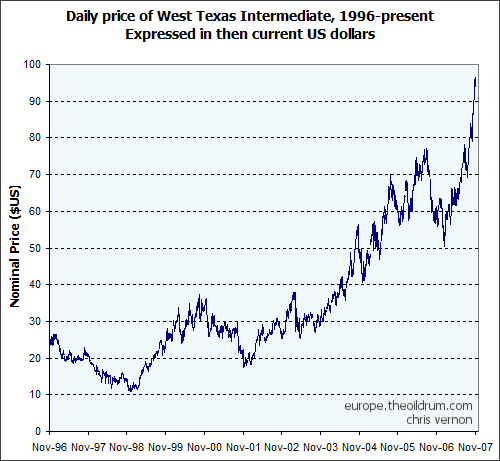
Source: EIA
We know the market price has diverged from production costs as the amount of money the oil companies are spending on exploration and production has not increased in step – resulting in a the large profits reported in recent years.
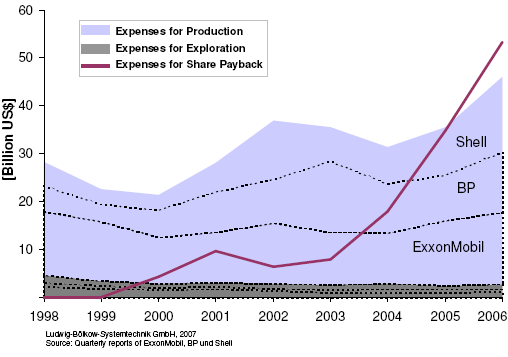
Source: Energy Watch Group Oil report Oct 2007
When a market exhibits this it means there is shortage, marginal supply is no longer determined by marginal price as it would be in a normal market and as such whether you fly to Sydney or not, even assuming British Airways then burns less oil that day as a result, does absolutely nothing for global oil production. It fails the test and does nothing for atmospheric CO2 concentrations.
With BA bidding for slightly less fuel, the market price will be marginally reduced enabling the previously marginally out-priced consumer to take up the slack. Some reallocation will have occurred, however Exxon’s production and resultant global CO2 emissions will remain unchanged.
An Alternative Approach
There is another way. Instead of attempting to change the behaviour or technology of billions of stakeholders we could instead just concentrate on the few dozen fossil fuel producing countries. A few dozen vs. billions – that has to be easier?If a government accepts that climate change is serious, that atmospheric concentrations of CO2 must be reduced, all they have to do is to reduce the extraction of fossil fuel from their territory. We don’t even need to worry that there could be dozens of companies operating in a country – the government licences their operations.
To grasp just how simple this is we can return to oil. Oil is extracted from ~98 countries in the world today. In ~60 of these countries oil extraction is already in terminal decline (Oil Depletion Atlas). Would the US sign up to an international climate change bill that only had one clause:
- Annual oil extraction from the USA will reduce from year to year.
We haven’t had to convince billions of people, we haven’t had to build new vehicle fleets or infrastructure, we haven’t had to do anything other than pass and enforce a single line of legislation in a couple of dozen governments, many of whom already agree that climate change is serious enough to do something about. The resulting impact on emissions would be immediate.
The same can be said for coal. Here the numbers are even better; only 10 countries are responsible for 96% of the world’s hard coal extraction (World Coal Institute). Convince these governments to extract less and the job is done. Also six countries (USA, China, India, Russia, South Africa, Australia) hold 84% of world hard coal reserves. Four out of these six (USA, Russia, China, Australia) also account for 78% of world brown coal reserves (COAL - The Roundup).
Partial Adoption
Another problem with the conventional demand based approach is that a partial solution doesn’t cut it. If the UK reduced the oil consumption by 10%, that newly freed up resource would be consumed by another country. However with the supply focused approach, if Saudi Arabia reduced its oil extraction by 10%, close to 1 million barrels per day, global oil supply (and the CO2 emissions associated with it) would fall. In the alternative approach, one stakeholder can make a difference. The same can not be said for the current approach.Oil Depletion Protocol
In the case of oil there already exists a framework to mandate reduced extraction rates from countries that otherwise would increase their production. The Oil Depletion Protocol originally proposed by Colin Campbell states amongst other things:No country shall produce oil at above its current Depletion Rate.Depletion rate is defined as annual production as a percentage of the estimated amount left to produce.
www.oildepletionprotocol.org
Ecuador
A supply side approach has also been suggested by Ecuador with respect to their largest untapped oil fields in the heart of the Ecuadorian Amazon.This approach passes the test. Fossil fuels will be left in the ground that would otherwise be extracted. The report was from April 2007, I’m not aware of subsequent developments.Ecuadorian President Rafael Correa and his government say that if the international community can compensate the country with half of the forecasted lost revenues, Ecuador will leave the oil in Yasuni National Park undisturbed to protect the park's biodiversity and indigenous peoples living in voluntary isolation.
"The first option is to leave that oil in the ground, but the international community would have to compensate us for immense sacrifice that a poor country like Ecuador would have to make," said Correa in a recent radio address.
President Correa estimates the compensation figure at around US$350 million per year.
...
The oil fields, known as Ishpingo-Tiputini-Tambococha, ITT, are the largest untapped oil fields in Ecuador. They have been estimated by Ecuador's government and analysts to contain 900 million to one billion barrels of oil equivalent, about a quarter of the country's known reserves.
Such wealth transfer is not without its problems though as a recent communication with David Fleming highlighted. It would transfer a lot of money to low-dependency nations, which might well be spent building highly energy dependent systems. Money will be transferred away from high-dependency nations, just when they need it to achieve the massive turn round in their economies. Traditional societies could be disrupted by sudden inflows of wealth.
Tradable Energy Quotas (TEQs)
Whilst this article has considered supply reductions and is critical of the current demand driven approach, if implemented without addressing demand the consequence could be brutal. The traditional market based approach could lead to a highly inequitable collapse in order for demand to match supply.Any Governments favouring a more orderly response would be wise to adopt Tradable Energy Quotas (TEQs) as detailed here: www.teqs.net
TEQs is an energy-based, national system that enables a country to reduce its reliance on fossil fuel fast whilst ensuring fair access to energy for all.
Conclusion
Attempting to reduce atmospheric concentrations by demand side approaches is unlikely to succeed as it relies on billions of stakeholders making behavioural and technological changes. A partial adoption delivers a disproportionably small response and possibly none at all.A supply side approach achieved through extraction limits, agreed by a small number of governments removes the complexity associated with billions of stakeholders. There also exists the opportunity to compensate this small number of countries for lost revenue.
Whilst this artificial limitation of global fossil fuel supplies will create energy shortages, if the climate change predictions are correct this is likely to be preferable to the impact of climate change from unchecked extraction and combustion of fossil fuels. In any event, as fossil fuels are finite their reduced supply is inevitable. Should we reduce their supply before and in mitigation of dangerous climate change or after and cause dangerous climate change?
Personnel
Editors
Contributors
Peak Oil Primers
Archives
- November 2010 (3)
- October 2010 (6)
- September 2010 (4)
- August 2010 (7)
- July 2010 (6)
- June 2010 (7)
- May 2010 (2)
- April 2010 (8)
- March 2010 (4)
- February 2010 (6)
- January 2010 (3)
- December 2009 (5)
- November 2009 (8)
- October 2009 (12)
- September 2009 (6)
- August 2009 (5)
- July 2009 (11)
- June 2009 (8)
- May 2009 (16)
- April 2009 (10)
- March 2009 (7)
- February 2009 (10)
- January 2009 (15)
- December 2008 (9)
- November 2008 (9)
- October 2008 (9)
- September 2008 (13)
- August 2008 (10)
- July 2008 (14)
- June 2008 (23)
- May 2008 (16)
- April 2008 (12)
- March 2008 (16)
- February 2008 (9)
- January 2008 (13)
- December 2007 (13)
- November 2007 (16)
- October 2007 (22)
- September 2007 (8)
- August 2007 (9)
- July 2007 (16)
- June 2007 (8)
- May 2007 (7)
- April 2007 (7)
- March 2007 (10)
- February 2007 (10)
- January 2007 (12)
- December 2006 (9)
- November 2006 (15)
- October 2006 (4)
- September 2006 (5)
- August 2006 (5)
- July 2006 (9)
- June 2006 (5)
- May 2006 (10)
- April 2006 (9)
- March 2006 (13)
Vital Trivia
License

This work is licensed under a Creative Commons Attribution-Share Alike 3.0 United States License.
shouldn't the real alternative be in here?
http://www.energy.iastate.edu/becon/downloadNH3/AmmoniaMtg07.html
Very nice link. The solid state method of ammonia production looks very useful. I looked at another low pressure method here, which is thermal so that solar energy can be used without conversion. Might be cheaper that using electricity but the energy reduction reported in your link looks quite good.
Chris
SSAS only need part of its energy input in electricity, the rest is in heat.
Yes, I saw that in the last slide. Seems clever.
Whilst I think it is important to approach the problem of climate change from all angles, I feel you are unduly haranguing demand-side activists. I've been witness to your views on this subject developing over the last few months but I maintain that I don't think its helpful to make this distinction, if only to tell activists, who are trying to improve energy efficiency and cut demand, that they are 'doing it all wrong'.
Besides this, I think there are some flaws in the argument that require further consideration. Within the few dozen governments that we should 'just' focus on, it seems to me from Strahan's map, with the exception of Canada, (and perhaps parts of Southern America, based on more socialist regimes) The governments who you would need to approach to curb supply, are the least likely governments to prioritise climate change above national profits. Kazakhstan has still yet to ratify the kyoto protocol and Iraq hasn't even noticed it was created. What's more, the coal producing countries you mentioned are those most robustly opposed to legal emissions limits - what makes you think they'll jump at the chance to stop taking coal out of the ground.
If America needs to be paid not to take coal out of the ground in order to convince them its a good idea, who the hell is going to pay them??
If supply is to be cut in countries where oil has not already peaked, and they are to be convinced by the Western world (consisting of the most oil dependent countries), how do you expect this to come about without the behavioural change needed to induce leaders to do the convincing on behalf of the oil dependent countries. Put another way, what leader would willingly ask a major oil producer to cap and reduce their output, while their population maintains a soaring demand for that oil.
More than anything, I think your analysis shows your pessimism for grassroots groups such as your local Transition group, which I note today has put together a programme of events with national level spokesmen for the largest transition community in the UK after a mere few months of existing.
Those of us choosing not to fly are a growing number, and your presumption is that any fuel I don't burn will lower the price so that other people will just burn it anyway. Again this underlines a fundamental pessimism that a critical mass of people making different choices has no impact on leaving fossil fuel in the ground. Though I think Monbiot could benefit from entertaining this tactic, it is one-dimensional to take this test mentioned as the only yard stick of success. By making different choices about the way we consume fossil fuel at an individual level we raise awareness in our own communities about these issues, engage others with this debate, question societal values about oil dependence and much more. If oil producing nations are expected to impose policies that cap oil production whilst Americans are still lusting after 4mpg monster cars, I wonder how long it will be before another oil producing nation is 'occupied' and such policies reversed.
It would be comforting to accept your arguement, Louise, to feel that our no-flying and transitioning are doing good, are keeping fossil fuels in the ground. However, the difference between the oil price and the production cost demonstrates that Chris's pessimism is justified. Fuels that you and I don't burn will be burnt by others entering the market.
Nobody is suggesting that empowering the leaders of fossil fuel rich nations to forego production is going to be easy but it is the only way to stop the carbon being burnt.
To reduce supply in the current situation without placing into effect a demand side plan that replaces fossil fuels with alternative energy sources is to beg for disaster on a massive scale. The above paper overlooks entirely the deep dependency that all current human socio-economic structures have upon fossil fuels. The author is in reality proposing that we accomplish by directive precisely what Mother Nature will require through the natural terminal decline of productivity inherent in the concept of Peak Oil. Soon global production of oil will begin its steady terminal decline, providing the restriction upon supply that the Vernons propose. Why take years convincing 30 nations to cut back on production when Nature will do that anyway? And who would enforce this? No one would have the incentive, neither producers, nor consumers.
The article reveals a shocking lack of perception of the catastrophic effects that would ensue upon the heels of such a decision. The global economy would suffer greatly, critical services and food supplies would be at risk, transport upon which 90% of global commerce and we all now depend so heavily upon would be negatively affected and immense pressure would be brought to bear upon the producing countries to increase production. The stronger nations might well say, "Sod it. We'll just take what we need with our military". Weaker nations would likely get very little and people will starve. To the rather naive suggestion that producing countries be compensated for cutting back, just how will that be done when the economy is going to hell in a basket?
Bottom line. It's just not that simple. The things that will help the most to cushion us against the approaching disaster via peak oil are (1) conservation and (2) heavy investments in alternative energy.
We don't have much time. Climate change is no longer humankind's most immediate problem.
Victor, the questions are:
Is natural decline in fossil fuel production fast enough to prevent dangerous climate change?
Is the damage to society by a faster reduction in fossil fuel use worse than the resulting climate change?
I would suggest that we can’t rely on natural depletion alone – Hansen’s business as usual scenario of just burning conventional oil, gas and coal takes us to 580ppm, that’s before looking at unconventionals or any positive feedbacks.
click to enlarge
Regarding the relative damage of rapid fossil fuel loss or climate change, who can tell? What do you think about TEQs as a response to rapid fossil fuel loss?
Impossible is the word that comes to mind when considering any political leadership proposing either supply or demand restraint.
The reality is any political party that proposes that recession is the way forward will either not get voted into power or will be voted out of power. This means the FF will be burned, almost everybody wants growth and a better way of life if possible - get used to it, and plan accordingly. Sadly, it looks like we don't have enough resources or time to waste on unproductive sidetracks.
Nobody. This is the big problem - nobody knows what the future will be, and politicians won't do anything that adversely affects society unless you can tell them with precision.
The current statistical probabilities are a completely inadequate tool for anybody to decide which way to progress.
As has always happened in the past, it looks almost certain that nature will decide the way forward, not humans.
If you understand the political process you will realise the world's politicians don't have the solutions to the approaching cluster of problems - so, don't rely on them for you and your family's future well being as it's very probably not a viable plan.
Xeroid.
shouldn't it be to prevent MORE dangerous or ABRUPT CC?
how dangerous is dangerous? hasn't dangerous CC already occurred and is getting more dangerous everyday? it may indeed be politically "unwise" to state the truth in mass media, but is that so even in TOD?
You must first answer whether dangerous climate change is even on the horizon to begin with. How bad will it be? How much will be affected? Not the alarmist Goristic dire pridictions that even the IPCC contradicts, but the solidly understood scientific evidence.
Richard Wakefield
London, Ont.
No one is ahead of their time, just the rest of humanity is slow to catch on.
Richard,
I thought you were now persuaded. The IPCC synthesis report makes a big point that the rate of sea level rise is increasing. I think it is the economists rather than the scientists who are on squishy ground.
Chris
There is no increase in the over all rate of sea level. I noted before I would find refs and here are a few.
http://www.worldclimatereport.com/index.php/2006/12/04/decelerating-the-...
http://www.worldclimatereport.com/index.php/2007/09/14/sea-level-slowdow...
http://www.worldclimatereport.com/index.php/2007/02/09/shocking-facts-ab...
Also note that the amount of snow fall in the Antarctic is increasing, and together with the reduction in Arctic melting is a mere 5% over all reduction in ice between the 2.
I read as much as I can on both sides of the issue, as long as WorldClimateReport reviews PEER REVIEWED papers that contradict the premisses of AGW, I remain skeptical. Especially the hard core extreme alarmist Gorist dogma.
No don't give me the excuse that WCR is funded by Big Oil. A few months back Newsweek tried to do the same thing, but had to retract their own article when it was revealed that, yes, Big Oil in the past 20 years has put in some $18million into challenging AGW theory. But those who work in the theory in the same time frame were funded $50 BILLION. Thus who has money to loose at stake?
And no, the latest IPCC report is 7" to 23" in 100 years. The 7" is the current past average rise that has already been happening for the past 100 years of measurements. That rate has not yet been found to change and the IPCC report admits that.
Richard Wakefield
London, Ont.
No one is ahead of their time, just the rest of humanity is slow to catch on.
why haven't the investment bankers thought about creating yet another derivative that perhaps can make up some of the losses they are suffering from the subprime scandal - write up some put and call options on the coastal properties that have values directly linked to the sea level - the sea-level-rise believers can put their money in puts and doubters can put their money in calls? shouldn't the IPCC members get at least a meaningful percentage of their pay by the type of options according to their opinions?
Richard,
From the synthesis report:
You other points are not relevant since you set the criteria that you need to see a change in the rate of sea level rise. Now you've seen it.
Chris
As long as the 'business as usual' people control the media, all the global warming scientists don't matter. It takes waiting till it's too late, till the hurricane surge comes over the levee, the orchards and vinyards run out of irrigation water, the forests burn down and take exurbia with it, and the Arctic ice pack disappears completely, before it is no longer possible to deny global warming.
Which is about where we are right now.
OK, so we denied tenure to people that talked about global warming years ago, when it wasn't too late. So we defunded people by denying them grants to gather the data that tracked global warming years ago, when it wasn't too late. It doesn't matter any more.
The question that matters now is, what can we do. Note, I am not asking what should we do, I am asking what can we do.
If we shut down oil production six years in advance of running out anyway, all that does is piss off the gasoline buyers, the commuters, and make them blame the Liberal environmentalists.
The Conservative denialists get off scott free and walk away with the money, laughing.
And what does it get us?
Better to just let us hit the wall six years harder. What difference does it make? We are in an irreversible climate shift. Six less years of burning oil and we are not going to save Greenland. Those six years are going to increase greenhouse warming by what, six percent? It's a compound interest thing. The last six months of running up your credit cards are not nearly as ruinous as the first six years.
We are not just concerned about the present amount of CO2 in the air, we are concerned about the melted snow that is no longer reflecting sunlight, the treeline moving north across the taiga and higher along the mountain sides, absorbing sunlight as the snow lies below the branches, the CH4 desorbing from the muskeg as the permafrost melts, and bubbling up from the wave stirred hydrates of the Arctic as the wave damping ice pack melts in the summer sun of the Arctic ocean.
Greenhouse gases from oil and coal are no longer the most important part of the global warming problem. The compound interest on the old greenhouse gases are what is more important.
You know, we went through this before in California. The ecofreaks got the government to buy up the last of the old growth forest. We saved about five years worth of lumber industry, and spent the next forty years with the rural areas bitching about us denying them good jobs at good wages, and subsidizing them by supplementing their taxes to compensate them for losing the employment. We got to compensate them eight times for every lost dollar of wages.
Why go through that again?
Hit the wall six years early and destroy the Conservatives as a political philosophy. Works for me.
Example of unsubstantiated hype. Greenland isn't all going to melt. The last time it was ice free was 180,000 years ago. Other past warm spells did not melt it all, neither will this one. Besides, it would take THOUSANDS of years to melt all that ice even if it warmed with no winters. You can't get past physical laws.
GW is happening, we have to live with it. We should not be spending a dime on trying to stop it as that will use up valuble resources we soon won't have. As oil depletes more people are going to starve to death than people who drown from higher sea levels. Oops, but that isn't happening...
We need to funnel our resources to preparing for a society with dwindling FF supplies. This hype over GW is distracting everyone from that goal, making the time when that realization does happen way too late.
Richard Wakefield
London, Ont.
No one is ahead of their time, just the rest of humanity is slow to catch on.
It doesn't all have to melt to cause serious trouble. Total melting will raise sea levels ~21 feet, but 10% will flood cities, river deltas, etc.
Quite wrong. Many of the options for switching away from fossil fuels (esp. nuclear and some of the biofuels) also have a large impact on AGW emissions. Relatively minor changes to system designs and incentives can address both problems simultaneously.
I think you are correct that we are beginning to see feedbacks that could ultimately dwarf the effect we have had so far on the climate, but I think you are incorrect that how we behave now makes no difference. Only half of our emissions remain in the atmosphere so drastically reducing our emissions should lead to reduced forcing since the atmospheric concentration of CO2 should begin to come down. We will know if there are feedbacks than need to be handled once we have done this, that is we will see if the carbon dioxide concentration continues to decline or if it begins to rise again. If the latter occurs, we should have time to remove carbon dioxide from the atmosphere ourselves since any feedbacks happening now are still small compared to our emissions.
Chris
Chris, to make the 23" in 100 years the rate must go up THREE TIMES! (for Gore ridiculous 20 feet it would have to rise 10x more than that. Gee, that is a MAGNATUDE more!)
But that rate change is not happening. In the World Climate Report summaries of REFEREED PAPERS is it quite clear that to establish the actual rate of increase is very hard. It goes through cycles of faster rates and slower rates, that at 7" per year has been going on for more than 100 years, long before we came along with FF buring.
If you read the summary in WCR you will note that the rate DROPPED between 1940 and 1993. And the quote you note is very clear that the current increase CANNOT WITH CERTAINTY be because of GW, it might, and most likley is, due to these small fluctations. Besides, this rate change is VERY small, just a few percent change.
Bottom line is the scare mongering of FEET or METERS increase in the next 50 years is PHYSICALLY IMPOSSIBLE.
So if all this melting is going and, and reviews in WCR dispute there is wide scale increases, where is all the water going? This is a serious, and theory breaking, problem. Theories stay or fall on their predictions. If the predictions of feet increases in sea level in the next 100 years does not pan out, the theory is in serious trouble. If there is no change in the rate over the next ten years, the theory is in trouble.
Please, don't just take the IPCC and the Gorites hook line and sinker, read papers that do not support the AGW dogma, there's lots of it. Hence I remain SKEPTICAL (not a denier) that we are contributing 100% to GW and hence can change the current trend.
And BTW, there is an astrophysis, who just died recently, who noted that the changes in the planets around the sun causes the solar system center of gravity to wobble, and with it the sun wobbles causing more or less activity, which affects our climate.
Richard Wakefield
London, Ont.
No one is ahead of their time, just the rest of humanity is slow to catch on.
"...the changes in the planets around the sun causes the solar system center of gravity to wobble, and with it the sun wobbles causing more or less activity, which affects our climate."
Total Crapola! (no surprise you don't understand AGW)
http://www.canada.com/nationalpost/financialpost/comment/story.html?id=b...
And you know this for a fact? Where have you published refuting this? And I do understand AGW, that's why I reject it.
Richard Wakefield
London, Ont.
No one is ahead of their time, just the rest of humanity is slow to catch on.
No, you don't understand it. If you did, you'd understand that the glacial cycles correspond to Earth's orbital eccentricity and axial tilt/precession. Jupiter influences Earth's orbital eccentricity IIRC, but that's already accounted for.
Could it be that one aging scientist could be right, and the entire IPCC is wrong? Far more likely that the aging scientist is getting senile, and you're latching onto his claims because they align with what you want to believe.
These are different issues entirely. You were concerned with observed changes. Those are observed. How well projections work is another matter. It is not too hard to say that with the present trend of the rate of sea level rise doubling every decade we would see 3 meters a year in 100 years. Or we might project a linear rate of increase so that the rate is 3 cm/year in 100 years and it takes 30 years to get one meter. As the IPCC points out, the current rate of sea level rise is consistent with model expectations as is the observed increase in the rate. What we do know is that thermal expansion alone gives a couple of meters once the oceans have fully mixed so you'd need quite a lot of snow piling up somewhere to counter that. We also know that just a couple of degrees or so more warming gives us about 25 meters of sea level rise from melting which could come fast or slow. The science is beginning to favor fast. The reason we know about the 25 meters is because that is what it did last time. The maxium observed rate of increase for sea level is about 5 meters per century but that is likely a lower limit since decade level rates can't be discerned, so five meters in a decade could have happened. Some evidence of destructive flooding suggest pulses are involved in these kinds of things. At least meters in a half a century have been observed so this is not physically impossible. In our present situation of very rapid climate change, it might be more likely to be expected than not.
For those who like more direct evidence than the rate of sea level rise I think this link demostrates our situation very clearly. In another 40 years, the Mountain Ash that used to range down to West Virginia won't have a habitat in the lower 48. That is much less time than the life of a tree. You can see why mass extinction is expected from the climate change we are causing.
Chris
That is NOT what the IPCC says. It clearly notes that the current (small) rate change cannot with certainty be known to be by anything other than normal variations. You even posted that quote.
Unsubstantiated speculation. The oceans will never "fully mix" it will always have warm sections, and deep cold sections, and have currents that circulate. It's gone on like that for 4 billion years.
When and where did this happen? Post a link to the reference to support this. There is nothing in the past 100 year measurements that shows this. Go to the Tide and Currents website and give me the link of the place where that happened.
The graphs I've seen published shows that at the end of the last ice age the rate of sea level was much faster than today, but has since dramatically slowed down (to the current 7"/Cy on average) looking like the left half of a bell curve.
Richard Wakefield
London, Ont.
No one is ahead of their time, just the rest of humanity is slow to catch on.
Richard,
You need to read the synthesis report. Clearly, the increased rate of sea level rise is taken as supportive evidence. It is important to caution that past performance may not be inticative of future results. We don't know if we are settling into 3 mm/yr of if the trend will change in the near future, perhaps to 6 mm/year.
You clearly don't understand thermal expansion. There are temperature variations in the oceans. But those deltas are not what mixing is about. The deltas may remain the same (or get back to what they were) but the deep water is warmer with mixing. The whole scale shifts preserving the deltas. So, there are portions of the oceans now that have yet to warm, but very predictably will which leads to more thermal expansion.
It is during periods of catastrophic deglaciation that the highest rates of sea level rise are measured. You might want to read Hansen et al. in Philispohical Transactions this year for a masterful treatment. Read it carefully, and you'll be well repayed for the effort.
Chris
The pace of melting of the Greenland ice cap has tripled in just the last 5 years. It is a fait accompli.
Chris,
The presentation at the Houston ASPO meeting from NASA GISS pretty much said that peak oil as typically portrayed here together with peak coal, similar to the way Dave Rutledge or the Energy Watch Group look at that, together look like Hansen's alternative scenario (which is lower than any scenario considered by the IPCC) rather than his BAU scenarios. However, NASA GISS is moving to the view that the level of dangerous climate change lies below 450 ppm CO2. You can understand why if you read Hansen et al.'s treatment of slow feedbacks in their recent Phliosophical Transactions publication linked here.
I feel that you are correct to point out unconventional oil, and I hope Dave will look at "acts of desperation" coal since that seems to be the basic model for coal in any case, but some depletion models look a lot different from the Hansen or other BAU models.
Chris
Hi mdsolar,
What are "acts of desperation" coal?
Thanks,
Dave
Hi Dave,
I'm thinking of very thin or very deep coal seams that we would not consider economical but which exist. The effort in Utah seems to me to be an act of desperation, but one could imagine even greater brazenness. I'm wondering if desperation could be quantified in mining deaths per ton? If so, then we have a long way to go to match early 20th centrury desperation levels in the US while deperation tolerance may be higher elsewhere.
Chris
Chris,
Due to depletion of reserves the peak of CO2 emissions might happen 60 years sooner than Hansen projects. The CEO of ConocoPhilips is on record claiming that oil production will never go above 100 million barrels a day. World oil production has declined in the last 2 years. Why keep treating the conventional nightmare CO2 scenarios seriously?
Not necessarily. Economies react sensibly to slow changes, catastrophic change comes only from catastrophic changes.
For example, we can say that a depletion in supply of 0.01% a year could definitely be compensated for without any significant trouble at all by efficiency gains, putting alternate means of energy generation, and so on; a depletion of 50% a year would definitely make a mess. So, somewhere between 0.01% and 50% depletion is a level which will allow for useful change but cause no economic disaster.
You also neglect to recall that the essence of the idea of peak oil is that a big drop in supply is inevitable. Whether peak oil is today or in 100 years, at some point there'll be a dramatic drop in supply - and we'll have to adjust then. Do you imagine that change forced upon us by physical limits is somehow less painful than change we choose to go through by treaty and law?
We're climbing down a cliff, and the rope is unravelling. So, we can either try to climb down before it breaks, or we can just hang around waiting until it breaks and drops us.
Hi Biff,
We haven't been introduced, but Chris has mentioned fondly the Lincolnshire life.
I believe empowering the leaders of fossil fuel nations to forgo production is not just 'not easy' but impossible without the backing of the majority of the global community.
While I suppose one could imagine circumstances in which people are aware of the problem, insist on the capping of production in oil-rich countries, and yet decide not to change their own behaviour, I struggle to think of an individual example where someone who fully understands the gravity of this issue has not changed their behaviour where they felt able. It seems that if you are convinced that individual action / government action on the demand-side does nothing, you lose the platfrom from which you could insist suppliers cut their production.
On discussing this further with Chris, I better understand that there are grounds on which to say that right now, the choice not to fly (etc.) does not directly stop any particular quantity of oil being extracted owing to the divergence of the cost of extraction and price of oil as you say, however the direct effect is inconsequential if it builds on the culture that is necessary to make direct caps and reductions. On both demand-side and supply side, attitude change is the most crucial factor, but I adamantly believe that if an attitude change can be achieved, the demand-side changes will happen as a consequence. If an attitude change cannot be achieved, attempts by a few enlightened individuals to try to cap supply will be either short-lived or have adverse consequences.
Hi Louse
Yes life's grand in Lincolnshire. I've just been watching the 20 new turbines being erected by Ecotricity at the end of my road. :)
There's no belittleing of demand side action intended. It is vital, just not sufficient. So far all the talk is about the demand side and supply side has been ignored.
You're quite right, culture is important.
Anyone who has studied the history of movements of social liberation will understand the importance of individuals and groups as examples. The Suffragettes in the UK, a tired black woman who wouldn't move from her bus seat in the US South, a skinny old Indian guy who went for a walk to make salt - individual change can have impressive effects in changing the culture as a whole.
Hi Louise,
I expect my post came across unnecessarily down on the demand-side activists. That is not my intention. The Transition Network has my complete support, not least as it shows how we can survive with less fossil fuel, an inevitable necessity due to both climate change and peak oil. The work done by the Transition Network makes the supply cuts I’m suggesting more palatable for our Government to support.
Regarding your point that the target suppliers are the least likely to prioritise climate change, fair point. But successful action on climate change absolutely has to curtail production from these same countries. The only question is how best to achieve it, bearing in mind the tight timescales within which we are to act. I don’t imagine it will be easy – only that proactive reductions in supply need to be considered, as an alternative approach, where today I don’t see anyone considering it.
It does seem politically impossible for an importing country to request production cuts, but doesn’t it just depend on how serious they are about climate change? Government’s frequently do things that are unpopular in the belief there will be a net benefit at the end of the day. Isn’t climate change science telling is just that, that there is net benefit from addressing climate change?
Am I pessimistic that a critical mass of people can leave fossil fuels in the ground? Yes – for two reasons. Time and magnitude. We’re told we have get emissions down fast, as demand reductions will at first only result in global reallocation there is a significant lag between demand reductions and any eventual supply response. Secondly there is just such a large body of people – literally billions who would dearly love to consume more fossil fuels if only your wealthy critical mass would give up some, relaxing the price a little.
Your final point I am in complete agreement with – we need demand side activists to raise awareness in order to facilitate the necessary supply side constraints. My concern lies with expecting partial success on the demand side (we can’t hope for more than a partial success) driving supply reductions.
A well considered response, sorry to catch you off guard so early this morning!
I'm more pessimistic about the (UK) government's response than the grassroots, seeing as the government continues to be lagging behind both citizens and emerging scientific data, but that's another story.
I will carry on not flying, while I lobby King Abdullah bin Abdul Aziz to stop all this oil producing nonsense :)
As a campaigner for the climate policy framework of "Contraction & Convergence"
(and for many years the Rural Development Liaison for the framework's founding organization,
Global Commons Institute www.gci.org.uk)
I too am a supply-side activist.
I should point out that the author seems to have heard George Monbiot on an off day -
he too is a supply-side activist in that he is one of C&C's most vocal staunch supporters.
Given our society's complicity in the unprecedented scale of genocide-by-famine which is now likely unavoidable,
with the predicted 50% cut in Africa's food production by 2020,
( www.irinnews.org/Report.aspx?ReportId=74481 )
we need to cut the supply of sources of GHGs at the most rapid pace that can avoid causing geo-economic collapse.
C&C will achieve this by defining nations' rights to emit GHGs,
thus limiting the global volumes of fossil fuels it is profitable to extract in any given year.
Campbell's Oil Depletion Protocol was very carefully designed for another, very specific, task -
and I've yet to see any suggestion that he feels it should, or could, be applied instead to re-stabilizing the climate.
The core difference between it and C&C is that it focusses on Nationally Owned (fuel) Resources, not on (emissions to) the Global Commons of the Atmosphere.
The core of C&C's negotiability lies in its phased equitable distribution of national rights of emissions to the atmospheric commons,
according to the size of national population (the convergence concept),
under an agreed annually-declining GHG budget (the contraction concept).
The Protocol offers no such basis in per capita equity of rights (de facto) to fossil energy usage,
nor the prospect of significant income from the S > N trading of those rights to maximize the rate of change out of fossil fuel dependency,
and thus it lacks the requisite incentives for sufficient support to gain critical mass.
By contrast, C&C now has the endorsement of the Nobel Laureates,
of the EU Parliament,
of the Africa Group of Nations at the UNFCCC,
and of India, Pakistan, and others.
(See Endorsements at GCI website).
Notably, we also have increasingly strong hints that China will adopt C&C at some point of its choosing.
If the Oil Depletion Protocol were re-written to allow the global distribution of an agreed annual ration of a set mix of fossil fuels according to per capita parity,
with agreed rights to trade surplus national fuel allocations (with revenues' spending ring fenced to GHG mitigation)
it would in fact approximate C&C and offer some of its incentives.
Yet negotiating that deal would mean nations' abdicating ("commonizing"?) their Ownership of their (ill-defined) strategic National fuel Reserves . . .
which looks likely to be a discussion needing rather more decades than we have available . . .
Regards,
Backstop
This supply side limiting, and contraction and convergence, both suffer from severe reality deficits. In reality no producer is likely to limit production for CO2 purposes - in the same way that no first world country is going to destroy its economy so third world countries can pollute more.
To effect any workable change you have to be more subtle than that. As a minimum you show producer countries how limiting production will increase prices and result in them earning even more from less (I get the feeling they've learnt that one already). You might also describe how mutual pacts can prevent military and economic strongarm tactics.
However in reality the main threat is coal. Its distribution and availability will make it the option of choice for the main world consumers. There is zero chance of getting them to artificially restrict supply, and even less of getting them not to use it. The only option therefore is to get it used in ways that don't release CO2. Carbon sequestration could be promoted, but I get the feeling that practical reality will continue to push that option into the "we're studying it" pile as far as coal power stations are concerned. However carbon sequestration for coal-to-liquids plants would seem plausible - part of the quid pro quo politicians would engage in to avoid mass green action when they suggest it as a solution to lack of oil.
Action that minimises the carbon released from coal based activities, particularly in terms of new research or plant designs, seems the most effective way of minimising the threat.
Several new coal power plants being planned in the USA and UK will test their government's commitment to emissions reduction, as well as the public mood.
There are two applications pending in the UK, one is likely to be approved by Kent council soon. Final decision rests with central government.
I hear that James Hansen is in vocal opposition to new coal power plants being proposed in the US. I guess approvals for new plants would be made at a state level?
AFAIK there are no actual CSS schemes in operation, not even pilot plants. The UK government abandoned a project to build a new gas power plant with CSS, in order to reopen the tendering process.
That doesn't help nearly enough. Even if half the carbon going into a CTL plant is sequestered, it may still not be any better than coal-fired electric generation to run an EV and may well be worse. The BEV can potentially be run by a non-emitting power source; the ICEV is inherently an emitter.
how about with carbon-free liquid fuels?
If you are talking about ethanol and biodiesel, there isn't enough biological productivity to run our society that way (with the possible exception of algal sources). If you are talking about ammonia, you have the same end-to-end efficiency problem as hydrogen (see Ulf Bossel's critique of hydrogen fuel cells), plus even greater losses if you use it for combustion engines, plus toxicity hazards from leaks.
SSAS is a great idea for fertilizer, but pitching it as a way to turn wind power into vehicle fuel runs into the same issue as hydrogen; you can get several times as much energy to the wheels by running it through batteries instead of chemicals.
ethanol and biodiesel ain't carbon-free.
ammonia doesn't have to be reformed back to hydrogen to be used thus the end-to-end efficiency problem is not inherent to ammonia. if the toxicity of ammonia is indeed a problem, the world would have been very different today.
without getting into the difference between ammonia and hydrogen again and the difference between fuels in liquid or other forms, just ask oneself: where are the majority of the wind/solar resources situated on earth? is there time and is it practical to replace majority of the ICE powered equipment into battery powered before this whole argument about CC becomes meaningless?besides, ain't batteries basically heavily packaged or equipped chemicals?
No, but they can be carbon-neutral (and some methods of production, e.g. perennial grasses, sequester large amounts of carbon in the soil). So long as we push our carbon requirements low enough to meet them with available productivity, that's not a problem.
Ethanol and biodiesel have the advantage of compatibility with existing infrastructure. Further, ethanol and biodiesel spills do not present acute public health hazards.
Hogwash. Any decrease in chemical energy means less energy available at the point of use. Further, if you mean you intend to use ammonia as fuel in a combustion engine (perhaps 40% efficiency) instead of a fuel cell (60%), you take an even bigger loss than the one for hydrogen shown on page 36 of this presentation. That would put you down to about 16% end-to-end. It would take roughly 5x as much generating capacity to do the job with ammonia compared to batteries.
The entire US could be powered by the land-based and nearby off-shore wind resources. The entire world could be powered by the sun falling on a fraction of Arizona. With that much local abundance, why should we care if "most of it" is in places like southern oceans and the Sahara? Why should anyone living today care?
You beg the question of compatibility of today's ICE-powered equipment with ammonia. Short answer: it isn't. Batteries are going to be far cheaper, quieter, cleaner and safer than building 5x as much RE generation for the sake of powering combustion engines with ammonia.
you can start a new thread on them but they are beyond the scope of the original question.
no need to get "poetic" here. decrease in energy available is inevitable by the fundamental laws of thermodynamics. the only question is by how much, at what cost and what is the lead time. 40% efficiency of ICE is not an inherent limit for ammonia given its high octane number. 60% of fuel cell efficiency is desirable but how long will take and at what cost?
why one has to stick with the conventional electrolysis+HB approach to ammonia synthesis? SSAS gives energy conversion efficiency of more than 70% - more efficient than hydrogen production from electrolysis. even with the 40% efficiency of the existing ICE, the end-to-end as you defined should be 28%. now is battery lossless or 100% efficient? the highest efficiency in charging a battery alone is about 85% - let alone by ignoring the leakage and loss to the internal resistance during discharge. then there is again the question of how will the energy be transported? at what cost?
what conversion efficiency is assumed? the efficiency of the free market will sort the question out if a time frame for CO2 reduction is set.
that is the fundamental difference indeed.
the 5x assertion not withstanding, quieter, cleaner and safer - to the end user - not in dispute, far cheaper is dubious given the limited battery life and complete replacement of equipment. the question again is the time. an ideal solution in distance future can hardly change BAU for now. then, the original question is not just for personal vehicles - which could be more idealistically replaced by bicycles - how about farming, industrial machineries, truck fleets, ships, planes and power station in population centers far from where the RE can be gethered?
Why are you objecting to a one-sentence treatment of the issue?
I swear you must be blind. The point is that any conversion from electricity, to chemical fuel, back to electricity has a fraction of the end-to-end efficiency of batteries. That's any conversion, whether it involves ammonia or not. Using heat engines instead of fuel cells just makes the efficiency even worse (more steps with inevitable entropy increases).
Hydrogen is not the answer because it is too lossy. Ammonia is just a way to store hydrogen more easily, and has roughly the same losses. You have utterly failed to address this issue.
Modern Li-ion cells are 95%+ efficient. Several chemistries can charge about as fast as a fuel tank can be filled. The energy density isn't as high, but you have no material to handle or leak.
You utterly miss the point. It makes no sense to take a system which has to ship energy from Minot, Amarillo and Los Cruces to Chicago, Houston and Los Angeles and build it around a medium needed only if you are capturing energy in the Southern ocean west of Perth for shipment to New York. It makes even less sense if you won't need such shipment for 50 years, if ever.
We need ammonia for fertilizer, sure. Electrolytic ammonia for fuel? The huge losses make it uncompetitive with electricity used directly, and there are other competitors for the niche it would occupy. They need to be evaluated on their merits, including the direct and indirect carbon emissions/sequestration. You haven't done that.
no objection. just trying to focus on the question. no matter how disagreeable KongFuZi's doctrine is, some of his words are still helpful - without clearly defined terms, no argument can go well.
are batteries not doing the chemical conversions themselves? the point here is not against batteries and fuel cells - they do have their places - albeit limited and slow coming - in the whole picture, it is what can make the biggest and quickest differences.
can you point out one battery charger that is more than 86% energy efficient? how long can the claimed efficiency of the Li-ion cells last? anyone used a laptop computer for a few years should have some feelings about how they behaves.
if there is a system for transporting the hydrocarbons in existence, it can be used to transport ammonia without much modifications. if there is none, the economics will sort the question out provided that the urgency of combat PO and ACC is priced in.
ammonia doesn't have to be from electrolysis - there are SSAS and thermal-chemical synthesis without the forming of H2. if you start a forum for the evaluation of the merits of various alternatives, people from the ammonia fuel network would be more than glad to participate and to provide as much information as needed.
to close, let me quote LaoZi: the good won't argue, the arguer ain't good. had we been good (by LaoZi's definition), we wouldn't even have the need to be here arguing...
Batteries are not required for electrified rail (intercity & Urban), electric trolley buses and bicycles.
Alan
I dont beleave that for a second. They may pay lip service to that but there is no way China is going to reduce their consumption of FF. They're going everywhere they can to secure more sources. They want to displace the US as a super power. Military spending in China is around 15% increase each year. They have increased contracts with African nations in Arms-for-Oil deals, and they are currently training pilots to take off and land on aircraft carriers they plan to build soon. They are also preparing to send a man to the moon.
Richard Wakefield
London, Ont.
No one is ahead of their time, just the rest of humanity is slow to catch on.
sorry to butt in.
This question of optimism and pessimism is very subjective. Which usually is taken to refer to individual interpretation of their experience and prediction of their future. On such a scale this is easily dismissed for either side of the discussion.
However, when large groups of people side with optimistic/pessimistic views then momentum for action is not easily dismissed.
In simple terms this could be called "mood".
To change the mood of many people is not easy and can be a slow attritional
process. Sudden shock can work more abruptly.
However, the actual shock must be easily recognisable. For the majority on this planet PO and GW are still abstract concepts, if known at all.
Until Katrina I thought single events could move opinion. It did, temporarily, but now I realise we are hardwired into 'moving on' individually, and as groups.
You may have to affect 6+ billion people directly to change them.
Only after the second world war did such an immense effect on humankind change the mood so strongly.
Close.
Shock Doctrine by Klein.
But the "shock" needs an outside unaffected source.
Otherwise Collapse ensues.
Arkansaw of Samuel L Clemens
Dear Chris,
I wrote this out to clarify my own thoughts, but I deemed it worth posting.
Clearly the earlier fossil fuel supply limits - whether geological or voluntary - are reached the better for climate change, but the more painful the 'Peak Oil' adaptation problems. Since in a technical sense demand (moderated by price) can never exceed supply, the Peak Oil question really is how painful the demand destruction will have to be to bring demand down to meet the limited supply. The earlier supply limits are reached the worse this pain will be. The oil price thus becomes a rough measure of this pain (and at almost $100 it is already a fatal level of pain for many around the world).
However, since CO2 concentrations are also threatening to reach fatal levels for even more of the world (as you have highlighted there is enough coal to take us way past acceptable levels, even, to my understanding, in light of the latest coal reports), you are suggesting that we need to bring the fossil fuel supply limits forward, despite the increased pain of higher prices and even more vicious demand destruction this would cause. This becomes the lesser of two evils. Sadly I have to agree. And of course we would both agree that any demand-side improvements that can be made (such as those that TEQs would stimulate) to lessen the viciousness would also be most desirable.
What do you mean by "fatal levels"? CO2 will never reach consentrations that will kill people as a gas. CO2 levels in the geological past were 3-4 TIMES the current levels and life flourished. In fact it is thought that such high levels made plants grow so fast that it is the only way that such times supported the Sauropods that fed off them. The IPCC scenarios predict CO2 doubling current levels. No where near geological past levels.
Richard Wakefield
London, Ont.
No one is ahead of their time, just the rest of humanity is slow to catch on.
Yes, I meant the climatic consequences of the concentrations. Apologies if that wasn't clear.
But those have not been proven, only speculated. If the CO2 levels in the geological past were 3-4 times higher, then how can 2x higher be "fatal"?
Richard Wakefield
London, Ont.
No one is ahead of their time, just the rest of humanity is slow to catch on.
"Geological past" is a nebulous term, but according to the World Health Organisation 150,000 people are dying each year as a consequence of climate change ALREADY.
We have so far seen around a 0.8 degrees C rise in temperature over pre-industrial, and around another 0.6 degrees is already 'in the pipeline' and effectively guaranteed.
I see nothing controversial about the claim that the consequences of climate change are proving fatal for ever-increasing numbers of people.
Higher CO2 levels mean the plants don't have to have as many stomata. Stomata bring CO2 into the plant, and leak H2O in return. So if CO2 levels are higher, plants evolve to have fewer stomata, lose less water, and grow in drier areas.
That is unprovable. It is just as unprovable as claiming Katrina was because of climate change. If climate change wasn't happening would that same number of people have died? There is no way to prove that. Besides the article is also clear in the same paragraph that "Measurement of health effects from climate change can only be very approximate." So their calc is highly suspect, by their own admission.
BTW in the article you linked it said:
"Globally, 1998 was the warmest year and the 1990s was the warmest decade on record"
Actually that was recently proven mathematically to be false. The hottest times on record is still the 1930's. Who ever did the calc for recent numbers screwed up.
Richard Wakefield
London, Ont.
It's a bogus claim.
No one is ahead of their time, just the rest of humanity is slow to catch on.
Well, specific individual events being linked to climate change is unprovable, just as it's unprovable that any given driving death is caused by blood-alcohol levels - but that doesn't mean there isn't overwhelming evidence that drinking and driving kills people. And yes, numbers are approximate. Again, this doesn't mean that the trend is any less clear, or that the calculations are 'highly suspect'.
And with regard to the 1930s claim, I suspect you know the truth of this, but because I've got nothing better to do.. In August this year (after the release of that WHO report) some minor revisions were made to the NASA GISS data to account for previously unnoticed differences between two sources of US temperature data used. None of these differences are statistically significant, but where 1998 (1.24 ºC anomaly compared to 1951-1980) had previously just beaten out 1934 (1.23 ºC) for the top US year, it now just misses: 1934 1.25ºC vs. 1998 1.23ºC. The difference is a few hundredths of a degree in data that only concerns the US (and even here 1998-2002 is still substantially warmer than 1930-1934). Big wow. The impression some have tried to give that the science has suddenly shifted sixty-odd years in its assessment of the warmest period is deeply misleading.
And of course in the global mean the warming trend is even more pronounced. It is not a bogus claim.
I'm not denying the planet is warming up. I'm skeptical as to the current dogmatic claims that:
a) we are causing it all due to CO2 emissions (even the IPCC report of 2007 says that global land use change is also a major contributor to higher temps)
b) that it's all doom and gloom, the world will be unlivable ala Lovelock et al. That's nonsence. The planet is a huge buffer and recovers quickly. Even the KT impact was recovered from quickly.
c) that it is fixable. Even if we can reduce our CO2 and remove what we can from the atmosphere what is the economic and resource costs to do it? IN an era of oil decline do we have the moral right to use that resource on AGW? Who in turn is to be without home heating fuel? How many will die because we divert oil to solving AGW. Remember The Law of Unintentional Consequences rules. There is no way anyone can predict what can possibly go wrong.
d) the absolute media hype and misrepresentation (the Gorites). This includes predictions that are presented as "will happen" when they are nothing of the sort (some predictions even viotate physical laws). Whenever any published study does not support the dogma it's not mentioned in fear of shaking the State of Fear the media requires to keep ratings.
e) climate science is not like other sciences. You can't very well stop the Gulf Stream from happening as an experiment to see what happens. We can't roll back the clock, change parameters, and see what happens. Climate is governed by Chaos Theory, is influenced by the Butterfly Effect, and we have just scratch the surface in our understanding of how it all works. This makes ANY preditions of future climate changes HIGHLY SUSPECT.
f) finally, AGW is too far in the future. Even Simmons is now saying PO is the bigger threat. That sentement will expand as that threat becomes more popular.
Richard Wakefield
London, Ont.
No one is ahead of their time, just the rest of humanity is slow to catch on.
Sorry jrwakefield, I just don't have time to engage with this nonsense. You said "The hottest times on record is still the 1930s" - how is that not denying that the planet is warming up?
This seems like classic contrarianism - not actually putting forward a consistent position but simply disagreeing with everything the scientific community reach agreement on, then reluctantly backing down to the next point of uncertainty and denialism when the evidence becomes overwhelming. Why?
I'll just have to refer you here to find some decent responses to your various inconsistent points. But I agree that Peak Oil is just as critical as Climate Change (see my first post here that started all this) - they are really just two sides of the same problem. Solving one while making the other worse is no use.
I thought my point list made it clear on my position. The fact is the 1930s at least TIES with the 1990 values. Undisputed. We have to wait and see what the future numbers are.
Bottom line is I'm not fixated on a postion. I will let the evidence show me what is happening. If we go into years of cooling what would your position be? It can't happen you say? That's not science, that's dogma.
And I'm not alone, I have a VERY long list of scientists who reject AGW, including some formerly from the IPCC. And no, they are not funded by Big Oil.
Richard Wakefield
London, Ont.
No one is ahead of their time, just the rest of humanity is slow to catch on.
Richard,
You need to recheck your facts here. The thirties were significantly cooler than the ninties. you may be confusing the US record with the global record.
You are very likely being influenced by people who wish to deceive you. Hope this helps you to recognize the deception and be more careful in the future. There's a sucker born every minute, but there are 251 other people born every minute, so you don't have to be the one.
Chris
So everyone on WorldClimateReport is out to deliberately decieve people???? People like Richard Lindzen who utterly reject AGw on SCIENTIFIC grounds (and no he is NOT funded in any way by Big Oil, I have a letter from him categorically denying the lies on the Internet)
No, it's REFEREED PAPERS that contradict the dogma of AGW. I'm QUITE capable of understanding the issues (I thought myself geology and published a paper in 1988 solving a small geological enigma). And yes, it was the US numbers, never said it wasn't. The fact is the hottest years was forced to be changed because it was wrong. That is a fact.
This graph you posted it telling indeed. Why did temps start to rise between 1890 and 1940 before there was significan CO2 emissions? Why did it level off just as we started to pump CO2 in huge quantities?
Richard Wakefield
London, Ont.
The more complex society becomes, the more myth and fantasy people invent to explain it.
What is a "refereed" paper? Do you mean a "peer reviewed" paper?
Did you teach yourself geology, or just think about it? Could we have a reference to this paper and where it was published, so we can see if your science is as good as your spelling?
What is a level of "significant" emissions according to Mr Wakefield? Are you aware of the existence of the steam engine buring coal, ships burning coal or diesel, etc, before 1940? Are you aware that the industrial age using fossil fuels began in the late 18th century, not only after 1940? Did you perhaps imagine that the Fuhrer's tanks were powered by solar cells, and the Royal Navy's dreadnaughts ran on sherbert?
Because things other than carbon dioxide affect the global climate. Most significantly, when you burn coal and oil, there are aerosols, particulate emissions - basically, soot. While CO2 has a warming effect, soot has a cooling effect.
However, soot drops out of the air after a bit, while the CO2 remains, so that the warming effect of the CO2 comes forward. In addition, in December 1952 there came to London the Great Smog. London had always been well-known for its "pea soup" fogs, but this time it killed 4,000 people in four days, with another 8,000 dying in the following weeks and months. This led to the Clean Air Act of 1956, and over time the pea soup fogs went away.
People having decided that choking to death on soot was not a desireable outcome, this sort of legislation spread, reducing the amount of particulate emissions from the burning of fossil fuels. As the aerosols diminished, so did their cooling effect.
And that's why you see the temperature decline or plateau in the 1945-75 period. Soot.
We could bring the soot back if you like, there's that minor problem of choking to death on the stuff, but aside from that it should slow global warming a little bit - at least until the soot drops out of the air and leaves the CO2 behind to warm us.
Richard,
How it is that you are repeatedly making false claims? You state that the rate of increase of sea level rise has been constant when it is not. You claim that the thirties were as warm as the nineties when they were not. Either you are making these claims in good faith but have been duped, or you are deliberately trying to mislead people. Based on some of your thoughtful other comments, I am guessing that you are being influenced by disreputable and malign people who are working in concert to attempt to sow doubt and falsehood. These people exist and so seeing their propaganda being repeated from time to time by otherwise thoughtful people is not unexpected. But, twice now, I have shown you a blatant error in a statement of yours and I do not see you applying skepticism to your false sources, but rather defending them. I urge you to consider how you approach factual information in this topic and start looking hard at the intentions of those you frequently cite.
Chris
According to Tide and Currents, Australia's National Tidal Facility and the IPCC the RATE OF SEA LEVEL RISE HAS NOT CHANGED
Please post a reference that disputes these respectable science institutions and their measurements.
Here are mine that shows it is not changing:
http://www.bom.gov.au/ntc/IDO60023/IDO60023.2005.pdf Note pages 23-24. THE RATE IS FLAT since 1972 in the Pacific.
and http://tidesandcurrents.noaa.gov/sltrends/sltrends_global_station.shtml?.... This is Sydney Australia. I picked this because it's a stable craton. But you can check any on this site. THE RATE IS FLAT!!!
Oh, I see. I'm incapable of looking at evidence and making my own judgement. I'm entirely swayed by what devious people try to put over on me. Get real. I'm a reasonably intellenegent individual capable of reading science papers and understanding them. Don't be insulting to me. My IQ is bigger than 50. I figured out Peak Oil 20 years ago on my own, so I can figure out AGW too.
So you have made an accusation of deceit. Maybe you can show me evidence of this at WWW.WorldClimateReport.com or the 60 climate scientists who wrote to our Prime Minister. http://www.cbc.ca/news/background/harper_conservatives/pdf/lettertoharpe.... What is their motive for deception? Don't speculate, provide evidence. If you can't do that then your guess is wrong.
I could challenge back and say all those who take AGW hook line and sinker are the one's being decieved (Gore's film has all kinds of deception and inaccuracies he knows about), and say that the dogma of human causation of climate change is a communist plot to bring down the world's capitalist systems. But I'd have to provide evidence of that wouldn't I?
So it's OK to challenge peak oil theory, challenge the consequences of oil depletion, but it's not OK to challenge AGW? Sounds like a double standard to me.
Richard,
We have come full circle. You now deny that the rate of sea level rise has changed when you had previously conceded that it has, and you do so by referring to incomplete evidence. This is similar to your false statements about temperature trends. This is not arguing in good faith. Others have already said they don't have time for you. I took you at your word that you would be persuaded if you knew the rate of sea level rise had changed. It has. Your statements just don't seem to be truthful, so I'll not waste any more time on this.
Chris
What????? I've always maintained that the measurements show the rate HAS NOT CHANGED. I posted references showing just that. IT HAS NOT CHANGED. How can you look at these graphs and say the rate has changed when the lines are straight????
This will come up again...
Richard Wakefield
http://gristmill.grist.org/story/2006/11/19/223942/43
Interesting that this author does not understand what chaos theory means. Climate is an execellent example of a chaotic system -- many input variables, where small initial values can have huge changes in behaviour. Of which we still do not understand how it all works.
So your reference is a tad suspect, but I'll read more. Will you read World Climate Report? Or are you so fixated on AGW dogma that contrary evidence is just a priori wrong?
Richard Wakefield
London, Ont.
The more complex society becomes, the more myth and fantasy people invent to explain it.
Quickly? How many thousands of years are we talking? Certainly not quickly enough for the dinosaurs or any other species that was wiped out.
Some dinos made it. Birds. The 75% of species wipped out with the KT impact is just part of evolution. It's happened before, is happening now. Just we are the agents of the current exctinction.
There is no know precise time that the earth recovered, as the next layers of sediment after the IR layer has life in it again.
If you read what happened at Krakatoa for example, you will see that within just a few years life returned. Within 10 years it had inhabitants again. Now it's a lush tropical forest.
Of course, time frames are relative. We look at our very short lives and expect that what we see is what is normal. We expect things to happen within our own time frames of existance. But that's not how Nature works. Assuming AGW is true, and irreversable, then the buffering effects of the earth may indeed be 100 years or more to recover from our mess. I suspect that other messes we have created will take far far longer (such as replacing all the farm land with normal ecosystems). But eventually, Nature will have the last word on us and our messes.
Richard Wakefield
London, Ont.
No one is ahead of their time, just the rest of humanity is slow to catch on.
Shaunus4,
Big international organizations can't be trusted when there's a big political motivation to just parrot the party line. Look at the International Energy Agency that still has to pretend that the Persian Gulf oil producers are honest in their published official oil reserves.
Actually they say "may be dying". At best it is a guess.
To put this number in some context, 4.84 million people died of smoking in 2000. AIDs around 3 million, road accidents about 1.2 million (2001).
While I am fully onboard with the science in the IPCC reports, there is a lot of commentary about them that is overhyping the impacts to the point of hysteria.
The context is appropriate, thanks, although it is also worth remembering that the climate change figure is a snapshot of a rapidly rising problem which we know has already got worse since 2000, and will get much worse in the near-future regardless of the choices people make (not to mention getting much, much worse given 'Business As Usual').
Due scientific process in the giving of the results of analysis does not make the results of that analysis "at best a guess". Please justify this comment.
It is easy to estimate deaths based on specific weather events, but as we know it is very hard to pin these to climate change. I admit I haven't seen the WHO report, still looking, but it can only be a guess. The science is simply not able to be precise. Call it an educated guess if you prefer.
Regarding trends in deaths due to weather events:
I would expect there to be more deaths due to extreme weather simply because the population density where extreme events happen is much higher.
Talking about even millions of deaths is unjustified and alarmist.
ain't modern medicine, sanitation treatment and rapid projection of aids having more to do with the decline than the severity of the climate related events?
so long as the pot has not been heating up abruptly and enough frogs are dead in the water, any frog calls to jump is an alarmist.
And that is EXACTLY why the WHO prediction cannot be taken at face value. There are just too many factors at play.
Richard Wakefield
London, Ont.
No one is ahead of their time, just the rest of humanity is slow to catch on.
Well isn't that graph revealing!! Even though the population has doubled since the 1920s, weather related deaths has gone WAY down and falling. So that graph just showed the WHO wrong.
BTW, a study reviewed in WCR showed that in the past 5000 years storm numbers and intensity in Europe has not changed. There have not been more storms lately due to climate change.
Also, the death toll from the cyclone in Bangladesh was far far fewer than the all time high death toll in the 1960s at 500,000. Rising death due to climate change is not panning out. Once death starts to rise from oil decline, how will the two affects be separated?
Richard Wakefield
London, Ont.
No one is ahead of their time, just the rest of humanity is slow to catch on.
Hi BobCousins - what's the source for this graph please? And could you explain the difference between deaths per year and death rates per year? I must be missing something there.
In terms of the results of any scientific analysis just being an educated guess, well, if you insist, but it seems a very strange (not to say misleading) use of language to me. I might guess at the numbers of molecules in the Atlantic Ocean, but I think there would be a fundamental difference between that and the results of an analysis of the problem, despite the fact that the analysis would be equally unable to give a perfectly accurate and precise figure.
Source for the graphic http://commonsblog.org/archives/000543.php
Note that this is weather related events.
I chased down the source of the "150,000" figure and it comes from a study by Dr. Diarmid Campbell-Lendrum. He considered deaths from floods, diarrhea, malaria and malnutrition. For example "he looked at a study that charted hospital admissions for diarrheal diseases in Lima, Peru, between 1993 and 1998. Every increase of one degree Celsius in average temperature produced an 8 per cent increase in hospital admissions".
Om malaria part:
Not all scientists were convinced by the study, especially by the link it draws between warming and malaria.
"It is naive to predict the effects of 'global warming' on malaria on the mere basis of temperature," Paul Reiter, a professor at Paris's Pasteur Institute, said in a statement."
From this Campbell-Lendrum estimates death rates for each degree of warming. Extrapolating like this one from small bit of data is what I call guessing.
Interesting what you've dug up there - thanks for that. Presumably the numbers would have been higher than 150,000 if Dr. Diarmid Campbell-Lendrum had considered all the impacts of climate change, and not just temperature change. Not to mention that the WHO report clearly states that the figure is based only on a subset of the possible health impacts, and that these impacts are only likely to increase after 2000.
But I still consider this figure somewhat more rigourous than my own somewhat higher educated guess as to the number of fatalities currently caused by climate change each year.
Re: the weather figures you produced, it is a classic cherry-pick. If you look at the source of the data here (under the heading "Natural Disasters Trends: World 1900 - 2006") you will see that the data in your chart is far from representative of the overall picture, which clearly shows that the overall trend for natural disasters is overwhelmingly an increase, and hence that the decrease in fatalities absolutely cannot be put down to a decrease in extreme weather events. Presumably our purely evidence-based friend jrwakefield will find this data equally revealing...
Indur M. Goklany of the Commons blog, who produced the chart, presumably also saw this data and knew full well that the answer to his question "why, if the globe is warming, aren't matters getting worse?" is that "they are". I recommend you ask him why he chose to mislead his readers.
Absolutely. It's absolutely meaningless. Just because there APPEARS to be a correlation does not mean there IS a correlation. Such entrapments happen all the time. Without control groups, without experimentation, there is no way one can make the conclution that all those deaths were a direct result of warming.
First, was the warming in those areas actually happening? Climate Change theory does not mean that the entire world's temp is increasing. The upper temps may not increase at all, but the lower temps do, leading to more moderate temps which gives a higher average.
To provide any statistical relationship one would have to specifically plot the temperature, and its resulting affects, directly with deaths. Was that done in this study? I suspect not. VERY difficult to do.
Second, how many people are living LONGER due to climate change. Don't tell me none, because if a study is done I'll bet there are people who are benifiting and living longer.
And as for all those deaths from current storms, just a perfect example of jumping the gun and imposing a 1:1 ratio of deaths to climate change where none exists. In the 1960's 500,000 people in Bangladesh died from one cyclone. The 10,000 from this one is a huge change for the better. We have better warning systems, better evacuation plans, all change how many will be killed from any one storm.
Richard Wakefield
London, Ont.
No one is ahead of their time, just the rest of humanity is slow to catch on.
I'm not sure how best to interpret the data, the number of reported disasters is up, but trends of fatalities are down.
The relations are obviously very complex, therefore I still maintain that the estimate is little better than a guess.
While GW is of great potential concern, actual and predicted impacts seem to remarkably low.
The elephant in the room is really the huge population increase in coastal and low lying areas that are already prone to risk. You can also throw in drought prone areas. Humans have rapidly filled lots of sub-optimal areas, which even from the record of the past 10,000 years, are subject to damaging climate variation.
It's true that AGW over the next 100 years presents a risk, but we have built a precarious systems that is at risk from any climate change, whether natural or anthropogenic.
Dunno where you got that chart from, but it's missing several million deaths. Considering just hurricanes in Bangladesh, in 1970 there were 300,000-500,000 dead, and in 1991 there were , 138,000 dead
Or does your chart just count elderly Westerners dying from heatstroke as "extreme weather event" casualties?
No, you have misread the graph! It shows average deaths per year over a decade. The underlying data has a high yearly variation.
You can see year by year data here http://www.em-dat.net/disasters/img/Natural/kilyr1.pdf
The trend is the same.
I admit that I would expect the trend to be up, so I find this rather puzzling.
No-one seems to have pointed out the revious attempt at limiting production, OPEC and their production quotas, begun in the early 1980s.
The quotas were to be based on reserves. The idea was that quotas would give price stability, and ensure that all the OPEC countries used up the last of their oil at about the same time. Now, their intention was simply financial, with no consideration of peak oil or climate change, but it's similar to what you're proposing, in that it was an international agreement among oil exporters to limit those exports.
And what do we find with the history of OPEC? We find that as soon as they'd agreed to limit production to proportional with their reserves, their stated reserves jumped by hundreds of billions of barrels. And quite a few countries - tempted by high prices - regularly produced over their quotas.
What was lacking from the OPEC agreement was what we have in arms reduction treaties - international inspectors for verification, and provisions for action on violation. OPEC ought to have had some international body which would determine and verify the reserves, and some mechanism for penalties for overproduction, just as in arms control we have international inspection teams, and provision for sanctions, and so on.
So OPEC's production quotas shows us an attempt at restricting oil consumption solely by a supply-side approach.
What was also missing from OPEC's quotas was bringing the buyers into it. We need to look at both supply and demand. The OPEC quotas demonstrated that there's no sense agreeing to limit production if others won't limit their consumption, because the temptation will always be there for the producers to violate the agreement. If supply is deliberately limited to 100 units, and the demand is 101 units, this drives the price up, and then one of the suppliers is definitely going to break.
You're quite right that the supply side has been largely ignored. But honestly, if you're only going to look at supply or demand, it's better to look at demand. It's best of it to deal with both supply and demand, but if you really must focus on just one, focus on demand.
Lastly, I'd note that I think demand is most focused on because it can be looked at through lots of levels. As an individual I can change my demand for stuff; as a community or company I can change my demand; as a country I can work to change our demand. But I can only change supply at an international level, by treaty. Focusing on demand lets me do something whether I'm just some average Joe, a town councilman, a CEO, an MP, or diplomat. But unless I'm a Prime Minister there's really nothing I can do about supply. So demand has got the focus because it offers almost anybody the chance for real action. Whether it's effective action or not is of course another question.
I think your history of OPEC is a little off. OPEC has in the past managed to reduce supply in order to maintain a price level. The quota system is not perfect, but still can be effective.
For oil importers, which most countries are, that is obviously not true. A country could easily place a limit on imports. They already have customs and police to provide inspection and enforcement.
Speaking as an American taxpayer rather than getting taxed to pay Venezuela or Ecuador not to produce oil I'd rather get taxed to:
1) Convert the heating of all government buildings to geothermal heat pumps.
2) Better insulate all government buildings.
3) Convert all government vehicles to diesel and/or hybrid technology.
4) Design much more fuel efficient designs for military aircraft and ships and vehicles.
5) Fund more research into photovoltaics and nuclear energy.
My understanding is that there are two major stumbling blocks to reducing fossil fuel consumption voluntarily:
1. Developing countries see economic growth as a way to help many of their citizens escape dire poverty. Unfortunately, a consequence of economic growth will be increased consumption of fossil fuels
2. Developed countries will be extremely reluctant to accept a lower standard of living, which would be a consequence of reduced fossil fuel consumption. Remember George Bush's statement "The American way of life is non-negotiable".
Tragically, it will be the citizens of the poorer countries who suffer most from the effects of climate change. However, in my experience, most people are reactive and won't change their behaviour until something really nasty happens. By then, with the time lags inherent is the planet's climate system, it will be too late.
Sorry to interrupt:
But:
Showing now and later on at 23:00 UK Time.
Sky
Business Channel (in the Documentaries) on Ch 547:
' High Risk Barrel'
An in depth look at oil.
Interviewed at length: MATT SIMMONS , COLIN CAMPBELL.
Serious , cold analysis. KSA Reserves secrecy comes up.
tv guide:
http://www.sky.com/portal/site/skycom/template.PAGE/menuitem.a56d5c1f4ec...
It comes up here as well:
http://library.digiguide.com/lib/programme/A+High-Risk+Barrel-587263/Bus...
WELL WORTH AN HOUR OF YOUR TIME
ON AGAIN ON NOV 24
To reduce fossil fuel use by reducing demand is a better solution and can cause less economic disruption than by simply reducing supply and hoping for the best as prices skyrocket.
First try this: The thermodynamic processes that turn fossil fuels into motion and electricity can be more efficient.
1. Encourage (force?) industries lthat use heat in their processes to locate next to coal fired power plants so they can use the residual heat from condensors (upgraded using heat pumps running with ammonia) instead of the industires burning nat gas or coal.
2. Develop technologies that use residual heat from air conditioners to heat potable water in offices buildings, apartment buildings, restaurants, public facilities.
3. Dictate that new coal fired plants use integrated coal gasification to provide H2 or CH4 (methane) to fire combined cycle power generation that is 62% efficient versus 39% for conventioanl plants.
4. Convert transport to electric powered (cars, trains and small trucks) that can use an source of electricity, including oil fired combined cycle power plants which can also provide heat for industrial process as noted above.
5. Encourage wind power to be used to pump water to storage reserviors that can supplement solar electric power at night.
6. Taxes on conventionally used fossil fuels used in cars, trucks, airplanes, trains, and industry must be increased to provide loan funds to bring these new energy technologies into use. This would also encourage conservation by conventional users. Tax rebates could be given to industries that are more efficent at moving passengers & freight like railroads.
The governments, especially the US, must act to bring energy conserving technology forward now. To wait until we are on the steep downslope of peak oil with a wrecked economy will be too late. Once sources of capital dry up and nations (US) cannot sell treasury notes or get loans to finance deficit spending, industries and individuals will not be able to afford implementing energy saving technology. Start now or we will be forever burdened with an inefficient GHG spewing economy that will see most in the US and developed world becoming poor in wealth and health.
Mark in St Louis, USA
I suspect that, if we really want to deal with the double whammy of peak oil and global warming, we will have to have a "Marshall Plan" to address these monumental problems.
1) Taxing fossil fuels is what Europe has been doing for years.
2) Why can't the US do this? All money could go directly to pay for alternative energy projects and public transport based on clean alternative energy.
3) Would this destroy the economy? Less than the WAR IN IRAQ!
To suggest such a thing proves that you do not understand thermodynamics. More energy would have to be wasted to upgrade the waste heat than to take it out of the powerplant at a higher temperature in the first place; you eliminate two steps which both increase entropy.
Commercially available already. However, they are not used enough, and they are of questionable utility if e.g. solar DHW heaters are used.
I dont think it matters how much oil-use reduction we implement really. Whether it takes 20,40,100 or 1000 years, we're still going to use up every drop we can squeeze out of the Earth, most of it being burnt. On a geologic timescale then, it makes no difference to the end effect.
From the climate change point of view, the whether the oil is burnt over 20, 40, 100 or 1000 years is significant due to the way CO2 is taken out of the atmosphere. The slower the reserves are burnt the lower the maximum atmospheric concentrations will be.
This is the pulse response function that Hansen uses to model the proportion of CO2 that remains airborne t years after emissions:
It implies that one-third of anthropogenic CO2 emissions remain in the atmosphere after 100 years and one-fifth after 1000 years. However it doesn't consider nonlinearities.
Do any of these models stop to ask if there is actually enough coal in the world to get to 600ppm?
My own rough calculation would be that the official reserve figure of about 1 trillion tonnes is just about enough to do it.
Since I don't place much faith in the official reserve figures, and since I would expect a "peak coal" effect to render extraction of the dregs uneconomic, I'm pretty dismissive of any scenario that assumes that we will still be burning coal "business as usual" past 2050.
You can't burn what you don't have.
If we are to believe in things we cannot see or touch, how do we tell the true belief from the false belief?
Kharecha & Hansen have a paper on this Implications of "peak oil" for atmospheric CO2 and climate
The IPCC projections on FF use are completely unrealistic unfortunately. I raised the issue on RealClimate but got quickly smacked down :( They take EIA data as gospel.
We discussed that Hansen/Kharecha paper on The Oil Drum a few months ago:
http://europe.theoildrum.com/node/2559
Hansen uses a scenario (d) "less oil reserves" which stabilizes slightly under 440 ppm CO2, but this requires like all other scenarios a linear coal phase out between 2025 and 2050.
The weakness of all scenarios is that oil, gas and coal production is assumed to be independent of each other while in reality it is not and there are multiple feed back loops. One would really need to model e.g. how demand for coal depends on declining oil production, already before 2025. Once peak oil impacts physically there might be less demand for coal due to a recession.
Hansen has of course to be conservative and assumes all oil and gas will be burnt (resource constrained) as fast as possible
There are few climatologists who have really understood peak oil. Otherwise there would have already been a strong call to set aside oil and gas fields for the sole purpose of serving as an energy input into all those projects needed to reduce emissions. Imagine we have finally started to mass produce solar panels or mirrors and there is no diesel to bring them to desert locations.
I don't think there is actually much scope for increasing coal production, people who have reserves are already exploiting them as fast as possible e.g. USA and China. There is probably scope for increasing output from Australia, but getting coal from Australia is constrained by shipping.
One thing that does puzzle me is that one one hand Peak Oilers say that coal will not be able to mitigate for declining oil, then in the context of GW say that there will be massive increase in coal usage. I don't see how that adds up. Declining oil supply will increase the cost of all energy sources, including coal, which will have an impact on demand.
Failing to include PO is one of the biggest faults in the IPCC work IMO.
You are ignoring the massive amounts of CO2 that are being released due to warming itself. There does not have to be all that CO2 in the coal. The coal simply has to cause sufficient additional warming to force the tundra to release its CO2. These are not simple systems that can be modeled in isolation. There are feedbacks all over the place.
"The greatest shortcoming of the human race is our inability to understand the exponential function." -- Dr. Albert Bartlett
Into the Grey Zone
Do you have a reference for that?
would the facts of that warmer ocean absorbs less CO2 and that defrost causes methane release suffice?
I recognise the words, but not the grammar ;)
I would have expected it to be in the IPCC report, if it is a significant factor.
I wouldn't be too surprised if coal reserves wind up being restated upwards, not downwards, in the future. China is a good example. Not too long ago its reserves were states as around 40 or 50 billion tonnes. Today it is producing close to 2.5 billion tonnes per year, with supply growing at close to 10%/year. China is still before the peak, and a peak rate well north of 2.5 billion tonnes per year implies far larger reserves, probably several hundred billion tonnes.
China has very high domestic coal prices compared to less exploited countries such as the USA and Australia. Will those reserves also be revised upwards dramatically as the price rises?
Hi yartrebo,
Coal reserves have tended to drop over time, not increase. It is different from oil and gas. This is partly because discovery is not an important factor for coal, and partly because more doing more careful surveys usually means applying more restrictions. To give an example, US coal reserves were 1,484Gt in 1922, 708Gt in 1967 and about 250Gt now. For the world,the total reserves listed by the World Energy Council were 984Gt in 2002, 708Gt in 2005, and 243Gt in 2006.
Chinese coal reserves are difficult to pin down, and I have seen numbers between 114Gt, which the World Energy Council has used for many years, and 1Tt. I received this list from Sandro Schmidt in the German resources agency BGR, and it is the one I use. The units are Mt.
Region Reserves
Total 189,122
Shanxi 58,448
Inner Mongolia 46,205
Shaanxi 16,406
Yunnan 10,809
Guizhou 9,219
Anhui 6,853
Henan 6,230
Ningxia 4,129
Xinjiang 4,117
Hebei 4,108
Heilongjiang 3,915
Shandong 3,478
Sichuan 3,291
Liaoning 2,588
Gansu 2,331
Jiangsu 1,567
Jilin 1,002
Hunan 992
Chongqing 939
Qinghai 806
Guangxi 521
Jiangxi 394
Fujian 287
Beijing 234
Hubei 166
Guangdong 69
Zhejiang 18
Tianjin 0
Hainan 0
Tibet 0
Shanghai 0
Coal reserves were dropping in America despite the dramatic rise in the price of coal. Higher prices did not bring forth higher reserves. Open pit mining did not increase reserves, either.
Now, if we could develop robot miners that could mine thinner seams, underwater so we don't have to dewater the mines, cheaper than human miners, then prices would drop.
The World Energy Council World Coal Reserves for 2002 should be 909Gt and for 2005, 847Gt. Sorry for the typo.
Dave
And if the population is considerably lower in 50 years you won't have the rate of burning either.
It's all a bunch of big unknowns.
Richard Wakefield
London, Ont.
No one is ahead of their time, just the rest of humanity is slow to catch on.
Although I believe strongly on demand side reduction, I agree that that it has little effect and that a supply side approach is required.
Say you and others forgo the trip to Sydney and the airline switches to a smaller plane and CO2 emissions are reduced. What happens to the ticket money you save? You will likely spend it somewhere in a way that will lead directly or indirectly to similar CO2 emissions as the flight. The only way out is to use the money to buy land and plant trees, to destroy the money, or to work less to reduce you income by the same amount. I am curious to know if people have other strategies and how they justify them.
Thought I've read before that homes spew out over twice the CO2 that autos do.Tax breaks for home owners to increase conservation measures would also put people to work.I read a number of years ago that if all the refigerators were replaced in the US it would have the same effect as 5 new nuke plants.
It depends on how you do the accounting. In terms of direct emissions, residential housing is relatively low, but if you look at embodied energy use, it become greater.
In a sense, all energy use is linked. A lot of transportation and industrial use of energy is to make products that end up in people's homes.
Hi Biophiliac
The idea of destroying money to reduce money velocity, economic activity and CO2 production has also ocurred to me. I think the very best ways to use you money (energy tokens) is to reduce debt (this annihilates them via fractional reserve banking) or to harden yourselves by investing in energy saving in the future (insulate your house) This will have the effect fo strengthening the more future-adapted industries as well (energy saving, alternative power etc.)
Possibly (sarconal) the US has decided to opt for world depression as a means of reducing money velocity and lowering the metabolism of humankind.
Carbon, Coventry UK
p.s. like Louise Rouse.. My partner and I don't travel much and we don't use aeroplanes at all.
Yep, I've done all of those things, and more, but it's still not nearly enough for a sustainable future for me, let alone society in general - I still use massive amounts of FF.
Xeroid.
Hi CwLf,
I agree that reducing economic activity is the only way, but I'm not sure how debt fits in to that scheme. I have zero debt, mostly because I rent my housing, but the economic activities that took place to generate my apartment are quite similar to those that would have taken place had I purchased it instead. Energy efficiency is good for your budget (and a moral imperative in my opinion), and insures your future comfort, but only reduces CO2 to the extent that you can destroy the economic activity of your savings. Some reduction in economic activity may follow naturally from thriftiness because it allows you to work less or for less money. I am still trying to figure out it there are any savings/investment strategies that don't generate to much CO2. Any ideas?
The key problem with debt is that it is allowing us to go on living a lifestyle - with the associated carbon implications - that we cannot afford. The US in particular is borrowing on a massive scale to fuel its consumption binge; the carbon effect of transferring savings from the Chinese, who produce about 3.5t of carbon a year, to Americans who produce 20t for them to spend, is massive.
I don't understand this assertion that "burning less stuff" = "shrinking economy."
Do people imagine that wind turbines spontaneously assemble themselves in landfill from burned-out toasters and broken washing machines?
Just because we're not burning stuff does not mean we're not producing and consuming stuff.
Oh, we will still produce some stuff but it's not likely to be as much as if we use FF!
Unfortunately, historical evidence does not back up your hypothesis that "burning less stuff" = "growing economy."
Checkout what happened to world economic growth in the 1970s when oil consumption was forcibly reduced, or any other recession for that matter.
All the evidence seems to show energy consumption and economic growth are directly linked - an inconvienient truth!
There is no adequate, easy alternative to oil (or fossil fuels in general) - an inconvienient truth!
IMO it's best to plan your future to take these truths into consideration - all the current evidence seems to show that faith in the 'just-in-time technology fairy' coming to the rescue is a plan that is very likely to fail, so you'd better have a plan B for your family as well.
Xeroid.
There are examples of a couple of European countries who've fairly aggressively pursued renewable energy, burning less coal, and had strongly-growing economies. However at the same time they burned more natural gas and oil, so the data is ambiguous.
Energy consumption and economic growth are linked, but the correlation is not perfect. And of course, we're talking about different things, since "energy consumption" =/= "burning fossil fuels".
What we see is that while all very poor countries use very little energy, some well-off countries use a lot of energy, and some use less than others. Russia uses as much energy as Korea or France, but doesn't do much with it compared to them. In fact, the country which has the highest of wealth and energy balanced is the USA.
Notice here that some countries get a lot more money per unit of energy than others. We can see from this xls that it takes the USA 9,113BTU to make US$2,000 (in purchasing power parity terms) of GDP, but only takes Denmark 5,173BTU to do the same. Or in metric, Denmark makes $91.61 from each terajoule (TJ) of energy expended, and the USA just $52.00, Australia only slightly better at $52.39. Germany makes $67.50/TJ, apan $72.47, Hong Kong $110.71, and so on. Why? Could it be that at least half the USA and Australia's energy is simply wasted?
Certainly there are many poor countries with a high $/TJ ratio - it's not really much of an achievement to earn (say) $200/TJ, but then only earn $200! But there are quite a few countries which earn very decent incomes, but do so using much less energy than the US or Australia.
So, just as using less fossil fuels need not mean using less energy, so too using less energy need not mean earning less money. Dropping energy consumption need not mean economic collapse, still less does using less fossil fuels doom us.
What hurts is involuntary change. If I am earning $1,000 a week, and am fired without notice and put on the dole for $100 a week, then for a while I'll keep spending $1,000 a week, get $900 a week into debt and do myself harm. But if I know I'm going to lose my job, I can lower my spending to $100 so that when I do lose the job it won't hurt so much, I'll have savings and in any case will be used to the lower income. Alternately, I can look for a new job - this may have an income of $2,000, of $500, I don't know - but it's got to be more than that dole of $100, that's for sure. Maybe I won't be able to lower my spending much, and maybe I won't find a new job - but I won't be any worse off for trying.
Likewise, if we anticipate fossil fuel depletion and lower our energy consumption and seek alternate energy sources, then things won't be so difficult for us. Things may or may not be painless as a result, I don't know. But they can't be any worse than not preparing at all.
I'm confident we in Australia and the USA could halve our energy consumption, and thus our fossil fuel consumption and greenhouse gas emissions, without doing any harm whatsoever to the economy at all. Other countries do it, why not us? Are we inferior in some way?
I don't believe in the technology fairy. Firstly, I would not suggest we try any unproven technologies, or rest our hopes on things which are currently just lab experiments, like paint-on solar cells, or fusion power, or car batteries with a range of 10,000km. Instead I would focus on proven technologies, like wind turbines, electric trains and so on - things that have worked for decades.
Nor would I expect these technologies to simply appear by the magic of the marketplace - the invisible hand sometimes punches you in the nuts. Instead I work on changes both bottom-up - I order wind power from my electricity retailer, I take the train - and top-down - I write to my local MPs, etc. I don't think change simply happens, we have to make it happen.
This is a common tactic used by left-envrionmentalists who want places like the US and Canada to feel guilty about our gluttonous energy consumption.
It's hogwash. It misses some key points. Population density for one. Demnark is a very small country with people far more packed in that the US, Australia or Canada. Canada has more people living further north than people in Denmark. Denmark's winters are less severe than ours here. Australia has it's own ligitimate issues with energy use that will force the per capita increase over Denmark.
If market economies are working right, they are pretty close to being as efficient as they can be. Sure there are things that can be done, but those are usually a small percentage of the total energy requirement.
Only by looking specifically at the energy demand sectors, where the energy is actually being consumed and by how much, can you do a meaningful evaluation when comparing countries.
Richard Wakefield
London, Ont.
The more complex society becomes, the more myth and fantasy people invent to explain it.
I don't want us to feel guilty, I want us to get our shit together and stop wasting energy.
Population density is misleading. What matters is not how much space there is in a country, but how far apart are the places they want to travel to. If you look at a population density map of Australia, you find that in effect we're not a continent but an archipelago, several islands. Yes, there are people living in Kalgoorlie, but I don't need or want to travel to see them even annually, let alone daily; my daily trips, like those of most Danes, will be under 100km.
"If market economies are working right, they are pretty close to being as efficient as they can be."
That's a big "if". In fact we see that we don't have any free markets. For example, here in Australia renewable energy costs more than coal-derived electricity. Why? Simply because the energy companies didn't have to pay for the coal-fired plants (they were built with public money in the 1950s and 1960s), but they do have to pay for the renewable plants. It's like one guy inheriting a house and renting it out compared to his buddy who buys a house and rents it out - obviously the second guy is going to have to charge a higher rent to make the same profit.
Subsidies and taxes are designed to produce market "inefficiencies" in favour of fossil fuel consumption. Public money pays for coal-fired stations, but not so much for renewables; so the market prefers coal-fired. Likewise, public money pays for roads, but not for rail; so the market prefers roads.
We don't have a free market; and in any case markets are not about efficiency, they're about making money. There's also an assumption in market theory that people react simply to price, and nothing else. If this were true, my friend would not drive the three blocks to his work, because walking is cheaper, and with the car starting up, turning across a busy road, etc, it's actually quicker. But people are not entirely rational, or rather they consider things other than just price.
It's not surprising that some countries take more or less energy to produce the same amount of wealth. After all, you can get a single man on $40,000 struggling to pay his bills, and a family of four on $35,000 who save $10,000 a year. People vary in how well they manage their money, in how efficiently they spend it. Likewise, countries vary in how well they manage their energy, how efficiently they spend it.
Just as we have debt-ridden, spendthrift people, so too do we have wasteful industrial economies.
I'm sure there is, I've seen it. But without an energy audit there is no way of knowing the magnatiude of that waste and what can be changed.
Then there is the economics. Example. I drive my wife to work every day and pick her up. 20 min drive each way (I often do other things then like food shop). I spend an extra $1.50 a day to do that, but we save $8.50 a day in parking. That $300/month savings will allow me to fund the ground source heat pump getting off Natural Gas.
2 years ago I made the decission to move out of Toronto because of impending PO. Moved from a small lot 2800sqrft home to a large lot 1000sqr ft home. But now all our relatives are 2 hour drive away. So is it a waste to drive to go and visit family members?
My father died Sept. It cost 4 of us $160 to drive there and back for the funeral. We could have taken the train (then would have had to rent a car), but it would have cost us $2500!! No brainer. Rail was out.
In the US this Thanksgiving an interesting trend happened reported in our paper. Air travel was up more than last year even though airline prices are up due to fuel costs. Why? Speculation is that people flew instead of drove because of the high cost of gas. But air travel is less fuel efficient.
So "efficiency" is kinda relative and complex. Bottom line is you can't just compare 2 countries energy requirements (One group aroud here compares us to Nigera and says that's how much waste there is here!) You have to look at the energy use profile for each.
Richard Wakefield
London, Ont.
But air travel is less fuel efficient
Southwest Airlines is averaging 53 pax-miles/gallon. With Thanksgiving loads, certainly higher.
A family of 4 in a Prius certainly is better than flying, but not 1 or even 2 people in a SUV.
Alan
I'm sure it is. The issue becomes when you travel with many for such events when luggage has to come too. My daughter could not do without her Honda SUV. It's smaller and more fuel efficient that its larger cousins. But when they come and visit they can't see out the back window it's so loaded. And this is just for 2 adults and 2 children staying over for a weekend. Just about all of it is required. Atleast she says it is.
Richard Wakefield
The few fossil fuel producing countries are managed by politicians who depend on being re-elected. To make them change things in democracies will require that voters demand that change and that the media participate as well. The electorate, however, is still not well informed about the facts of climate change. No matter how we look at the problem, there is no way around a continuous education campaign of the whole population.
The longer we wait with reducing emissions the less chance there will be that democracies can make it in an orderly transition. Because that global warming beast is non-linear.
I've certainly argued that oil is supply constrained, at least for conventional oil. Most likley NG as well, i.e. all of these resources that can be cheaply extracted will be. The real battle is over coal/unconventional oil. Also we have the potential for CCS (not very convincing at this point, as no-one wants to pay the cost at other than labrotory scale projects). We still need to push conservation of demand for oil/gas, for reasons that are known to the PO community, i.e.
buying time for the economy to adjust to their decline, as well as decreasing the incentive for coal and unconventional liquids.
There are also possibilities for carbon absorption outside of the sources, the latest silicate weathering proposal
http://www.sciencedaily.com/releases/2007/11/071119112231.htm
is interesting. It is possible that the need to, or amount of carbon constraint needed will change in the future.
We need some way that people and organizations of means can simply buy up undeveloped fields and keep them from being developed for decades, even centuries.
Mechanisms could be developed that allow the public at large to invest money in these schemes. (Say to guarantee a resource remains undeveloped until after 2100 and then, when it is exploited, the profits accrue to one's heirs)
We have to go far beyond moral suasion for solutions to GW. We have to tap our desire to provide for our own and our instinct to hoard in difficult times.
The green left hobbles itself by wanting to solve GW and PO *and* create a more just society at the same time. Realistically, if we manage to emerge with the status quo intact or just slightly degraded, it will be a friggin' miracle.
Unfortunately that would be a small percent of the resource, but it's still a fine idea.
I must confess I like the notion of injecting our nuke waste into the coal to "sequester" it more effectively. Property laws won't keep people away in perpetuity.
I doubt that will happen in climate meaningful numbers. The current value of the energy resources is many trillions of dollars. I can imagine a few locally important areas could be bought by the likes of the Nature Conservancy, but overall I don't believe even a tiny dent in likley. Far more effective to use the money to subsidize renewable, reasearch, and renewable and/or energy saving measures.
The idea came from the StreetTracks Gold Exchange Traded Fund that trades in the US.
For the past few years, you can buy gold on the stock exchange. There is real physical gold in a vault and you purchase a share of it.
This simple financial product radically changed the gold market because it made it extremely easy and convenient to own the metal. Annual world gold production is about 4000 tonnes. I think the fund now contains 600 tonnes and continues to grow rapidly. It has been a phenomenal success.
Of course, it's not feasible to store truly massive amounts of produced oil. Nevertheless we can monetize the resources that remain underground (at least those that remain in the OECD). We have to do it in order to get a sense of their true value.
Currently the public is shut out from determining the true value of oil reserves. I say securitize some of them.
If there are actual physical reserves behind the paper, I think the public will soon be extremely interested as they are with gold.
Right now people lack the ability to secure an energy future for their children and grand children. We have the financial wizardry to do this. The market for such products, even if a tiny fraction of the whole, would send a strong message to the markets.
I'm assuming at this point that renewable energy is more or less a bust and that we have no choice but to stretch our fossil resources as far into the future as we can manage.
Something might arise to change my mind, of course. But the clock is really ticking. Cries for subsidies move the confidence meter in the wrong direction!!!
Jevon's paradox anyone? If everybody gets super efficient in using energy by insulation and efficient fridges and hybrid vehicles then energy will be cheaper so more hybrids will be built and more Chinese and Indians will get appliances, etc. So demand reduction will never work in a national or global sense. FFs will therefore be burned by somebody somewhere. PO will of course make mining of coal that much more expensive and labour intensive and make any new well drilling or NG exploration more difficult and expensive (but profitable maybe when found).
You have to do both at the same time for it to work. For instance earth is a command economy with a total energy or FF allocation in Joules or CO2 output. We divide that amount by the number of people and get a certain ration amount for free. You can sell your ration to someone richer and live off the income so he can drive his Mercedes or fly.
Meantime the UN climate/PO board can decide the annual total quota for earth to reduce or maintain climate targets. Maybe depletion/peak FFs will make that a mute topic but it is an idea.
To make this actually work all energy sources would become international property to avoid energy nationalism/ELM effect.
Draconian conservation measures, etc. would be imposed to maintain this regimen to avoid energy wars.
All this is fantastic Sci Fi but actually the only way you could really make it work, even in theory. otherwise the whole thing is a lot of bull and you can forget it.
“Without a video the people perish”-Is. 13:24
Dear Surfer,
I agree with most of your observations. They are to the point and unsentimental and pragmatic, that's if we're really serious about mitigating the potentially disasterous effects of non-linear, runaway, climate change; which my chum on the edge of the IPCC says is a distinct possibility.
However, we're not really serious about climate change. It's talk and hot air. We live in a society that loves to talk but hates to act. If we lived in a deomcracy I'd be more optimistic about our ability to change the way we live, there'd be real debate in the MSM, there'd be real political parties and politics, there'd be truly representative legeslative insitutions...
We'd also need to break the monopoly of political power currently occupied by the ruling political elites. These people don't represent or reflect the interests of the population at large they represent the interests of the economic elite, who own, and control the commanding heights of the economy.
In order to really stand a chance of mitigating the worst effects of climate change, we have to change too. We need to re-organize the way our economies function and radically democratize society, we need to introduce a system of per capita energy equality on a global basis and share the benefits and burdons fairly.
Unfortunately this does mean a massive re-distribution of energy consumption and this is closely connected to the distribution of wealth. Now re-distributing wealth and power, whilst desirable, has never been particularly popular with the rich who are selfish beyond measure. Now, dealing with the challange of climate change will require not just a re-distribution of wealth on a national level, but on an international level.
I think we are already too rich and too selfish in the West, we simply consume more than our fair share of the earth's resources, and we are gorging ourselves almost to the point where our bellies are ready to explode, whilst others are starving and dropping off the edge of the world. Stopping, and reversing this "culture of greed" is not going to be easy. It sounds almost utopian, or science-fiction, yet, I don't see what the alternative is. All of our major problems; the environment, climate change, peak oil, can, in theory, be solved, but the solutions, are, at heart, fundamentally political.
You forget two things:
We in the West can push this along by setting an example.
Persuading producers to keep the oil and coal in the ground is going to be about as easy as persuading randy teenagers to keep it in their pants. I honestly don't think it's a promising approach. Except from the point of view of voluntary retention by producers to preserve future earnings (making it last). But that will only be delaying the climate impact by decades, at best.
The huge amount of money to be made, will determine that the easily extracted resources will be extracted. The major mechanisms which will keep them off the market will be : lack of infrastructure; lack of investment; poor management; insecurity.
Hey, maybe we should invade oil-producing nations, destroy their infrastructure and governments, and foment civil war between rival ethnic or religious groups? That would be a pretty good way of reducing production.
Oh wait...
I was at a meeting last week with these guys: http://www.handsoffiraqioil.org
Their basic point is that Iraqi oil should be in the hands of the Iraqis, developed by a national oil company rather than foreign IOCs. They say the expertise is available and financing can be borrowed against future oil revenue...
Anyway, Iraq produces some 2mbpd right now from a reserve base capable of producing 6mbpd (clearly highly uncertain). When asked about the climate change implications of this increased production the response was that the reserves WILL be exploited – no question... however, in the future, when things have settled down, they recognised potential for climate inspired supply constraints and suggested that dealing with a national oil company would be easier than several IOCs.
It would seem though that the last 15 year’s “interference” in Iraq has depressed their oil production below what it could have been with implications for peak oil and climate change.
Yes, and also must agree with Carbon Waste Life Form:
No need for sarconal there. With murky crystal ball in hand, I can't help but foresee that the coming world recession, or worse, will take care of the problem, supply side and demand side, and possibly just in the nick of time to save our collective -- how do you say it -- arses from thermal meltdown. Plus leave what's left of the US as the dominant economic and military force, sorry to say. Never thought I'd be hoping for economic catastrophe to save the planet!
You heard it here first on TOD!
Economic collapse could be the best tool we have to fight climate change, see the emission cuts that Russia achived without even trying!
click to enlarge
Dear Chris,
I appriciate your work on this site and your willingness to dare to propose radical and speculative strategies for dealing with our problems. If we are going to get through the coming decades we are going to need, determination, imagination and the courage to question and confront many of the current political and economic dogmas that we believe to be "natural".
The idea of economic collapse as a panacea for our problems isn't as "crazy" as it seems. The idea that one could actually orchestate demand destruction, letting the weak perish, so the strong and healthy can find room to grow, has long been more unpleasant characteristics of the Capitalist system. Great tomes have been written about this method of getting rid of the dead wood. These periodic crises are, however, very destructive and wasteful. Vast ammounts of capital and resources are wasted. Not only that the social and political consequences are often highly distabilizing and dangerous. Wars often follow in the wake of economic, social and political collapse.
So, advocating or encouraging economic collapse in order to save the planet so to speak, is an awfully risky strategy in my opinion. I mean, it could go either way, we could literally jump out of the frying pan and into the fire!
There's an alternative scenario that's worth considering as a radical solution to our problems that would really create "lebensraum", at least for the chosen and blessed survivours!
A group of half-crazed, christo-fascist, madmen, gain control of the richest and most powerful country on earth, and they are fully aware of peak oil and it's consequences. They are also viciously avaricious and morally corrupt, determined to maintain their wealth and power at any cost, any cost. They also believe the "end times" are near and the time has come to sort the wheat from the chaff. The "them" from the "us". They have a really radical solution to a world that is slowly and inexorably slipping out of their control and into apparent chaos. Their answer is simply to start all over again, to wipe the slate clean, for they believe in the panacea of "creative destruction" which lies at the core of their christo-fascist ideology. A new, cleaner, better, brighter, world will emerge, phoenix-like, from the ashes of the old. There will be pain, but the pain of new life returning, not the pain of death, at least not for these christo-fascists who plan to emerge from their mountain bunkers, born again, after World War Three!
Chris,
Iran has also been under sanctions with active discouragement of development of its oil reserves. So, there are a couple of examples of your model for reducing supply. But, they do seem to take gunboat diplomacy and more to implement. To me, a boycott of fossil fuels and products that use fossil fuels in their manufacture or transport makes more sense. You don't have to persuade anyone but yourself. If oil producers appear on our shores with a scimitar in one hand and a cadillac in the other, we'll just slow them down with sixty pounds of title and registration (One sheet at a time, and it won't cost us a dime).
I think the price of oil ought to be about $5 a barrel because no one is willing to buy it. Labeling of all products showing the amount of fossil fuels used to make them would be a good start. China should be able to fabricate 1.5 GW of solar capacity this year and they've got over 2 GW of wind. If they put these towards their export goods production then that would be the only limit on their export capacity. It would not be hard to find the biofuels to support the shipping of that level of exports. Chinese goods could arrive anywhere certified fossil fuel free. Boycotting uncertified goods would encourage greater expansion of their renewable base.
Informed consumers can have a larger and more effective impact than aircraft carriers sometimes.
Chris
I have a better suggestion - just detonate all those nuclear warheads currently rusting in siloses around the world. The resulting population decline would solve all our problems - GW and oil depletion included.
Seriously, what is the added value of posting such ridiculous ideas as "voluntary cuts in production"? This can and will never happen. If there is demand for a product and the product can be produced it will be produced (that is supplied). There is not a chicken and egg dilemma here, demand is the primary and is the cause of supply. As long as there is demand for oil (meaning people willing to pay for it) and there is oil to be produced, it will be produced. This is the fundamental of what we call a free market, and the free market is a multi-trillion beast of vested interests which will simply run over such suggestions.
Who has economic interest in production cuts - oil producers? oil consumers??? The correct answer: neither. What we really need are FF alternatives, because as long as there are people around the demand for energy will exist - be it for oil or for anything else.
If your suggestion comes to pass (and fortunately it won't) the result is easily predictable - the world economy will collapse, with the poor countries and the poor folks within richer countries being quite literally exterminated.
Like I said - better bring up the nukes; at least those will not select their victims according to social and economic status.
We do have alternatives.
And your non-ridiculous added value is...? ;)
what are they that will halt the CO2 emission yet have high enough energy density and are practical?
We do have alternatives.
Oh really. Sorry for not noticing. And which ones of the alternatives have been demonstrated on large enough scale to make a difference? Looking at the world energy mix:
86% - FFs
6% - hydro
6% - nuclear
<1% is "other"
Where other is solar, wind, biomass and biofuels combined. If these are your alternatives then we are really screwed.
And your non-ridiculous added value is...?
At least I don't suggest impossible things and make them sound like possible. Feel good but unworkable solutions are worse than no solutions at all. They will make things worse, letting us protract the problem and waste time until we reach a crisis mode.
You are quite the master of the non-sequitur.
By definition alternatives are not implemented yet. But you are not talking about feasible alternatives, you want an Instant Magic Energy Supply. We don't have one of those.
Thanks for your continuing non-ridiculous contributions...
We do have alternatives and they are being implemented. We are very rapidly building direct and concentrated solar energy systems. We are very rapidly ramping up wind energy systems.
We could build some variety of nuclear reactors fast enough to catch up with our constantly increasing supply of wind and solar, though, if not the currently fashionable Pressurised Water Reactors.
PWRs demand large, thick, hard to fabricate pressure vessels, and complicated and precision machinery fuel and control rod machinery.
You did not answer my question. Has any of your alternatives proven it can scale up to make a difference? I don't think so. You may tout renewables all you want but in recent years the bulk of demand growth has been met by traditional energy sources.
And to show you what really matters: world energy usage rises with ~1.5% per year. In the past 10 years solar and wind rose from virtually zero to about 0.5% of energy usage. So just a third of a year (4 months) of energy usage growth overwhelms all the addition for those 10 years.
Many things are not implemented yet (though we know how to do them), including fusion or space solar cells. This does not make those technologies true alternatives. A true, workable alternative should be able to grow much faster than FFs and start displacing them at some point. There are too many issues around renewables to call them true replacements and cost is not even the biggest one. For example how exactly wind electricity is an alternative to oil? How exactly are you going to power a country like Canada with solar during winter?
It is way too early to say we have viable alternatives for fossil fuels - so far the only proven ones are hydro and nuclear and even they can not replace them for all applications. It is also an established fact that most renewables do not work without traditional energy sources - we need something to provide power when there is no wind or sun. In this context calling them "alternatives" is funny to say the least. Does a true alternative need what it is supposed to replace?
are you seriously looking for one that is practical, widely in use, carbon-free and scalable? have you checked the link provided in the first entry?
Hi LevinK,
Wind is now 1% of world electricity, having grown by a factor of 10 in 9 years. I do not see any reason that by 2020, wind cannot make a contribution similar to hydroelectric or nuclear, which have each been about 15% of electricity.
Photovoltaics have a similar growth rate to wind, but are ten years behind in total generating capacity. They should be able to make a contribution similar to hydroelectric and nuclear by 2030.
You write that "we know how to do" fusion. For electricity? We do?
Dave
There are many reasons why wind will not be a major energy source and I have debated its issues many times - I'm not sure this is the place to open this discussion again.
PV and especially solar thermal hold more promises but they need to have their costs driven down several times to have the chance to make a difference. Then again something will have to power the grid at night and during cloudy days etc... for many areas like transportation or efficient house heating we don't have good candidate alternatives to FFs at all. Biofuels are already turning into the disaster they are poised to be.
As for fusion we know how to make energy positive fusion reaction. We could build a small fusion power station if we decide to, but at this stage this is neither practical nor desirable. Before solving the technical problems around using the fusion on large scale (how to handle neutron irradiation, where we get the tritium from, etc.) it will be just a very expensive and short-lived experiment. There are many ways to produce super-expensive energy, but this is not our goal.
Hi LevinK
Hydro and nuclear are major energy sources. That is why I made comparisons to them.
Biofuels are a relatively new area, with major research funding only recently. We make ethanol now because we have been making it for a thousand years, and we know how to do it well. Let's give the engineers a chance and see what else they come up with.
Dave
Dave,
You can't make automatic comparisons between energy sources with different characteristics and claim that just because some did it others will too.
Wind energy has been used for quite a few decades (and even centuries), PV has been around since the 70s and so are solar thermal and biofuels. Neither has been shown to be as good as FFs or able to take a huge chunk of their place, for various reasons - most often boiling down to that they are too disperse and/or can not be brought on and off when they are needed.
Nuclear and hydro are proved as viable alternatives but I don't expect too much of them, partly because of sometimes misplaced environmental opposition.
The bitter truth is that for the foreseeable future we are stuck with FFs. Personally I don't think within our current arrangement AGW is solvable problem at all. I think we should focus on mitigation.
Those who comment that renewables can't take the place of fossil fuels and therefore we shouldn't try them, it makes me wonder what they think will happen when we run short of fossil fuels. I assume such people are hoping we'll grab the world's supply so that the rest of the world has none, and we have plenty - but still, in the end, we run short.
What then? Well then presumably we try to make renewables work...
With current technology, setting aside any environmental dangers, nuclear reactors are not a long-term prospect because uranium, like oil, coal and gas, is a finite resource; like oil, coal and gas, its richness in the Earth in particular spots can be low enough that it takes more energy to extract it than can be got from its use. Peak uranium will follow on not much after peak oil, coal and gas - or possibly sooner.
Hydro is a good resource, but not without its problems. One is silt deposition; rivers large enough to be worth damming have silt, soil suspended in the water, which silt contributes to the yield of the soil in farms taking the water, and which blocks up the turbines of the hydro dam. So at first you get power but less food grown, and later you get less power and much much less food grown. Not perhaps ideal.
A second problem is that with global warming, many glaciers around the world will disappear, so that many rivers wil die off, making hydro projects less tenable.
Again: if renewables are so impossible, what exactly are we supposed to do when the fossil fuels run short?
Hi Kiashu,
I'm encouraged by recent efforts by my utility, Nova Scotia Power, to expand their renewable energy portfolio. NSP is 90 per cent fossil driven, the bulk of this being coal, and whilst I'm not privy to their boardroom discussions, I suspect the socio-political, regulatory, economic and supply risks associated with imported coal are becoming increasingly self-evident.
Earlier this week, NSP announced that they will be adding an additional 240 MW of wind power to the 60 MW already in service (in 2006, provincial peak demand was just under 2,100 MW).
Source:
http://nspower.ca/about_nspi/in_the_news/2007/11192007.shtml
I can see the shift to renewable energy accelerating going forward. In neighbouring PEI, installed wind capacity currently stands at 72 MW (provincial peak demand is 210 MW) and the Province has stated that they would like to raise this number to at least 200 megawatts by the year 2010.
Source:
http://www.gov.pe.ca/index.php3?number=news&lang=E&newsnumber=4386
NB Power is expecting to add 400 MW of wind power to its system by 2010.
Source:
http://www.nbpower.com/en/corporate/media/press/PressRelease_WindRFPNets...
A scant ten years ago, wind power wasn't even on these utilities' radar, so I'm more optimistic now than ever before.
Cheers,
Paul
I did not say "we should not try renewables" you made this up.
I'm just trying to paint a little more realistic picture here as to where we are and what can we do with them. I am perfectly fine with continuing the efforts to improve renewables where it makes sense, and my personal bet is on solar thermal.
Knowing the limitations of renewables should give us the correct guidelines for the correct policies. Government mandates to produce XX% of the energy by year YY are the worst possible policy, because they are often totally detached from reality. For me the correct policies in this situations should go along the following lines:
1) Conservation is our primary priority. Of course it also has its limits which should be known.
2) We should continue investing in renewables but in absence of breakthroughs (low-cost storage, low-cost production methods) we should stop betting the farm on them. Environmentalists sometimes think that it's only a matter of pouring X amount of dollars in it - it is not; at some point you are facing real world constraints.
3) Nuclear is a viable alternative and if not explicitly encouraged at least should not be stopped. I don't agree it is not a "long-term" alternative - judging from the uranium concentration in certain widely available rocks we have reserves for thousands years. The fact these rocks are not mined is a current, short-term economical decision, there are no technical difficulties for using them. Even at these high prices uranium itself is just 7% of the cost of nuclear electricity so there is a lot of margin if we need to use more expensive one.
4) Unfortunately we are stuck with FFs for the nexts several decades, whatever we do. Therefore we can try at least to minimize their impact - build more efficient power plants, try CCS where possible.
5) It is not realistic to apply supply-side restriction - if the "demand" side is not prepared, the overall effect would be ruining. The rich will outbid the poor and it will be the poor who will take the burden of mitigating CC, even though their contribution to it has been the least. A billion people will have to forego buying diesel for their farm equipment so that several million could drive their SUVs... It is easily foreseeable that there will be a backslash in which less-wealthy countries choose to go counter international efforts and use their dirtiest and cheapest FFs as much as they can.
In absence of demand-side restructuring, it is a no-win proposition, whichever way you look at it.
Ok, so what happened to:
Now you are in favour of them. Were you just trolling before? Make up your bleedin' mind mate ;)
No one actually said there should not be demand side restructuring, that is another of your strawmen.
Your position appears to be 99% the same as everyone else but instead you like to create the impression of being different just so you can stamp your name on it. Would it hurt so much to admit there is a lot of common ground?
what are [the alternatives] that will halt the CO2 emission yet have high enough energy density and are practical?
This was not my statement but I mostly agree with it.
Now you are in favour of them.
Like I said I'm in favour to anything that works. I just happen to have a different opinion of what works or not than most of the people here.
And I am not contradicting myself. The fact that I don't consider renewables a good enough alternative to FFs does not mean that investing in them is waste of money (up to a certain point of course). Some of the renewables can indeed help a little (like wind) and some do have the potential to reach a competitive status - like solar and solar thermal.
It is not as simple as 'liking' or 'disliking' them.
No one actually said there should not be demand side restructuring, that is another of your strawmen.
Chris was advocating supply side constraints, regardless of what is the situation on the demand side. I strongly disagree with such approach and I repeatedly explained why.
To repeat myself - there are other, even more effective ways to wreck the world economy and to ruin the lives of millions of people. In case you did not understand that part - the nukes example was just a sarcastic illustration that such ways do exist.
Whilst I'm advocating supply side constraints I'm not against action on the demand side - demand side action is vital to mitigate at least some of the inevitable hardship of reduced supply. My point is that demand side action isn't likely to reduce total, global, extraction of fossil fuels from the ground. Something that has to happen (excluding CCS) if we are to bring down atmospheric CO2 concentrations from what they would otherwise be.
I didn’t reiterate my strong support for demand side action (efficiency improvements, technology change, behavioural change) as the article was long enough already and it’s obvious. Who wouldn’t be in favour of demand side responses?
But Chris, my main point is that demand is the cause and supply is the effect.
You are somehow separating them and saying we could constrain supply without worrying about demand. How could we? Isn't artificially constraining supply going to result in rationing by price? If you don't come up with anything better to offer to the less wealthy this means you are basically denying them the energy they need so that the wealthy get the energy they want.
OK, I could support a little more complex version of your suggestion, which would address the unfairness of rationing by price.
Basically we could establish an allowances market in which every country is given allowances to use fossil fuels on global per capita basis. These allowances will be traded internationally, so high per capita users will have to buy from low per capita users. Over time we should lower the global per capita allowance so that we could lower FF global usage - in step of your proposed production cuts.
This approach could work, though it is as unrealistic to expect it ever happening as yours - the rich countries will block it. But again it is a demand-side approach, or at least it looks like it, and there is a reason for it.
Your approach does not make sense by any ethical standards. Are producers "guilty" for providing us with the goods we ordered from them? If not why should we address their behavior? If yes, then we should find something else to perform the functions of the free market because a free exchange of goods between willing parties is that's what it's all about.
You'll note my support for Tradable Energy Quotas in the article.
My separation of demand and supply is really just to point out that no one's talking about supply from climate change point of view. Not only is no one talking about it - but I think it could be important due to the "partial adoption" issue I mention, that we’re pretty much also supply-side limited already and the timescales involved if the IPCC are correct.
On your last point about producers and guilt... there are many examples where the bringing to market of some hazardous product/process has been politically curtailed at source rather than relying on demand side response. Why should fossil fuels, once one agrees the hazardous nature of CO2, be any different?
Because FF is the foundation of this civilization. Reducing that, regardless of how, will force the economy into collapse, and people, by the MILLIONS, could very well die because of that. Ultimately it could be BILLIONS due to offshoot effects of oil depletion/rationing.
AGW can't match that with the same certainty.
Richard Wakefield
London, Ont.
At one point the energy foundation was biofuels: wood, hay, oats and the like.
As recently as 1978, oil accounted for better than 1/6 of all US electric generation. In 2006 it was down to 686 out of 41327 billion kWh, or about 1.7%. It was more than replaced by a non-fossil energy supply, nuclear fission. One of the foundations of our civilization was ripped out and discarded.
Are you asserting that the electrical grid collapsed between 1978 and 2007? The problems it has are unrelated to changing energy sources.
There is far better evidence for AGW than your baseless assertions.
That oil depletion has a very great potenital to collapse society? Gee, isn't that what this site has been discussing many times? Guess you haven't read The Long Emergency then...
Richard Wakefield
Actually not.
Proper public policies (a maximum push for renewable energy and a maximum push for developing a non-Oil Transportation while moving away from coal) gives the largest economy. (See work I did with the Millennium Institute).
With Colin Campbell's oil availability #s, we got a 50% reduction in Greenhouse Gases for the USA, a 62% reduction in US Oil Use and the largest economy (+50%) in thirty years.
And the negative effects are more certain and worse than the lesser evils of post-Peak Oil. GW is just not as immediate.
Alan
ain't that the precise reason why they have to be stored in a easily transportable carbon-free liquid fuel with high energy density such as shown in there?
I didn't have the time to review the links about amonia you've provided (it is Thanksgining after all :), but I haven't heard of any way to produce it in large enough quantities - that it besides the most common way - from NG.
AFAIK biotic ways do have the potential to produce amonia directly from sunlight, but again I'm not familiar with both the efficiency and the costs of such methods.
If amonia is to be used as energy carrier (e.g. synthesized using wind power), than IMO a much batter approach would be to use batteries.
I also favour methanol as an energy carrier if batteries don't make it. First it is a trivial procedure to adapt existing ICEs for using it. Second, methanol can be made carbon neutral - personally I envision a process in which, using heat from fission, limestone is heated to release CO2. The CO2 is then combined with water (H20) to produce methanol (CH3OH). The resulting lime when exposed to the air will recapture the CO2 that went into the methanol thus making the process carbon neutral.
then ship the batteries back and forth between the "stranded areas" (from your previous argument against wind) to where they will be used? transport energy over long distance, especially over ocean, in chemical bonds is the most efficient if not the only way.
sounds a bit miraculous. why then commercial process uses CO rather than CO2 to produce CH3OH?
We have the electric grid to transport electric energy, we don't need to ship batteries.
Using CO2 instead of CO is possible if you have enough hydrogen and under higher temperatures. Similar ideas are expressed for example here.
Of course economically the process I described can not compete with production of methanol from synthetic gas (CO + H2), which uses cheap coal or NG as a feedstock. Ignoring environmental issues probably coal would be the feedstock to produce methanol on large scale; however I think there are much more environmentally friendly ways to do it.
if one can only get the wind/solar energy within where the grid connection is available or reachable, then your doubts on their potential are understandable.
even if so, how much limestone one has to have and to deal with in order to absorb/produce CO2 at the rate sufficient for the "scalable" methanol production? how much energy is needed to heat the limestone? and if one is to convert some of the vast majority of the renewable energy resources - happen to be on ocean and out of the reach of the electric grid - on spot, where will the limestone be found?
Let's see:
It is clear that what "was around" is not the same as what we have today, and is but a shadow of what we're heading for.
Doesn't Denmark get 20% or so of its electricity from wind? You can do better if you have storage systems or other good DSM. We've barely touched the potential of those technologies.
There is an effect of diminishing returns that affects both the economics and the practical contribution limits of wind and solar.
As far as wind goes the low-hanging fruit has been picked, and even industry representatives do not see many more opportunities for cost reduction. OTOH there are significant cost reduction opportunities for solar.
Same goes to renewables penetration - there are relatively few problems going up to 5-10% of wind penetration, but reaching higher levels is already problematic.
And no, Denmark does not get 20% of its electricity from wind. 20% of the electricity it produces is from wind, but most does not match demand internally and is exported to Norway at dumping prices. I've seen figures that only 6-7% of electricity Danes consume is from wind.
Thus to estimate allowable penetrations you would have to consider the complex Denmark - Norway grid, in which wind represents some 5-6% of the total.
It is not insignificant of course but it is not the big deal it is claimed to be.
I've seen figures that only 6-7% of electricity Danes consume is from wind
That is a deceptive statistic. Denmark is split into two separate and unconnected electrical islands. Jutland, where most of the wind is, but fairly few people, and often runs a surplus and either sells to the highest bidder (most often Germany), not at "dumping prices" and or uses a electrical trade agreement with Norway per my understanding.
The Area around Copenhagen has most of the people and electrical demand and is a net electricity importer (much as the Red Sea coast of Saudi Arabia is a major oil importer).
Wind is a major success in Denmark.
Alan
As far as wind goes the low-hanging fruit has been picked, and even industry representatives do not see many more opportunities for cost reduction
Variable Hertz operation with power electronics (a minigrid that feeds a HV DC converter).
A breakthrough in crane design that allows bigger WTs to be installed on land.
Ever bigger WTs installed at sea with barge or ship mounted cranes
Hyperboloid framework towers (less steel)
Mounting new WTs on old towers (the 2nd generation of, say 1.5 MW WTs should be cheaper than the first because the towers, electrical supply, roads can be reused if similar size/weight WTs are installed).
New lighter blades (taking technology from the Boeing 787 for example) mean savings at every step (hub design, tower strength).
Lower maintenance & Longer life (35 years design life/ 45 years actual instead of 20 years design/25-30 years actual) will reduce costs. This type of savings will just naturally happen as the industry matures.
More and cheaper cranes :-)
Best Hopes for a Rush to Wind,
Alan
I feel I must take exception to your statement claiming there's no good candidate to FFs for house heating. This issue is important because home heating (and the summer A/C too) is a large fraction of the overall energy use by individuals in the U.S. and Canada. In the first place, our U.S. building codes have not been very energy efficient, thus our buildings tend to require a rather large input of energy to heat and cool. This is especially true with commercial buildings, where cheap steel frame buildings are thrown up quickly with minimal insulation. Simply increasing the amount of insulation in these buildings would result in considerable savings in energy. With a so-called "super insulated" house (or commercial building), solar heating becomes very practical, although some combination of storage and backup would be needed when the sun isn't shining. On site storage of wood (especially wood pellets), could provide this backup energy.
I think the discussion about sources also misses the point that the uses for FFs which presently exist are the result of the wide spread availability of cheap FFs, especially oil. The discussion has centered on continuing these many uses, ignoring the fact that much of what is now done simply won't be done as FFs, particularly oil, becomes much more expensive. The alternatives so far are more expensive and, as we all know, involve different approaches to take advantage of the energy which is available. The future is not going to look like the past, but then change is a constant process and today's world is different from that of previous centuries.
We should be discussing how to continue the human experiment of civilization, not how to repeat past mistakes. For most of mankind, the joys of our Western high energy lifestyles are but dreams from a magazine, TV or the movies. Looks to me like those folks aren't going to have the chance to enjoy those dream lifestyles, but then they don't have far to fall if TSHTF. They will survive, living (and dying) as they always have, but there's no guarantee that we will.
E. Swanson
That's why I said that conservation should be our primary priority. An obscene portion of our FF usage in the West is pure waste.
But there are many places in the world where advocating conservation is quite misplaced. How much could they cut back in India or Bangladesh? In the harsh winters of Russia? Most people of the world have been forced to conserve long before we in west ever turned the required attention to it. Other places have already pretty much "depleted" the potential for conservation - like for example Germany or Japan.
The question is what do we do after we insulate our houses? Passive solar is obviously inapplicable to most of the existing housing stock and rebuilding it all is hardly an option.
The second (and more important) issue to address is how to address the "rebound" effect of conservation, also known as Jevons paradox. How should we prevent using the savings in one place to be used to consume more energy in another place?
We have decided to build a fusion reactor. It is called the ITER. But it is not intended to produce electricity. It is to be followed by DEMO which is intended to produce electricity in 2050.
Chris
AFAIK there is no practical problem with ITER producing electricity, it's simply not what it is intended for (like the first nuclear reactors were also only for research).
Personaly I am a huge sceptic about this technology, I think money would be much better spent on fission. Some technologies like PBR and closed fuel cycle are practically ready and could achieve a major breakthrough in both the safety and waste management areas.
We'll see if the ITER works.
I think that fission technology has a pretty obvious revenue stream to draw on if any further research is needed. I'd say the key thing is to fund decommisioning of existing plants though on an accelerated schedule. It looks like the mergers and aquisitions process we've seen has been failing to fund decomissioning so it seems very unlikely that plants can be operated safely to the end of their licenses when this kind of BS is going on. On going production subsidies also need to be ended.
Chris
This is just one case it's not fair to generalize that much.
FWIW nuclear plants are required by law to deffer 1 mil (0.1c) of every kwth for decommissioning and spent fuel costs. This is unique as no other energy source does it. Obviously at Vermont Yankee someone is trying to do some savings, which of course is not a good idea at all...
Actually Entergy has been doing quite a bit of "savings." One example is posting solo guards at Indian Point. Indian Point! One was found napping not too long ago. There are quite general management issues which are having a very negative impact on safety. Shutting these plants down needs to be a top priority.
Chris
I don't really bother with your questions as they are so loaded with assumptions and strawmen to render them meaningless. I haven't "touted renewables" at all, you made that up.
You have not proved that the decline rate in FF will exceed the ramp of alternatives sources (and increased efficiency). Neither you nor I can predict the future. However it has been adequately proved that the potential supply is vast, if we can only wean ourself off the idea that FF are irreplaceable energy sources. We don't need oil.
You are a beer drinker running out of beer, and you demand that the fridge is immediately restocked with beer. Well the fridge is empty. There is a store down the block selling wine, but no beer.
You can get off your ass and start drinking wine, or sit around on the couch moaning with your empty beer cans.
We have had conversations before and I know what your position is.
You are not contributing anything meaningful to this one I don't really have what to respond to.
I imagine past conversations with you were as meaningful as this one :)
So far all of your comments are looking pretty much like this one.
I don't see the point of continuing this.
But you still do...
Contradicting yourself, yet again!
Where other is solar, wind, biomass and biofuels combined.[?]
Well right here:
86% - FFs
6% - hydro
<1% is "other"
How exactly do you think what you are citing as data got to be what we use as an energy source?
FF *IS* biomass from solar power.
The hydro cycle is driven via solar energy.
The problem is energy concentration and ease of use.
A kg of coal contains the same energy as couple of kilograms of wood. However wood would have to be grown up, harvested, dried, replanted etc. - all financially and energy intensive operations. The energy surplus will be very small, so wood can not be used as an effective replacement to FFs.
Damming a river offers a good energetic return because it allows us to concentrate and harvest solar energy which was initially dispersed over many thousands square miles - evaporating water, which comes down as rain and ends in the river at higher altitudes.
Where the energy originates from hardly matters for us; nuclear energy for examples also originates in stars that turned into supernova-s long time ago. What matters is how effectively we can gather and use it and what resources need to be invested for a given energy output.
The only chance I see of leaving the oil, coal and gas in the ground is if renewable energy is cheaper than the FF production cost.
Wind is already competitive with coal for electricity generation, solar, tidal, wave will be too in the next decade or two. Micro solar thermal is already competitive for water and space heating in many areas, micro wind and solar electric are either competitive or almost competitive with consumer prices of electricity in suitable climates. Once they are clearly cheaper a tipping point will be reached, in which economies of scale will lead to yet lower prices.
Electric vehicles are already cheaper in fuel cost per mile, if they achieve near purchase price parity for similar performance then they will quickly replace ICE vehicles. 20 years after the tipping point would see >50% of the fleet replaced.
I would guess that renewable energy will be less than the production cost of coal and gas for wholesale electricity production sometime in the next 10 years. It would then take about 20 years to replace >50% of electricity production plant (including grid upgrades).
I would also guess that life cycle cost of EV will be lower than the life cycle cost of an ICE vehicle (with fuel costs of the production cost of petrol + taxes) in the next 15 years.
If these guesses are correct, in about 30 years FF will be left in the ground because renewables will be cheaper than production costs. Fossil fuels will still be produced because there are uses that will not be easily replaced (aviation fuel, plastics, specialty chemicals, road surfaces, etc.), but much of this production will not end up as CO2 in the atmosphere.
will the tipping point of CC be so "considerate" to wait for the tipping point of cheaper renewable alternatives to be reached first without even taking into account the amount of CO2 will be generated by the almost complete replacement of infrastructure and equipment?
Heh :) I've often thought about this - is there some chance that the two events (PO/PFFs and AGW) are somehow predetermined to come in sync?
My answer is no... which for me means we are screwed, GW-wise. There is an estimated 20,000 GB of oil equivalent left in various fossil fuels. We may theoretize all we want how tar sands, CTL and oil shale will never make a difference, but once real world shortages come by then we will have a totally different mode in which the environment will be quickly forgotten and the various minor technical difficulties around them would be gone too.
So, my answer would be "NO". AGW would not be kind enough to wait for us to consume all the cheaper energy sources before going to renewables (or nuclear - so far the only proven large scale alternative to FFs).
The complete replacement of the world's energy infrastructure and vehicle fleet would take <10% of the remaining fossil fuels. So that in itself would not alter CC one way or the other.
The timing is however pretty tight, to say the least. I think it likely to take 30 years or so to replace 50% of the vehicle fleet with electric vehicles. By that time 70-80% of the easy oil will have been used, 60% of gas and perhaps 50% of coal.
So even if renewables are by then so cheap that FF are left in the ground most of the CO2 that could be released will already have been released. If most of the remaining FF were left in the ground we might avoid some anthropogenic climate change but only 20-30% of the that if all the FF were burnt.
Will the climate be "considerate" enough to not be dangerous, I don't think so. Unless the climate sensitivity is at the bottom of the IPCC range (<5% chance) then we are going to go above 2C. If it is in the upper half (>50% chance) we are going above 3C and if at the upper end (10% chance) we are going above 4C. These are short term temperature rises, long temperature rises would be a degree or two higher. Climate feedbacks which increase the amount of CO2 in the atmosphere are only going to make things worse.
A third factor is that particulate pollution tends to cancel out the minor positive forcings. Renewable energy usage will reduce particulate pollution much faster than the minor positive forcings can be reduced, leading to warming of the equivalent of an extra 20-30 years present CO2 emissions.
So, will cheap renewables mean that some of the fossil fuels be left in the ground and not burnt? Yes. Will this have a large effect on global warming? No.
" I think it likely to take 30 years or so to replace 50% of the vehicle fleet with electric vehicles."
In the US, 50% of miles are driven by vehicles less than 6 years old (newer vehicles are used more). Most hybrids can be upgraded to plugins very easily.
The US could switch to 75% plug-in hybrid new vehicles in 10 years, and replace 50% of miles driven in another 5. So, that's 15 years.
Will it happen that fast? If oil stays at $100, I think it will. Otherwise, probably not, but 20 years seems very possible.
wouldn't it then make more sense to use a carbon-free renewable liquid fuel that can be used in existing ICE with minor modifications rather than to spend decades and use so much FF to replace the infrastructure and the equipment?
The problem with vehicle replacement is that first the manufacturers have to design and test the vehicles. Then they manufacture in only moderate numbers until they gain sufficient confidence that the bugs have mostly been worked out. Then (if market demand is sufficient), they can start converting factories to build the new models. That process probably takes at least a decade, that kind of time delay is in addition to the fleet turnover delay. It looks to me like we can't turn this supertanker around in time to avoid the reef.
more the reason why one should not wait for the replacement/turnover. isn't it?
This is why some of the unconventional biofuels are so important. If fuels like coppiced willow, switchgrass or Miscanthus giganteus are carbonized to gases (for fuel or synthesis) and charcoal for sequestration, we can generate energy while taking carbon out of the atmosphere. The charcoal can be used to improve soil productivity, leading to a virtuous cycle.
Wow, this is a serious mistake. You can't just arbitrairly reduce production and expect society to continue to work. Our whole understanding of PO is that reduced output will have destructive ramifications. Now this guy want's us to impose on the masses a reduction in supply?!!
Reducing demand side will kill economies and will kill people who's lives depend on FF.
Especially for the cause of trying to reduce climate change. I know this is not what you want to hear because of the hype put into the dooms day scenarios. But
all this hype is just that, unsubstantiated predictions. We don't even know for sure we can even change the direction of OC2 output!
There is serious doubts over these climate change scenarios that never makes it to the media because it is not part of the State of Fear that the media purpetuate to increase their ratings.
There is serious reporting on peer reviewed papers that are published that does not support the dogma of dire consequences due to AGW. www.worldclimatereport.com. They review such papers. Does not matter where these guys come from, what matters is the EVIDENCE they present. I know all about realclimate and read it often. How many of you read WorldClimateReport?
The bottom line is that the science is NOT settled on the DIRE CONSEQUENCES that AGW proponents predict. Hence, any actions, such as imposing FF restrictions on the masses, will do far more harm. Don't forget about the Law of Unintention Consequences. What are those consequences in a forced supply cut?
Richard Wakefield
London, Ont.
No one is ahead of their time, just the rest of humanity is slow to catch on.
If the IPPC are roughly correct, we can't continue to use fossil fuels as we do currently and expect society to continue to work. Something has to give?
You logic doesn't follow - you start by saying the science is not settled - then settle it yourself by stating FF restrictions will do more harm.
As Shaunus4 pointed out above, it's the lesser of two evils. Unchecked fossil fuel use and the resulting climate change or proactively reduced fossil fuel use and exaggerated impact of peak oil. Of course there is uncertainly, it's the future after all!
What I wanted to do in this piece is explore the supply-side aspect of "proactively reduced fossil fuel use" as the debate seems almost totally focused on the demand-side.
The only way you are going to distrupt the FF supply side is to produce an alternative that is cheeper, more plentyful, has just as much energy density, is in liguid form, produces plastics and other petrochemicals, and to top it off does not contribute to CO2.
Since such an alternative does not exist, reducing supply prior to PO will never happen. Besides, you would have to have the UN get all countries to agree. And since the European airlines are already going to challenge the carbon trading system, you will have every other industry and union groups who's lives depend on the status quo also challenging any attemps. It will never happen save from a natural decline.
Richard Wakefield
London, Ont.
No one is ahead of their time, just the rest of humanity is slow to catch on.
Also, it was noted yesterday that people will be driving, bussing and flying from all over Canada to watch the Grey Cup Games. Celine Dion will be flying all around the world on a tour, with people driving to the concerts to see her.
If climate change is the scary alarmist scenario everyone says, should these activities not be stopped? How do you stop them? People's livelyhoods depend on such events.
Richard Wakefield
London, Ont.
No one is ahead of their time, just the rest of humanity is slow to catch on.
Constraining the supply of coal is a great solution to climate change. You only need a few of the big suppliers to cooperate and the price mechanism will limit the rest of the market. For example, if the USA and Australia impose a hefty carbon tax on domestic coal production, it will send up coal prices around the world. Coal production taxes should be easy to sell to the public as they are effectively taxing foreigners. The cost is imposed on the energy use of coal importers such as Japan.
In Australia, the Labor party is forecast to win next Saturday's election and plans to ratify the Kyoto protocol immediately. It seems likely that a carbon tax will be introduced there in the next few years. Assuming Democrats take control of the US congress in 2009, the USA should not be far behind in the carbon tax game.
If Australia were to put say South Korea on a declining coal allocation then the prices of Hyundai cars for example would go up. Then again we could all maybe adapt, though it could get tougher the longer it is delayed. Critics of coal allocation will see the short term price effects but not the emissions cuts.
Sigh. How come all you good people, quite capable of thinking independently, sit around and talk only about keeping fossil fuel in the ground- impossibility thereof- and don't say a word about what has got to be the energy source of the future as it has been in the past?
There is all the solar energy we will ever need sitting on the deserts of the planet. There are known ways to turn it into electricity- I refer to thermal machines of quite conventional design, well proven. Not PV. There are ways to get this electricity to anywhere- high voltage DC transmission. And there are obvious and well-proven ways to turn electricity into anything we want. AND we know how to store any amount of it- pumped hydro.
WE DO NOT NEED FOSSIL FUELS.
Costs too much? Ha! Fossil fuels cheaper? Only if you don't count the planet on the cost side of the ledger. Politically impossible? Maybe, in which case we are doomed- and good riddance. Sorry about that, planet, been nice t' know ya.
We discussed CPS at some length a few months back:
Concentrating Solar Power
Thanks very much for reminding me, Chris. You did a great job. I hope other readers here go back and check your excellent contribution.
I guess what bothers me is this. If all you (and many others) say is true, then what is holding us back???
I did a little naive arithmetic that concluded that about 10 years of USA auto production diverted to solar conversion would make the entire country fully solar powered for everything. I for one would happily give up any new car purchase for that time, along with a lot of other crap that people are trying to sell me that I do not want and will never buy, in order to give my grandkids a chance for a happy life.
Request to everyone- when you talk about cost of solar-or anything-, don't put it in dollars, but instead in trade for equivalent things we are doing right now that we don't need to do. That puts an entirely different prospective on cost- a realistic one.- that reveals with unavoidable clarity the absurdity of our present economic behavior.
I presume that "shortly" a global crisis due to PO, GW, credit crisis resulting in a political instability and a New World Order after turmoil which will result in a changed mix of world leadership and priorities depending on who has the remainig capacities will come into being.
Ater WWII USA had 50% of global GDP as EURASIAN economies were destroyed and USA had most of oil production which had in previous couple of decades become the basis of the new economic technology, namely petroleum powered automobiles, airplanes, shipping and their corresponding military equivalents.
Already we see the debasement of the US currency rapidly occurring similar to that of the British stirling before it in the interwar period. The Euro seems likely successor this time in conjunction with a friendly/overbearing Russian oil/gas supplier/blackmailer.
The UN and its IPCC and Kyoto protocols, etc. are not worth the paper they are printed on. The situation is critical in all interlocking systems right now: Finance Energy, climate and the corresponidng politcal power balnce which comes from the interworkings of these systems. Only the US hegemony or the stable cold war bipolarity allowed agreement in the UN based international system. Since we are now in a destabilized transition stage we must wait until a new balance of power emerges with posssibly a Eruasian power axis in control which can determine who gets what and has the say in a future climate and energy conference and in such a new fangled UN based NEO-Bretton Woods type system with some sort of reserve currency or other. This is presuming that we don't all get burned when somebody gets overly nervous in Washingotn or Moscow or Beijing and pulls the trigger. I am not alarmist here just trying to see a way past the current impasse. Washington is not the future superpower and oil has had its day. The new superpower or balance of power will be based on new technology and energy sources. Possibly a multilateral world where everybod goes their own way and due to the slower pace of life with "sail boats" and steam trains and wind mills is nevertheless peaceful.
So an international solution must wait until after the current crisis coming due to PO and finance crisis which destroys US hegmeony completely is resolved. So this solution is not possible in the presented form of original post as the UN is a paper tiger on its last legs.
“Without a video the people perish”-Is. 13:24
At what point do governments/industry refuses to invest in costal areas because in the long term they will be underwater due to the melted ice?
Eric,
In the Uk it has already started - a 'managed retreat' they call it!
Xeroid.
Kudos to you Chris, for pointing out something which should be obvious, but is generally ignored. It certainly is worth discussing a lot more than it has been.
I lead a low-energy-consumption life, but I don't kid myself. That's a matter of personal aesthetics; it will not reduce the rate or amount of fossil fuel which is oxidized.
I also once saved a large amount of oil from burning... and of course it was subsequently burned anyway, just in SUV's instead of in large fires. Aside from transitory human motion and titillation, the oxidation was equivalent, making the same amount of CO2, indeed increasing the world's human overshoot and environmental degradation perhaps more than if I'd just let it burn. So my own 'net' carbon footprint may be hugely negative, but it makes no practical difference to the earth. Tough thing to admit, but there it is.
Will nations voluntarily cut back on exporting? Certainly not all of them. But could you get, say, Australia to cap it's coal exports due to GW concern? Maybe, temporarily. If so, it would be a real accomplishment.
As I have long noted, the best carbon sequestration is to leave it where it is: keep the fire-monkeys away from the black rocks. Those who worry that this will wreck the economy and cause human suffering need to read and understand Malthus, who always bats last. Those things will happen anyway - it would be nice to have a habitable planet in 500 years. The earth's future and its inhabitants' welfare doesn't seem to be 'real' to most current cultures in any useful sense.
What is more useful for the earth: a million Priuses or a large coal-miner's strike? I'd say the latter. Ditto for mine collapses, infrastructure problems, and economic collapse. What I think is "nice" has little to do with what promotes or retards damage. The more coal we keep in the ground until after human civilization collapses, the more likely it won't be the last one.
Waiting for universal enlightenment has always been a long wait, and we certainly don't have the time now. It's nice, and I'll applaud and go along with the aesthetics of personal efficiency, but it's not a plan in any reasonable sense. When it comes to preventing heating the planet and destroying biodiversity, in general anything that keeps it in the ground unoxidized is progress, anything that doesn't, isn't.
Even if the Australian federal government changes this weekend it looks like there will be no reduction in coal exports.
If we really are post-peak for oil production then this proposal matters not at all. If we are even within 5 years of the peak this proposal would cause little change from trend.
Supply side: Our best bet is to accelerate the development of cleaner alternatives. If we are near the peak then we need those alternatives. If we are not near the peak the development of cheaper alternatives could substitute for fossil fuels and reduce fossil fuels consumption that way.
When a market exhibits this it means there is shortage, marginal supply is no longer determined by marginal price as it would be in a normal market and as such whether you fly to Sydney or not, even assuming British Airways then burns less oil that day as a result, does absolutely nothing for global oil production.
I agree with this statement. I don't know what else to call the dynamic but greed. The amount pulled out of the ground will always remain proportional to how much we find. No one will purposefully sit on a treasure trove when it can make money immediately.
Chris,
you point out and ask very fundamental questions.
However, whether on purpose or otherwise, you do not take this to the logical extreme.
- What happens if we leave oil in the ground?
-> We use NatGas?
- What happens if we also leave NatGas in the ground?
-> We use coal? (even worse emissions)
- What happens if we also leave coal in the ground?
-> We use biofuels and everything we can get a hold of (regardless of their systemic emissions feedbacks)
...ad infinitum
As long as there is no:
1. clean (no GHG emissions or other big systemic ecological degradation)
2. abundant (as in widely available in reserve, flow and geographical location)
3. cheap (as in relatively cheap to current and cheap in absolute terms without externalities)
4. scales fast (can actually replace in a fairly short time, i.e. has investment incentives with a detectable investment horizon)
5. scales high (can actually replace in volume/magnitude majority of so called dirty fuels)
6. infrastructure compatible (does NOT require a total worldwide systemic infrastructure replacement of production, delivery, refinement, local distribution, end-use parts, but can use existing structures/companies/financing methods)
...alternative primary energy source*, we will keep on using what we've got, whether oil, natgas, coal, heavy oil, biofuels or some combination of those.
The above, is what I see as the BAU-rational choice, unless we actually power down.
That is, we actually reduce the absolute combined energy consumption from ALL sources (until that magic clean fuel is found and in place).
Meaning, we power down the economic growth (fiat currency, debt creation, pension systems, everything related to the current economic model of 2% pa. minimum growth).
Now, what is the likelihood of a voluntary powerdown in any industrialized developed society? How about the developing ones?
Didn't think so :)
Of course, I remain optimistic - that is a psychological choice.
But rational analysis does not leave a lot of room for realistic options that point to a happy future with significantly less GHG emissions. That is an intellectual result that is hard to deny, regardless of the psychological state of mind.
PS *One could argue that solar power does come close, but it currently utterly fails on 4&6 and has issues with other requirements (even geographical availability).
SamuM,
Actually, you sound realistic - which is slightly different, it may be optimistic but doesn't have to be.
If we are realistic then we will invest our time, money and effort in such a way that we get an optimum outcome to any problem.
At the moment most people in the world don't even know there is a problem with oil supply post peak. If told about it they deny it, let alone accept it, they are not realistic. By the time enough people are realistic it will be too late for an optimum outcome. :-(
Xeroid.
Solar does not fail on 4 or 6. See Chris' note below mine upthread.
Maybe PV does, but solar thermal is far better.
Wimbi, I too am a fan of CSP and would love to see it ramped up massively asap. However, to some extent it does fail criteria 6, as it only produces electricity, not liquid fuels, and so a major infrastructure refit would be required. Nonetheless, that process would be made a heck of a lot easier with vast supplies of cheap electricity!
It also requires HVDC cables being laid across vast distances if it is to supply many parts of the world (e.g. Northern Europe).
With regard to criteria 4, I have yet to see any figures on how long it takes to get a big CSP setup set up and producing - have you?
Hi Shaunus4,
It's fast. For Nevada Solar One, ground breaking was in March 2006, and the connection to the grid was last summer.
http://www.solartoday.org/2007/mar_apr07/nevada_solar_one.htm
Dave
Great link - thanks Dave :) Another piece of the puzzle seems to be in place.
I don't suppose by any chance you've got a five minute solution to the laying of a HVDC infrastructure across Africa and Eurasia in your back pocket too? ;)
I am very bad at catching and holding good references. Re HVDC I remember seeing lots of such talk over several decades. I had a great poster on my wall in my old office a decade ago giving a well-documented German vision of just what I was advocating- solar thermal in sahara- HVDC to Europe. And I have seen similar schemes for australia, and the gobi. So a good web searcher should turn up tons of real numbers on these things.
I am hoping somebody more energetic than I will do a solid argument for this general idea, toss it into the fire of criticism here, and see what comes out.
PS. since electricity is pure available energy people ought to be able to use it to do just about anything, sez here in my old p-chem book.
Hi wimbi, sounds like you're referring to TREC. I have a link to them from our website.
And as Chris pointed out above, CSP has already been tossed into the refining fire of TOD, and it came out of it rather well I'd say.
Re: TREC's plans the main obstacle I see to implementation is the time and cooperation involved in getting the infrastrcuture set up, hence my question to Dave.
Solar does fail on 6. Utterly.
You can't mine solar.
You can't tanker solar.
You can't pipe solar.
You can't refine solar.
You can't pour solar into a combustion engine tank.
You can't fly planes with solar, you can't sail ships with solar
... WITHOUT replacing the existing infrastructure 1st (cars, planes, ships, engines, production, transport, delivery, transformation, etc) to work on whatever solar cycle one wants to build (whether that is electricity, hydrogen, biofuels or some other vector).
This is the real challenge with any non-fossil replacement.
I'm _NOT_ against solar in general, not even PV in particular. Hell, I probably want much more of it than the guy next door.
But the challenges remain there, even if I hide my head in the sand and deny reality.
This is also the reason, why any wholly infrastructure replacement requiring alternatives does NOT scale up fast.
UNLESS we miraculously drop everything else on the energy front and all unite against a huge solar revolution and push through a solar/electricity infrastructure revolution in 20-30 years through all developed/developing societies.
I don't see this happening as very likely.
Economics/politics is too much modeled by zero-sum game theory for countries, economic blocks and old/current adversaries to start working on shared concentrated efforts.
I'm not a great believer in the likelihood of instantaneous collective enlightenment either, but something akin to that is needed, if the infrastructure and political challenges ahead are to be solved in a fairly short period of time (c.20 years).
People often forget that our oil/coal/natgas infrastructures have been 100+ years in building.
They can't be replaced overnight. Regardless of how wonderful the alternative technology is.
Building transmission lines, power plants, energy storages and other real world energy structures actually takes time, money and manpower. Something which we often forget in our idea driven "let's put together a few power point slides to save the world" -type bubble.
Yes, we may have gone to the moon in less than a decade, but that was a few rockets. We needs tens of thousands of power plants and other infrastructure upgrade projects.
The challenge is indeed daunting.
Which is why people much wiser than I'll ever be, have been saying for years now that we should have started years ago.
Going to the moon involved a lot of rockets, not a few. We were working out ICBMs at the time.
It is very odd that you would say that our fossil fuel infrastructure has taken more than a century to build. Most recent activity has been in maintenance and replacement rather than building. It was basically built by the end of WWII and has had some expansion since then. Counting demand limited growth as a big build is a little silly. We've been using rocks for millions of years so bullets could never replace them in a million years....
Finally, we did start years ago. NREL has been working at the problem for years now. There is now plenty of developed technology to role right out. You might get the impression that people are still working to improve it, they are, but that does not mean that it can't be used as it is, it can.
Chris
not directly indeed. but you can use the energy from solar and wind to synthesize a carbon-free liquid fuel which can be transported via tanker, pipe, no need to be mined or refined, has been used to power cars, trucks, buses, ships and even the fastest plane ever existed.
the challenge is indeed daunting if the whole infrastructure has to be replaced. but it is not necessary.
There are some options which work pretty well. I like the use of biomass in carbon-negative systems. For instance, farmers plant sterile Miscanthus giganteus on buffer strips and swales to recapture eroded soil and generate fuel (15+ tons/ac/year per my correspondent from UIUC). The dry grass is cut and processed by carbonization (major products: charcoal, medium-BTU gas and some tars) or fast pyrolysis (major product bio-oil with some gas and char). This scales fairly rapidly. Combustion engines can use the gas to make electricity and heat, or we can try to push technologies like solid-oxide fuel cells out past the vehicular APU market (they're coming) and into stationary generation. Anything made in volume for the automotive market will scale pretty rapidly too; 10 million units/year at 5 kW/unit is 50 GW/year, or about 5% of US nameplate generation capacity. Every year.
IIRC, charcoal production yields up to 30% of the dry mass and about 50% of the original energy as charcoal and the remainder as gas and heat. Bio-oil production yields about 70% of the mass as bio-oil, and 15% each as gas and char (much of which needs to be used as fuel for the process). At 17.4 GJ/ton and 15 tons/acre, an acre of Miscanthus could yield:
If the gas can be turned into electricity at 50% efficiency (SOFC), each acre's crop could generate 14,500 kWh. The rhizomes will also pull a substantial amount of carbon out of the atmosphere (I'm told 150%-175% as much mass below ground as above). If the charcoal is used as a soil amendment (presumably on part of the land which grows annual crops instead of disturbing the Miscanthus plantings) the total sequestered carbon would be about 4.5 tons/ac/yr permanent plus another 20+ tons/ac as long as the stand is growing. I'll let you calculate the carbon savings from the energy production.
The utter scale of the replacement of FF is mind boggling. Just the USA uses nearly 1.25 billion tons of coal a years. That's 38 tons/second! To replace that over a 20 year period means 110 MW of capacity from non-FF sources needs to come on line every day. That is 46,000 sq mtr of concentrator mirrors every day. Twice that area if it's PV. That's a nuclear powerplant start every 12 days. That's at least 800 acres of algae ponds every day. That is just to replace coal in one country. At least 10 times that to replace all FF use globally when you consider a reasonable increase in demand from developing countries and the electrification of cars and rail. I have no doubt it could be done. I seriously doubt that we will even try to do something at such a grand scale over such a long period of time.
Well now, ya gotta remember that a mW of electrcity is a whole lot more effective than a mW of thermal energy. And of course keep in mind that we (USA) are wasting a huge percentage of our primary energy in multiples of stupid ways we could get rid of entirely and be better off without- Just think of the benefits of quitting entirely the whole soft drink industry! Or the benefits of putting proper insulation in our houses. Or having an on-call car any time we wanted instead of some hunk of entropy sitting 90% of the time in our two car garage so jam-packed with energy consuming junk that we have to kick our way thru it.
As you say, we COULD do the solar thermal thing. Or, we could just go on ruining this planet for the next x millennia by just doing what we are doing. Take your collective pick, Comrads.
Anyhow, thanks for even saying anything, Thomas. More response than I expected.
To replace that over a 20 year period means 110 MW of capacity from non-FF sources
I am not sure how you came up with that number.
I get 31.5 MW of new constant generation/day will replace all coal fired generation in two decades.
http://www.eei.org/industry_issues/industry_overview_and_statistics/indu...
Since new new nukes are going to be 1.2 GW, 1,6 GW or 1.7 GW, a new "1.5 GW" nuke with 91% capacity factor (after a decade of operation), a new nuke would be needed every 43 days or so. (8.5 new nukes/year)
Or, with a 32% capacity factor, 40 new 2.5 MW (or 100 1 MW) wind turbines/day (more like 45 or so due to transmission losses & pumped storage losses).
A struggle, but not quite as difficult as you make out. And it may take us 27 years to replace 90% of coal fired generation. That would certainly *NOT* be a failure !
Best Hopes for TRYING,
Alan
The 110 MW figure is based on the assumption that the duty cycle of solar and wind is equal to the thermal efficiency of coal burners, about 30%. There could be considerable variation from one location to another so if all wind farms are concentrated in the windiest locations then duty cycles would be much better. Solar tracking systems even on clear days can only put out peak power for about 8 hours and non tracking systems would be considerably less.
The non-FF source that could be implemented quickest is waste biomass since it could be used in existing coal burners with relatively minor modifications. What it requires is a collection and distribution system which is a mixture of truck and rail. Using the DOE figure of one billion ton potential supply the we could replace 1/2 of coal use in maybe 3-5 years. I see this as the most bang for the biomass buck as it needs no bioengineered bugs or exotic catalyst breakthroughs to work.
To put the whole Climate Change issue into perspective vis-a-vis the Peak Oil Crisis, everyone needs to ask themselves, their associates, all sitting elected officials and those seeking office, especially the office of President of the United States, “What is more threatening in both the long and short terms, a beneficial 1 degree (F) rise in average world temperatures over the past 100 years, or a 1 percent decline in world oil production over the last 100 weeks - with steepening declines in the pipeline? Can our economy better deal with declining fuel inventories in an environment of persistent warming, or in an environment of declining average temperatures over the next several decades, the most likely scenario?”
jjauregui,
your post has to be some of the most feeble denialist cant yet published on TOD.
The idea that the global hazard of "Climate Change" consists of
"a beneficial 1 degree F rise in average world temp over the last 100 years"
is such classic denialist piffle that it's hardly surprising that denialism is increasingly being derided worldwide.
Like other denialists and their recent spawn, the delayers,
you studiously ignore both the content of the IPCC Reports,
and the fact that they are not only formulated by hundreds of the world's greatest scientists,
they are also assessed, amended and approved, line by line,
by both the scientific representatives and the diplomats of the signatory nations of the UNFCCC,
including such 'greeny' regimes as Cheyney's Washington, Faisal's Saudi Arabia, China, Howard's Australia and Putin's Russia.
Your absurd claim that "the most likely scenario" is of
"declining average temperatures over the next several decades"
lacks even a hint of supporting evidence,
and is thus evidently mere propaganda that further discredits you.
Given the IPCC's recent projection of a 50% decline in Africa's food production by 2020 as a result of Climate Destabilization,
that is, the loss of current food supplies for over 350 million (dark-skinned) people over the next 13 years,
I find such brazen attempts as yours to discourage support for the necessary integration of action on PO & GW,
in an equitable and efficient Treaty of the Atmospheric Commons,
to show your complicity in manifesting an essentially racist genocide of unprecedented scale.
If other members of TOD see a reason to offer greater politeness to genocidal racists, then that is up to them.
Personally I have African friends, and their children,
increasingly at risk as a result of the Denialists' last two decades of lying obstruction.
And that is not to mention the growing threat they are imposing on our own children here in Europe.
Regards,
Billhook
What Backstop said.
You've posted this before, and it's been refuted. You are not discussing, you're trolling.
What if the problem is not global warming, but global warming plus global dimming? What if the problem is not just CO2, but CO2, CH4, and various particulate pollutants?
Oh, yes, I know someone is going to point out that the two problems are contradictory. But rather than head off that objection, I'll let it be raised so I can then effectively show how they aren't contradictory.
710,
If you do some pretty basic study of the climate issue, you'll find that about 20 years ago a range of more than 6 gasses were being monitored as culprits in causing GW,
and about 11 years ago the impact of coolants, such as sulphur dioxide, were calculated into the scientific research.
The warming we have observed is a consequence of these two forcings.
The many thousands of scientists involved really are very highly qualified.
Your question is entirely valid, and is very well researched.
Regards,
Billhook
Late in the thread but this post mirrors soem of my thunking.
Can be constraint carbon emissions from oil ? No. Not even worth trying IMO.
Can we constrain carbon emissions from coal ? Yes, and that is a major focus of my efforts.
1) We cannot "Rush Everything". A major push for building renewables and building a very energy efficient non-oil transportation system AND a Rush to Coal for CTL, tar sands, oil shale, etc. will exceed our industrial capacity and economic limits IMHO. We cannot do the recommendations of the Hirsch Report and my alternative at the same time.
2) The greater the human suffering. the less hope that there is, the less concerned we will be @ GW. Focusing on renewable energy & non-oil transportation should give us hope and widespread economic activity (unlike CTL & tar sands that are more localized).
Best Hopes,
Alan
I hope you're right. Let's hope also that the economy does not collapse due to its own weight. Otherwise we will have very little hope of getting out the next Great Depression let alone trying anything new.
Richard Wakefield