


Localism and some thoughts on Social Change
Posted by Luis de Sousa on June 5, 2007 - 3:00am in The Oil Drum: Europe
| A few days ago I attended a talk by Professor David Hess, entitled “Rethinking the Sustainable City: Exploring the Potential of Local Social Enterprises”. It gave me a lot to thought about on the social questions raised by the Hubbert Peak, and how energy (or the lack of it) can shape the future of our Society. Less energy will likely mean less travel and more local networks. Reshaping our Society to the local level might seem both good and inevitable, but what problems may we encounter doing so? |

|
Contrary to previous posts I’m adopting a more informal direct speech this time. This post is just a collection of thoughts on some social aspects of the Hubbert Peak’s consequences, without the technical goals of previous writings. I just intend to lead you to think about it and discuss it.
The talk by prof. Hess was organized by a group of Sociology PhD students, from a kin Faculty, integrated in a series of thematic sessions; this one was called “Other Habitats”. The session call had the following abstract:
These subjects, that I’ll give you a bit insight, are covered in prof. Hess’ latest book, “Alternative Pathways in Science and Industry”, from which the first chapter is available online (here – pdf).
This was the first time prof. Hess visited Lisbon and he took his time touring. He was pretty impressed with the city, and said that comparing with the US this was Utopia. The words Lisbon and Utopia had never come to mind together, but prof. Hess explained how different it was from the American urban landscape built to the “scale of the automobile”.
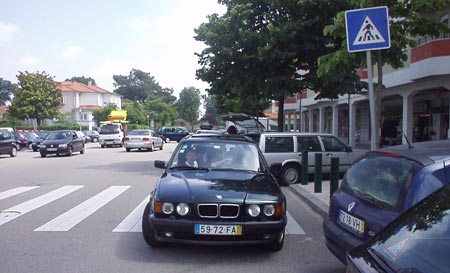
Lawless parking.
I usually think of over-traffic and lawless parking associated with Lisbon (half of the cars entering the city every day don’t have a park place) and never really looked at it from the bright side. Like prof. Hess pointed, most of the commerce in the city is still controlled locally; in fact restaurants, snack-bars, bookstores, drugstores, tool-shops, etc, are all run by small family business. They exist because the center of the city cannot take in the big malls and warehouses, and believe me, local stores are convenient and people use them. Obviously they depend on immense supply lines and deal mostly goods from abroad, but this was a good starter for what prof. Hess had latter to say.

A brighter side of Lisbon.
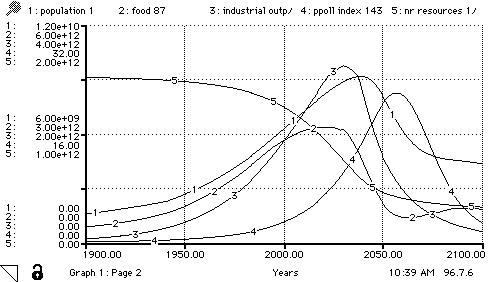
The base case produced by World3 in the late 1980s.
Eventually Mankind will have to shift the interaction with its Environment/Habitat to a Sustainable fashion. And prof. Hess explicitly indicated that he was using Herman Daly’s definition of Sustainability:
But this time the Limits are being faced globally, responses 1 and 2 will eventually become ineffective, these options can promise much but they just adjourn the problem - after all the Earth is round. We may bring War to Mars and Trade to Venus, but that won’t change much the picture either.
So we have the other two options (3 and 4) left. Here prof. Hess traced a line between those that favour Innovation and those that prefer Social Change, the belief that “Technology will save us” or that it won’t. He pointed that Innovation is mostly preferred among Europeans whereas Social Change has been studied more deeply in the US. Naturally prof. Hess is an adept of Social adaptation bringing us to the concept of Localism.
Before we move on let me just tell you that there are in fact people studying Localism (or some resemblance of it) in Europe. Especially two gentleman that I had the fortune to met at ASPO-5, Robert Hopkins and Folke Gunther, have some serious work in this vein. If you don’t know their work, check it out, it’s worth it.
But there's another issue not addressed by Innovation, the system that supports elderly people after retirement. Here prof. Hess focused on the US case where Pension Funds are either directly managed by Corporations or dependent on corporate results (through investment on stock markets). The individual becomes dependent on Corporations, and it's their growth that guarantees future pensions. Once growth constraints set in this system is bound to failure.
And so prof. Hess proposes a social rearrangement towards small communities where individuals create stronger bounds inside it and lessen dependence on larger organizations – something called Localism. Economic activity gets spatially constrained; goods and services are produced locally, mostly by small sized or family businesses, and consumed locally. Politically the governing responsibilities are concentrated locally and a local culture naturally emerges. Agriculture becomes the socio-economic center around which society gravitates, with communities becoming largely self-sufficient.

Local market.
These are the pillars of Localism, as laid down by prof. Hess:

Local transport.
Localism’s advantages on an energy constrained world are quite evident: the long supply lines that feed and clothe us and that provide the fabric of our homes become expendable; and with it the gross of our energy needs. With the economy evolving at a local level transportation of people and goods becomes marginal.
In the case of the US, with a population density of 32 people per square km, Localism looks like a realistic option, but what about elsewhere? The EU has almost 4 times the population density of the US, around 112 people per square km. Think of the triangle made by Paris, Amsterdam and Frankfurt, or the London metropolitan area, can all these people go local? And what about Localism in Japan?
But I have other question marks. Is in fact Sustainability self-evident on a local scale? On the source side of the interaction with the environment this is pretty much the case, but is it so on the sink side of it? What stops me from sending my waste downstream? It’ll disappear from my local environment, why bother further?
This last question takes me to a broader point: when going local it is easy to miss “the big picture”, you can see that your tree is healthy but at the same time miss that the forest is ill. Think of a natural disaster, can local communities fare better in face of such events? And Education, can local schools teach advanced skills to form doctors, architects, engineers, etc?
Don’t take me as adverse to Localism, in fact I can concept life on small local communities as better than how we live on the stressing hurrying metropolises. I just think that if our answer to the Hubbert Peak goes through Localism, once more the Lone Ranger will have to pack his belt.
Luís de Sousa
The Oil Drum : Europe
The talk by prof. Hess was organized by a group of Sociology PhD students, from a kin Faculty, integrated in a series of thematic sessions; this one was called “Other Habitats”. The session call had the following abstract:
The problems of global warming, resource depletion, persistent pollution, and habitat destruction suggest that human civilization is no longer adapted to its global habitat. The technology for achieving a transformation to a more sustainable relationship with the environment already exists in the form of green buildings, renewable energy, public transportation, and sustainable agriculture. However, the implementation of the transformation is proceeding at a very slow pace, and it occurs alongside ongoing growth of environmental deposits and withdrawals. This talk examines the argument that an economic system based on the large, publicly traded corporation with its emphasis on short-term growth creates a growth logic that is not adapted to the global ecology. The emergence of the localist movement in the United States--around small businesses, nonprofits, and local government agencies--is examined for its potential to generate a more liveable human habitat and an economy that is more adapted to life within the planet's carrying capacity.“Resource depletion” is a term hard to resist, especially when associated with someone with the curriculum of prof. Hess.
These subjects, that I’ll give you a bit insight, are covered in prof. Hess’ latest book, “Alternative Pathways in Science and Industry”, from which the first chapter is available online (here – pdf).
First impressions
Prof. Hess started by surprising everyone who didn’t knew him with a clean brasilian flavoured portuguese – he lived in Rio de Janeiro for some time – and used it throughout half of the presentation. The second half he hadn’t the time to translate.This was the first time prof. Hess visited Lisbon and he took his time touring. He was pretty impressed with the city, and said that comparing with the US this was Utopia. The words Lisbon and Utopia had never come to mind together, but prof. Hess explained how different it was from the American urban landscape built to the “scale of the automobile”.
Lawless parking.
I usually think of over-traffic and lawless parking associated with Lisbon (half of the cars entering the city every day don’t have a park place) and never really looked at it from the bright side. Like prof. Hess pointed, most of the commerce in the city is still controlled locally; in fact restaurants, snack-bars, bookstores, drugstores, tool-shops, etc, are all run by small family business. They exist because the center of the city cannot take in the big malls and warehouses, and believe me, local stores are convenient and people use them. Obviously they depend on immense supply lines and deal mostly goods from abroad, but this was a good starter for what prof. Hess had latter to say.
A brighter side of Lisbon.
The Limits and how Society faces them
The basic idea behind the talk was the concept of Overshoot – Mankind has exceeded the carrying capacity of its habitat and will have to face some sort of adjustment to go back into balance with it. Citing previous work by prof. Charles Hall, we were showed how the projections made in the early 1970’s by the Meadows work-group at the MIT have been essentially correct up to now. Mankind will face the Limits to Growth before mid-century.
The base case produced by World3 in the late 1980s.
Eventually Mankind will have to shift the interaction with its Environment/Habitat to a Sustainable fashion. And prof. Hess explicitly indicated that he was using Herman Daly’s definition of Sustainability:
Society can face Limits to Growth essentially with four different responses:
- Rates of use of renewable resources do not exceed regeneration rates;
- Rates of use of nonrenewable resources do not exceed rates of development of renewable substitutes;
- Rates of pollution emission do not exceed assimilative capacities of the environment.
-
Turning to the Outside:
- War – acquiring resources abroad;
- Trade – exchanging internal surpluses by needed items from abroad;
- Innovation – creating new processes and techniques that allow further exploitation of the habitat;
- Social Change – rearrange Society in order to diminish its resource requirements;
Turning to the Inside:
But this time the Limits are being faced globally, responses 1 and 2 will eventually become ineffective, these options can promise much but they just adjourn the problem - after all the Earth is round. We may bring War to Mars and Trade to Venus, but that won’t change much the picture either.
So we have the other two options (3 and 4) left. Here prof. Hess traced a line between those that favour Innovation and those that prefer Social Change, the belief that “Technology will save us” or that it won’t. He pointed that Innovation is mostly preferred among Europeans whereas Social Change has been studied more deeply in the US. Naturally prof. Hess is an adept of Social adaptation bringing us to the concept of Localism.
Before we move on let me just tell you that there are in fact people studying Localism (or some resemblance of it) in Europe. Especially two gentleman that I had the fortune to met at ASPO-5, Robert Hopkins and Folke Gunther, have some serious work in this vein. If you don’t know their work, check it out, it’s worth it.
Localism
The thesis put forward by prof. Hess is that Social Change is basically the only effective answer to the growth constraints we are facing. He doesn't see Innovation as a better option, for it may not deliver on its promises, but above all because it implies sacrifices from the individual – wind energy, hybrid vehicles, they all represent extra burdens for those who opt for them.But there's another issue not addressed by Innovation, the system that supports elderly people after retirement. Here prof. Hess focused on the US case where Pension Funds are either directly managed by Corporations or dependent on corporate results (through investment on stock markets). The individual becomes dependent on Corporations, and it's their growth that guarantees future pensions. Once growth constraints set in this system is bound to failure.
And so prof. Hess proposes a social rearrangement towards small communities where individuals create stronger bounds inside it and lessen dependence on larger organizations – something called Localism. Economic activity gets spatially constrained; goods and services are produced locally, mostly by small sized or family businesses, and consumed locally. Politically the governing responsibilities are concentrated locally and a local culture naturally emerges. Agriculture becomes the socio-economic center around which society gravitates, with communities becoming largely self-sufficient.
Local market.
These are the pillars of Localism, as laid down by prof. Hess:
- Finish Corporations, freeing individuals from corporate economic growth, making them reliant on the local community;
- Promote Local Businesses, creating economies independent of Corporations;
- Sustainability, provided by a local scale economy that makes sustainability issues self-evident;
- More Local Power, an improvement to Democracy.
Local transport.
Some thoughts and questions
First of all let me stress how refreshing it was to hear and see people from different scientific areas discussing the subjects surrounding the Hubbert Peak. Instead of the traditional technical/engineering talk, the social/political perspective can help you getting a boarder view of our future. It was really interesting to hear an attendant using the terms Myth of Growth during the Q&A.Localism’s advantages on an energy constrained world are quite evident: the long supply lines that feed and clothe us and that provide the fabric of our homes become expendable; and with it the gross of our energy needs. With the economy evolving at a local level transportation of people and goods becomes marginal.
In the case of the US, with a population density of 32 people per square km, Localism looks like a realistic option, but what about elsewhere? The EU has almost 4 times the population density of the US, around 112 people per square km. Think of the triangle made by Paris, Amsterdam and Frankfurt, or the London metropolitan area, can all these people go local? And what about Localism in Japan?
But I have other question marks. Is in fact Sustainability self-evident on a local scale? On the source side of the interaction with the environment this is pretty much the case, but is it so on the sink side of it? What stops me from sending my waste downstream? It’ll disappear from my local environment, why bother further?
This last question takes me to a broader point: when going local it is easy to miss “the big picture”, you can see that your tree is healthy but at the same time miss that the forest is ill. Think of a natural disaster, can local communities fare better in face of such events? And Education, can local schools teach advanced skills to form doctors, architects, engineers, etc?
Don’t take me as adverse to Localism, in fact I can concept life on small local communities as better than how we live on the stressing hurrying metropolises. I just think that if our answer to the Hubbert Peak goes through Localism, once more the Lone Ranger will have to pack his belt.
Luís de Sousa
The Oil Drum : Europe
Personnel
Editors
Contributors
Peak Oil Primers
Archives
- November 2010 (3)
- October 2010 (6)
- September 2010 (4)
- August 2010 (7)
- July 2010 (6)
- June 2010 (7)
- May 2010 (2)
- April 2010 (8)
- March 2010 (4)
- February 2010 (6)
- January 2010 (3)
- December 2009 (5)
- November 2009 (8)
- October 2009 (12)
- September 2009 (6)
- August 2009 (5)
- July 2009 (11)
- June 2009 (8)
- May 2009 (16)
- April 2009 (10)
- March 2009 (7)
- February 2009 (10)
- January 2009 (15)
- December 2008 (9)
- November 2008 (9)
- October 2008 (9)
- September 2008 (13)
- August 2008 (10)
- July 2008 (14)
- June 2008 (23)
- May 2008 (16)
- April 2008 (12)
- March 2008 (16)
- February 2008 (9)
- January 2008 (13)
- December 2007 (13)
- November 2007 (16)
- October 2007 (22)
- September 2007 (8)
- August 2007 (9)
- July 2007 (16)
- June 2007 (8)
- May 2007 (7)
- April 2007 (7)
- March 2007 (10)
- February 2007 (10)
- January 2007 (12)
- December 2006 (9)
- November 2006 (15)
- October 2006 (4)
- September 2006 (5)
- August 2006 (5)
- July 2006 (9)
- June 2006 (5)
- May 2006 (10)
- April 2006 (9)
- March 2006 (13)
Vital Trivia
License

This work is licensed under a Creative Commons Attribution-Share Alike 3.0 United States License.
Ya' gotta' love the way Professor David Hess defines innovation:
"Innovation – creating new processes and techniques that allow further exploitation of the habitat;"
Gee, and one would hope that innovation could help
(a) Get a greater amount of benefit out of each BTU consumed
(b) create structures of recycling and streamlining of consumption so as make production more efficient, and reduce demand on natural resources (i.e., products built with life cycle use in mind, and methane recapture from waste in which the methane would be used instead of being vapored off as a damaging greenhouse gas)
(c) create alternative ways to take advantage of heat and energy that is all around us but which does not reduce the amount of said heat and energy by using it (i.e., geothermal and heat from solar energy)
But no, sadly, innovation means only "exploitation".
Imagine education of our young based on the premise that innovation is exploitation....should it then be avoided?
The so called "green" and "sustainable" intellectuals though, cannot figure out why the average educated citizen shakes their head sadly and turns away.
This discussion is now being framed by the deep green and anarcho-neo primitivist philosophy. That's o.k., but it should at least be admitted by way of disclaimer if nothing else.
RC
I have two "solutions" that have nothing to do with localism:
1) Implementing a draconian world government which begins reclaiming all resources back into the commons, greatly restricting use and taking them out of ("off") the market - restricting the power of individuals and of corporations.
This would, btw, probably require WAR (solution nr. 1) to implement.
2) Growth and building "more": much compacter cities (like Hong Kong) which are built vertically (saves land resources) or are even suspended above ground. Solar and wind are collected better at higher altitudes anyway, creates shade to help grow plants /develop wildlife in presently desertified areas..
Draconian world governments? Resources reclaimed into the commons? Restricting power of individuals AND corporations?
You seem to have an affinity for that which lumps individuals and corporations together when it is the "fictional entity" known as the corporation that ALREADY "eats" its fill of individuals daily.
Are you by chance some perverse mutation of the "constant gardener"?
How about instead simply removing the legal concept of the corporation as "fictional person" (revoking corporate personhood) for starters?
That would go an awfully long way toward restoring corporations to their logical status as OBJECTS with NO RIGHTS other than what is permitted them by the people, or barring such a doubtful miracle, requiring that for every "human rights and freedoms" demanded by corporations, an equal share of responsibility is shouldered, from each according to "their" ability, thus rendering the "fictional persons" known as corporations more...."human" and thus more "local".
After all, as you well know, it's in vogue these days to remind everyone that "freedom isn't free".
Localization is simply a natural part of the ELP triumvirate
Economize
Localize
Produce
War torn humans smashed into compact cities with little or no resources will have no will or inclination to produce. Rather, they will be inclined to SUCKLE at the teat of the "mother state", they will be turn on each other and civility will be reduced to that of an animal level.
Why be civil when one's life has no value, when the individuals are, to quote Howard Beale, "utterly without value and as replaceable as piston rods"?
Hong Kong functions as a compact city because of its enormous wealth and production OF resources.
I think I'd like to pass on your Bladerunner-style dystopian bergscape.
:-)
Well, I can't reply to everything at the moment, so I'll take a chunk a time.
I never watched Bladerunner :-( , so I don't know which images are passing through your head.
"Are you by chance some perverse mutation of the "constant gardener"?"
Again, I'm not sure of your reference, found le Carre's book/movie with the same name, but is there something else behind it? (I'm beginning to feel pretty illiterate, or at least media-illiterate)
My point is, if you want to change the way we use (i.e. "exploit":-) our resources, you also need to change the way things work.
"Localizing" is a nice title, but it does not change the biggest problem:
MAKING SURE THAT EVERYBODY ELSE IS PLAYING BY THE "NEW" RULES TOO.
If "growth" is going to be reversed or channelled, then we have to make major, major changes on the free-market system, on the present world socio-economic-political system.
How do you do this? By taking away everyone's rights.
- Individuals need to be revoked of the right to consume at will (my example was the right of building anywhere, which is especially a US problem)
- Corporations need to loose the right to expand/operate at will in unregulated regions (moving offshore AND exploiting resources of 3rd World..)
- Nation/States have to be revoked the right to pass or not pass laws at will. Who's going to force the US to ratify Kyoto? Who's going ot enforce world wide laws??
The free market has its advantages. It however MUST be heavily, heavily regulated - which, on the global level, it is not at all presently...
--
My grandfather pumped oil with an engine-house,
my father pumped oil with a 20 lb. electric motor,
can't I just pump it online?
Or as Luis put it:
"Is in fact Sustainability self-evident on a local scale?
...
What stops me from sending my waste downstream? It’ll disappear from my local environment, why bother further?"
The movie "Bladerunner" is probably Harrison Ford's best early work. It was based on the SciFi Novella "Do Androids Dream of Electric Sheep?", written by Phillip Dick and also wonderful.
The concept of economic sanctions could be used against the US. The Bush administration is the most dangerous government in the world and the European Union and other civilized nations should have banned imports from the US long ago. That they haven't means the Europeans actually approve of the US's use of military power in poor Asian countries and its flaunting of Kyoto and other international laws such as kidnapping "terrorists" from their homelands and imprisoning them at Gitmo and other secret prisons.
Might help, but I'm not that fit in law to tell you what the consequences would be.
I think calling a corp. a person only means that you can deal with it as a separate legal entity..
Meaning, that it's the same thing as calling the corp. an "object", as you propose. Any lawyers here?
There's a book (and DVD!) called The Corporation, that explains the advantages that being a person in a legal sense entails for a corporation.
IT means the first paragraph of the 14th amendment applies.
http://www.law.cornell.edu/constitution/constitution.amendmentxiv.html
IOW, a state cannot close down a corporation's operation, nor deny it permission to open up, nor can it seize property in compensation for damage suffered, nor can it decide to regulate a particular corporation to protect its own local suppliers, etc, etc.
And the question of Luis' post ist, does this make sense?
He puts it in question. On a personal level, it is certainly the thing to do: "simplify" !!
On a political level, I think this is exactly the wrong thing to do.
If you plan on avoiding dieoff on the level of the human race (which I don't think is anywhere near inevitable), there are going to be a lot of non-voluntary changes in everybody's lifestyle. And like I've been saying, these changes will have to be enforced, probably from above..
How would you propose taking away "rights" from individuals, corporations and up til now sovereign states? I'm afraid the UN is not a very good response.
You might be imagining the worst case. I'm just assuming that these three groups will all demand their own advantage during the reorganisation..
..if that's the way you see ending suburbia. If you want to "save" the earth in any acceptable way, it will have a lot to do with sacrificing living space on the ground.
as if we had a great choice.. Resources WILL be strained.
And then you continue my example of Hong Kong. Funny that the Chinese there didn't roll over and suck on socialist teats.
Yes, Hong Kong is a good example of what will probably be a viable organisational solution, if not Cuba..
Yes but the "Hong Kongians" (is that right?) haven't had all their rights taken away by said "draconian world government"...not yet anyway. You're definitely leaning toward Cuba with the DWG model for sure...not that we can't learn an awful lot from the Cuba model to be sure.
Depending on how things go in the next couple of years we may very well see large parts of this country wind up looking very "Cuban".
Roger, "exploitation" was my choice of words.
It has no intended negative semantics; think of it like using fertilizers to increase crop yields per hectare, or putting a thermal solar panel on your roof.
Luís,
Please accept my apology for the misatribution, and if I engaged in rhetorical overreach, I again apologize.
I have been on something of the defensive, attempting to provide any technology with the justification to exist, so yes, a thermal solar panel would be welcome, and I will attest to the miracle of composting in the garden, so that is more than enough for me. :-)
I think I am going to save the very nice article and string of posts on concentrating solar power from TOD the other day, and just go off and study for awhile!
Thank you for your post, it made me think of a simpler time, of the "Village Homes" Development of Micheal and Judy Corbett from back in the '70's, and the "New Urbanism" ideas. As us boomers get older, we are going to learn to live in communes again.....only now they will be called "Senior Towers" "Retirement Communities.", so our lifestyle is already set anyway....:-)
RC
Remember, we are only one cubic mile from freedom
I'm not trying to push either way; Innovation or Social Change, both have its goods and bads. The all point is about "Silver Bullets", and how complex are the problems the Hubbert Peak raises.
Great RC, You have just made ten points in The Great Flummox Google with Innovative Jargon, game.
Your search - anarcho-neo primitivist - did not match any documents.
Suggestions:
* Make sure all words are spelled correctly.
* Try different keywords.
* Try more general keywords.
* Try fewer keywords.
Think of the innovation of using wind power to create electric power to use for personal warmth compared to grabbing a sheep chopping off it's hair (yes I know professionals use the term wool but I want to be all inclusive with my jargon) anyway, chopping off it's hair and knitting a sweater to keep warm...of course if you would prefer new innovation even here, possibly a new glue to apply that hair with would be more to your tastes? ;>)
(edit)
I shouldn't get carried away like that but when I read something that avoids the problem and then you, Thats it, feed into that avoidance how can I be serious.
we get this:
and then nothing but wallpaper.
"Your search - anarcho-neo primitivist - did not match any documents"
Well, re-enter it now, because it does...my reference on TOD!
Holy Cow, I've created a catch phrase! :-)
Well, actually I didn't, I just mis-combined a well known set of philosophies:
http://en.wikipedia.org/wiki/Anarcho-primitivism
http://en.wikipedia.org/wiki/Green_anarchism
http://en.wikipedia.org/wiki/Green_Anarchist
http://en.wikipedia.org/wiki/Eco-anarchism
http://en.wikipedia.org/wiki/Neo-Tribalism
RC
Remember, we are only one cubic mile from freedom
I think the point was to highlight the differences between the strategies; without social change, the application of technology will indeed focus on further exploitation of resources, not diminishing their use (that is explicitly included under social change).
I think thats slightly unfair. efficiency gains are increased exploitation in a sense.. It would be odd to if hess is against efficiency gains
process that further exploitation can be seen as efficiency.
semantics aside I think we can stretch boundaries... In essence you are attcking the meaning of a single items wording here...
how about the general analysis or thrust of his argument...do you find that equally unsound?
Boris
London
One of the issues is that Localism is in conflict with economic growth, at least the way we do it now.
It doesn't help to make a few bicycle paths in a town and put up some posters about 'going green'. At one point, you have to say: we will invest the majority of our money in bicycle paths and we will close down the city centre for cars.
At that point, the conflict becomes pretty clear. That's also the point where most people won't put words into deeds and back off.
Localism was put forward by prof Hess as a Social answer to the end of growth (at as we concept it today). There's no conflict.
Well, maybe there is still a small conflict ... ;-)
You can't just say: Let's stop growing. That would basically mean the end of society as we know it. (Sounds a bit dramatic, I admit)
Our society is build around the assumption that we grow it x% per year. That's going to be difficult in a world with finite resources, but 'pulling the plug' now means basically refusing people a fighting chance.
Richard you’re misinterpreting what’s going on here. No one wants to “pull the plug”; we’re just wandering “what are we going to do when the plug is pulled?”
I think you're getting caught up in a chicken/egg discussion.
"what are we going to do when the plug is pulled?"
We are going to pit our interests against each other, like Richard is trying to point out. The "dog eat dog" world is about ready to become just that...
Luis,
Prof Hess lists 4 points, two of them are:
This is a problem.
Corporations are enormous wealth creators. If we just abandom them, we go to a village economy that India has been untill about 1990. That means poverty, you know. You don't really think we can all live reasonably happy by making wooden furniture in the shed and trading it for bread with our nextdoor neighbour?
I don't want to be too negative, but what if we just try to keep the best of our economy up and running and fix the part that is broken? Prof Hess seems to think all is lost and best is if we just give up.
I think we easily can reduce our energy & resource consumption by 30% without any significant change in lifestile and another 30% with only small sacrifices. How about we do that first?
This is simply not true. Up until the 1970s stagflationary period there were almost no Corporations in Europe, and individuals did not depend on them for Retirement (as is pretty much the case today). Monopolistic businesses like water/electricity supply, phone networks, etc, were state owned, and please remember that there were still some fascist states in Europe at that time. Then the neo-liberal politics set in and the picture changed.
Also think of the Soviet Union of the late 1970s, obviously they were profiting from being the world’s largest oil producer, but they didn’t need Corporations to be wealthy.
The Soviet Union of the late 1970s? I'll take corporations over gulags any day.
?
Could you define what you mean there? (I think you have something else on your mind.)
Let me start with the German ones, who til the 1970s were very very successful on an international level:
VW, Mercedes-Benz, MAN, Allianz, Siemens, AEG, Grundig, etc.., etc..
Luís,
What I remember from history class is that after WW II, the economy changed, from a village type economy to a much more international / global economy with much deeper markets. Both manufacturing, service and financially.
This change already started in the US and Europe before WW II and this process really caught speed after the war. Remember 'whats good for GM is good for America'? This process is no different in Europe as in the US. There are many examples of large international companies who really grew after the war. Philips, Royal Dutch Shell, Fiat, etc, etc.
If I look at who is really creating wealth today, I see that a lot of it is done in large corporations. Not in the small shops that sell clothing, or where you buy coffee and something to eat. It's the large manufacturing and service providers that create wealth and thousands and thousands of good paying jobs. Did you ever see a shop assistant making 100.000 euro a year? How about a senior engineer at * insert technical company * ?
If we abandon all this, we drastically reduce our productivity. And thus we drastically reduce our wealth. And I'm afraid: yes, that means poverty, like in rural India today. There is no reasonable scenario where we can come even close to maintaining a reasonable living standard, let alone paying pensions to the retired, without maintaining our massive productivity.
Small remark about the Soviet Union: It also had large corporations. Only they were owned by the state (or by the maffia actually) The only difference between the SU and the free world is how close incentives were linked to people. Apart from the massive political oppression, that is.
Hi Richard,
Somewhat late in the day to comment - but it's such an important topic.
re: "If I look at who is really creating wealth today, I see that a lot of it is done in large corporations."
Could you possibly go into a little more detail on this?
What is it about corporations that makes them "create wealth"?
What is it about the corporate structure that you see as necessary?
If we have large manufacturing plants, for example, does this necessitate corporations?
Or...?
Is there any alternate organizational structure that might work as well?
Is there any alternative structure that would allow for restrictions, such as local anti-pollution laws, or other things people see as "good".
Anyway, I'd like to hear more if/when possible.
"Growth" won't be a binary on-off sort of thing (like a light switch). Thinking of it as "growth simply ends" or "pulling the plug" destroys all the mental elbow room for realizing how we can and will adapt.
Instead try thinking of the end of economic growth (as we know it today) in stages. Like a car accelerating up an incline that loses power...
Today we are using our power to accelerate up an incline ("accelerating upward" being = to economic growth). The vehicle would not normally go up an incline on it's own, much less accelerate, but the use of power lets it do these things. That is our growth today - of population, resource use, economic growth, and virtually all the things that do not fit the category of 'sustainable'.
Next the vehicle loses power - for whatever reason. First, it stops accelerating. Not that it stops going uphill - momentum keeps it moving upward - but it ceases to accelerate and begins to slow. In economics this would be called a "recession", a period of slower than desired growth.
Next, the momentum slips to zero and the vehicle momentarily stops on the hillside. This is a balance point between recession and depression.
Then gravity takes over and the vehicle begins to roll back down the incline - this is negative economic growth, economic contraction, depression.
At the bottom of the incline the car coasts to stop and becomes stationary - the mysterious "Steady-State Economy". A condition that is often feared simply because it is the great unknown.
Recessions shake the status quo. It is a rough time for people. Businesses that rely on growth fail, as do those that are over-extended, or rely on discretionary or frivolous spending. They are tough times, but not the end of the world. The do alter the status quo to favor "recession-proof" business models. This is the first stage of adapting, of changing.
Depressions are much worse. They wreak havoc on the status quo, and on the lives of many many people. They lay waste to so much of the economic landscape that a new status quo is virtually guaranteed - one that reflects the conditions at the end of depression.
Which brings us back around to that vehicle sitting still on the flat ground below the incline, the Steady-State Economy. If the changes in energy availability play out in the future like the tail of Hubbert's Curve, then the conditions will be so different from today that there is no chance that the status quo of today, the economic growth paradigm of today, or the ever accelerating trends in energy, population, globalization, etc of today will shape the creation of this new economy.
I don't know what it will look like, or how it will work, or barely even what to do to prepare for it. But that does not mean that a steady-state will not be created. Just because we can not imagine something does not mean it will never exist...
Well, it wont ever exist in a timeframe worth discussing. At 3% energy consumption growth per year we're still some centuries from coming close to using up the solar budget.
At one point, you have to say: we will invest the majority of our money in bicycle paths and we will close down the city centre for cars.
If you ban cars there is no more need for bicycle lanes. (Actually, there is no need for bicycle lanes at all. They were invented by car-centric urban planners and serve for getting the bikes out of the cars way.)
Actually, I think that even if you get rid of the cars, you need separation between pedestrians and bicyles in certain areas. I ride a heavily used bicycle lane in Boulder which has lots of pedestrians and it is dangerous for both the pedestrians and the bikes. This doesn't mean all bike lanes need separation; it depends upon the density of different modes.
Yeh, perhaps separate bike lanes were invented by car centric planners, but they are certainly a lot more pleasant, in general, than having to worry about cars.
In the pedestrian mall in Boulder, bikes are banned for good reason --- there are way too many pedestrians.
Yes, pedestrians should be protected from both bicycle and car traffic.
One major street north-south and one west-east reserved for bicycle traffic in a city would be a great start.
Localisation is probably the only viable long-term solution
to the problems facing mankind, and for this to work will
need to be combined with a drastic reduction in population
levels, and a more equitable sharing of resources.
Those who have done very well under the existing economic
system will (perhaps correctly) see this as a form of Communism, and bitterly oppose any change. It is of course
these people who control the main political parties, so
don't expect to see any alteration to the status quo.
Localism has its roots on agrarian Anarchism, one of the earliest forms of Socialism (along with Reformism and Communism).
But as out laid down by prof. Hess the production means are kept on private hands, so I don't think it configures any Socialist setting.
That's a lot of 'isms' to swallow at once. Perhaps what we will see is a new[ish] one - Survivalism - that will be rather more pragmatic by necessity, at least at first.
The human tendency is to band together to survive a threat; once the threat has passed or been mitigated, we return to hierarchies and social divisions. This banding together is what makes war an acceptable tradeoff to many because the social strata are temporarily suspended. A prince and a pauper will pull evenly on their oars until the lifeboat reaches land.
What follows Survivalism will be the interesting part.
As a child, I and sibling(s) were sent for vacations to family in the South of France. As a small tot, I remember there being no electicity. These people were not poor - they owned land, and a car; they were not yet on the grid. Soon light came, though.
It was principally a flower farm. Children were prized, small, nimble and quick, as picking jasmine is easier for a child than an adult. Up each day well before dawn, we were, to work in the fields.
Heat was provided with wood or coal. Water came down the hill and was shared by the farms along the route in a complicated water-sharing / irrigation system. Small agricultural machines ran on gas for digging and spraying, all the rest was done by hand. They kept rabbits and chickens, and produced wine, nut wine, orange wine, fruit -dried figs amongst others-, vegetables, and olive oil. The car was used only to transport matériel/goods and for some rare outings. The neighbor had donkeys, which he lent in exchange for produce. Walking to the two available shops took an hour and the donkeys were cool. A bus to the town (Grasse, perfume industry) was available after a good long walk.
I learnt to count there. I would gaze at the vista - to the sea, the Med - then, it was almost always visible, and count the white or grey spots that were houses. 4...5... then I could count to 11! The 60’s hit and rapidly no human or machine could count the houses, and I of course lost interest. Today, the entire area is completely built up. Completely! From 50 kms. inland down to the Med, it is the French version of MacMansions. I was going to post a Google Pic but it depressed me too much. You cannot produce anything there - except maybe for tiny fruit/veggie garden. A few pigs perhaps. (It used to be populated by sheep.) That’s it. Maybe you could grow mushrooms in the swimming pools.
Hi Noizette,
I found this beautiful - thank you. Sad, of course, as well.
Noizette, it is indeed sad, but many French still want that way of life. Unfortunately, the economy now gets in the way of people living the kind of life they would like.
Many people in the countryside still grow vegetables, fruit, raise chickens, rabbits, make wine, etc. Not because they need too, but because it is part of their culture. In the UK, people doing the same are considered somewhat eccentric.
I myself have joined the French and their love of the land. Should the economy fall apart as I suspect it will, then the French have tradition and local knowledge to fall back upon. In fact the sooner the better, before the curse of economic pragmatism transforms the French into dependant zombies like the British and Americans. Debt culture is already making inroads into French society.
Triumvirate of collapse - Economy, Ecosystem, Energy
I think it is the other way around: when a threat is present, there is no time for discussion, only for following orders. In all days and ages the upper strata stayed far from the heat of battle, and let the paupers be the cannon fodder. If there is a typical example of a hierarchical organization, it's an army, no? (The only exceptions would be medieval knights, but in that case the idea was to capture, not kill the (heavily armored) noblemen and ask ransom. Samurai groups often compared their relative strengths and decided who the winner was without fighting.)
I think the success of localism will depend upon the locality, especially climate and availability of local resources. Yes, we need to increase the degree of localism, but recognize that the extent of localism will depend on where you live. It is a lot easier to localize in most parts of California than Colorado.
Ideally, of course, we would shrink the population so that we could concentrate in those areas that are the most feasible for localalization. In the mean time, we have to muddle along with the cards we have been dealt.
We will always have and need trade, regardless. After all, trade existed way before fossil fuels.
Repeat after me:
Separated Bike Lanes.
Separated Bike Lanes.
Separated Bike Lanes.
Changing transportation from FF to human power or electricity is key.
If human powered, most of the health problems we currently experience will go away!!!(think about it, obesity, diabetes, weakness, and heart disease are symptoms of not exercising and letting ones body atrophy)
Absolutely, we need separate bike lanes. A truly wonderful thing which I have spent many hours enjoying both in Frankfurt, Germany and Boulder, Colorado.
In the mean time, cars still proliferate. Despite the access to bike alternatives, the traffic in Boulder just gets worse and worse. After spending a day there, I need two days to recover in order to flush out all the toxins. My guess that those who live there don't realize how toxic it is because they know nothing else. This is probably true of cities in general. And Boulder is relatively clean!!
Many of the maladies you speak of can also be caused by air pollution.
The irony is that Boulder is the first, perhaps only city in America, to impose a carbon tax on itself, voted by the people. They are planning to cut carbon but cannot come close to any reasonable goal unless they cut way back on the automobile's domination of this supposedly enlightened and progressive city.
Boulder built a new mall which lets you drive right through the center of it. Somehow, that is not what I envisioned. Aren't malls for walking?
If they have the balls to say no to the auto, then I will believe they are serious. Otherwise, it's just the typical Boulder bullshit.
Build parking centers outside the city. Require buses, street cars, and light rail to ferry you into and out of the city. Also allow shared NEVs within the city and to and from the parking centers. Under this arrangement, bicyclists and walkers will rule.
the diseases i talk of have NOTHING to do with air pollution.
Heart disease? Your heart becomes:
-too engorged with fatty cholestrol deposits
-too weak to pump
In both cases your heart fails to deliver blood. Air pollution is definitely not a major factor here, let alone even considering it a minor factor. Exercising will reduce cholesterol buildup in your arteries/veins (your metabolism will utilize fatty acids stored in your blood)
Diabetes HAS NOTHING to do with AIR pollution, it is generally two things:
-Your body becomes resistant to insulin
-Your body attacks the pancrease and the islets of langerhorn or something (where insulin production takes place)
Exercise increases insulin sensitivity, and cannot protect against #2. Exercise also balances the bodys insulin response to food inputs.
Obesity has nothing to do with air pollution. It can be solved using the first law of thermodynamics, burn more energy than you intake to lose mass. Biking provides for the energy loss and you get skinnier and fitter. Both in strength terms and cardiovascular system!
One must acknowledge a problem exists before finding a solution. Cars are a symptom of an overabundance of cheap energy, current living conditions in 1st world countries the same. I like living like this, and I know I can afford to bike around for a long time still to keep myself living like this.
Repeat after me:
Wrong.
Wrong.
Wrong.
--at least for separated bike lanes of the sort shown in the head post, over the caption "local transport". That type of bike lane functions as a second sidewalk. Its real function is to endanger the cyclists by hiding them out of sight and out out of mind of the car drivers.
Perhaps it also makes some exceedingly foolish cyclists feel "safer", but it is very hazardous, as about 98% of the crashes occur at intersections, and the incidence is doubled or even quadrupled. In my city, sidewalk-riders are regularly nailed, and occasionally killed, because they are out of sight, out of mind:
(and that's to say nothing of the hazard from blind driveways, nor of the fact that lanes like that force cyclists to pop out of nowhere and often to go the wrong way - i.e. surprising other users - through intersections.)
If you want real safety rather than a dangerous illusion of safety, then consider the work of Hans Monderman. Of course, if you can get rid of the cars entirely, then perhaps the hidden bike lane might become "safe".
Of course, if you have got rid of all the cars, then you don't "need" the lane. But that will never happen: the disability lobby will never permit it. So fuhgeddaboudit.
Paul, I agree with almost everything you said.
However, there is another aspect to this: those separated bike lanes, like the one in the photo, really do seem to increase cycling. I was in Montreal recently, a city where that kind of cycle path is heavily promoted. I was much impressed with the sheer number of people out there on bikes. I was a lot less impressed with their traffic behaviour, which is totally anarchic.
The downside to Montreal's cycling culture is a very high death and injury rate. Just as you said, these pathways provide the illusion of safety, not real safety. But it seems to be that illusion that gets people out there on their bikes. Does that benefit outweigh the resultant death toll? That's an interesting ethical question.
Driving in Montreal is friggin' crazy.
Less crazy drivers == a good outcome.
It's like there are no rules, and no nothing there.
As for death tolls, if you stopping from driving to work, and biking instead saves you 40$/week in gas, you can afford to eat when others cannot!
My impression is that Montreal drivers have much improved. Maybe there was a crackdown or something.
But Montreal cyclists are completely lawless and unpredictable. I'm sure that is a factor in the high death rate.
Separated bike lanes will not function as second sidewalks with clear markings. Do you walk in the middle of the street? Does the street function as a 'second sidewalk'?
People naturally yield to faster and more massive objects, using separated lanes codifies this and most/all will understand the function.
As to injury, what is the difference in severity of injuries? I am willing to accept even a 10X increase in skinned knees, bruised elbows if fatalities from biking are reduced. With proper signage and lights at intersections, bikes are perfectly safe and compatable with drivers.
In addition grouping sidewalk riders into a separated bike path study, such as your link does, is blatanlty retarded. If bikers stick to the separated paths, then use studies which examine the incidence of injury ONLY on separated paths, ONLY on sidewalks, ONLY on streets, and the combinations thereof.
The disability lobby could easily pay someone to bike them into a town centre, (or electrified rail if that ever passes)
You seem to have an unnamed assumption that all bike lanes will be created stupidly. Let the engineers figure it out and it should all be fine.
As someone who's cycle-commuted to school and work for over two decades now, this discussion has spurred me to make my first post on TOD. :-)
Gilgamesh: "People naturally yield to faster and more massive objects, using separated lanes codifies this and most/all will understand the function."
Correct. But that segregationist approach is counter-productive to useful, safe cycling. On that theory, you would also make separate lanes for motor scooters, cars, trucks, garbage collectors etc - clearly not workable. A better approach is to develop a culture of responsibility to obey the laws, uphold people's rights to use the roads and look out for the more vulnerable road users.
Gilgamesh: "If bikers stick to the separated paths, then use studies which examine the incidence of injury ONLY on separated paths, ONLY on sidewalks, ONLY on streets, and the combinations thereof."
My terminology: "bike lane" = a marked lane on the road dedicated for bicycles, "separated lane" = a lane between road and footpath, not accessible to motorists, and "bike path" = off-road bike path, probably shared with pedestrians.
Is there ever going to be a city where every home and business is fully connected by bike lanes and/or paths? I doubt it. The reality is that for useful transport, cyclists need to use normal traffic lanes on at least part of their journeys.
In my experience (mostly Melbourne and Sydney), the effectiveness of bicycle lanes and paths is very specific to local conditions.
Bike paths are useful alongside rivers, train lines, freeways etc, that have few crossing roads so the cyclist doesn't have to frequently give way to road users.
Bike lanes are most useful on streets with few intersections. As someone else already noted, cyclists in the bike lane are not so visible to motorists, and turning motorists will cross the bike lane, maybe without checking it first. Using a bike lane to under-take a queue of stationary vehicles past intersections can be dangerous due to poor visibility, and the chance that the queue might start moving and a motorist turn across your lane unexpectedly.
For a bike lane to be effective and safe, the street must be wide enough to accommodate it in the first place. Bike lanes painted alongside vehicle parking spaces often try to position cyclists in the "door zone", which is very dangerous. Another problem with bike lanes is that they are often blocked by parked couriers, construction activity etc. Being "stuck" in a bike lane or separated lane makes turning into a side street more difficult for the cyclist.
Segregating cyclists and motorists is not always the best approach. Riding the bicycle as a vehicle and part of the traffic stream may be a cyclist's best option, depending on:
- Rider skill and experience.
- Road conditions, eg width of lane, cross-roads.
- Current motorist speeds and density.
- Cyclist speed (eg downhill).
- Motorist attitude and behaviour.
See:
http://en.wikipedia.org/wiki/Vehicular_cycling
http://en.wikipedia.org/wiki/Bicycle_path
http://www.bikexprt.com/streetsmarts/usa/index.htm
It's really "horses for courses". Up a long hill beside a park with no cross-roads or driveways I may ride slowly up the footpath like a pedestrian. In congested inner-city streets I often ride as a motor scooter rider does, in the centre of a normal traffic lane.
One skill that's important for vehicular cycling is being able to travel in a straight line while indicating for several seconds and turning your head to look at the vehicles behind you. Very useful for turning, merging and changing lanes.
I've ridden a bike in Hanoi in 1996. It was amazing, very few cars on the road, cyclists moving together like schools of fish. If a cyclist or motorcyclist ran a red light, the policeman on the corner had a stick to hit them with as they went past!
Look at pictures of western cities in the early part of the 20th century, up to the 50's. Cyclists all over the roads, very little space consumed by parked cars.
My vision for western cities as cycling makes a larger share of transport trips is:
- Bicycles given the status of roadworthy vehicle (if they aren't already).
- Free bicycle education in all schools.
- Subsidised/free adult training in cycling skills.
- Cyclist awareness included in driver tests.
- Driver tests must be renewed regularly.
- Government advertising to improve public awareness of cyclists' rights.
- Bike paths alongside all trains, freeways, rivers etc.
- Bike lanes provided where useful and safe.
- Take away "traffic calming" narrowings in roads.
- In residential areas, use long, wide speed humps to slow motorists.
- Road rules properly enforced on cyclists.
- Stiff penalties enforced for negligent/dangerous use of motor vehicles.
- Equalisation or removal of special treatment given for motor vehicles, eg tax breaks, parking, access to areas etc.
- Facilities to integrate cycling and public transport, including taking bikes on trains, trams etc.
Gilgamesh: "You seem to have an unnamed assumption that all bike lanes will be created stupidly. Let the engineers figure it out and it should all be fine."
LOL! The problem is that transport engineers currently seem to be focussed and prioritised on motorists, and have a very limited understanding of cycling needs.
Obviously different roads have always been used for different modes of transportation. Highways in Germany are not allowed for pedestrians and bikers. Pedestrian zones are not allowed for cars and bikes, except at delivery time.
I think one should give reserved bicycle lanes a try. Preferably lanes that really serve to cross a city. Of course pedestrians could be allowed on each side, but I'd really like a kind of main road for bikes alone. Reserve another one only for cars if necessary.
There are many Amish families here in Decatur County, Iowa. No cars, no electricity, very hardy and hard working and still just as rotund as everyone else. Maybe they should pull the buggy and let the horses ride. It is not a lack of exercise which accounts for the shape but what and how much they eat.
If I'm not mistaken, the picture of the market is of the Farmer's Market in Arcata, California, my home town. From Lisbon to Arcata....Ah.....globalization.
In fact I don't know where those two last pictures are from ... they're just illustrative. There's nothing like it in Lisbon.
Arcata, (known to its critic's as The People's Republic of Arcata) is a progressive University town of 15,000 on the north coast of California. In the 1970's it constructed a wastewater treatment facility that used wetlands and created a wildlife sanctuary in the process http://redwoods.info/showrecord.asp?id=1729 .
It has had a farmers market in the central Plaza for many years, where local farmers and craftpeople sell their wares. local musicians perform and people just get together and visit.
Arcata also has a bike library where less than perfect bikes can be checked out for a $20 deposit.
http://redwoods.info/showrecord.asp?id=1729
I'm not so sure about that. On the right, it is only neocons and fascists (I'll leave it to others to argue about whether or not those are one and the same) that like big centralized government. Libertarians and Tory/paleoconservatives would be very sympathetic towards the notion of shrinking central governments and devolving political power back to the local level. At the same time, the left is populated with plenty of people, including all state socialists and communists, who are advocates for big centralized governments.
It is probably valid to assert that most people on the right, regardless of flavor, see no problem with big corporations dominating the economy. Libertarians and Tory conservatives are sympathetic toward small businesses as well, but not beyond simply assuring that they have a level playing field on which to compete. The left is generally hostile toward big corporations, but that does not uniformly translate into advocacy for small local businesses -- more often what is seen is advocacy for state socialism.
The "Left vs. Right" paradigm is becomming increasingly irrelevant in describing the actual political landscape.
There are many problems with "Localism" as a political & economic platform. The notion that specialization and division of labor can be essentially done away with is ludicrous, no society is going to give that up. Even if the cost of transport shortens supply lines, some trade between communities is going to continue to happen, as will trade between specialists within communities -- it is simply too beneficial for it to not happen. There is also our old nemesis war; unless human nature is changed through genetic engineering, war will continue to be a threat, and communities are going to find it advantageous to band together for self-defense rather than trying to stand entirely alone.
Therefore, I believe a more useful and practical concept to embrace for the adaptation and reform of the political and economic realm is SUBIDIARITY.
Under the concept of subsidiarity, political and economic activitiy is organized and operated at the lowest appropriate level and scale. In practice, this means that most political and economic power is devolved to local communities, and thus shares much of the agenda of localism. Unlike localism, however, subsidiarity recognizes that it is neither desirable nor often possible for local communities to be entirely self-sufficient. Progressively larger federal networks of cooperation and interdependence are nurtured for the mutual benefit of the constituent communities. Political, economic, and social institutions that cannot be maintained at the individual community level become possible at these larger scales.
I anticipate that critics will immediately retort that any such larger scale cooperation will become impossible because there will be no energy inputs to sustain it. It is certainly true that the present panoply of large governmental bureaucracies and mega corporations that dominate the landscape are unsustainable. I would point out however that overland and maritime trading networks and trading fairs were common even among neolithic peoples. Even native American tribes sometimes established loose federations for peace and mutual defense. Instituions of higher learning existed in medieval towns and even in ancient Athens. Asserting that the only choice is either to maintain the entire energy-intensive superstructure we have built or to devolve to neo-primative, hermetically sealed small communities is a false dichotomy. The first option is obviously impossible, but the other option is by no means necesssary or desirable or inevitable. We will certainly need to see much devolved to a localized level. But it is not impossible, even given severe energy constraints, to maintain some interconnections and some cooperative larger-scale institutions between local communities.
Thanks for an interesting comment.
I agree with that, associating Localism with the Left doesn’t make any sense. As I stated above you can trace Localism's roots to agrarian Anarchism, but today it is a completely different thing for it advocates private ownership of means of production.
I disagree with that. Such claims are typical Liberal discurse, which just tries to make people forget about opposite political veins. There’s a world of a difference between a society were the means of production are controlled by the state and another were they’re not. I can eventually acknowledge that today’s political fight goes more between Liberals and Non-Liberals.
I don’t think we need a new name for that; it has been usually called Federalism throughout History.
You advocate an interesting federal setting were the power goes up only when strictly needed. This opposes the current US Federation that concentrates power at the highest level. In its early days the US functioned closer to that Federation you described, but after the 1860-64 war, it progressively centralized the power at the highest level, as the communication technologies allowed it.
Maybe with modern means of communication that light-weight Federation you suggest won’t be that hard to maintain.
The right/left prism is not useful. “Subisidiary” arrangements in the western world are all topped off with a Federal (type) hat, principally for 3 reasons: a) Our Nation states (defence for ex.), b) the fact that there is power to be had at the top, c) the need to quash conflicts between regions and provide some form of ‘compensation or ‘balance.’
In the ‘developing’ world, relations between regions/tribes/etc. where Central Gvmt. is non-existent or very weak are sometimes catastrophic, very violent, devastating. Of course many examples of peaceful trade and co-existence exist. Now that does not mean that things cannot change; particularly, one might argue that problems between ‘regions’ (the smallest reasonable entity; or entities that seem appropriate in size) might be diminished by *more* power at the local level. But history, on the whole, is not kind to this pov.
In the Western world, we can examine examples of ‘devolution’ or ‘regionalisation’ (eg. Spain, France, Ireland) and examples of the opposite, a move towards more cooperation, sharing, and centrality (Switzerland, the US) - and come up concluding that, well, err, there is some illusive balance - never the same in different places - that is perpetually out of grasp, but that must serve for now.
The last difficulty is that the entities are defined territorially - with a map. We can see Gertrude Bell with her measures; all the colonialists in fact. It makes sense: people have roots. Resources are located somewhere, like in Russia. But in today’s world, with its multiple overlay structures on territory (eg. global capital which roams freely; transport routes; new geographical definitions, such as ‘has snow’, ‘is near sea level’, ‘imports wheat’, ‘belongs to AELE’ - which is political - to mention only the obvious), the corporations, and the emergence of ‘new tribes’ - eg. mobile workers that belong to the ‘elite’ - the definition of ‘localism’ is a tough call. I myself don’t know what it means, beyond a sort of anarchist, individualist, community driven type meme. Back to the past - modern - thus corporate - feudalism or some such. Anyway, just musing about it all.
"I myself don’t know what it means, beyond a sort of anarchist, individualist, community driven type meme."
Or lock yourself in a room and communicate with the world through internet while growing vegetables on the roof?-)
Bryan's "The Vermont Papers", now in reprint, is all about this. He makes it very clear that the "communitarian" concept is neither right or left. You help your neighbor when you see him in the ditch because 1) he'll help you and 2) he'll recognize you tomorrow and know you didn't, etc....
Decisions need to be made at the smallest relevant scale. I don't think that will take more energy. There is a huge amount of embedded energy in hierarchies and administrative structures required to maintain complexity. Backing off from complexity to simplicity will take less energy - history shows that - and changes the form of energy required.
The classic structure Bryan uses is larger scale organization develops standards and provides library of technical expertise but decisions are localized. So for a river, the state might provide tech services and standards while the string of communities along the river jointly decide on uses of the river. Contrast that with a DEP where the agency develops standards, regulates, enforces AND is charged with helping businesses "navigate environmental regulations" - it makes for lots of corporate funded lunches.
There are all sorts of problems with it, but opportunities as well. Why, for example, should the Feds be making laws (US) that prevent communities from banning GMOs, regulating water, corporations and so forth? It's easier to own the Feds, that's why. But locals, while many many more, can still be owned.
Bottom line, size matters. A lot.
cfm in Gray, ME
Gee, what you just described is the US Constitution. Specifically limited Central Governement with all other powers going to the individual States or the people.
Unfortuately we have the Republicans which are constantly moving more towards Fascism and the Democrats which are moving towards Communism both of which are all powerful Cental Government entities.
I don't see either political party taking any action in the forseeable future that will return the Constitutional powers they have wrongfully usurped back to the States or the people. We will continue to lose our individual freedoms and privacy at an ever increasing rate. The coming energy problems will only accelerate the coming transition to one form or another of absolute dictatorship. You will all do as you are told because "It's the Law".
Sadly, I see an awful lot of posts here advocating trying to control other peoples lives to suit the posters socio-political thinking via the "It's the Law" activities.
Interesting… I see it the complete opposite way, both moving towards Liberalism. And that’s basically the politics that they put forward.
The Democrat party is openly following a Liberal agenda; confusing that with Communism is quite hard.
The way that both the US Congress and Senate are facing increasing oil prices is a clear sign that they are not following fascist ideas.
Nice piece!
Let's start with the oil companies, at least that way if we at first fuck up, we really won't be losing anything.
As far as the traditional left/right, I completely agree it is of little or no value. Over here in the States, it wasn't until the New Deal, that the "left" bought into centralization as democratic. The New Deal was reactionary -- a reaction to the national/global economy that had been created by modern industrial/financial corporations.
Previously, Thomas Jefferson gained one of the few real physical laws of politics - democracy is by nature decentralized. In the American tradition, the "d"emocratic - small "d" - response to corporate power was anti-trust or to break them up. It was a response shared by both Democrats and Republicans, but since the New Deal's capitulation to corporate power, it basically became a dead issue and now that corporations completely control the US government, it's bad conversation in "good company."
Nonetheless, any poll over here that asks the question, "Do corporations have too much power," is 80% affirmative, but any response crumbles, and rightly so, if you say DC is going to have more power. We need to break-up the corporations and create distributed networked government, we can actually improve the future.
Delenda est Exxon, Shell, BP et al - hah.
I suppose this article is related to Peak Oil and the coming changes in the way we live. But all this chattering about the idealized way of structuring our wonderful new emerging society is rather pointless, and somehow I doubt that its going to be like a quaint New England or Tuscan village with a local coffee shop with croisants and some background music and a bike stand and water bowl for your wire terrier, and flowers on the table, etc. etc. Where is the hard discussion about the energy that is actually going to power whatever structure you might imagine. Isn't that the real point of Peak Oil? That we haven't got, and will never discover, and can't invent anything that has a great energy density than oil (unless you imagine that nuclear fusion is somehow just about to be commercialized). Until you can figure out how much power is available and in what forms it is available there is no point in discussing imaginary social structures. The hard physical reality will crush those imaginary dreams.
I think that declining oil and gas will mean an end to building major new infrastructure, since building infrastructure tends to be energy intensive. Instead, we will need to use what we have, and perhaps some simple things that can be made with very limited amounts of raw materials and energy.
If there is relocalization, the only way it seems like it can be done is using houses and shops and roads that we already have, perhaps in different ways--with more people in some houses, and other houses torn down. I can imagine new bicycles (because they are relatively small), and greater use of car pooling, and gardens near people's current homes.
Because of overshoot, I fear that there will have to be population adjustments in many parts of the world.
It might be a reasonable speculation if we were running out of energy, but we arent. Declining oil and gas will mean a boom in infrastructure development (nuclear, solar, wind, HVDC lines, pumped storage, CTL plants, and so on) and the big question mark is weather the boom will coincide with economic growth or if it will be simply inflationary.
But the notion we're at the end of big infrastructure is silly.
Hi Oscar,
Thanks.
re: "Until you can figure out how much power is available and in what forms it is available there is no point in discussing imaginary social structures."
There's an important point here. May I re-phrase slightly?
"It is of upmost import to: Until you can figure out how much power is available and in what forms it is available."
I wouldn't say there's no point to discussing social structures. Why dis something someone else might do successfully?
Q:
1) Can you possibly give some examples of how one/groups might go about figuring out "how much power is available and in what forms it is available."
2) Could you possibly get back to us at some time in the future with more of your thoughts on this? How to analyze it? Do you start, for example, with goals and end-points?
do you start with an assessment of what, for example, the current power demand of fresh water supply to the US population might be (for example)?
Or, do you look at the still-tiny wedge of renewable power input, see how much it can grow, see what it can do?
Anyway, this seems to me to be very important, and I'd encourage you to pursue this line of thinking. Perhaps get back to us with some concrete results and/or examples. I'd be very interested.
Et tu, Brutus?
Corporations main obnoxious problem is that they provide insulation for the Board and the Executives from the legal consequences of their actions. So if BP uses undocumented aliens to clean out benzene tanks in Texas City (they do) and the poor guys get lukemia (they do) the CEO and Board have zero responsibility and the poor guys get their medical care dumped on the Galveston County Health District. Thats pure evil in my opinion, and they should suffer the consequences. BP needs to be broken up, its Capital Punishment! (bad pun intended) And, their present and former management needs to pay the health costs, not the stockholders or the county. A little jail time wouldn't hurt either.
Hi oilmanbob,
Thanks for providing a specific (though unfortunate) example.
Is there a safe way to clean benzene tanks? Just curious.
Is it the cost savings in not providing protective gear or something?
I wonder what the issue is from the point of view of BP.
And who is most closely involved in the decision?
I wonder if it's the "decision at the top" via a specified cost, then carried out by lower-level management, and no one feels directly responsible, because at each point, he/she is "just doing my job".
What do you think?
It seems to me that part of our problem is in accepting the dominant materialist cultures definition of wealth and economic progress. We give far too great a weight to judging wealth by the standards of increased consumption of physical commodities. Am I richer if I own a brand new Hummer and sit 1 1/2 hours each way in the freeway traffic to Houston each day to work a high paying job to pay for the fuel, the insurance, the license plate taxes, and the debt service equal to the payment on a house? Or am I more wealthy if I go catch a bucket of fish to trade for vegetables and rice? Is it better to own one or two really good pieces of art, or to bicycle down to the Galveston Art Center to see what exhibits of Texas Artists they have this month?
Oh shit, I've talked myself into becoming a hippy again. Anybody know where to get some good LSD?
To paraphrase Mr. Gill in his question 'What is the "love that dare not speak it's name"?' with "what is the solution that rarely speaks it's name"
Without some manner of population control no long term solution is possible; mitigation only moves it down the road. Ignoring the problem of an overpopulated world will not make it go away, it will only result in more tears. We have at least some small mention that there even is a problem in the above posts and article.
This article was about social change and what greater and more appropriate social change would be some change in our reproductive proclivity.
Crystal,
That’s an important point undoubtedly. I didn’t address it directly, but as you can see from the World3 model, a drop in population is a given fact if Overshoot is left unattended. Even if action is taken, almost every case produced by the World3 model results in population collapse (you could question the model, but that’s not the intent of this thread).
Anyway, I would like to point that the Population problem is much more complex than the way you put it. Population growth has accelerated not because people reproduce more but because people live longer. And this complicates even further the Retirement issue.
Check this old post on Poplation by Stuart.
Of course everything is more complicated than the way I put it. For instance all populations are not equal as far as resource consumption as well as the age they reach along with average family size. I haven't seen anything (possibly you could direct me )that would give a weighting to the world populations that would reflect those factors. How much value would a vasectomy have here over one in India etc? I doubt there is time to do much in the form of solution and population collapse will be the outcome. Personally I don't want my family and friends to be part of that solution and am working to that end. In the meantime about pushing for population control I figure that while I don't want to put all my money onto a lottery I think buying at least a ticket still keeps you in the game. It's a long shot, but for a buck what the hell, eh?
Peak oil per capita and peak energy per capita are in the past - 25 years ago or more for both. There are quarrels about the numbers, what you count and how, as has been discussed on TOD.
This parag. is snipped from “The imperialist world system” by J. B. Foster, in the Monthly Review, May 2007:
The recognition that there was a much more fundamental problem of development—what we would now call the “development of underdevelopment”—was thus slow to emerge even amongst socialist thinkers. It is true that European countries had colonized much of the world in the early centuries of the capitalist era, but systematic, persistent discrepancies in economic development were not as evident as they would be later on. In 1830, in Marx’s youth, the countries that make up what we now call the third world accounted for 60.9 percent of the world’s industrial potential. By 1860, the decade in which Marx’s Capital was written, this had fallen to 36.7 percent. By 1953, around the time Baran was writing The Political Economy of Growth, it had declined to a low of 6.5 percent. China’s share of world industry fell from 33.3 percent in 1800 to 6.3 percent in 1900 and 2.3 percent in 1953. As historian David Christian has noted, “The twentieth century term the third world could have made no sense in 1750, when today’s third world countries accounted for almost 75 percent of global industrial production. By the late twentieth century, they counted for less than 15 percent.”
Monthly Review
Besides considerations about imperialism, economic hegemony, post colonialism, and today the role of the IMF and the World Bank, the G8, etc. corporate supremacy, contractors (eg. in Iraq) etc. it is easy to see that ‘third world countries’ have done only what they could - ie. Localize - economize as well; produce what they could..
Unable to play on the world stage, for whatever reasons, lacking their ‘fair share’ of energy, or having it taken from them or not delivered in exchange for other goods - they became poorer and poorer. One need only look, for ex. today, at a large part of Africa, or Iraq (1920 to 2005.)
Now that PO has become a kind of semi accepted or semi denied reality, a matter of fact, the West (US, Commonwealth, EU, Japan..possible Russia..) it finds itself in the same situation as many ‘third world’ countries, so must Localize and Economize and so on. Unbridled development can no longer take place. The times of ease and plenty are gone; the ‘developed nexus’ can no longer keep up with its own aims, arrogant claims, dreams. It has resorted to war, and not only recently btw, to defend its position.
Thanks for the comment and the link. Much appreciated.
On a MACRO scale localism is occurring from the top down. The money is talking.
look at energy infrastructure developments. its all pipelines and commidisation of supply.
there is a conflict away from transferring energy from the eurasian land mass to the continental USA.. it is simply unsound to move the energy to the americas when nearer markets are on-hand via a growing pipeline network.
efficiency is an increasing localization of supply. the transfer of energy from the eastern hemisphere to the western is simply uneconomic in the long term and I think corporate interest will act to optimise... it makes sense economically to breakdown into smaller components...through ..paradoxically a global infrastructure and the globalisation of capital...
while globalisation creates winners and losers in time it will tend to move capital in a sort of "entropic" manner dispersing it into a low density lake of equality...
moving LNG in tankers to the americas on a large scale...ain't going to happen... more profit keeping it in pipes... and pipe milage/cost per end user ratio is going to be an issue as well
innovation will drive a degree of localisation as efficiency means reduction in long distance trade when such long distance trade has a high energy cost..
many innovation technologies may only make sense locally... the flip-side is the solutions that require large scale implementation... vast arrays in the Sahara or what ever..
there are two forces at work here...perhaps they are not mutually exclusive.
Innovation... big word
Boris
London
Hi Boris,
Thanks for your comment.
1) re: "efficiency is an increasing localization of supply."
Well, what about the idea that - it depends on what one is trying to actually do?
Supply of what? For what end?
If something that requires, say, a fuel source of a particular type (hate to say oil, but might as well), then the issue is...how to localize? If it's not possible, then what? How to best transition to something that is available locally?
Or, could you possibly provide better examples than mine?
2) re: " the transfer of energy from the eastern hemisphere to the western is simply uneconomic in the long term and I think corporate interest will act to optimise...
How do you see this taking place?
Could you please give an example?
3) re: "it makes sense economically to breakdown into smaller components...through ..paradoxically a global infrastructure and the globalisation of capital..."
Could you please possibly expand upon that last part of your sentence?
What does the paradox consist of?
Not to be repetitious, but could you give an example? It would help me get a better picture of what you're saying here, which I'd very much like to undderstand.
1) you have a point, good question..... this is where quality vs quantity to have a part to play.
2) tankers.. US foreign policy for the last 5 decades has a thread of controlling trade through sea lanes... if you look at it in gross terms energy is being moved from the old world to the new..and will be increasingly so as the new world depletes...
this is in part a accident of history... 1979 if it was not for the Iran-iraq war the trend or comparative depletion rates between OPEC and the OECD would have been more equal...
3) Investing in pipelines which optimize geographically (geography is destiny) with capital borrowed from anywhere.. proposed Iran through pakistan to India pipe thing energy straight to the masses
excuse my brevity I have my Hoffmann lenses on for a local festival I am involved in
Stokey fest N16 for anyone reading today 10th june btw
Boris
London